Meeting of the Port Phillip City Council
2 September 2025
|
Welcome Welcome to this Meeting of the Port Phillip City Council. Council Meetings are an important way to ensure that your democratically elected representatives are working for you in a fair and transparent way. They also allow the public to be involved in the decision-making process of Council.
About this meeting There are a few things to know about tonight’s meeting. The first page of tonight’s Agenda itemises all the different parts to the meeting. Some of the items are administrative and are required by law. In the agenda you will also find a list of all the items to be discussed this evening. Each report is written by a Council officer outlining the purpose of the report, all relevant information and a recommendation. Council will consider the report and either accept the recommendation or make amendments to it. All decisions of Council are adopted if they receive a majority vote from the Councillors present at the meeting. |
Public Question Time and Submissions Provision is made at the beginning of the meeting for general question time from members of the public. All contributions from the public will be heard at the start of the meeting during the agenda item 'Public Questions and Submissions.' Members of the public have the option to either participate in person or join the meeting virtually via Teams to ask their questions live during the meeting. If you would like to address the Council and /or ask a question on any of the items being discussed, please submit a ‘Request to Speak form’ by 4pm on the day of the meeting via Council’s website: Request to speak at a Council meeting - City of Port Phillip |
|
|
|
|
Meeting of the Port Phillip City Council |
To Councillors
Notice is hereby given that a Meeting of the Port Phillip City Council will be held in St Kilda Town Hall and Virtually via Teams on Tuesday, 2 September 2025 at 6:30pm. At their discretion, Councillors may suspend the meeting for short breaks as required.
AGENDA
1 APOLOGIES
2 MINUTES OF PREVIOUS MEETINGS
Minutes of the Meeting of the Port Phillip City Council 20 August 2025.
3 Declarations of Conflicts of Interest
4 Public Question Time and Submissions
5 Councillor Question Time
6 Sealing Schedule
Nil
7 Petitions and Joint Letters
Nil
8 Presentation of CEO Report
Nil
9 A Healthy and Connected Community
Nil
10 An Environmentally Sustainable and Resilient City
Nil
11 A Safe and Liveable City
Nil
12 A Vibrant and Thriving Community................................................................. 6
12.1 St Kilda Triangle Feasibility - Advocacy Outcomes............................................ 7
13 An Engaged and Empowered Community.................................................... 16
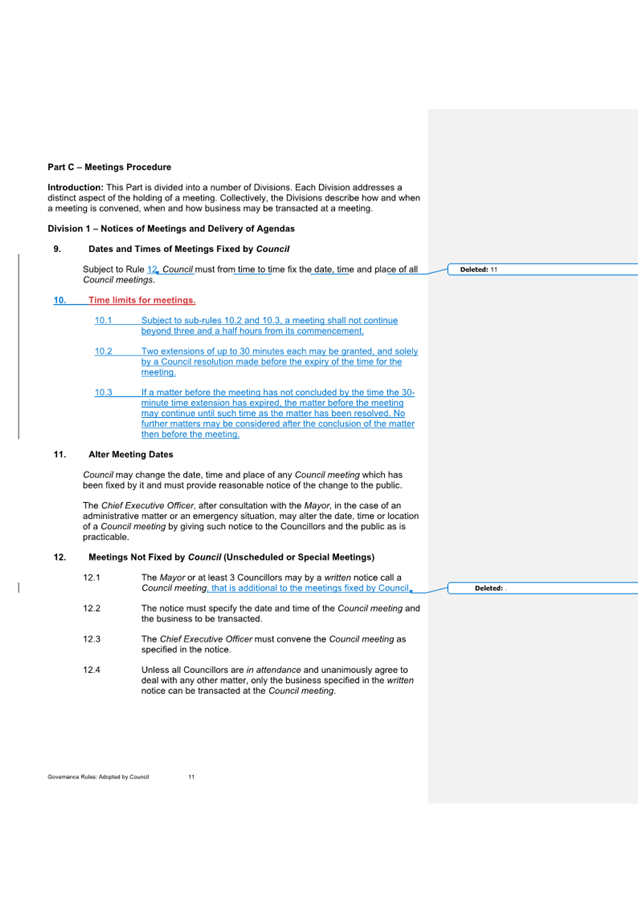
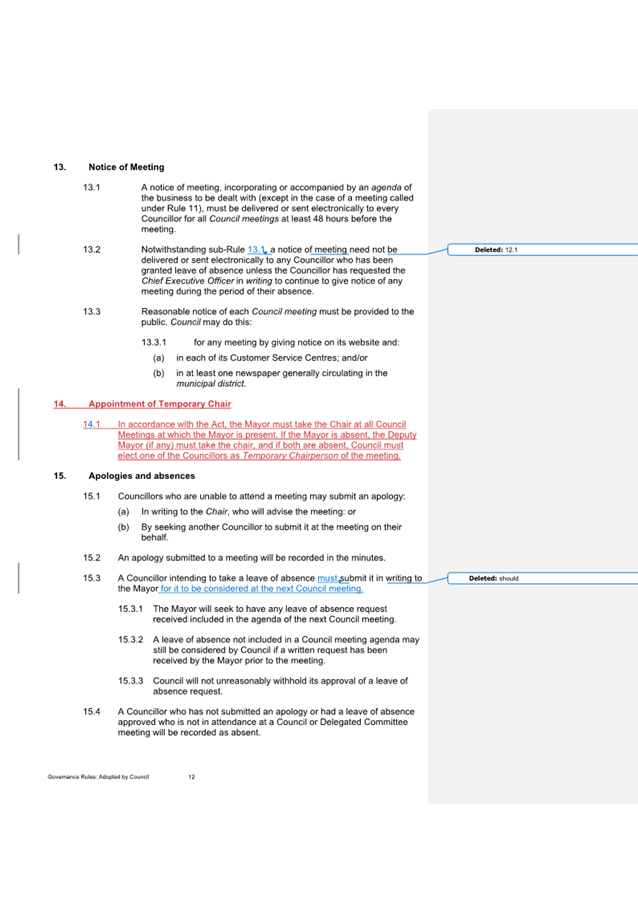
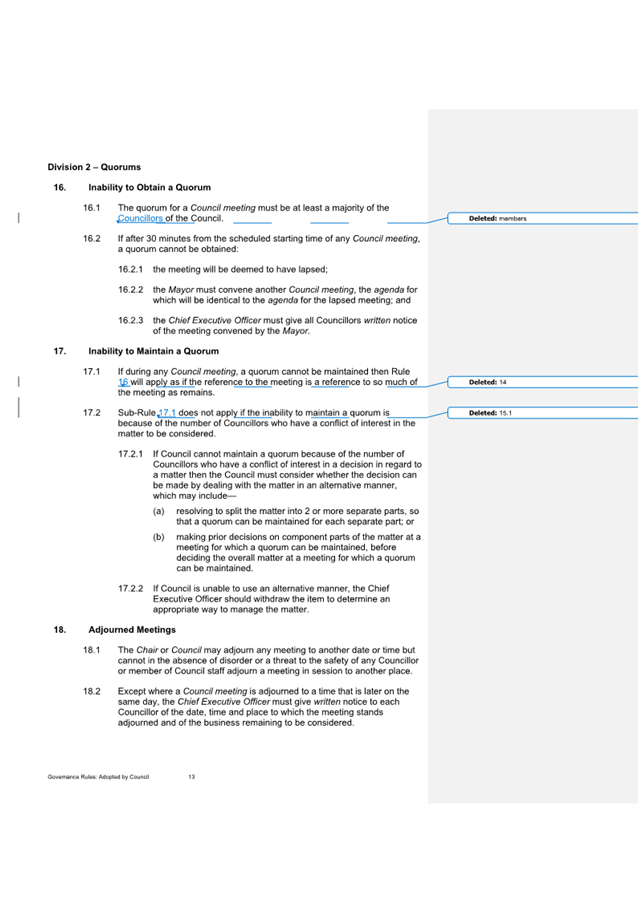
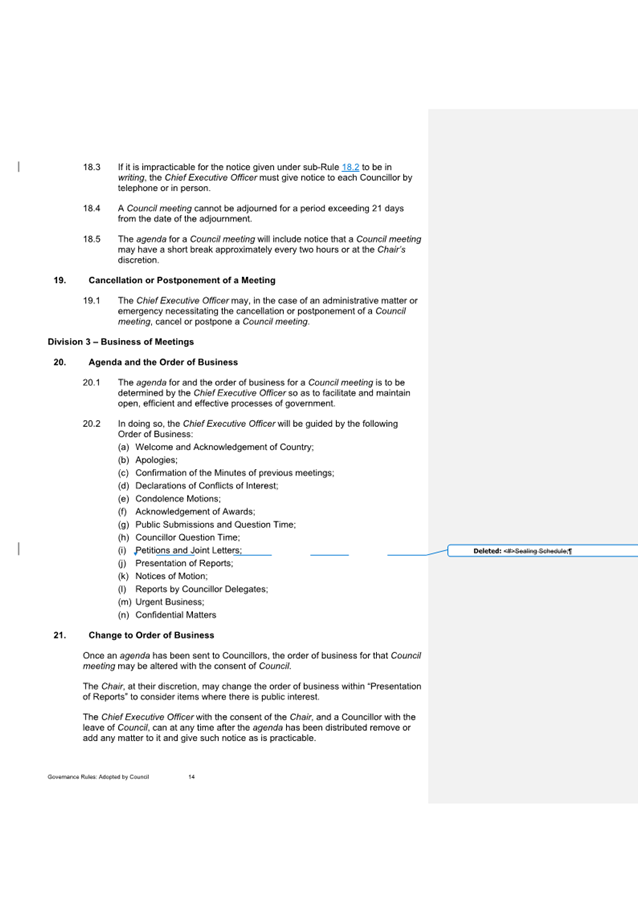
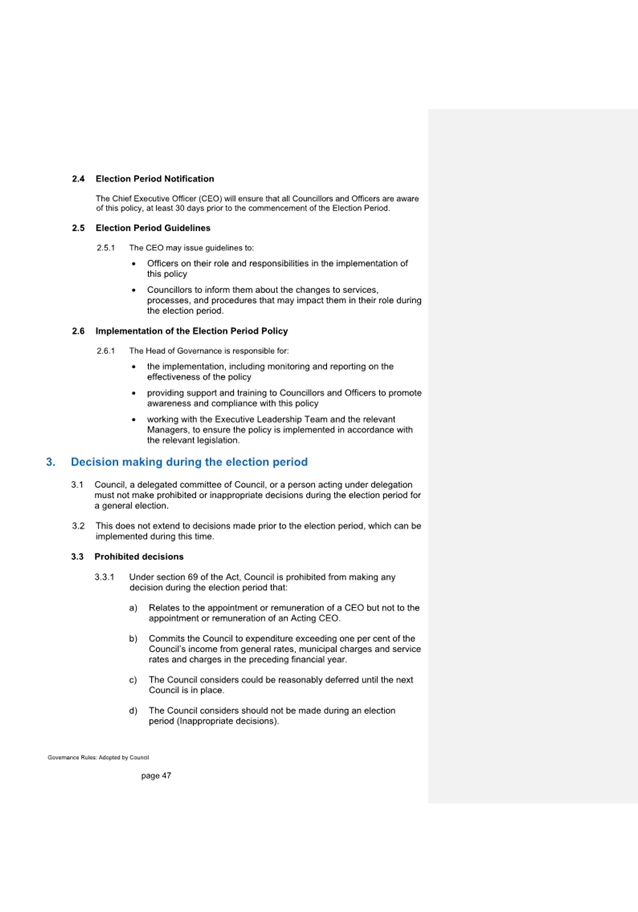
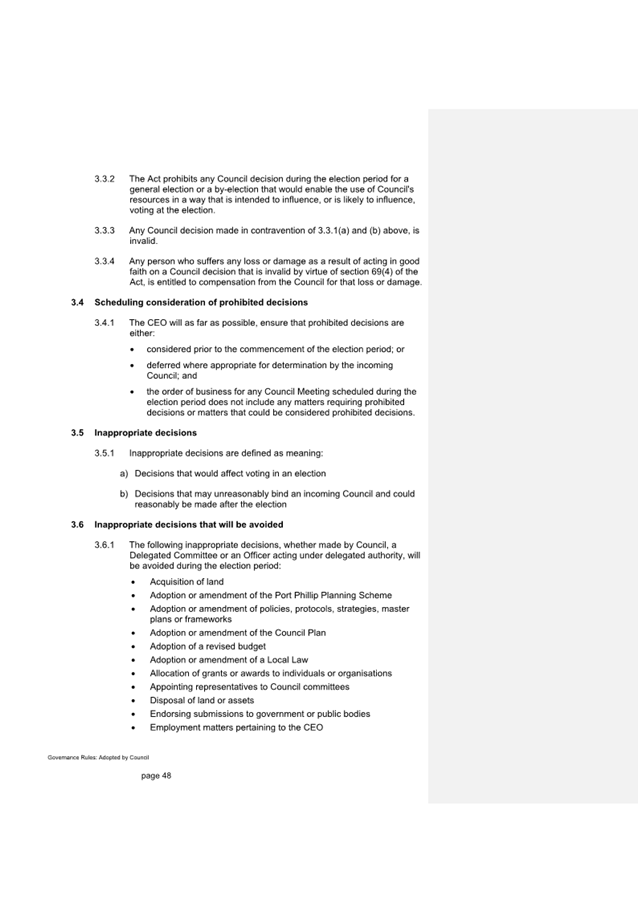
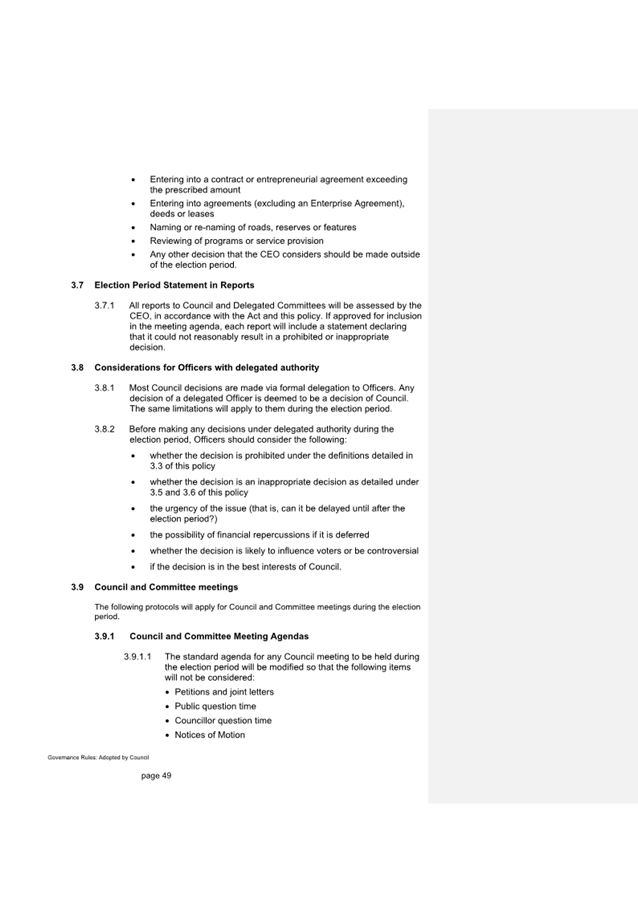
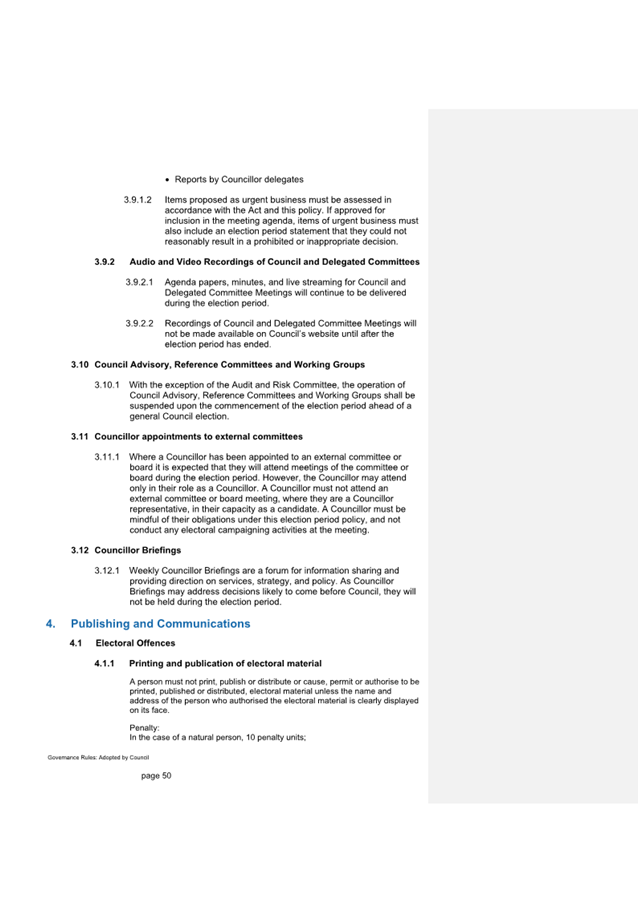
13.1 Governance Rules - Final approval of updates post consultation.................... 17
13.2 Update to the Procurement Policy.................................................................. 114
13.3 Review of Council's Delegations to the Chief Executive Officer and Delegated Committee 152
13.4 Appointment of Authorised Officer Pursuant to the Planning and Environment Act 1987 167
14 A Trusted and High Performing Organisation
Nil
15 Notices of Motion
Nil
16 Reports by Councillor Delegates
17 URGENT BUSINESS
18 Confidential Matters....................................................................................... 173
The information contained in the following Council reports is considered to be Confidential Information in accordance with Section 3 of the Local Government Act 2020.
18.1 South Melbourne Town Hall - Contract Variation
3(1)(a). Council business information, being information that would prejudice the Council's position in commercial negotiations if prematurely released.
Reason: This report contains contractural information, including project and construction contract contingency provisions, that if released at this time would disadvantage Council in its ability to manage its contruction contract in the best interests of the community.
18.2 71A Acland Street – Expression of Interest Process
3(1)(e). legal privileged information, being information to which legal professional privilege or client legal privilege applies
3(1)(a). private commercial information, being information provided by a business, commercial of financial undertaking that if released, would unreasonably expose the business, commercial or financial undertaking to disadvantage
Reason: This report outlines the details of a recently completed procurement process which contains confidential commercial information that if released would prejudice commercial businesses and Council. The report also includes confidential legal and probity advice in relation to the procurement and property management information
18.3 CEO Employment Matters – 2024/25 Performance Assessment and 2025/26 Annual Performance Agreement
3(1)(f). personal information, being information which if released would result in the unreasonable disclosure of information about any person of their personal affairs
Reason: Under the CEO Employment and Remuneration Policy, Section 16 - Confidentiality, Council does not disclose any personal information, being information which if released would result in the unreasonable disclosure of information about any person or their personal affairs. The CEO's performance and remuneration fall into that category.
1. Apologies
2. Minutes of Previous Meetings
|
That the Minutes of the Meeting of the Port Phillip City Council held on 20 August 2025 be confirmed. |
3. Declarations of Conflicts of Interest
4. Public Question Time and Submissions
5. Councillor Question Time
6. Sealing Schedule
Nil
7. Petitions and Joint Letters
Nil
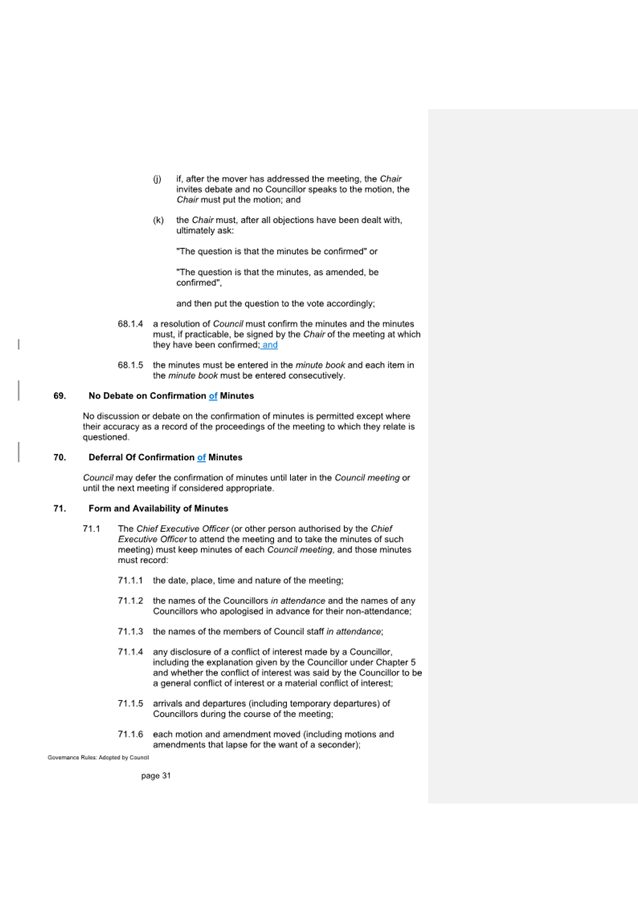
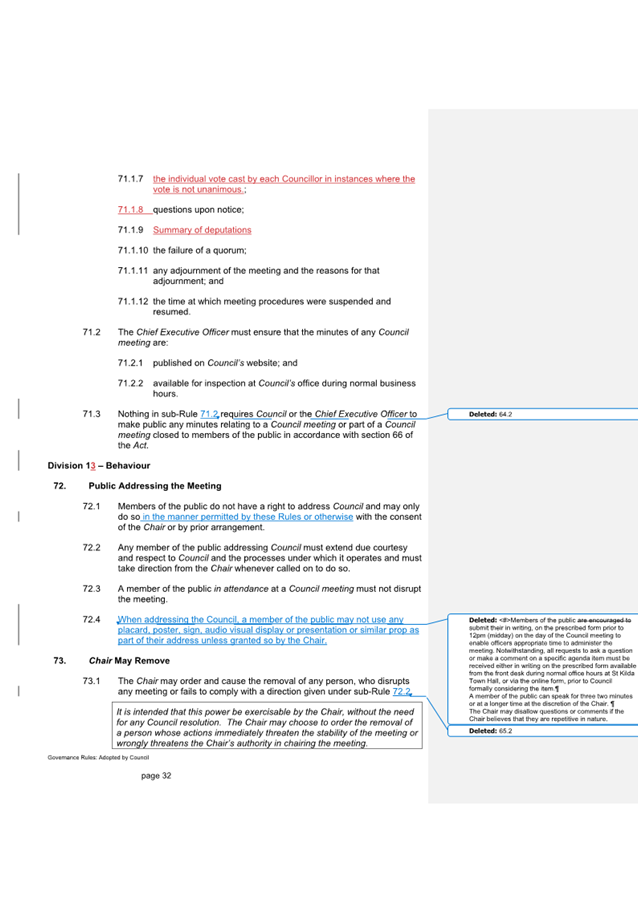
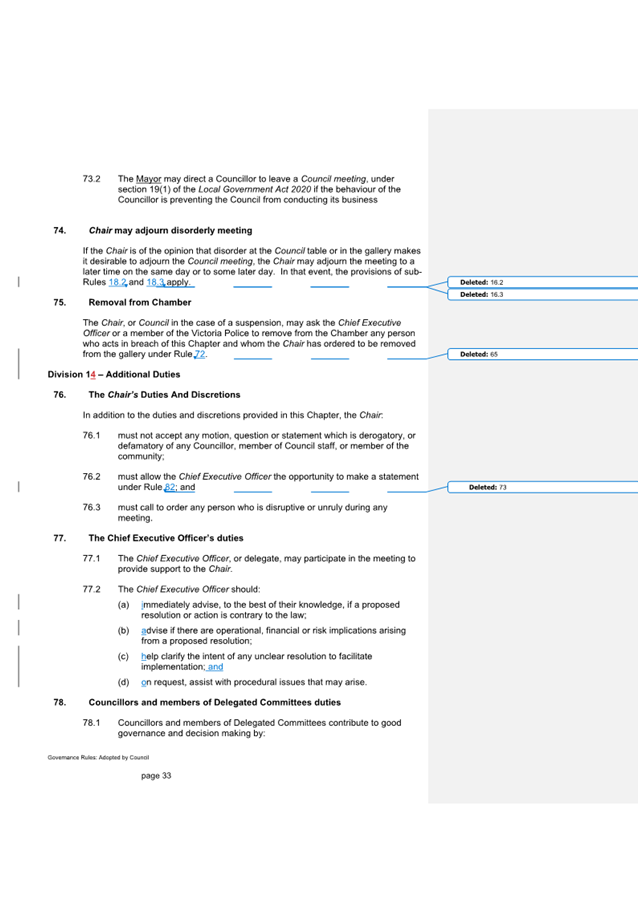
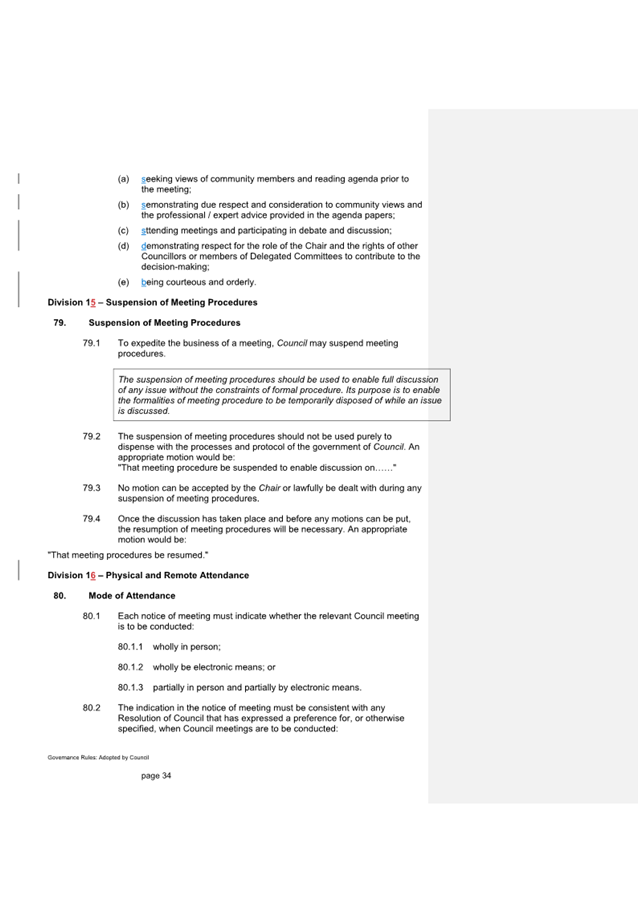
8. Presentation of CEO Report
Nil
9. A Healthy and Connected Community
Nil
10. An Environmentally Sustainable and Resilient City
Nil
11. A Safe and Liveable City
Nil
12. A Vibrant and Thriving Community
12.1 St Kilda Triangle Feasibility - Advocacy Outcomes............................................ 7
Meeting of the Port Phillip City Council
2 September 2025
|
St Kilda Triangle Feasibility - Advocacy Outcomes |
|
|
Executive Member: |
Brian Tee, General Manager, City Growth and Development |
|
PREPARED BY: |
Daniel Boden, Senior Program Manager Fishermans Bend Emma van der Linden, Delivery Lead Urban Renewal |
1. PURPOSE
1.1 To update Councillors on the outcomes of the advocacy strategy for the Live Music Venue proposal and seek approval on the next steps for the St Kilda Triangle site.
2. EXECUTIVE Summary
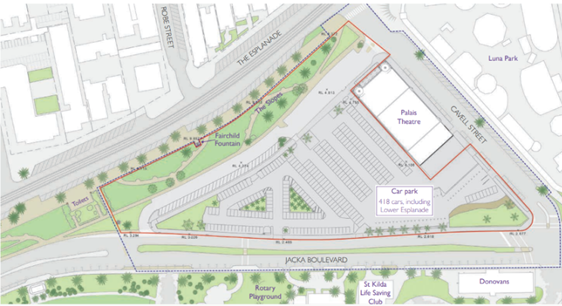
2.1 The St Kilda Triangle site has a long history and association with live music until the Palais de Danse / Palace venue was destroyed by fire in 2007. Since then, it has been a car park and used intermittently for temporary events.
2.2 On 7 September 2022, Council decided to undertake feasibility work for the St Kilda Triangle site to assess the viability of a live music-led, performance venue development. This stage 1 feasibility considered urban design, market sounding, commercial feasibility and development options, planning pathways and engagement.
2.3 On 6 December 2023 Council elected to progress beyond stage 1 with a targeted market engagement to clarify the level of interest and potential funding options, alongside advocacy to the Victorian Government for investment in a business case
2.4 In July 2024, Council received a summary of the outcomes of the targeted market engagement. Council decided to continue advocacy to the State Government while other project works on the St Kilda Triangle site were paused.
2.5 Despite advocacy efforts since July 2024, including meetings with relevant State and Federal MPs, no interest has been expressed in contributing to progressing the project either financially or otherwise.
2.6 Within the limited funding opportunities from the State and Federal Governments a number of alternative options for next steps has been considered. These options, ranging from progressing the project, to continued advocacy and pivoting to investigating new permanent uses, have been discounted due to a number of reputational and financial risks.
|
That Council: 3.1 Places all work related to the Live Music Venue proposal on hold until there is further interest from the State Government or another third party. 3.2 Requests officers to investigate options for short-term amenity and beautification upgrades for the St Kilda Triangle site for consideration through the Great Places and Precinct Program in 2025-26. |
4. KEY POINTS/ISSUES
4.1 For more than a century, the St Kilda Triangle site has a history of live music and performance venues. Paired alongside the iconic 1927 Palais Theatre, the Palais de Danse / Palace venue operated on the site from 1919 until 2007 when it was destroyed by fire.
4.2 It is since this time that the site has operated as a car park with part of the site occasionally used for various temporary events.
4.3 Two significant attempts have been made since 2010 to develop and deliver a vision for the site but for various reasons these did not prevail.
 |
St Kilda Live Music Precinct
4.4 In 2021, Council endorsed the Live Music Action Plan to help ensure live music continues to thrive in our city. The plan recommended the development of a live music precinct. As a celebrated home of live music, St Kilda was selected as the prime location for a precinct.
4.5 In parallel with the work on the Live Music Precinct, Council considered the possibility of accommodating a live music and performance venue on the Triangle site and, at a public meeting in September 2022, Council elected to proceed with Stage 1 feasibility work for the St Kilda Triangle to assess the viability of a live music led / performance venue development on the site.
4.6 This included taking in key aspects of the 2016 St Kilda Masterplan, which outlines Council and community's agreed future aspiration for the development of the Triangle site.
4.7 In December 2022, Councillors were presented with a set of project objectives designed to translate this direction to an outcome that facilitates Council decision-making about the future of the St Kilda Triangle Project.
4.8 Stage 1 feasibility works included the preparation of; a Commercial Analysis and Development Strategy, Market Sounding Report and a Design Feasibility Report, which would detail options for how a venue, parking, access, connections, and open space can be arranged and operate on the site, using the 2016 masterplan as a key reference point.
4.9 A series of workshops and briefings were held with Councillors at key stages of the project to present packages of work and obtain feedback to evolve and guide the subsequent works.
4.10 At the Council Meeting on 6 September 2023, Council noted the release of the following two key deliverables:
· the St Kilda Triangle Potential Live Performance Venue Market Sounding Report, detailing the gaps in and operational requirements of the live music and performance venue market.
· 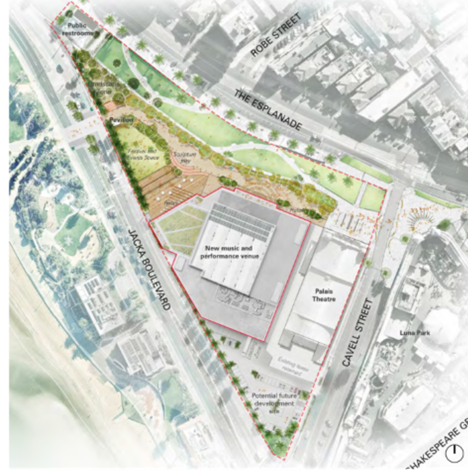
the St Kilda Triangle Design
Feasibility for a Live Music and Performance Venue setting
out the design process to arrive at a recommended option as the indictive site
layout that best meets the project objectives.
Figure 2: Live Music Venue Concept Plan (Design Feasibility Report)
4.11 Stage 1 feasibility work, including community engagement, concluded in late 2023. Following the consideration of this work, on 6 December 2023, Council elected to progress further work to:
· Advocate to the Victorian Government for investment in a business case for a new live music and performance venue on the St Kilda Triangle, with a possible contribution from Council to the business case to be confirmed.
· carry out stage 2 market testing to further clarify the level of interest in investing in a new live music and performance venue on the St Kilda Triangle and understand the level of funding contribution that could be available.
Stage 2 Feasibility
4.12 The key findings from the various pieces of work carried out to date were presented at the Council Meeting on 17 July 2024 (Item 10.1) and included:
· There is demand for a flexible 5000 standing live music and performance venue.
· The ‘proof of concept’ layout shows that a venue can be effectively accommodated on the St Kilda Triangle with carparking, public realm and other uses.
· There is strong industry support for a new venue to be located in St Kilda.
· There is majority support for a live music and performance venue, including strong support by representatives of the Traders Associations for Acland Street and Fitzroy Street, though there is some local opposition to the idea.
· There was concern expressed by destination venues immediately adjacent about a reduction in parking leading to loss of business.
· Carparking and traffic movement, the scale of the building and ongoing activation of or need for the venue were raised as concerns by those who did not support the concept and there were mixed views regarding parking.
· The likely cost of the ‘proof of concept’ idea that has been explored for a new live music and performance venue is estimated as a range between $113m-$139m, including the venue, basement carparking and public realm.
· The cost estimate that has been developed is useful for understanding the type of cost for a development such as this but would need to be reassessed to reflect any key changes that have been incorporated to the final design and cost of construction at the time.
· Operators are likely to have capacity to include a significant capital contribution as part of a bid in a competitive procurement process for a new venue in future, with the quantum being directly related to the length of tenure.
· Given the regional significance and civic nature of the project, it is likely that public funding or other subsidy will be required to support private investment in the development, to achieve an overall outcome for the site that will realise the full benefits possible.
4.13 Council were also informed that confidential market testing has indicated that significant uncertainty existed around the level of funding that would be offered through the market process and whether this would be sufficient to provide the quality of outcome required by Council and community for the site.
4.14 This testing also confirmed that delivery of a live music and performance venue would require a significant public contribution for the development of the venue plus the full cost of the associated carpark and the public realm works.
4.15 Council considered the key findings and the three options presented for the next steps in the project, as set out below. These were:
· Option 1 (Recommended & Endorsed): Undertake Advocacy to State Government while other project works pause.
· Option 2: Begin preparation for a Competitive Market Process whilst continuing to advocate to State Government.
· Option 3: Pause All St Kilda Triangle Live Music Venue Work and review next steps with the newly elected Council.
4.16 Council decided to progress Option 1, to continue advocacy to the State Government while other project works pause.
Advocacy
4.17 With the targeted engagement concluded, there was an opportunity to test whether there was increased interest from state government regarding support for next steps, given that the engagement confirmed that there is significant interest from the market in participating in a competitive process for the opportunity to develop and manage a live music and performance venue on the St Kilda Triangle.
4.18 Since July 2024, officers have continued to implement an advocacy strategy for this item, including engagement with relevant state and federal government representatives and ministerial offices across the creative industries, infrastructure, tourism, and major events portfolios.
4.19 The project was considered in the context of various grant funding rounds, state and federal budget processes, and federal election advocacy opportunities. Despite these efforts, the project was found to be ineligible for available funding streams and did not receive prioritisation in budget or election platforms.
4.20 Overall, there has been limited appetite from either level of government to fund or co-fund a business case or provide tangible support for the project. While there is recognition of the opportunity among political stakeholders, current budgetary constraints and competing priorities have meant that financial support is not forthcoming at this time.
Options for Next Steps
4.21 Officers have considered a range of options for next steps, on the basis that the advocacy strategy has not yielded any progress or commitment to funding the next stages of the St Kilda Triangle live music proposal;
· Option 1: Continue advocacy to State Government while other project works remain paused
· Option 2: Begin preparation for a Competitive Market Process whilst continuing to advocate to State Government
· Option 4: Investigate other permanent uses for the site
· Option 5: Investigate options for short-term amenity and beautification upgrades
Option 1: Continued Advocacy Approach
4.22 Continue a refined advocacy to State Government to seek support and funding for a business case. Given the lack of interest and commitment to date, this option is not recommended as it would be at the cost of officer time and advocacy capital that would not be available to spend on other Council advocacy priorities and items.
4.23 At its meeting on 6 August 2025, Council formally endorsed the advocacy priorities for the 2025–26 financial year. These priorities reflect Council’s strategic focus areas and are intended to guide engagement with State and Federal Government partners, community stakeholders, and other key organisations.
4.24 Notably, the endorsed priorities do not include the St Kilda Triangle. While the site remains of strategic interest, it has not been identified as a focus area for advocacy in the coming year.
Option 2: Begin preparation for a Competitive Market Process
4.25 This option requires a Council commitment to fund the parts of the project (carpark, public realm and possible contribution to the venue) in-lieu of any State of Federal funding support. This option is not recommended as there are significant financial risks associated with this option.
Option 3: Put all work related to the Live Music Venue proposal on hold until there is further interest from the State Government or another third party.
4.26 Pause all work indefinitely and monitor changes in State Government’s priorities and budget allocations to assess future potential support for the Live Music Venue on the Triangle site. This option is recommended as it responds to State Government policy changes.
Option 4: Investigate other permanent uses for the site.
4.27 It is likely that other cultural uses, such as a gallery or creative spaces, would require substantial State or Federal funding and would result in similar, if not greater financial challenges than the Live Music Venue option.
4.28 For example, the Victorian Government has invested heavily in the $1.7bn in the Melbourne Arts Precinct Transformation Project, including the new NGV Contemporary, theatre building upgrades and a new 18,000 sqm urban garden due for completion in 2028.
4.29 Significant Council resourcing has been allocated in developing the Live Music Venue proposal. Without any formal support for alternative cultural uses from the State or Federal governments, the investigation of other large-scale permanent uses is not recommended due to the financial and reputational risks to Council.
Option 5: Investigate options for short-term amenity and beautification upgrades
4.30 The current St Kilda Triangle car park site caters for a range of ad-hoc events, from one-off Saturday morning car shows, to school holiday-specific events and more substantial bookings such as the live music Palace Foreshore Festival that has hosted internationally renowned bands in late summer.
4.31 However, the site is generally in poor condition, and it is an unattractive part of the wider St Kilda Foreshore. Opportunities for low-impact, short-term amenity improvements and beautification upgrades, including creative activations, could be explored to enhance the site during non-event times.
4.32 This option is recommended for consideration as part of the Greater Places and Precincts program to include a focus on maintenance and safety upgrades of the car park to be supplemented by activation, greening, beautification and wayfinding-based improvements.
5. CONSULTATION AND STAKEHOLDERS
5.1 Extensive community and stakeholder engagement informed the development of the St Kilda Triangle Masterplan 2016. There has also been significant community consultation over the years for work that preceded the 2016 Masterplan. There is significant interest in the project by the community, stakeholders and the market.
5.2 As part of the Stage 1 feasibility work, the live music and performance industry was consulted in terms of demand for a venue in the proposed location via a market sounding process and subsequently consulted upon completion of the design feasibility work.
5.3 Community engagement was undertaken in the first stage to understand the sentiment and feedback about the outcomes of the design feasibility work and new direction for the site. The Council Report for the 6 December 2023 public meeting presented the findings of that engagement program.
5.4 While it is intended that the feedback from the community informs subsequent stages of the project, this stage has focussed on State Government advocacy and further market engagement
6. LEGAL AND RISK IMPLICATIONS
6.1 The recommended option ensures that legal, financial and reputational risks for Council associated with pursuing the live music venue option without State or Federal government funding support, can be managed effectively.
7. FINANCIAL IMPACT
7.1 The total costs of stage 1 and stage 2 feasibility has been $568,401 to date. Most of the budget was spent in previous years, with the focus in 2024/25 on advocacy which has been carried out via existing officer time.
7.2 The feasibility work has indicated significant costs required to deliver a live music venue at the St Kilda Triangle site. A substantial component of this would need to be publicly funded via local, state and/or federal sources. This would include funding for basement parking, public realm and a contribution to the venue itself.
7.3 Despite significant advocacy efforts, there has been no commitment of funding to the project from State of Federal governments.
8. ENVIRONMENTAL IMPACT
8.1 There are no environmental impacts from this stage of the project. Short term beautification upgrades could consider options for additional greening which may provide urban cooling and increased biodiversity benefits.
9. COMMUNITY IMPACT
9.1 The concept of a live music venue, carparking and public realm redevelopment of the high-profile St Kilda Triangle site, currently an aging carpark, proposes a solution that responds directly to a gap in the live music industry market to enable not only St Kilda, but Melbourne, to maintain its reputation as a live music hub.
9.2 The recommendation to investigate short term amenity and beautification upgrades has the potential to provide local and broader community benefits attached to this prominent foreshore site, including access, wayfinding, improved amenity and activation of the site and supports the work of Council in delivering Victoria’s first live music precinct.
10. Gender Impact Assessment
10.1 There is no gender impacts assessed from this stage of the project.
11. ALIGNMENT TO COUNCIL PLAN AND COUNCIL POLICY
11.1 This project supports achieving Strategic Direction 4, A Vibrant and Thriving Community of Council’s Plan for Port Phillip 2025-35. The recommendations in this report support a number of outcomes and priorities to achieve a vibrant and thriving community, including;
· Enhance local precincts through the Great Places and Precincts Program to deliver more inviting and engaging spaces for the community to enjoy
· Deliver initiatives that foster creative use, exploration and activation of public space to support social, cultural, sustainable and economic connection among our community.
11.2 Amenity and beautification improvements to the St Kilda Triangle will also support the delivery of our existing events and festivals program that use the site throughout the year.
12. IMPLEMENTATION STRATEGY
12.1 TIMELINE
12.1.1 Subject to Council’s endorsement, consideration of maintenance and safety improvements will be investigated through the existing 2025/26 maintenance budgets and for consideration through the Great Places and Precincts program.
12.1.2 Options for further amenity and beautification upgrades could be developed through 2025/26 for implementation in 2026/27 subject to funding opportunities including through the Great Places and Precincts Program.
12.2 COMMUNICATION
12.2.1 Any community engagement on upgrades to the St Kilda Triangle site will be determined based upon the projects that will be carried out.
13. OFFICER MATERIAL OR GENERAL INTEREST
13.1 No officers involved in the preparation of this report has declared a material or general interest in the matter.
|
ATTACHMENTS |
Nil |
Meeting of the Port Phillip City Council
2 September 2025
13. An Engaged and Empowered Community
13.1 Governance Rules - Final approval of updates post consultation.................... 17
13.2 Update to the Procurement Policy.................................................................. 114
13.3 Review of Council's Delegations to the Chief Executive Officer and Delegated Committee....................................................................................................... 152
13.4 Appointment of Authorised Officer Pursuant to the Planning and Environment Act 1987 167
Meeting of the Port Phillip City Council
2 September 2025
|
Governance Rules - Final approval of updates post consultation |
|
|
Executive Member: |
Robyn Borley, Director, Governance and Organisational Performance |
|
PREPARED BY: |
Emily Williams, Senior Council Business Advisor |
1. PURPOSE
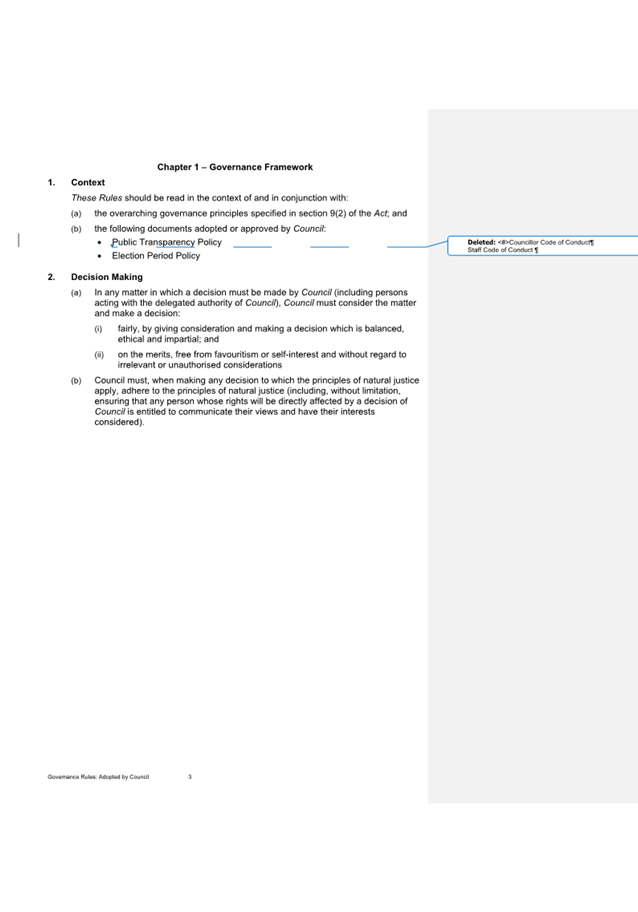
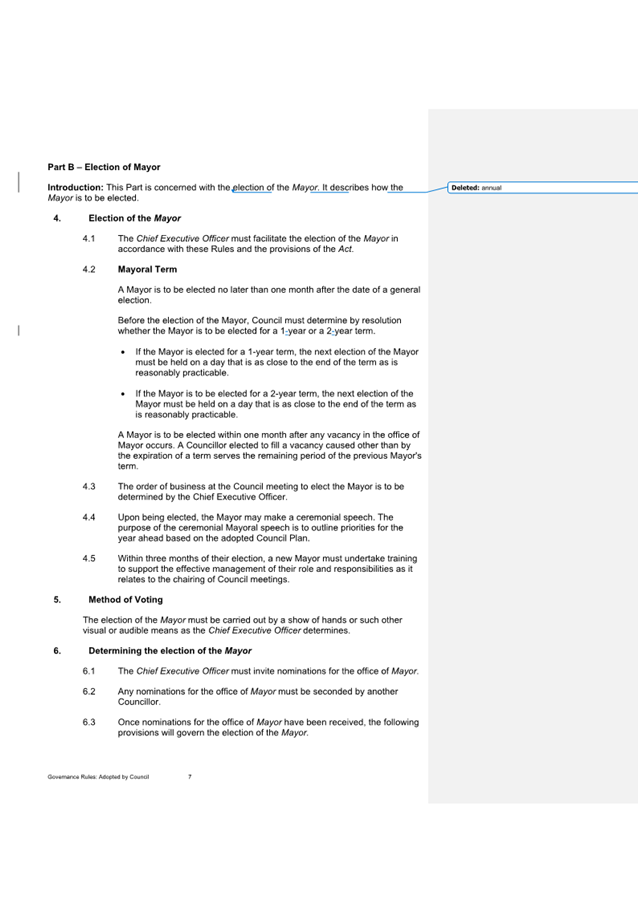
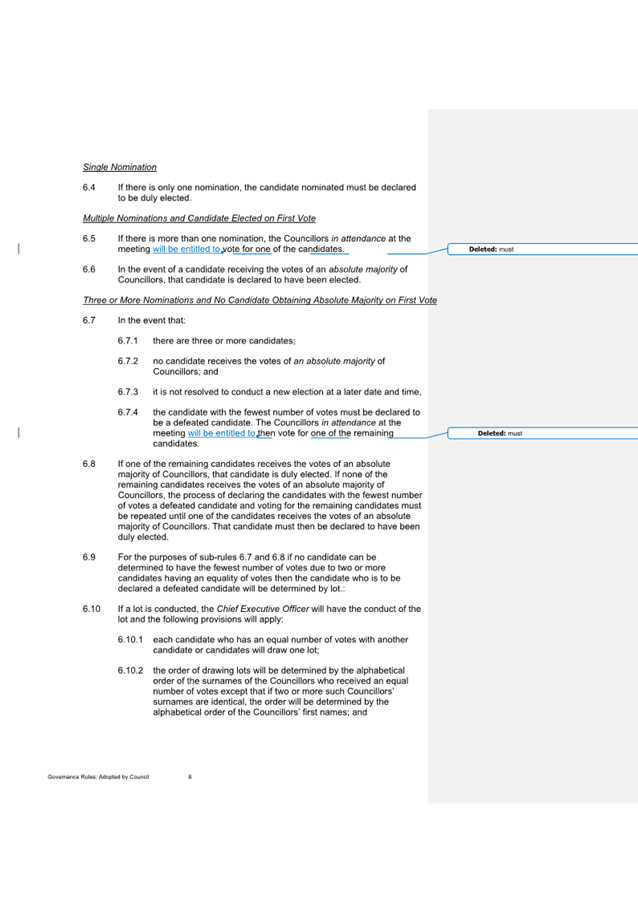
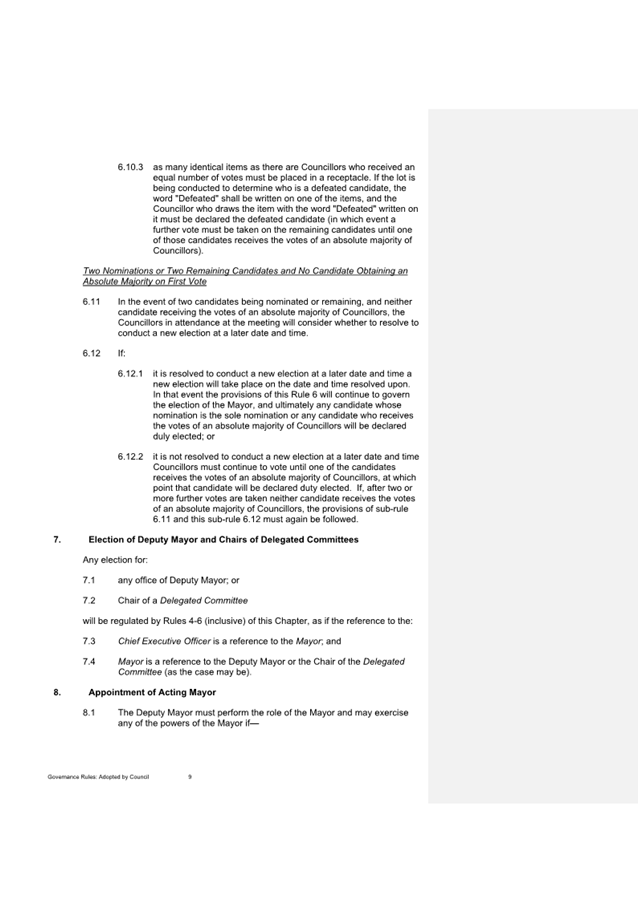
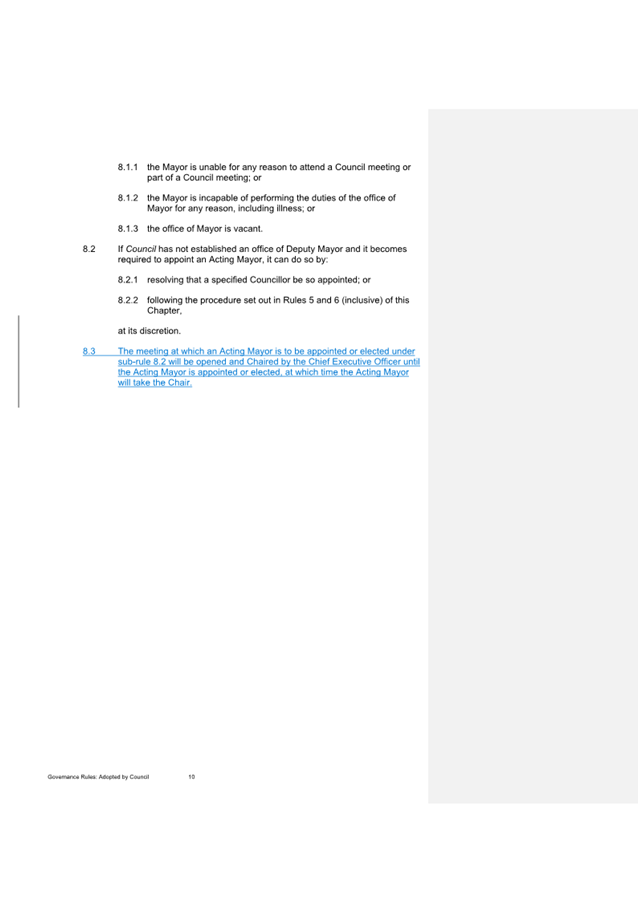
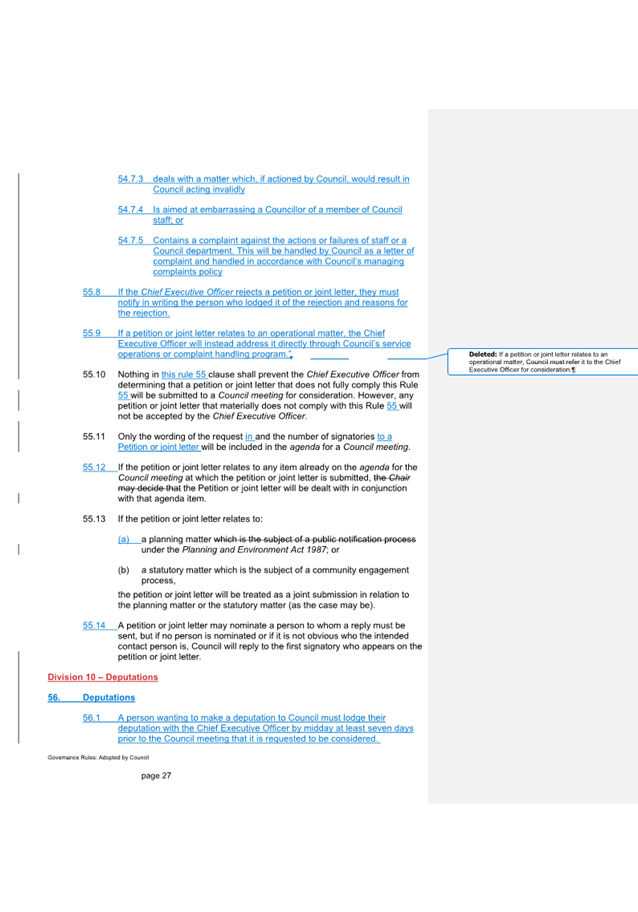
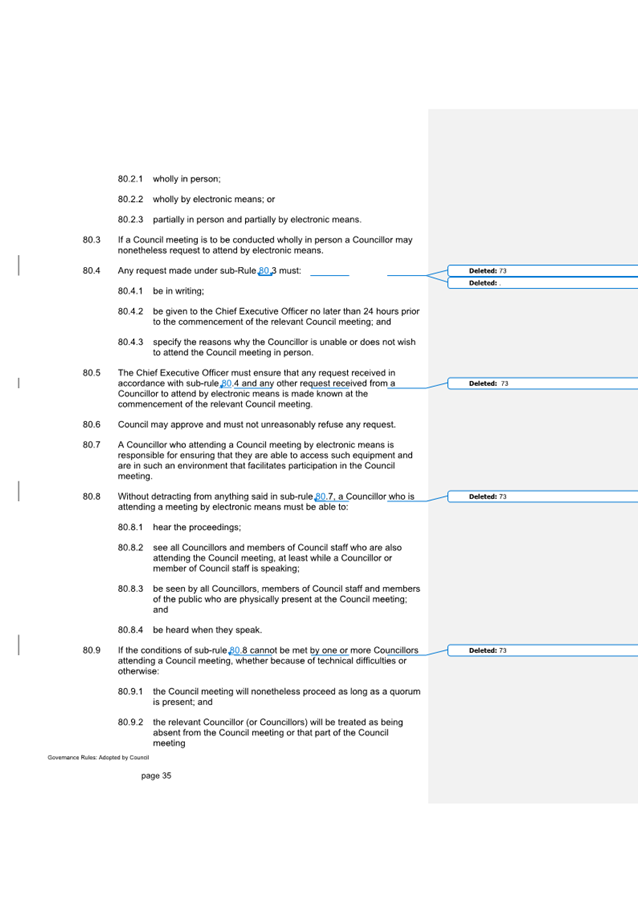
1.1 To present a summary of the feedback received during the community engagement process on the Draft Governance Rules which ran for four weeks via Council’s Have Your Say Page from Monday 7 July – Sunday 3 August 2025.
1.2 To present the proposed amendments to the Governance Rules, aimed at improving the effectiveness of decision-making and meeting procedures at the City of Port Phillip, for Council’s consideration and adoption.
2. EXECUTIVE Summary
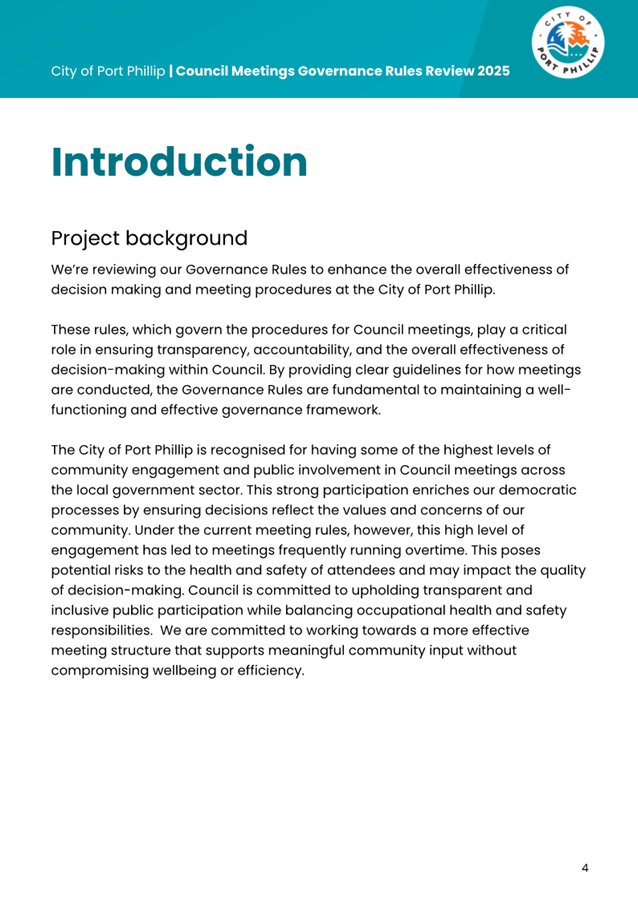
2.1 Council is required to adopt and maintain Governance Rules in accordance with section 60 of the Local Government Act 2020 (The Act). These rules, which govern the procedures for Council meetings, play a critical role in ensuring transparency, accountability, and the overall effectiveness of decision-making within Council. By providing clear guidelines for how meetings are conducted, the Governance Rules are fundamental to maintaining a well-functioning and effective governance framework.
2.2 City of Port Phillip’s Governance Rules were last updated in 2022, being adopted on 8 September 2022. The Rules have been in effect since that time. City of Port Phillip Governance Rules 2022.
Governance Rules Benchmarking
2.3 In 2024 Council requested officers to undertake a review of the Governance Rules due to a recurring pattern of meetings running late.
2.4 Council officers sought feedback from the former Councillors in August 2024. A benchmarking exercise was conducted in late 2024 as part of this proposal to compare the City of Port Phillip’s Governance Rules against those of neighbouring councils, to allow the City of Port Phillip and the community to consider best practice.
2.5 In early 2025, officers presented the findings of the benchmarking exercise to Council and recommended proposed changes to the Governance Rules. With the knowledge that Model Governance Rules are likely to be released later in 2025, Councillors were supportive of undertaking a review.
2.6 The benchmarking identified that the City of Port Phillip has one of the highest levels of community engagement and public participation at Council meetings across the Local Government sector. This has resulted in a recurring pattern of meetings running late under the existing rules which creates challenges, including health and safety concerns and the risk of reduced effectiveness in decision making.
2.7 This review presents a valuable opportunity to refine our practices, ensuring that Council continues to operate efficiently and in the best interests of the community with a particular focus on the following objectives:
· Health and safety obligations, ensuring a safe and supportive environment for Councillors, officers and the community.
· Enhancing good governance and fostering a culture of transparency and accountability,
· Ensuring that Councillors are empowered to fully and effectively carry out their roles and responsibilities, and
· Streamlining meeting processes to improve efficiency and decision-making.
Community Consultation
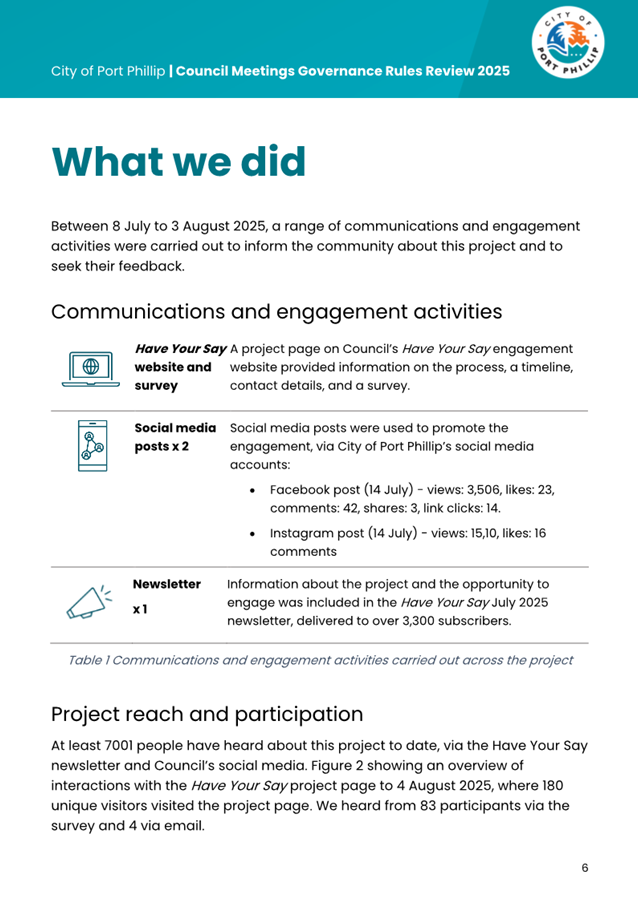
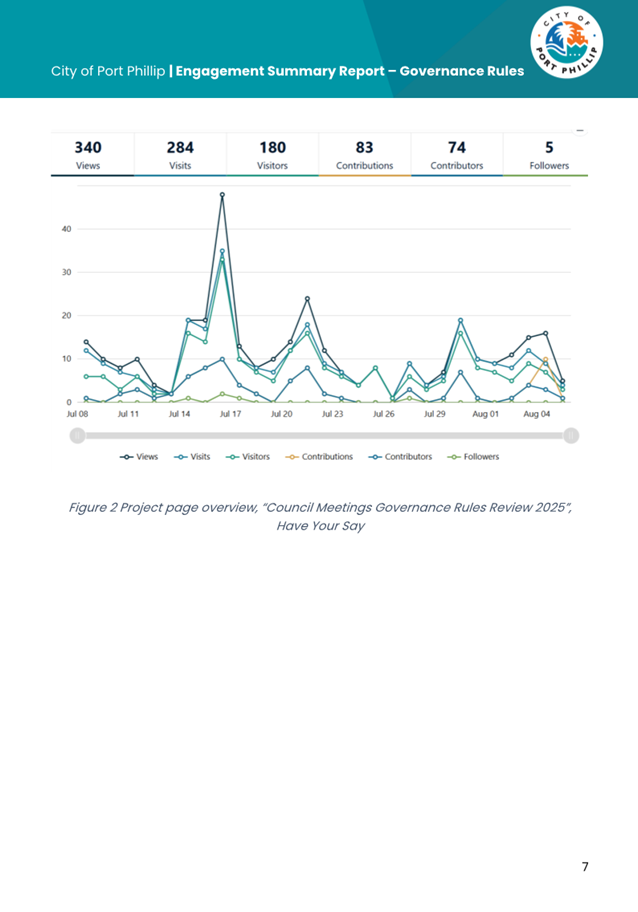
2.8 Community consultation on the draft Governance Rules ran for four weeks via Council’s Have Your Say Page from Monday 7 July – Sunday 3 August 2025.
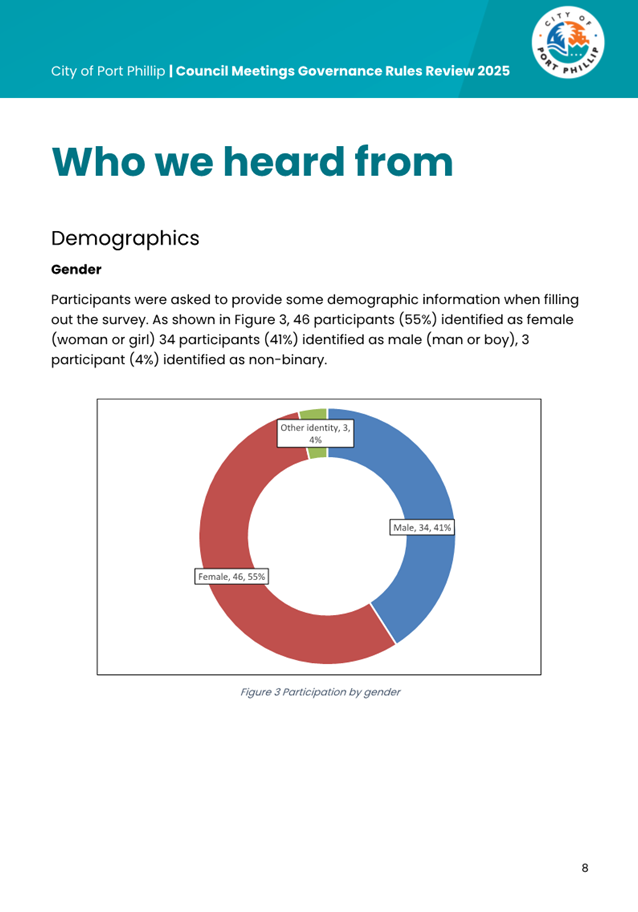
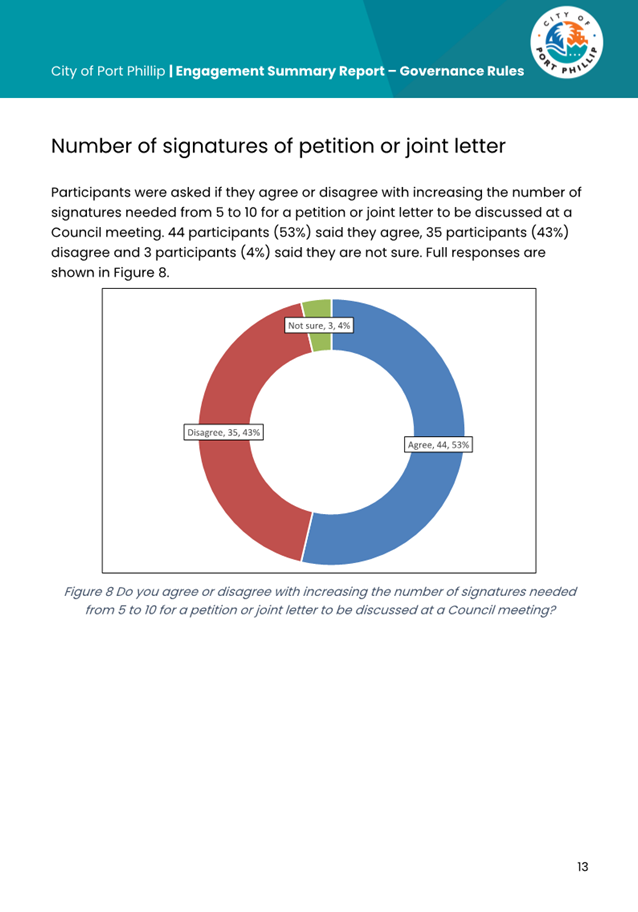
2.8.1 We heard from 74 participants via the Have Your Say survey
2.8.2 Four emails received from community members
2.8.3 One submission at the 2 July Council meeting.
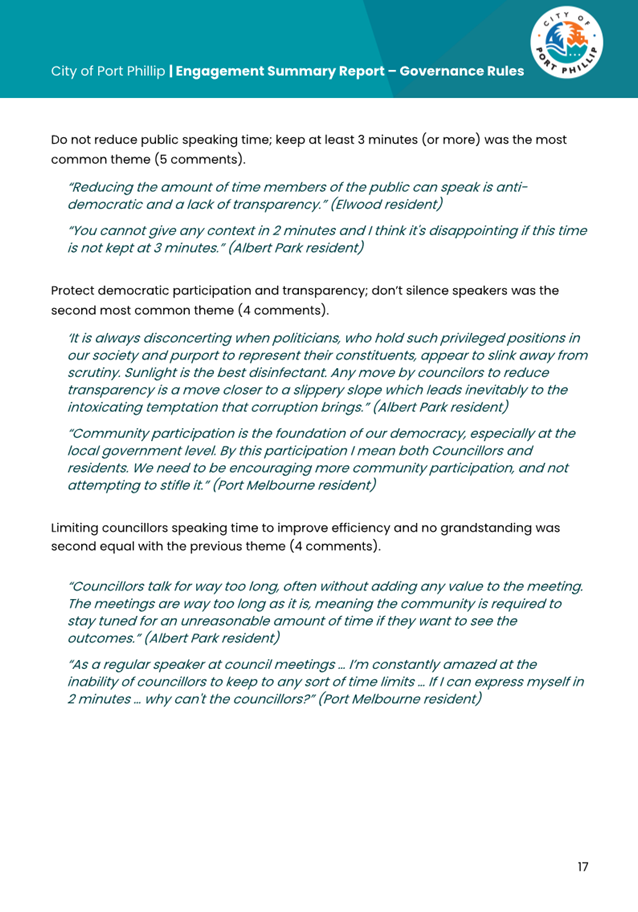
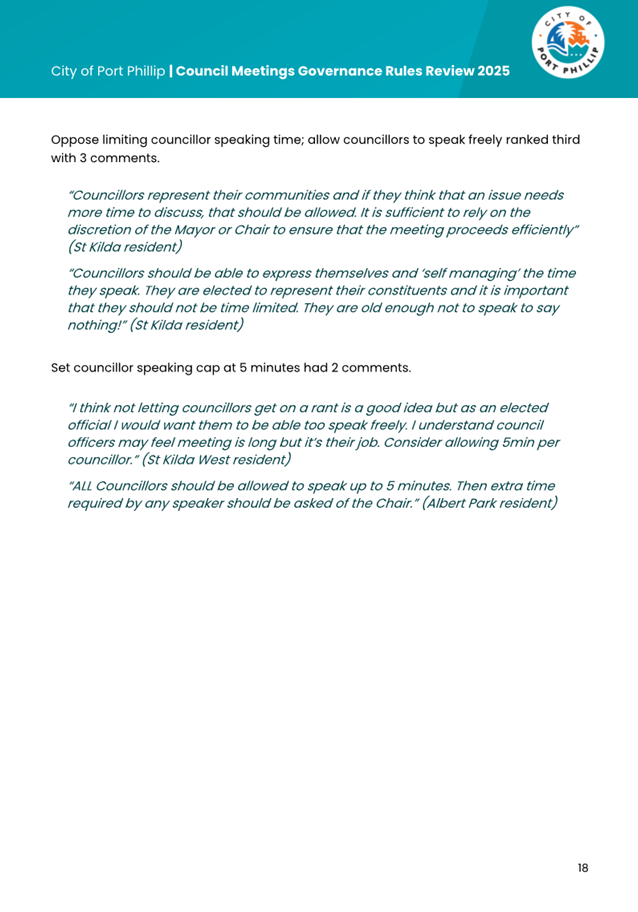
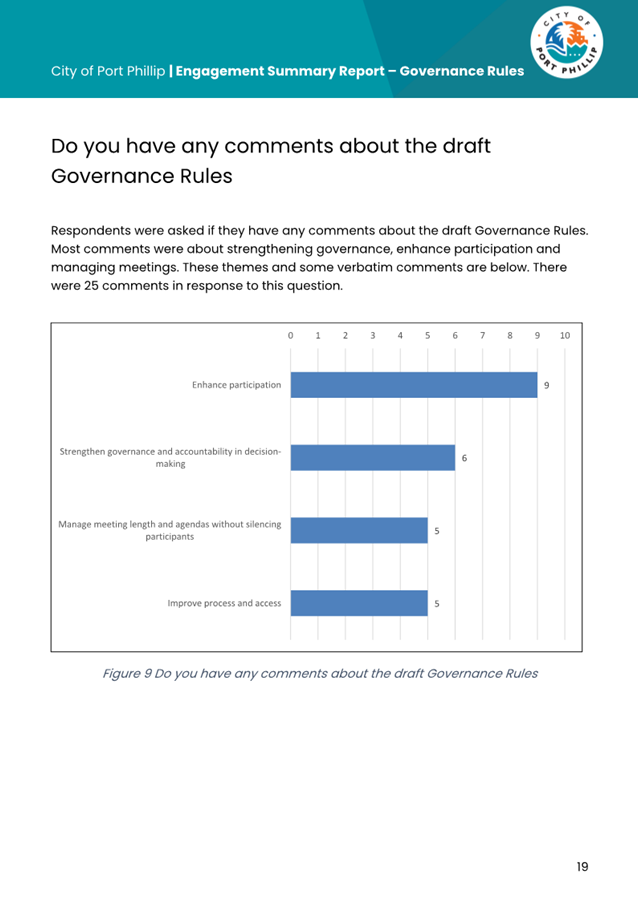
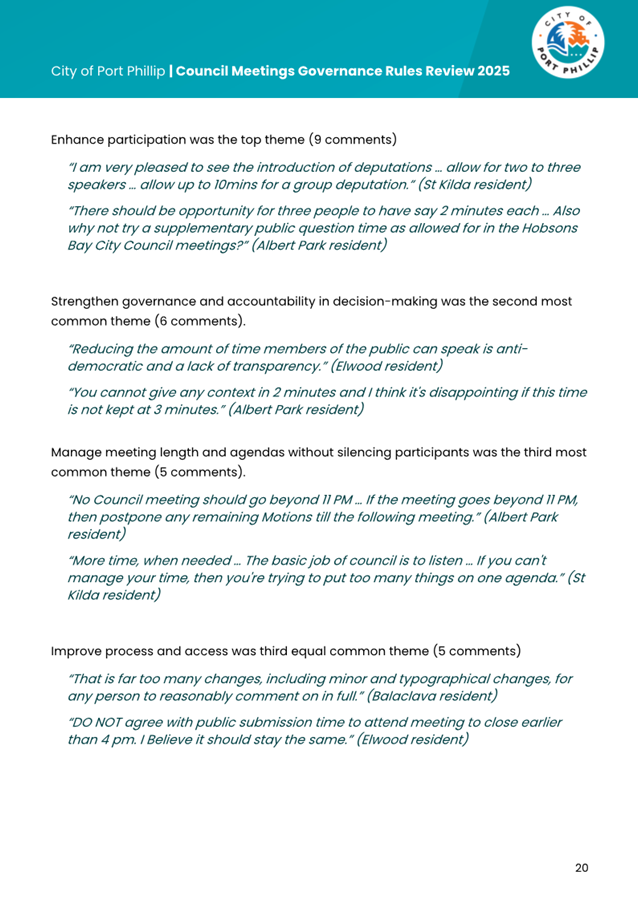
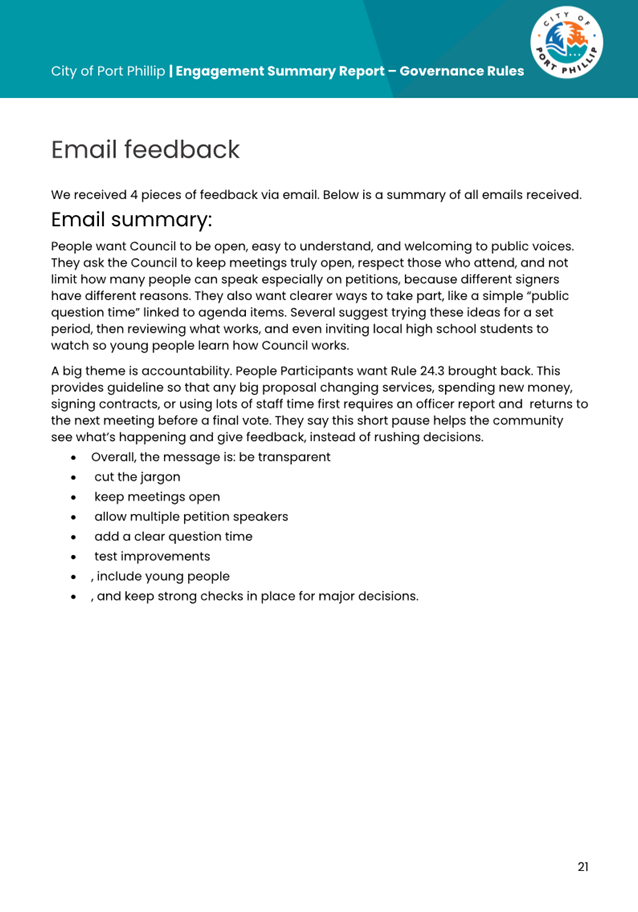
An engagement summary report including the findings of the community consultation can be found in Attachment 1.
Petition: Supplementary Public Question Time Principle, Purpose and Practice
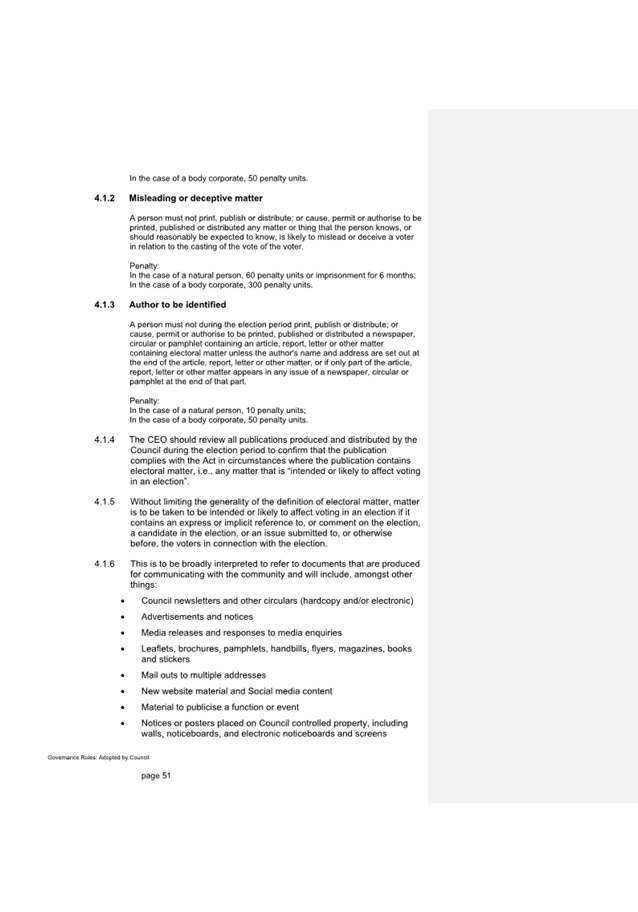
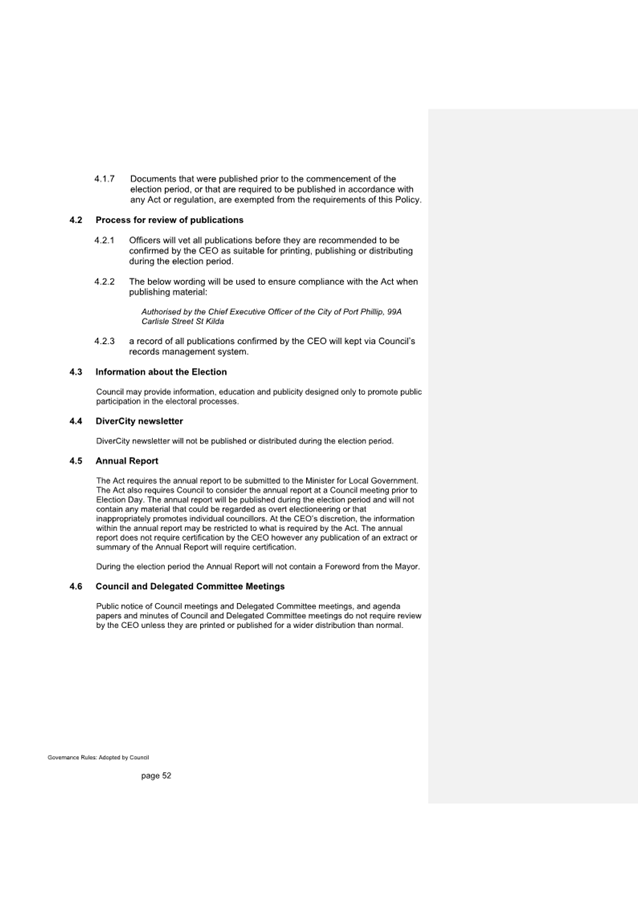
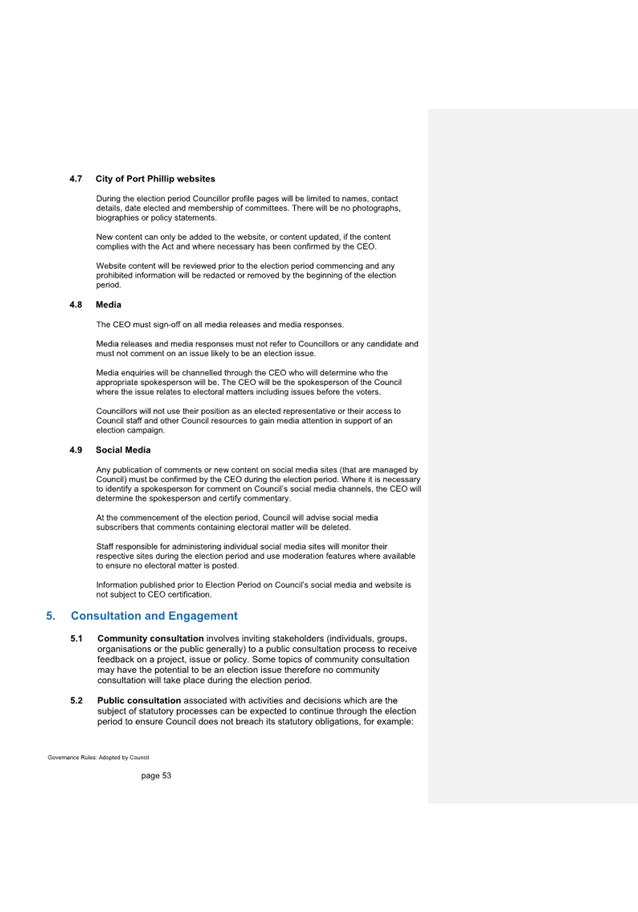
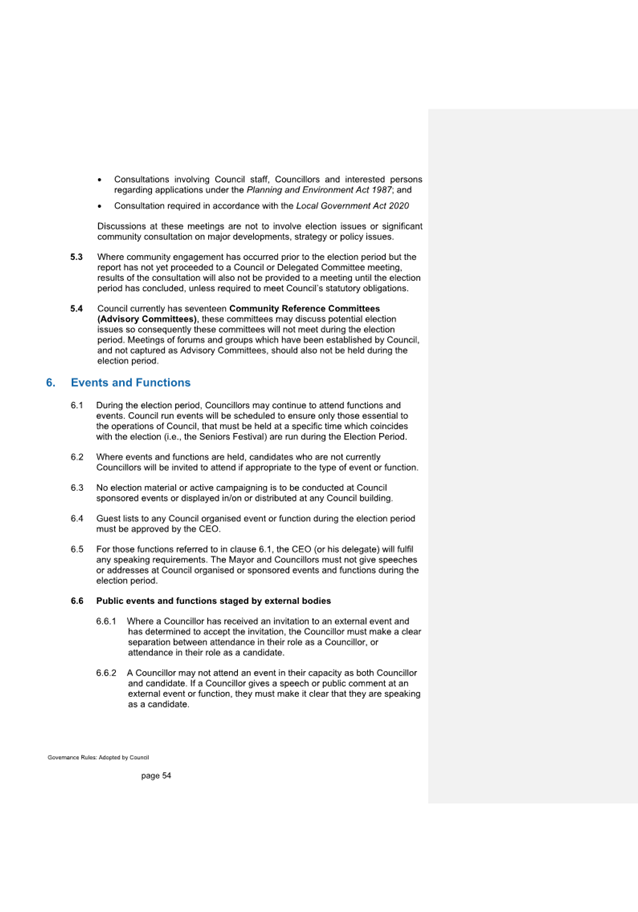
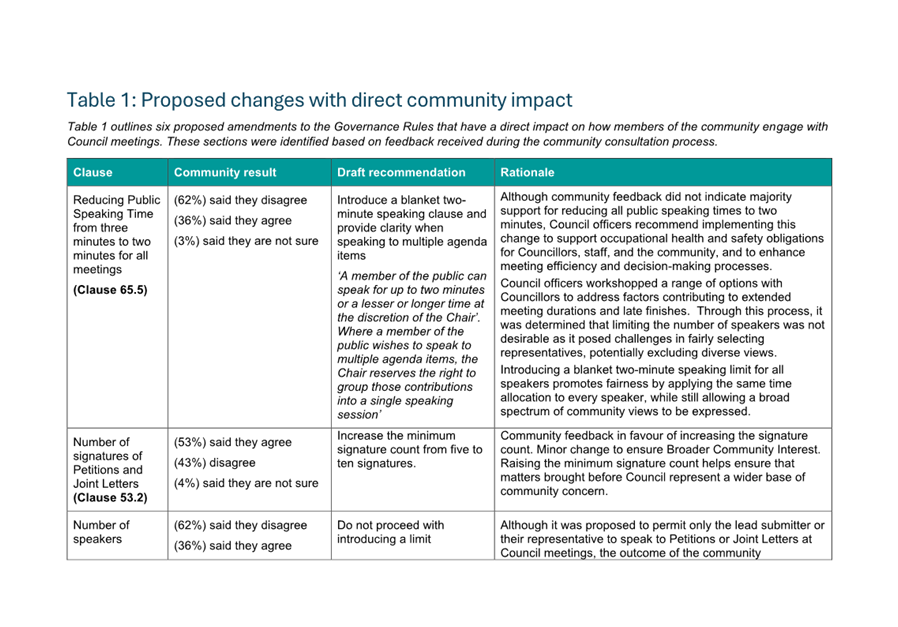
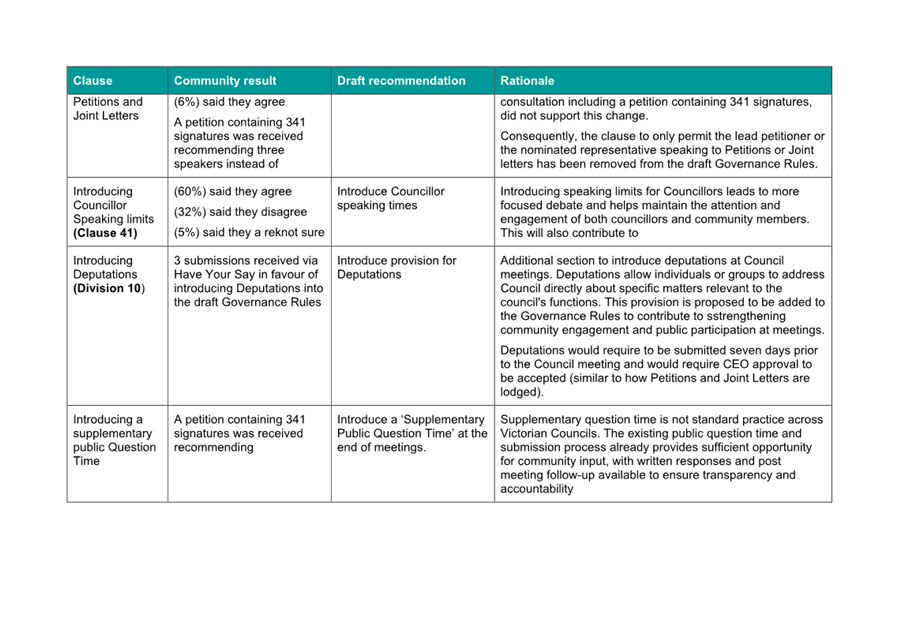
2.9 A petition containing 341 signatures was received and noted at the 6 August 2025 Council meeting. It called for amending clause 55.15 of the Draft Governance Rules to allow up to three speakers, rather than just the lead submitter or their representative to speak to Petitions or Joint Letters and proposed the introduction of a ‘Supplementary Public Question Time’ at Council meetings.
Request to amend clause 55.15 –speakers to petition and Joint Letters
2.9.1 Following review, it was determined that limiting the number to two or three speakers posed challenges in fairly selecting representatives, potentially excluding diverse views. The City of Port Phillip remains committed to ensuring that community feedback is inclusive and representative of the broad range of perspectives within our municipality.
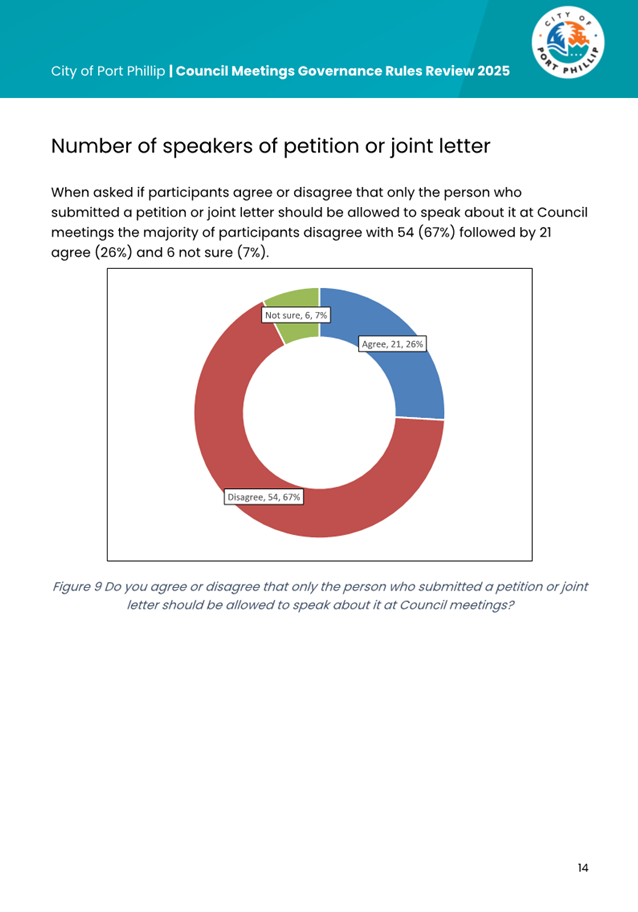
2.9.2 Officers have determined not to recommend limiting speakers on Petitions or Joint Letters. While the draft Governance Rules proposed restricting this to the lead submitter or their representative, community consultation did not support the change. Accordingly, no amendment is proposed to current speaking arrangements.
Request to introduce a ‘Supplementary Public Question Time’
2.9.3 Following a comparative review of Governance practices across Victorian Council’s, it was found that supplementary question time is not a standard provision. Most Council’s maintain a single based public question time segment.
2.9.4 Council meetings must balance transparency with effective time management. Introducing an additional question time segment could significantly extend meeting durations, potentially impacting the ability to address scheduled agenda items thoroughly and efficiently.
2.9.5 The current public question time and submissions agenda section provision is currently uncapped for number of speakers, and allows community members to raise matters of concern. In cases where questions cannot be addressed during the meeting, written responses are provided, ensuring accountability and follow up. There is also the opportunity for members of the public to submit clarifying questions in relation to Council decisions after the meeting via Council’s website and a response be provided to provide clarification.
2.9.6 Given the above, there is no recommendation to introduce a ‘Supplementary Public Question Time’ to the Governance Rules.
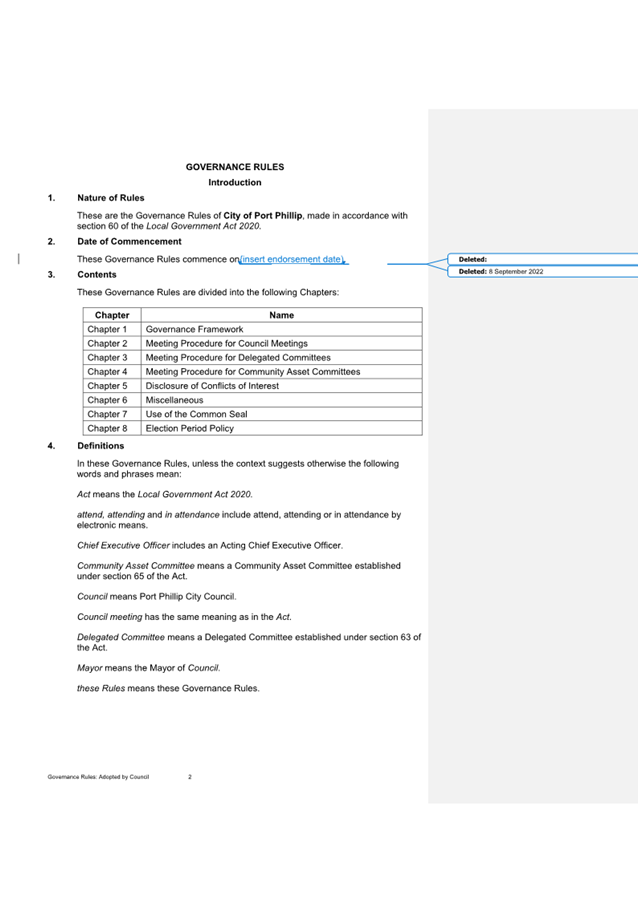
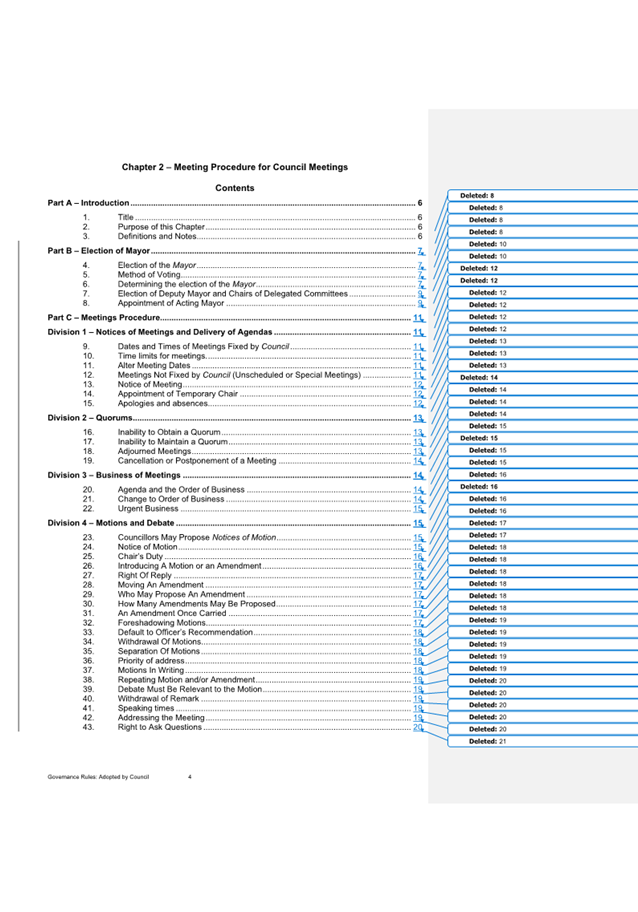
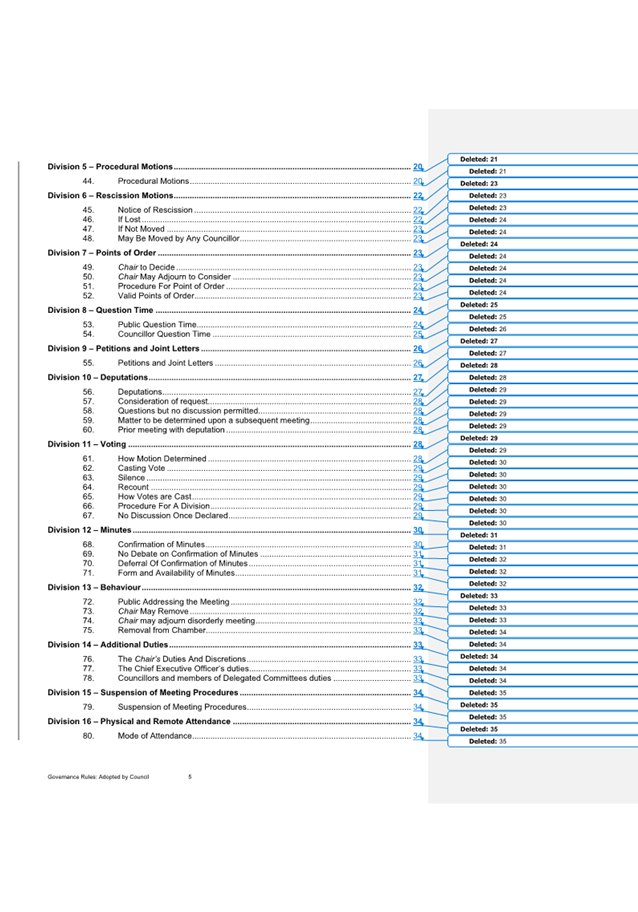
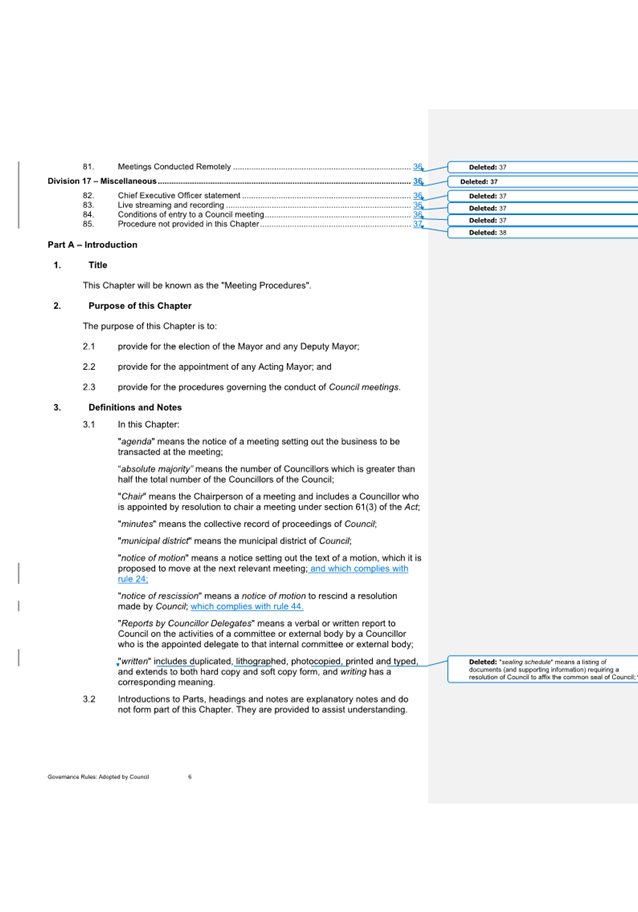
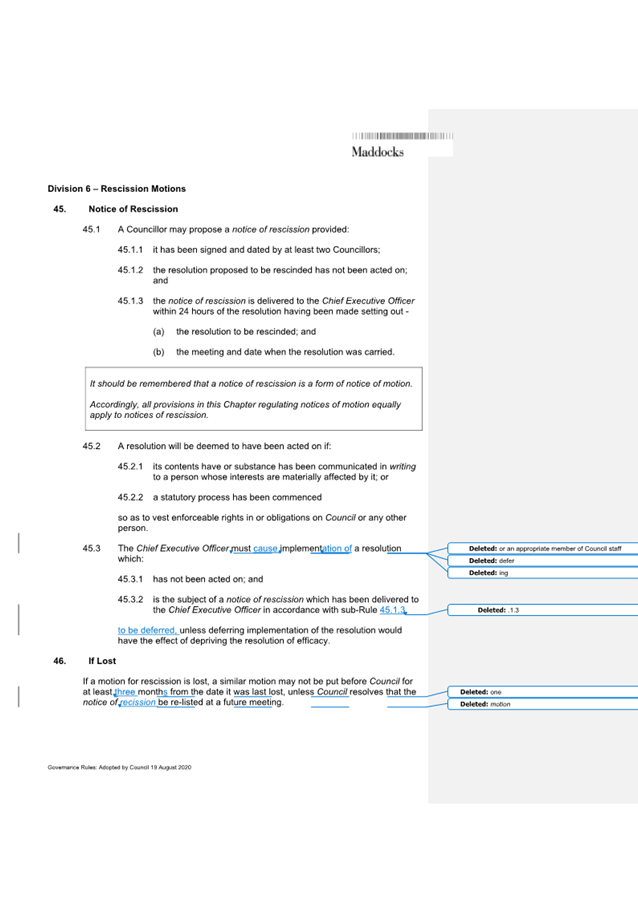
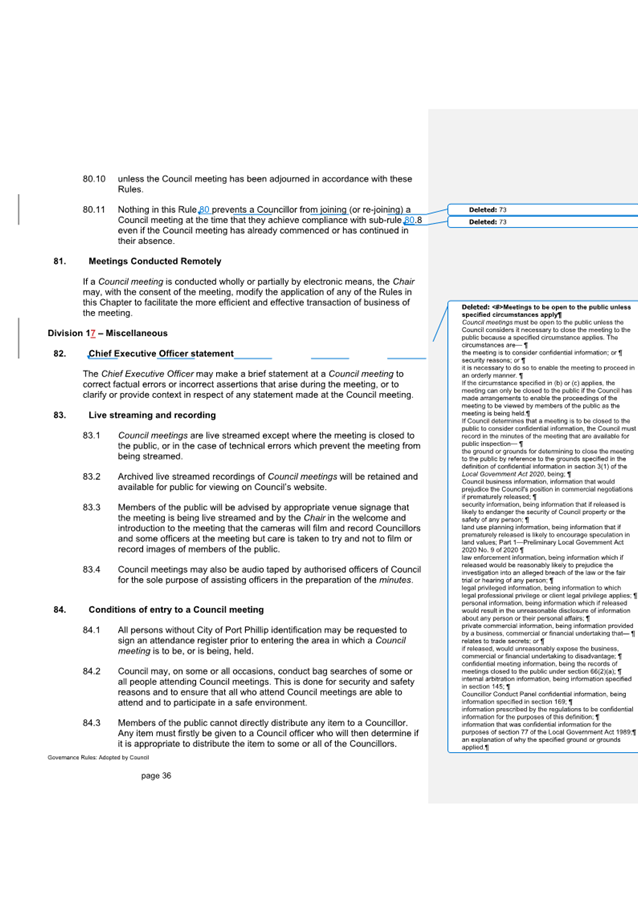
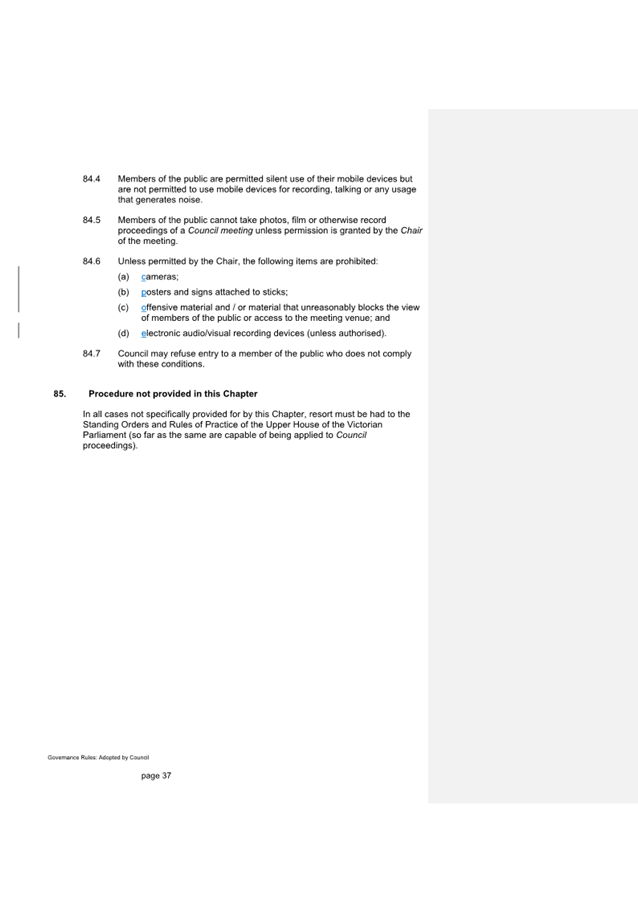
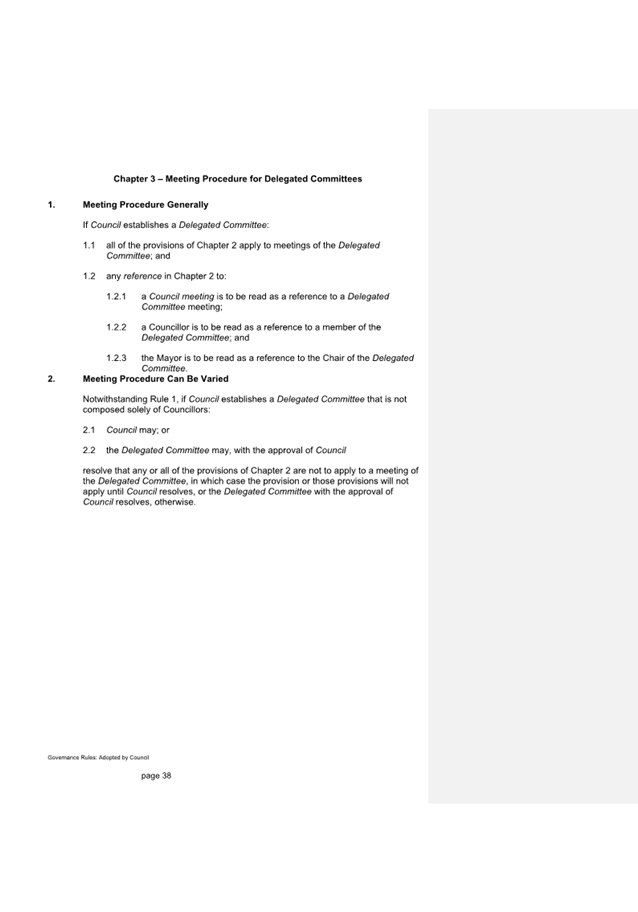
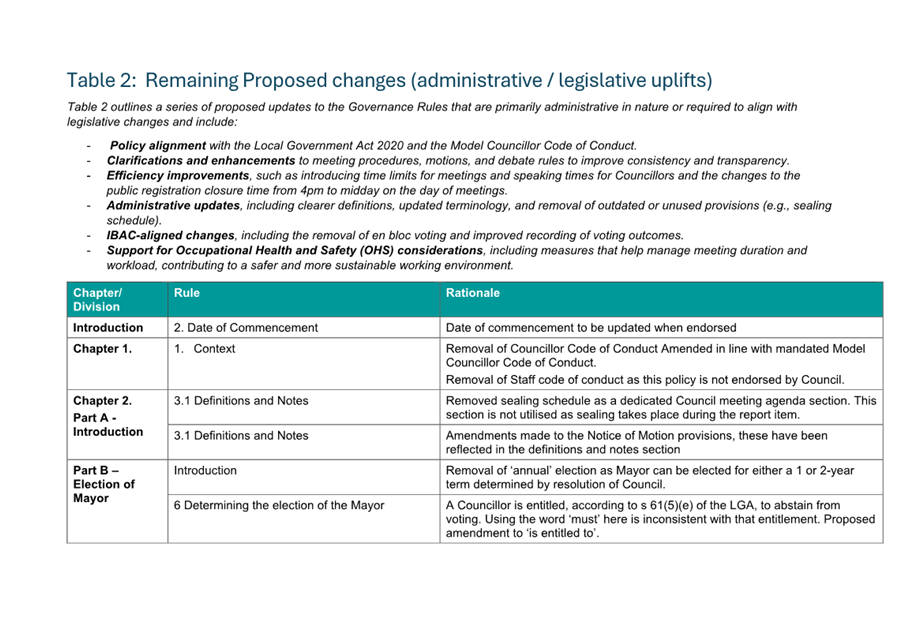
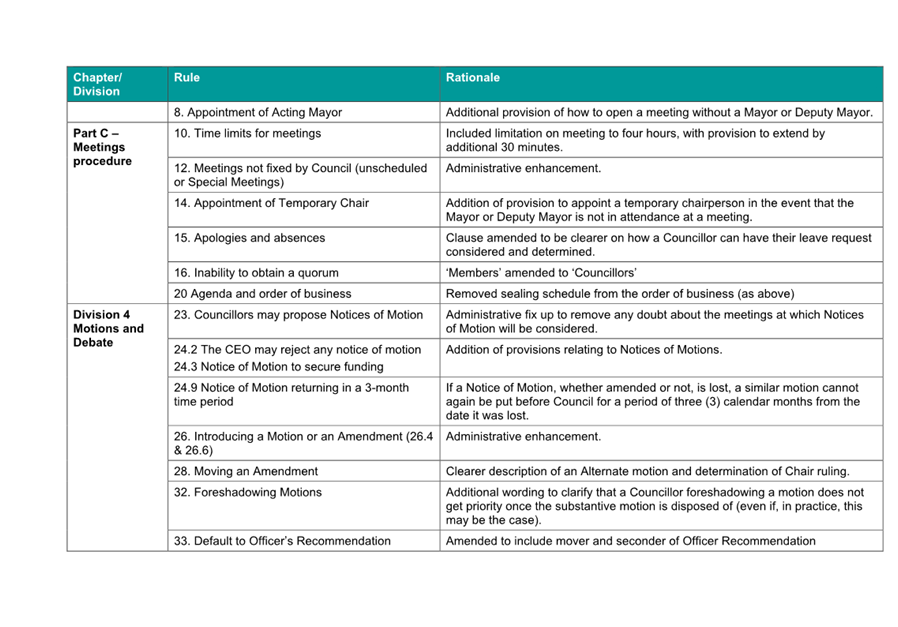
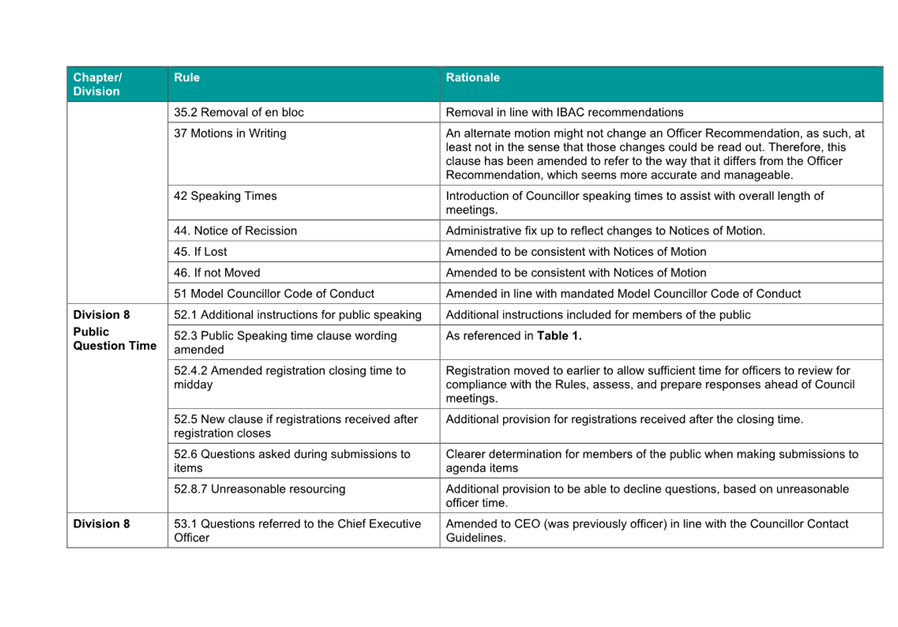
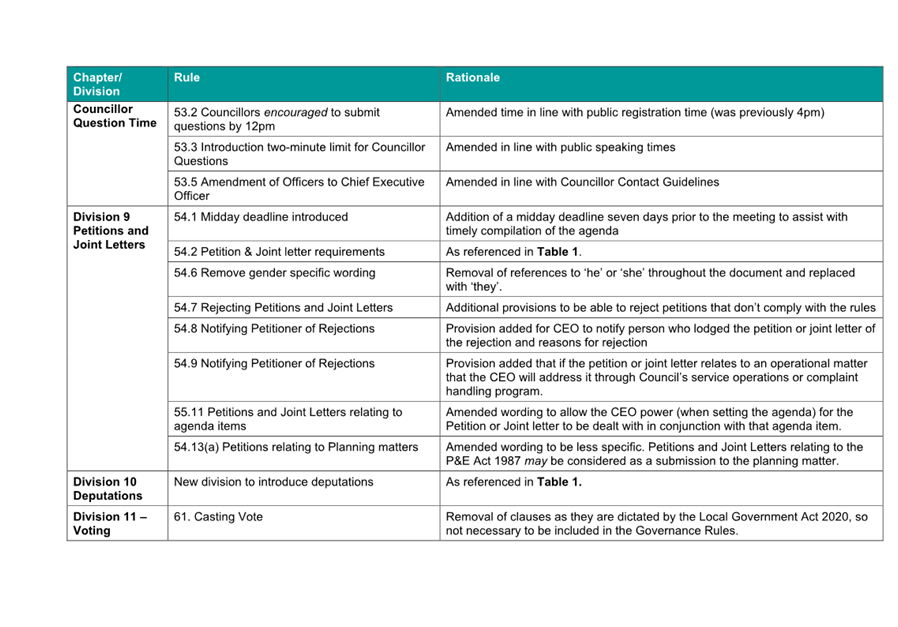
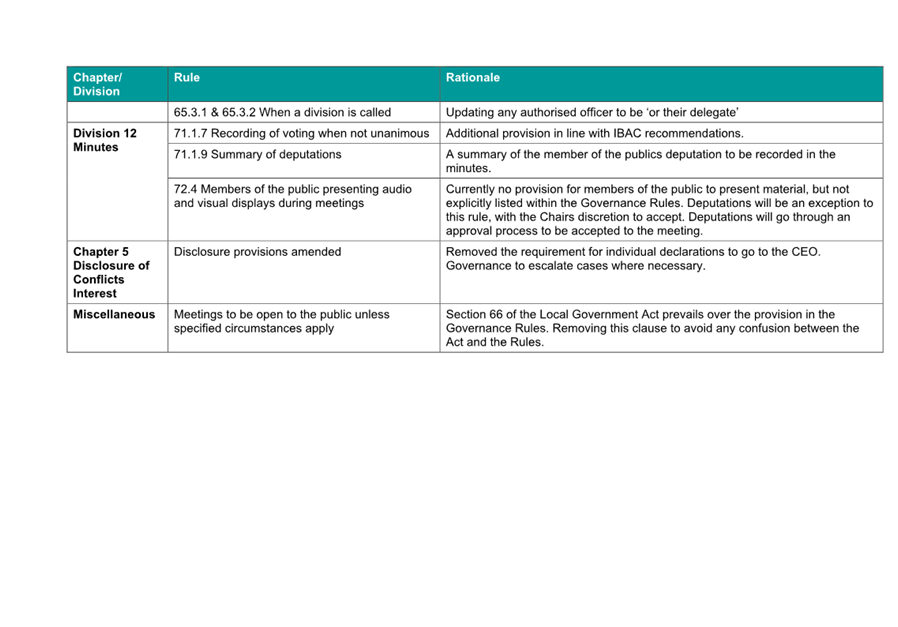
2.10 The Governance Rules have been updated (Attachment 2) with proposed changes for Council endorsement. A summary table has been provided (Attachment 3) that describes the proposed changes and the intent behind them.
|
That Council: 3.1 Thanks community members that provided feedback via the Have Your Say page and the petition. 3.2 Notes that community engagement occurred via Council’s Have Your Say page from 7 July to 3 August, the findings of the engagement are contained in Attachment 1. 3.3 Endorses the Governance Rules provided as Attachment 2. 3.4 Authorises the Chief Executive Officer, or their delegate, to make minor editorial amendments that do not materially alter the Rules. |
4. KEY POINTS/ISSUES
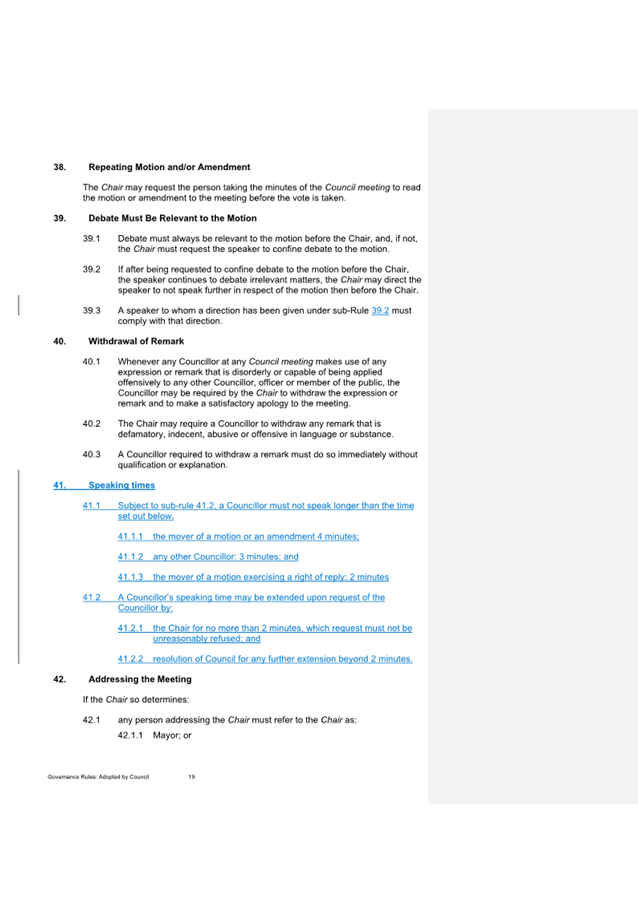
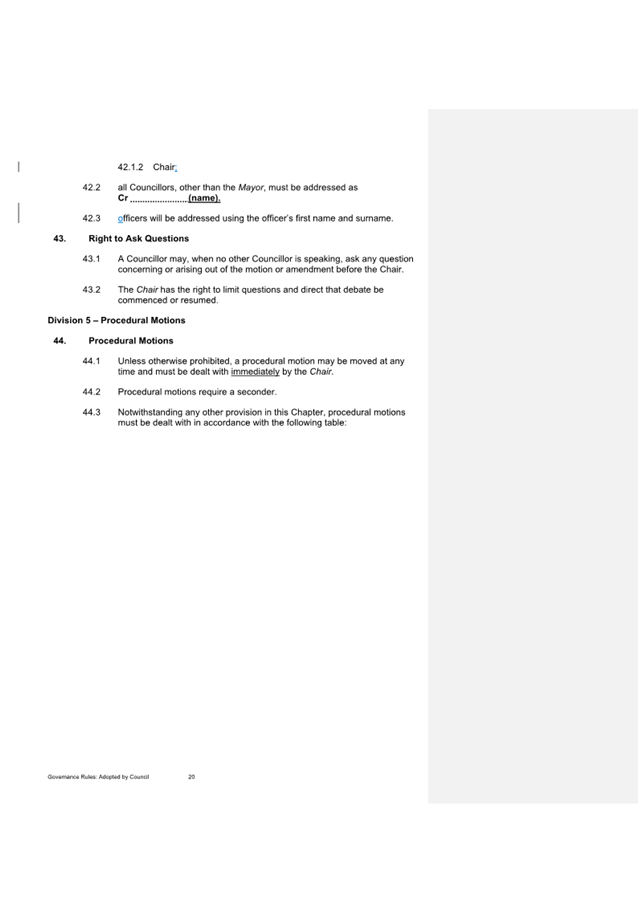
4.1 The key changes have been proposed to streamline meeting processes to improve efficiency and decision making including:
Proposed changes that enhance Safety and Well-being
4.2 A number of changes were proposed to reduce the overall time duration of Council meetings and address the CEO’s occupational health and safety obligations, ensuring a safe and supportive environment for both Councillors and officers.
a) Proposed introduction of a time limit for the overall duration of meetings
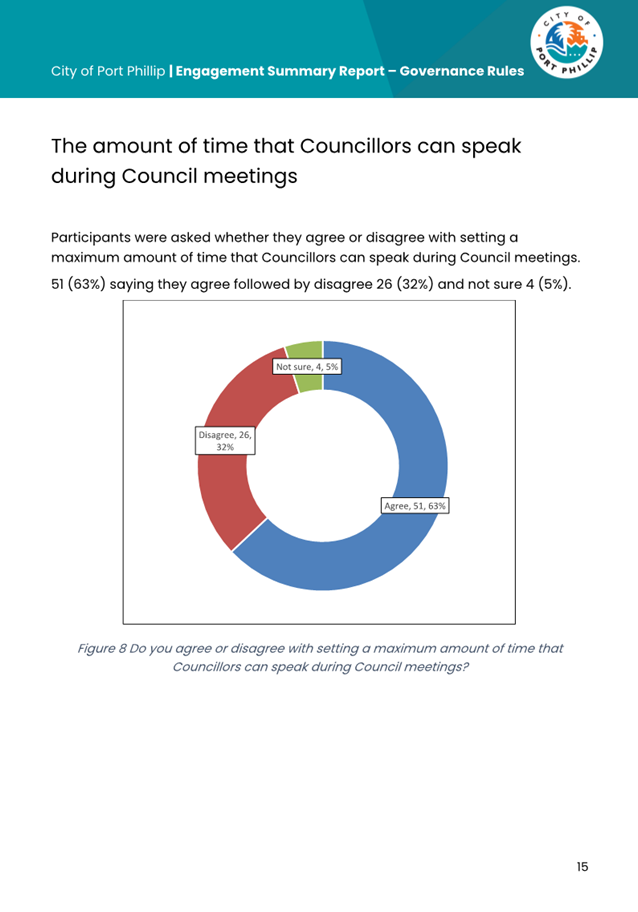
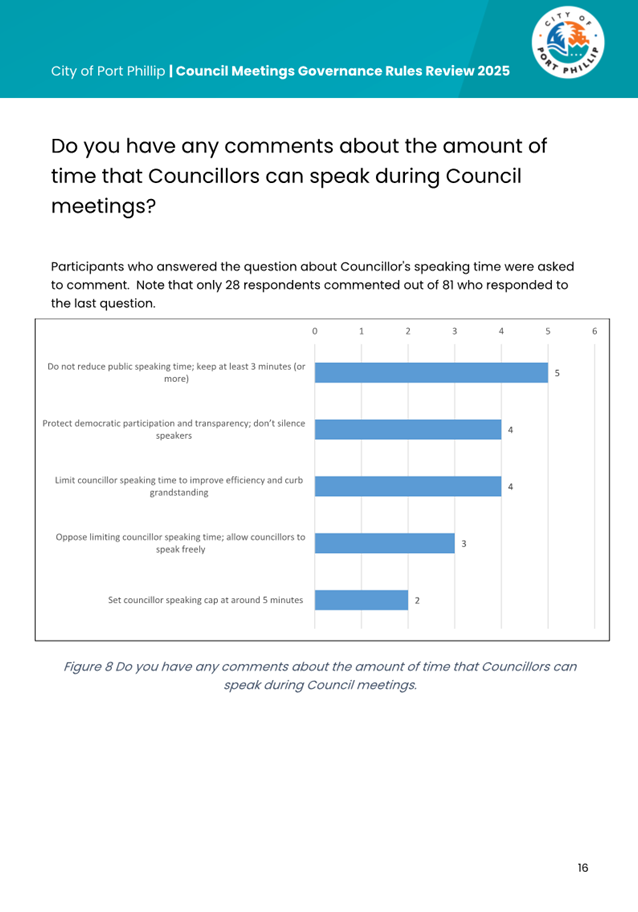
b) Proposed introduction of Councillor speaking times
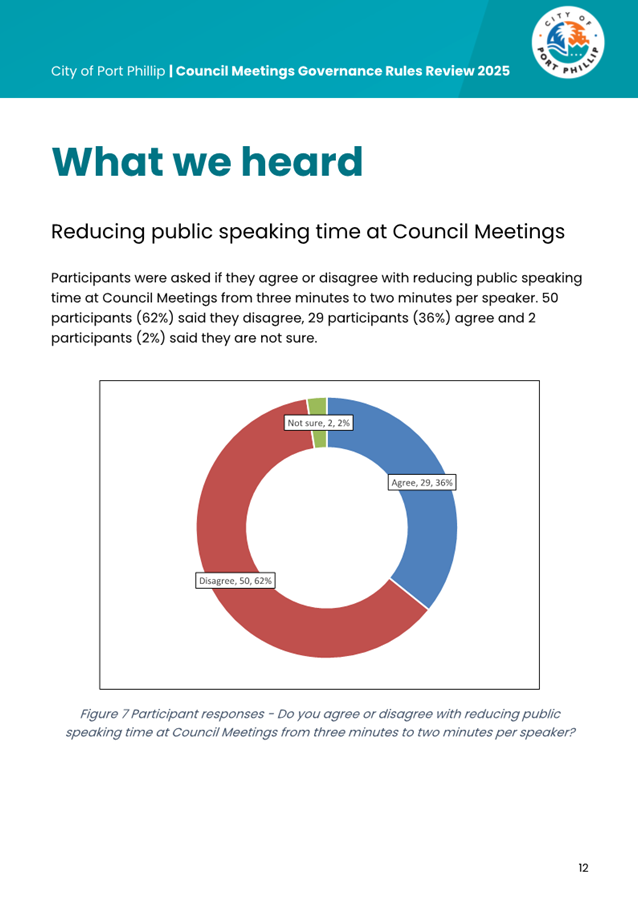
c) Proposed reduction of all public speaking time to two minutes per speaker.
IBAC Recommendations
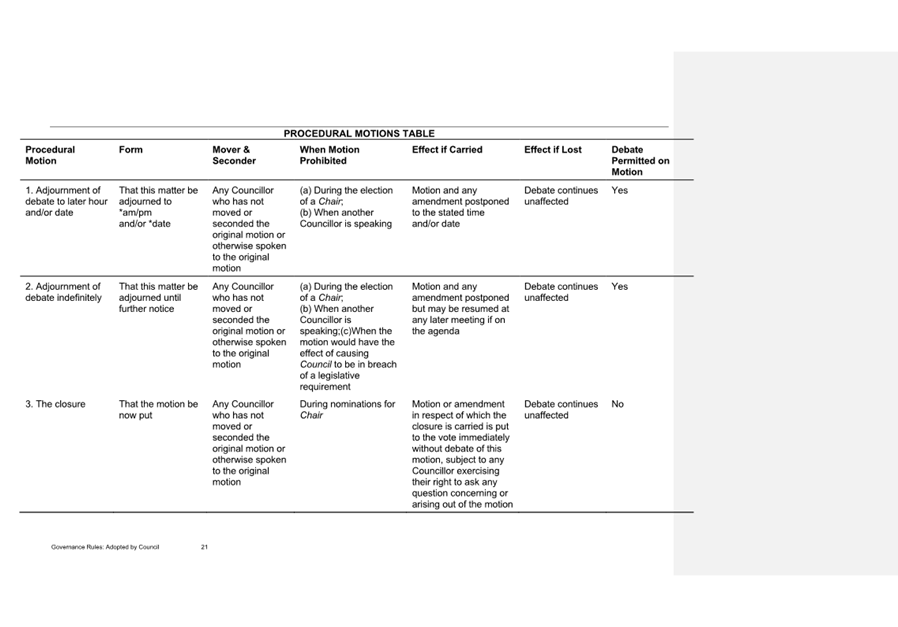
4.3 Recommendations directed to the Minister for Local Government as a result of the 2023 Operation Sandon Special Report released by the Independent Broad-based Anti-Corruption Commission (IBAC) have also been proposed to:
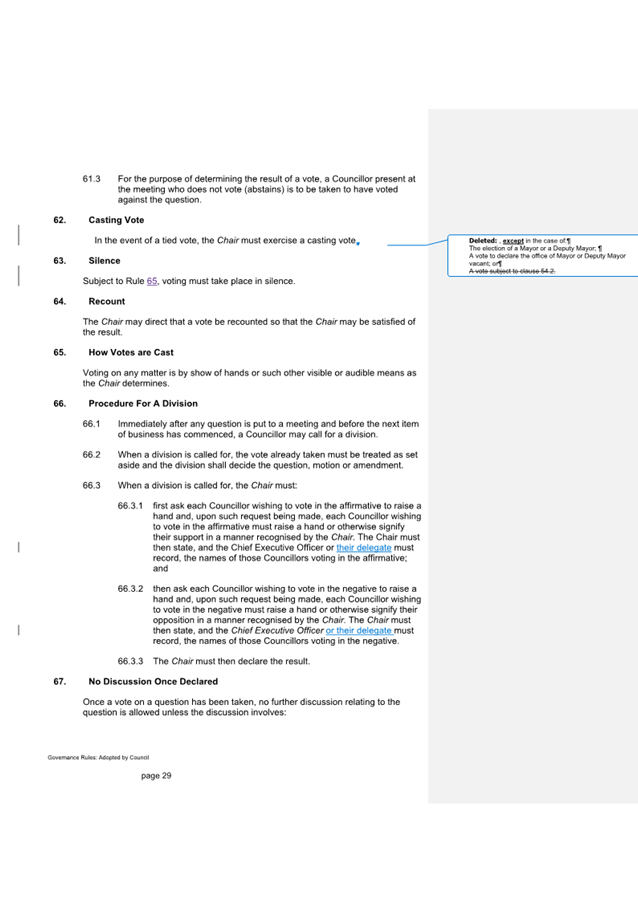
a) Remove provision for items to be moved and seconded en bloc. (En bloc refers to the practice of grouping motions together and taking a single vote to pass the grouped motions).
b) Record the vote of Councillors where the vote is not unanimous
These recommendations are anticipated to be incorporated into the proposed model Governance Rules. Local Government Victoria (LGV) has confirmed they have commenced the development of Model Governance Rules to be published by December 2025.
Petitions, Joint Letters and Deputations
4.4 A number of changes have been proposed to refine the process for lodging a Petition or Joint Letter to a Council meeting including
a) Increasing the minimum number of signatures required for a petition from five signatures to ten signatures.
b) Introduction of provisions to decline a Petition or Joint Letter that:
i. Is vague or unclear in intention
ii. deals with a matter which is beyond Council's power;
iii. deals with a matter which, if actioned by Council, would result in Council acting invalidly;
iv. is aimed at embarrassing a Councillor of a member of Council staff; or
v. contains a complaint against the actions or failures of staff or a Council department. This will be treated by Council as a letter of complaint and handled in accordance with Council’s managing complaints policy.
c) Additional provisions for Petitions and Joint Letters pertaining to operational matters be referred to the CEO for consideration.
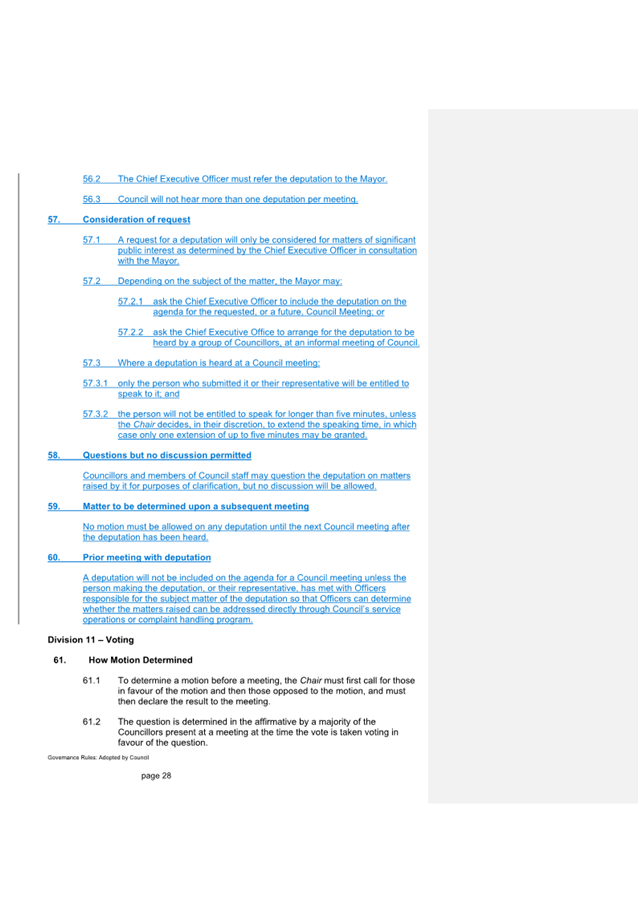
d) Introduction of a midday deadline for submitting Petitions and Joint Letters introduced at least seven days prior to the meeting to assist with the timely compilation of the agenda.
e) Additional section to introduce deputations at Council meetings. Deputations allow individuals or groups to address Council directly about specific matters relevant to the council's functions. This provision is proposed to be added to the Governance Rules to contribute to strengthening community engagement and public participation at meetings.
Although it was proposed to permit only the lead submitter or their representative to speak to Petitions or Joint Letters at Council meetings, the outcome of the community consultation did not support this change. Consequently, there is no recommendation to restrict speaking rights in relation to petitions.
Proposed minor clarifications and updates
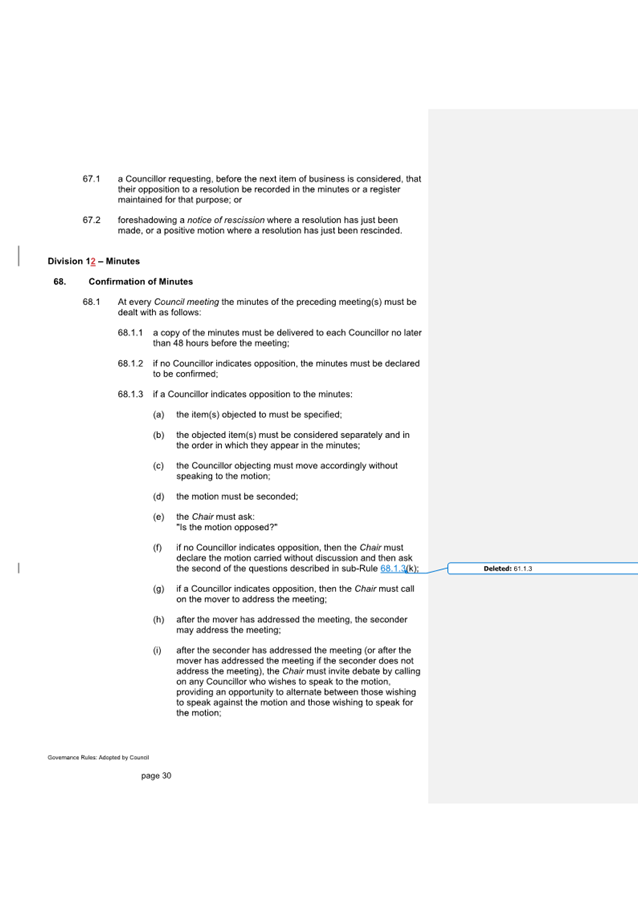
4.5 A number of minor changes have also been proposed to the overall document to ensure that Council meeting processes are clear and fair for the benefit of both the community and Councillors. The full list of these changes has been provided as a summary in Attachment 2.
5. CONSULTATION AND STAKEHOLDERS
5.1 Section 60 (4) of the Local Government Act 2020 requires any changes to the Governance Rules to go through a community engagement process prior to being endorsed.
5.2 Consultation was undertaken between Monday 7 July – Sunday 3 August 2025 viaCouncil’s Have Your Say page.
5.3 The Draft Governance Rules have also been reviewed by a governance specialist to ensure alignment with recommended best practice, where practicable.
6. LEGAL AND RISK IMPLICATIONS
6.1 The proposed changes ensure compliance with the Local Government Act 2020.
6.2 The Draft Governance Rules have been reviewed by Maddocks law firm to ensure they comply with the Local Government Act and that the proposed changes are both lawful and coherent.
6.3 The Draft Governance Rules will help reduce organisational risk by supporting compliance with Occupational Health and Safety (OHS) legislation.
6.4 The Local Government Act 2020 further requires that a process of community engagement is followed in developing or amending a Council’s Governance Rules. The community engagement process set out in this report has satisfied this obligation.
7. FINANCIAL IMPACT
7.1 There are no financial impacts from the proposed changes.
8. ENVIRONMENTAL IMPACT
8.1 There are no environmental impacts from the proposed changes.
9. COMMUNITY IMPACT
9.1 The proposed changes recommend to:
9.1.1 Reduce public speaking time to be two minutes at all times.
9.1.2 Amend the public participation registration closure time from 4 pm on the day of the meeting to midday.
9.1.3 Increase the minimum number of signatures required for a petition from five signatures to ten signatures.
9.1.4 Amend the deadline for submitting Petitions and Joint Letters to be midday at least seven days prior to the meeting (previously close of business) to assist with the timely compilation of the agenda
10. ALIGNMENT TO COUNCIL PLAN AND COUNCIL POLICY
10.1 The changes align to the strategic direction ‘An engaged and empowered community’ ensuring that Council have Governance Rules that are fit for purpose and compliant with the Local Government Act 2020.
11. IMPLEMENTATION STRATEGY
11.1 TIMELINE
11.1.1 Implement changes in Governance Rules as required with new process and procedures, including training of councillors.
11.1.2 Updated Governance Rules to be provided on Council’s webpage.
11.2 COMMUNICATION
11.2.1 Following the adoption of the Governance Rules at the Council Meeting, a coordinated communication approach will be implemented to ensure internal and external stakeholders are informed of the changes.
11.2.2 The updated document will be uploaded to Council systems and made publicly available on Council’s website.
11.2.3 Community facing website pages relating to Council meetings will be updated to reflect the new provisions, ensuring transparency and accessibility.
11.2.4 Councillors will be briefed on the finalised rules and the implications for the conduct of Council meetings.
12. OFFICER MATERIAL OR GENERAL INTEREST
12.1 No officers involved in the preparation of this report has declared a material or general interest in the matter.
|
ATTACHMENTS |
1. Engagement Summary Report⇩ 2. Draft Governance Rules with tracked changes⇩ 3. Changes summary table⇩ |
Meeting of the Port Phillip City Council
2 September 2025
|
Update to the Procurement Policy |
|
|
Executive Member: |
Lachlan Johnson, General Manager, Operations and Infrastructure |
|
PREPARED BY: |
Peter Liu, Chief Financial Officer Wayne Moore, Coordinator Procurement, Contracts & Fleet Graham Millar, Procurement Contracts Management Best Practice Lead |
1. PURPOSE
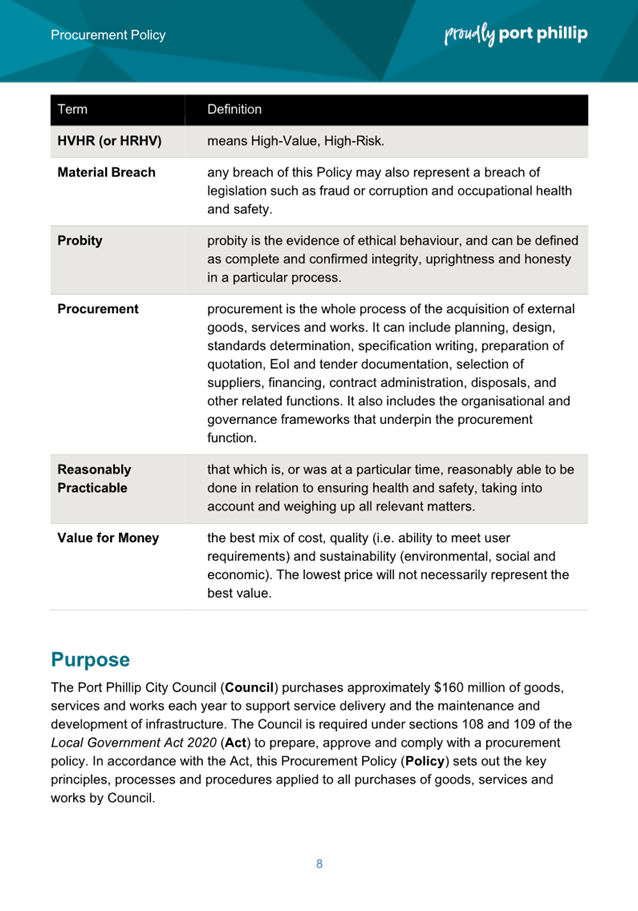
1.1 To present an updated Procurement Policy (the Policy) for Council endorsement, in accordance with section 108(5) of the Local Government Act 2020.
2. EXECUTIVE Summary
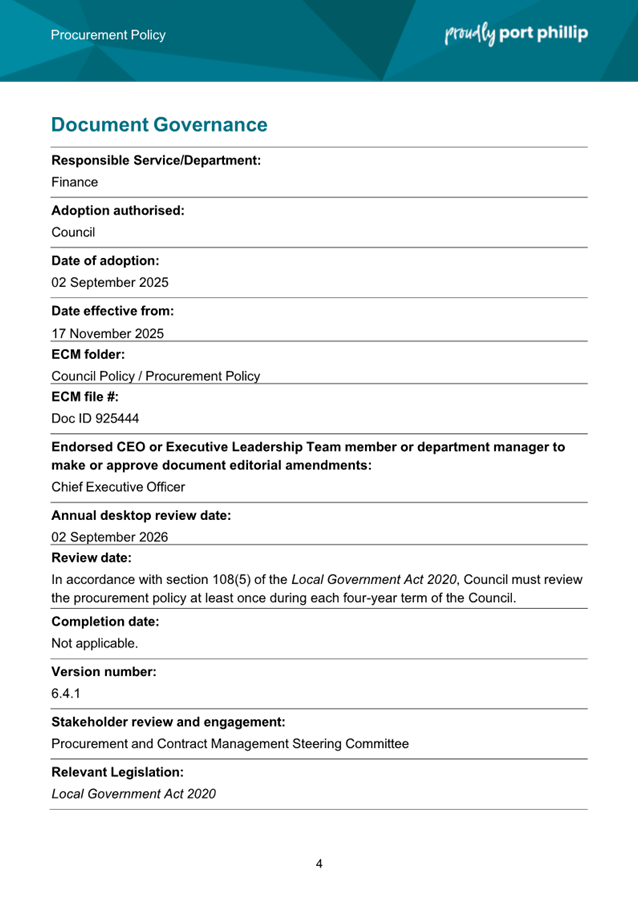
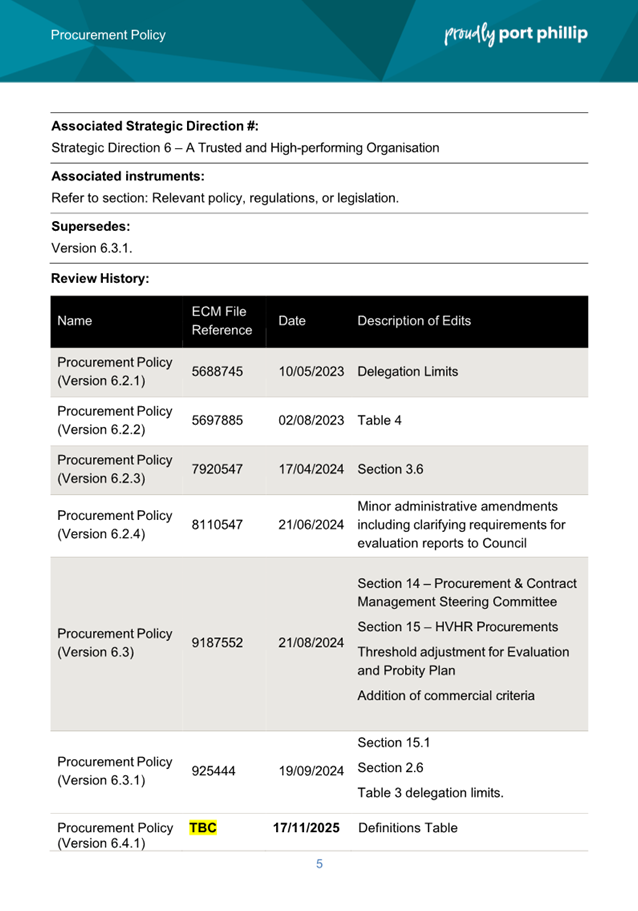
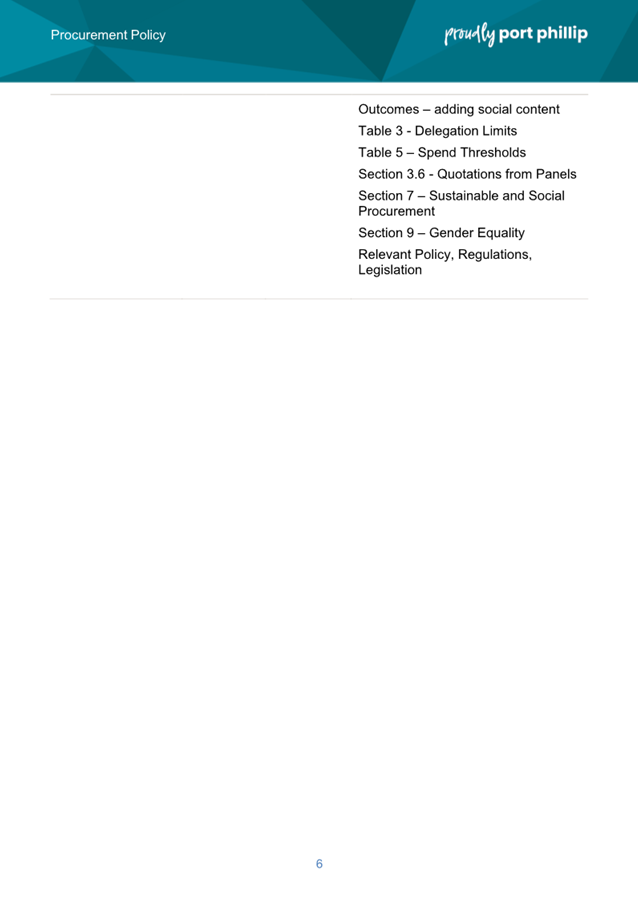
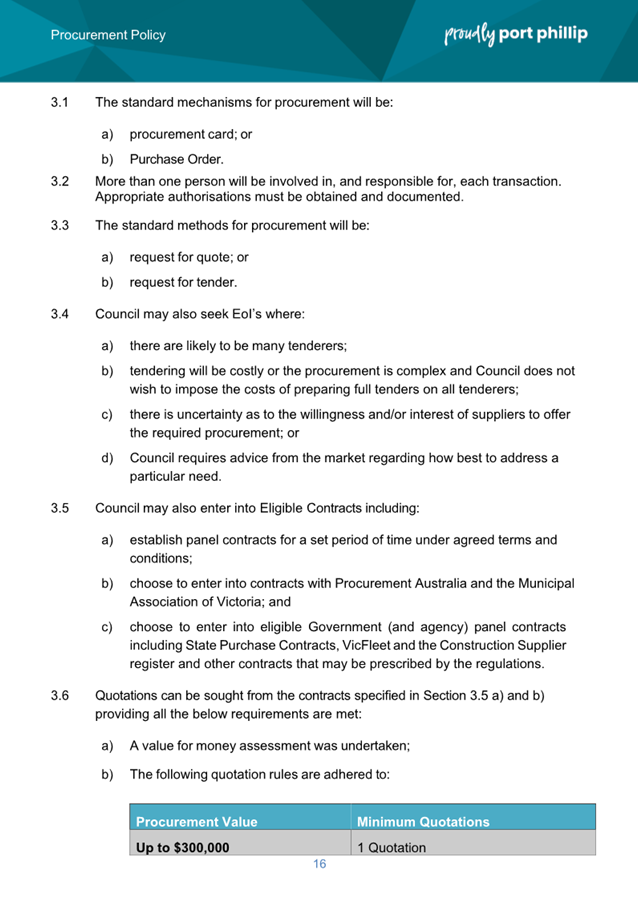
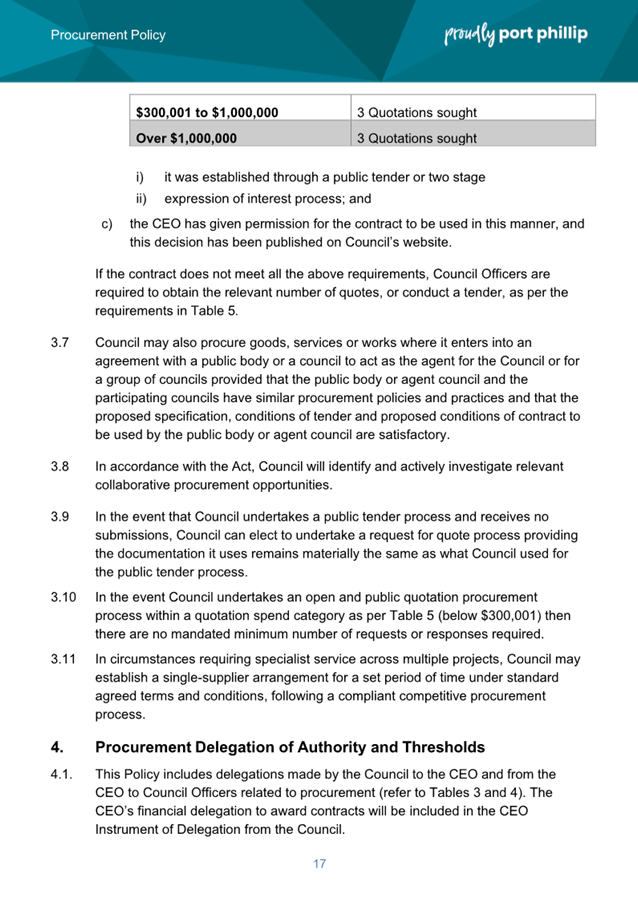
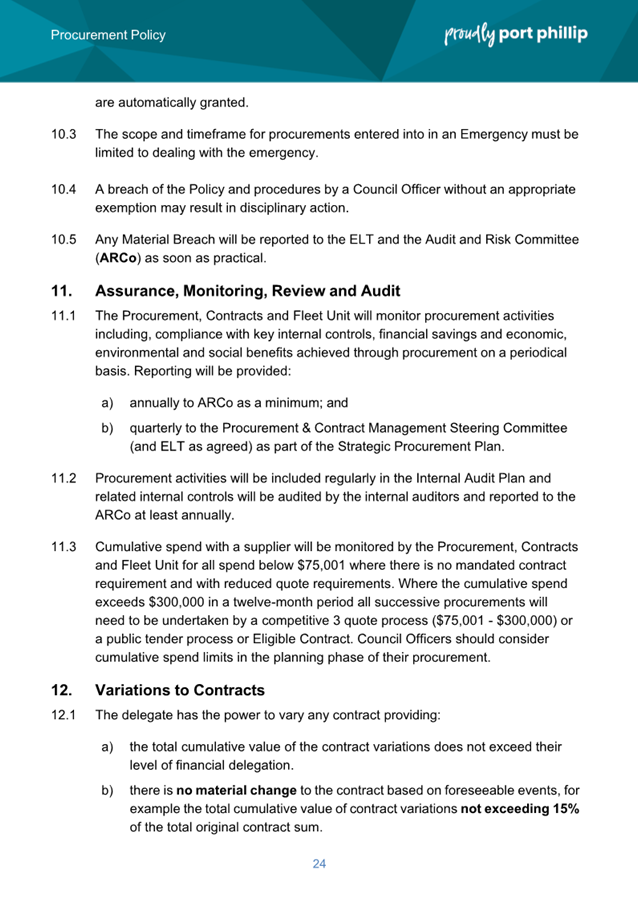
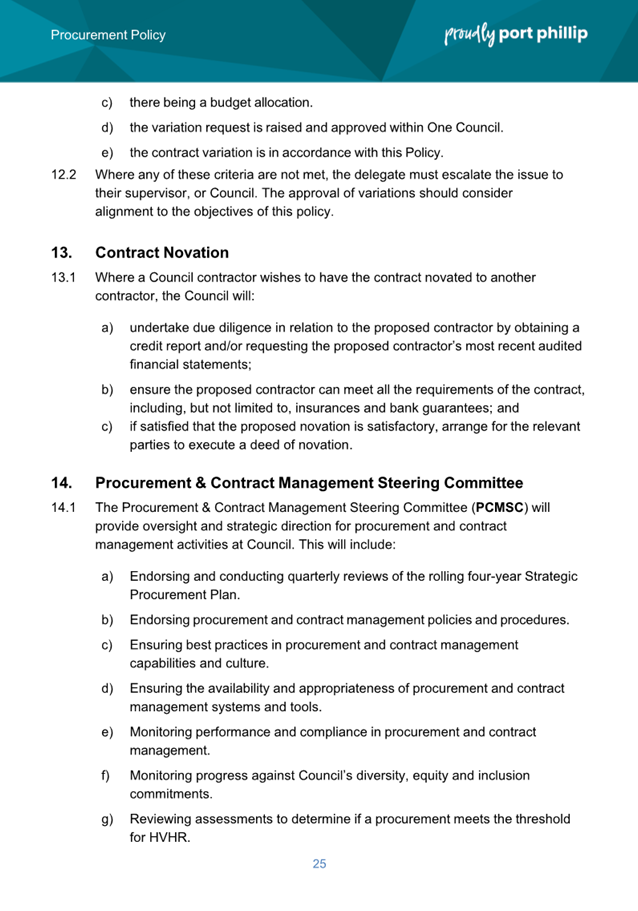
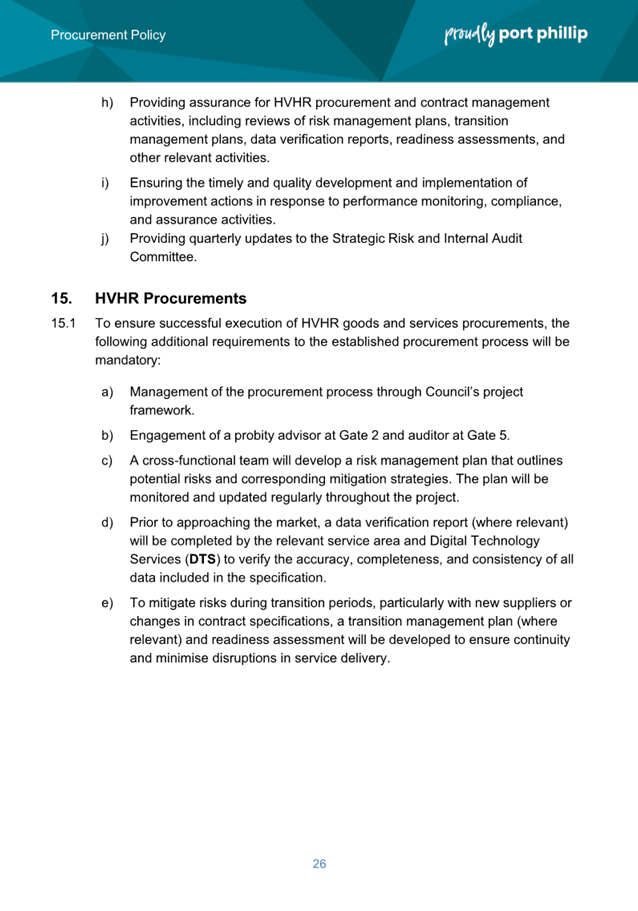
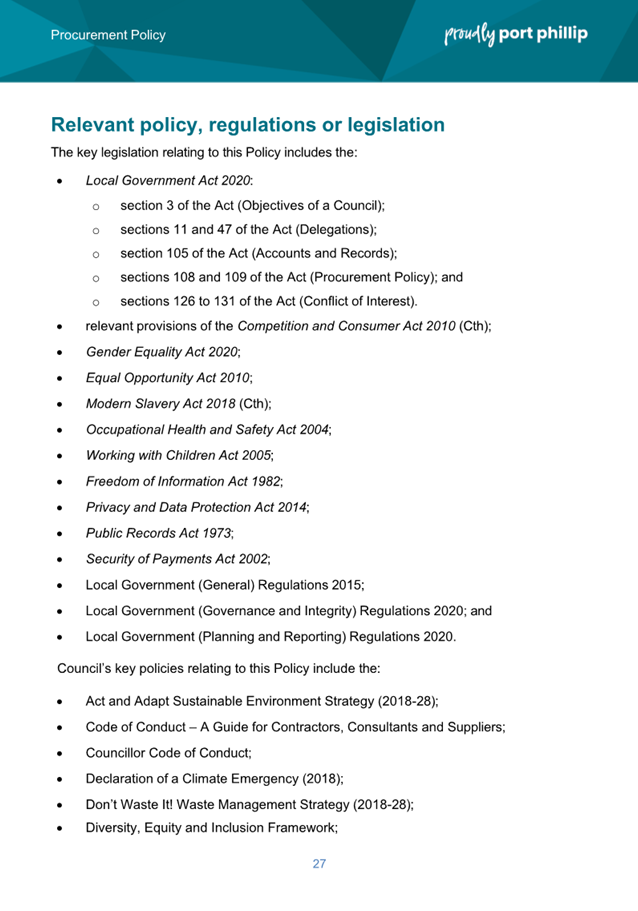
2.1 Council adopted current Version 6.3.1 of the Policy on 21 August 2024, with the proposed amendments forming the basis of the forthcoming Version 6.4.1.
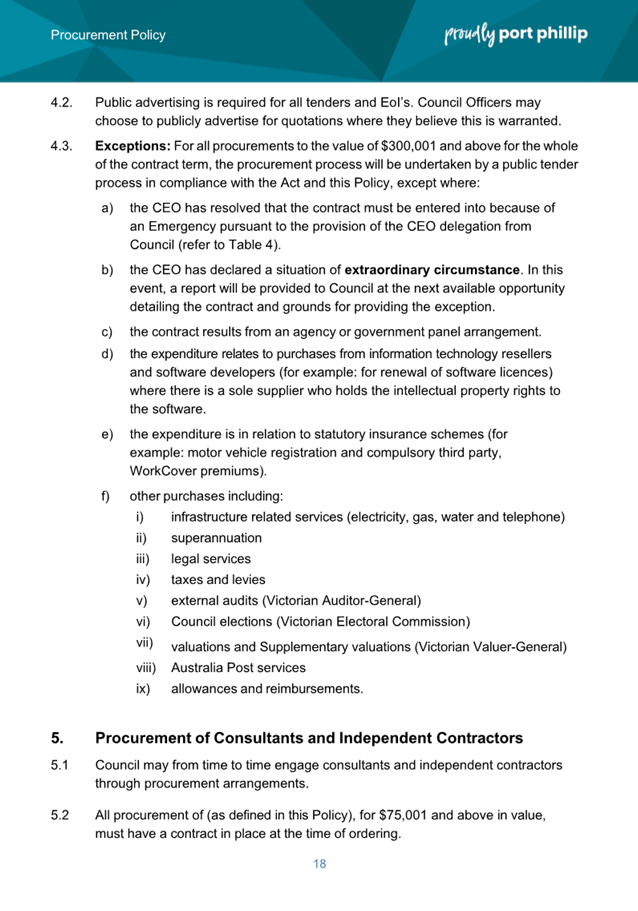
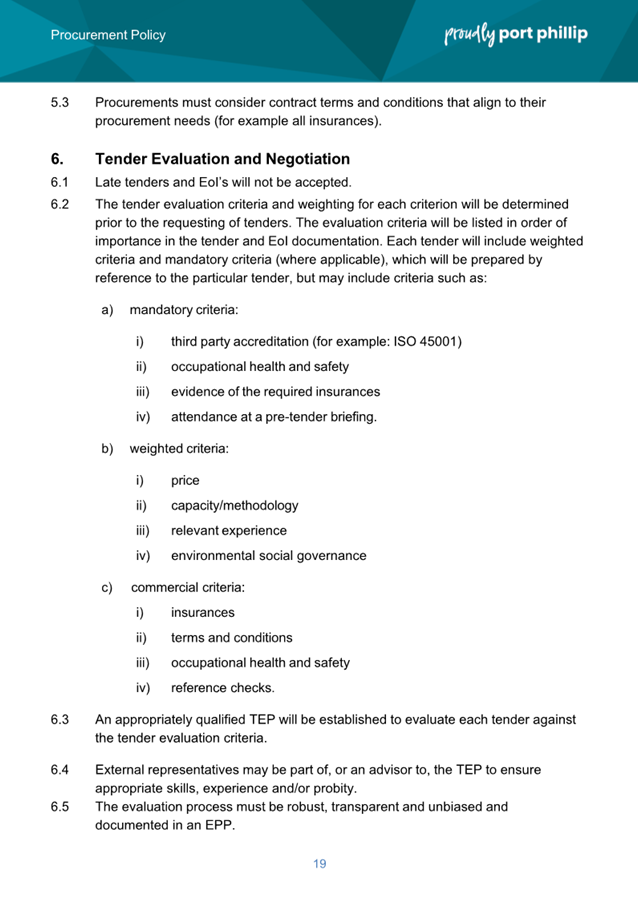
2.2 To ensure the Policy continues to provide efficient processes, and an effective framework for achieving value for money in the expenditure of public funds, the updated Policy includes key amendments:
· Adjustments to Financial Delegation Thresholds, to improve procedural efficiency and standardise management role groupings. These changes are based on benchmarking with other councils, procurement trend data analysis, resource assessments, alignment with the new Council Plan and project portfolio, audit findings, lessons from past projects and staff feedback.
· Proposed adjustments to Procurement Thresholds, based on a benchmarking exercise, to better align with Financial Delegations and accountability, enhance internal efficiencies, and reflect for annual inflation.
· Proposed inclusion of a provision for establishing single-supplier arrangements for specialist service, such as architectural services, following a compliant competitive procurement process. This aims to efficiency and economy of scale where works are aggregated and explicitly signalling to the market that the successful tenderer is guaranteed a volume of work.
2.3 The Policy also introduces greater ownership of end-to-end procurement (for purchases under $300,001) by individual business area, with a greater focus and support from Procurement Business Partners on higher-value and higher-risk strategic procurements across Council.
2.4 Collectively, these amendments are designed to strengthen governance, mitigate risks, and enhance the efficiency and effectiveness of Council’s procurement processes.
|
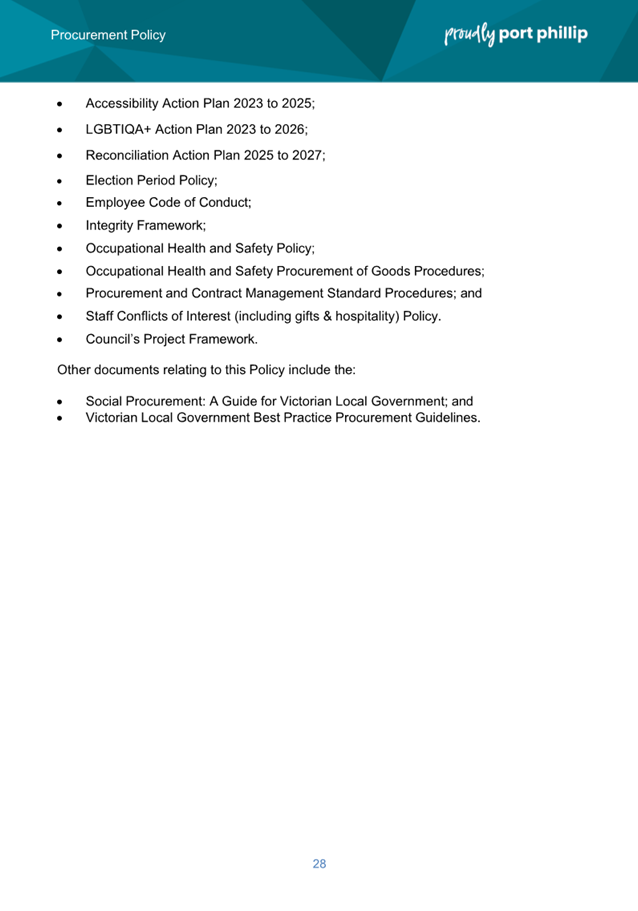
That Council: 3.1 Adopts the updated Procurement Policy 6.4.1 as per Attachment 1 noting the following key amendments: 3.1.1 Financial Delegation Limits: Updates to financial delegations to improve procedural efficiency and standardise management role groupings. These changes are based on benchmarking with other councils, procurement trends, resource assessments, alignment with the new Council Plan and project portfolio, audit findings, lessons from past projects and staff feedback. 3.1.2 Additional Financial Delegation - Insurance Expenditure Delegation limits: Increase in delegation limit to $4 million, reflecting the current insurance operating environment. 3.1.3 Spend Thresholds: Adjustments made to better align with the updated Financial Delegations Limits in section 3.1.1. These changes aim to enhance internal efficiencies, account for inflation, and ensure a greater focus and support from the Procurement team on higher-risk procurement activities. 3.1.4 Provision for establishing single-supplier arrangements for specialist service: Aims to efficiency and economy of scale where works are aggregated and explicitly signalling to the market that the successful tenderer is guaranteed a volume of work. 3.2 Authorises the Chief Executive Officer, or their delegate, to finalise and make minor changes that do not materially alter the Procurement Policy. |
4. KEY POINTS/ISSUES
4.1 Council has a Procurement Policy in place in accordance with its obligations under section 108 of the Local Government Act 2020. Council last adopted the Procurement Policy in 2024. There is also a requirement that this Council must review its Procurement Policy at least once during the four-year term.
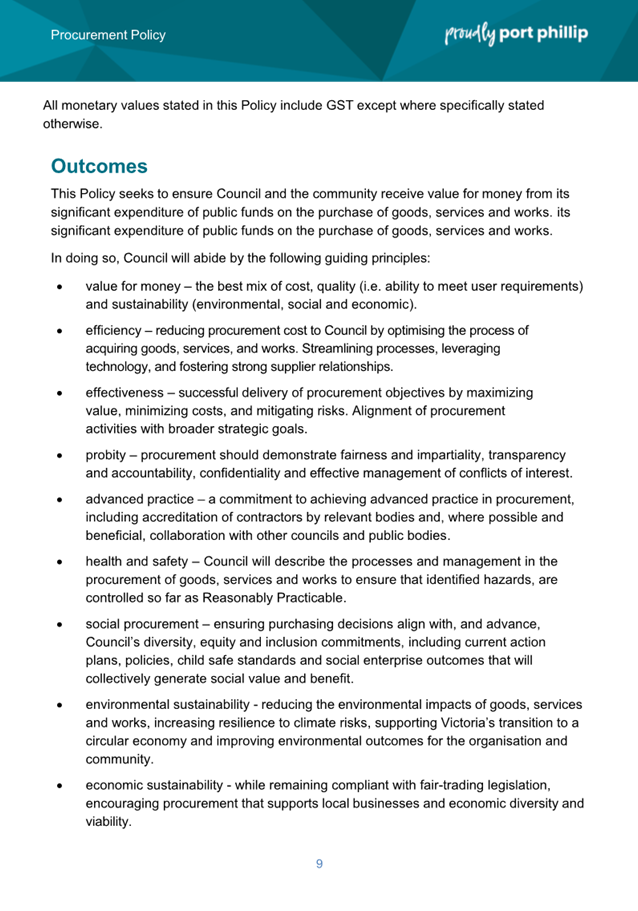
4.2 This report presents proposed updates to the Procurement Policy to ensure that it remains an efficient and effective way to provide best value for expenditure of public funds and that Council upholds the highest standards of probity.
4.3 The Procurement Policy has the following guiding principles:
· Value for money
· Efficiency
· Effectiveness
· Probity
· Advanced practice
· Health & safety
· Social procurement
· Environmental sustainability
· Economic sustainability
4.4 Council operates a mixed centre-led hybrid procurement model. This model centralises procurement policies, processes, and strategies, while allowing execution of activities at the department level, with a hybrid approach applied to procurements valued at above $300,000.
4.5 In accordance with the Procurement Policy, procurement and contract management across Council is governed and oversighted by the Procurement & Contract Management Steering Committee (PCMSC). This committee comprises senior managers from across the organisation and chaired by the General Manager of Operations & Infrastructure.
4.6 Under the committee’s remit, a comprehensive review of the current Policy has been undertaken to ensure alignment with the nine principles. This review has incorporated benchmarking of other councils, trends across procurement and contract management activity, a review of resourcing and efficiency across the centre-led team and in key areas of procurement activity such as project delivery, a review of the new Council Plan and in particular the project portfolio, staff feedback, and recommendations from audits and lessons learnt through project delivery.
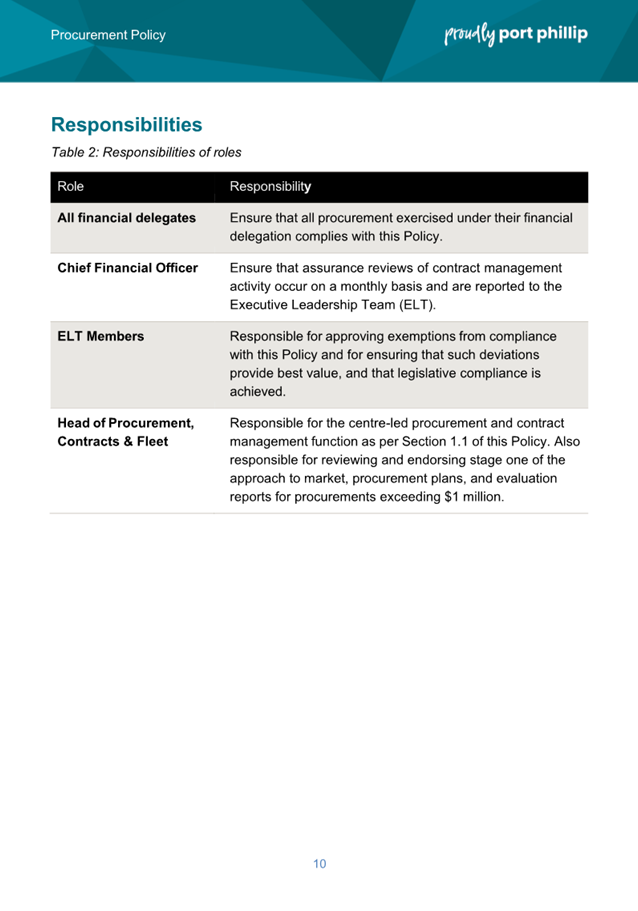
4.7 A key focus of the review has been to enhance efficiency in procurement while maintaining strong probity standards. Proposed changes, such as adjustments to financial delegations and quotation thresholds seek to increase the efficiency of procurement activity that Council undertakes, at the same time as providing greater capacity for the management of higher-risk procurement activities. This delegation model is supported by a robust second-line defence audit and assurance framework.
4.8 The following sections examine the key proposed changes.
Financial Delegation Thresholds
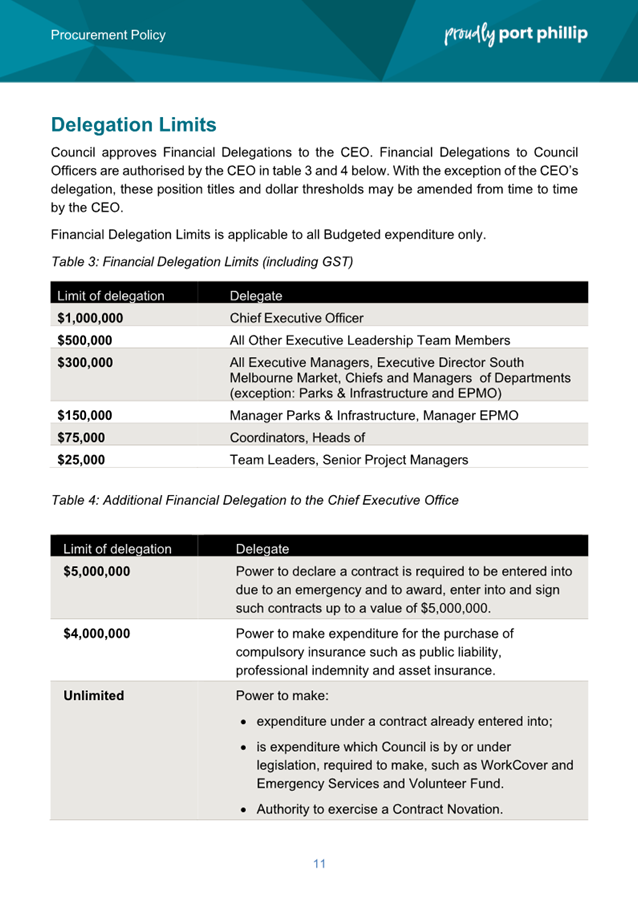
4.9 The following financial delegations have been updated for Council staff (sub-delegated by the Chief Executive Officer pursuant to the Section 7 instrument of delegation under the Local Government Act 2020).
4.10 The revisions to the financial delegations to officers seek to improve the efficiency of procurement activity and to provide a more consistent approach across the organisation. The previous delegations sought to draw distinctions of risk and capability across the organisation with varying financial delegations allocated. This revised approach provides consistency across the level two (executive) cohort and provides a higher degree of consistency in other levels across the organisation.
4.11 The changes also lift the financial delegation of direct supervisors at the level four (coordinator/Head of) and level five (team leader), aligning these to the proposed quotation thresholds (see following section). This builds competence and capability through process familiarity with these delegates.
4.12 These changes were informed by a benchmarking exercise with similarly sized councils to assess and compare delegation levels.
4.13 The table below outlines Council’s previous financial delegations alongside the new delegations, updates inclusive of GST:
|
Previous delegation Limit |
Delegate |
Updated Delegation limit |
Updated Delegate |
|
$1,000,000 |
Chief Executive Officer |
$1,000,000 |
Chief Executive Officer |
|
$500,000 |
General Manager Operations & Infrastructure |
$500,000 |
All Other Executive Leadership Team Members |
|
$350,000 |
All other General Managers |
||
| $300,000 |
Executive Manager Waste & City Waste |
$300,000 |
All Executive Managers, Executive Director South Melbourne Market, Chiefs and Managers of Departments (exception: Parks & Infrastructure and EPMO).
|
|
$200,000 |
All other Chief Officers All other Executive Managers Manager Property & Assets Manager City Planning & Sustainability Manager Safety & Amenity Manager Project Delivery |
||
| $100,000 |
All other Managers |
$150,000 |
Manager Parks & Infrastructure Manager EPMO |
|
$50,000 |
Coordinators Heads of |
$75,000 |
Coordinators Heads of |
|
$15,000 |
Team Leaders Senior Project Managers |
$25,000 |
Team Leaders Senior Project Managers |
Procurement Thresholds
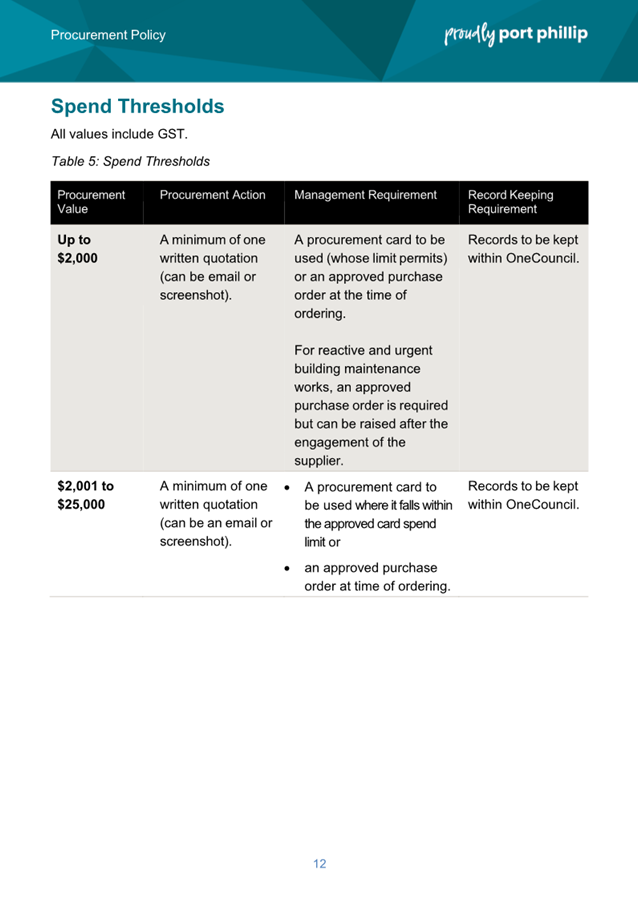
4.14 A review of Council’s expenditure profile over the last two years (2023 and 2024) has indicated that lower bound transactions (<$1k under the current Policy) are reducing with a commensurate increase in the $1k to $2k range. This is mostly due to inflation and cost increases. To ensure continued efficiency in the procurement of these low risk, high-volume transactions, it is proposed to increase the lower threshold from $1k to $2k.
4.15 Similarly, the current limit of $15k for receiving one written quote and $50k for seeking two quotes are proposed to be lifted to $25k and $75 respectively to allow for cost increases. The proposed increases align the procurement quote requirements to the financial delegation of level five (team leaders and senior project managers) and level four (coordinators and heads of) ensuring consistency in the process that these officers will expect to be followed when considering procurements.
4.16 Council’s current Policy encourages the uses of a Procurement Card (P-Card) for low value transactions (often supply of materials or equipment) as it is a highly efficient manager of procurement. The current P-Card limit is $15k. It is not proposed to increase the limit of P-Card transactions beyond the $15k at this stage. Analysis of the spend profile up to $25k indicates that the majority of spend between $15k and $25k is for service delivery (specialist technical advice) where a P-Card would not be an appropriate mechanism.
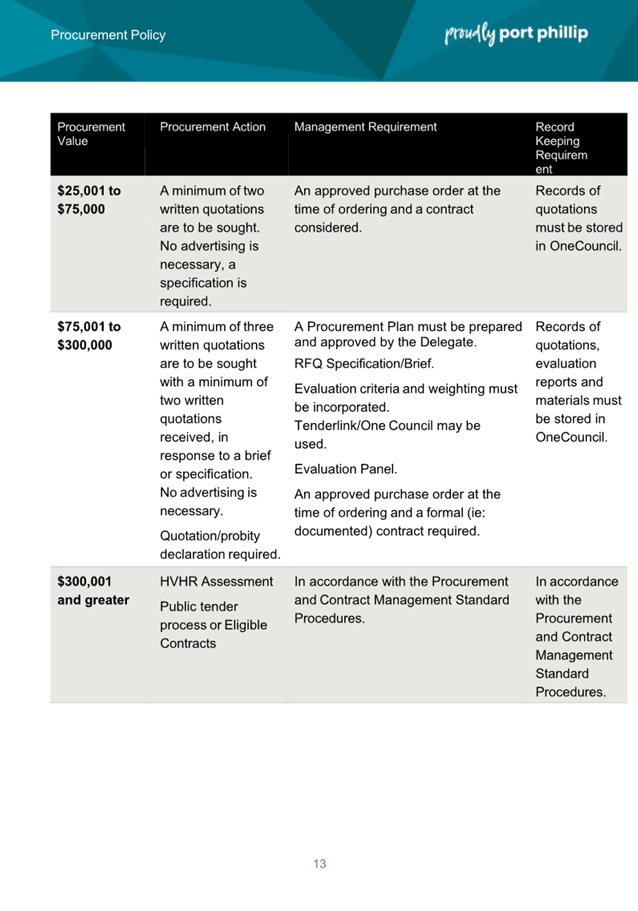
4.17 It is proposed to revise the procurement requirements for purchases ranging from $75k up to the public tender threshold of $300k. Currently, the Policy mandates that the centre-led Procurement Team review and provide input on all procurements in this range exceeding $150k. In practice, this is resulting in significant inefficiency.
To address this, it is proposed that this requirement be removed, allowing procurement resources to be redirected towards higher-risk procurements exceeding $300k. To mitigate potential risks associated with this change, the current requirement to ‘seek’ three quotes will be updated to require a minimum of ‘two written quotes’. Where two quotes cannot be obtained, approval from General Manager will be required before proceeding.
Additionally, it is proposed that a formal contract be mandated for procurements in this range. Under the current Policy, a contract is recommended, but the use of a purchase order is permissible.
4.18 It is not proposed that there are any changes to the requirement to undertake a public tender process (or use an eligible contract) for expenditure over $300k. This aligns with the approach of other similar councils.
4.19 The proposed changes to quoting requirements are summarised in the following table. The changes will help to improve efficiency in procurement whilst enhancing competitive requirements for high-value procurements. The changes will also ensure that appropriate oversight is provided for the highest risk procurements, those exceeding $300k and are subject to public tender (or eligible contract).
|
Current Thresholds |
Current Requirements |
Proposed Thresholds |
Proposed Requirements |
|
$1k (up to) |
· A minimum of one quotation (verbal or written). |
$2k (up to) |
· A minimum of one written quotation. · Purchase order engagement or P-Card (preferred). |
|
$1k to $15k |
· A minimum of one written quote. |
$2k to $25k |
· A minimum of one written quote. · Purchase order engagement or P-Card (<$15k). |
|
$15k to $50k |
· A minimum of two written quotes to be sought. |
$25k to $75k |
· A minimum of two written quotes to be sought. · Purchase order engagement. |
|
$50k to $300k |
· A minimum of three written quotes are to be sought. · Amounts over $150k require review the Procurement Team. |
$75k to $300k |
· A minimum of three written quotes are to be sought with a minimum of two written quotes received. · A formal contract to be established. |
|
$300k (or greater) |
· High-Risk, High-Value Assessment. · Public tender or eligible contract. |
$300k (or greater) |
· High-Risk, High-Value Assessment. · Public tender or eligible contract. |
Sole Supplier Arrangements
4.20 Council frequently enters into long-term service provider contracts for services. This includes things such as maintenance trade services (plumbing, electrical, etc.) and other services that Council needs to regularly call-upon. Maintaining in-house capability or capacity for these services is neither efficient or practical, making external contracting the preferred approach.
4.21 Council often establishes panel contracts where it awards a contract to multiple providers on the potential to supply them work. Whilst doing so provides flexibility to engage different providers, it often does not provide best-value or an efficient way of engaging services. A tenderer for a panel must consider the uncertainty of work arising from being a successfully appointed panel participant.
4.22 To address these challenges, the updated Procurement Policy proposes the introduction of a ‘sole supplier arrangement’. Under this model, Council could aggregate work and provide it to the market, explicitly signalling to the market that the successful tenderer is guaranteed a volume of work, thus capitalising on efficiencies and economies of scale, rather than establishing a panel where the uncertainty of work volume leads to higher rates. The updated Policy proposes that, subject to certain conditions, an established sole supplier arrangement can be utilised efficiently to deliver works capitalising on those economies of scale.
4.23 The proposed sole supplier model is expected to provide greater value for money in spend areas that are a priority under the recently adopted Council Plan, for example in increased road pavement, kerb and channel and footpath investment. This arrangement will enable Council to aggregate works over several years, where some scopes for projects in other years are yet to be determined, and achieve competitive rates on the commitment for large volumes of work over longer periods of time.
Other Policy Changes
4.24 Council’s Procurement Policy includes a provision to manage the risk of cumulative expenditure exceeding quotation or tending thresholds. Under the current Policy, any further expenditure with a single vendor/supplier that in exceeds an aggregate of $300k within a twelve-month period must be undertaken through a public tender process.
With the proposed changes requiring that any procurement above $75k obtaining multiple quotes, thereby introducing market competition and competitive pressure, it is recommended that such procurements no longer contribute to the annual aggregate spend limit of $300k. This adjustment aims to streamline procurement processes while maintaining transparency and value for money.
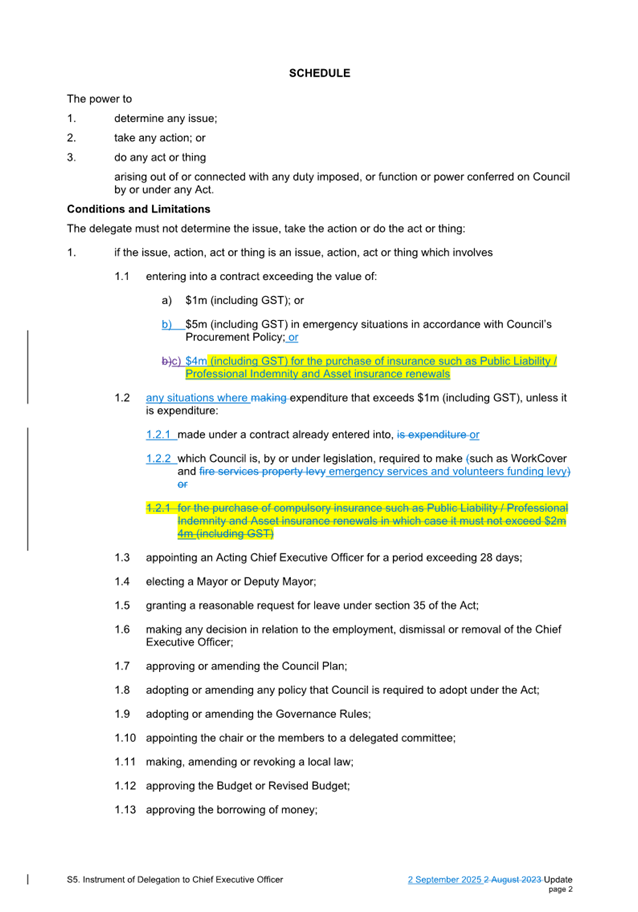
4.25 It is proposed to increase to CEO’s delegated expenditure authority for insurance from $2m to $4m, to align with cost escalation since the previous review.
4.26 Additional wording has been added to the contract variation clause of the policy to provide clarity on Council’s ultimate role and approval considerations.
5. CONSULTATION AND STAKEHOLDERS
5.1 The Procurement & Contract Management Steering Committee has provided strategic input and guidance to ensure that the Policy’s objectives are effectively achieved across all Council’s procurement activities.
5.2 A key component of the PCMSC review has been the internal assurance program, which continuously monitors compliance with the Policy and associated procedures. This includes analysis of trends such as the time taken to progress from a tender award to contract execution, the compliance levels of the requirements to raise purchase orders at the time of engagement, the use of P-Cards for low value, high-volume transactions and the results of the monthly contract audit ‘deep dives’ undertaken for the committee.
5.3 Additionally, feedback forums have played a pivotal role in identifying opportunities to enhance the Policy’s efficiency. Staff and stakeholders have contributed valuable insights into which elements of the Policy support or hinder effective service delivery.
5.4 Finally, recently completed audits undertaken and reviewed by Council’s Audit and Risk Committee.
6. LEGAL AND RISK IMPLICATIONS
6.1 Achieving high levels of probity is an objective of Council’s Procurement Policy. The proposed changes help to ensure that probity remains a focus for how Council spends public funds.
6.2 The proposed changes seek to balance efficiency – having the procurement led and undertaken by those closest to the service that it will deliver – whilst ensuring a high degree of risk mitigation.
6.3 Under the current Policy, there are requirements to ‘seek’ quotations for procurements up to $300k. The proposed changes to the Policy will increase the requirement for competition by requiring a minimum of two quotations to be obtained with at least three sought. This reduces the potential for ineffective quoting processes to undermine probity and value for money.
6.4 Additionally, Council has in place several assurance testing processes to manage probity risk arising from a lack of process adherence or other actions. This includes monthly reporting on key metrics such as purchase orders raised at the time of engagement, contracts being in place, completed probity declarations and conflict-of-interest declarations.
6.5 The Procurement & Contract Management Steering Committee also undertakes sample testing of procurements at varying levels to assess process adherence with a focus on probity and record keeping
6.6 As part of the implementation of the proposed changes to the Procurement Policy, the assurance program will be updated to ensure appropriate sample testing, particularly at the $75k to $300k range, to ensure that the key requirements of the Procurement Policy are being adhered to. This trust and verify approach aims to balance the need for efficiency, to deliver value for money for public expenditure, and maintain the highest standards of probity that our community expects.
7. FINANCIAL IMPACT
7.1 Whilst the proposed changes to the Procurement Policy do not have any direct financial impact, they are intended to help improve efficiency for both undertaking procurement activity but also provide value for money.
7.2 In particular, the proposed sole supplier arrangements will ensure that Council can achieve greater on the ground delivery for infrastructure investment for its expenditure through aggregated volumes and economies of scale.
8. ENVIRONMENTAL IMPACT
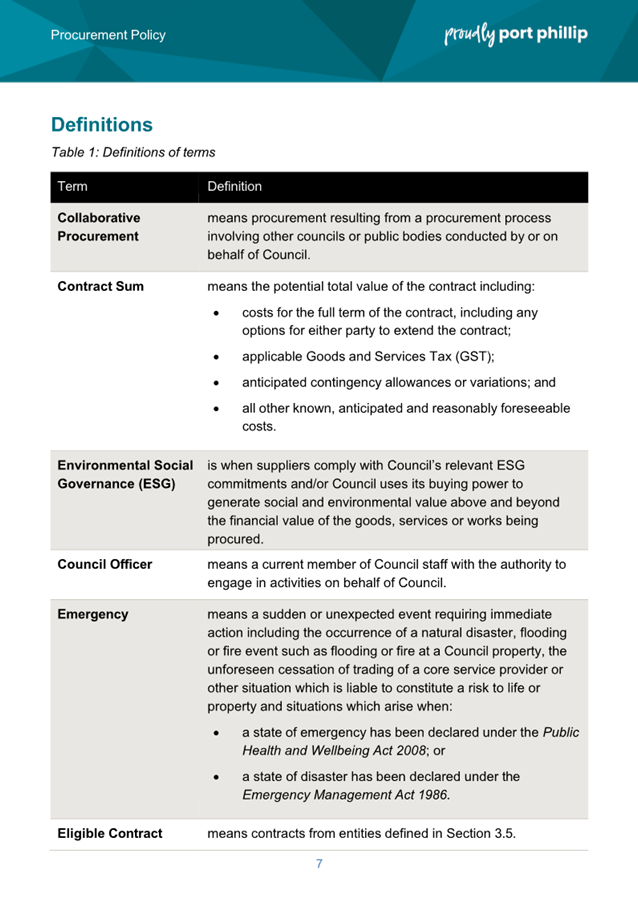
8.1 It is proposed to change the Policy reference from Corporate Social Responsibility (CSR) to Environmental Social Governance (ESG) in keeping with industry wide terminology (Environmental Protection Authority Victoria, Victorian Chamber of Commerce) incorporating unchanged procurement elements of; environmental, social, and local economy.
8.2 Aside from naming consistency, the proposed changes to the Policy will provide greater clarity and focus on achieving ESG outcomes from Council’s various procurement activities.
9. COMMUNITY IMPACT
9.1 The proposed changes are unlikely to have any direct impact on the community.
10. Gender Impact Assessment
10.1 In line with the other updates to ESG commitments in the Policy, the proposed amendments continue Council’s commitment to leverage its expenditure of public funds to further address social issues such as gender equality.
10.2 Under Council’s Policy, procurers are engaged to weight ESG (previously CSR) and to assess prospective suppliers’ commitments to gender equality including through gender pay-gap initiatives, engagement of diverse workforces, anti-family violence commitments and flexible working arrangements.
11. ALIGNMENT TO COUNCIL PLAN AND COUNCIL POLICY
11.1 The Policy supports the Council Plan 2021- 2031.
11.2 Whilst procurement activity supports all of Council’s strategic directions, it most closely aligns with:
· Direction 6 A Trusted and High-Performing Organisation
12. IMPLEMENTATION STRATEGY
12.1 TIMELINE
12.1.1 Subject to Council approval the updated Policy will commence 17 November 2025
12.1.2 The updated Policy will be made available through Council’s website.
12.2 COMMUNICATION
12.2.1 The updated Policy will be made available on Council’s website and the internal intranet.
12.2.2 Council’s corporate systems and supporting documentation including procurement procedures, templates, guidance and training material will be updated.
12.2.3 Council’s internal assurance program, governed by the Procurement & Contract Management Steering Committee will be updated with an increased sample size for the $75 to $300k quoting range implemented.
13. OFFICER MATERIAL OR GENERAL INTEREST
13.1 No officers involved in the preparation of this report have any material or general interest in the matter.
|
ATTACHMENTS |
1. Procurement Policy Version 6.4.1⇩ |
Meeting of the Port Phillip City Council
2 September 2025
|
Review of Council's Delegations to the Chief Executive Officer and Delegated Committee |
|
|
Executive Member: |
Robyn Borley, Director, Governance and Organisational Performance |
|
PREPARED BY: |
Katrina Collins, Senior Governance Advisor |
1. PURPOSE
1.1 To present to Council the delegations from Council to the Chief Executive Officer and Delegated Committees, which are required to be reviewed within 12 months following a general election.
2. EXECUTIVE Summary
2.1 In accordance with Section 11(7) of the Local Government Act 2020 (the Act) Council must review, within the period of 12 months after a general election, all delegations which have been made under this section and are still in force. The general election was held on 26 October 2024.
2.2 This report presents the following to Council for consideration:
2.2.1 Instrument of Delegation from Council to the CEO (Attachment 1)
2.2.2 Instrument of Delegation from Council to the CEO – South Melbourne Market (Attachment 2)
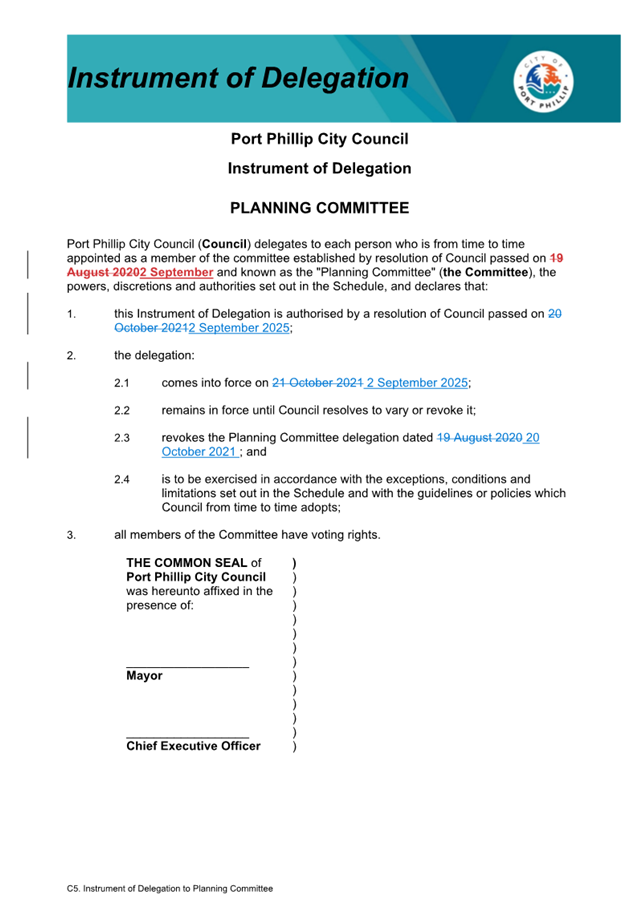
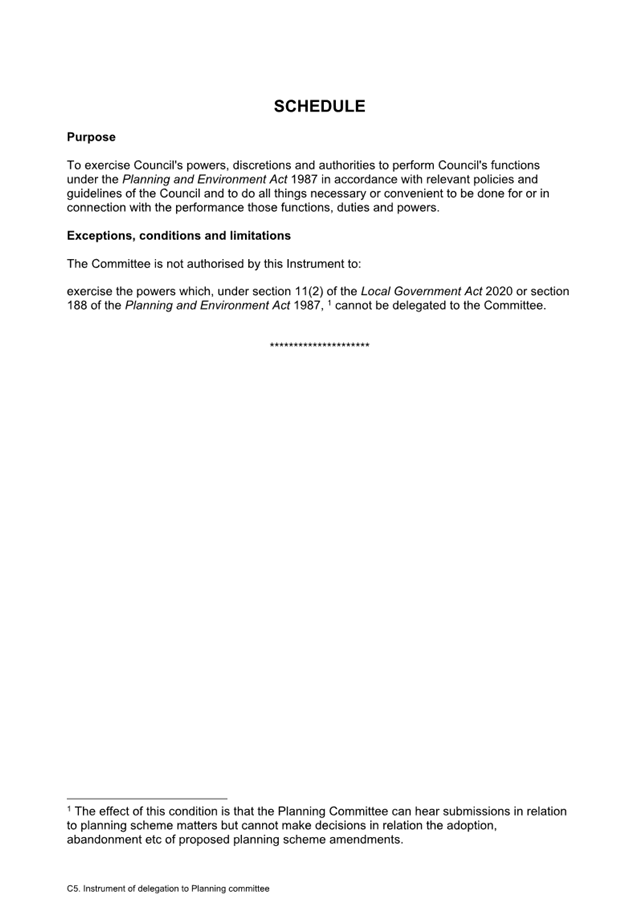
2.2.3 Instrument of Delegation from Council to Planning Committee (Attachment 3)
2.3 These Instruments of Delegation are based on ‘model delegations’ provided by and regularly updated by Maddocks lawyers. This format of delegations is used extensively by Councils across the local government sector.
|
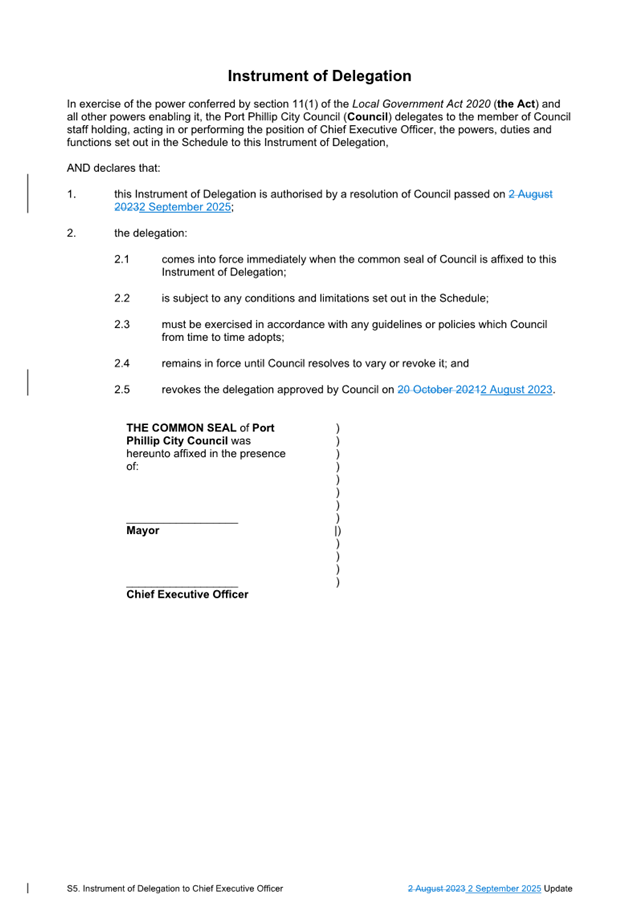
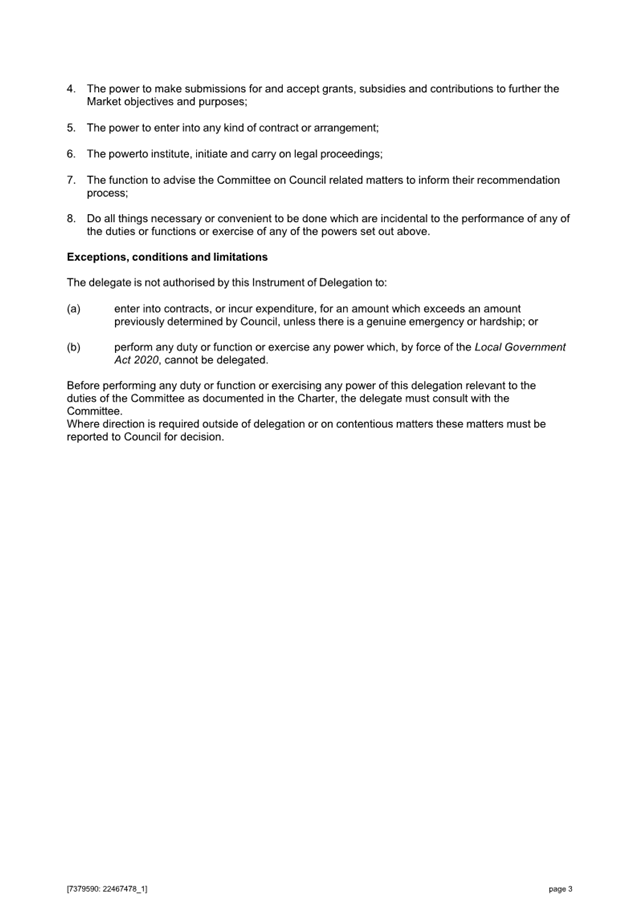
That Council: 3.1 Notes the review of delegations from Council to the Chief Executive Officer and Delegated Committees that are currently in place under various Acts and Regulations, and which are required to be reviewed pursuant to the Local Government Act 2020; 3.2 Delegates to the Chief Executive Officer the powers, duties and functions set out in the following Instruments of Delegation: 3.2.1 Instrument of Delegation from Council to the Chief Executive Officer (Attachment 1) 3.2.2 Instrument of Delegation from Council to the Chief Executive Officer – South Melbourne Market (Attachment 2) 3.3 Delegates to the members of the Planning Committee the powers, duties and functions set out in the Instrument of Delegation (Attachment 3). 3.4 Affixes the common seal of Council to the above Instruments (Attachments 1-3). 3.5 Notes: 3.5.1 these Instruments come into force immediately upon resolution; and 3.5.2 remain in force until Council determines to vary or revoke them. 3.6 Notes that on the coming into force of the Instruments (Attachments 1-3), the previous Instruments of Delegation are revoked: 3.6.1 Instrument of Delegation from Council to the Chief Executive Officer – 2 August 2023 3.6.2 Instrument of Delegation from Council to the Chief Executive Officer – South Melbourne Market - 19 July 2023 3.6.3 Instrument of Delegation Council to Planning Committee - 20 October 2021 3.7 Notes that the duties and functions set out in the instruments must be performed, and the powers set out in the instruments must be executed, in accordance with any policies of Council that it may from time to time adopt. |
4. KEY POINTS/ISSUES
4.1 Council
is required by the Act (Section 11(7)) to conduct a review of its delegations
to members of Council staff
(including the CEO) and to Delegated Committees within
12 months of a general election.
4.2 The Act provides for a Council to delegate a power, duty, or function to a member of Council staff, enabling them to act on behalf of the Council. As a legal entity composed of Councillors, the Council is not a “natural person” and can only act in one of two ways: either by resolution at a Council meeting or through others acting on its behalf as delegates. Given the impracticality of Council addressing all day to day matters directly, many operational decisions and actions are carried out by staff under delegation from Council.
4.3 The following delegations were reviewed after the 2020 general elections and came into force by Council resolution on 20 October 2021.
4.4 Delegation to the Chief Executive Officer (CEO)
4.4.1 The Instrument of Delegation enables the CEO to perform the role of a CEO, and empowers the further delegation of powers, duties and functions to members of Council staff. This delegation from Council to the CEO has since been endorsed by Council with minor amendments on 2 August 2023.
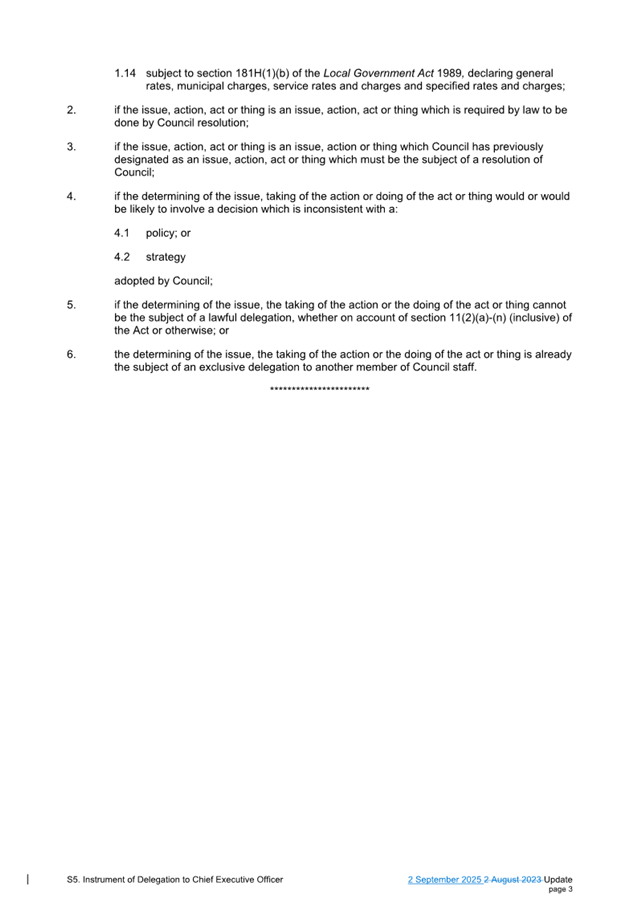
4.4.2 The delegation from Council to the CEO is subject to detailed conditions and limitations which restrict the CEO from acting in certain circumstances, as set out in the Schedule. For example, the CEO must not make decisions on a matter which Council has resolved that the matter must be determined by a Council resolution. Other limitations on the power of the CEO include not making local laws, not adopting the Budget or Council Plan, and not returning a general or supplementary revaluation. Where the CEO’s power has been limited in the delegation, these functions must be exercised by the Council as the subject of a Council resolution.
4.4.3 This report proposes two changes to this delegation:
4.1.3.1 It proposes an increase to the value of expenditure for the purchase of insurance such as public liability, professional indemnity and asset insurance.
4.1.3.2 The expected date of this Council resolution (Attachment 1).
4.4.4 South Melbourne Market
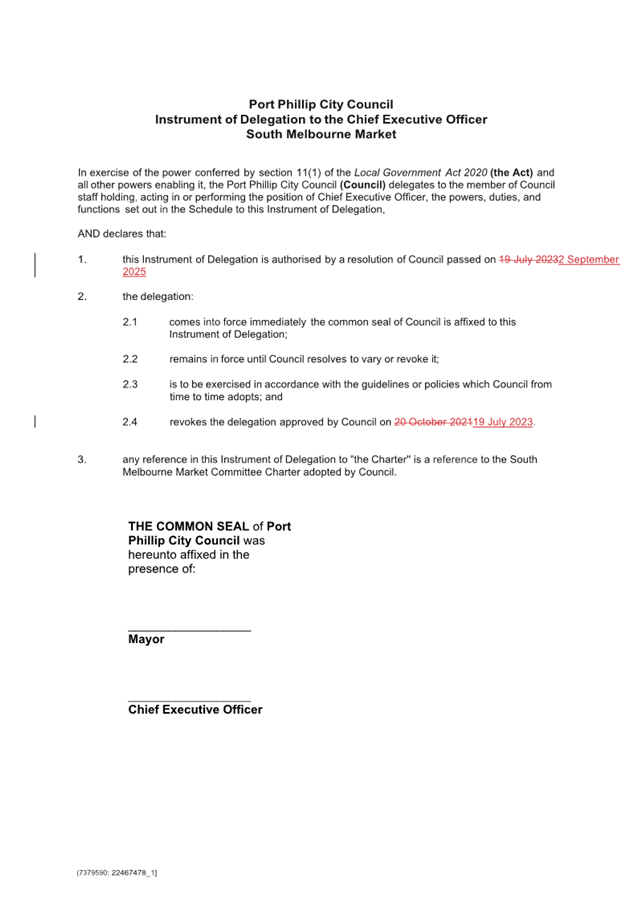
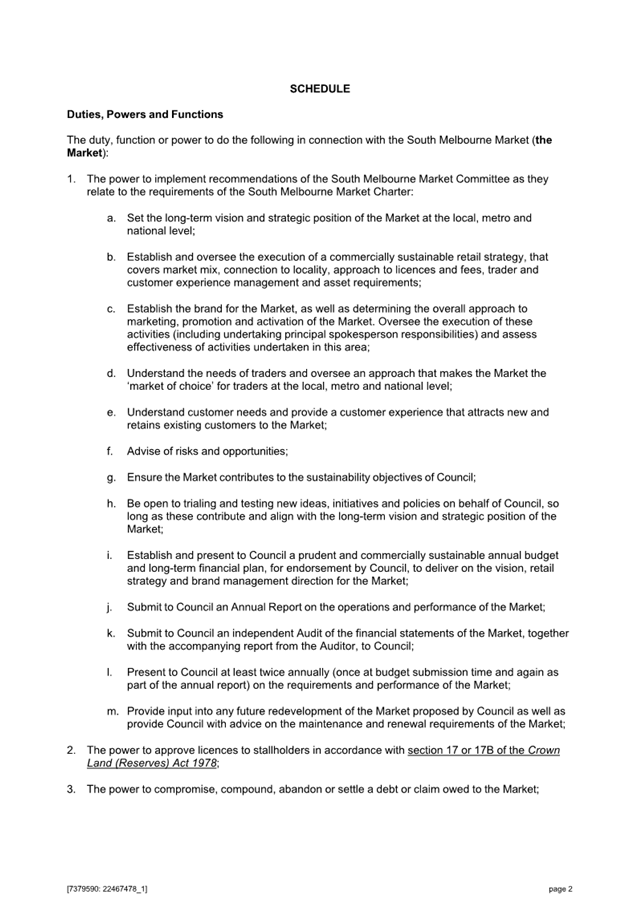
At its meeting of 2 September 2020, Council transitioned the South Melbourne Market Committee from a delegated committee under the 1989 Local Government Act to an Advisory Committee of Council, and delegated to the Chief Executive Officer the powers, duties and functions set out in the Instrument of Delegation. The current delegation from Council to the CEO - South Melbourne Market was endorsed by Council with minor amendments on 19 July 2023.
The only change proposed to this delegation is the expected date of this Council resolution (Attachment 2).
4.5 Delegation to Committees
Council established the Statutory Planning Committee on 25 June 1997 for the purpose to exercise Council’s powers, duties and functions under the Planning and Environment Act 1987 in accordance with relevant policies and guidelines of the Council. The Statutory Planning Committee comprises all Councillors and meets monthly. It is charged with the authority to deal with statutory planning matters only. The current delegation to the Committee was endorsed by Council on 20 October 2021.
Attachment 3 is a general delegation of Council’s powers, duties and functions under the Planning and Environment Act 1987 to the Statutory Planning Committee. The only change proposed to this delegation is the expected date of this Council resolution.
5. CONSULTATION AND STAKEHOLDERS
5.1 The instruments of delegation are statutory documents under the Local Government Act 2020 and is based on information supplied by Maddocks Lawyers.
5.2 The attached Instruments have been prepared in consultation with relevant Council officers.
6. LEGAL AND RISK IMPLICATIONS
6.1 Delegations reflect the powers, duties and functions that can be delegated under a wide range of Acts and Regulations and are essential to enable the day to day operations of the Council to be performed.
6.2 The proposed delegations contain exceptions, conditions and limitations which must be adhered to by the delegate.
6.3 This review of delegations confirms Council’s compliance with section 11 the Local Government Act 2020.
7. FINANCIAL IMPACT
7.1 The Instruments of Delegation are consistent with the financial delegations included in Council’s Procurement Policy.
8. ENVIRONMENTAL IMPACT
8.1 There are no environmental impacts arising from this report.
9. COMMUNITY IMPACT
Accurate and accessible instruments of delegation assist the community to:
9.1 Ensure decision making by Council is transparent and understandable.
9.2 Ensure decision making is conducted in accordance with the principles of procedural fairness and good governance.
9.3 Ensure decision making is made in a safe and respectful environment.
10. Gender Impact Assessment
10.1 In the preparation of this report a Gender Impact Assessment (GIA) in accordance with the Gender Equality Act 2020 was not required.
11. ALIGNMENT TO COUNCIL PLAN AND COUNCIL POLICY
11.1 This report supports Strategic Direction 5 of the Plan for Port Phillip – An Engaged and Empowered Community, by providing a transparent and responsible approach to decision making.
12. IMPLEMENTATION STRATEGY
12.1 TIMELINE
12.1.1 Delegations will apply with immediate effect.
12.2 COMMUNICATION
12.2.1 Under section 11 (8) of the Local Government Act 2020, and according with Council’s Public Transparency Policy, a Register of Delegations must be maintained and made publicly available on Council’s website.
12.2.2 Notification of endorsed changes will be circulated to all council staff.
13. OFFICER MATERIAL OR GENERAL INTEREST
13.1 No officers involved in the preparation of this report has declared a material or general interest in the matter.
|
ATTACHMENTS |
1. Instrument of Delegation - Council to CEO⇩ 2. Instrument of Delegation - Council to CEO - South Melbourne Market⇩ 3. Instrument of Delegation - Council to Planning Committee⇩ |
Meeting of the Port Phillip City Council
2 September 2025
|
Appointment of Authorised Officer Pursuant to the Planning and Environment Act 1987 |
|
|
Executive Member: |
Robyn Borley, Director, Governance and Organisational Performance |
|
PREPARED BY: |
Katrina Collins, Senior Governance Advisor |
1. PURPOSE
1.1 For Council to approve the two appointments of Council staff as Authorised Officers pursuant section 147(4) of the Planning and Environment Act 1987. (Attachment 1).
2. EXECUTIVE Summary
2.1 In accordance with the Planning and Environment Act 1987 (the Act), Council is required to authorise officers for the purpose of enforcing the provisions of the Act.
2.2 It is proposed to appoint the Council staff detailed in Attachment 1 as Authorised Officers pursuant to Section 147(4) of the Act.
|
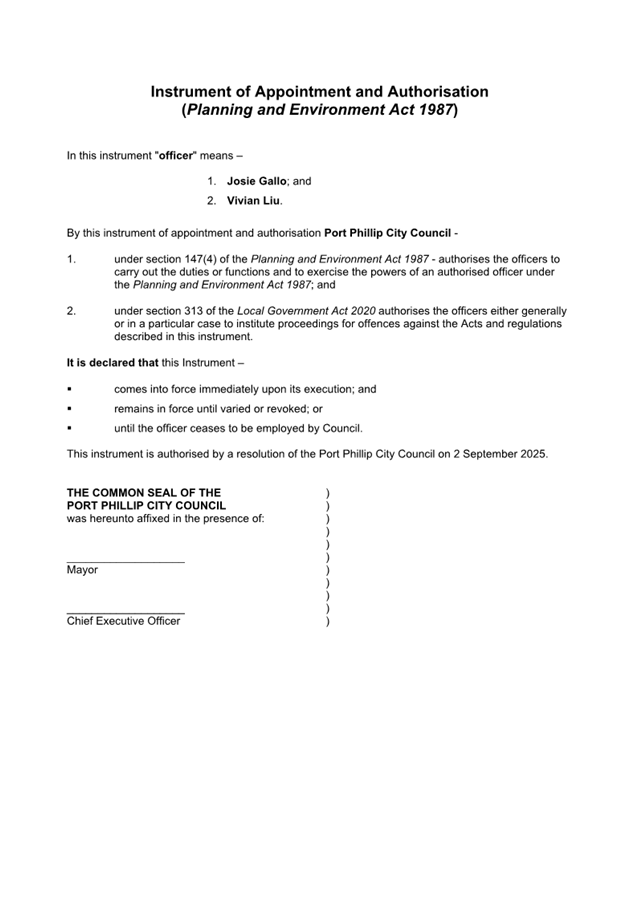
In the exercise of the powers conferred by section 147(4) of the Planning and Environment Act 1987 Council resolves that: 3.1 The members of Council staff referred to in the Instrument of Appointment and Authorisation at Attachment 1 be appointed and authorised as set out in the Instrument. 3.2 The Instrument of Appointment and Authorisation comes into force immediately once the common seal of Council is affixed to the Instrument and remains in force until Council determines to vary or revoke it. 3.3 The Instrument of Appointment and Authorisation be sealed. |
4. KEY POINTS/ISSUES
4.1 Council routinely appoints Council staff as Authorised Officers. Typically, they are directly appointed by the Chief Executive Officer through the power of delegation conferred through the S5 Instrument of Delegation.
4.2 Section 188 (2)(c) of the Planning and Environment Act 1987 does not allow this function to be delegated to the Chief Executive Officer. The Act specifically requires that Council staff be appointed by resolution of the Council.
4.3 Council subscribes to the Maddocks Authorisation and Delegations Service, and relevant advice has been considered in the preparation of this report and the Instrument of Appointment and Authorisation.
4.4 This report is being presented to Council due to the onboarding of two officers within the compliance team who require powers to carry out their duties as mandated by the Act. These powers include issuing planning certificates, serving a planning infringement notice and power to enter land under the Planning and Environment Act 1987, as well as instituting proceedings under the Local Government Act 2020.
5. CONSULTATION AND STAKEHOLDERS
5.1 Council subscribes to the Maddocks Authorisations and Delegations Service, which provides advice regarding legislative amendments to instruments of delegation and authorisation templates.
6. LEGAL AND RISK IMPLICATIONS
6.1 The Instrument of Authorisation prepared is based on the latest Instrument and Authorisation template version supplied by Maddocks Lawyers.
6.2 It is essential that relevant Council staff have the proper authorisation required under the Planning and Environment Act 1987 to enable them to undertake their responsibilities.
6.3 Section 188(2)(c) of the Planning and Environment Act 1987 provides that a responsible authority cannot delegate the power to authorise officer under the Act.
7. FINANCIAL IMPACT
7.1 There are no financial implications as a direct result of this report.
8. ENVIRONMENTAL IMPACT
8.1 There are no environmental implications as a direct result of this report.
9. COMMUNITY IMPACT
9.1 There are no community impact implications as a direct result of this report.
10. Gender Impact Assessment
10.1 A Gender Impact Assessment was not required.
11. ALIGNMENT TO COUNCIL PLAN AND COUNCIL POLICY
11.1 This report supports Strategic Direction 5 of the Plan for Port Phillip – An Engaged and Empowered Community, by providing a transparent and responsible approach by ensuring Council meets its statutory obligations.
12. IMPLEMENTATION STRATEGY
12.1 TIMELINE
12.1.1 The Instrument of Appointment and Authorisation pursuant to the Planning and Environment Act 1987 will be effective immediately upon execution under the Seal of Council.
12.2 COMMUNICATION
12.2.1 Pursuant to section 224(1A) of the Local Government Act 1989 Council must maintain a register that shows the names of all Council staff appointed to be authorised officers.
12.2.2 Additionally, sections 224(2) and (4) require authorised officers to be issued with an identity card which must be produced upon being requested to do so.
13. OFFICER MATERIAL OR general INTEREST
13.1 No officers involved in the preparation of this report has declared a material or general interest in the matter.
|
ATTACHMENTS |
1. S11A Instrument of Appointment - P&E Act - Josie Gallo and Vivian Liu _September 2025⇩ |
Meeting of the Port Phillip City Council
2 September 2025
14. A Trusted and High Performing Organisation
Nil
15. Notices of Motion
Nil
16. Reports by Councillor Delegates
17. Urgent Business
18.1 South Melbourne Town Hall - Contract Variation........................................... 173
RECOMMENDATION
That Council resolves to move into confidential to deal with the following matters pursuant to section 66(2) of the Local Government Act 2020:
18.1 South Melbourne Town Hall - Contract Variation
3(1)(a). Council business information, being information that would prejudice the Council's position in commercial negotiations if prematurely released.
Reason: This report contains contractural information, including project and construction contract contingency provisions, that if released at this time would disadvantage Council in its ability to manage its contruction contract in the best interests of the community.
18.2 71A Acland Street – Expression of Interest Process
3(1)(e). legal privileged information, being information to which legal professional privilege or client legal privilege applies
3(1)(a). private commercial information, being information provided by a business, commercial of financial undertaking that if released, would unreasonably expose the business, commercial or financial undertaking to disadvantage
Reason: This report outlines the details of a recently completed procurement process which contains confidential commercial information that if released would prejudice commercial businesses and Council. The report also includes confidential legal and probity advice in relation to the procurement and property management information
18.3 CEO Employment Matters – 2024/25 Performance Assessment and 2025/26 Annual Performance Agreement
3(1)(f). personal information, being information which if released would result in the unreasonable disclosure of information about any person of their personal affairs
Reason: Under the CEO Employment and Remuneration Policy, Section 16 - Confidentiality, Council does not disclose any personal information, being information which if released would result in the unreasonable disclosure of information about any person or their personal affairs. The CEO's performance and remuneration fall into that category.