Meeting of the Port Phillip City Council
6 May 2026
|
Welcome Welcome to this Meeting of the Port Phillip City Council. Council Meetings are an important way to ensure that your democratically elected representatives are working for you in a fair and transparent way. They also allow the public to be involved in the decision-making process of Council.
About this meeting There are a few things to know about tonight’s meeting. The first page of tonight’s Agenda itemises all the different parts to the meeting. Some of the items are administrative and are required by law. In the agenda you will also find a list of all the items to be discussed this evening. Each report is written by a Council officer outlining the purpose of the report, all relevant information and a recommendation. Council will consider the report and either accept the recommendation or make amendments to it. All decisions of Council are adopted if they receive a majority vote from the Councillors present at the meeting. |
Public Question Time and Submissions Provision is made at the beginning of the meeting for general question time from members of the public. All contributions from the public will be heard at the start of the meeting during the agenda item 'Public Questions and Submissions.' Members of the public have the option to either participate in person or join the meeting virtually via Teams to ask their questions live during the meeting. If you would like to address the Council and /or ask a question on any of the items being discussed, please submit a ‘Request to Speak form’ by midday on the day of the meeting via Council’s website: Request to speak at a Council meeting - City of Port Phillip |
|
|
|
|
Meeting of the Port Phillip City Council |
To Councillors
Notice is hereby given that a Meeting of the Port Phillip City Council will be held in St Kilda Town Hall and Virtually via Teams on Wednesday, 6 May 2026 at 6:30 PM. At their discretion, Councillors may suspend the meeting for short breaks as required.
AGENDA
1 APOLOGIES
2 MINUTES OF PREVIOUS MEETINGS
Minutes of the Meeting of the Port Phillip City Council 22 April 2026,
Minutes of the Special Meeting of the Port Phillip City Council 29 April 2026.
3 Declarations of Conflicts of Interest
4 Public Question Time and Submissions
5 Councillor Question Time
6 Petitions, Joint Letters & Deputations
Nil
7 Presentation of CEO Report
Nil
8 A Healthy and Connected Community........................................................... 5
8.1 Community Grants Program 2026/27................................................................. 6
9 An Environmentally Sustainable and Resilient City
Nil
10 A Safe and Liveable City.................................................................................... 73
10.1 Proposed Local Law Amendment and VicPol Protocol.................................... 74
10.2 8 Carlisle Street, 3, 5 and 9 Havelock Street, and 3 Albert Street, St Kilda (Cosmopolitan Hotel) – Council Response to DTP Notice of Draft Planning Scheme Amendment C230port and Planning Permit Application..................................................................... 210
11 A Vibrant and Thriving Community
Nil
12 An Engaged and Empowered Community.................................................. 300
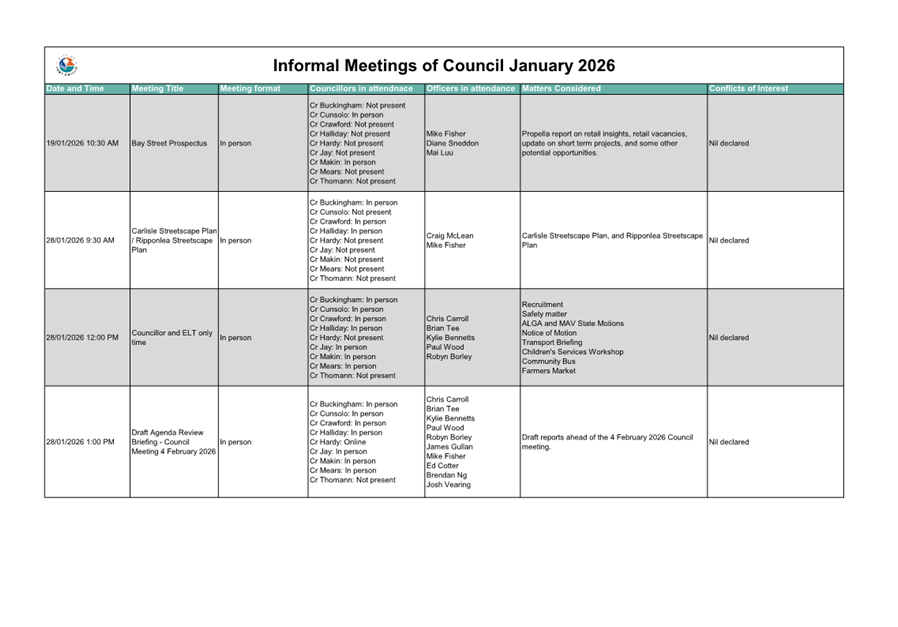
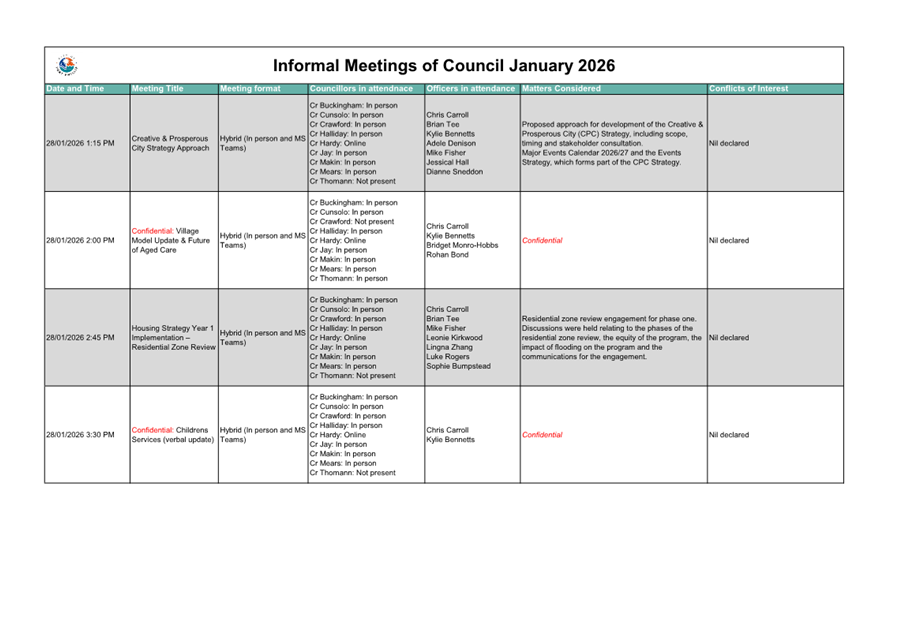
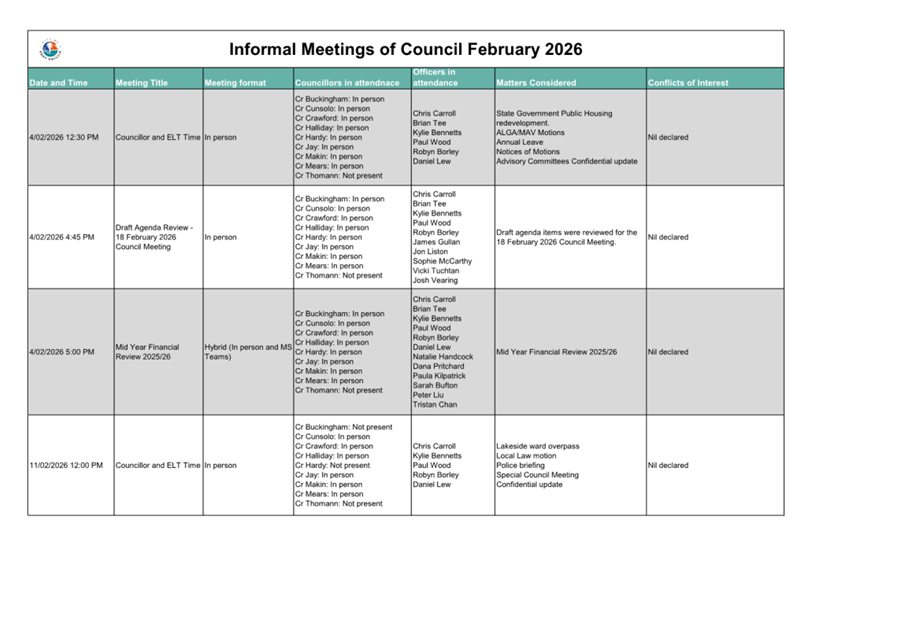
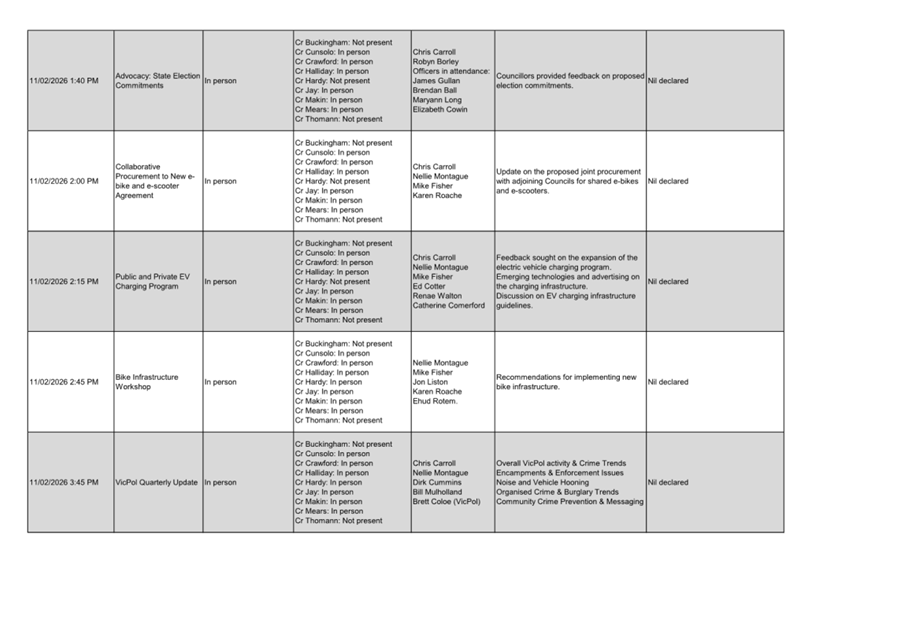
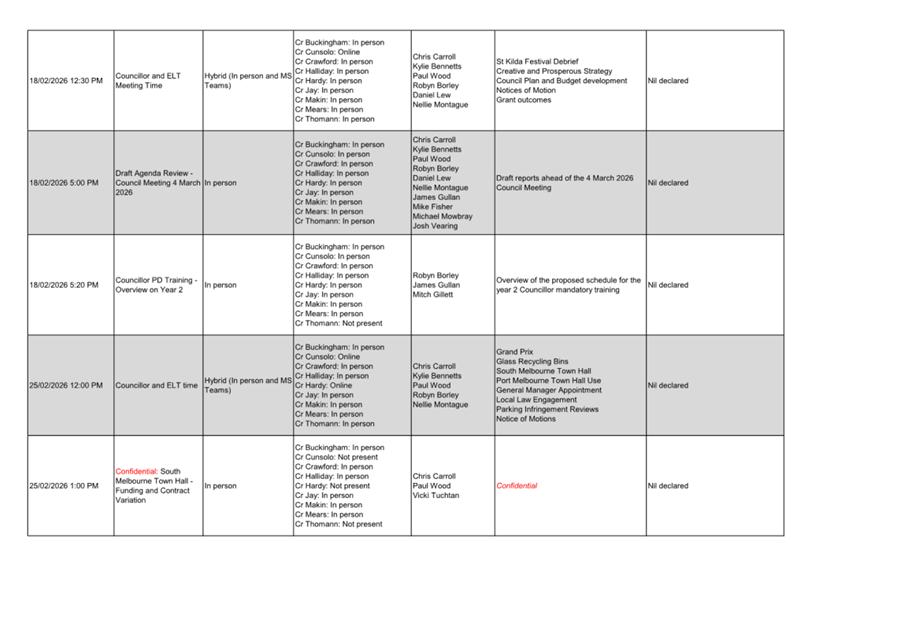
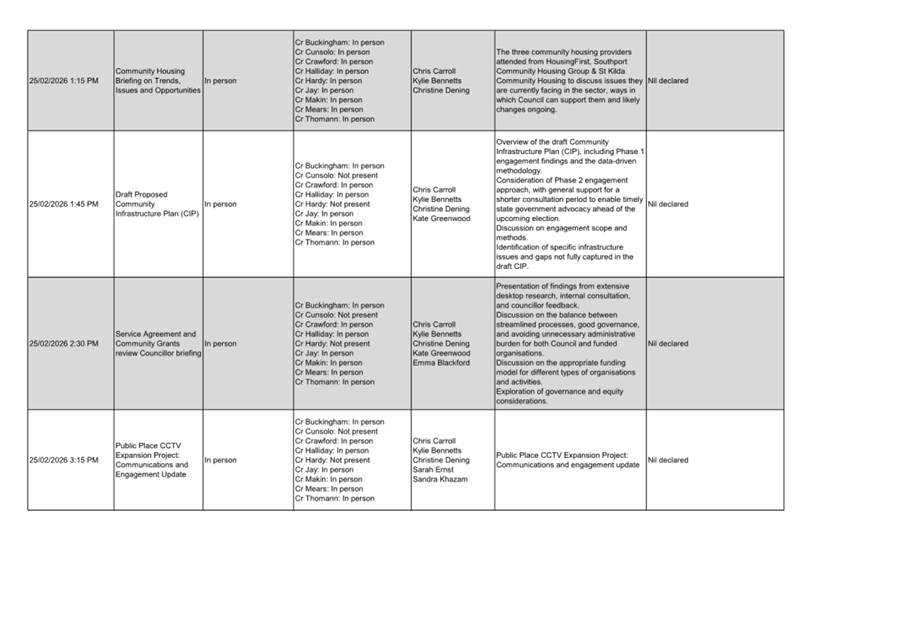
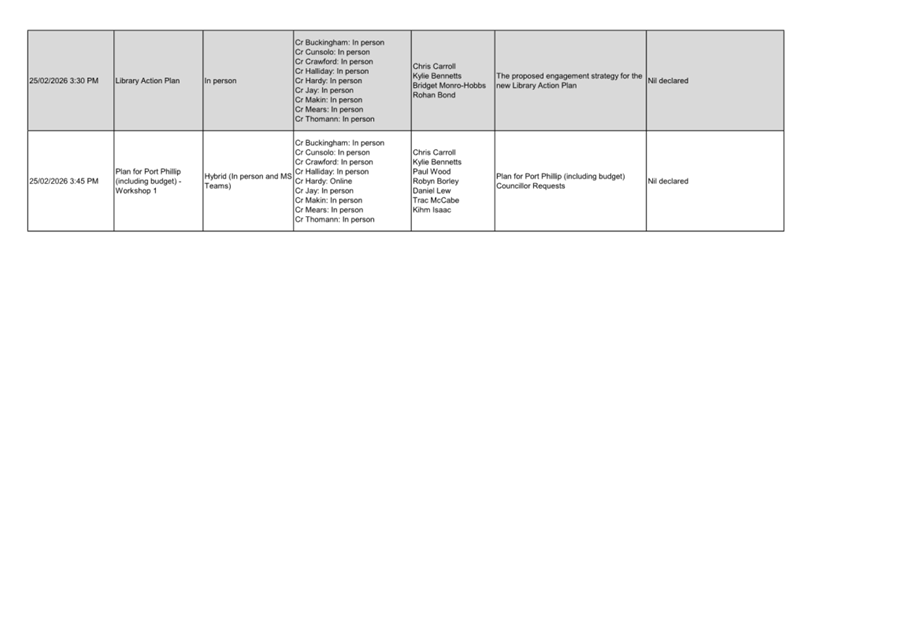
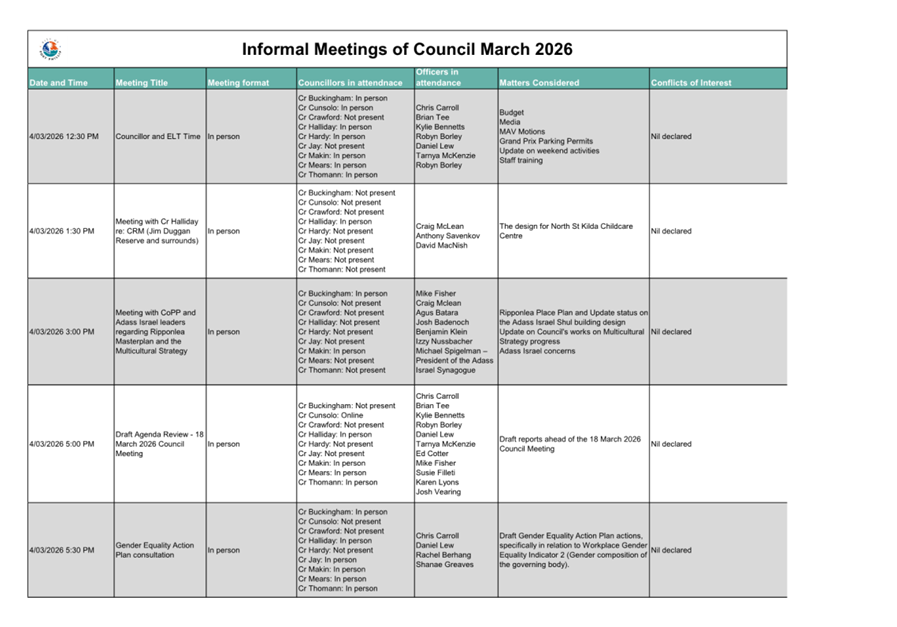
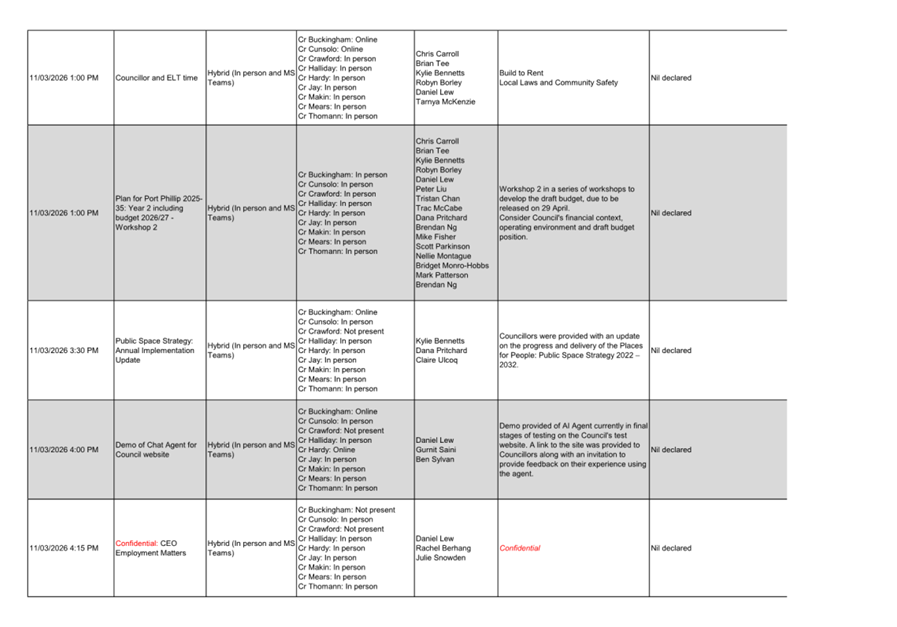
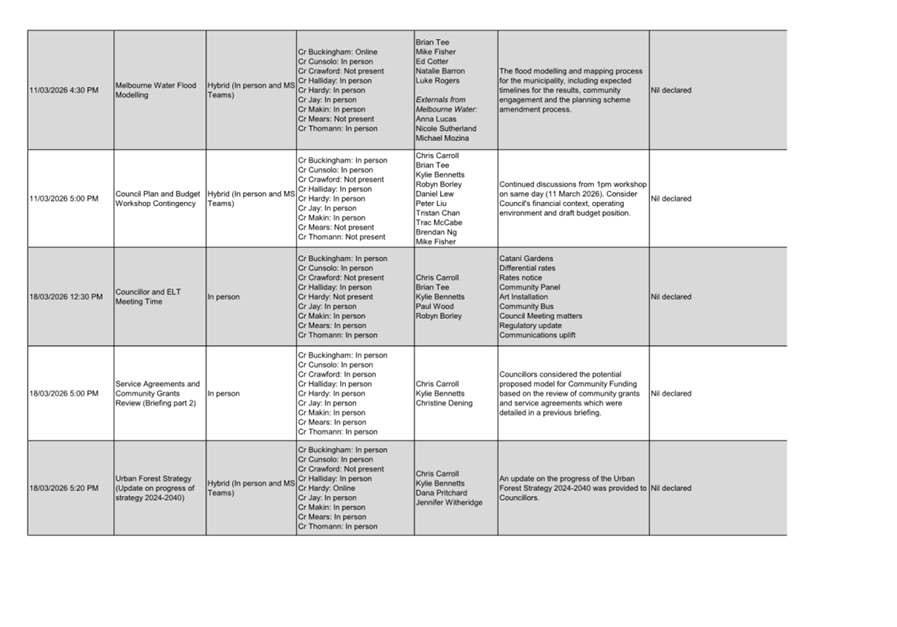
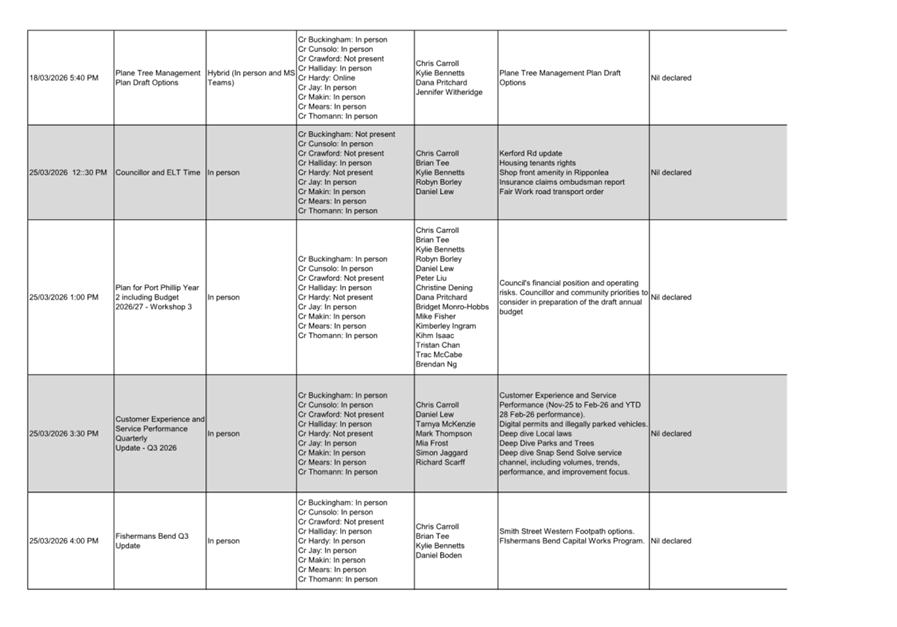
12.1 Quarterly reporting of Records of Informal Meetings of Council - 1 January - 31 March 2026 301
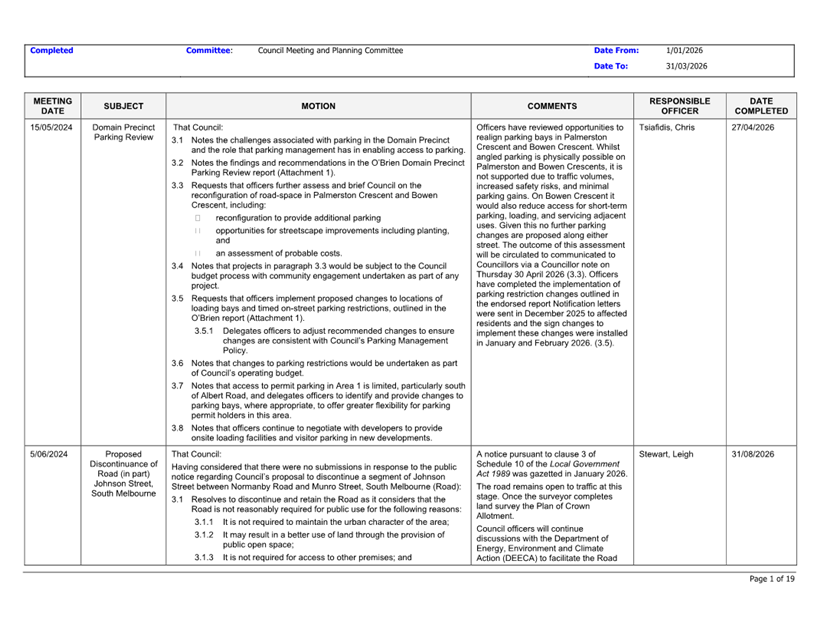
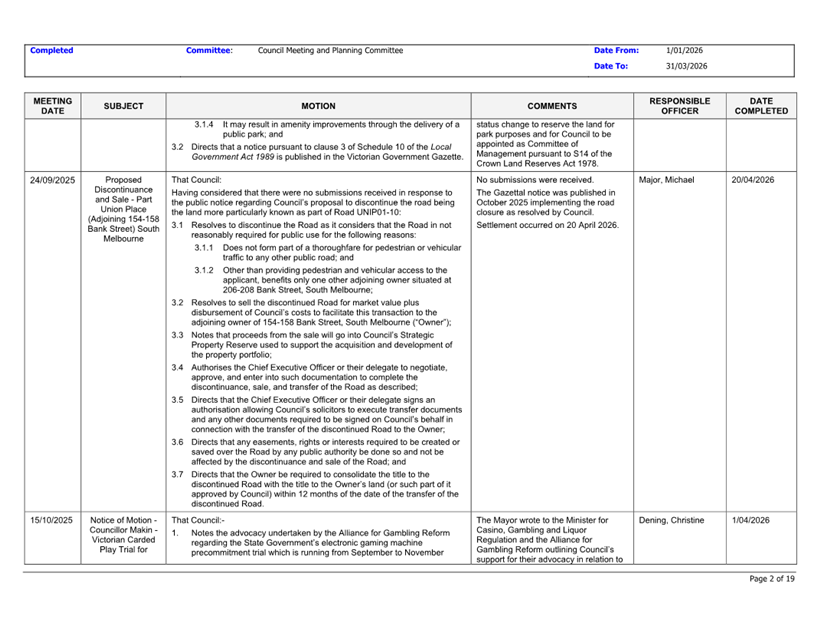
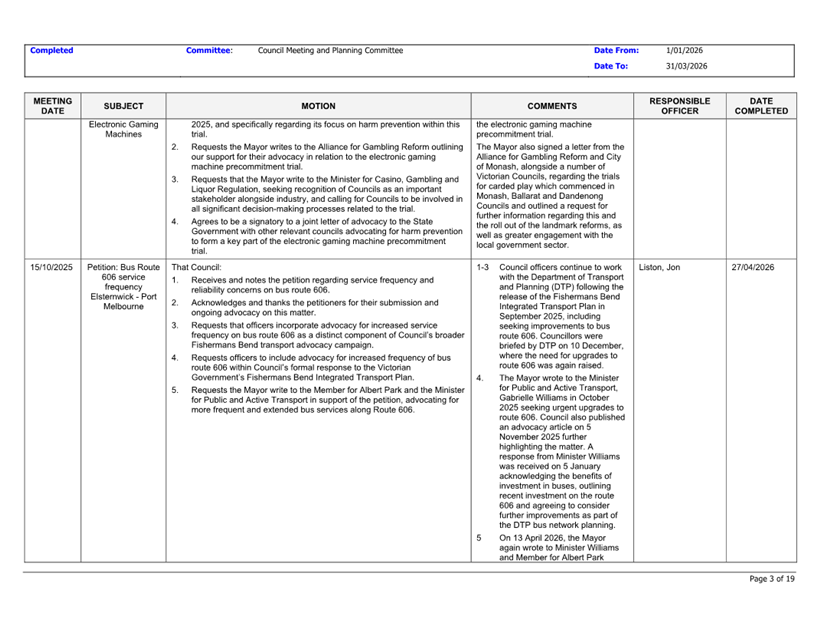
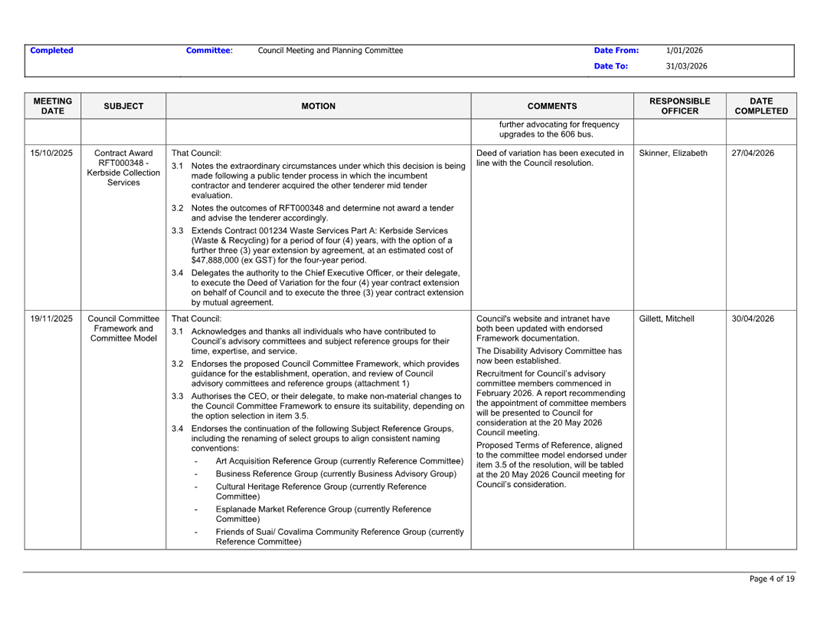
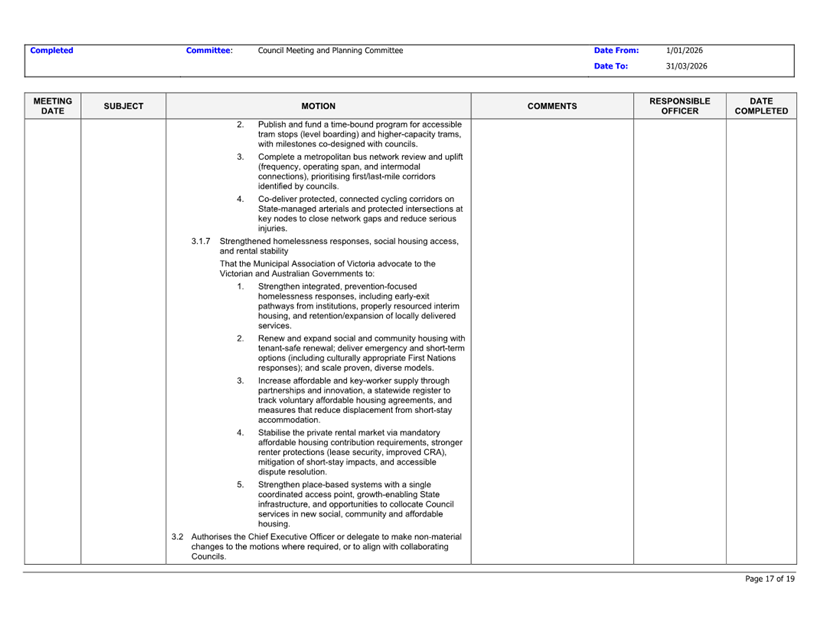
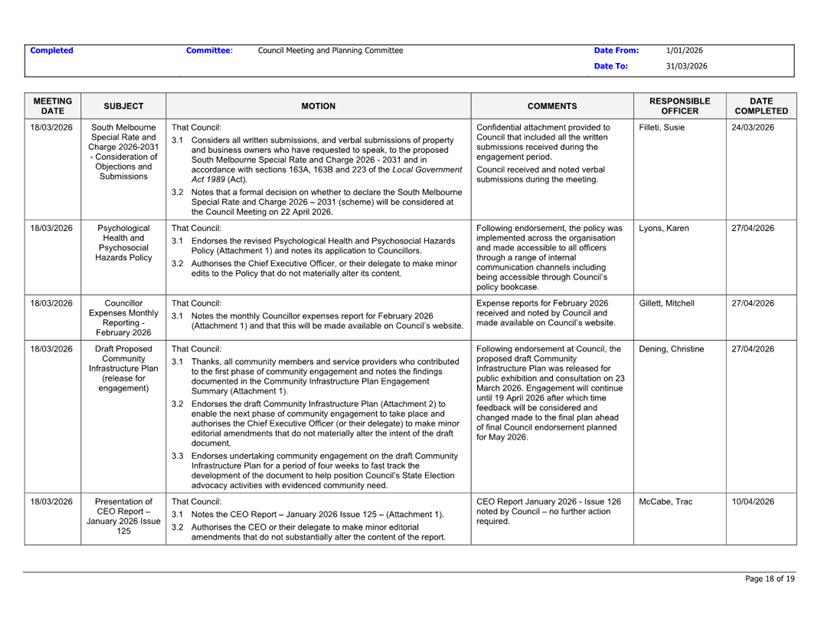
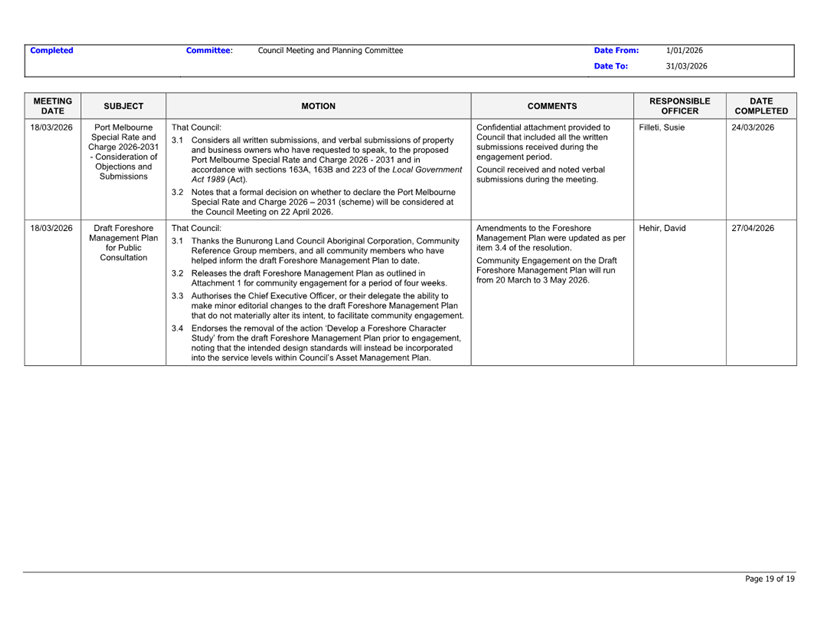
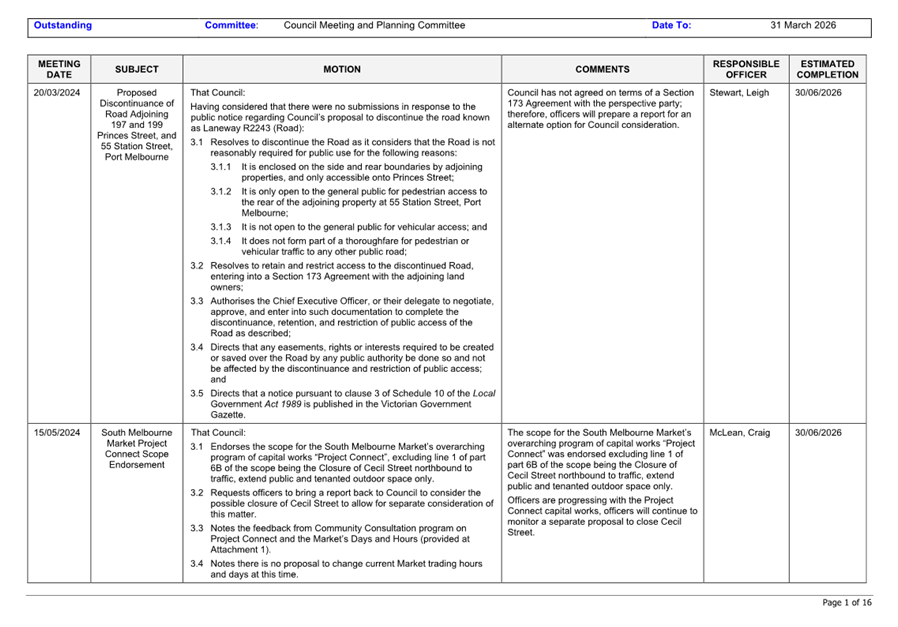
12.2 Status of Council Decisions and Questions taken on Notice Recorded by Council: 1 January to 31 March 2026................................................................................................ 315
13 A Trusted and High Performing Organisation
Nil
14 Notices of Motion
Nil
15 Reports by Councillor Delegates
16 URGENT BUSINESS
17 Confidential Matters
Nil
1. Apologies
2. Minutes of Previous Meetings
|
That the minutes of the Meeting of the Port Phillip City Council held on 22 April 2026 be confirmed. |
|
That the minutes of the Special Meeting of the Port Phillip City Council held on 29 April 2026 be confirmed. |
3. Declarations of Conflicts of Interest
4. Public Question Time and Submissions
5. Councillor Question Time
6. Petitions, Joint Letters & Deputations
Nil
7. Presentation of CEO Report
Nil
8. A Healthy and Connected Community
8.1 Community Grants Program 2026/27................................................................. 6
Meeting of the Port Phillip City Council
6 May 2026
|
Community Grants Program 2026/27 |
|
|
Executive Member: |
Kylie Bennetts, General Manager, Community Wellbeing |
|
PREPARED BY: |
Disa Linden-Perlis, Coordinator Community & Social Planning Emma Blackford, Team Leader Grants and Funding Christine Dening, Manager Community Building and Inclusion |
1. PURPOSE
1.1 To seek Council endorsement of the annual Community Grants Program (inclusive of Quick Response) grant categories and funding allocation for delivery in the 2026/27 financial year.
2. EXECUTIVE Summary
2.1 Council delivers a number of competitive grant programs to support community‑led initiatives that respond to local needs and strengthen community participation.
2.2 The Community Grants Program is delivered annually and provides financial support to eligible not‑for‑profit organisations and community groups to deliver projects and activities that promote social connection, inclusion, access and health and wellbeing. The program supports initiatives that address existing and emerging community needs, strengthen local capacity, and reduce barriers to participation.
2.3 The Community Grants Program has historically comprised four grant categories being Program Support, Diversity and Ageing Support, Social Inclusion Partnerships and Community Strengthening.
2.4 The Quick Response Grant Program provides small grants at short notice to eligible organisations and individuals. The grants support the establishment and delivery of valuable services, programs, activities, and events to the City of Port Phillip community.
2.5 The Community Grants Program has a total funding allocation of $285,000 for Program Support, Social Inclusion Partnerships and Community Strengthening categories. An additional $22,745 is allocated towards Diversity and Ageing grants. The Quick Response Grants Program has a total annual funding allocation of $20,000.
2.6 This report seeks Council endorsement to retain the four existing Community Grants Program categories and introduce an additional program category as part of the Quick Response Grants for the 2026/27 financial year to support informal and unincorporated community groups to access small‑scale funding.
2.7 The report also seeks Council endorsement of the introduction of a requirement for all City of Port Phillip Community Grants applicants to sign up to the Victorian State Government’s Social Inclusion Values Statement as a condition of funding. Finally, the report provides information about of a number of operational refinements to improve program accessibility, governance and inclusivity for the Community Grants Program.
2.8 These changes respond to priority findings from Council’s 2025 review of the Community Grants Program; remaining review recommendations will be progressed through further work and engagement during 2026/27 and brought to Council in a future report.
|
That Council: 3.1 Approves the delivery of the Community Grants Program for the 2026/27 financial year. 3.2 Approves the 2026/27 Community Grants Program budget allocation of $285,000 across four grant categories: o Community Strengthening grants of up to $10,000 o Social Inclusion Partnerships grants of up to $5,000 o Program Support grants of up to $1,000 o Quick Response Grants of up to $2,000 3.3 Approves the 2025/27 Community Grants budget allocation of $22,745 towards the Diversity and Ageing grants of up to $1,000. 3.4 Approves the 2026/27 Quick Response Grants budget allocation of $20,000 across three grant categories: o Quick Response Grants for individuals of up to $500 o Quick Response Grants for Community Organisations and Social Enterprises of up to $2,000. o Quick Response Grants for unincorporated Community groups of up to $750. 3.5 Endorses the introduction of a requirement for all City of Port Phillip Community Grants applicants to sign up to the Victorian State Government’s Social Inclusion Values Statement as a condition of funding. 3.6 Notes that operational changes will be introduced as part of the 2026/27 grant round to improve program accessibility, inclusivity and governance. |
4. KEY POINTS/ISSUES
Background
4.1 The Community Grants Program and Quick Response Grants operate under Council’s Community Funding Policy (Attachment 1) which provides a strategic and transparent framework for the allocation of Council funding to community organisations and groups. The policy ensures that funded activities align with Council Plan objectives, demonstrate value for money, and deliver clear community benefit.
4.2 Council has historically delivered thirteen competitive grant types across five primary funding programs each year, with the composition and availability of grant categories informed by Council Plan priorities, annual budget considerations, legislative and policy settings, identified community needs, and the outcomes of program reviews and evaluation processes.
4.3 This report distinguishes between ‘community grants’, which refers to the overall range of grant programs administered by Council, and the ‘Community Grants Program’, which is a specific annual program supporting community‑led initiatives focused on social connection, inclusion and health and wellbeing.
Community Grants Program
4.4 The Community Grants Program is the principal mechanism for supporting community‑led initiatives focused on social connection, inclusion and wellbeing.
Community grants aim to support projects and activities that:
· Identify and respond to existing and emerging community needs
· Strengthen the capacity of local community organisations and networks
· Promote social connection and participation in community life
· Address health and wellbeing inequities
· Enable access, inclusion and participation for diverse communities
· Support sustainability initiatives and innovation
4.5 The Community Grants Program has a total funding allocation of $285,000 towards Program Support (categories 1), Social Inclusion Partnership (category 3) and community strengthening (category 4). An additional $22,745 is allocated towards the Diversity and Ageing (Category 2). The proposed grant categories for the 2026/27 Community Grants Program are:
|
Category |
Purpose |
Maximum funding per project |
New or existing |
|
Category 1: Program Support
|
Supports small groups in initiating and running activities.
|
$1,000
|
existing |
|
Category 2. Diversity and Ageing Support
|
Supports culturally and linguistically diverse (CALD) seniors' groups in initiating and running activities. |
$1,000
|
existing |
|
Category 3. Social Inclusion Partnerships
|
Supports projects and activities that involve 2 or more organisations working in partnership to increase social inclusion. |
$5,000 |
existing |
|
Category 4. Community Strengthening |
Supports projects and activities that build community and organisational capacity
|
$10,000 |
existing |
Quick Response Grant Program
4.6 The Quick Response Grant Program provides small grants at short notice to eligible organisations and individuals. The grants support the establishment and delivery of valuable services, programs, activities, and events to the City of Port Phillip community.
4.7 The Quick Response Grants Program has a total annual funding allocation of $20,000.
Unspent funds from the Community Grants Program may be reallocated to the Quick Response Grants Program within the approved total budget allocation, subject to operational need and demand, and subject to Council decision following the Community Grant Program assessment process.
The proposed grant categories for the 2026/27 Quick Response Grants Program are:
|
Category |
Purpose |
Maximum funding per project |
New or existing |
|
Category 1: Individuals
|
To fund individual residents experiencing barriers to participate in elite and competitive local, state, national and international events/activities. |
$500
|
existing |
|
Category 2. Community Organisations and Social Enterprises
|
To fund community organisations and social enterprises to deliver programs and projects that support Council to achieve its strategic directions, and do not align with other Council grant program objectives and timelines. |
$2,000
|
existing |
|
Category 3: non-incorporated community groups |
Supports informal and unincorporated community groups to access small scale funding for grassroots, community led initiatives without requiring auspicing. |
$750 |
new |
Victorian Social Inclusion Values Statement
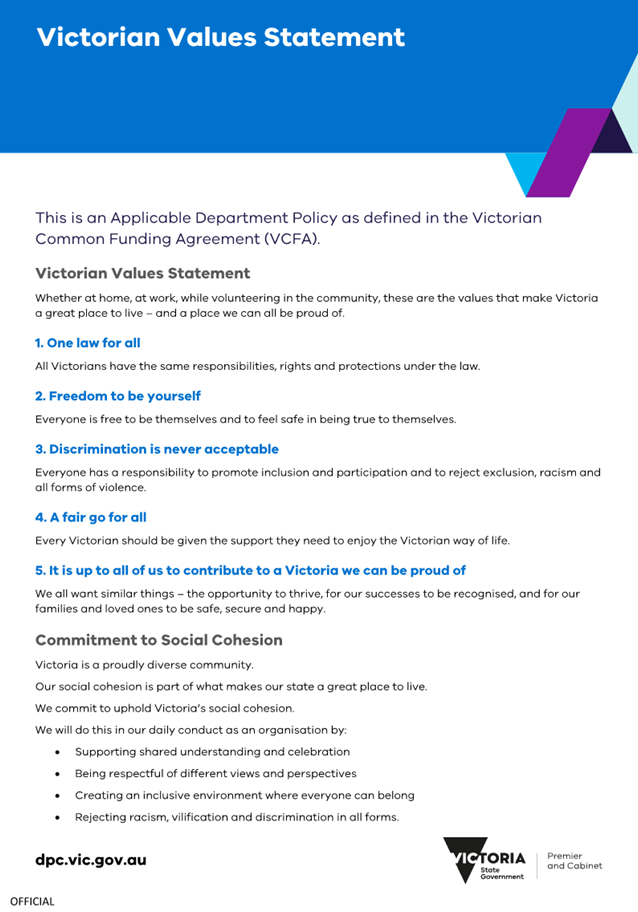
4.8 It is proposed that all Community Grants applicants be required to sign up to the Victorian State Government’s Social Inclusion Values Statement (Attachment 2) as part of the application process.
This requirement will:
· Reinforce shared expectations around inclusion, respect and social cohesion
· Provide a consistent values framework across funded activities
· Support community safety and ethical conduct in a proportionate and accessible way
The sign‑up will not require additional reporting and will be incorporated into existing grant application processes.
Operational improvements
4.9 Key operational refinements are proposed for the 2026/27 grant round, including:
· Strengthening auspicing support by clarifying roles and responsibilities in auspicing arrangements, and providing guidance for both auspiced groups and auspicing organisations.
· Providing clear tools and guidance for small initiatives, including providing application information and practical resources to support community‑led ideas.
These changes are intended to improve equity, accessibility and governance without increasing administrative burden for applicants.
Rationale for community grants proposal and changes
4.10 Community and Councillor feedback has identified that informal and early‑stage community groups often experience barriers to accessing Council grants due to incorporation and administrative requirements. The introduction of a small‑scale grant stream for informal groups is intended to reduce these barriers and enable broader participation in the program.
4.11 In addition, increased focus on social cohesion at State and local government levels supports the introduction of a consistent, values‑based requirement for Council funded organisations.
5. CONSULTATION AND STAKEHOLDERS
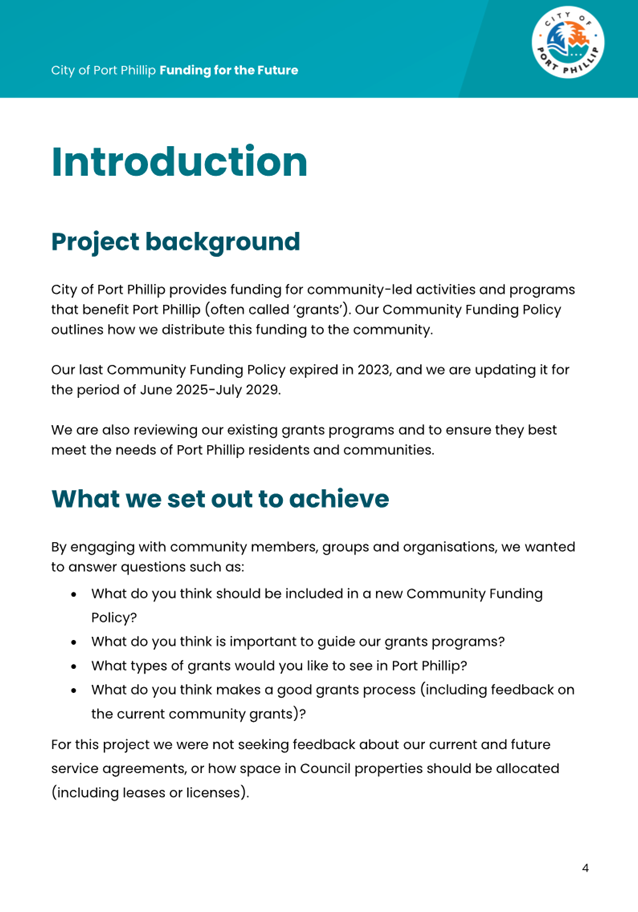
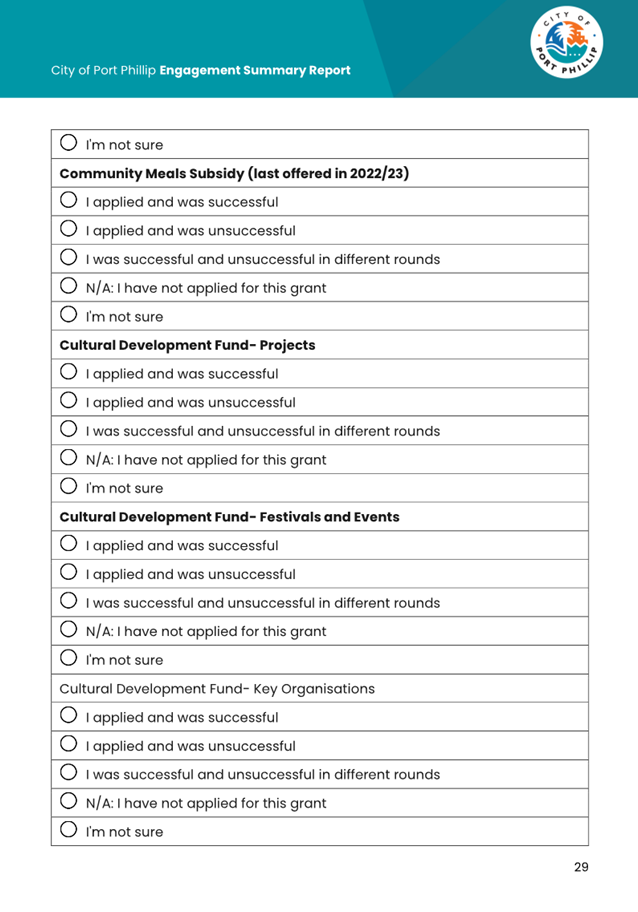
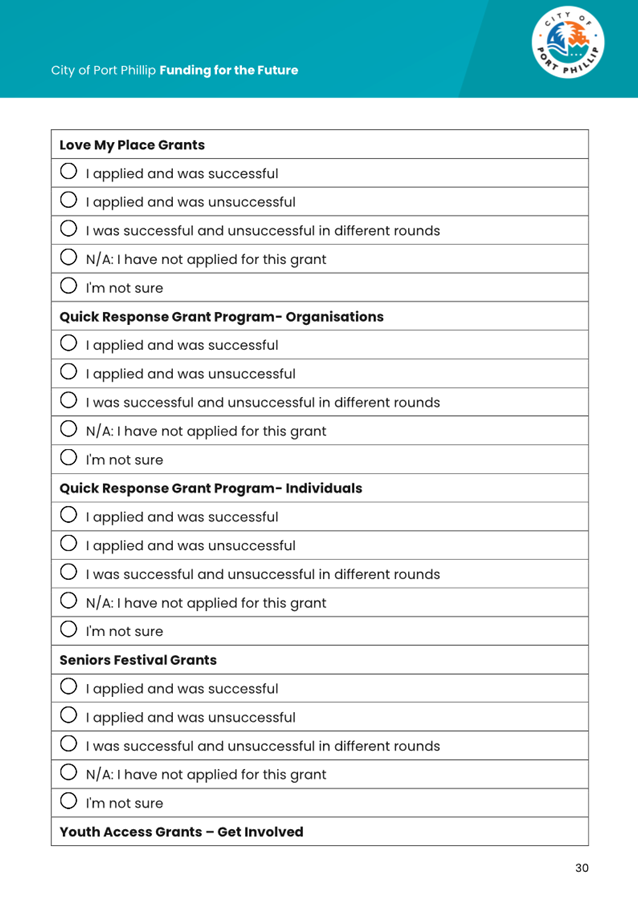
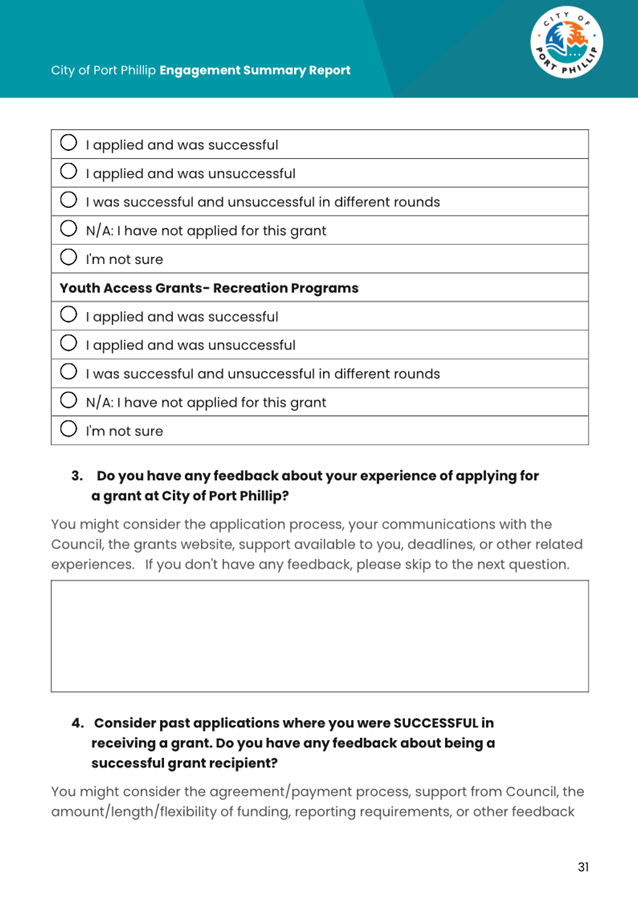
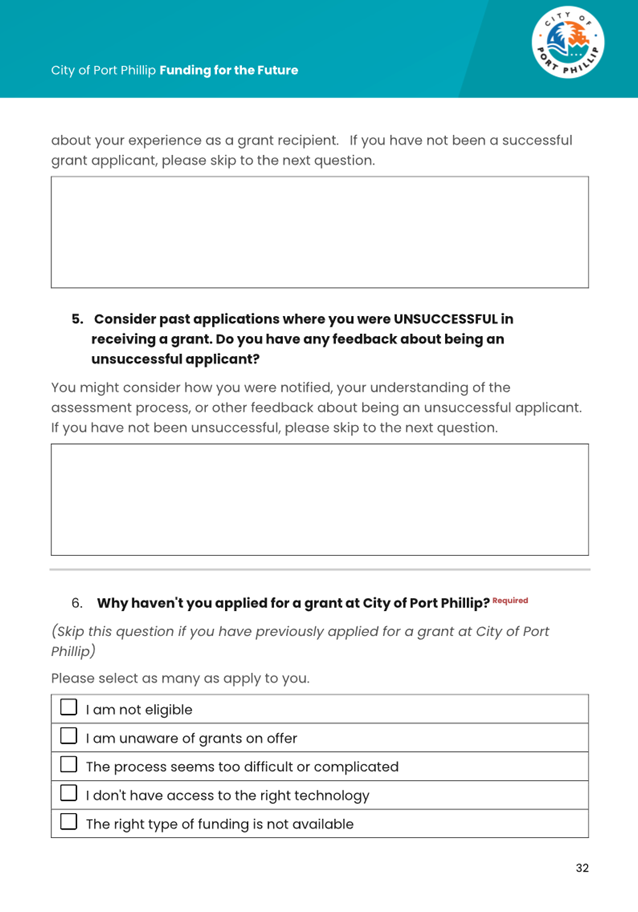
5.1 Council undertook a review of the Community Grants Program in 2025 and conducted formal engagement with community between Monday 3 March to Sunday 30 March 2025 (see Attachment 3). To inform the development of a more contemporary and responsive community funding approach.
5.2 The review sought to understand what should be included in a new Community Funding Policy, the principles that should guide Council’s grants programs, the types of grants the community would like to see offered, and what constitutes a fair, accessible and effective grants process. The feedback and recommendations arising from the review are being considered through a planned and staged process, recognising that some changes require further development, testing and engagement.
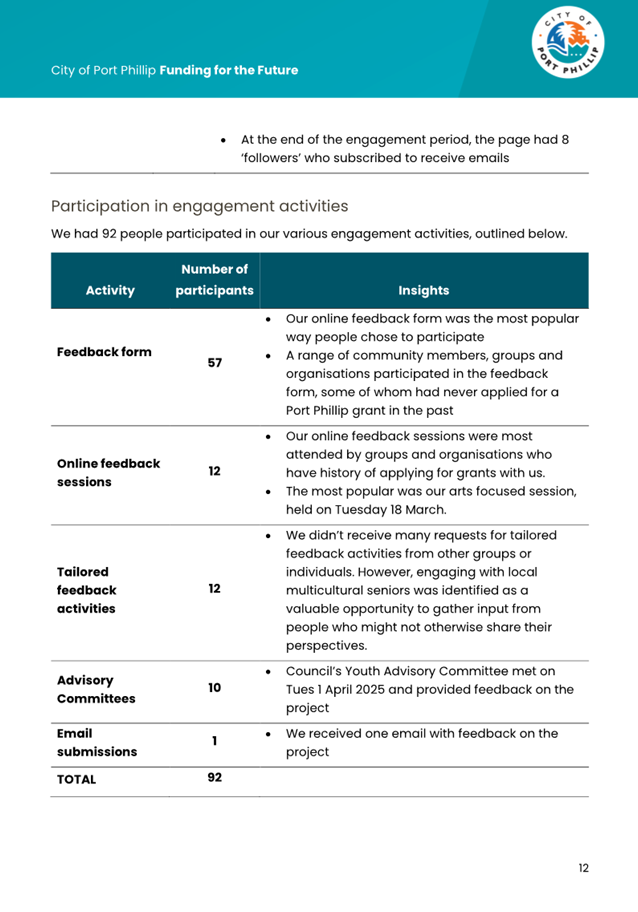
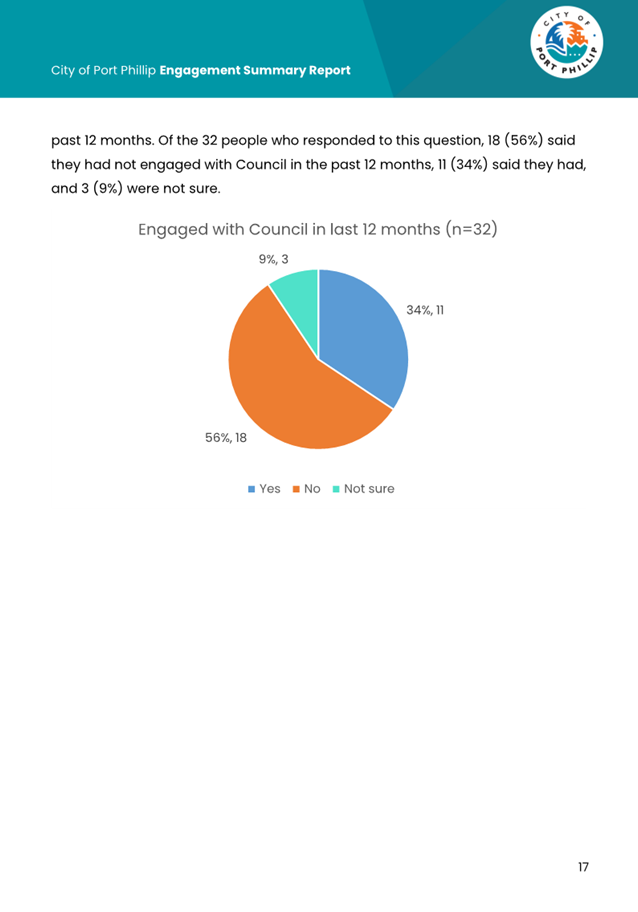
5.3 92 participants provided feedback via a have your say survey and workshops with stakeholders.
5.4 For the 2026/27 financial year, the proposed program settings and changes respond to a portion of the feedback received, while maintaining continuity and delivery certainty for community organisations. These changes include improving accessibility for informal/unincorporated groups by introducing a new grant category that allows them to apply. The changes also strengthen inclusion expectations and accountability through the introduction of a mandatory sign-up to a Social Inclusion Values Statement.
5.5 Remaining review recommendations, such as broader changes to grant structures and funding levels and the implementation of simplified processes will be progressed through a staged program of work and will be subject to a separate Council report and decision.
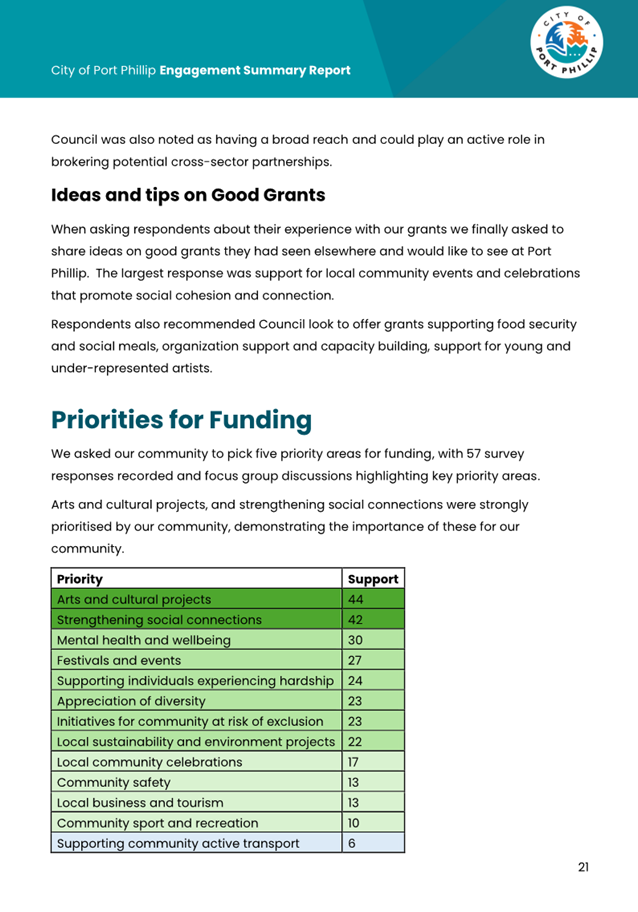
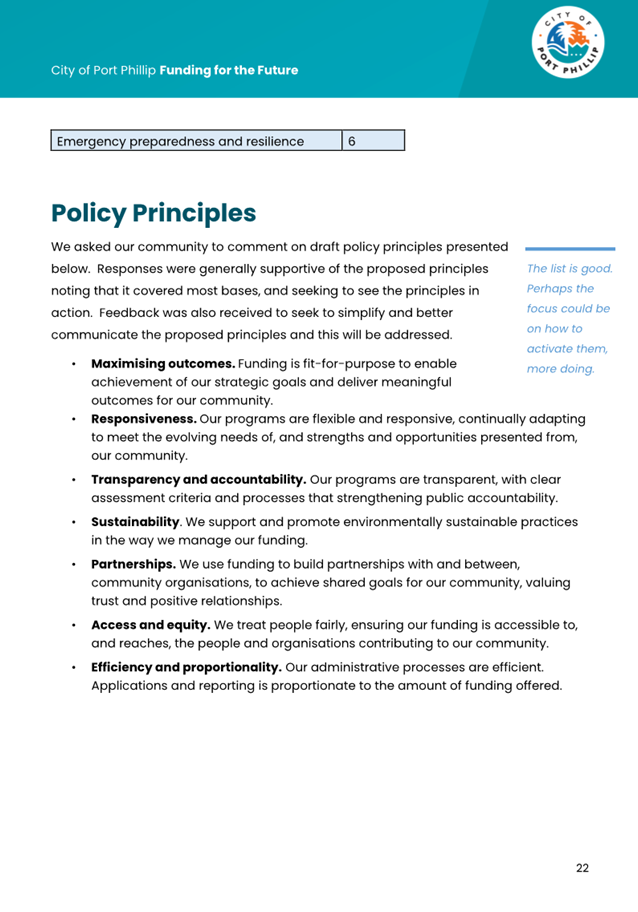
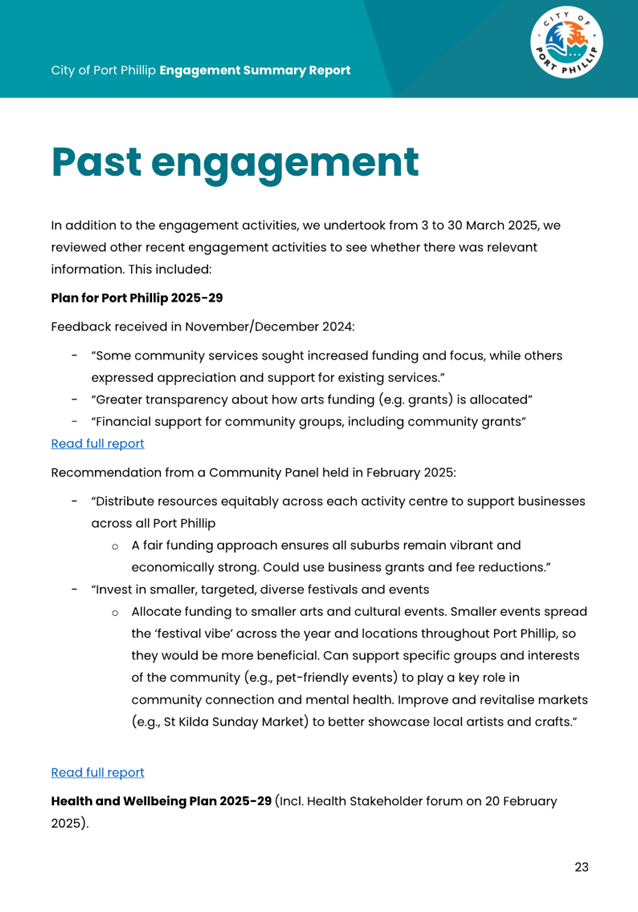
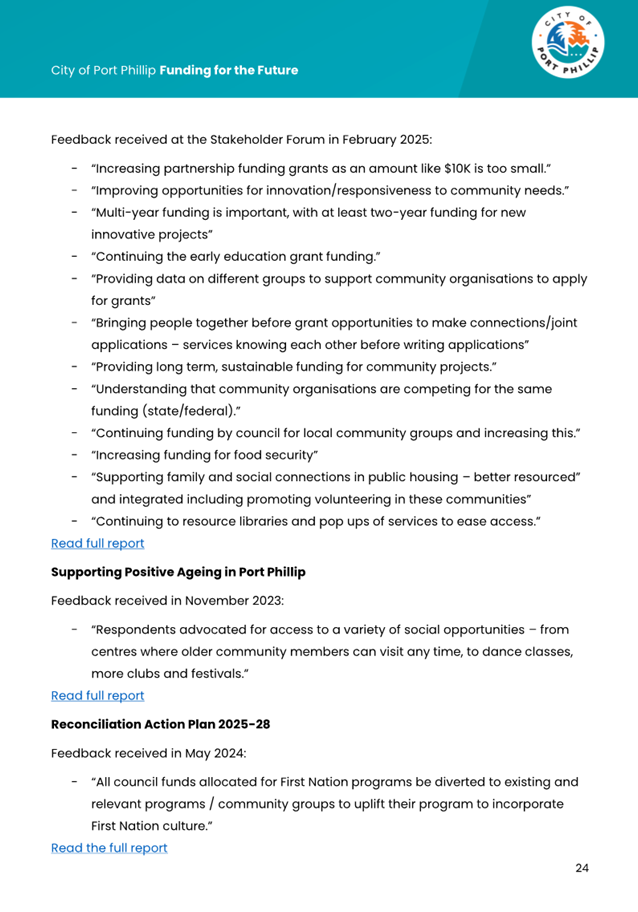
5.6 Key themes from the Community Engagement Report (Attachment 3) and Council’s staged response to the feedback are summarised below.
|
Engagement feedback (Funding for the Future Engagement Summary Report, June 2025) |
Phase 1 response (implemented for 2026/27 round) |
Phase 2 / future work (to be progressed during 2026/27) |
|
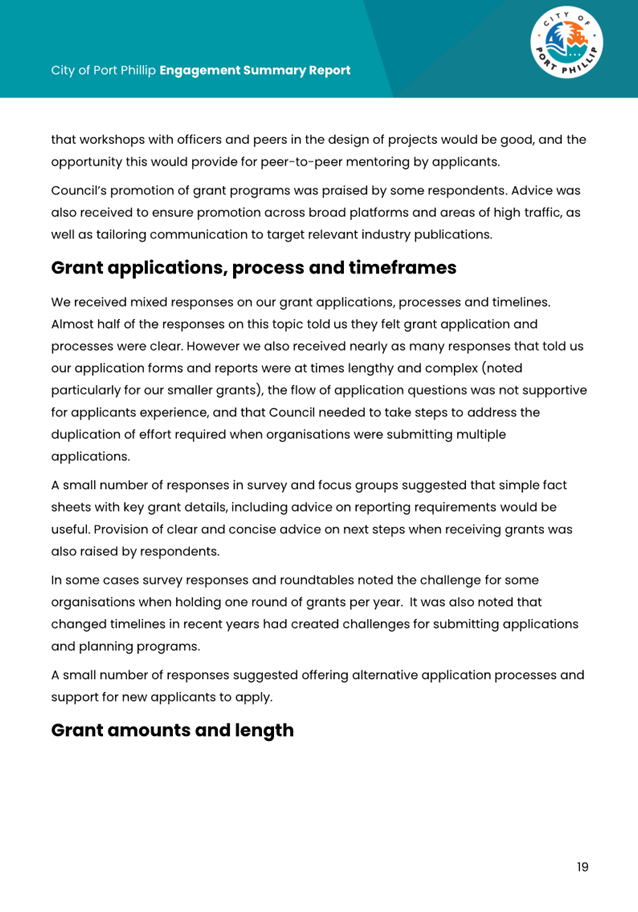
Barriers to accessing grants for smaller, informal or less formal groups; interest in alternative application pathways and support for new applicants. |
Introduce a new Quick Response grant category for unincorporated community groups (up to $750), designed to reduce incorporation and administrative barriers. |
Continue to test and refine the settings for informal group access (including proportional governance and assurance settings) through further engagement and evaluation. |
|
Small grants can feel disproportionately complex; requests for simpler information (e.g., fact sheets), clearer “next steps”, and more proportionate requirements. |
Prepare clearer applicant support materials for the 2026/27 round (including practical resources for small, community-led ideas) and strengthen auspicing guidance (roles and responsibilities). |
Further simplification of forms/processes and proportional reporting settings as part of broader program redesign work. |
|
Feedback for unsuccessful applicants could be improved and made more actionable. |
Clarify grant guidance and assessment expectations to support applicant understanding of eligibility and criteria in the Grant Guidelines. |
Develop improved, more consistent feedback mechanisms for unsuccessful applicants (including guidance and/or process changes) for future rounds. |
|
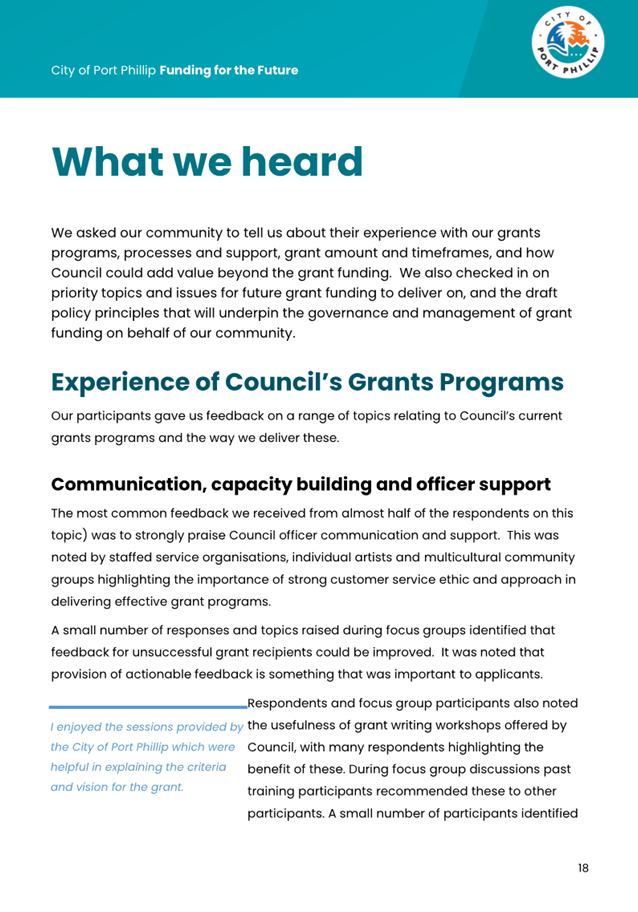
Strong value placed on officer support and grant-writing workshops; suggestion for additional capacity-building and peer learning opportunities. |
Continue to promote applicant support through information sessions and guidance materials for the 2026/27 round. |
Consider additional capacity-building approaches (e.g., peer learning / co-design sessions) as part of Phase 2 engagement and program development. |
|
Desire for Council to be clearer about expectations for funded activities, including principles that support access and equity and community benefit. |
Introduce a requirement for applicants to sign up to the Victorian Government’s Social Inclusion Values Statement as a condition of funding. |
Further work to embed policy principles into program design, including any additional governance expectations (as appropriate and proportionate) through the broader funding framework update. |
|
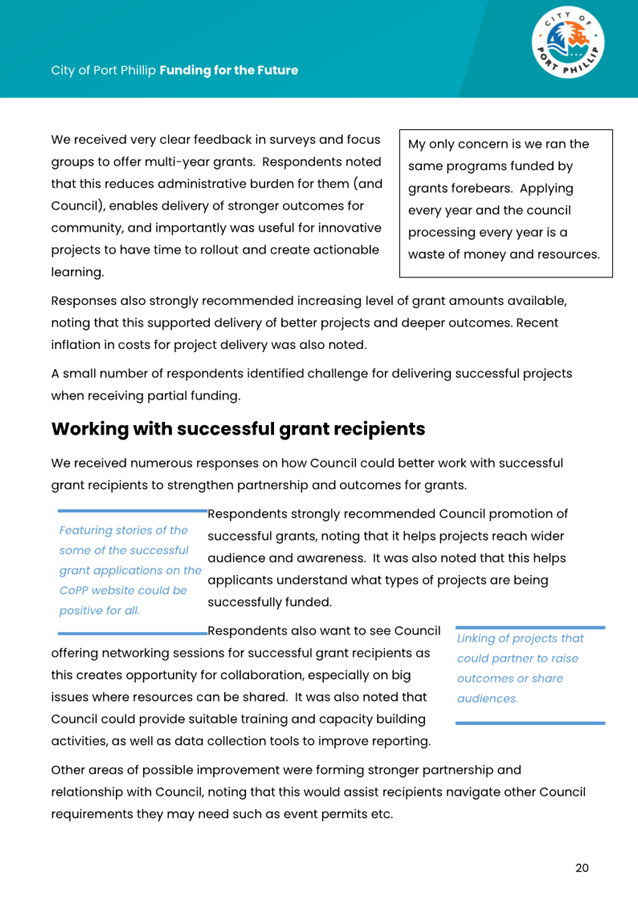
Strong feedback to offer multi-year grants and increase grant amounts to better reflect costs and reduce annual reapplication burden. |
Noting community feedback; maintain existing annual settings for 2026/27 to ensure continuity while Phase 2 work is undertaken. |
Consider options for multi-year funding and updated funding levels as part of broader program redesign, including Council consideration in a future report. |
6. LEGAL AND RISK IMPLICATIONS
6.1 The Community Grants Program operates with alignment to the Community Funding Policy.
6.2 Key risks include:
· Reputational risk if funded organisations do not operate in a manner consistent with inclusion and safety expectations
· Governance risk associated with funding informal groups.
6.3 These risks will be mitigated through:
· Clear eligibility criteria and funding conditions
· Alignment with VAGO recommendations
· Proportionate governance requirements for informal non-incorporated groups
· The introduction of the Social Inclusion Values Statement sign‑up.
7. ENVIRONMENTAL IMPACT
7.1 There are no direct environmental impacts associated with this report. The Community Grants Program will continue to encourage applicants to consider environmental sustainability in project design and delivery.
8. FINANCIAL IMPACT
8.1 The proposed Community Grants Program for 2026/27 will be delivered within the existing annual budget allocation of $285,000.
8.2 No additional recurrent or capital funding is required. The introduction of the new grant stream will be accommodated within existing resources.
9. COMMUNITY IMPACT
9.1 The Community Grants Program provides significant positive community impact by enabling local organisations and groups to deliver programs that improve social connection, inclusion and wellbeing.
9.2 The proposed changes will:
· Increase access to funding for informal and grassroots groups
· Strengthen social cohesion and inclusion outcomes
· Support equitable participation across diverse community groups
The program aligns with Council’s commitment to social justice and inclusion.
10. Gender Impact Assessment
10.1 The Community Grants Program provides significant positive community impact by enabling local organisations and groups to deliver programs that improve social connection, inclusion and wellbeing.
10.2 The proposed changes will:
· Increase access to funding for informal and grassroots groups
· Strengthen social cohesion and inclusion outcomes
· Support equitable participation across diverse community groups.
The program aligns with Council’s commitment to social justice and inclusion.
11. ALIGNMENT TO COUNCIL PLAN AND COUNCIL POLICY
11.1 The Community Grants Program supports Council Plan strategic directions, particularly:
· A Healthy and Connected Community
· An Engaged and Empowered Community
· A Trusted and High‑Performing Organisation
11.2 The program is delivered in accordance with Council’s Community Funding Policy.
12. IMPLEMENTATION STRATEGY
12.1 TIMELINE
The Community Grants Program 2026/27 will be implemented in accordance with the following staged timeline:
|
Milestone |
Dates |
Activities |
|
Council Decision |
6 May |
Council consideration of the Community Grants Program settings for the 2026/27 financial year. |
|
Preparation and Program Set-up
|
May to June 2026 |
· Finalisation of Community Grants Program guidelines. · Detailed design and internal approval of the new Quick Response grant category for informal and unincorporated community groups. · Updates to grant management systems, application forms and assessment tools. · Internal staff briefings and preparation of applicant support materials. |
|
Community Grants Program Delivery |
July 2026 |
Community Grants Program opens. |
|
August – September 2026 |
Assessment period, including: · Eligibility checks. · Assessment by the Community Grants Assessment Panel. · Officer due diligence and moderation of funding recommendations. |
|
|
Council Consideration of Grant Allocations |
October 2026 |
Council endorsement of annual Community Grants Program funding recommendations. |
|
Notification and Grant Payments |
From October 2026 |
· Applicant notifications issued following Council decision. · Grant payments processed, subject to funding agreements being executed. |
|
Quick Response Grants delivery |
July 2026 – June 2027 |
· Applications accepted and assessed on a rolling basis. · Officer assessment undertaken in accordance with delegated authority and funding guidelines. · Applicants notified of outcomes as assessments are finalised. · Grant payments processed following acceptance of funding conditions. |
12.2 COMMUNICATION
12.2.1 Information about the 2026/27 Community Grants Program, including endorsed grant categories, funding allocations and key program changes, will be communicated to the community through a range of channels to maximise reach across diverse audiences. This will include:
· Updates to Council’s website and dedicated grants webpages, including program guidelines, eligibility criteria and application timelines.
· Targeted promotion through Council newsletters and existing community email distribution lists.
· Direct email communication to previous grant applicants, funded organisations, and relevant community networks.
· Promotion through Council’s social media channels to increase awareness of imminent grant opportunities.
· Delivery of online and or in‑person information sessions and applicant briefings to explain program priorities for 2026/27, and application requirements.
· Provision of clear, plain‑language resources and application guidance to support accessibility and reduce barriers to participation.
12.2.2 Key messages to community will include:
· Council’s ongoing commitment to supporting community‑led initiatives that strengthen social connection, inclusion and wellbeing.
· Overview of the 2026/27 Community Grants Program and Quick Response Grants, including available funding and key dates.
· Introduction of the new Quick Response grant category for informal and unincorporated community groups and how this improves access to funding.
· Requirement for grant applicants to sign up to the Victorian State Government’s Social Inclusion Values Statement (Attachment 3) as a condition of funding, and what this means in practice.
· Where and how to access support, guidance and further information.
13. OFFICER MATERIAL OR GENERAL INTEREST
13.1 No officers involved in the preparation of this report has declared a material or general interest in the matter.
|
ATTACHMENTS |
1. Community Funding Policy 2. Victorian Values Statement - Commitment to Social
Cohesion 3. Community Funding - Engagement Report |
Meeting of the Port Phillip City Council
6 May 2026
9. An Environmentally Sustainable and Resilient City
Nil
10.1 Proposed Local Law Amendment and VicPol Protocol.................................... 74
10.2 8 Carlisle Street, 3, 5 and 9 Havelock Street, and 3 Albert Street, St Kilda (Cosmopolitan Hotel) – Council Response to DTP Notice of Draft Planning Scheme Amendment C230port and Planning Permit Application..................................................... 210
Meeting of the Port Phillip City Council
6 May 2026
|
Proposed Local Law Amendment and VicPol Protocol |
|
|
Executive Member: |
Brian Tee, General Manager, City Development |
|
PREPARED BY: |
NELLIE MONTAGUE, MANAGER SAFETY AND AMENITY |
1. PURPOSE
1.1 To update Council on the outcome statutory local law amendment process including the formal community engagement on the proposed Community Amenity Local Law Amendment 2026. This proposed amendment seeks to respond to encampments on Council land where there are adverse amenity, welfare or safety impacts.
2. EXECUTIVE Summary
2.1 Between October and December 2024, groups of individuals regularly gathered at the Jackson Street Carpark, bringing various personal belongings. This activity raised significant concerns among nearby residents, who reported adverse amenity impacts including antisocial behaviour, visible drug use and paraphernalia, rubbish accumulation, suspected stolen goods, and aggressive or disruptive conduct, particularly at night. Residents also described feeling unsafe, experiencing sleep disruption, and suffering negative mental health impacts. In response, Council has undertaken a range of activities, with this report outlining the findings from engagement regarding a proposed Local Law amendment to assist with addressing encampments.
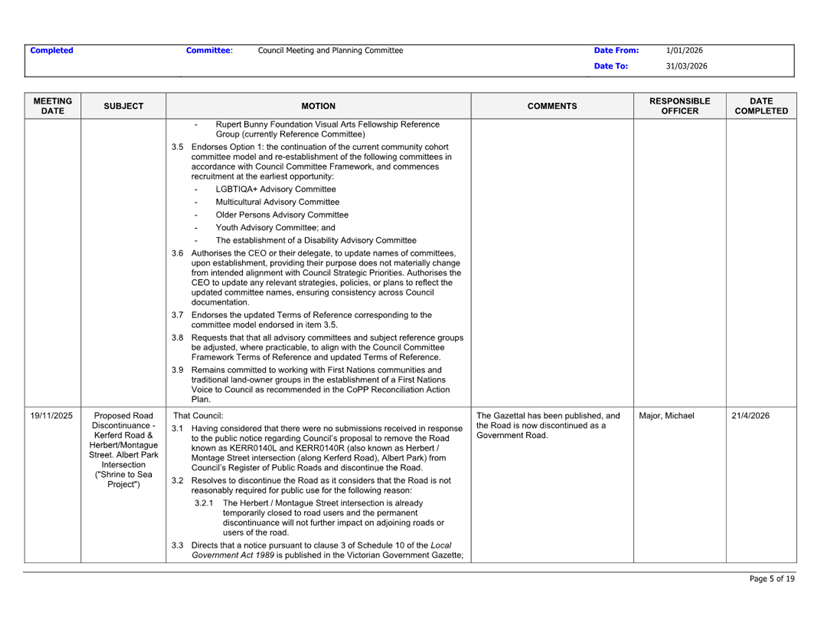
2.2 At its 10 December 2025 meeting, Council resolved to:
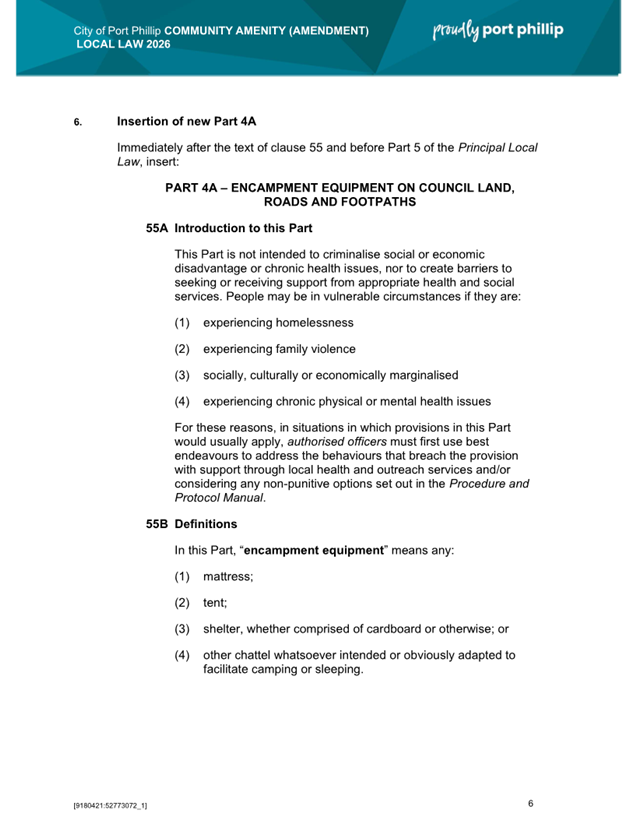
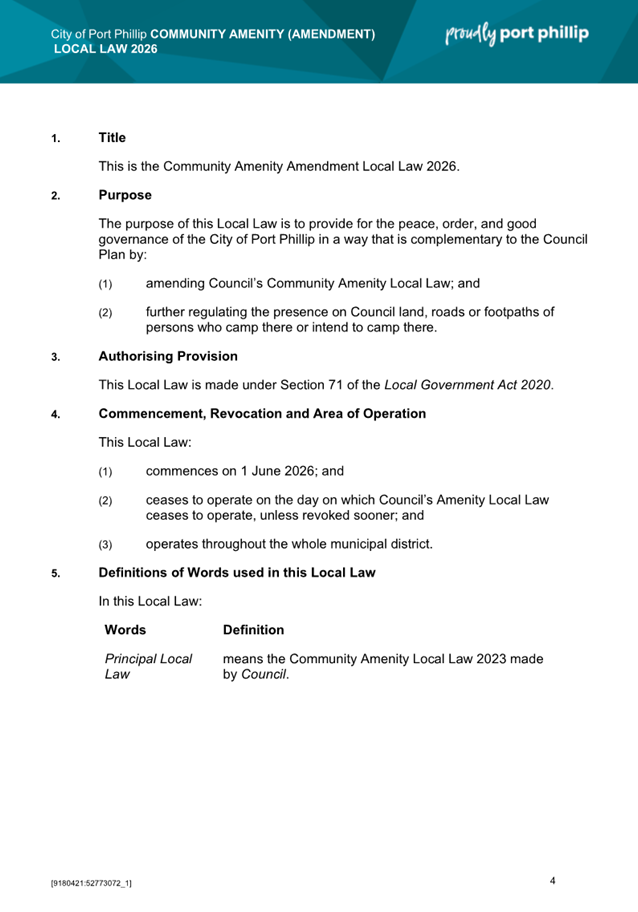
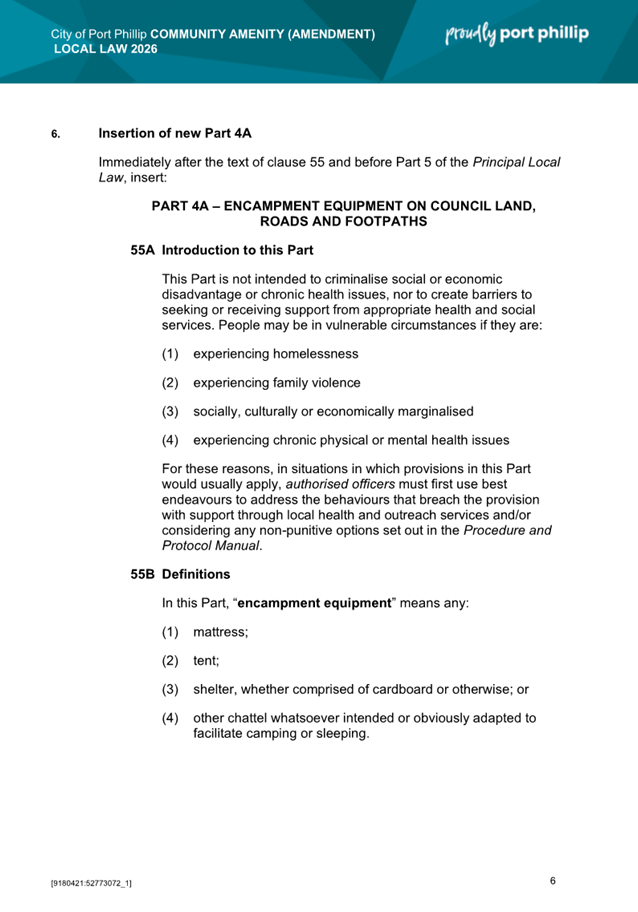
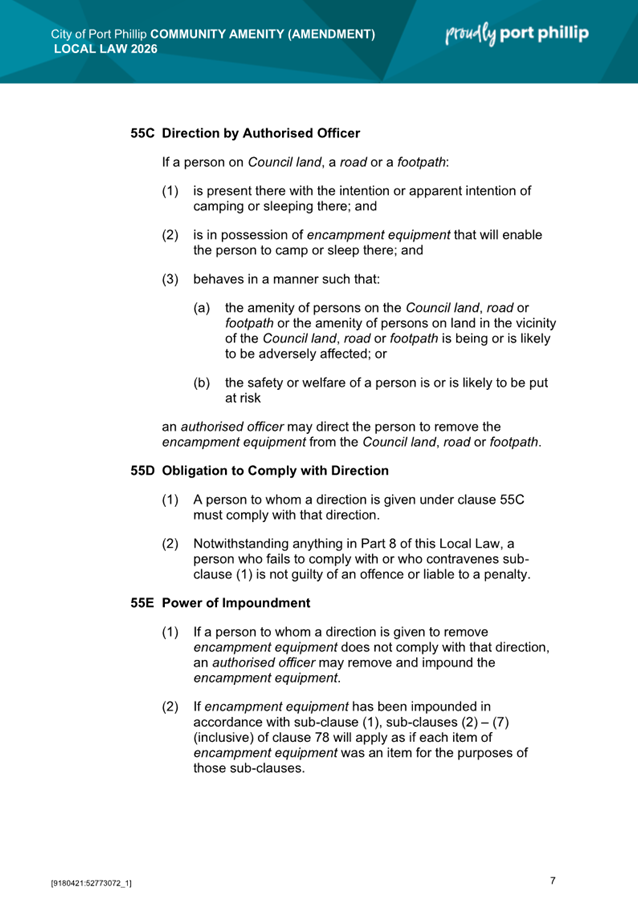
· Authorise the CEO to commence the statutory process for a Local Law amendment to add a new Part 4A Encampment Equipment on Council Land allowing Council’s Authorised Officers to respond to behaviours in camps that have or may have adverse amenity and welfare impacts, provided the conditions in the local law are met and empowering Council’s Authorised Officers to remove encampment equipment.
· Authorise the CEO or delegate to renegotiate the Police Protocol so that it applies to the proposed Local Law amendment, and requests that any renegotiated Protocol is brought to a future Council meeting for endorsement.
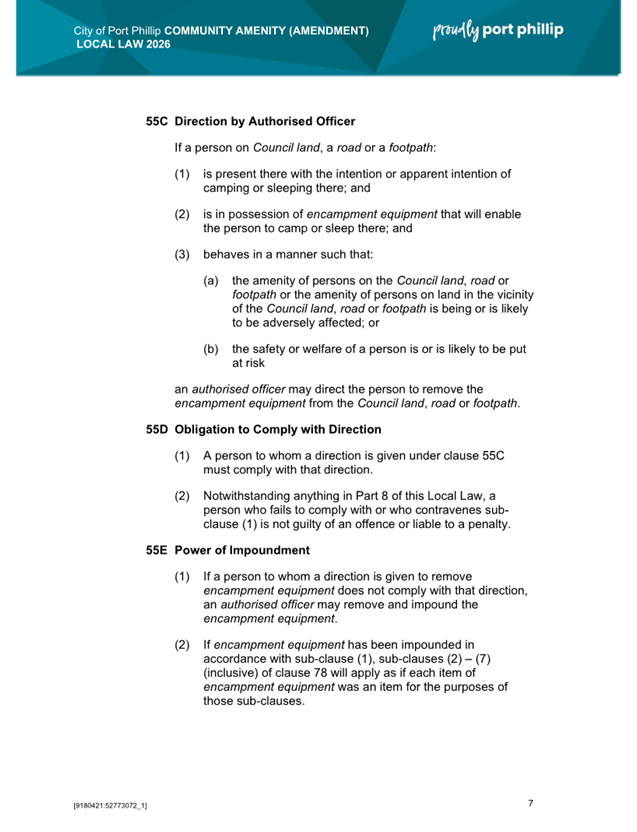
2.3 The proposed Local Law amendment would empower authorised officers to address encampments impacting community safety and amenity. These include directing a person to remove encampment equipment, removing the equipment if that direction is not followed, and impounding the equipment where required (noting that any impounded equipment could be collected by the owners at no cost).
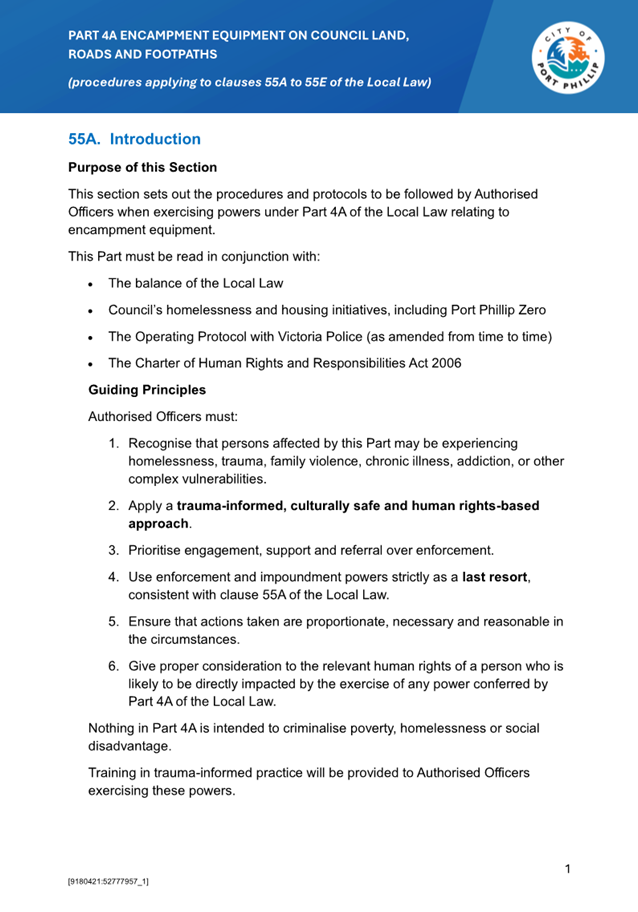
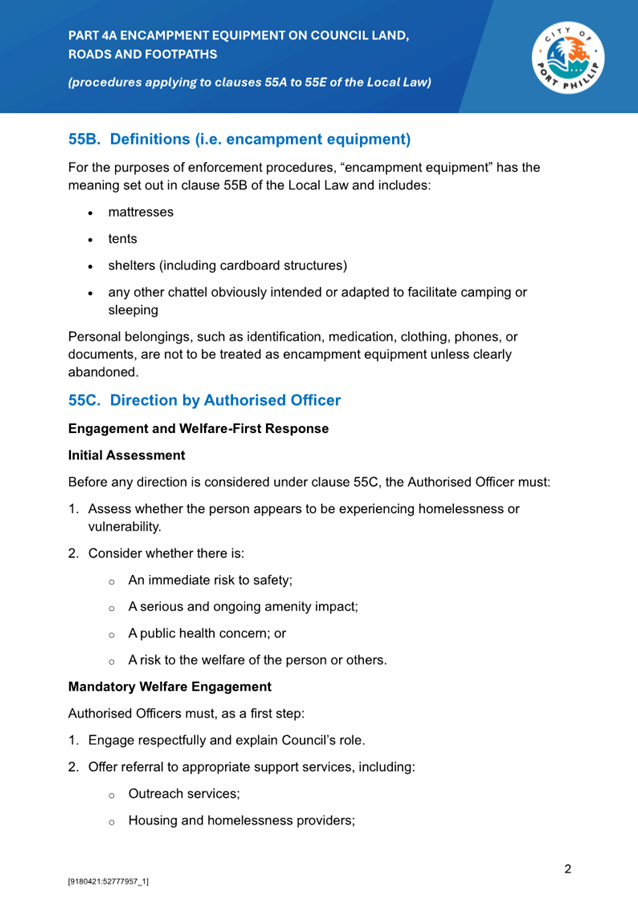
2.4 The proposed Local Law amendment is supported by a new Part 4A in the Procedures and Protocols Manual (incorporated under the Local Law). This section sets out the procedures and protocols to be followed by Authorised Officers when exercising powers under Part 4A of the Local Law relating to encampment equipment.
2.5 Formal community consultation on the proposed Local Law amendment was conducted between 2 March and 29 March 2026. Feedback was received from 726 individuals and organisations (708 surveys, 18 written submissions). A further 24 people attended an online information session. 76.1% of respondents reported that they do not support the proposed Local Law Amendment.
2.6 Written feedback reflected strong community interest and a mix of views, with key themes centred on homelessness, support for evidence-based solutions, and concerns about the removal of belongings and potential displacement. While some respondents supported the proposed Local Law amendment to improve safety and amenity, many emphasised the need for compassionate, proportionate responses. Overall, the community is seeking a balanced approach that addresses amenity while supporting vulnerable people.
2.7 Victoria Police support the proposed Local Law amendment, community service providers do not.
2.8 As per the Council resolution of 10 December 2025, officers have successfully negotiated a revised protocol with Victoria Police. Regardless of whether the proposed Local Law amendment is adopted, the intent is to progress and endorse the City of Port Phillip and Victoria Police Operating Protocol. This Protocol expresses the Council's and Victoria Police desire to work together to improve the response to rough sleeping generally (Attachment 1).
|
That Council: 3.1 Thanks the community for its feedback during March 2026 on the proposed Community Amenity Local Law Amendment 2026 (encampments). Option A: 3.2.1 Notes the legal certification for the Community Amenity (Amendment) Local Law 2026 (Attachment 1). 3.2.2 Adopts and thereby makes the Community Amenity (Amendment) Local Law 2026 (Attachment 2). 3.2.3 Authorises the Chief Executive Officer to publish the required notices under the Local Government Act 2020 in the Victorian Government Gazette and on Council’s website, as well as a notice in a local newspaper and on the City of Port Phillip website (Attachment 4). 3.2.4 Endorses the inclusion of clauses 55A to 55E (inclusive) in the Procedures and Protocols Manual, on and from 1 June 2026 (Attachment 5). These clauses set out the procedures and protocols to be followed by Authorised Officers when exercising powers under Part 4A of the Community Amenity Local Law relating to encampment equipment. 3.2.5 Authorises the Chief Executive Officer, or their delegate to sign the City of Port Phillip and Victoria Police Operating Protocol (Attachment 6) on behalf of Council. Option B: 3.2.6 Does not amend the Community Amenity Local Law. 3.2.7 Authorises the Chief Executive Officer, or their delegate to sign the City of Port Phillip and Victoria Police Operating Protocol (Attachment 6) on behalf of Council. |
4. KEY POINTS/ISSUES
4.1 The City of Port Phillip has a proud history of a compassionate approach to assisting the most vulnerable in our community and being a sector leader in working with housing, mental health, drug and alcohol and other services to address the underlying causes of rough sleeping. Many of the Council initiatives are detailed in Council’s Feel Safe. Be Safe. Community Safety Plan 2025-2029 and are also being considered and actioned by Council through the Affordable Housing and Homelessness Strategy, Port Phillip Zero Program and Trauma Aware Port Phillip. Council continues to implement the Community Safety Plan Actions and other programs and strategies to improve community safety.
4.2 Port Phillip has 109,515 residents from 163 birthplaces, speaking 114 languages. Most are aged 18–49, but the proportion of residents over 60 is expected to grow. 91% of residents live in medium/high-density housing; 41% of households are singles; 44% are renters. The population of Port Phillip is forecast to grow by 60,000 by 2041. Housing stress is significant, with Council advocating for State and Federal intervention.
4.3 Around 25 people sleep rough nightly; many more are in cars, “couch surfing” or in crisis accommodation. Causes include family violence, housing shortages, unemployment, mental illness and substance abuse.
4.4 Crime rates in Port Phillip are higher than the Victorian average. In the year ending June 2025, Port Phillip recorded 10,974 criminal incidents per 100,000 people, compared to the Victorian average of 6,814. Perceptions of safety data from the annual Community Satisfaction Survey 2025 showed perception of safety in public areas was reported as 7.6 on a very unsafe to very safe scale of 1 to 10.
4.5 Port Phillip’s incidence of family violence is below the state average but does fluctuate. June 2025 rate: 1,425 per 100,000 vs Victorian average of 1,499.
4.6 In 2021, alcohol and drug-related hospitalisations were 22.6 per 1,000 residents (Vic avg: 8.73). Drug offences in 2020/21 were 50% higher than the Victorian rate; alcohol-related family violence incidents were 71% higher.
Option A: Proceed with Local Law Amendment
4.7 The proposed Local Law amendment provides that, where person or persons are camping with encamping equipment and behaving in a manner that has adverse amenity impacts or may risk safety or wellbeing, an authorised officer can direct the person to remove the encampment equipment from council land. If the person does not comply with the direction, the council officer can remove and impound the encampment equipment.
4.8 Prior to authorised officers directing items to be removed, authorised officers must use their best endeavours to address the behaviours that are adversely impacting amenity or safety with support through local health and outreach services. The proposed Local Law amendment is supported by a new section 55A in the Procedures and Protocols Manual (incorporated under the Local Law). This section sets out the procedures and protocols to be followed by Authorised Officers when exercising powers under Part 4A of the Local Law relating to encampment equipment.
4.9 In reviewing this approach, Council officers have considered views of the community and stakeholders (Police and Community Service providers), the ability to implement the proposed Local Law Amendment and the impact of implementation and the legal review (including the Human Rights Charter). This review is summarised in Table 1.
|
Measure |
Detail |
Comment |
|
Community |
Formal community engagement outcomes from 708 survey responses in March 2026 show 76.1% of respondents reported that they strongly opposed or opposed the proposed Local Law amendment. |
76.1% of surveyed community members do not support the proposed Local Law amendment. |
|
Service Provider Feedback |
Service providers have advised that they do not support the proposed Local Law amendment. Instead, they support improved services, outreach and prevention rather than changes to the Local Law. |
Service providers support services and outreach, not the proposed Local Law amendment. |
|
Police |
Police have advised Council that they do support the proposed Local Law amendment. |
Police support the proposed Local Law amendment. |
|
Ability to
implement |
The proposed Local Law amendment: · applies across the municipality at all times. · decision to commence enforcement will be made by authorised officers. · does not have a formal requirement to request Police support, in practice, authorised officers will not implement if it is not safe to do so. Prior to the removal of encampment equipment, authorised officers must first use best endeavours to address the behaviours that breach the provision with support through local health and outreach services. This approach is summarised in the protocol with Police (Attachment 6). The Appendix to the protocol includes a request for Police to support officers in the removal of “encampment equipment”. Enforcement would not include fines. Instead, the focus is on the removal and impoundment of encampment equipment. The items would be stored and subsequently returned upon request at no cost. Prior to removal, owners of equipment (where known) will be asked to remove the equipment and advised that, if the equipment is not removed by the owner, they could be removed by authorised officers. Smaller personal items such as bags and paperwork will not be removed, unless they are abandoned. The threat of removing encampment material may act as a deterrent. The proposed Local Law is limited to the removal of equipment; it does not require the removal of the individual. This may inhibit the effectiveness of this clause. |
The proposed Local Law amendment is able to be implemented and will enable removal of encampment equipment as a last resort.
|
|
Legal Human Rights Charter |
A legal review of the proposed Local Law amendment found that, while not beyond doubt, the amendment can be made to the Local Law following community engagement and gazetting. In implementing the proposed Local Law amendment officers will need to comply with all State Legislation and the Human Rights Charter. |
Legal review on the proposed amendment has been undertaken and found the amendment can be made. |
Table 1. Review of Proposed Local Law Amendment
Option B: To Not Proceed with Proposed Local Law Amendment
4.10 Option B is to not proceed with the proposed Local Law Amendment.
4.11 While there are mixed views, the outcome of Council’s engagement process is that a large majority of the community do not support the proposed Local Law amendment.
4.12 While the proposed Local Law amendment is to be applied as a last resort after supports through local health and outreach services have failed, there is a risk that council will be criticised because the removal of encampment equipment does not address the underlying causes of rough sleeping.
4.13 The proposed Local Law amendment will require the provision of notice or direction that encampment equipment must be removed. However, if the equipment is not removed, the implementation of the proposed Loca Law amendment may require Police to restrain people so that Council officers can safely remove encampment equipment.
4.14 Council’s new Community Safety Plan was developed through extensive engagement, will expand services, programs, and partnerships. This enhanced service delivery may provide early intervention that may avoid or disperse encampments without the need for a Local Law change. Not proceeding with the proposed Local Law amendment at this time would allow the enhanced service delivery model to be implemented and for Council to subsequently review the impact of those additional services, programs and partnerships on encampments.
Protocol with VicPol
4.15 Officers have agreed with the VicPol on a City of Port Phillip and Victoria Police Operating Protocol and seek Council endorsement of that protocol.
4.16 The Protocol documents (and builds on) existing City of Port Phillip practices, including council, service providers and Police work together to deliver coordinated responses connecting individuals to housing, mental health, and drug and alcohol and other support. The Protocol adopts a trauma-informed, culturally safe, and human rights-based approach, balancing the rights of individuals in public spaces with community safety.
Joint Patrols
4.17 The Protocol provides that Local Law Officers will work with VicPol to jointly patrol key high streets. Police were unable to commit to a minimum number of joint patrols because they depend on the availability of Police resources, and competing Police priorities may limit attendance.
4.18 The Joint patrols provide opportunities to share street-level information and allow traders and residents to raise concerns with Police and Local Laws Officers. They can also help deter, detect, and resolve crime and improve safety perceptions.
Weekly Operational Meetings with Service Providers
4.19 The Protocol provides that Council officers and VicPol will attend weekly meetings with service providers to coordinate the delivery of support to address community, rough sleepers and encampment issues.
Encampments
4.20 Under the Protocol, when an encampment is identified, Council and VicPol will convene a meeting of service providers to connect the individuals in the encampment to housing and other support.
The Protocol Appendix 1 Dealing with Encampment Equipment
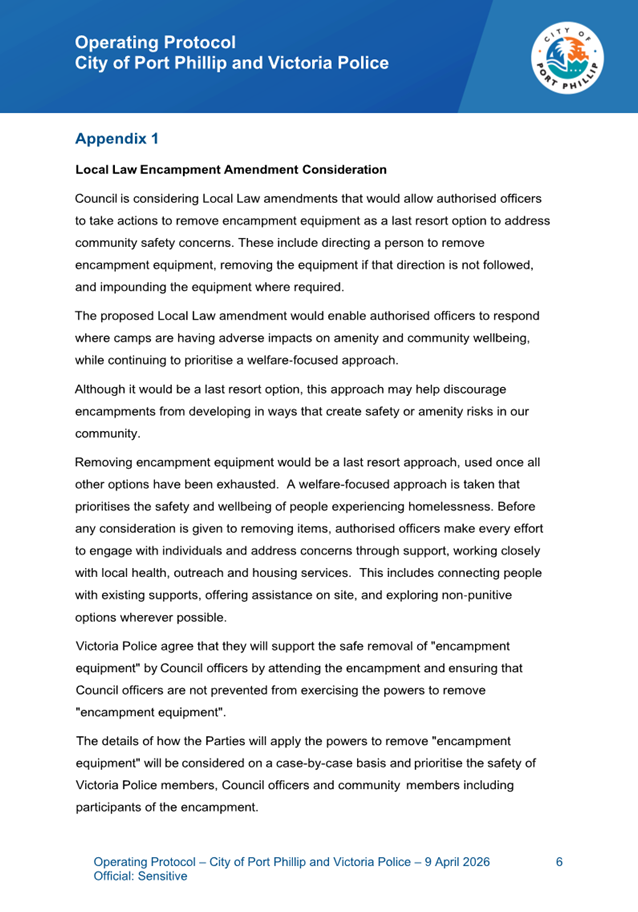
4.21 The Appendix 1 of the protocol will only apply if Council amends the Local Law to include the proposed Local Law amendment (Option A).
4.22 Under the Protocol, Victoria Police agree that, if available, they will support the safe removal of “encampment equipment” by attending the encampment and ensuring that Council officers are not prevented from exercising the powers to remove “encampment equipment”.
Current regulatory framework
Council legislation
4.23 Several existing clauses in the Community Amenity Local Law 2023 are relevant to the consideration of development of the proposed Local Law amendments including:
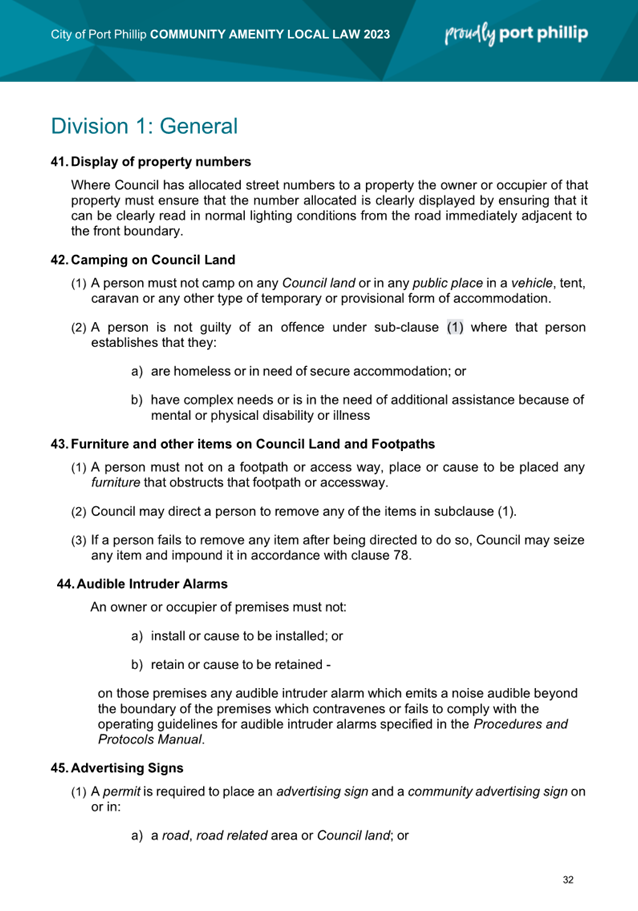
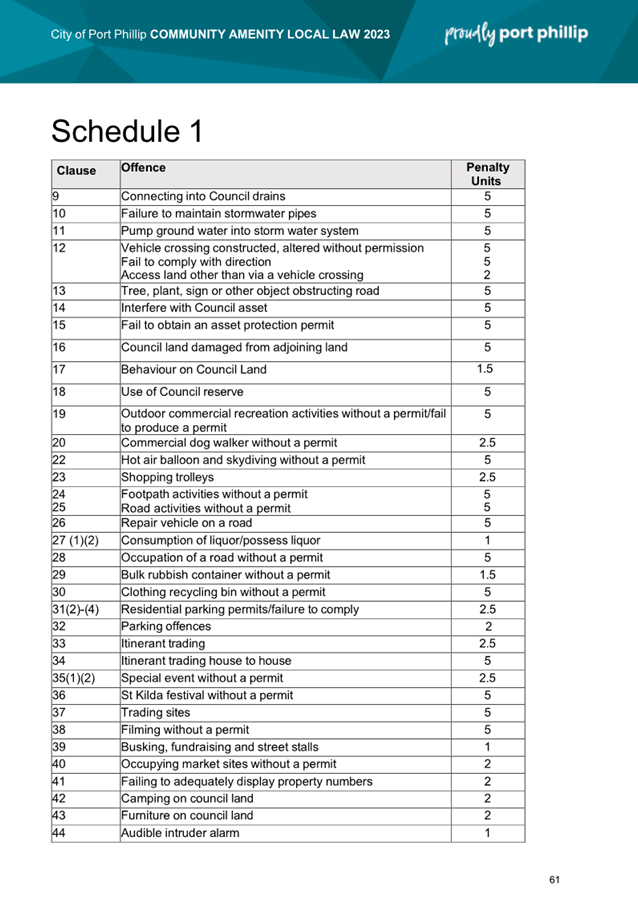
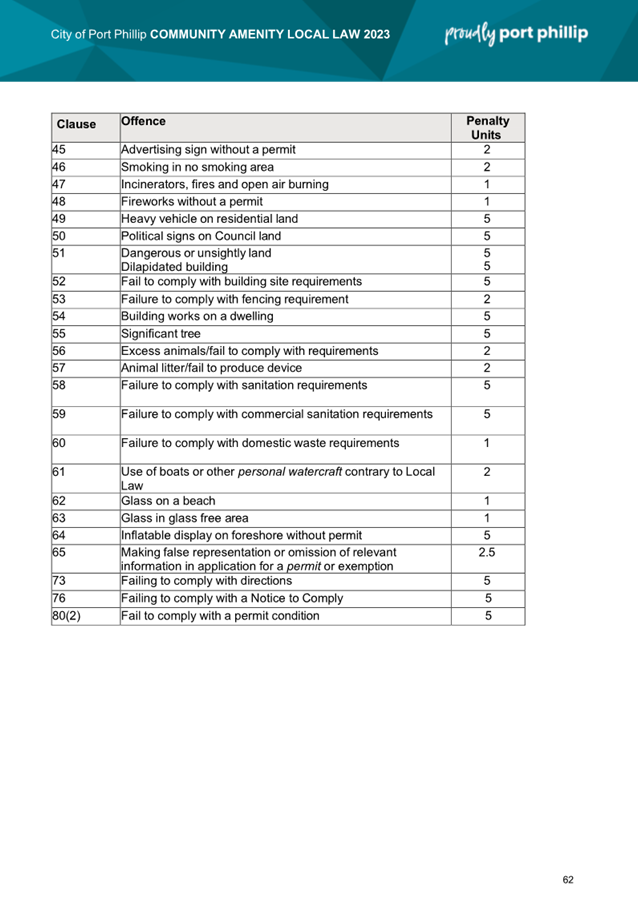
· Clause 17 - Behaviour on Council Land and Roads - a person must not create a nuisance, interfere with others, harass or fail to comply with directions from an Authorised officer.
· Clause 42 - Camping on Council Land - a person must not camp. However, people are exempt if they are homeless or have complex needs or need additional assistance because of mental or physical disability or illness.
· Clause 43 - Furniture and Other Items on Council Land and Roads - a person must not obstruct footpaths or accessway; if items are not removed when asked, items can be seized. Furniture includes bed frames, bed mattresses, chairs, tables, crates, kitchen appliances, and the like.
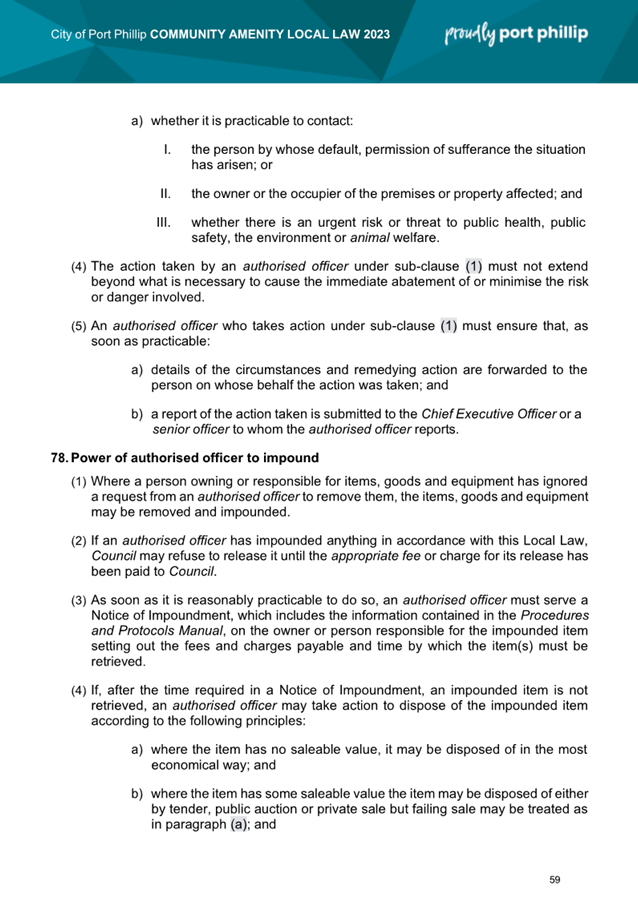
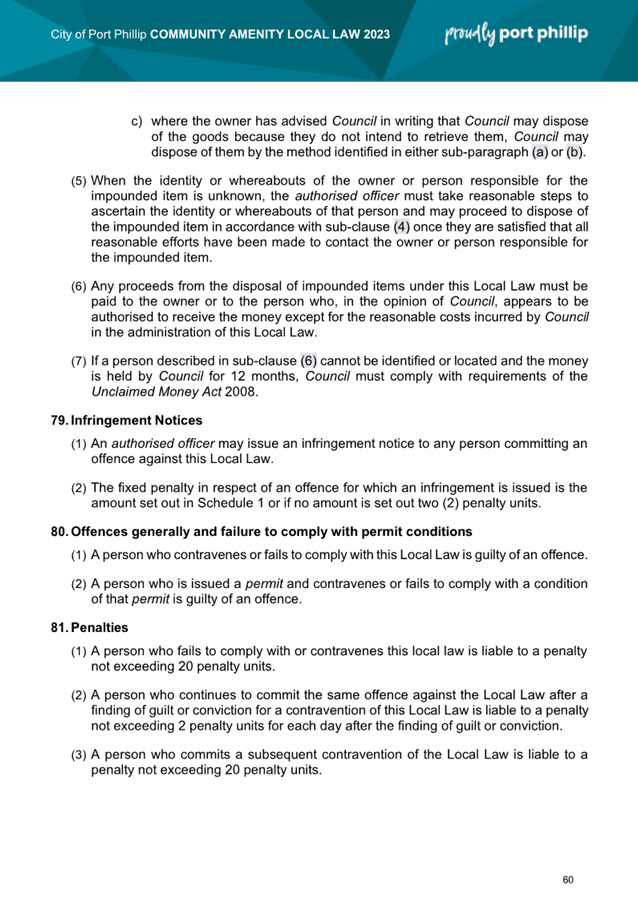
· Clause 78 - Where a person owning or responsible for items, goods or equipment has ignored a request from an authorised officer to remove them, the items can be removed or impounded.
4.24 In addition, the current Procedures and Protocol Manual provides that;
“When conducting any investigations under the Local Law, authorised officers will have regard to their obligations under the Charter for Human Rights and Responsibilities.
The City of Port Phillip recognises that there are many people within the community that are homeless or may have complex needs, such as mental illness, addiction or domestic violence.
Authorised officers will continue to perform their duties with consideration and compassion and provide referrals to other work areas in Council to assist in these circumstances”.
State Legislation
4.25 Amendments to Council’s Local Law cannot cover areas already covered by State Legislation. This section of the report summarises the relevant State Legislation.
4.26 VicPol, under the Summary Offences Act (1966), have powers to 'move on' individuals breaching or likely to breach the peace, endanger safety, or damage property. Police have authority, training, and equipment to move people and respond to criminal behaviour. Council cannot make a Local Law to “move on” individuals.
4.27 Any new Local Law must also comply with the Charter of Human Rights and Responsibilities Act 2006. Rights protected in the charter include freedom of movement, privacy, peaceful assembly, and property rights.
How the Proposed Port Phillip Approach Differs from that taken by Moreton Bay, Qld
4.28 In early 2025, Moreton Bay City Council repealed its Persons Experiencing Homelessness (PEH) Framework and began enforcing the Camping on Public Land Local Law 2023, resulting in displacement of homeless residents and the seizure or disposal of tents, shelters and belongings.
4.29 Supreme Court Findings:
In March 2026 the Supreme Court of Queensland found that Moreton Bay City Council had acted unlawfully and breached multiple human rights when clearing homeless encampments in 2025. The Queensland Supreme Court found that the process used to remove the camp breached provisions in the Queensland equivalent of the Victorian Charter of Human Rights and Responsibilities Act 2006.
The Court did not strike down the local law itself. Instead, it found that the way the powers were used breached several obligations under Queensland’s Human Rights Act 2019 — for example, not allowing reasonable time, not considering individual circumstances, and unlawfully disposing of belongings. In other words, the law stood; the exercise of the power did not.
4.30 Key differences between Moreton Bay and Port Phillip:
· Human rights safeguards: Moreton Bay had no formal safeguards, while Port Phillip’s amendment will require an outreach-first approach before enforcement.
· Trigger for action: Moreton Bay treats camping itself as an offence; Port Phillip would require evidence of intent and impact of encampments.
· Enforcement approach: Moreton Bay used fines, notices and removals; Port Phillip does not and will not issue financial penalties and may only impound items in certain circumstances. Any impounded possessions may be reclaimed at no cost.
4.31 The case highlights the legal and reputational risks of enforcing laws without discretion, support pathways or consideration of human rights.
4.32 The Court also found that councils cannot rely on blanket enforcement. They must provide reasonable notice, assess each situation individually and consider housing or support options.
Proposed Local Law Amendment in Context
4.33 Between October and December 2024, individuals gathered in the Jackson Street Carpark, a small council owned carpark 50 metres from Fitzroy St. While the number of individuals varied and could spike, generally there were between 10 and 15 people with items including mattress, trolleys, suitcases, bedding, bicycles, boxes and other articles.
4.34 Local residents raised concerns about the adverse amenity impacts including at a Council meeting on 27 November 2024, when residents presented their experiences of seeing people defecating and urinating in nearby residential properties, clearly visible drug paraphernalia, drug use and dealing, the presence of rubbish and what appeared to be stolen goods, yelling and aggressive behaviour including late at night. Residents reported feeling intimidated and unsafe, being unable to sleep and described adverse mental health and other impacts.
4.35 In response, Council increased Local Law patrols, placed Council’s mobile CCTV camera in the carpark and worked with drug and alcohol, housing and other service providers to try find suitable alternative accommodation and provide required support. Every morning Local Law officers attended and asked campers to leave. Local Law officers were threatened and could not enter the area safely without Police. Local services continued with assertive outreach to support with housing options and links to health supports. Following ongoing concentrated patrols with Police support over a period of time, the campers moved away.
4.36 Following the concerns raised at the 24 November 2024 Council meeting, a notice of motion on 11 December 2024 supported a Community Safety Roundtable to bring together services with a range of experience, expertise and capability to identify actions to increase public safety and perceptions of safety. The motion requested that the Mayor write to Victoria Police seeking advice and recommendations on Local Laws. This occurred on the 24 January 2025 and, in response, Victoria Police proposed a working group to consider Local Law amendments.
4.37 On 19 February 2025 Council passed a notice of motion to investigate changes to the Council Local Law Clause 17 (Behaviour on Council land), Clause 42 (Camping on Council Land) and Clause 43 (Furniture and other items on Council Land and Footpaths) to see if such changes could help address public safety and amenity concerns while considering human rights and other relevant factors.
Roundtable Report
4.38 In response to the December 2024 Notice of Motion, a Community Safety Roundtable was held on 19 March 2025 with twenty stakeholders, including service providers with expertise in drug and alcohol support, housing, mental health, legal and academic expertise and Police. It was chaired by Ian Gray AM, a long-time Port Phillip resident with experience in the legal, justice, and community sectors. The roundtable relevant recommendations are:
· An increase in Victoria Police resources for the Neighbourhood Policing model, including more foot patrols, local engagement, and problem-solving in identified safety hotspots. CoPP to continue advocating and collaborating.
· Advocate for an Aboriginal Community Liaison Officer dedicated to the Port Phillip Police Service Area.
· Develop and pilot a welfare-based joint patrol model involving Victoria Police, CoPP Local Laws, outreach workers, peer support, and other services to engage rough sleepers and people with complex needs.
· Establish a formal partnership agreement between Victoria Police and CoPP for a coordinated homelessness response, drawing on the City of Melbourne and Victoria Police Homelessness Operating Protocol.
· Confirm adequacy of current by-laws, focusing on effective implementation and coordination rather than change.
· Ensure CoPP and Victoria Police protocols prioritize rapid social and therapeutic intervention as the primary goal, with enforcement as a last resort.
4.39 In their submission to the Roundtable Report, the Police recommend Local Law amendments with a tiered response:
· Intervention – Prioritise swift social and therapeutic support, offering alternative living and sleeping arrangements.
· Assessment – Agencies quickly determine needs and implement housing, medical or support solutions.
· Enforcement – If support is refused, Local Laws Officers and Neighbourhood Policing Team dismantle encampments.
4.40 On 2 May 2025 Council received a joint letter from service providers opposing the Local Law amendment proposed in the February motion. The letter was signed by the CEOs of Southside Justice, First Step, Justice Connect, Fitzroy Legal Service and Inner Melbourne Community Legal, and was endorsed by 28 other services. The service providers expressed support for investment in services, outreach and prevention, and opposed the proposed changes to the Local Law. The letter was tabled at the 21 May Council meeting.
21 May 2025 Council Meeting
4.41 The Roundtable Report was tabled at the 21 May 2025 Council meeting.
4.42 In addition, at the 21 May 2025 Council Meeting an alternative amendment to the Local Law to the one outlined in the February 2025 motion was supported by Council. Instead of the February motion, an amendment to the Local Law targeting encampments was endorsed for community engagement. The local law included:
4.43 The ability to temporarily designate an area as a “no encampment area” where:
a) The amenity of the Council land or the amenity of land in the vicinity of the Council land is or is likely to be adversely affected; or
b) The safety or welfare of a person is or is likely to be put at risk by behaviours of persons congregating on Council land with the intention or apparent intention of camping or sleeping there.
c) such a designation could be considered an exceptional circumstance after existing and enhanced assertive outreach models with service providers and supportive conversations had failed
d) enforcement of the potential amendment would not include fines, but would allow for the instead, the impoundment of equipment following provision of outreach and support services, where individuals have refused both a request and then warning to remove the material from the designated area.
Community Engagement Outcomes – Round 1 Initial Engagement
4.44 As resolved in the 21 May 2025 Council meeting, community engagement occurred between 22 May and 29 June 2025 around community safety in general as well as a different Local Law amendment to that engagement on in March 2026, that would provide the ability to temporarily designate an area as a no encampment area in consultation with key stakeholders. Engagement included an online survey, neighbourhood pop ups and 5 community workshops.
Survey
4.45 852 responses to the proposed Local Law amendment were received. 54.3% oppose (48.7% strongly oppose), 37.3% support (26.7% strongly support)
· Opposition themes include human rights concerns, criminalising homelessness, and harm to vulnerable people.
· Support themes include improved safety and consistency with other councils.
Written submissions
4.46 As part of the engagement process, 11 written submissions were received:
· 8 opposed the proposed Local Law amendment
· 2 supported the proposed Local Law amendment
· 1 suggested the amendment does not go far enough
4.47 One submission included a petition with 255 signatures, raising concerns about potential harm to vulnerable people and urging a focus on recommendations from the Community Safety Roundtable.
Workshops
4.48 At five community safety workshops in May and June, 43 participants provided feedback—some supporting the proposal, others expressing concern.
10 December 2025 Council Meeting
4.49 At the 10 December 2025 Council Meeting an alternative amendment to the Local Law outlined in the 21 May 2025 motion was supported by Council. The 10 December meeting also endorsed commencement of the statutory process for the Local Law amendment to add a new Part 4A Encampment Equipment on Council Land. The amendment would allow Council’s Authorised Officers to respond to behaviours in camps that have or may have adverse amenity and welfare impacts and empowering Council’s Authorised Officers to remove encampment equipment. In summary, the proposed Local Law amendment would provide an option, where other interventions have failed, to dismantle an encampment through the removal of encampment equipment.
4.50 The next section of this report summarises outcomes of the 2026 public engagement as required by the statutory process.
5. CONSULTATION AND STAKEHOLDERS
5.1 As resolved in the 10 December 2025 Council meeting, community engagement occurred between 2 March and 29 March 2026.
5.2 A survey delivered online through a Have Your Say survey was provided to collect feedback on the proposed Local Law amendment. Hard copy surveys were also available at Customer Service Centre, Libraries, Community Centres, Maternal and Child Health Centres, Pride Centre, South Melbourne Market and Madden House.
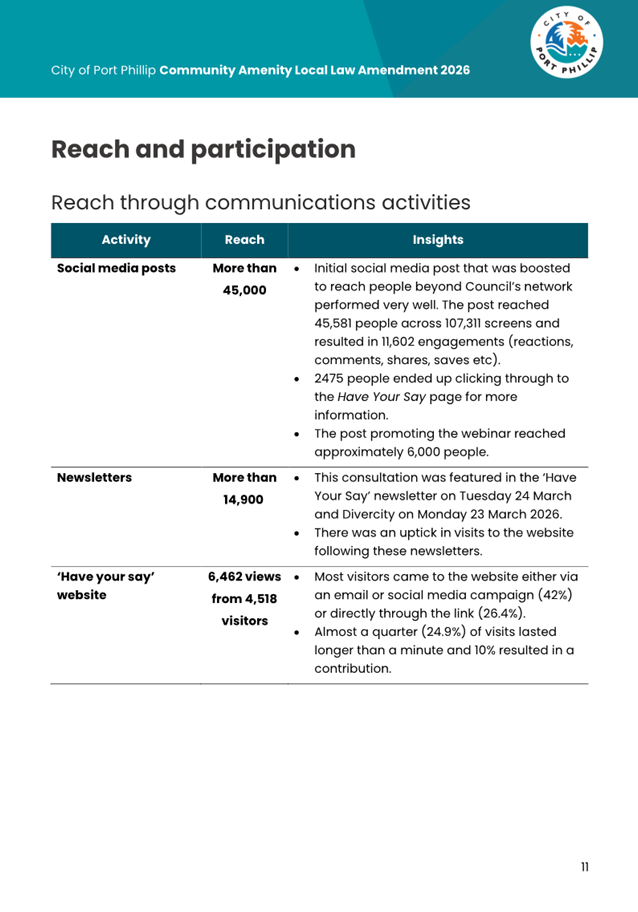
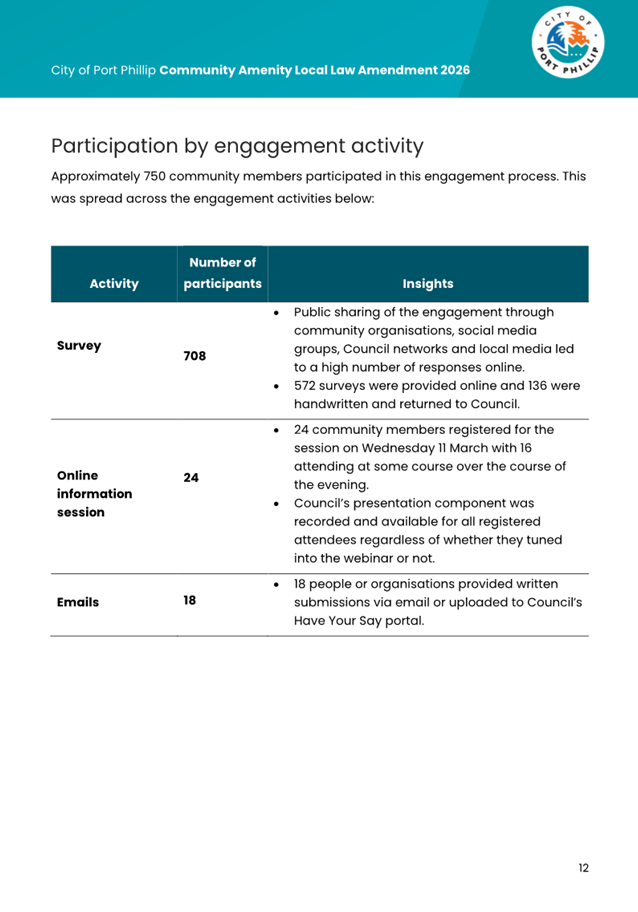
5.3 Approximately 750 community members participated in this engagement process. This was spread across the engagement activities below:
· Survey (708 responses: 572 online and 136 hard copy)
· Written submissions (18 responses)
· Online information session (24 people participated)
Survey
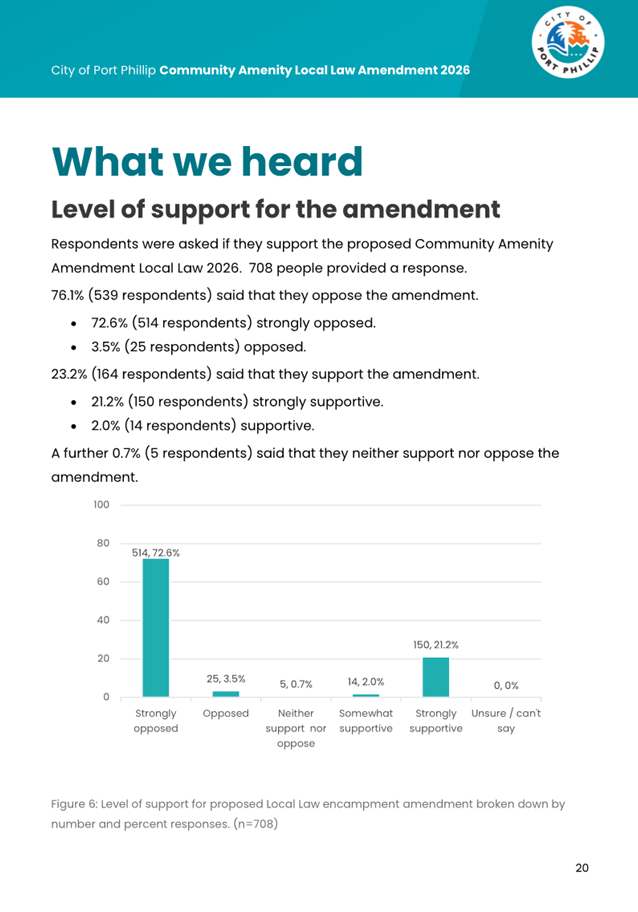
5.4 Respondents were asked if they support the proposed Community Amenity Amendment Local Law 2026. 708 people provided a response.
76.1% (539 people) said that they oppose the amendment.
· 72.6% (514 people) strongly opposed.
· 3.5% (25 people) opposed.
23.2% (164 people) said that they support the amendment.
· 21.2% (150 people) strongly supportive.
· 2.0% (14 people) supportive.
A further 0.7% (5 people) said that they neither support nor oppose the amendment.
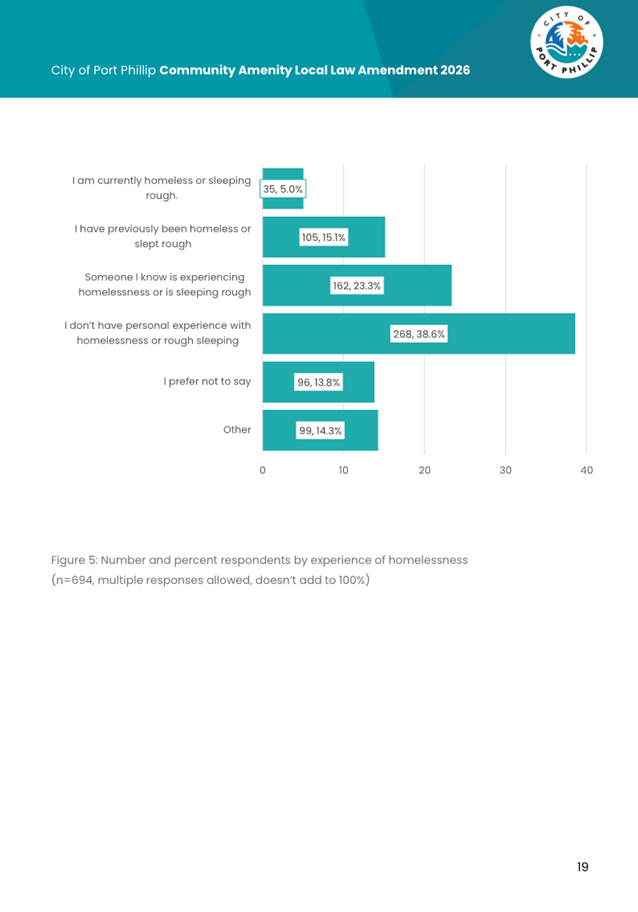
5.5 To understand if we were hearing feedback from people with lived experience of homelessness, we asked participants to share their personal history of homelessness or rough sleeping.
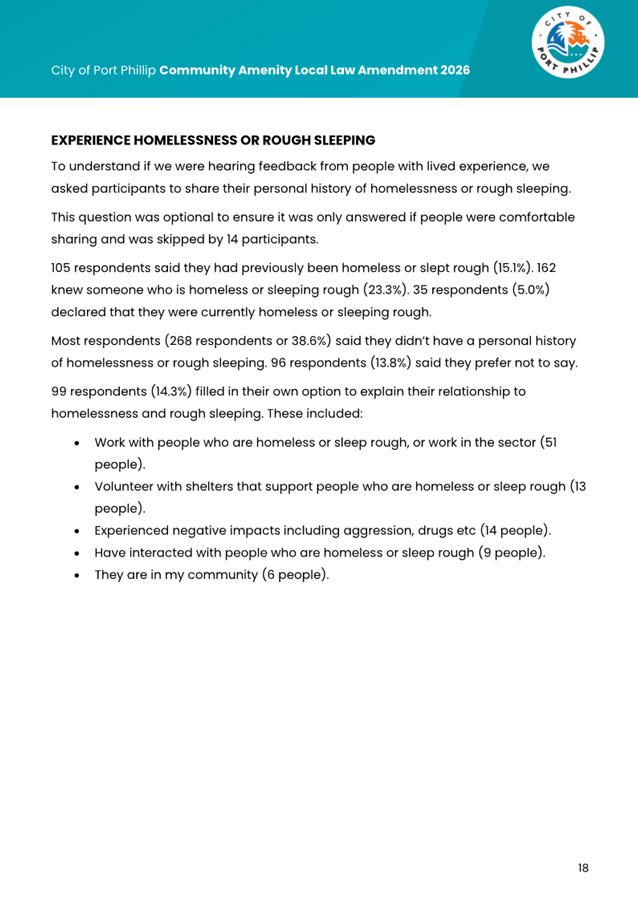
· 105 respondents said they had previously been homeless or slept rough (15.1%). 162 knew someone who is homeless or sleeping rough (23.3%). 35 respondents (5.0%) declared that they were currently homeless or sleeping rough.
Written feedback
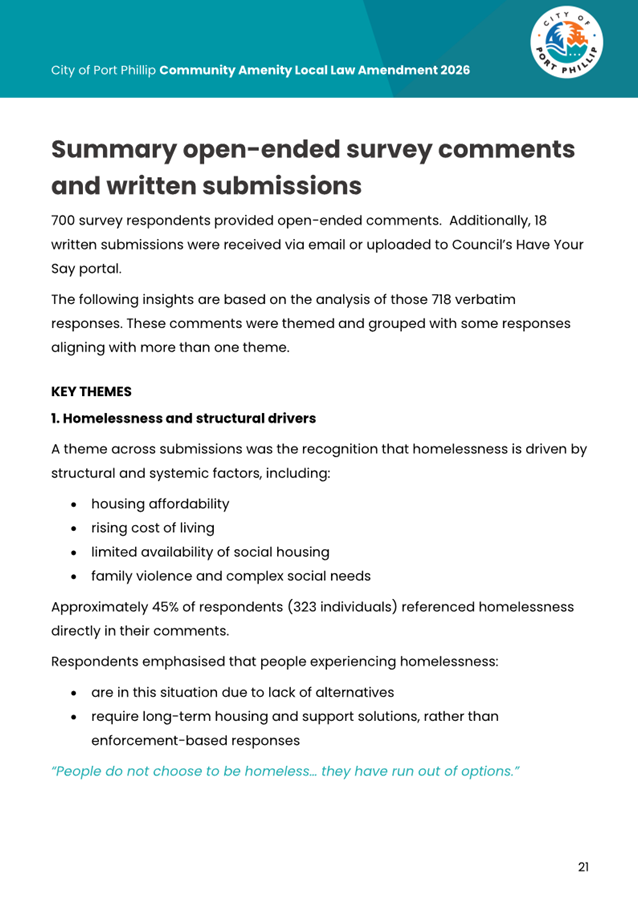
5.6 700 survey respondents provided open-ended comments. Additionally, 18 written submissions were received via email, or uploaded to Council’s Have Your Say portal.
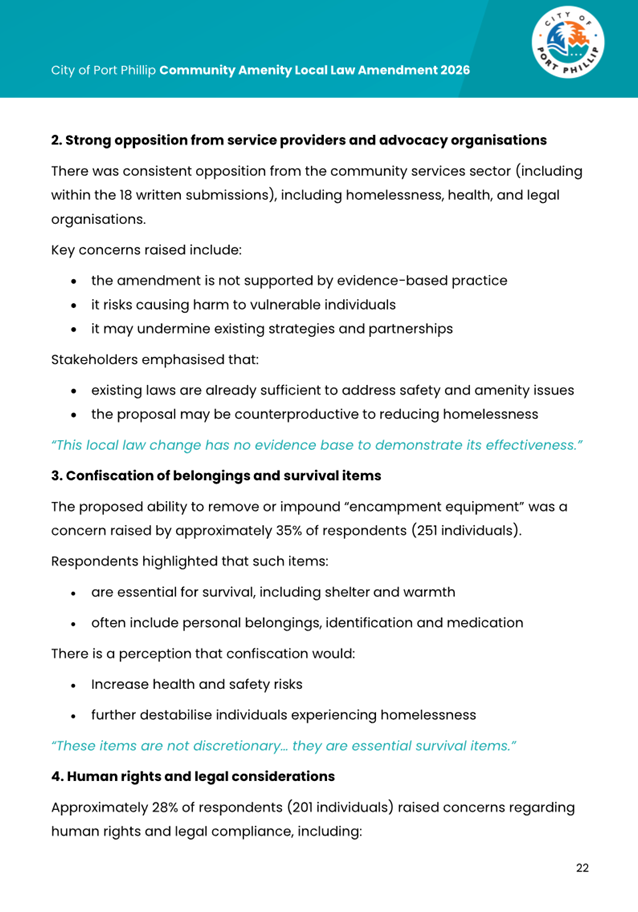
5.7 Written feedback reflected strong community interest and a mix of views, with key themes centred on homelessness, support for evidence-based solutions, and concerns about the removal of belongings and potential displacement. While some respondents supported the proposed Local Law amendment to improve safety and amenity, many emphasised the need for compassionate, proportionate responses aligned with Council’s strategies. Overall, the community response is seeking a balanced approach that addresses amenity while supporting vulnerable people.
Please refer Attachment 7: Community Amenity Amendment Local Law 2026 Engagement Summary Report May 2026.
6. LEGAL AND RISK IMPLICATIONS
6.1 The Local Government Act (2020) outlines the process for reviewing a Local Law, with further detail provided in the Department of Planning and Community Development’s Guidelines for Local Laws Manual. These provisions restrict what can be included in a Local Law. For example, it must not duplicate, conflict with, or be inconsistent with existing legislation or planning schemes
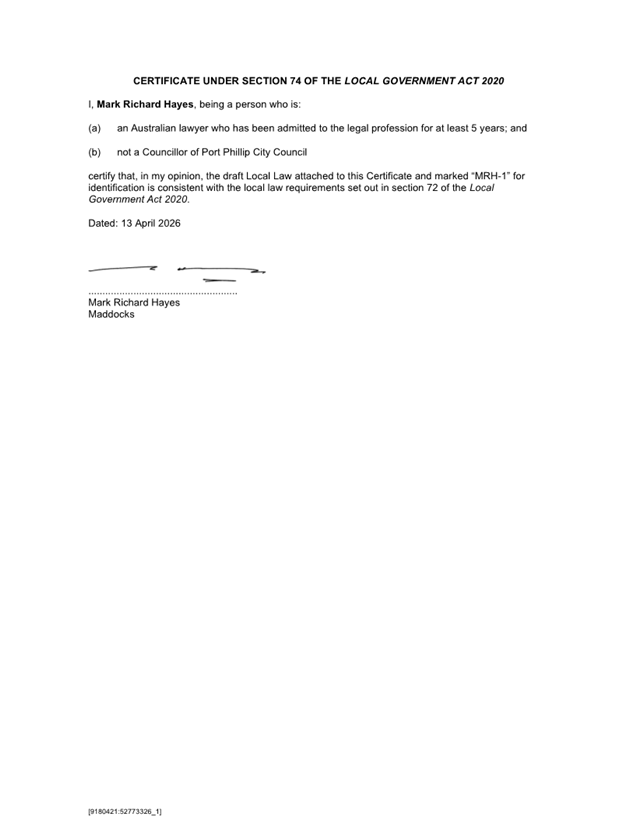
6.2 As required under the Act, Council must obtain a certificate from a qualified person confirming the proposed Local Law complies with legislative requirements. The proposed Local Law amendment has been reviewed and certified pursuant to section 74(1) of the Act by Mark Hayes, Partner Public Law at Maddocks. The certificate has been attached as Attachment 1.
7. FINANCIAL IMPACT
7.1 Should Council adopt the proposed Local Law amendment; it is expected that implementation and enforcement can be accommodated within existing resources.
7.2 At the 10th December Council Meeting a budget of $60,000 was allocated for communications, engagement, reporting and legal review to fulfil the Local Government Act requirements to progress the Local Law Amendment. The allocated amount is on track to be spent.
7.3 Prior to December 2025 approximately $10,000 was spent on legal advice and engagement to understand options and community sentiment around Local Law changes to support response to encampments.
8. ENVIRONMENTAL IMPACT
8.1 Where possible, communication activities will minimise the use of paper products.
9. COMMUNITY IMPACT
9.1 A community impact statement was made available during round 1 engagement.
10. Gender Impact Assessment
10.1 Research shows that women and gender diverse people can experience safety and perceptions of safety differently. A gender impact assessment was undertaken prior to community engagement progressing.
11. ALIGNMENT TO COUNCIL PLAN AND COUNCIL POLICY
11.1 The Local Law supports the delivery of A safe and liveable City and An engaged and empowered community strategic directions.
12. IMPLEMENTATION STRATEGY
12.1 TIMELINE
12.1.1 If Council decides to adopt the proposed Local Law amendment, the following timeline could take place:
· May 6 2026 – Council public meeting with findings, legal certificate and meeting to decide whether to endorse amendment to Local Law.
· June 2026 - Published Local Law gazetted and comes into effect if endorsed.
12.2 COMMUNICATION
12.2.1 Any implementation activities will be supported with a communications plan.
13. OFFICER MATERIAL OR GENERAL INTEREST
13.1 No officers involved in the preparation of this report has declared a material or general interest in the matter.
|
ATTACHMENTS |
1. Legal certification of the Community Amenity
Amendment Local Law 2026 2. Community Amenity Amendment Local Law 2026 3. Community Amenity Local Law 2023 - As Amended 4. Public Notice of Making Local Law 5. Procedures and Protocols Manual (part 4A insert) 6. Operating Protocol City of Port Phillip and Victoria
Police 7. Community Amenity Amendment Local Law 2026
Engagement Summary Report May 2026 |
Meeting of the Port Phillip City Council
6 May 2026
|
8 Carlisle Street, 3, 5 and 9 Havelock Street, and 3 Albert Street, St Kilda (Cosmopolitan Hotel) – Council Response to DTP Notice of Draft Planning Scheme Amendment C230port and Planning Permit Application |
|
|
location/address: |
8 Carlisle Street, 3, 5 and 9 Havelock Street, and 3 Albert Street, St Kilda |
|
Executive Member: |
Brian Tee, General Manager, City Development |
|
PREPARED BY: |
James McInnes, Principal Planner |
1. PURPOSE
1.1 To provide a Council position on a request to the Minister for Planning to prepare, adopt and approve Amendment C230port into the Port Phillip Planning Scheme, and approve planning permit PA2503985 at 2 and 6-8 Carlisle Street, 3 Albert Street, and 3, 5 and 9 Havelock Street, St Kilda (the subject land).
2. EXECUTIVE SUMMARY
|
Ward: |
St Kilda |
|
Trigger
for determination |
Called in by a councillor |
|
COUNCIL ApplicATION NO: |
PDMR/00004/2026 |
|
Applicant: |
Minister for Planning c/o the Department of Transport and Planning (DTP) |
|
Existing use: |
Motel |
|
Abutting uses: |
Residential and commercial |
|
Zoning: |
General Residential Zone, Schedule 1 (GRZ1) |
|
Overlays: |
Heritage Overlay (HO5) Special Building Overlay, Schedule 1 (SBO1) |
|
Statutory
time remaining for |
Not Applicable |
2.1 An application has been made to the Minister for Planning c/o the Department of Transport and Planning (DTP) under Section 96A of the Planning and Environment Act 1987 and is a combined planning scheme amendment and planning permit application.
2.2 Planning Scheme Amendment C230port proposes to amend the Port Phillip Planning Scheme by replacing Schedule 1 to the General Residential Zone, with a new Schedule 14 to the General Residential Zone, which will exempt the subject land from the minimum garden area requirement to allow a greater site coverage than currently permissible in the zone.
2.3 If approved, the amendment would facilitate a more intensive redevelopment of the subject land as it would no longer be burdened by the minimum garden area requirement which currently limits the extend of built form permissible on the site in certain circumstances.
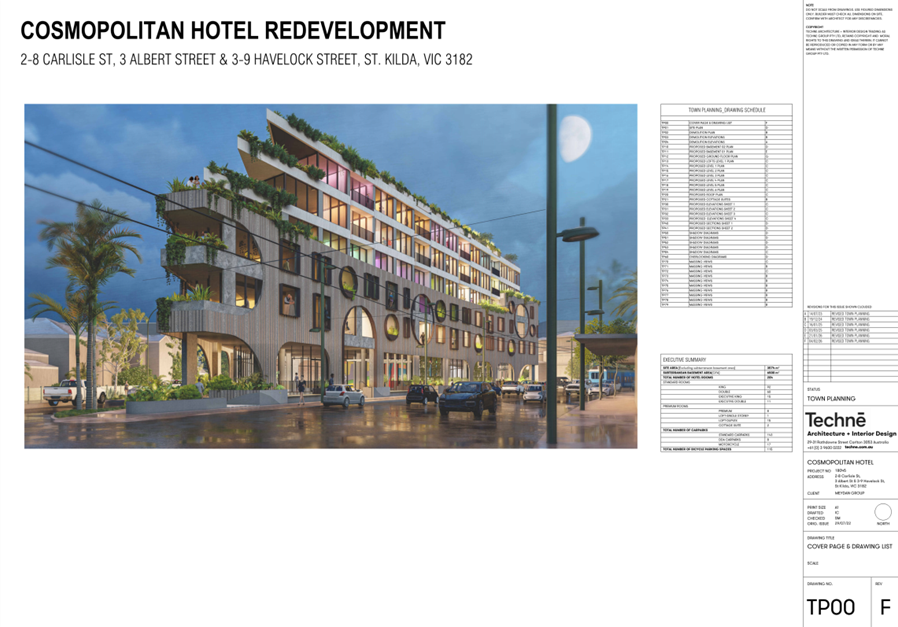
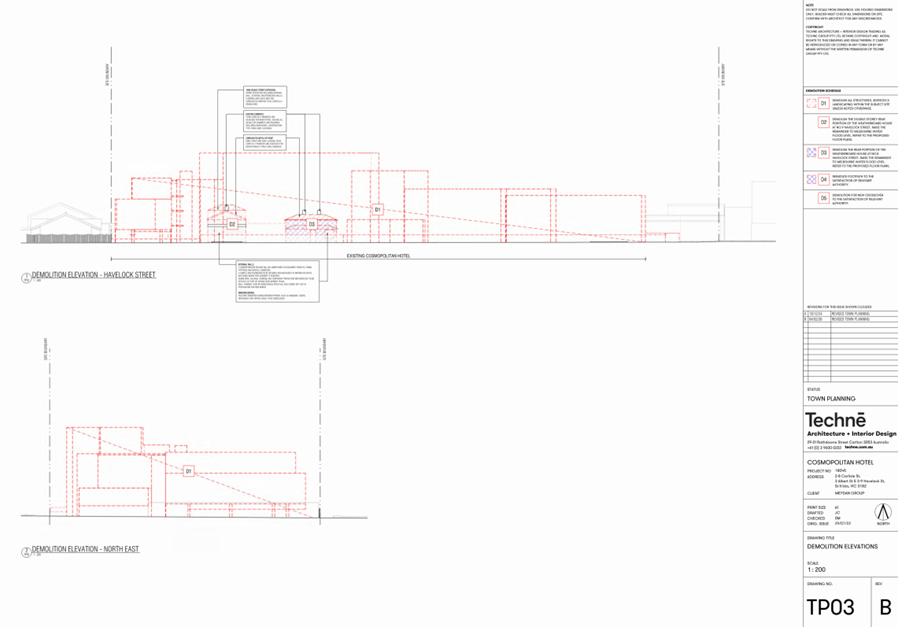
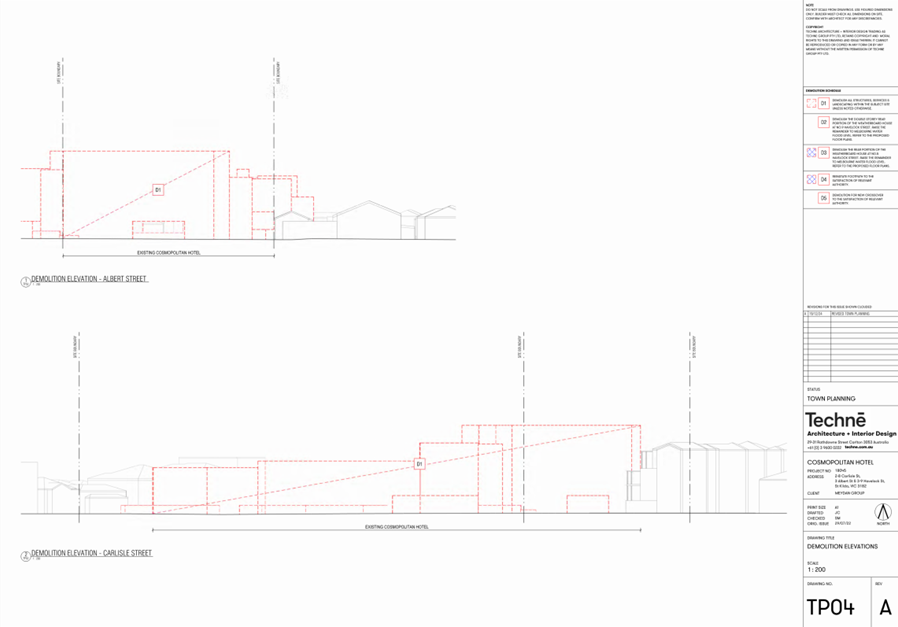
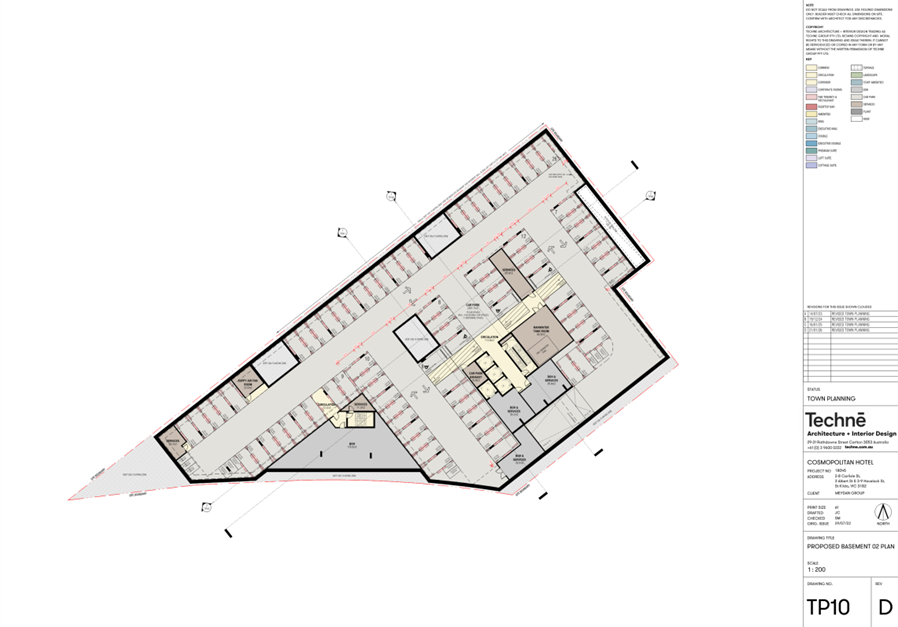
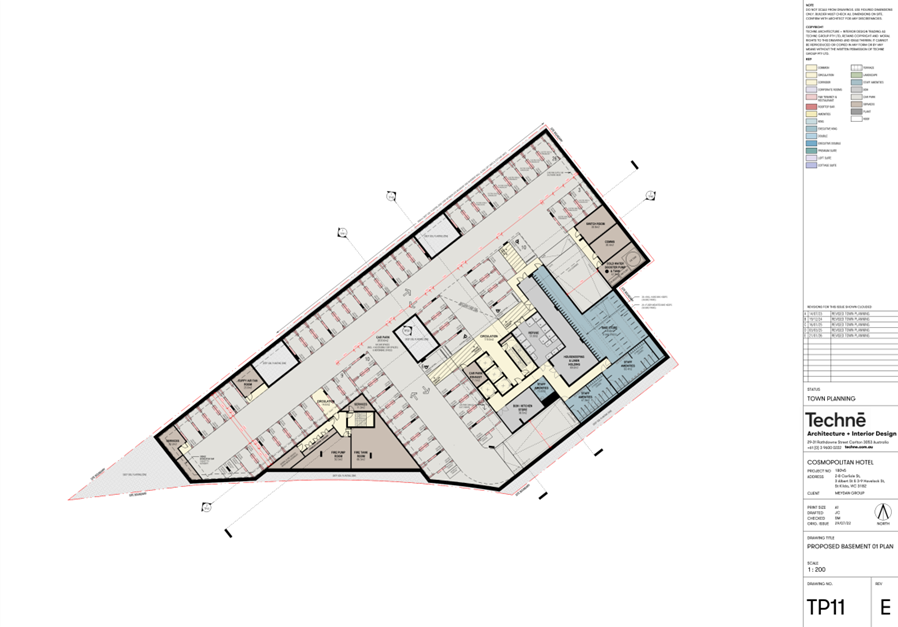
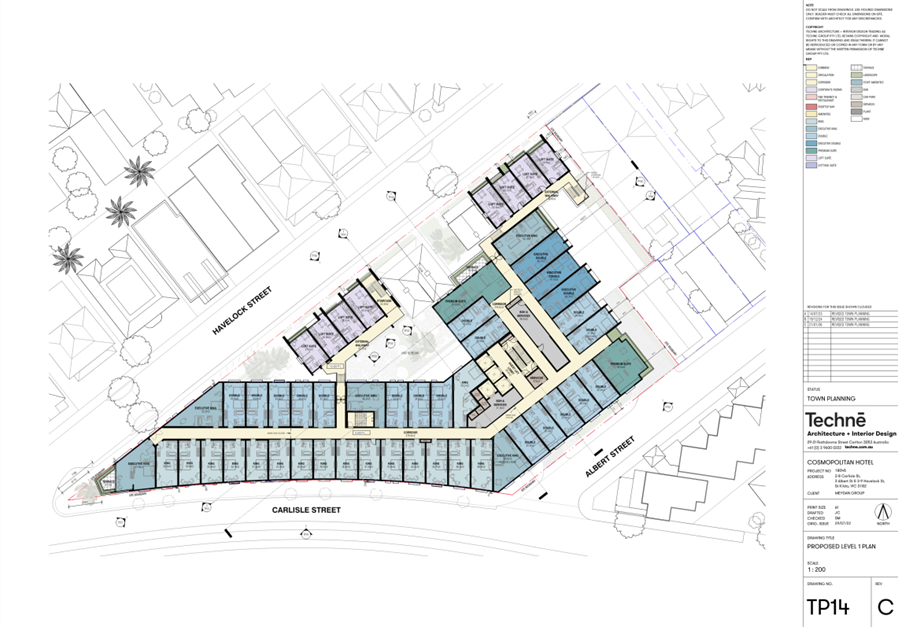
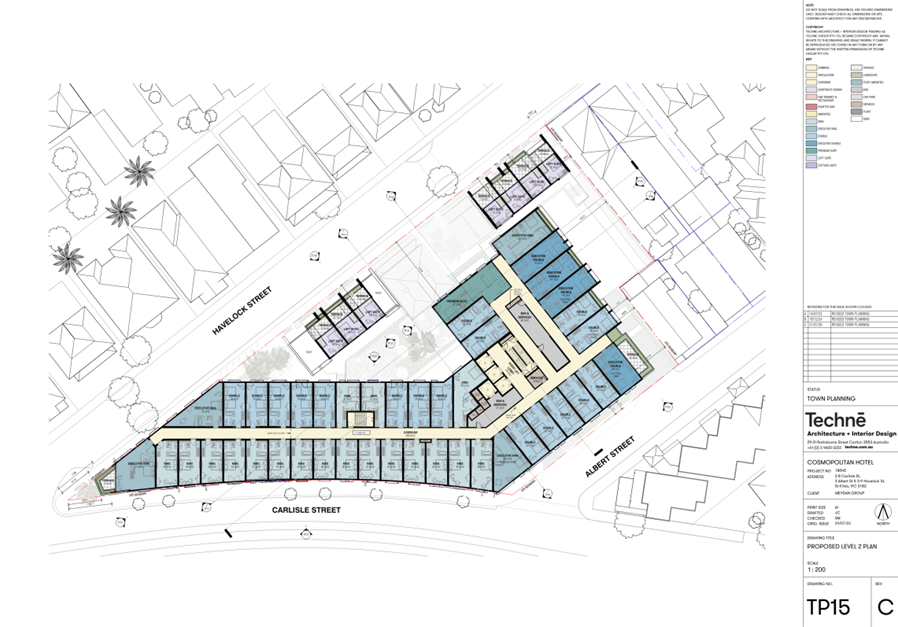
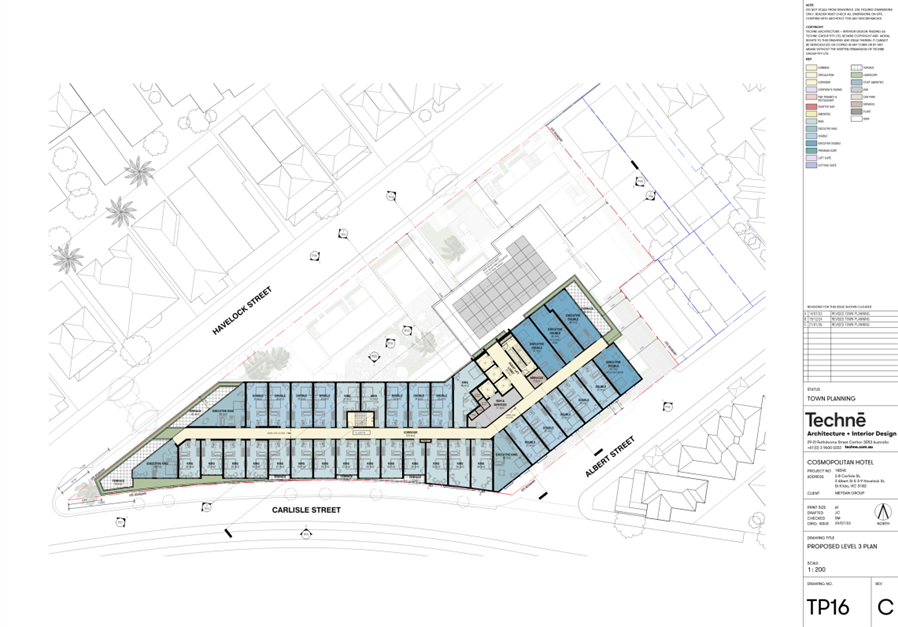
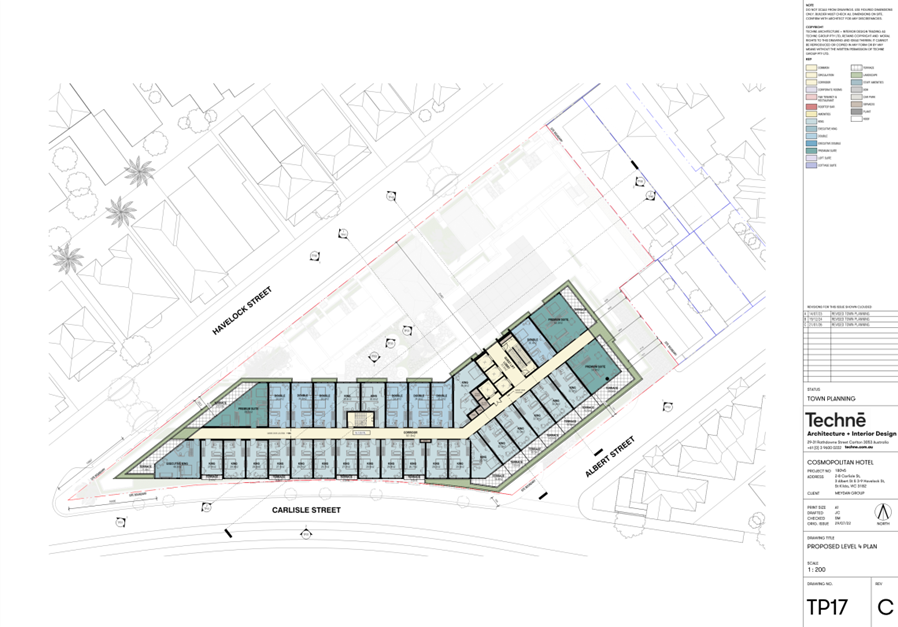
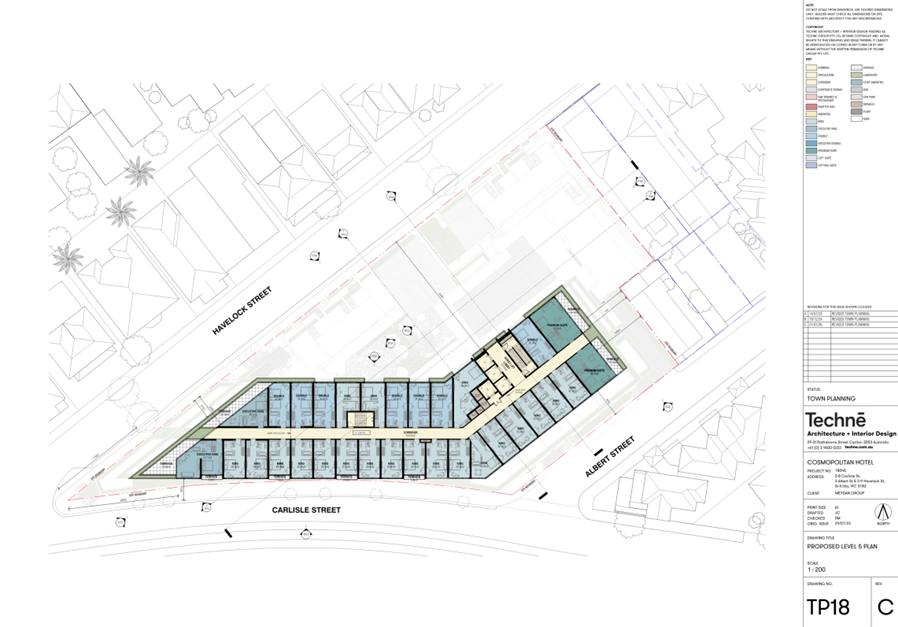
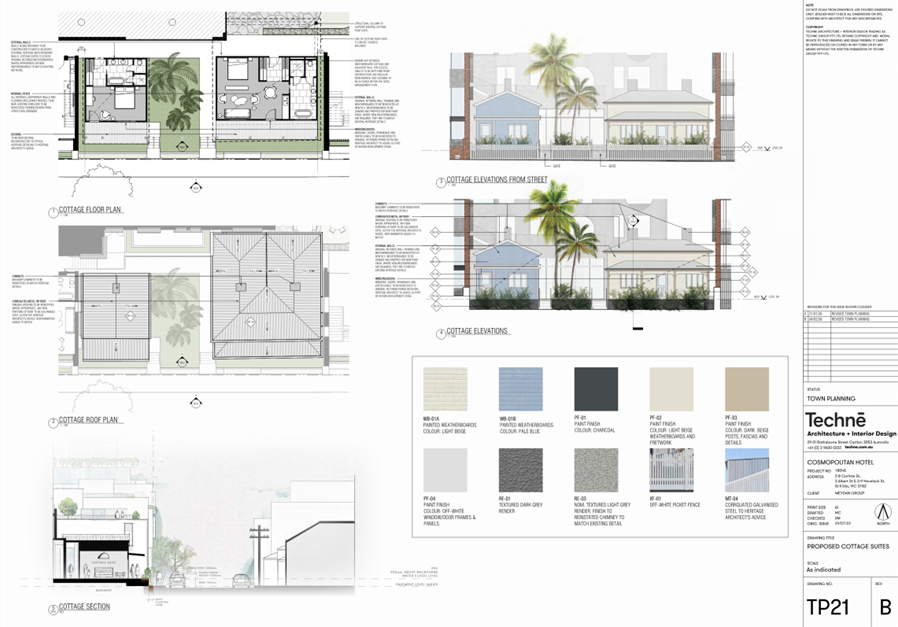
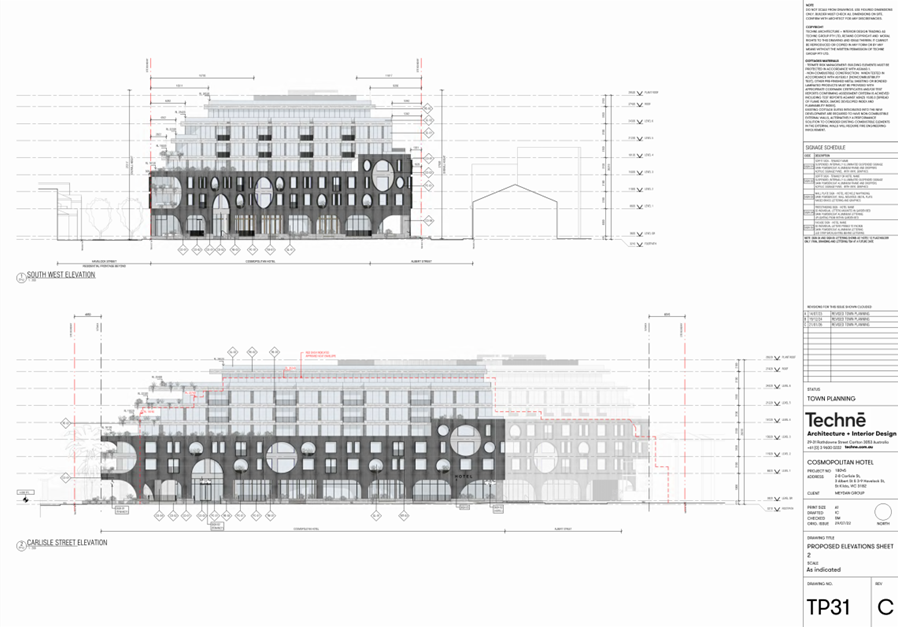
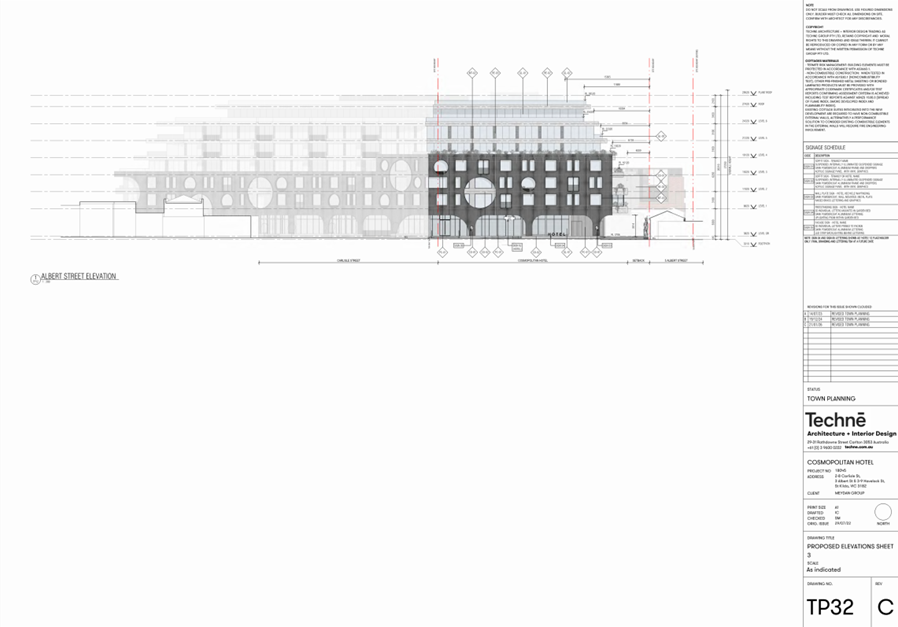
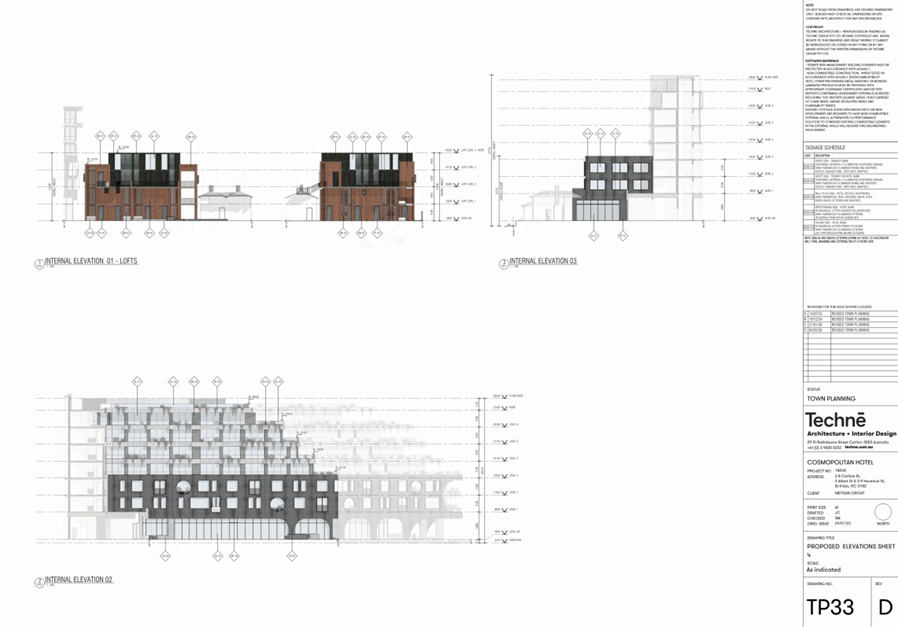
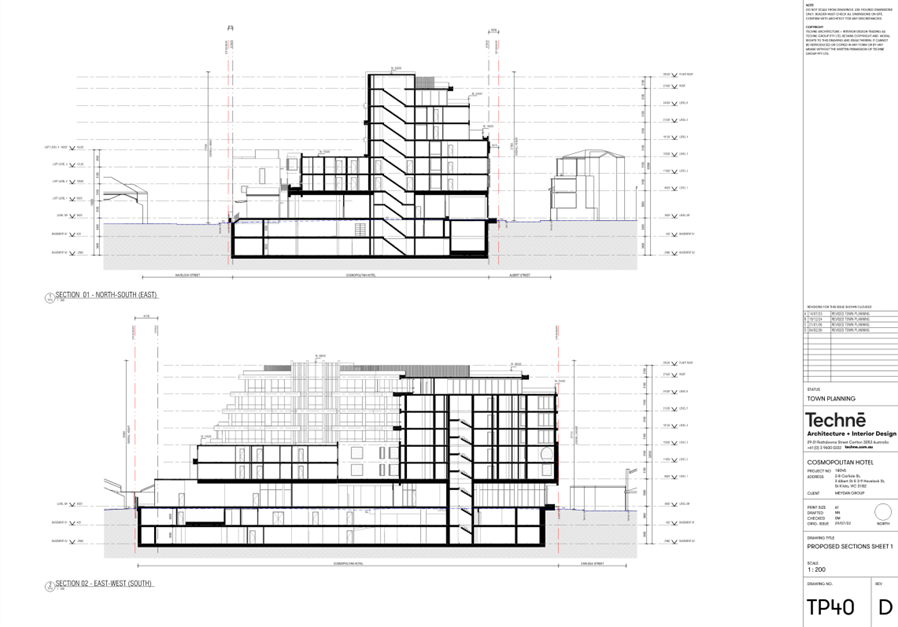
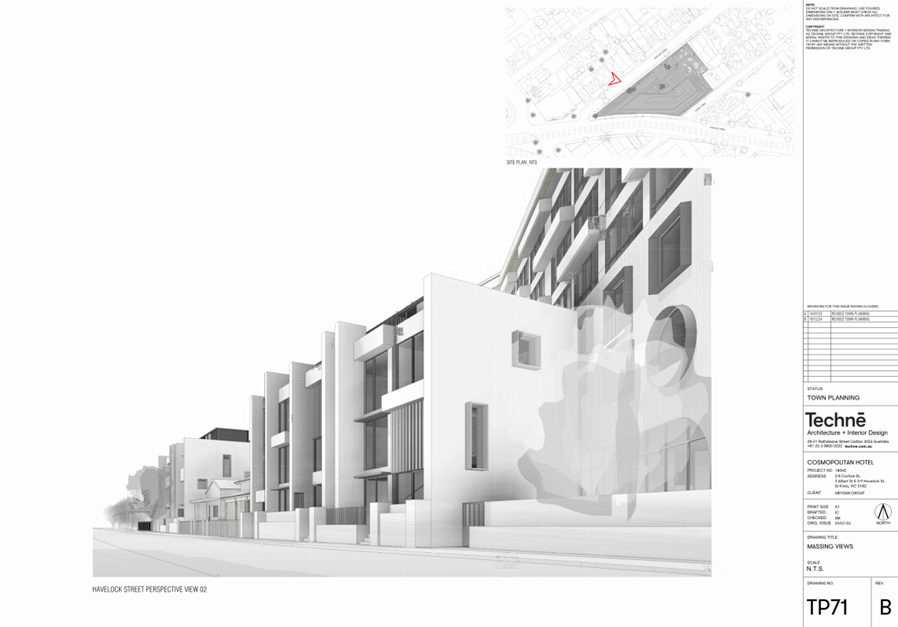
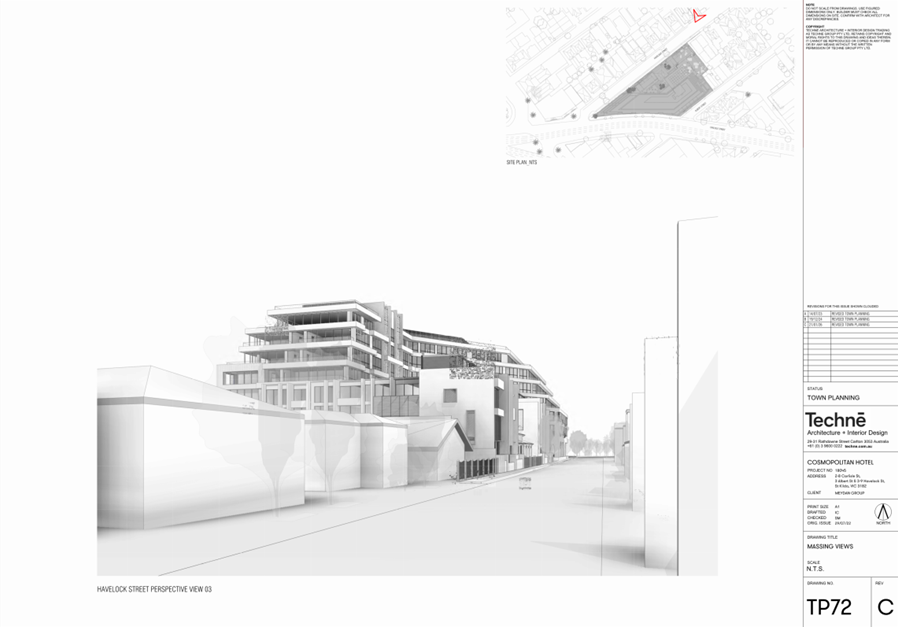
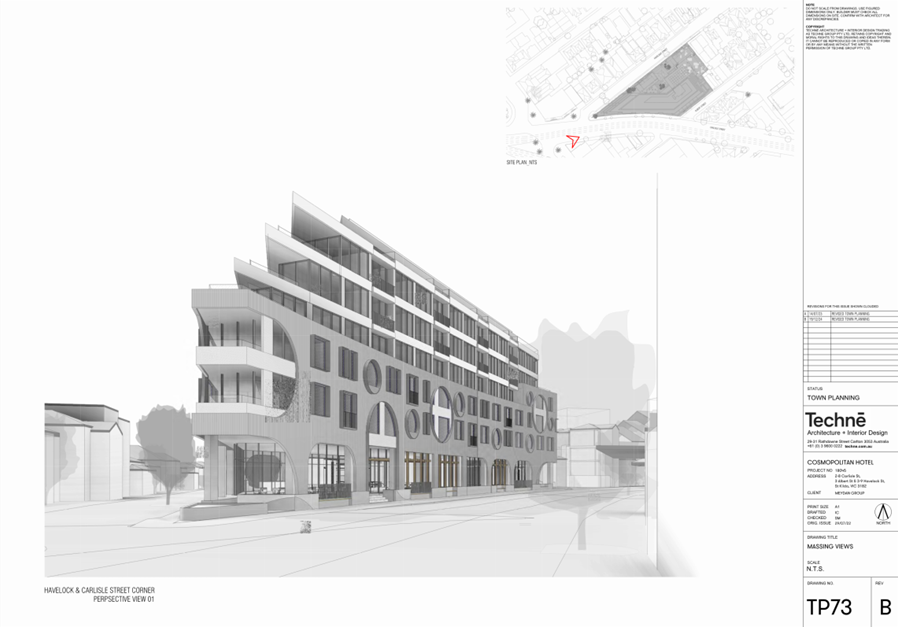
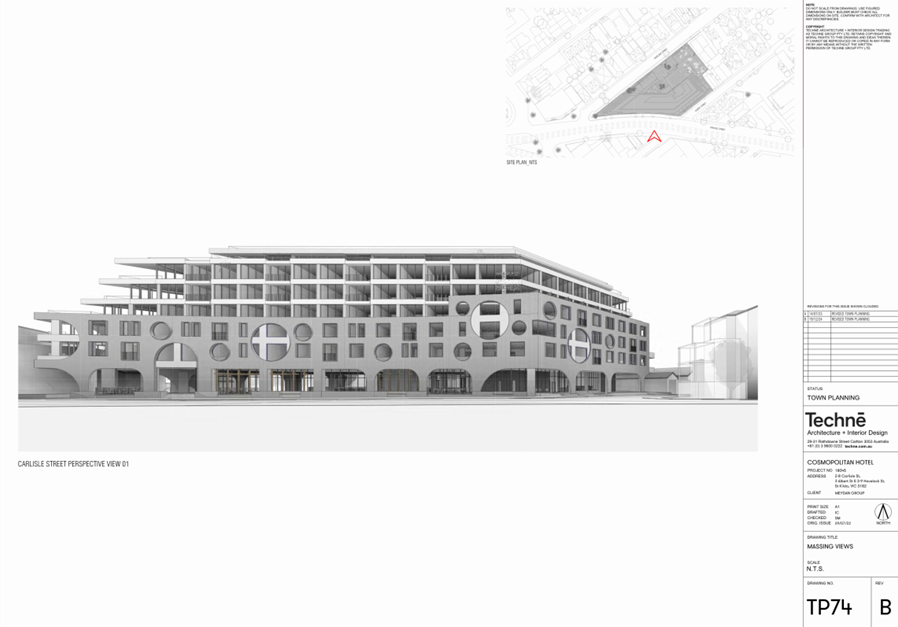
2.4 Planning Permit Application PA2503985 proposes the demolition of the existing hotel buildings on the site, and construction of a 204-room residential hotel up to 7-storeys in height, with associated function rooms and rooftop bar, a food and drinks premises and basement parking for 151 cars. Two existing heritage dwellings on the land are proposed to be partially demolished, with the retained sections of the buildings to be deconstructed, repaired and rebuilt on site. The dwellings will be altered and extended for use as hotel suites.
2.5 The planning permit application is made under Clause 53.22 – Significant Economic Development, of the Port Phillip Planning Scheme. These provisions provide the ability for the responsible authority, in this instance the Minister, to waive or vary any planning scheme requirements relating to building height or setbacks.
2.6 The Minister is consulting with Council under Section 20(5) of the Act and is seeking Council’s views on the draft Planning Scheme Amendment and Planning Permit Application for the subject site.
2.7 Following the consultation period, the Minister may decide to prepare, adopt, and approve the amendment and direct a permit be issued, or may refer this matter to the Priority Projects Standing Advisory Committee for advice and recommendations.
2.8 Any submissions the Minister receives will be considered in the assessment of the combined amendment and permit application.
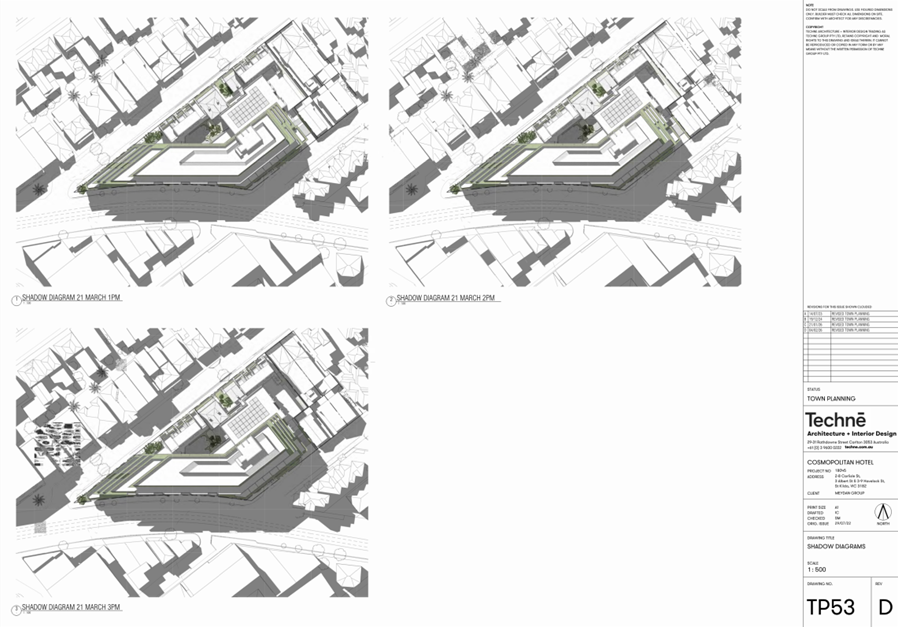
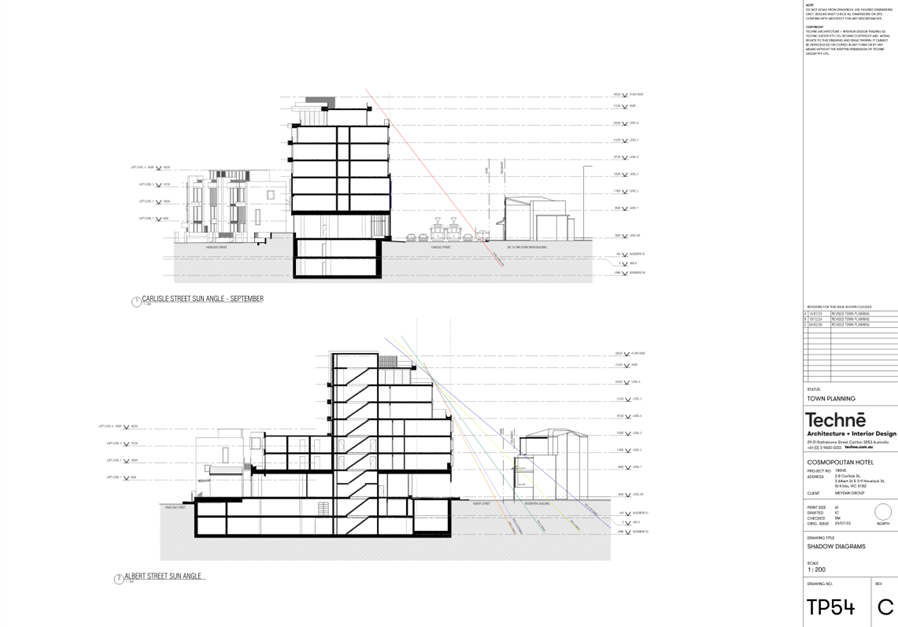
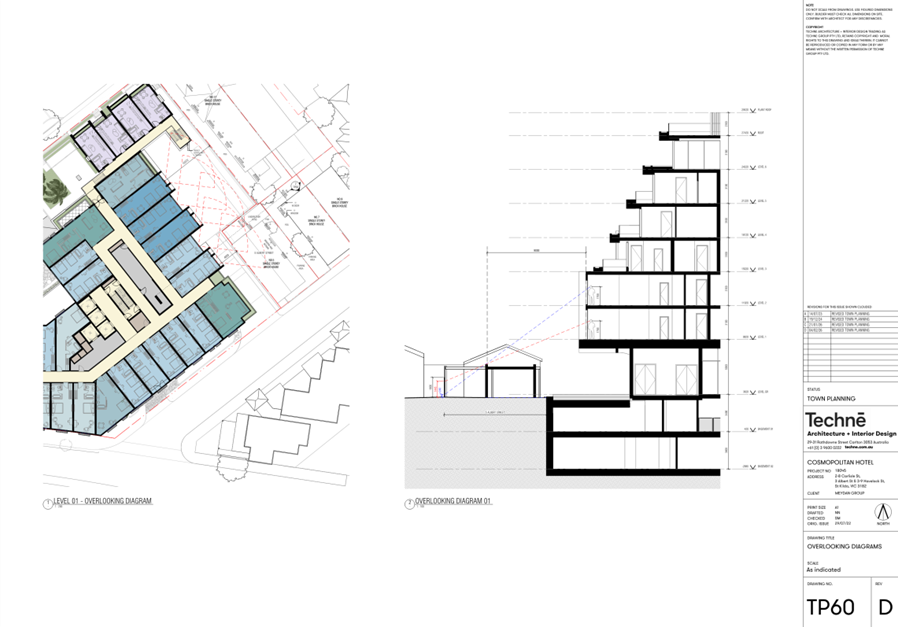
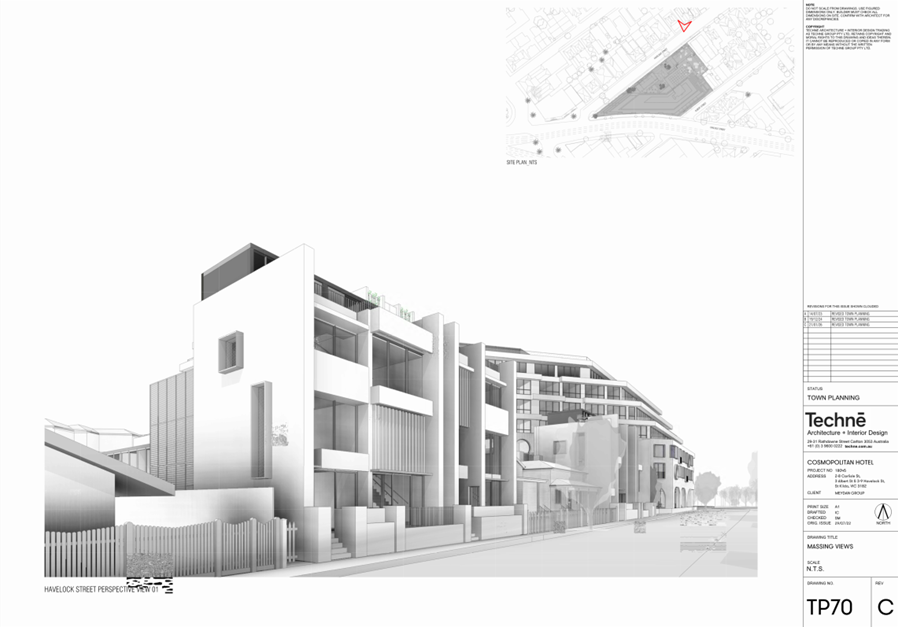
2.9 This report considers the draft amendment and planning permit application as outlined in the plans and reports provided to Council on 10 March 2026.
Application overview
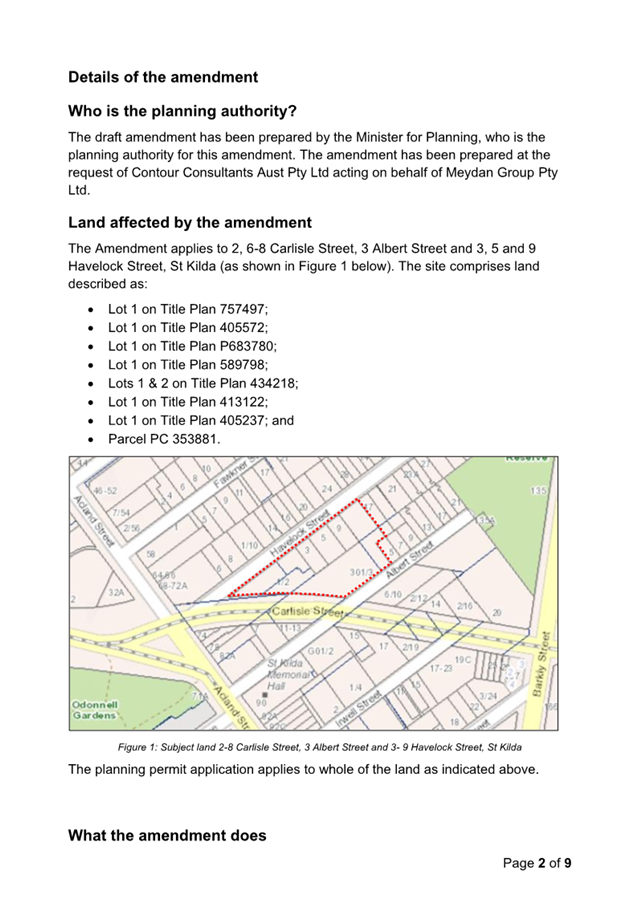
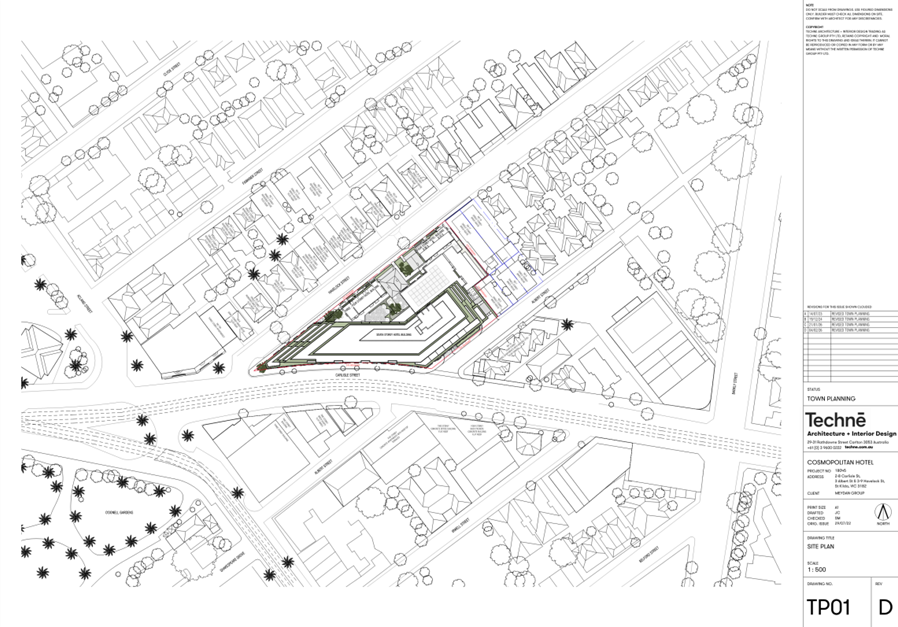
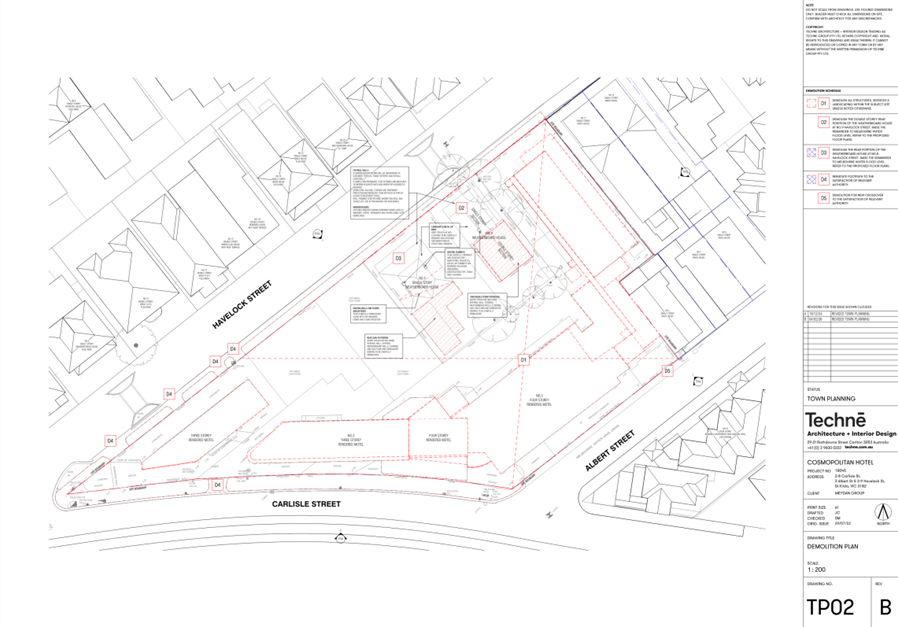
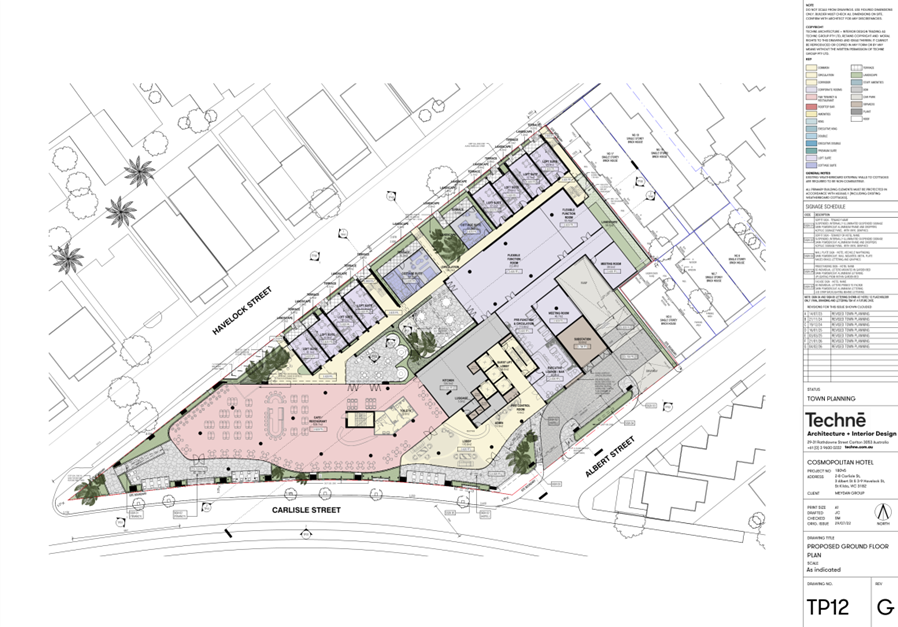
2.10 The subject site consists of 2, 6-8 Carlisle Street, 3 Albert Street and 3, 5 and 9 Havelock Street, St Kilda. The site is bound by Carlisle Street to the south, Albert Street to the south-east, Havelock Street to the north-west, and 17 Havelock Street and 5 Albert Street to the north-east.
2.11 The site is currently developed with the ‘Cosmopolitan Hotel and Apartments’, which consists of multiple buildings of three to five storeys in height, predominately located along the Carlise Street and Albert Street frontages, and at the north-eastern end of the site. At 5 and 9 Havelock Street, generally located near to the centre of the site along the north-western boundary, there two Victorian-era heritage dwellings. At-grade uncovered car parking and other hard paved areas occupy much of the remainder of the site.
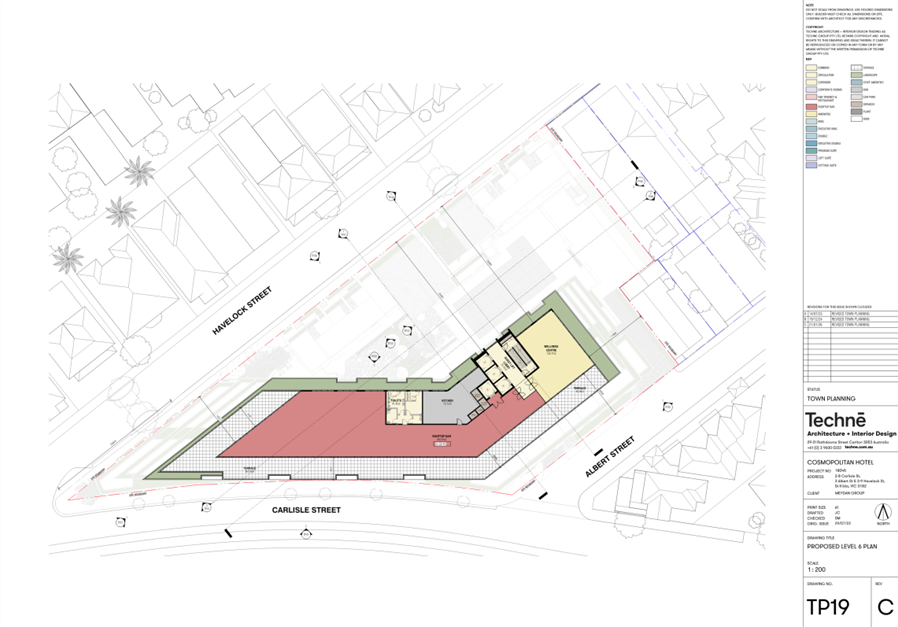
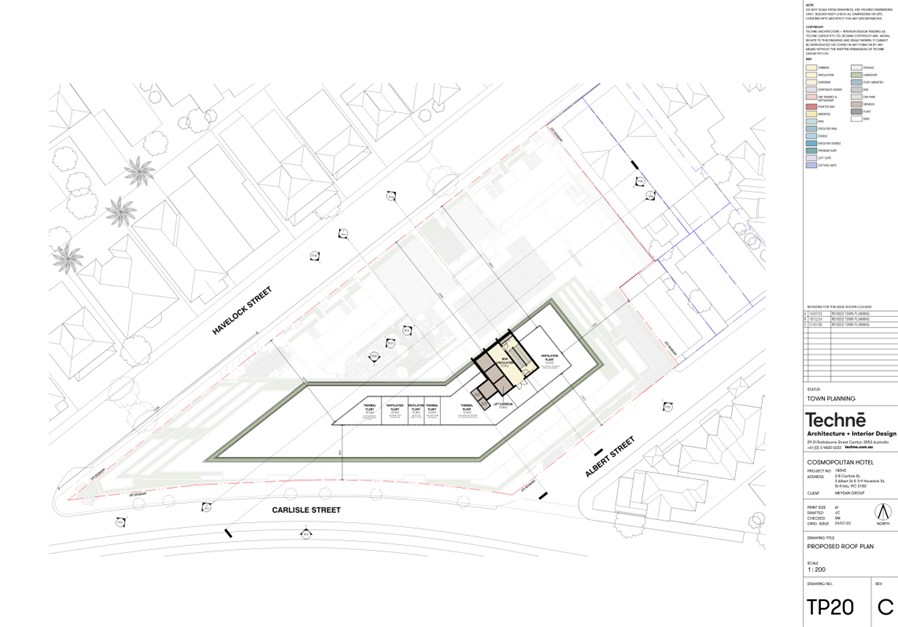
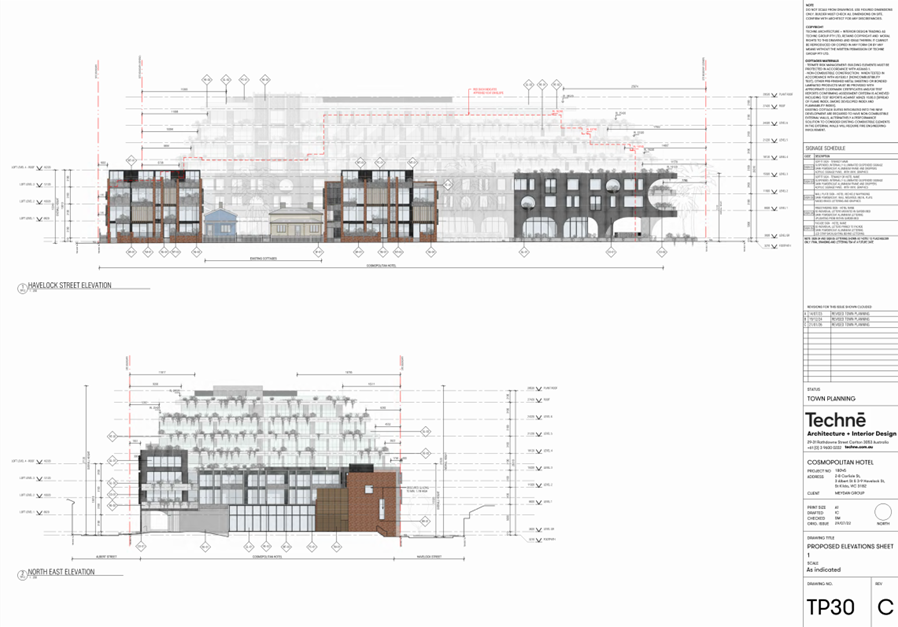
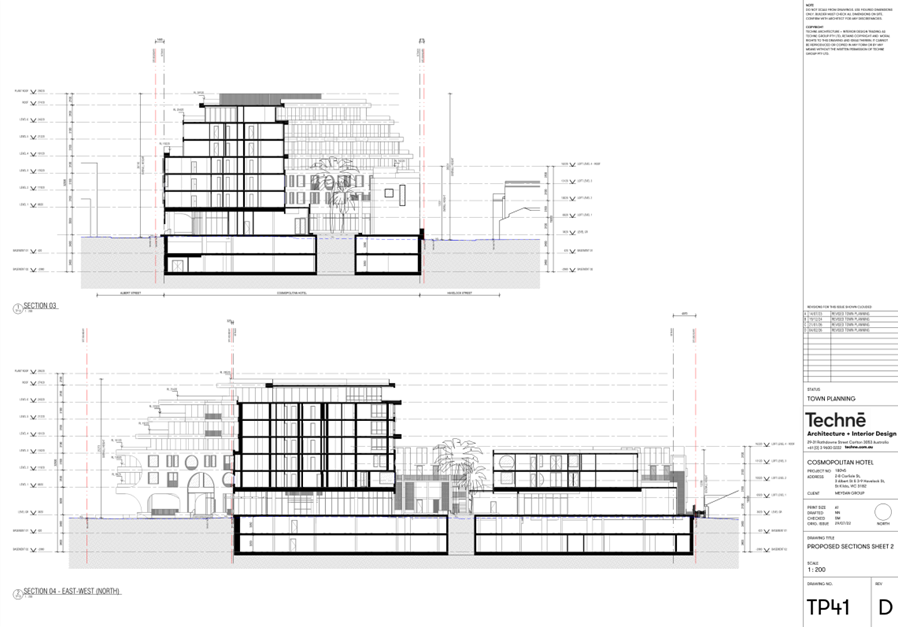
2.12 The proposed built form is somewhat staggered in nature, consisting of a seven-storey building to a maximum height of 27.52 metres generally along the south and south-eastern edges of the site interfacing with the Carlisle, Albert, and Havelock Street frontages. The principal entrance to this building is located adjacent the south-eastern corner of the site. Vehicle access to the two basement levels, and a port cochere and loading bay are accessed from Albert Street.
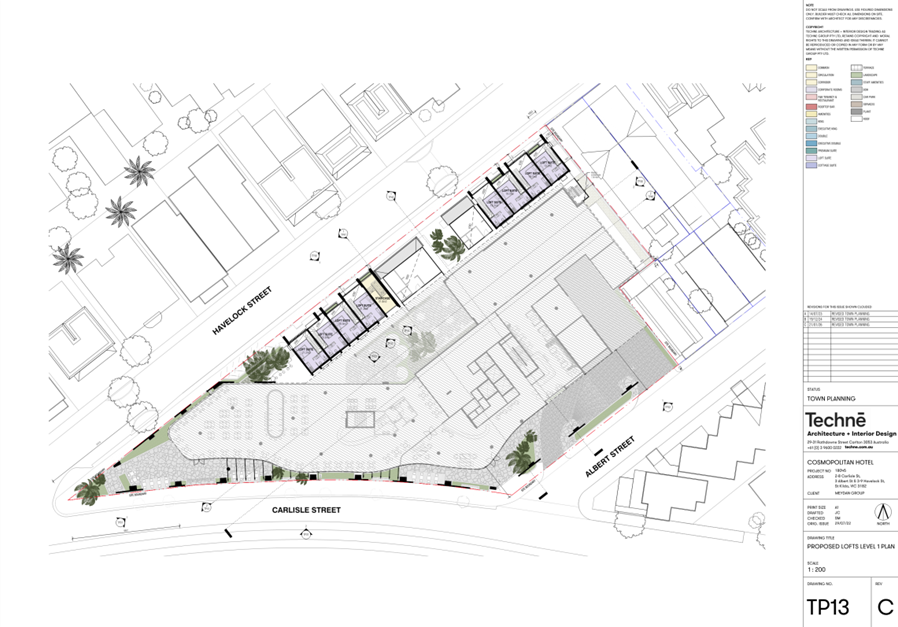
2.13 Along the north-western edge of the site and interfacing with Havelock Steet are two four-storey buildings to a maximum height of 13.34 metres, and the two retained single-storey heritage cottages.
2.14 It is recommended that Council resolve to advise the Minister that it objects to the Planning Scheme Amendment, raising issue with the removal of the mandatory garden area control not being the most appropriate mechanism to facilitate the development. It is also recommended that Council advise that a more appropriate amendment would see use of a Specific Controls Overlay (SCO) which could simultaneously allow for an intensified development of the site, whilst ensuring a specified development outcome was achieved.
2.15 It is also recommended that Council resolve to advise the Minister that it objects to the Planning Permit Application, raising a key procedural issue with respect to the owner’s obligations under an agreement encumbering part of the land.
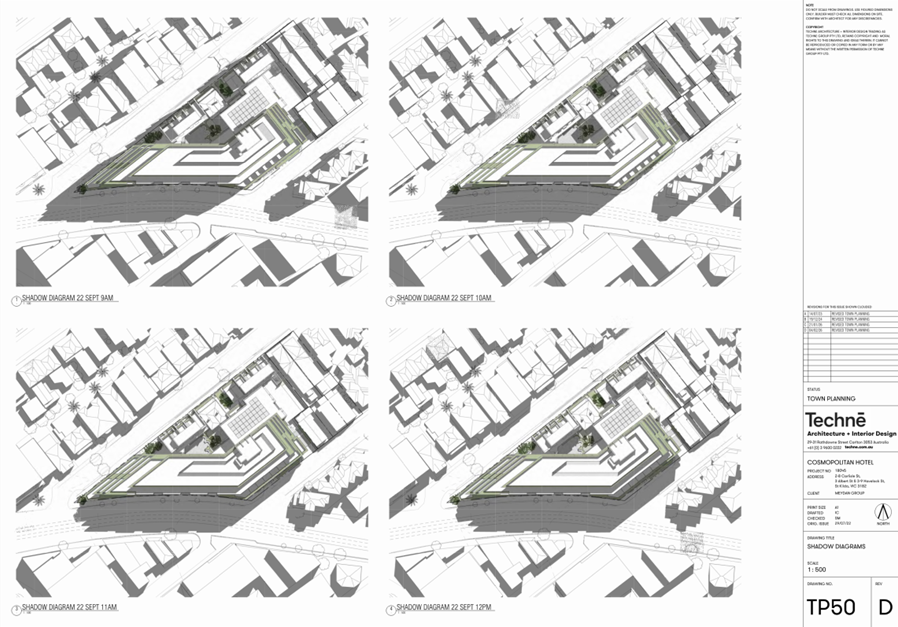
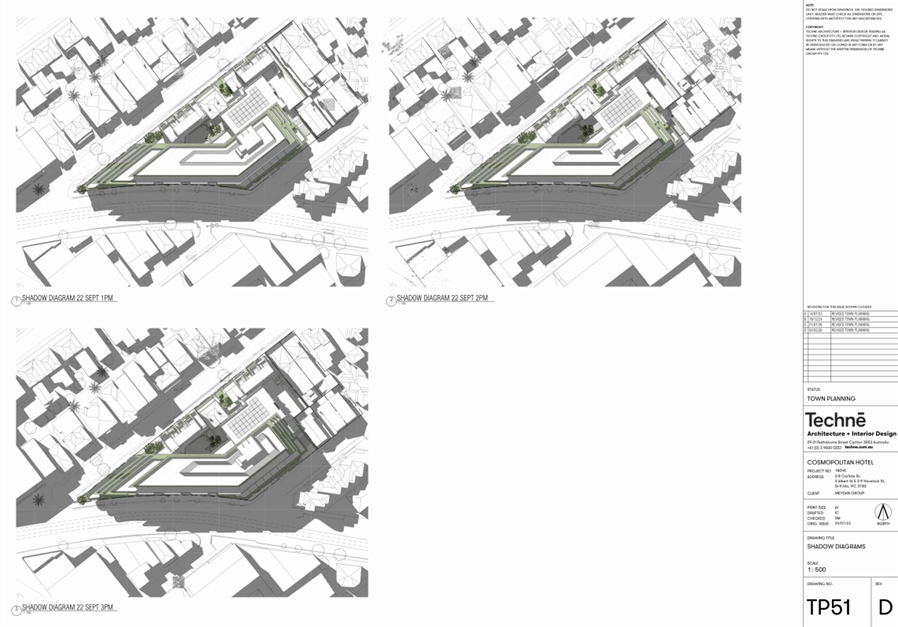
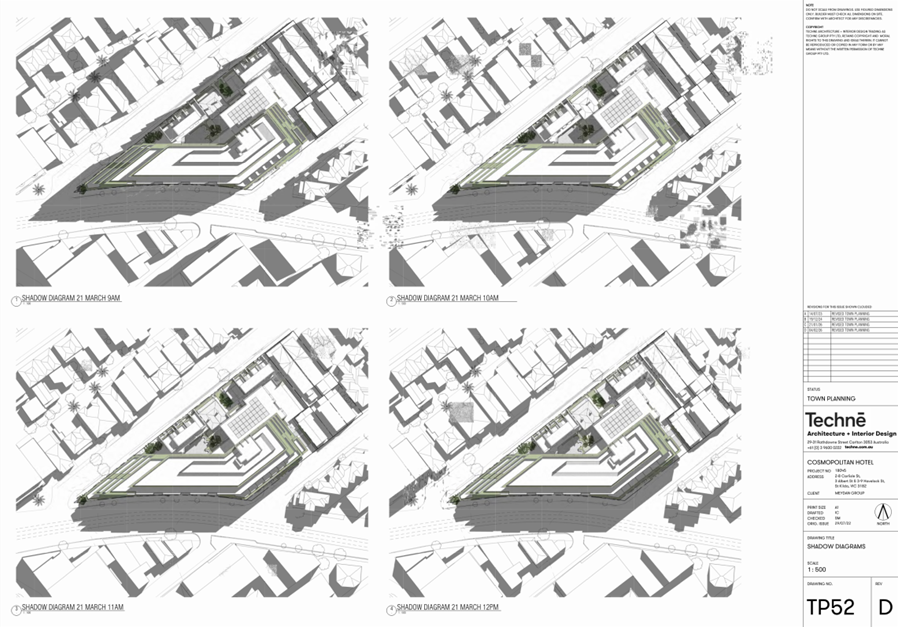
2.16 Additionally, key issues with the overall scale and the proposed urban design, architecture, and landscape architecture outcome are recommended to form additional bases of the objection.
2.17 Whilst it is recommended that Council resolve to advise the Minister of issues Council has with both the Planning Scheme Amendment and the Planning Permit Application, this report recognises the importance of providing the Minister with a suite of draft conditions upon which to base a permit if the Minister is of a mind to approve the application.
2.18 Failing to provide such conditions risks the issue of a permit which is not appropriately informed by the expertise Council possesses in urban design, landscape architecture, sustainable design, and waste management.
2.19 The suite of conditions, as best they can, seek to resolve key issues and omitted information identified in the application documents, as well as impose management plan requirements to ensure that if the use is approved, it will be managed appropriately.
2.20 It must be acknowledged that in performing what is akin to an advisory role to the Minister for this application, without the ability to formally request information from the applicant as would ordinarily occur, omissions from the application documents have not been able to be resolved directly with the applicant. The recommended conditions deal with this circumstance as best they can.
2.21 It is recommended that Council resolve to advise the Minister for Planning via the Department of Transport and Planning that Council:
· Objects to Planning Scheme Amendment C230port for the reasons set out in Recommendation – Part A
· Objects to Planning Permit Application PA2503985 for the reasons set out in Recommendation – Part B
· Requests that, if the Minister is of a mind to issue a permit for Planning Permit Application PA2503985, that it includes the conditions set out in Recommendation – Part C, and have regard for the fact that the conditions
2.22 It is further recommended that Council authorises the Manager Building and Planning Services to instruct planners or advocates in any future advisory committee proceedings as set out in Recommendation – Part D.
|
Recommendation – Part A 3.1 Council advises the Minister for Planning, via the Department of Transport and Planning, that Council objects to Planning Scheme Amendment C230port, and raises the following key issues: 1. The proposed Schedule 14 to the General Residential Zone to remove the mandatory garden area requirement from the site does not provide a certain development outcome in the event that the associated planning permit is not acted upon. 2. Consideration should be given to implementing a Specific Controls Overlay (SCO) which could simultaneously secure an appropriately intensive but specific use and development outcome for the site. Recommendation – Part B 3.2 Council advises the Minister for Planning, via the Department of Transport and Planning, that Council objects to Planning Permit Application PA2503985, and raises the following key issues: 2. The proposed scale of the development does not adequately respond to both the immediate and wider built form context as the development fails to: a) Adequately limit overshadowing to existing outdoor dining areas on the southern side of Carlise Street. b) Provide an acceptable graduation in building scale or massing between the established residential area to the north and the activity centre to the south. c) Provide sufficient upper-level recession to the north-eastern interfaces with the existing dwellings located within the Neighbourhood Residential Zone. 3. The views of the Office of the Victorian Government Architect have not been provided to Council, and it is unclear if the proposal has addressed concerns previously raised with the design as part of the Victorian Design Review Panel in December 2022 4. The proposed urban design, architecture, and landscape architecture outcome fails to adequately address the expectations of the purpose of Clause 53.22 and does not achieve a sufficient standard of design excellence to merit such a departure from the current height and setback controls which would ordinarily apply to the site.
Recommendation – Part C 3.3 Council advises the Minister for Planning, via the Department of Transport and Planning, that in the event the Minister is of a mind to issue a planning permit for the proposal, that the following conditions be considered for inclusion on any permit that may issue, with any necessary changes to ensure consistency with amended plans or documents submitted in the intervening time since Council provides this advice: Compliance with plans and documents approved under this permit 1. At all times what the permit allows must be carried out in accordance with the requirements of any plans or documents approved under this permit to the satisfaction of the responsible authority. Amended plans 2. Before the use and development starts, amended plans to the satisfaction of the responsible authority must be submitted to and approved by the responsible authority. When approved, the plans will be endorsed and will then form part of the permit. The plans must be drawn to scale with dimensions and must be generally in accordance with the advertised plans identified as TP02 to TP04, TP10 to TP21, TP30 to TP33, TP40 and TP41, prepared by Techne, but amended to show: a) Either Level 4 (shown on TP17) or Level 5 (shown on TP18) removed from the development to reduce the overall height by one storey, and with any resulting consequential and necessary changes contained wholly within the remaining approved building envelope; b) Setbacks of the built form where above level 4 and opposite the north-eastern boundary shared with 5 Albert Street to be as follows: i. Level 4 – no less than 13.4 metres ii. Level 5 – no less than 16.5 metres c) Relocation of the 7 floor mounted bicycle hoops at the Havelock Street frontage to a location visible to building entrances on Carlisle Street, and the adjacent landscaped area extended to the property boundary; d) External design features required to meet sustainable design commitments within the Sustainability Management Plan required by Condition 11 of this permit annotated on the architectural plans. This includes, but is not limited to, external shading devices, operable windows, and details of the solar reflective index of external materials. e) A minimum 1.8 metre solid imperforate barrier installed around the terrace area. Screening can be constructed from a minimum 10.38mm laminated glazing or approved alternative by a suitably qualified acoustic consultant. f) External glazing to rooftop bar installed with minimum 10.38mm laminated glass or 6/12/10.38mm insulated glass units (IGU) with full perimeter acoustic seals. g) Changes required to comply with the Conservation Management Plan required by Condition 5 of this permit; h) Changes required to comply with the Public Realm Improvement Plan required by Condition 7 of this permit; i) Changes required to comply with the Landscape Plan required by Condition 8 of this permit; j) Changes required to comply with the Sustainability Management Plan required by Condition 11 of this permit; k) Changes required to comply with the Waste Management Plan required by Condition 14 of this permit. Layout and use of the development not to be altered 3. The layout of the use and development must not be altered from the layout on the approved and endorsed plans without the written consent of the responsible authority. Recording before demolition 4. Before the demolition starts, an annotated photographic study to the satisfaction of the responsible authority must be submitted to the responsible authority as a record of the two heritage buildings to be retained. The study must be prepared by a suitably qualified person, and must include the following details: a) Each elevation of the buildings; b) Key architectural design details of each building (including, but not limited to, cast iron and verandah posts, windows, and architrave profiles); c) A statement prepared by an architectural historian describing and explaining both the design and construction of the building and the photographs. Conservation Management Plan 5. Concurrent with submission of amended plans required by Condition 2 of this permit, a conservation management plan to the satisfaction of the responsible authority must be submitted to and approved by the responsible authority. When approved, the plan will be endorsed and will form part of the permit. The plan must be prepared by a suitably qualified person, and must include the following details: a) Identify the buildings and works to be conserved; b) Fully describe and clearly demonstrate the methods of dismantling of the heritage fabric, restoration and repair, and the subsequent reconstruction of the buildings; c) Include references to the staging of demolition and reconstruction works on the site; d) Details the necessary protection works required during the demolition works to protect those parts of the building to be retained; e) Detail the necessary conservation methods for protection of materials during storage. The works details in the approved conservation management plan must be completed before the use approved by this permit commences, to the satisfaction of the responsible authority. Tree Management Plan 6. Concurrent with submission of amended plans required by Condition 2 of this permit, a Tree Management Plan (TMP) prepared by a suitably qualified arborist to comply with AS 4970-2025 Protection of trees on development sites to the satisfaction of Port Phillip City Council must be submitted to and approved by Port Phillip City Council. Once approved, the TMP will be endorsed by the responsible authority and form part of the permit. The TMP must set out how the existing street trees to the frontages of the site will be protected during demolition and construction works approved by this permit. The tree protection measures outlined in the TMP must be complied with to the satisfaction of the Port Phillip City Council. Public Realm Improvement Plan 7. Concurrent with submission of amended plans required by Condition 2 of this permit, a Public Realm Improvement Plan (PRIP) to the satisfaction of Port Phillip City Council must be submitted to and approved by Port Phillip City Council. Once approved, the plan will be endorsed by the responsible authority to form part of the permit. The public realm works shown in the PRIP must be designed in conjunction with Port Phillip City Council’s Planning and Open Space departments, and should include (but are not limited to): a) Treatment of the public realm within Carlisle Street, Havelock Street, and Albert Street b) A minimum of five trees interspersed along the footpath for the length of the Carlisle Street frontage. New planting species are to be to the satisfaction of Port Phillip City Council; c) A requirement that new street trees and all other planting must be maintained by the owner for a period of 12 months. Any diseased or damaged trees must be removed and replaces at the cost of the owner to the satisfaction of Port Phillip City Council; d) Planted build-outs, rain gardens, and/or street furniture (or other design features as appropriate) within the Havelock Street road reserve adjacent to where existing vehicle crossings are to be removed. All works shown within the PRIP must be completed within 6 months of the completion of the development. Landscape Plan 8. Concurrent with submission of amended plans required by Condition 2 of this permit, a Landscape Plan to the satisfaction of the responsible authority must be submitted to and approved by the responsible authority. When approved, the plan will be endorsed and will then form part of the permit. The Landscape Plan must be prepared by a person suitably qualified or experienced in landscape design and must be drawn to scale with dimensions. All plant species selected must be to the satisfaction of the responsible authority. The Landscape Plan must be generally in accordance with the ‘Landscape Concept Plan’ submitted with the application, identified as Drawing Number LC001, revision B – dated 4 March 2025, and prepared by RDLA, but amended to show: a) Layout of landscaping and planting, and location of paths, courtyards and decks, consistent with the plans required by Condition 2 of this permit; b) Layout of landscaping and planting within all open space areas of the subject land, and within all upper-floor areas shown as ‘Landscape’ on the plans required by Condition 2 of this permit; c) Retention and relocation of trees 2, 6, and 7 identified in ‘Arboricultural report, dated 10 December 2025, prepared by Galbraith & Associates’ to be incorporated into the landscape design; d) A survey (including botanical names) or all existing vegetation to be retained, relocated, or removed; e) Details of surface finishes of pathways, decks, courtyards, and driveways; f) A planting schedule of all proposed trees, shrubs and ground covers, including botanical names, common names, pot sizes, sizes at maturity, and quantities of each plant; g) Planter height, width, depth, and soil volume details, and confirmation the planters are of sufficient size to accommodate the plants they are proposed to accommodate; h) Confirmation all proposed plans are no invasive species; The responsible authority may consent in writing to vary any of these requirements. Completion of landscaping 9. The landscaping as shown on the endorsed landscape plan must be carried out and completed to the satisfaction of the responsible authority before the commencement of the use, or at such later date as is approved by the responsible authority in writing. Landscaping maintenance 10. At all times the landscaping shown on the approved landscape plan must be maintained (including the replacement of any dead, diseased or damaged plants) to the satisfaction of the responsible authority. Sustainability Management Plan 11. Concurrent with submission of amended plans required by Condition 2 of this permit, a Sustainability Management Plan (SMP) must be submitted to and approved by Port Phillip City Council. The SMP must be generally in accordance with the advertised SMP, revision 3 – dated 22 July 2025, prepared by WSP, but amended to show: a) A BESS Report, incorporated as an appendix to the report, and achieving at minimum best practice and pass scores in mandatory categories; b) A Water Sensitive Urban Design (WSUD) catchment plan which shows all permeable and impermeable surfaces, and associated catchment areas in accordance with the submitted STORM Rating Report (or if amendments are made a revised stormwater management report i.e. Blue Factor or MUSIC); c) Energy assessment provided under National Construction Code 2022 (NCC2022); d) Daylight modelling to support compliance with IEQ – 1.1 – Living Areas and 1.2 Daylight Access – Bedrooms requirements within the BESS Report. Upon approval, the SMP will be endorsed by the responsible authority to form part of the permit. 12. The provisions, recommendations and requirements of the endorsed Sustainability Management Plan must be implemented and complied with to the satisfaction of Port Phillip City Council and must not be varied except with the written approval of the responsible authority. Pre-occupation Sustainability Management Plan compliance report 13. Before the use starts, a report must be submitted confirming that all measures specified in the endorsed Sustainability Management Plan have been implemented in accordance with the approved plan. The report must be prepared by a suitably qualified Environmentally Sustainable Design professional and be to the satisfaction of the Port Phillip City Council. Waste Management Plan 14. Concurrent with submission of amended plans required by Condition 2 of this permit, a Waste Management Plan (WMP) must be submitted to and approved by Port Phillip City Council. The WMP must be generally in accordance with the advertised WMP, dated 4 March 2025, and prepared by One Mile Grid, but amended to show: a) A restaurant waste generation rate used for the restaurant/café use; b) The following waste generation rate used for the bar use: i. General waste – 50L per 10m2 per day; ii. Recycling – 50L per 100m2 per day. c) A maximum organic bin size of 240L; d) A minimum 1.5 metre door and corridor width for areas where 660L or 1100L bins are required to be moved; e) Details of the washdown area for bins, including location, and provision of any taps or drains; f) Details of the role of building management in the management of waste and resource recovery; g) Details of where hard waste will be stored; h) No more than three collections per waste stream per week; i) A scaled waste management drawing, including details of: i. The hard waste storage area and bin washing facilities; ii. Transfer paths of waste from the hotel to the waste storage area; iii. The transfer path of hard waste if hard waste is located in a different location from the bin storage area. Upon approval, the WMP will be endorsed by the responsible authority to form part of the permit. 15. The provisions, recommendations and requirements of the endorsed WMP must be implemented and complied with to the satisfaction of the Port Phillip City Council and must not be varied except with the prior written consent of Port Phillip City Council and the responsible authority. Vehicle crossing removal 16. Before the use starts, all existing disused or redundant vehicle crossings must be removed and the nature strip and kerb and channel reinstated to the satisfaction of the Port Phillip City Council at the cost of the owner. Hotel Management Plan 17. Before the use starts, a Hotel Management Plan (HMP) to the satisfaction of the responsible authority must be submitted to and approved by the responsible authority. When approved the plan will be endorsed and will then form part of the permit. The HMP must include: a) Responsibilities of the General or Duty Manager, and detailing they will be onsite at all times, providing immediate oversight of security, noise issues, maintenance and actioning of any complaints; b) Any CCTV surveillance to be provided; c) Reception/concierge operating hours; d) Staffing/management arrangements; e) Provision for ‘after hours’ arrivals and departures; f) Ongoing measures to be taken to ensure residential hotel guests and restaurant/café and bar patrons do not cause any unreasonable amenity impact to persons beyond the land; g) Establishment of a line of communication with adjoining owners and occupiers aimed at identifying and addressing amenity concerns; h) An outline of all house rules intended to be used to manage guests, including: i. guest behaviour; ii. noise; iii. use of private terraces; iv. methods of eviction if house rules are broken; i) Staffing and other measures which are designed to ensure the orderly arrival and departure of guests of the residential hotel and patrons of the restaurant/café and bar; j) Signage used to encourage responsible off-site patron behaviour; k) The training of staff in the management of patron behaviour; l) Staff communication arrangements; m) Measures to control noise emissions from the premises; n) Complaint handling process to effectively manage any complaints received. This must include a Complaints Register to be kept at the premises which records details of the complaint received, any action taken and the response provided to the complainant; o) Limit operating hours for the rooftop terrace to between 7am to 10pm each day; p) Limit maximum patron numbers to 200 within the rooftop terrace. q) Detail that music played within the terrace to be limited to background music only at approximately 70 dB(A) sound pressure level. Final music noise to be set to ensure compliance with EPA Publication 1826.4 Noise Protocol Part 2 criteria is achieved. r) Detail that deliveries must only be carried out on the land within the designated loading bays or within the basement levels, and must not disrupt the circulation and parking of vehicles on the land. s) Detail that deliveries to the land will occur only between 7am and 10pm to the satisfaction of the responsible authority: t) Detail that management of waste collection will be in accordance with the WMP required by Condition 14 of this permit. 18. The provisions, recommendations, and requirements of the endorsed Hotel Management Plan must be implemented and complied with to the satisfaction of the responsible authority. Regulation of rooftop terrace 19. The rooftop terrace may only be used between 7am and 10pm each day. 20. The rooftop terrace may accommodate no more than 200 patrons at any one time. 21. Music played within the rooftop terrace must be limited to background music only at approximately 70 dB(A) sound pressure level. Final music noise must be set to ensure ‘EPA Publication 1826.4 Noise Protocol Part 2’ criteria is achieved. Regulation of delivery times 22. Deliveries to and from the site must only be carried out on the land within the designated loading bays or within the basement levels, and must not disrupt the circulation and parking of vehicles on the land. 23. Deliveries to and from the site must only take place between 7am and 10pm each day. The responsible authority may consent in writing to vary this requirement. Car parking layout and access 24. Before the use starts, the areas set aside for the parking of vehicles and bicycles, and access lanes as shown on the endorsed plans must be: a) constructed b) properly formed to such levels that they can be used in accordance with the plans c) surfaced with an all-weather-seal coat d) drained e) line marked to indicate each car space and all access lanes f) clearly marked to show the direction of traffic along access lanes and driveways to the satisfaction of the responsible authority. At all times car spaces, access lanes and driveways must be kept available for these purposes. Once constructed, these areas must be maintained to the satisfaction of the responsible authority. General amenity provision 25. The use and development must be managed so that the amenity of the area is not detrimentally affected, through the: a) transport of materials, goods or commodities to or from the land b) appearance of any building, works or materials c) emission of noise, artificial light, vibration, smell, fumes, smoke, vapour, steam, soot, ash, dust, waste water, waste products, grit or oil d) presence of vermin to the satisfaction of the responsible authority. Permit expiry 26. This permit will expire if one of the following circumstances applies: a) The development is not started within 3 years of the issued date of this permit. b) The development is not completed within 5 years of the issued date of this permit. c) The use does not start within 3 years of completion of the development. In accordance with Section 69 of the Planning and Environment Act 1987, an application may be submitted to the Responsible Authority for an extension of the periods referred to in this condition. Recommendation – Part D 3.4 That Council authorise the Manager Building and Planning Services to instruct Council’s statutory planners and/or Council’s advocate on any future advisory committee proceedings. |
4. RELEVANT BACKGROUND
Planning permit 1286/2008 (issued 17 September 2009)
4.1 On 9 December 2008, a planning application was made to Council to redevelop part of the Cosmopolitan Hotel site. During the processing of the application, Council received 33 objections. On 19 June 2009, Council decided to issue a Notice of Decision to Grant a Permit for the proposal. None of the objectors sought a review of Council’s decision, and so the planning permit was issued on 17 July 2009. The permit granted permissions for:
To develop and use the land for the purpose of Demolition of particular buildings, construction of new buildings of partly 3 and partly 6 levels (dwellings and residential hotel) above basement car parking. Proposed uses including (3) food & drink premises (two being licensed restaurants), one café, once convenience shop together with reduction in parking provision (79 basement spaces) generally in accordance with the endorsed plans
4.2 The permit was subject to 35 conditions, including two conditions requiring the removal of one level form the building presenting to Carlisle Street (to be a maximum of 6 storeys), and one level from the buildings facing Havelock Street (to be a maximum of 3 storeys).
4.3 On 6 August 2009, the applicant lodged an application for review with the Victorian Civil and Administrative Tribunal (VCAT) seeking review of 14 of the conditions imposed by Council, including the two conditions relating to removal of one level. On 14 May 2010, VCAT varied Council’s decision, and directed a permit be issued. VCAT varied one of the conditions relating to removal of one level, however the maximum number of storeys permitted remained at 6 storeys.
4.4 Planning permit 1286/2008 was amended on 13 May 2014 to address potential soil contamination via inclusion of a new condition requiring a preliminary site assessment.
4.5 Council approved three extensions of time to the expiry of the permit, resulting in a permit expiry date of 13 May 2018 if the development did not commence. A fourth extension of time was requested on 9 April 2018, and Council refused this request. The permit consequently expired.
5. Subject site and surrounds
Subject site
5.1 The subject site is identified as 2 and 6-8 Carlisle Street, 3 Albert Street and 3, 5 and 9 Havelock Street, St Kilda. It is 3,574 square metres in area and is irregular in shape. The site fronts to Carlise Street to the south, Albert Street to the south-east, Havelock Street to the north-west, and 5 Albert Street and 17 Havelock Street to the north-east.
5.2 The subject site is zoned General Residential Zone, Schedule 1 (GRZ1), and is affected by a Heritage Overlay (HO5 – St Kilda Hill) and is partially affected by a Special Building Overlay, Schedule 1 (SBO1).
5.3 The site is constituted by land contained in the following certificates of title:
· Vol 03174 Fol 631 Lot 1 TP405572H
· Vol 06418 Fol 583 Lots 1 and 2 TP434218N
· Vol 08772 Fol 239 Lot 1 TP589798X
· Vol 03174 Fol 630 Lot 1 TP683780T
· Vol 04667 Fol 367 Lot 1 TP757497D
· Vol 03577 Fol 206 Lot 1 TP413122V
· Vol 07988 Fol 193 Lot 1 TP405237X
· Vol 10149 Fol 044 Land in Plan of Consolidation PC353881G
5.4 Land in Plan of Consolidation PC353881G is subject to an agreement entered into pursuant to Section 173 of the Planning and Environment Act 1987 (Agreement W796559C). The agreement contains a number of obligations on the owners of the land relating to a drainage easement contained within that land which benefits Council. The implications of the agreement on this application are discussed in more details later in this report.
5.5 The site is currently developed with the ‘Cosmopolitan Hotel and Apartments’, which consists of multiple buildings of three to five storeys in height, predominately located along the Carlise Street and Albert Street frontages, and at the north-eastern end of the site. At 5 and 9 Havelock Street, generally located near to the centre of the site along the north-western boundary, there two Victorian-era heritage dwellings. At-grade uncovered car parking and other hard paved areas occupy much of the remainder of the site.
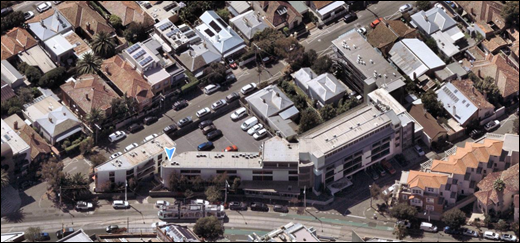
Figure 1. South oblique aerial image of subject site (Nearmap, 14 February 2026)
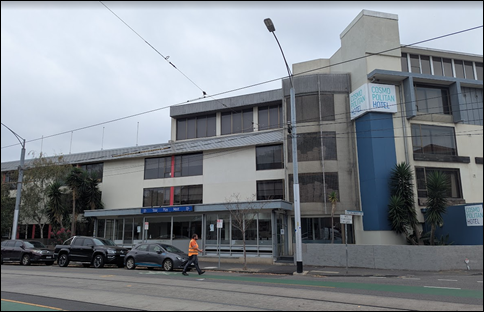
Figure 2. Subject site viewed from opposite side of Carlise Street (officer inspection, 27 April 2026)
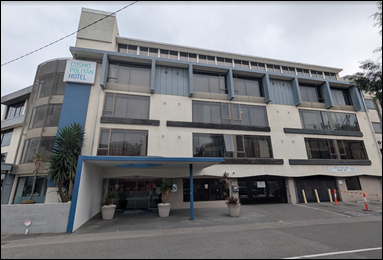
Figure 3. Subject site viewed from opposite side of Albert Street (officer inspection, 27 April 2026)
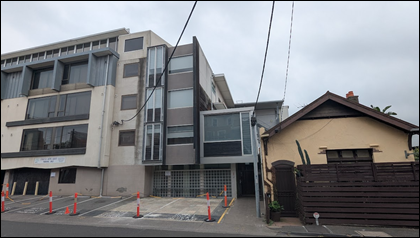
Figure 4. Subject site viewed from opposite side of Albert Street, showing existing interface with 5 Albert Street (officer inspection, 27 April 2026)
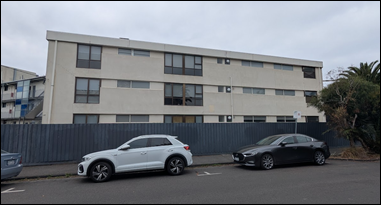
Figure 5. Subject site viewed from opposite side of Havelock Street, showing existing three-storey building at western corner of site (officer inspection, 27 April 2026)
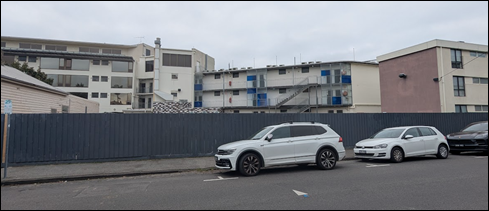
Figure 6. Subject site viewed from opposite side of Havelock Street, showing rear of existing three and five-storey building (officer inspection, 27 April 2026)
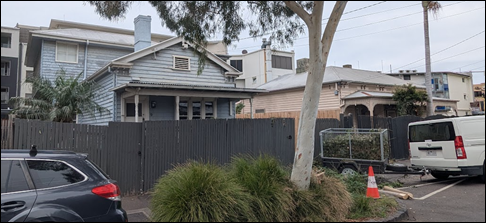
Figure 7. Subject site viewed from Havelock Street, showing existing heritage dwellings at 5 & 9 Havelock Street (officer inspection, 27 April 2026)
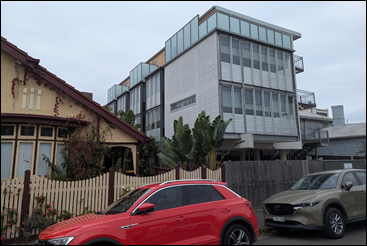
Figure 8. Subject site viewed from Havelock Street, showing existing four-storey interface with 17 Havelock Street (officer inspection, 27 April 2026)
Surrounding area
5.6 The site is located across Carlisle Street from the northern edge of the St Kilda Major Activity Centre. The area is characterised by a mix of land uses and building typologies, ranging from single storey dwellings to four-storey apartments, and one and two-storey office and retail uses.
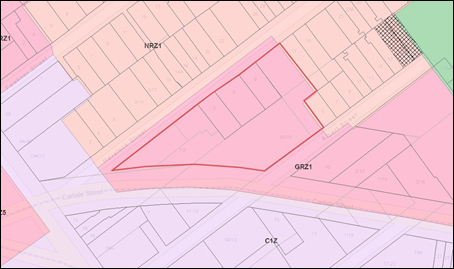
Figure 9. Map showing zoning of subject site and surrounding area (VicPlan, 27 April 2026)
5.7 Immediately adjoining and adjacent land is developed as follows:
North-west to north-east
Havelock Street runs the full length of the north-western boundary of the site. Beyond this, the land is predominately low-scale residential development constituted by one and two-storey dwellings, generally of Victorian and Federation-era. The same is said of the land directly abutting to the north-east. This land is zoned Neighbourhood Residential Zone, Schedule 1 (NRZ1).
South-east
Albert Street runs the full length of the south-eastern boundary. Beyond this, the land is developed with a four-storey apartment building, with ground floor car parking. This land is zoned General Residential Zone, Schedule 1 (GRZ1), the same as the subject site.
South
Carlisle Street runs the full length of the southern boundary and accommodates a tram line for the No. 3 and 16 trams. Beyond this, the land is developed with a mix of two to four-storey buildings, seeing a mix of commercial (food and drink premises and offices) and accommodation (apartments and backpackers) uses. This land is zoned Commercial 1 Zone
West
Beyond the Havelock Street and Carlisle Street intersection, the land is developed with a three and four-storey mixed use apartment building. This land is zoned Commercial 1 Zone.
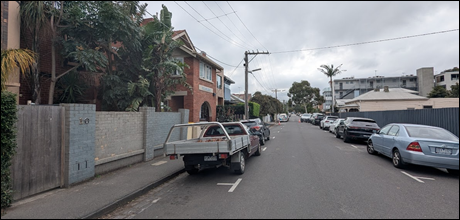
Figure 10. Looking north-east along Havelock Street from near western corner of subject site (officer inspection, 27 April 2026)
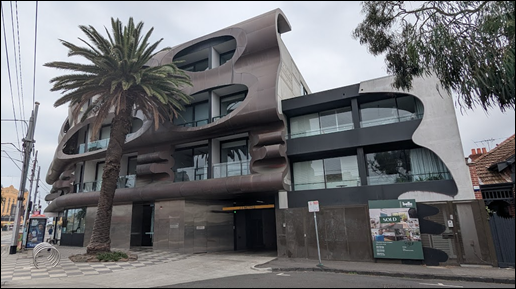
Figure 11. Mixed-use development at 68-72A Acland Street, viewed from Havelock Street near western corner of subject site (officer inspection, 27 April 2026)
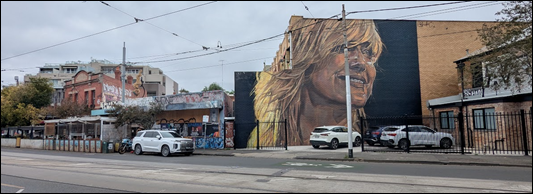
Figure 12. Commercial developments at 7 & 11-13 Carlisle Street, and rear of 78 & 78A Acland Street, viewed from near western corner of subject site (officer inspection, 27 April 2026)
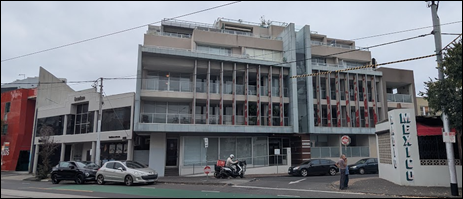
Figure 13. Mixed-use development at 2 Albert Street, viewed from near south-eastern corner of subject site (officer inspection, 27 April 2026)
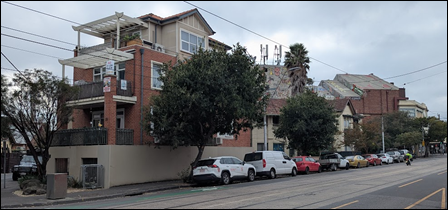
Figure 14. Apartment development at 10 Carlisle Street, viewed from corner of Carlisle and Albert Streets (officer inspection, 27 April 2026)
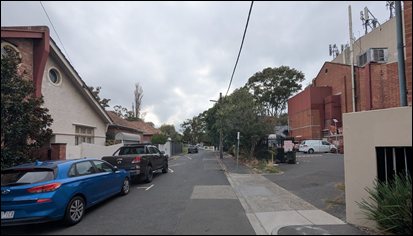
Figure 15. Looking north-east along Albert Street toward J Talbot Reserve from near eastern corner of subject site (officer inspection, 27 April 2026)
Figure 16. Mixed-use development at 17-23 Irwell Street, viewed from opposite side of Irwell Street (officer inspection, 27 April 2026)
6. proposal
6.1 Planning Scheme Amendment C230port proposes the replacement of Schedule 1 to the General Residential Zone that applies to the land with a new Schedule 14 (GRZ14) at Clause 32.08 (General Residential Zone) of the Port Phillip Planning Scheme. The proposed Schedule 14 to the General Residential Zone, which will provide an exemption to the mandatory garden area provisions at Clause 32.08-4 of the Port Phillip Planning Scheme.
6.2 The explanatory report for the proposed amendment is included at Attachment 1 of this report.
6.3 Planning permit application PA2503985 proposes the demolition of the existing hotel buildings and the construction of buildings and works for a residential hotel, use of land for a food and drinks premises, partial demolition and the construction of alterations and additions to buildings at 5 and 9 Havelock Street and use of these buildings as residential hotel, and removal of a canopy tree.
6.4 The architectural plans considered are included at Attachment 2 of this report.
|
Architectural plans |
Advertised plans, identified as TP00 to TP04, TP10 to TP21, TP30 to TP33, TP40, TP41, TP50 to TP54, TP60, TP70 to TP79, prepared by Techne |
|
Supporting plans / reports |
‘Port Phillip Planning Scheme Draft Amendment C230port Combined Planning Permit Application PA2503985 – Explanatory Report’ ‘Port Phillip Planning Scheme Amendment C230port – Instruction sheet’ ‘Port Phillip Planning Scheme – Local Provision, Amendment C230port, Part of Planning Scheme Map 6’ ‘Proposed C230port – Schedule 14 to Clause 32.08 General Residential Zone’ Landscape Concept Plan Ground Floor, LC001, revision B – dated 4 March 2025, prepared by Techne Memorandum of Heritage Advice, updated 22 January 2026, prepared by Bryce Raworth Arboricultural report, dated 11 December 2025, prepared by Galbraith & Associates TP80, drawing type ‘Signage Plan’, revision A – dated 12 December 2025, prepared by Techne Sustainability Management Plan, revision 3 – dated 22 July 2025, prepared by WSP Urban Context Report, revision c – dated 12 December 2025, prepared by Techne Cosmopolitan Hotel – Façade Lighting Detail + Lift Core Visualisations, dated 4 July 2025, prepared by Techne Cosmopolitan Hotel Redevelopment – Acoustic Assessment, revision 1 – 16 December 2025, prepared by Acoustic Logic Transport Impact Assessment, dated 14 January 2026, prepared by One Mile Grid |
6.5 Key aspects of the proposal include:
|
Building height |
Overall - 7 storeys / 27m • Main building 3-4 storeys (12-15m) near to centre of site, stepping up to 7 storeys (27m) to the Carlise Street, Albert Street and Havelock Street interfaces • Two, single storey ‘cottage suites’ (fronting Havelock Streets), formed from repurposed heritage dwellings. • Two, detached 4 storey buildings (13.5m) (fronting Havelock Street), containing ‘loft suites’ + 2 basement levels + rooftop plant |
|
Land use mix |
Summary • 204 hotel rooms • Ground floor café/restaurant, function space, bar and meeting rooms • Rooftop bar and terrace • Wellness centre Ground Level • Café/restaurant - 609sqm • Function space - 405sqm • Bar – 63sqm • 2 x meeting rooms 85sqm (combined) • Lobby 170sqm • 2 x ‘cottage suites’ • 16 x ‘Loft suites’ (two storeys per suite, total of 4 storeys) Level 1 • 43 rooms (17 ‘double’ rooms, 5 ‘executive king’ rooms, 2 ‘premium suites, 16 ‘king’ rooms, 3 ‘executive double’ rooms) Level 2 • 44 rooms (17 ‘double’ rooms, 4 ‘executive king’ rooms, 1 ‘premium suites, 18 ‘king’ rooms, 4 ‘executive double’ rooms) Level 3 • 36 rooms (12 ‘double’ rooms, 3 ‘executive king’ rooms, 17 ‘king’ rooms, 4 ‘executive double’ rooms) Level 4 • 32 rooms (7 ‘double’ rooms, 1 ‘executive king’ rooms, 3 ‘premium suites, 21 ‘king’ rooms) Level 5 • 31 rooms (7 ‘double’ rooms, 2 ‘executive king’ rooms, 2 ‘premium suites, 20 ‘king’ rooms) Level 6 • ‘Wellness centre’ – 127sqm • Roof top bar - 463sqm • Terrace - 409sqm |
|
Car parking |
143 spaces, located: • B2 – 79 spaces • B1 – 64 spaces |
|
Bicycle parking |
115 spaces, located • B1 – 95 • To Havelock Street – 14 • To Albert Street - 6 |
|
Motorcycle parking |
17 spaces • B2 - 11 • B1 – 6 |
|
Site access |
Lobby access via Carlisle Street and Albert Street. Pedestrian access via Havelock Street for ‘loft’ and ‘cottage’ suites |
|
Vehicular access |
Porte cochere – accessed via Albert Street Ramp to basements – accessed via Albert Street |
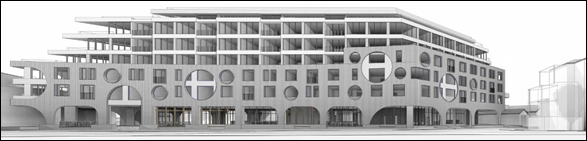
Figure 17. Carlisle Street perspective (excerpt from architectural plans)
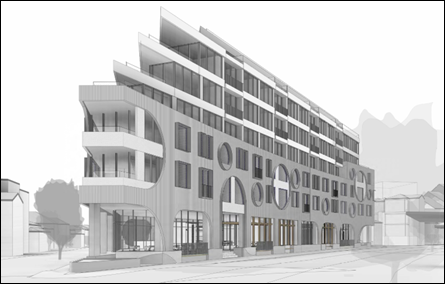
Figure 18. Havelock and Carlisle Street corner perspective (excerpt from architectural plans)
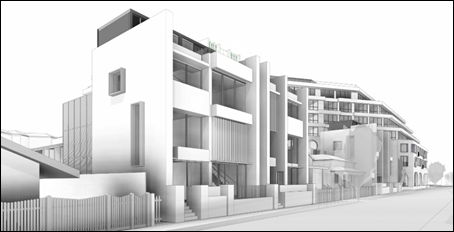
Figure 19. Havelock Street perspective from near front of 17 Havelock Street (excerpt from architectural plans)
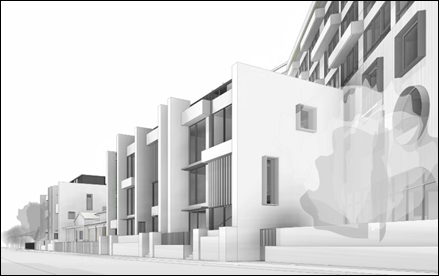
Figure 20. Havelock Street perspective from near front of 8 Havelock Street (excerpt from architectural plans)
7. Permit Triggers
7.1 Pursuant to the applicable planning controls, a planning permit is required under the following provisions:
|
Clause |
Permit requirement |
|
Use |
|
|
32.08-2 (GRZ) |
Use the land for a food and drink premises |
|
32.08-2 (GRZ) |
Use the land for a residential hotel |
|
Development |
|
|
32.08-7 (GRZ) |
Construct or extend a residential building |
|
32.08-10 (GRZ) |
Construct a building or construct or carry out works for a use in Section 2 of Clause 32.08-2. |
|
43.01-1 (HO5) |
Demolish or remove a building |
|
43.01-1 (HO5) |
Construct a building or construct or carry out works |
|
44.05-2 (SBO1) |
Construct a building or construct or carry out works |
|
Other |
|
|
52.05-2 |
Construct or put up for display a sign in Section 2 of Clause 52.05-13 |
|
52.37-2 |
Remove, destroy or lop a canopy tree in the Mixed Use Zone, Township Zone, Residential Growth Zone, General Residential Zone, Neighbourhood Residential Zone, and Housing Choice and Transport Zone |
8. Relevant planning policies and controls
Municipal Planning Strategy
8.1 The following objectives and strategies of the Municipal Strategic Statement of the scheme are relevant to the proposal:
· Clause 02.01 - Context
· Clause 02.02 - Vision
· Clause 02.03 - Strategic Directions
· Clause 02.04 - Strategic Framework Plans
Planning Policy Framework
8.2 The following objectives and strategies of the Planning Policy Framework of the scheme are relevant to the proposal:
· Clause 11 – Settlement
· Clause 13 – Environmental Risks and Amenity
· Clause 15 – Built Environmental and Heritage
· Clause 16 – Housing
· Clause 17 – Economic Development
· Clause 18 – Transport
· Clause 19 – Infrastructure
Zones
8.3 The following zones are relevant to the proposal:
· Clause 32.08 – General Residential Zone
o Clause 32.08 – Schedule 1 to General Residential Zone (GRZ1)
Overlays
8.4 The following overlays are relevant to the proposal:
· Clause 43.01 – Heritage Overlay
o Clause 43.01 – Schedule to Heritage Overlay (HO5)
· Clause 44.05 – Special Building Overlay
o Clause 44.05 – Schedule 1 to Special Building Overlay (SBO1)
Other relevant provisions
8.5 The following particular, general and operational provisions are relevant to the proposal:
· Clause 52.06 – Car Parking
· Clause 52.34 – Bicycle Facilities
· Clause 53.22 – Significant Economic Development
· Clause 65 – Decision Guidelines
· Clause 66.02–66.06 – Referrals and Notice
· Clause 72.01 – Responsible Authority for this Planning Scheme
9. REFERRALS
Internal referrals
9.1 The application was internally referred to relevant Council departments for comment. Those comments are discussed where relevant throughout the assessment below.
External referrals
9.2 The Minister for Planning via the Department of Transport and Planning is responsible for undertaking any required external referrals, including to Melbourne Water pursuant to the SBO1.
10. public notification/exemption from review
10.1 The Department is responsible for notifying relevant parties of the proposal, including landowners, occupiers, and referral authorities.
10.2 The Minister may determine whether the notice requirements of the planning scheme amendment under sections 17, 18, and 19 of the Act are applicable.
10.3 The planning permit application, under Clause 53.22-4 of the Port Phillip Planning Scheme, is exempt from the decision requirements of section 64(1), (2), and (3), and the review rights under section 82(1) of the Act. This means any objectors to the planning permit application will not be afforded any rights of appeal upon the Minister deciding the application.
11. OFFICER’S ASSESSMENT
11.1 Determining the acceptability of the proposal is constituted by two key areas of assessment, as below:
A. Is there strategic support for the Planning Scheme Amendment C230port?
B. Does Planning Permit Application PA2503985 respond appropriately to the Planning Policy Framework and relevant planning controls?
This is assessed through answering the following questions:
o Are the proposed uses consistent with the planning expectations for the site and site context?
o Is the proposed height, built form, and urban design outcome acceptable?
o Is the proposed partial demolition and reconstruction of the heritage dwellings acceptable?
o Is the proposed landscaping outcome
o Are the transport arrangements acceptable, including the provision of car parking and bicycle facilities, layout of the car parking areas, and proposed vehicle access arrangements?
o Are environmentally sustainable development (ESD) and water sensitive urban design (WSUD) initiatives appropriately incorporated into the proposal?
o Is the proposed waste management outcome acceptable?
o Are there any other matters that require consideration?
A. Is there strategic support for the Planning Scheme Amendment C230port?
Is removal of the mandatory garden area control appropriate for the site?
11.2 Under current controls for the site, development of the land for a dwelling or residential building (which includes a residential hotel, as proposed by Planning Permit Application PA2503985) would require 1,250.9 square metres (35%) of the site to be set aside for garden area.
11.3 Without the constraint of a minimum garden area, development outcomes could include increased building footprints and a higher proportion of built surfaces across the site. This would allow for more intensive development outcomes than are currently contemplated under the provisions of the General Residential Zone for dwellings and residential buildings. It also affords a greater level of flexibility in building layout, setbacks, and building envelope configuration.
11.4 Removal of the minimum garden area requirement would facilitate a more intensive form of development which may be appropriate in locations identified for increased residential and accommodation capacity, including areas proximate to activity centres. In this context, the amendment has the potential to enable development outcomes that align with the objectives of the adjacent St Kilda Major Activity Centre as set out in Clause 11.03-1L-06. Broadly, these objectives seek to reinforce the St Kilda Major Activity Centre as a significant retail, recreational, tourism, entertainment and leisure destination, whilst managing the cumulative impacts on local amenity and community safety.
11.5 In principle, a more intensive form of development would be an acceptable outcome for this site, acknowledging that its overall size, location proximate to the St Kilda Major Activity Centre, and direct interface with Carlisle Street lends itself to being considered a strategic site which can accommodate a higher level of development than may be achieved under the site’s current planning controls.
11.6 However, without the garden area requirement, there is a risk that development may present with diminished landscaping, reduced opportunities for deep soil planting and poorer interface outcomes with adjoining residential properties. This reinforces the importance of a site-specific design response to ensure that any development achieves a high-quality outcome consistent with the objectives of the GRZ and the broader planning policy framework.
11.7 The proposal was internally referred to Council’s strategic planning team, who identified that the proposed amendment does not provide sufficient certainly for a specific development outcome, particularly if the planning permit is not acted on, and the mandatory garden area control would still no longer apply to the site.
11.8 A mechanism to facilitate a site-specific outcome would be the implementation of a Specific Controls Overlay (SCO). This would allow an incorporated document to be developed for the site which approves a specified use and development, providing certainty of the outcome. Utilising an SCO in that manner does not lock the landowner into that specific development, whereby they could choose not to develop in accordance with the SCO, and rather seek a planning permit under the ordinary planning controls applying to the site, which would still include the minimum garden area requirement.
11.9 Given above, it is recommended to object to Planning Scheme Amendment C230port, identifying that the amendment will not provide a certain development outcome if the planning permit is not acted on.
11.10 Furthermore, it is recommended to identify that amending the planning scheme to implement a Specific Controls Overlay (SCO) would be a more appropriate mechanism to allow for a specific development outcome to be secured for the site without the risk of uncertainty introduced through simply removing the mandatory garden area requirement.
Consideration of the ‘agent of change’ principle and management of noise impacts on the proposal from nearby live music venues
11.11 Planning Scheme Amendment C220port is an amendment brought by Port Phillip City Council currently awaiting authorisation from the Minister before proceeding to public notice.
11.12 The amendment seeks to introduce a schedule to Clause 53.06 – Live Music Entertainment Venues, identifying the St Kilda Live Music Precinct, core live music areas, and a 50 metre buffer areas where new sensitive residential uses and development will be required to implement appropriate noise attenuation.
11.13 It is acknowledged that Council’s strategic planning team has noted that the subject site is within the 50m buffer area of the core live music area, and that the development should be required to provide itself with appropriate noise attenuation to protect itself from existing or proposed live music venues nearby.
11.14 The acoustic assessment submitted in support of the application details a number of noise attenuation requirements to protect the proposal from external noise sources, including measured music levels and patron noise from Radio Mexico directly opposite on Carlisle Street, and noise from traffic and trams. The assessment makes a number of recommendations for glazing thickness to appropriately mitigate noise impacts. Meeting these requirements will result in an acceptable internal amenity outcome for staying guests.
11.15 It is important to understand that whilst additional concerns raised regarding the live music area are understood, under the provisions of Clause 53.06, a residential hotel is not identified as a ‘noise sensitive residential use’. On that basis it is not recommended that the proposal be required to comply with any noise attenuation requirements beyond those already identified by the acoustic assessment.
B. Does Planning Permit Application PA2503985 respond appropriately to the Planning Policy Framework and relevant planning controls?
Are the proposed uses consistent with the planning expectations for the site and site context?
11.16 The proposal seeks permission to use the land for a ‘residential hotel’, and to use the land for a ‘food and drink premises’ with the inclusion of a restaurant/café at ground floor and a rooftop bar and terrace at the top floor. It is understood the food and drink premises will operate somewhat ancillary to the residential hotel, however details of this have not been provided to Council.
11.17 The planning scheme anticipates that for residential sites located near major activity centres a transition in land use intensity may occur. The proximity of the site to the northern edge of the St Kilda Activity Centre is a relevant consideration in this instance.
11.18 The activity centre accommodates a concentration of commercial uses, including live entertainment and food and drink premises, and also similar short-stay accommodation uses such as other hotels and backpackers.
Proposed residential hotel use
11.19 Whilst acknowledged that the number of rooms proposed (being 204) will result in an intensity of guest movements that will be greater than the existing hotel on the site, it is expected the intensity of the use will not be so great that the site and surrounds will be unable to accommodate it, or that amenity impacts would be untenable.
11.20 The site directly adjoins Carlisle Street, and provides a lobby, primary pedestrian entrance and port cochere which is close to the Carlisle Street end of Albert Street. The vast majority of vehicle and pedestrian movements are not expected to be along Havelock Street or the far end of Albert Street where greater amenity impacts could be realised to the existing dwelling throughout those areas.
11.21 Furthermore, the use may be controlled through conditions requiring a detailed Hotel Management Plan, including requiring details of management practices for the purpose of mitigating offsite amenity impacts arising from the use.
11.22 Such conditions form part of this recommendation, and in meeting these conditions, the proposed residential hotel use will align with expectations for the site without unduly impacting upon the more sensitive existing residential development abutting the site.
Proposed food and drink premises use
11.23 Noting the comments above, it is expected that the site is capable of supporting a higher degree of non-residential land use than would ordinarily be expected if the site were in an isolated residential setting. This is said provided that potential impacts are appropriately controlled.
11.24 The proposed food and drink premises land use is one that may be acceptably controlled in relation to hours of operation, patron numbers, and more broadly through limitations on hours deliveries and waste collection.
11.25 It is recommended that conditions include a management plan requirement relating to the food and drink uses proposed, and that hours of operation be controlled to ensure amenity impacts to nearby sensitive uses are appropriately minimised. Standard conditions in relation to delivery hours and waste collection are also recommended.
11.26 In meeting the recommended conditions, the proposed uses will respond appropriately to the expectations of the purpose and decision guidelines of the GRZ and applicable policies of the Planning Policy Framework.
Are specific measures required for the rooftop terrace?
11.27 One of the primary concerns with the proposed use relates to the use of the rooftop terrace area and noise and amenity impacts which may arise from patronage of that are.
11.28 An acoustic assessment was submitted in support of the application. The acoustic assessment correctly details that Environment Protection Authority (EPA) noise protocols do not address patron noise specifically, and on that basis, the assessment is required to make a number of assumptions with respect to patron behaviour.
11.29 The acoustic assessment has based its recommendations on a maximum of 200 patrons within the terrace area at any one time, with 50% of those patrons speaking at one time. It has also assessed on the basis of the Havelock and Albert Street ends of the terrace being expected to accommodate a maximum of 50 patrons each, with the remaining 100 patrons within the area facing Carlisle Street.
11.30 With respect to the rooftop terrace and patron noise emission from the terrace, the assessment makes the following recommendations:
1. The rooftop terrace will operate between 7am to 10pm and 7 days a week.
2. Maximum 200 patrons within rooftop terrace.
3. A minimum 1.8 metre solid imperforate barrier shall be installed around the terrace area. Screening can be constructed from min 10.38mm laminated glazing or approved alternative by a suitably qualified acoustic consultant.
4. External glazing to rooftop bar installed with min 10.38mm laminated glass or 6/12/10.38mm IGU with full perimeter acoustic seals. These windows shall be generally closed except during access.
5. Music played within the terrace shall be limited to background music only at approximately 70 dB(A) sound pressure level. Final music noise to be set to ensure compliance with EPA Publication 1826.4 Noise Protocol Part 2 criteria is achieved.
11.31 In meeting these recommendations, it is understood the noise and amenity impact from the use of the roof terrace to the surrounding area, including to the most sensitive interfaces of the dwellings opposite on Havelock and Albert Streets, will be appropriately minimised.
11.32 It is therefore recommended that the recommendations of the acoustic assessment form the basis for permit conditions to controls the use of the terrace, and to require recommended design measures to be implemented to the terrace edge.
Is the proposed height, built form, and urban design outcome acceptable?
11.33 The size, orientation, and location of the subject site lends itself to a more intensive development outcome than may be contemplated by the current planning controls applicable to the site. However, in considering a more intensive development, consideration needs to be given to the immediate and wider development context.
11.34 The proposal was internally referred to Council’s urban design team. The following key issues were raised with the proposal:
· The proposed building scale is inappropriate for its context, and should be reduced by one storey;
· Increased overshadowing to existing outdoor dining areas on the southern side of Carlisle Street is an impact which has not been clearly documented;
· To reduce noise impacts on adjoining residential properties, consideration should be given to re-orienting the rooftop terrace away from residential areas in Havelock and Albert Streets;
· An improved façade response to the St Kilda context should be provided, including:
o reducing the sheerness of the street façade through increasing articulation
o recessing upper levels and realigning to follow the street wall curve, and increasing façade depth
o increased articulation to the rear façade through provision of sun shading to all windows
· Relocation of visitor bicycle parking to a more visible and convenient location;
· Provision of details of fencing, planting, and wall details at ground floor where they interface with the public realm;
· A public realm plan to the satisfaction of Council should be provided to compensate for the reduction in garden area, provide community benefit, and to manage changes such as removal of existing vehicle crossings
11.35 Whilst it is acknowledged that the assessment pathway under Clause 53.22 allows the responsible authority to waive or vary any building height or setback requirement, this does not mean that this should occur. Waiving or varying these requirements should be contingent on a design response being proposed which justifies waiving or varying those requirements.
11.36 In this instance, the design response as proposed does not meet a standard of design or architectural quality to justify the overall scale proposed.
11.37 It is recommended that the urban design comments form the basis for amended plans conditions for the purpose or reducing the scale of the proposal to an acceptable level to justify the varied height requirement, and to generally implement positive design changes into the proposal, including within the public realm.
11.38 The reduction in height is recommended to be through the removal of either level 4 (shown on TP17) or level 5 (shown on TP18) as this would result in maintaining the consistent curved façade design at the lower levels, however would ensure the portion of the parapet which casts shadows across Carlisle Street would be reduced in height to limit impacts to outdoor dining areas opposite. This would not be achieved through removal of level 6.
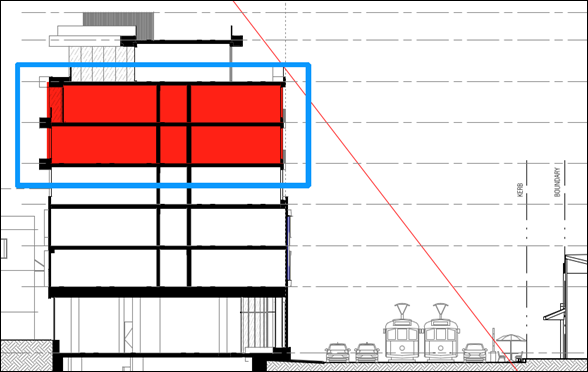
Figure 21. Excerpt from overshadowing section with mark-up showing levels 4 and 5. Proposed overshadowing to outdoor dining from level 5 parapet edge shown with red line
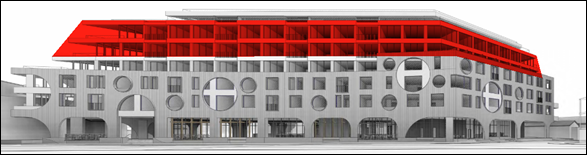
Figure 22. Excerpt from Carlise Street perspective with markup showing levels 4 and 5
11.39 It is not recommended to include conditions requiring redesign of the Carlisle Street façade in accordance with the urban design comments. Whilst such an outcome would result in an improved design response, the extent of change and design detail required to achieve the desired outcome is not recommended to be achieved via conditions as it may result in further changes to the design which are unexpected and may not align with the intent of such conditions.
11.40 It is not recommended to include a condition requiring reorienting of the rooftop terrace. The conditions recommended which are based on the submitted acoustic assessment, together with management plan requirements, are considered adequate to manage amenity impacts which may arise form use of the terrace.
11.41 In addition to the recommended conditions above, it is recommended to include a condition requiring built-form setbacks where opposite the north-eastern boundary shared with 5 Albert Street, above level 4 to be as follows:
· Level 4 – no less than 13.4 metres
· Level 5 – no less than 16.5 metres
11.42 These setbacks generally reflect the side and rear setbacks requirements which would ordinarily apply to the development pursuant to Clause 55 if it were not for the number of storeys proposed, and in this context provide an appropriate benchmark for reducing the impact of the built-form where above the podium level to the nearest of the dwellings opposite to the north-east.
11.43 It is not recommended to include a similar condition in relation to the interface with 11 Havelock Street, noting that the proposed built form at that interface would replace an existing condition which is quite similar.
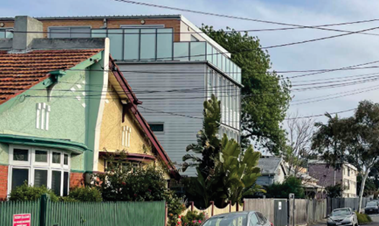
Figure 23. Image showing existing interface between subject site and 17 Havelock Street
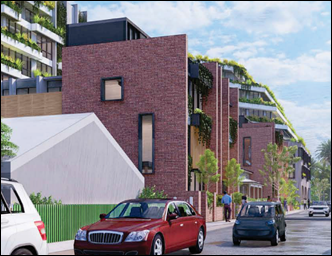
Figure 24. Excerpt of render showing proposed interface with 17 Havelock Street
11.44 In meeting the above recommendations, especially that relating to reduction in height and increased setbacks opposite 5 Albert Street, the proposal will respond more acceptably to its immediate and wider context.
11.45 No recommendations are made with the proposed suite of signage excepting for inclusion of standard conditions. The extent of signage is appropriate with respect to the scale of the development, will appropriately identify the site, and provide a wayfinding purpose for those attending the site.
Is the proposed partial demolition and reconstruction of the heritage dwellings acceptable?
11.46 The application proposes to demolish and reconstruct the two existing heritage dwellings on the site which front Havelock Street.
11.47 With respect to this aspect of the application, the proposal was internally referred to Council’s heritage advisor. Comments indicate that, in principle, the reconstruction of the two dwellings can be supported, subject to specific conditions.
11.48 It is recommended to include conditions requiring provision of the following prior to commencement of any demolition:
· An annotated photographic study detailing each elevation of the two dwellings, key architectural design details, and a statement by an architectural historian describing the design and construction of the buildings.
· A conservation management plan which identifies the buildings and works to be conserved, fully describes and demonstrated the methods of dismantling, restoring and repairing, and subsequent reconstruction of the buildings, details any staging required for the demolition and reconstruction, details any necessary protection works, and any conservation methods for protection of materials during storage.
11.49 In meeting the requirements of these recommendations, the demolition and reconstruction of the two heritage dwellings will be acceptable with respect to both the Heritage Overlay and the expectations for conservation of local heritage policy at Clause 15.03-1L.
Is the proposed landscaping outcome acceptable?
11.50 The quality of the proposed landscape architecture is a key consideration under the purpose of Clause 53.22. In this regard, the proposal as advertised provides an inadequate response.
11.51 Whilst the proposed renders and architectural plans indicate a suite of on-building and terrace-edge landscaping, a landscape plan has been submitted relating to ground floor landscaping only.
11.52 The application was referred internally to Council’s landscape architecture team, who have provided comments raising issues with the following:
· No landscaping details are provided for upper levels
· Planting locations above ground level appear to be located where maintenance would be difficult
· Deep soil planting areas do not have sufficient clearance from building canopies
· The submitted landscape plan lacks details on greening, deep soil, and soil volume
· The proposal does not provide sufficient integration with the public realm
· Insufficient new canopy tree cover is proposed
· Planters to Havelock Street result in a poor public realm outcome
11.53 One of the key issues with removing the garden area requirement is that with the land no longer burdened by that requirement, larger building footprints are permissible at the expense of what would likely have been open space landscaped areas.
11.54 The proposal shows the consequence of this, with only small pockets of landscape areas proposed where canopy trees could be accommodated in deep soil, and a heavy reliance on smaller garden beds, planters, and upper-floor landscaping to offset a lesser amount of canopy trees. Further to this, the footprint of the basement occupies a large portion of the site area, precluding much of the site from provision of deep soil.
11.55 It is not considered appropriate to contemplate redesigning the landscaping outcome through recommended conditions, as doing so may result in unforeseen built-form changes which may induce other design issues. Rather, it needs to be contemplated if through some minor design changes and provision of a detailed landscape plan via conditions, whether the on-building upper-floor landscaping proposed sufficient to address landscaping outcomes expected for the site.
11.56 If we consider the colourised perspectives of the urban context report as a best-case scenario for the landscaping outcome, the upper-floor landscaping makes substantial contribution to the overall landscape design, and softens much of the built form in a sought after manner, particularly in how the development presents to the residentially zoned interfaces. It also sees a marked improvement over existing conditions, which see little-to-no on-building landscaping, and extensive hard-stand across much the site, with generally smaller canopy trees only provided within the yards of the heritage dwellings, at the western corner of the site, and near the centre of the Carlisle Street frontage.
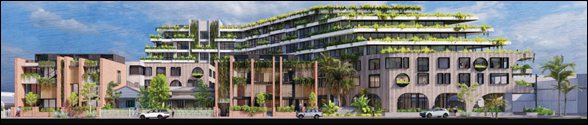
Figure 25. Excerpt of colourised Havelock Street perspective
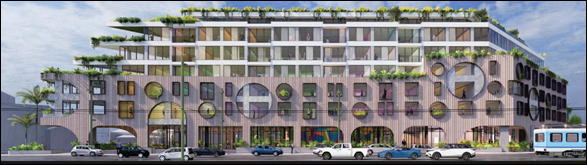
Figure 26. Excerpt of colourised Carlilse Street perspective
11.57 In meeting the recommended landscaping conditions which require both the provision of greater detail and specify the provision of landscaping in per the landscape areas indicated on the architectural plans, the landscape design outcome will provide an acceptable outcome in this context.
11.58 It is acknowledged that the recommended conditions to not allay all concerns raised as part of the internal referral. However, the following is noted:
· It is not for planning to concern itself with the maintenance of proposed landscaping. Through volunteering a specific landscaping outcome, as is shown on the proposed architectural plans, it will be encumbered upon the landowner or operator to maintain that landscaping in accordance with standard landscaping maintenance requirements. If this cannot be achieved, the proposal will be required to be amended, at which point the merits of such amendments can be considered.
· Whilst the recommended changes to the Havelock Street raised planters in the referral would result in an improved interface of the cottage and loft suites with the public realm, it is unsure what implications requiring smaller planters might have on engineering requirements, noting the raised basement level below and possible flooding requirements of Melbourne Water (which Council has not been furnished with).
Are the transport arrangements acceptable, including the provision of car parking and bicycle facilities, layout of the car parking areas, and proposed vehicle access arrangements?
11.59 A transport impact assessment has been submitted in support of the application. The impact assessment details key compliance aspects of the proposal, summarised below:
· Car parking layouts and accesses have been designed generally in accordance with the requirements of the planning scheme;
· The provision of loading is considered appropriate for the proposed uses;
· The proposed provision of staff and guest bicycle parking, and the provision of bicycle facilities (in the form of showers and change rooms) exceeds the requirements of the planning scheme;
· The provision of car parking is considered to be suitable for the proposal;
· The traffic generated by the development is equivalent to an average of approximately one vehicle movement every minute during the peak hours and is expected to be adequately absorbed into the surrounding road network.
11.60 For determining the number of required car parking spaces under Clause 52.06, the subject site is identified as being within Category 4 of the Car Parking Requirements maps. This sets only a maximum car parking requirement of 1 space to each 100 square metres of net floor area for the proposed food and drink premises. However, as the application benefits from the transitional provisions at Clause 52.06-12, no maximum rate applies. A ‘residential hotel’ is not a listed land use within Clause 52.06, meaning that the number of car parking spaces provided is to be to the satisfaction of the responsible authority.
11.61 The application was internally referred to Council’s traffic engineering team, who have provided the comments on the proposal, summarised below:
· The proposal indicates the basement car park is not to be controlled. Any further changes to this arrangement will require a traffic report which includes a queuing analysis;
· The sight splay on the northern edge of the basement entry is obstructed, consideration should be given to the installation of a convex mirror to support visibility;
· Redundant crossovers should be removed and reinstated;
· No columns within the basement are to impeded vehicle access to the accessible car spaces.
11.62 With respect to the above comments, the following is noted:
· If the function of the basement car park is proposed to be changed to be controlled, this will require and amendment to the plans, and further assessment can occur at the time;
· Whilst a fully compliant sight splay is not provided to the north-eastern edge of the vehicle access, given the overall width of the accessway and the setback of the abutting dwelling at 5 Albert Street, the varied sight splay is considered adequate without the need for provision of a convex mirror;
· A standard condition requiring reinstatement of redundance crossovers is recommended;
· The column identified as being sited to the front of the accessible car space does not appear in the proposed architectural plans.
11.63 In meeting the recommended conditions above, the proposed car parking and traffic outcome will appropriately accord with the requirements of Clause 52.06.
Are environmentally sustainable development (ESD) and water sensitive urban design (WSUD) initiatives appropriately incorporated into the proposal?
11.64 A Sustainability Management Plan (SMP) has been submitted in support of the application. The SMP outlines sustainable design and stormwater management initiatives proposed to be incorporated into the proposal to address sustainable design expectations of policy at Clause 15.01-2L-02 – Environmentally sustainable development, and stormwater management policy at Clause 19.03-3L – Stormwater management (water sensitive urban design).
11.65 The SMP was internally referred to Council’s sustainable design team, who have provided comments, summarised below:
· A Water Sensitive Urban Design (WSUD) is required which illustrates all permeable and impermeable surfaces, and associated catchment areas in accordance with the submitted STORM Rating Report (or if amendments are made a revised stormwater management report i.e. Blue Factor or MUSIC);
· Energy assessment provided under National Construction Code 2022 (NCC2022);
· Daylight modelling to support compliance with IEQ – 1.1 – Living Areas and 1.2 Daylight Access – Bedrooms requirements within the BESS Report;
· A full BESS Report is required in support of the proposal;
· External design features required to meet sustainable design commitments within the SMP annotated on the architectural plans, including (but not limited to) external shading devices, operable windows, details of solar reflective index of external materials.
11.66 It is important to detail that no BESS Report has been submitted with the application documents. It appears this may have been inadvertently omitted from the appendix of the SMP. Given this, it is incredibly difficult to fully assess the sustainable design aspects of the proposal, as the value of various sustainable design commitments is benchmarked against the scores those commitments achieve within the BESS Report.
11.67 Nonetheless, it is recommended the above comments form the basis of an amended SMP condition. Ultimately, if a permit is issued, the amended SMP will be required to be assessed in more detail when provided for approval. In meeting the requirements of the recommended conditions, the proposal will achieve best practice which is the benchmark for acceptability under BESS.
Is the proposed waste management outcome acceptable?
11.68 A Waste Management Plan (WMP) has been submitted in support of the application.
11.69 The WMP was internally referred to Council’s waste management team, who have reviewed the WMP against the requirements of the ‘City of Port Phillip Guidelines for Preparing a Waste Management Plan 2021’. The following comments have been provided:
Waste Generation
· The restaurant/café tenancy has proposed a waste generation rate in between a restaurant and café. Waste does not support this and advocates for the restaurant rate to be used and then waste generation rates resubmitted.
· The bar should use the following waste generation rate: General waste 50L per 100m2 per day. Recycling 50L per 100m² per day.
Bin Size, Quantity, and Colour
· 660L FOGO bins can become too heavy to lift. 240L FOGO bins should be the maximum size provided.
Bin Storage Room
· A minimum of 1.5 metre door and corridor width must be provided when using 660L or 1100L bins, ensuring bins can travel to their collection point.
· Describe where the wash down area for bins will be located, including any taps or drains.
Waste Systems
· Discuss the role of building management in the management of waste and resource recovery.
Additional Waste Requirements
· Provide e-waste bin.
· Discuss where hard waste storage will be in the proposed development and detail the size of the hard waste storage area.
Bin Collection
· Having more than 3 collections per waste stream per day is excessive, particularly in this location. 3 is the preferred maximum per stream.
· What is the collection trucks available headspace for clearance purposes.
Scaled Waste Management Drawing
· Show the hard waste storage area, bin washing facilities, and the e-waste bin on the drawing
· Show the transfer path of waste coming from the hotel to the waste storage area.
· Show the transfer path of hard waste if hard waste storage is located in a different location from the bin storage area.
11.70 It is recommended that the above comments form the basis of an amended WMP condition, requiring the applicant to address the outstanding issues. In meeting the requirements of those conditions, the proposal will appropriately respond to waste management expectations for the site and proposed uses.
Are there any other matters that require consideration?
Agreement relating to the drainage easement at 9 Havelock Street
11.71 The land located at 9 Havelock Street which forms part of the subject site is encumbered by a Section 173 Agreement (W796559C) relating to a drainage easement in favour of Council.
11.72 The easement in question is known as ‘E-1’ on Land in Plan of Consolidation 353881G, and is located as shown below, running the full length of the land:
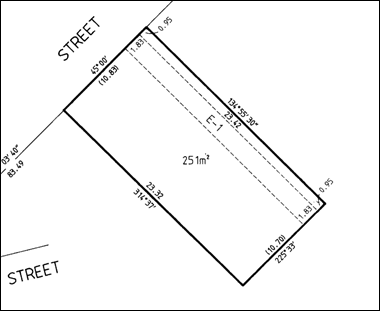
11.73 The application proposes extensive buildings and works which will encroach into this easement, including two levels of basement, the south-western end of northern-most loft suites, and part of the main residential hotel building (approximately through the middle of the ground floor ‘Flexible Function Room’).
11.74 Ordinarily encroachments into easements are not of concern at the planning stage, with subsequent build-over agreements able to be facilitated with relevant beneficiaries as part of the building permit process. However, in this instance the existence of an agreement entered into pursuant to Section 173 of the Planning and Environment Act 1987 elevates the relevance of these considerations in a planning assessment.
11.75 Section 60(1A)(i) requires the following of the responsible authority:
(1A) Before deciding on an application, the responsible authority, if the circumstances appear to so require, may consider—
(i) any agreement made pursuant to section 173 affecting the land the subject of the application;
11.76 The owner’s obligations under the agreement with respect to the drainage easement are as follows:








11.78 Council is not currently considering an application to amend or end the agreement, a process which is required under a separate part of the Act than under which planning applications are considered.
11.79 In light of this, it is recommended this be identified as a key ground of objection to the proposal. This issue should be resolved before a planning permit is issued.
12. OFFICER material OR general INTEREST
12.1 No officers involved in the preparation of this report has declared a material or general interest in the matter.
13. CONCLUSION
13.1 Officers consider that the request for a planning scheme amendment as proposed should not be supported, and that a more appropriate amendment utilising a Specific Controls Overlay would be a more appropriate planning control to facilitate then changes necessary to the planning scheme to facilitate the proposed development.
13.2 Officers consider that the planning permit application as proposed should not be supported for reasons relating to procedural complications which may arise due to an existing Section 173 agreement burdening part of the land, and due to the failure of the development to respond appropriately to the immediate and wider built form context.
13.3 Officers consider that, despite the positions above, a suite of conditions should be provided to the Minister to assist them in the event that they are of a mind to issue a permit.
|
ATTACHMENTS |
1. Explanatory report - Planning Scheme Amendment
C230port 2. Architectural plans - Planning Permit Application
PA2503985 |
Meeting of the Port Phillip City Council
6 May 2026
11. A Vibrant and Thriving Community
Nil
12. An Engaged and Empowered Community
12.1 Quarterly reporting of Records of Informal Meetings of Council - 1 January - 31 March 2026................................................................................................................. 296
12.2 Status of Council Decisions and Questions taken on Notice Recorded by Council: 1 January to 31 March 2026.............................................................................. 310
Meeting of the Port Phillip City Council
6 May 2026
|
Quarterly reporting of Records of Informal Meetings of Council - 1 January - 31 March 2026 |
|
|
Executive Member: |
Robyn Borley, General Manager, Governance and Performance |
|
PREPARED BY: |
Joshua Vearing, Council Business Advisor |
1. PURPOSE
1.1 This report presents the quarterly Records of Informal Meetings of Councillors held between 1 January to 31 March 2026 in accordance with chapter 6 of the City of Port Phillip Governance Rules.
2. EXECUTIVE Summary
2.1 An Informal meeting of Council record is required by chapter 6.1 of the Governance Rules if there is a meeting of Council that, is,
2.1.1 scheduled or planned for the purpose of discussing the business of Council or briefing Councillors;
2.1.2 is attended by at least one member of Council staff; and
2.1.3 is not a Council meeting, Delegated Committee meeting or Community Asset Committee meeting.
|
That Council: 3.1 Receives and notes the Records of Informal Meetings of Council held from 1 January to 31 March 2026: 3.1.1 Records of Informal meetings of Council January 2026 (Attachment 1) 3.1.2 Records of Informal meetings of Council February 2026 (Attachment 2) 3.1.3 Records of Informal meetings of Council March 2026 (Attachment 3) |
4. ALIGNMENT TO COUNCIL PLAN AND COUNCIL POLICY
4.1 Reporting on the Informal Meetings of Council records delivers on Strategic Direction 5 of the Plan for Port Phillip 2025-35 (An engaged and Empowered Community)
5. OFFICER MATERIAL OR GENERAL INTEREST
5.1 No officers involved in the preparation of this report have declared a material or general interest in the matter.
|
ATTACHMENTS |
1. Records of Informal Meetings of Council - January
2025 2. Records of Informal Meetings of Council - February
2025 3. Records of Informal Meetings of Council - March 2025 |
Meeting of the Port Phillip City Council
6 May 2026
|
Status of Council Decisions and Questions taken on Notice Recorded by Council: 1 January to 31 March 2026 |
|
|
Executive Member: |
Robyn Borley, General Manager, Governance and Performance |
|
PREPARED BY: |
Emily Williams, Senior Council Business Advisor |
1. PURPOSE
1.1 To provide Councillors with an update on the status of all Resolutions passed by Council at Council and Planning Committee Meetings between 1 January to 31 March 2026 and the status of actions that were previously reported as outstanding in the last quarterly status report.
1.2 To provide Council with an update on the status of Questions Taken on Notice during Council Meetings from 1 January to 31 March 2026.
2. EXECUTIVE Summary
Council Resolutions
2.1 The implementation status of Council Resolutions is a vital measure of Council’s performance. This process may also assist reporting for the Local Government Performance Reporting Framework.
2.2 There has been a total of 38 Resolutions (decisions) that have been made by Council, in Council and Planning Committee meetings open to members of the public, between the period of 1 January to 31 March 2026. Of these, 10 decisions remain open/outstanding.
2.3 There were four further decisions that were made in Council meetings closed to members of the public. These confidential decisions have been completed.
2.4 This report includes a further 14 decisions that remain outstanding and a further 9 decisions that have been completed from previous reporting periods (that is, prior to 1 January 2026).
2.5 This report is a report in time and is representative of decisions made by Council in the period 1 January to 31 March 2026.
Questions taken on notice
2.6 At each meeting, provision is made at the beginning for members of the public and for Councillors to ask general questions. Questions relating to a topic on the agenda are not permitted during this time however can be asked prior to the discussion of that item. When a question is unable to be responded to at the time, it is taken ‘on notice’ for a response to be provided.
2.7 The response status of Questions taken on Notice during Council meetings is a measure of Council’s engagement and communication with the community.
2.8 A total of 16 questions were taken on notice during the period 1 January to 31 March 2026 in Council meetings open to members of the public. Of these, one response remains outstanding. A copy of the responses to each of these questions has been made available on the website: Meetings and Agendas - City of Port Phillip.
2.9 A summary of responses to questions taken on notice during this reporting period are contained in Attachment 3 to this report.
2.10 A further one question was taken on notice during a meeting closed to members of the public, a response has been provided but not made available on Councils website.
|
That Council: 3.1 Notes the implementation status of Council and Planning Committee Resolutions as contained in Attachments 1 and 2. 3.2 Notes the response status of questions taken on notice during Council Meetings as contained in Attachment 3. |
4. KEY POINTS/ISSUES
4.1 Accountability is a fundamental requirement of good governance. Council has an obligation to report, explain and be answerable for the consequences of decisions it has made on behalf of the community.
4.2 Reporting on the progress of the implementation of Council resolutions provides Council with the information it needs to demonstrate its accountability to the community.
4.3 Decisions of Council should be implemented in an effective, timely, appropriate, and responsive manner that makes the best use of the available people, resources, and time to ensure the best possible results.
4.4 Council Resolutions
4.4.1 A resolution made by Council is when an officer recommendation or a Councillor’s motion is adopted at a Council Meeting or Planning Committee (i.e., a decision has been made). Once a decision on a recommendation has been made, it turns into a resolution. These resolutions are tracked through an internal system.
4.4.2 Attachments 1 and 2 of this report include a summary of the actions taken to implement resolutions where required, or confirmation that Council has noted items where appropriate. The summary of actions has been compiled and divided into the following categories:
· Status of Resolutions made at Council Meetings – Outstanding
· Status of Resolutions made at Council Meetings and Planning Committee Meetings – Completed
4.4.3 The Status of Resolutions documents include resolution of officer’s reports, notices of motion, petitions and joint letters, and items of urgent business. Resolution of procedural motions (i.e., attendances and apologies, closing the meeting to discuss confidential items) have not been included.
4.4.4 Some of the reasons that resolutions have not been fully implemented may relate to consultation processes being undertaken, awaiting legal advice, or waiting for documents to be executed.
4.4.5 Where it is expected that a resolution may take a longer time to fully implement, the expected completion date has been extended.
4.5 Questions taken on notice
4.5.1 At each meeting, provision is made at the beginning for members of the public and for Councillors to ask general question/s. Questions relating to a topic on the agenda are not permitted during this time but can be asked prior to the discussion of that item. When a question is unable to be responded to at the time, it is taken ‘on notice’ for a response to be provided.
4.5.2 Attachment 3 of this report includes a summary of questions asked and a link to where the responses to those questions has been published on Council’s website.
5. CONSULTATION AND STAKEHOLDERS
5.1 This report provides Council and the community with an update on the implementation of outcomes of council decisions.
6. LEGAL AND RISK IMPLICATIONS
6.1 If decision-making is open and able to be followed by observers, it is more likely that all relevant legal requirements will be complied with.
7. FINANCIAL IMPACT
7.1 There are no financial impacts arising from this report.
8. ENVIRONMENTAL IMPACT
8.1 There are no environmental impacts arising from this report.
9. COMMUNITY IMPACT
9.1 Making decisions and having to account for them in an open and transparent way encourages honest consideration of issues by Councillors and promotes community confidence in the decision-making process.
9.2 Members of the community should be able to follow and understand the decision-making process. This means that they will be able to clearly see where a decision was made, and how this decision was implemented.
10. Gender Impact Assessment
10.1 This report is a status report of decisions made by Council and does not require a Gender Impact Assessment to be completed.
11. ALIGNMENT TO COUNCIL PLAN AND COUNCIL POLICY
11.1 Reporting on the progress of Council resolutions delivers on Strategic Direction 5 of the Plan for Port Phillip 2025-35 (An engaged and Empowered Community), by providing a transparent and good governance approach to decision making.
11.2 Good decision-making processes helps people feel that Council will act in the community’s overall interest. It also encourages Councils to remember that they are acting on behalf of their community and helps them to understand the importance of having open and ethical processes which adhere to the law and stand up to scrutiny.
12. IMPLEMENTATION STRATEGY
12.1 TIMELINE
12.1.1 Council receives ongoing reporting on the status of implementation of Council Decisions, and questions taken on notice at Council Meetings, on a quarterly basis.
13. OFFICER MATERIAL OR GENERAL INTEREST
13.1 No officers involved in the preparation of this report has declared a material or general interest in the matter.
|
ATTACHMENTS |
1. Completed decisions 1 January - 31 March 2026 2. Outstanding decisions as at 31 March 2026 3. Questions taken on notice 1 January - 31 March 2026 |
Meeting of the Port Phillip City Council
6 May 2026
13. A Trusted and High Performing Organisation
Nil
14. Notices of Motion
Nil
15. Reports by Councillor Delegates
16. Urgent Business
17. Confidential Matters
Nil