Meeting of the Port Phillip City Council
10 December 2025
|
Welcome Welcome to this Meeting of the Port Phillip City Council. Council Meetings are an important way to ensure that your democratically elected representatives are working for you in a fair and transparent way. They also allow the public to be involved in the decision-making process of Council.
About this meeting There are a few things to know about tonight’s meeting. The first page of tonight’s Agenda itemises all the different parts to the meeting. Some of the items are administrative and are required by law. In the agenda you will also find a list of all the items to be discussed this evening. Each report is written by a Council officer outlining the purpose of the report, all relevant information and a recommendation. Council will consider the report and either accept the recommendation or make amendments to it. All decisions of Council are adopted if they receive a majority vote from the Councillors present at the meeting. |
Public Question Time and Submissions Provision is made at the beginning of the meeting for general question time from members of the public. All contributions from the public will be heard at the start of the meeting during the agenda item 'Public Questions and Submissions.' Members of the public have the option to either participate in person or join the meeting virtually via Teams to ask their questions live during the meeting. If you would like to address the Council and /or ask a question on any of the items being discussed, please submit a ‘Request to Speak form’ by midday on the day of the meeting via Council’s website: Request to speak at a Council meeting - City of Port Phillip |
|
|
|
|
Meeting of the Port Phillip City Council |
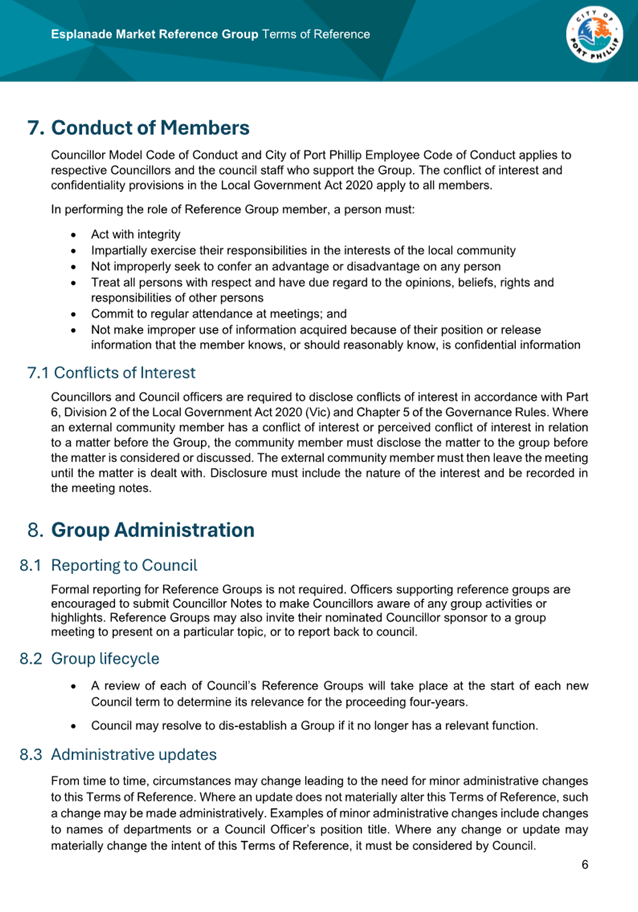
To Councillors
Notice is hereby given that a Meeting of the Port Phillip City Council will be held in St Kilda Town Hall and Virtually via Teams on Wednesday, 10 December 2025 at 6:30pm. At their discretion, Councillors may suspend the meeting for short breaks as required.
AGENDA
1 APOLOGIES
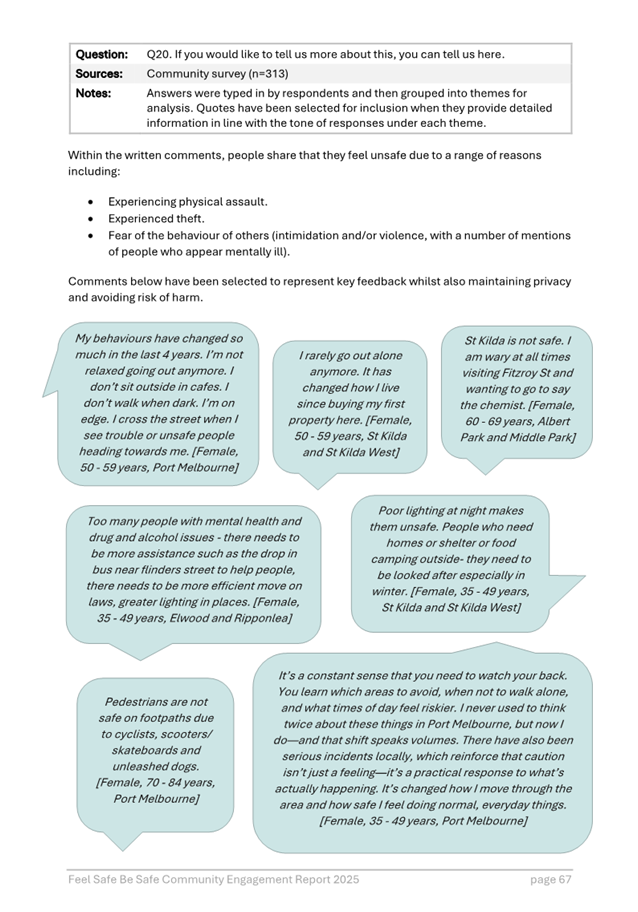
2 MINUTES OF PREVIOUS MEETINGS
Minutes of the Meeting of the Port Phillip City Council 3 December 2025.
3 Declarations of Conflicts of Interest
4 Public Question Time and Submissions
5 Councillor Question Time
6 Petitions, Joint Letters & Deputations........................................................ 5
6.1 Petition - Continuation of Social Inclusion Funding 2026-27.............................. 5
7 Presentation of CEO Report
Nil
8 A Healthy and Connected Community........................................................... 7
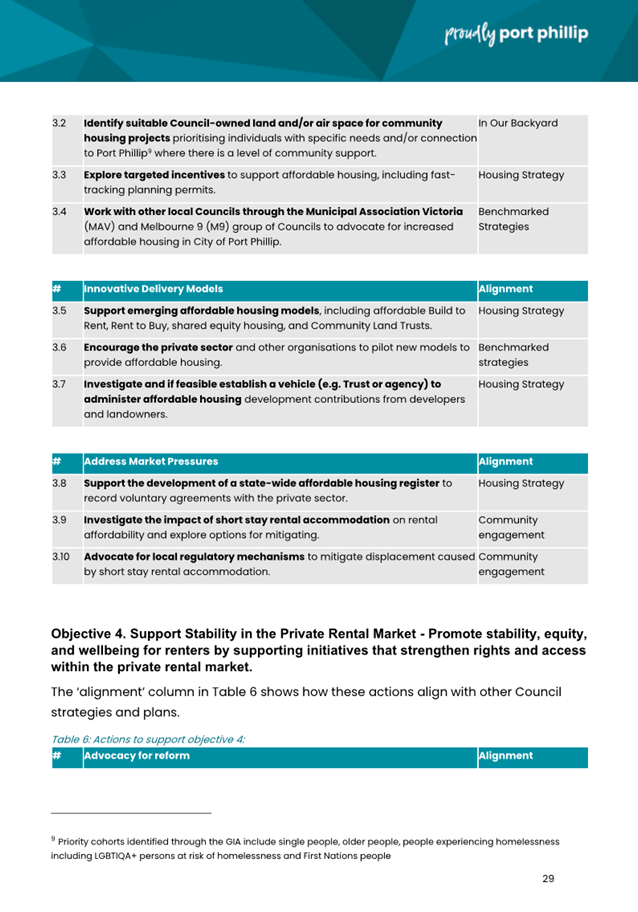
8.1 Homelessness and Affordable Housing Strategy............................................... 8
9 An Environmentally Sustainable and Resilient City
Nil
10 A Safe and Liveable City.................................................................................... 97
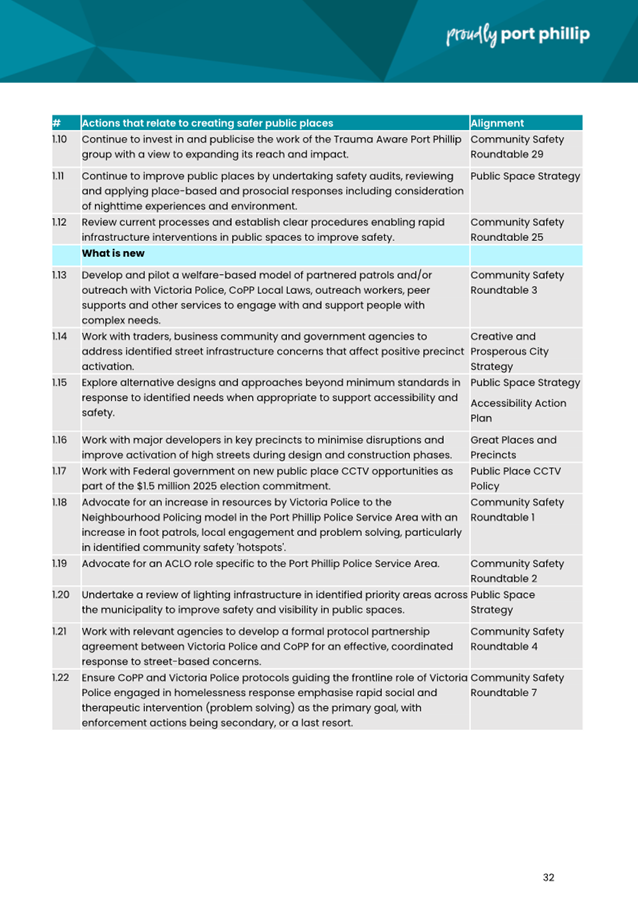
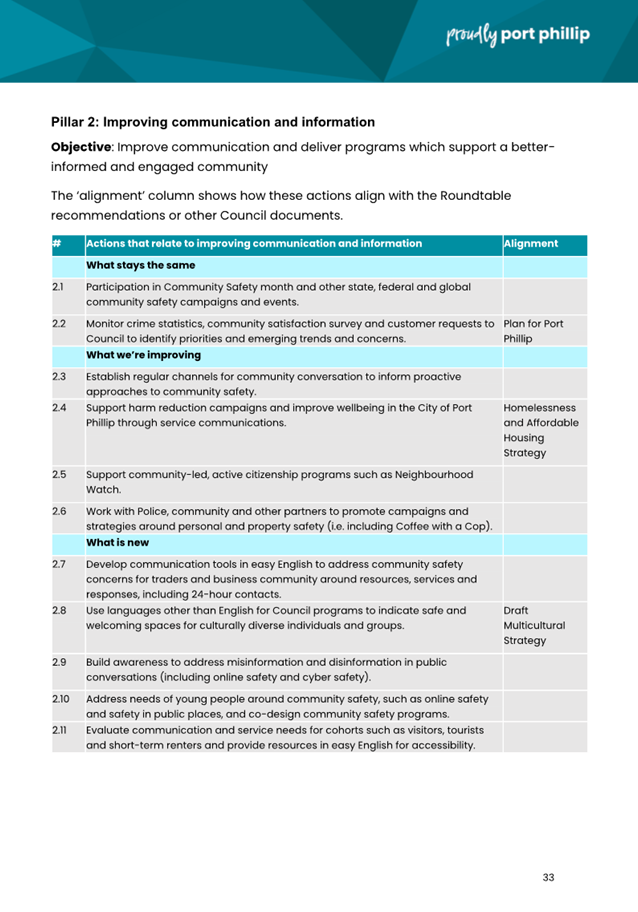
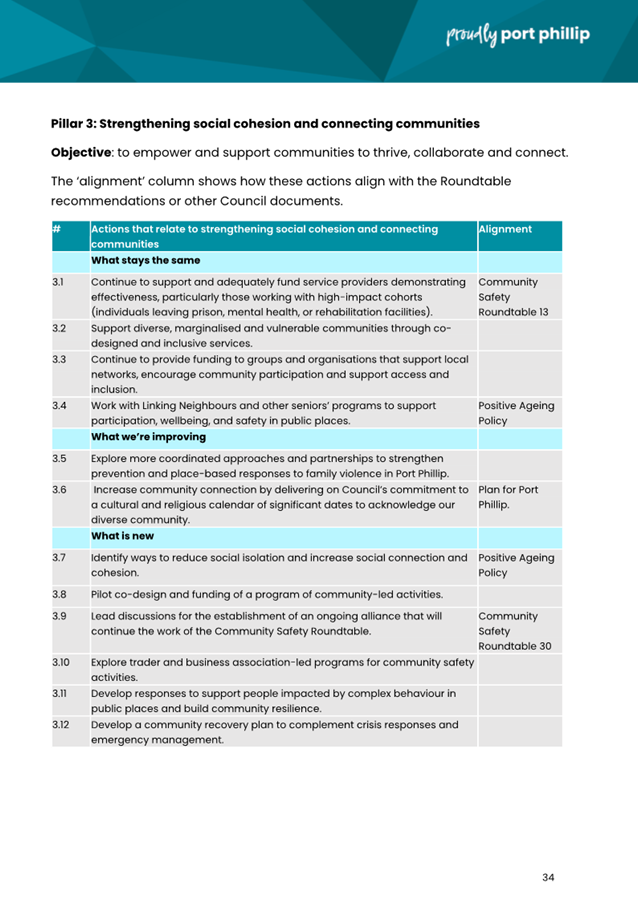
10.1 "Feel Safe. Be Safe. Community Safety Plan 2025-29"................................... 98
10.2 Proposed Local Law Amendment Update and Draft Protocol with Police..... 304
10.3 Changes to Planning Delegations (10 December 2025 until the first sitting of the Ordinary Council meeting in 2026)................................................................................ 489
11 A Vibrant and Thriving Community............................................................. 492
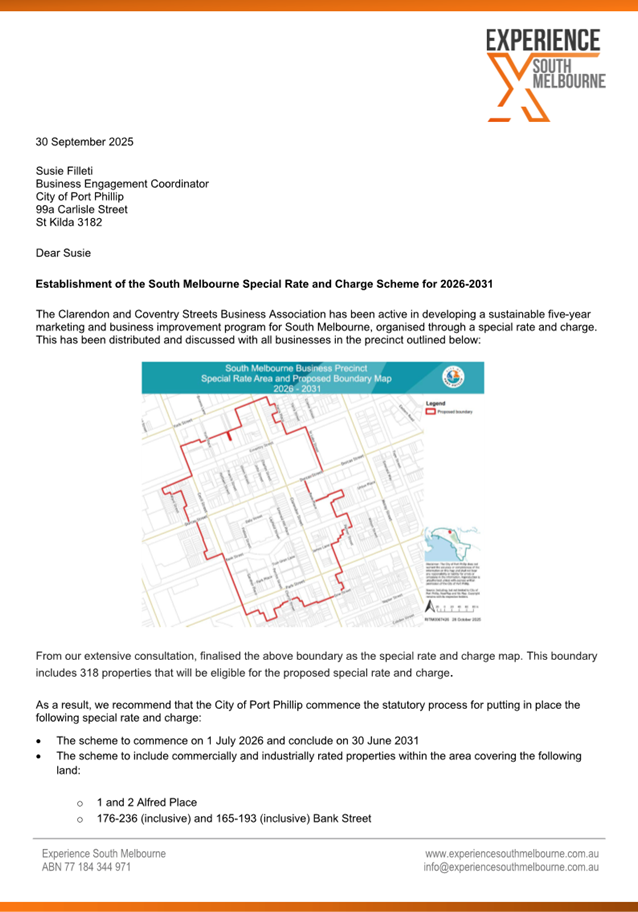
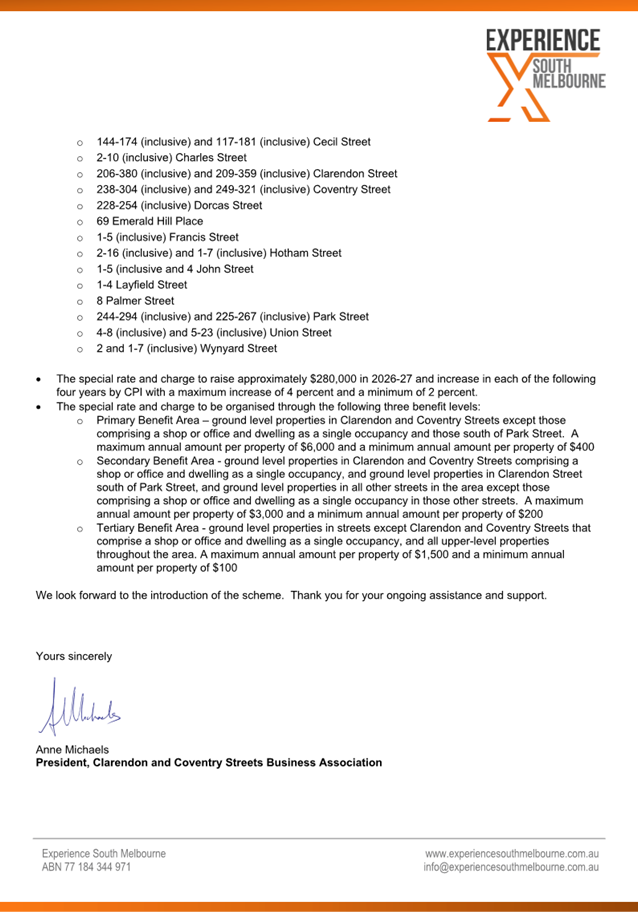
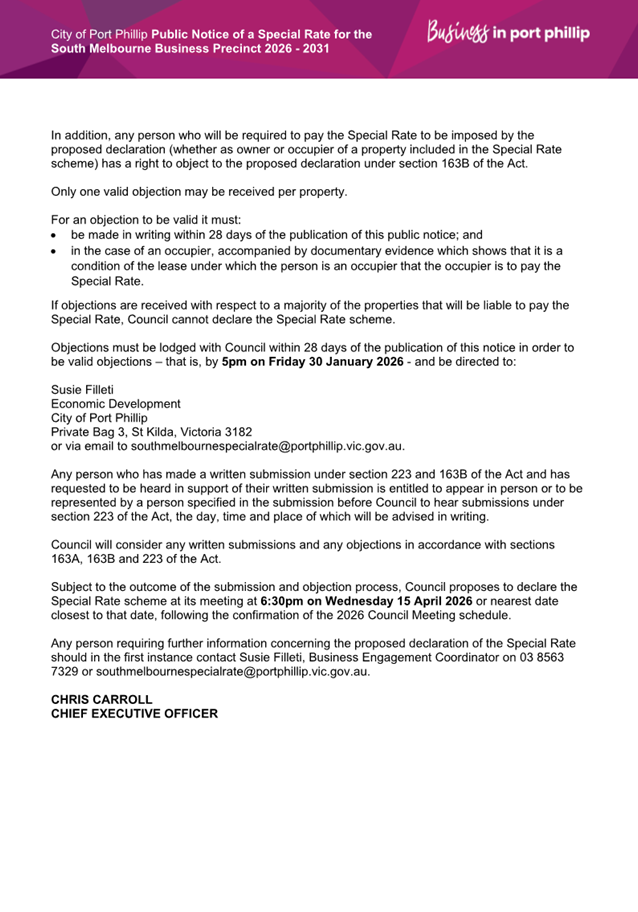
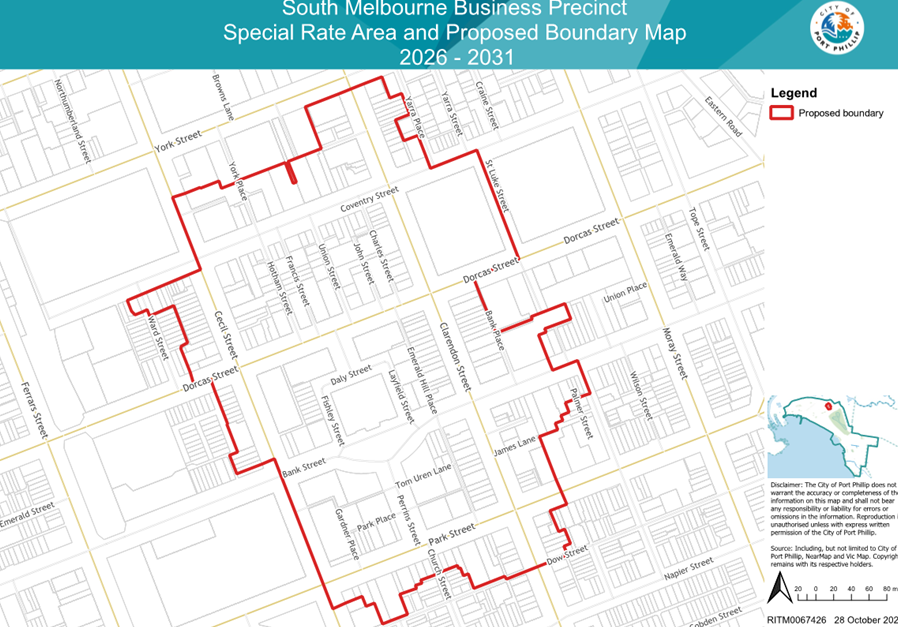
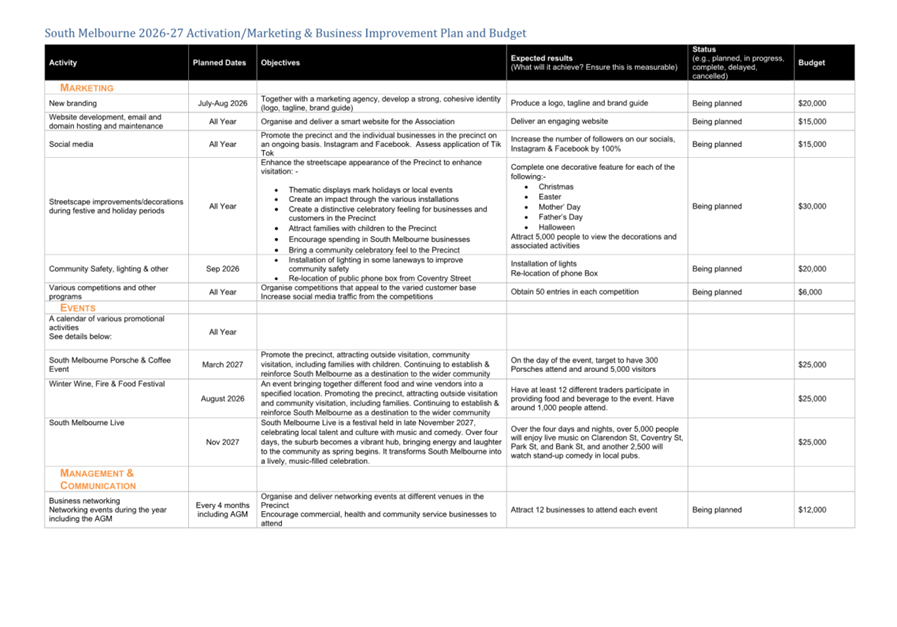
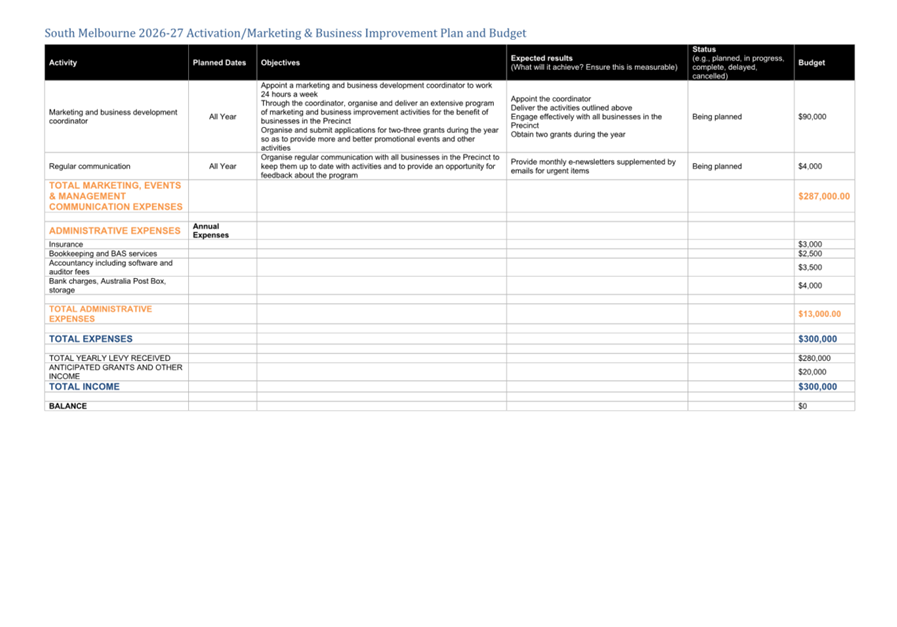
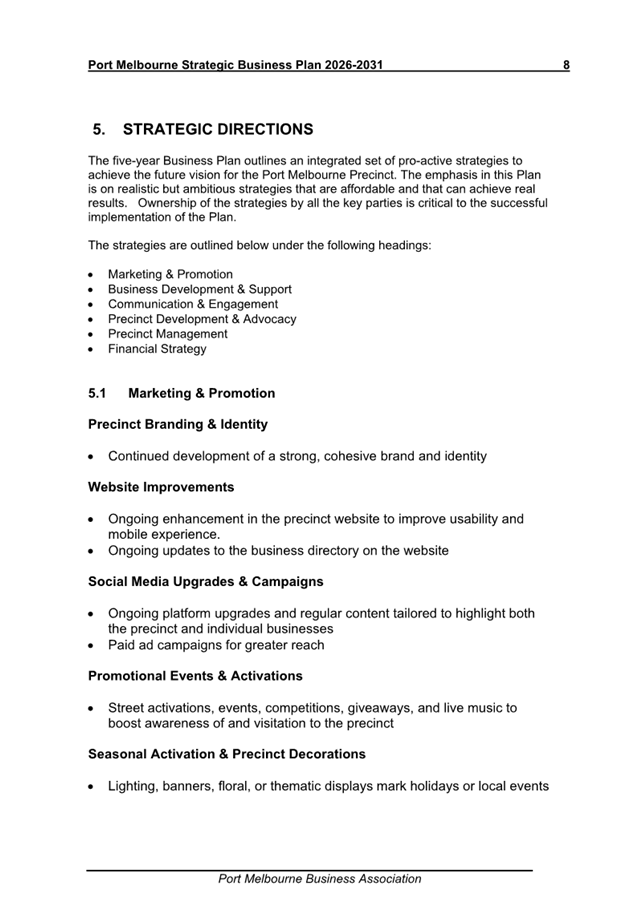
11.1 South Melbourne Special Rate and Charge – 2026-2031 Intention To Declare 493
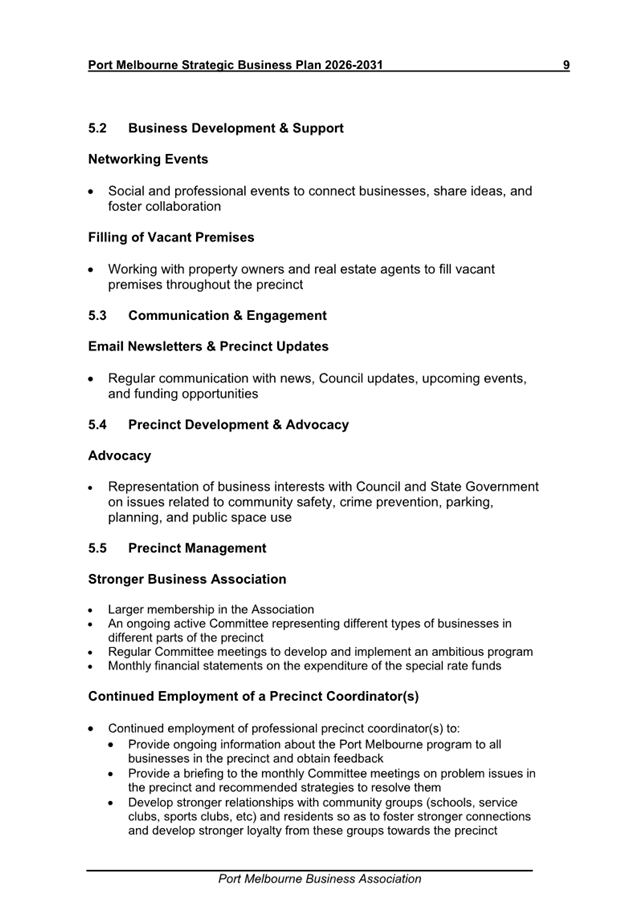
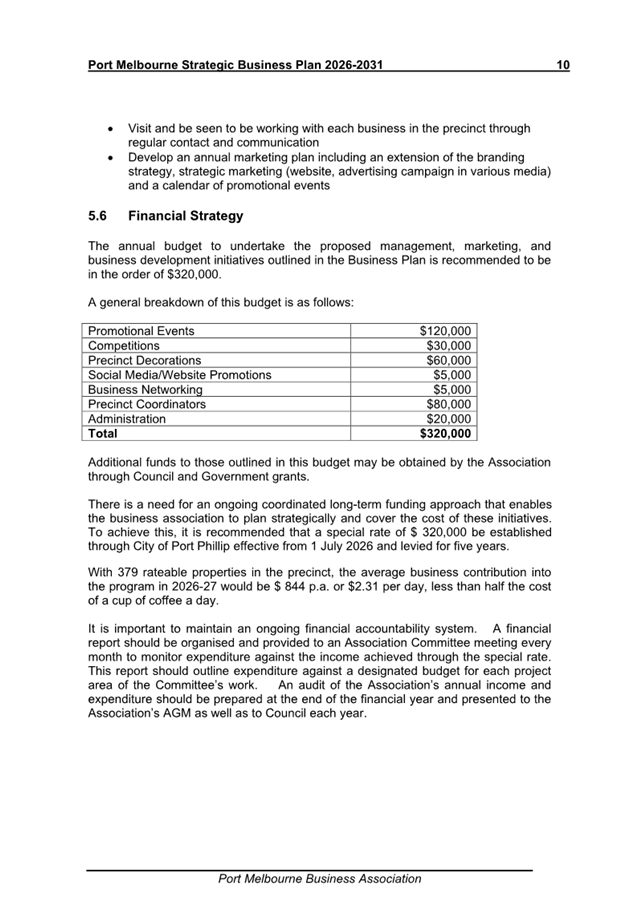
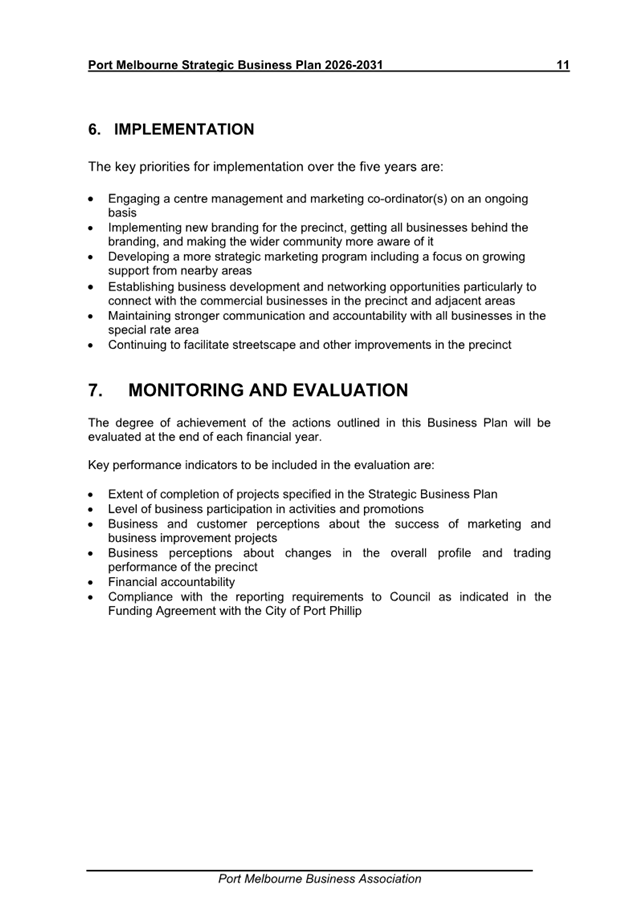
11.2 Port Melbourne Special Rate and Charge – 2026-2031 Intention To Declare 532
11.3 Port Melbourne Netball Infrastructure Project................................................ 568
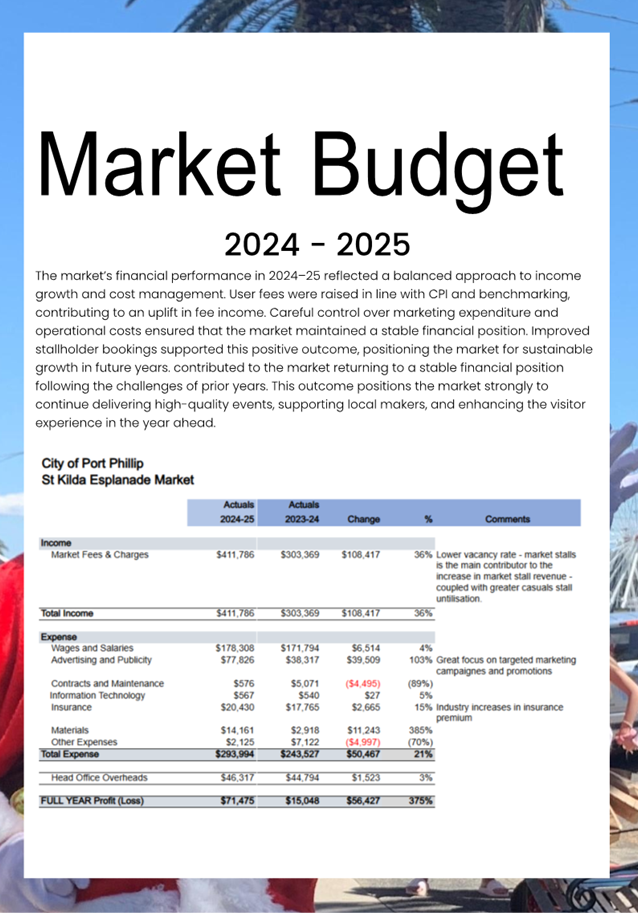
11.4 St Kilda Esplanade Market Annual Report 2024-25, Recommendations for the Reference Group Members & Updates to Terms of Reference....................................... 585
12 An Engaged and Empowered Community.................................................. 641
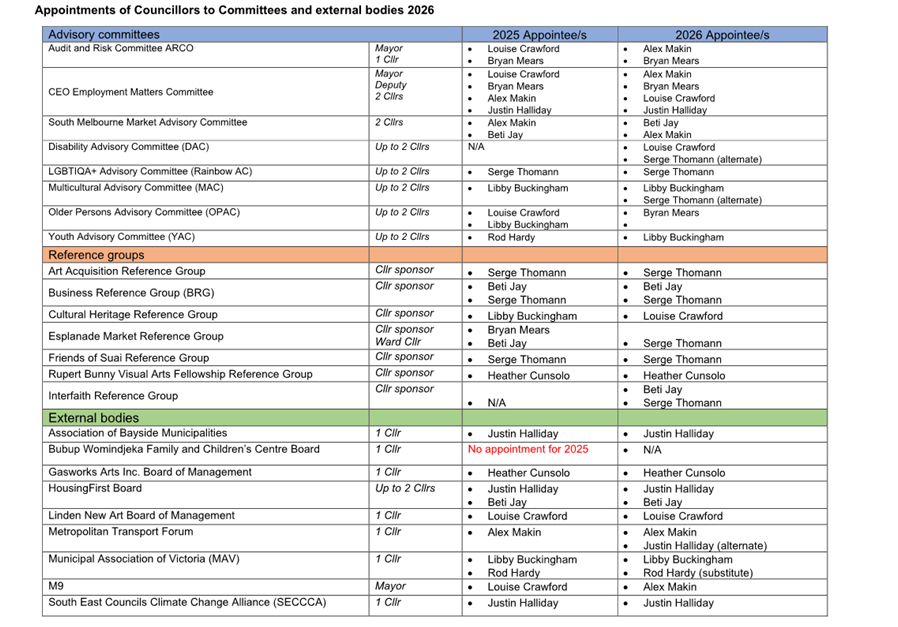
12.1 Appointments of Council Delegates to Committees....................................... 642
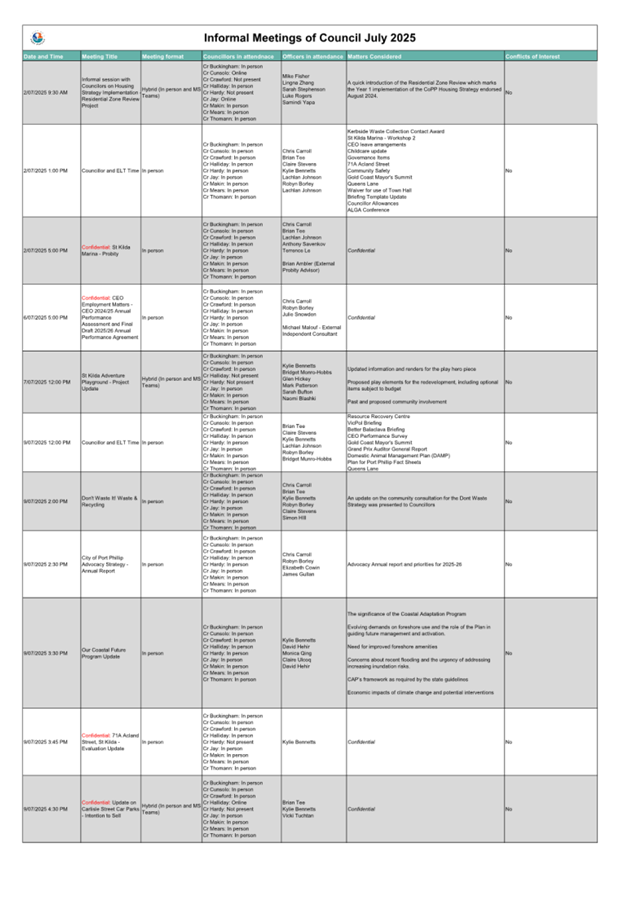
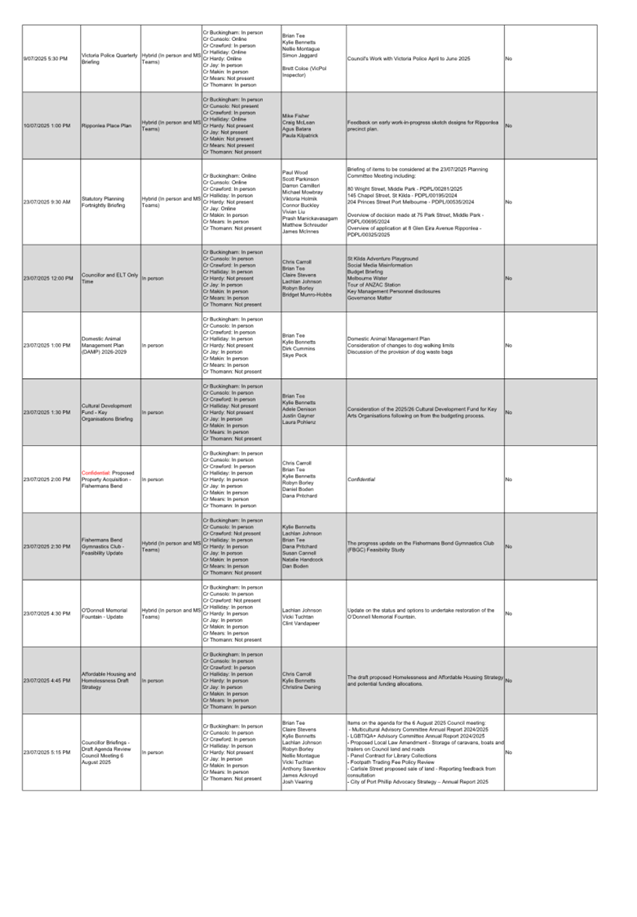
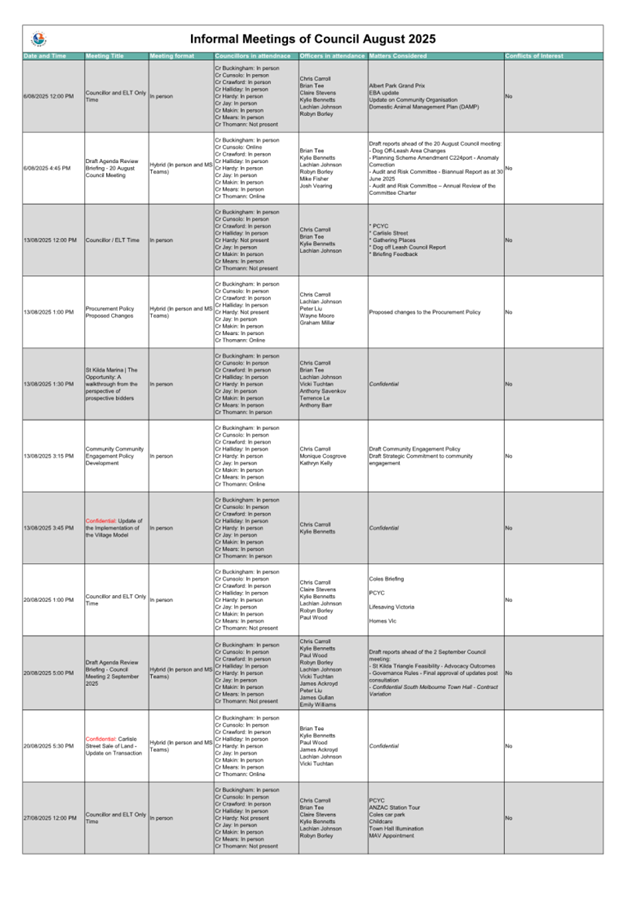
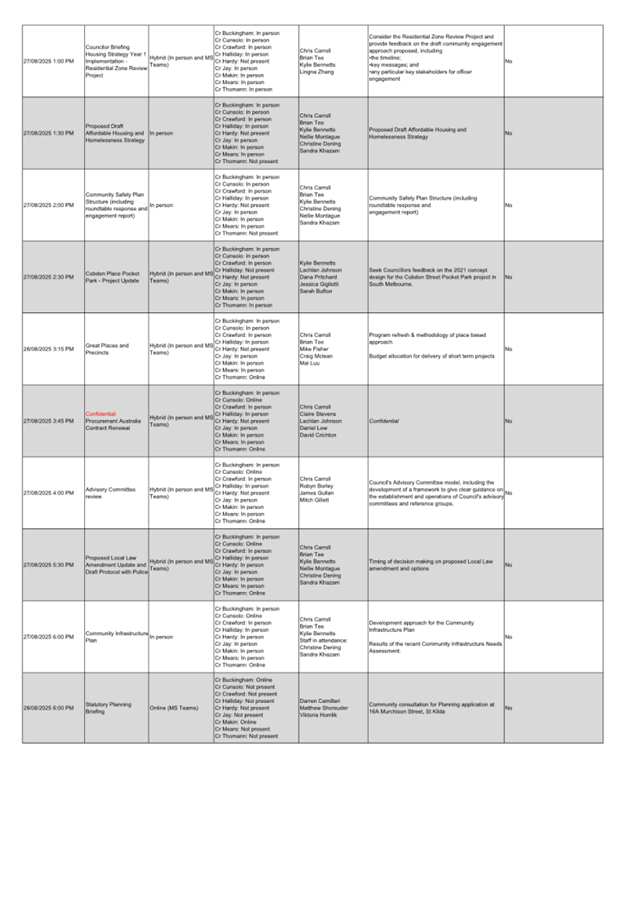
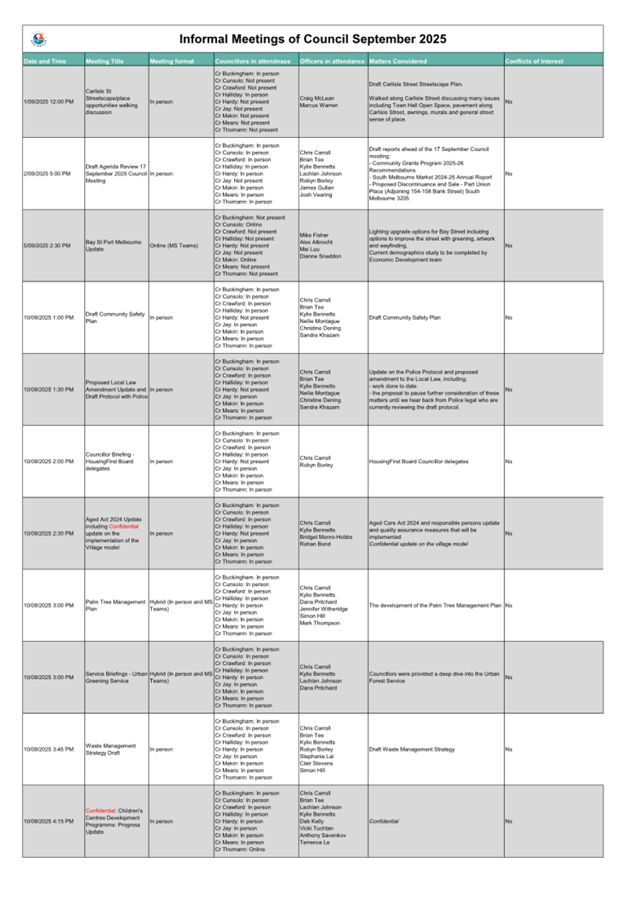
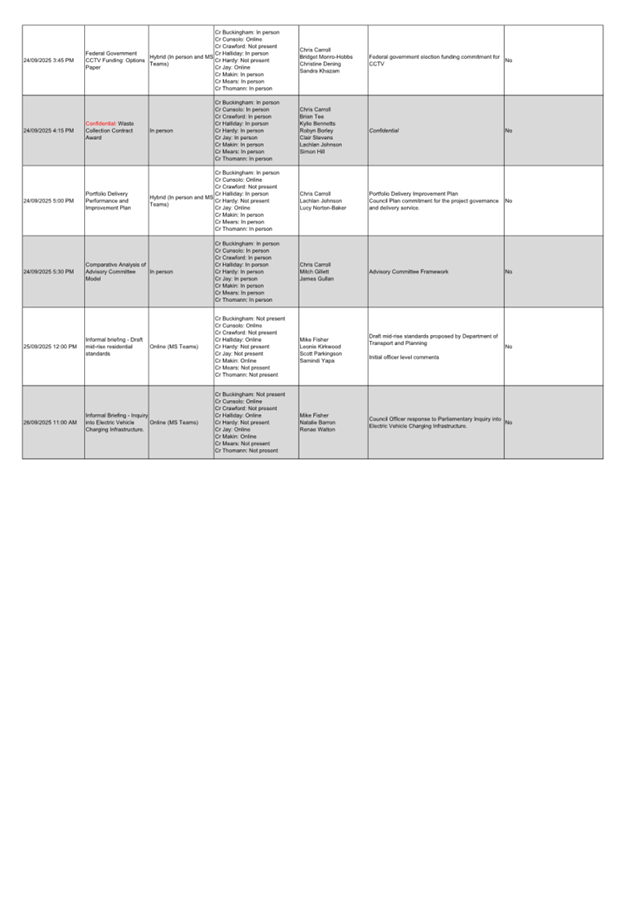
12.2 Quarterly reporting of Records of Informal Meetings of Council - 1 July - 30 September 2025 647
13 A Trusted and High Performing Organisation..................................... 655
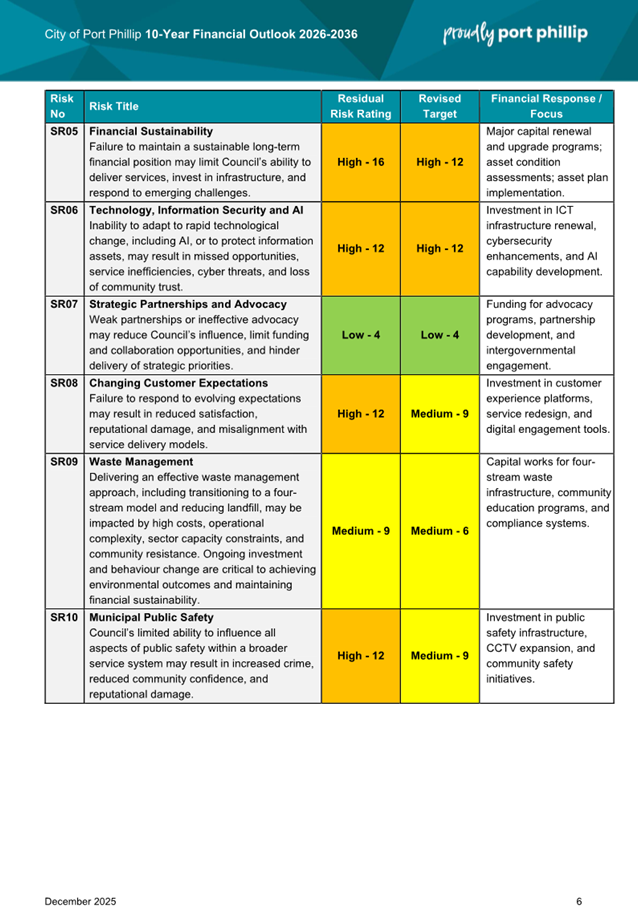
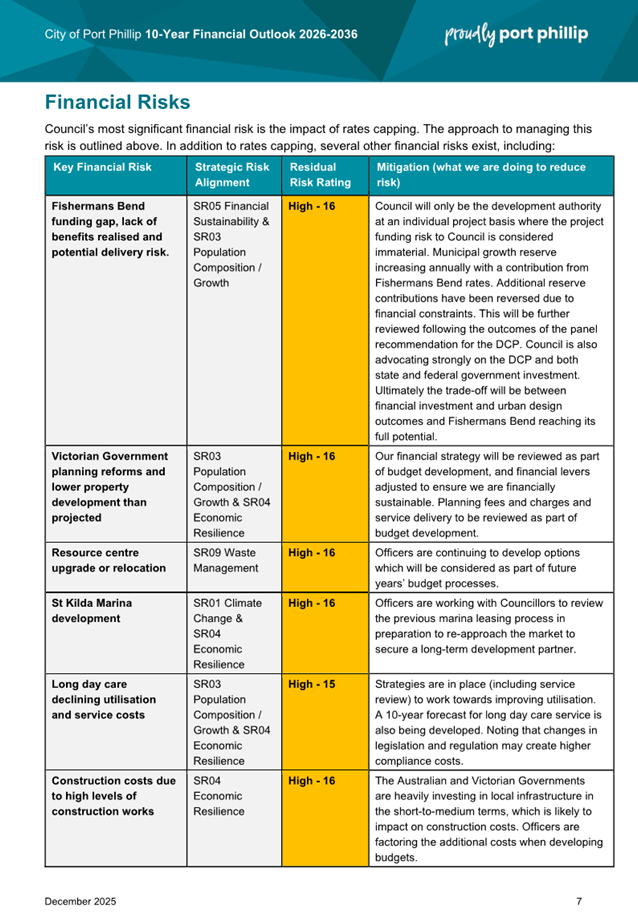
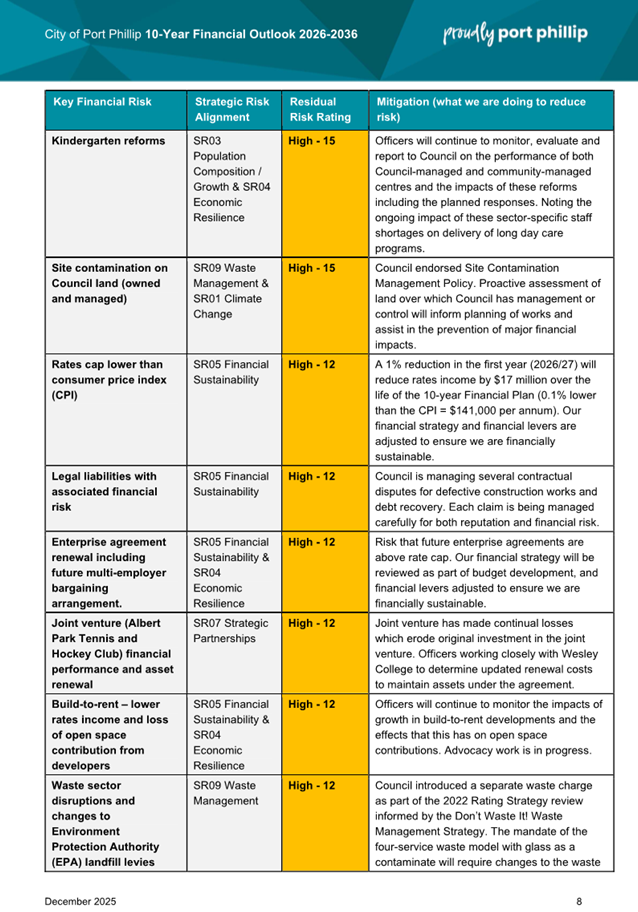
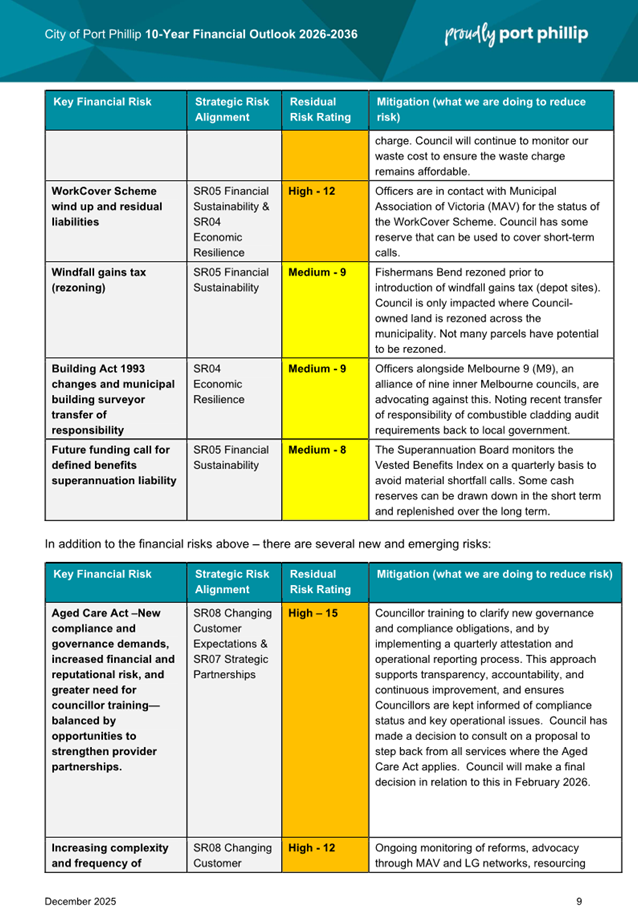
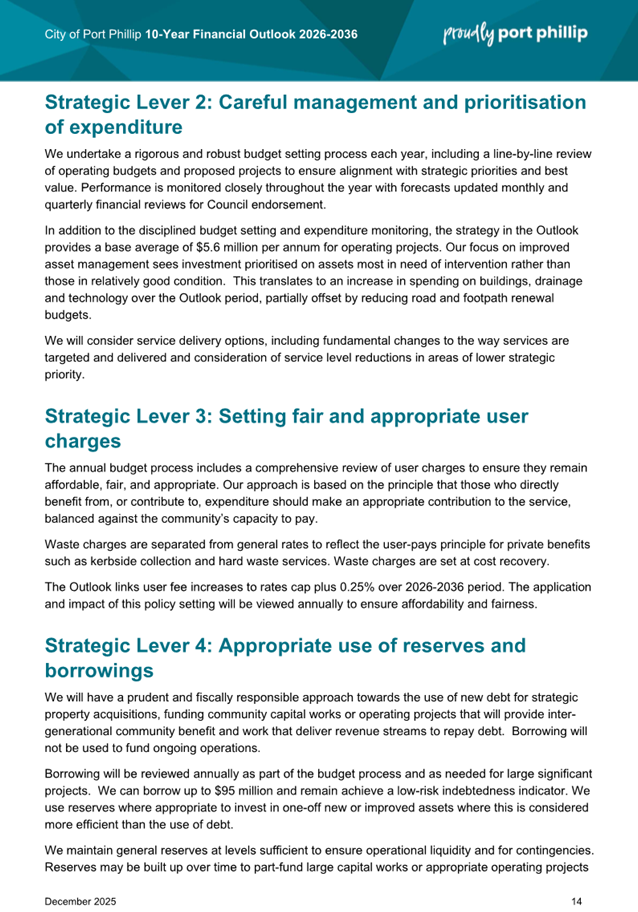
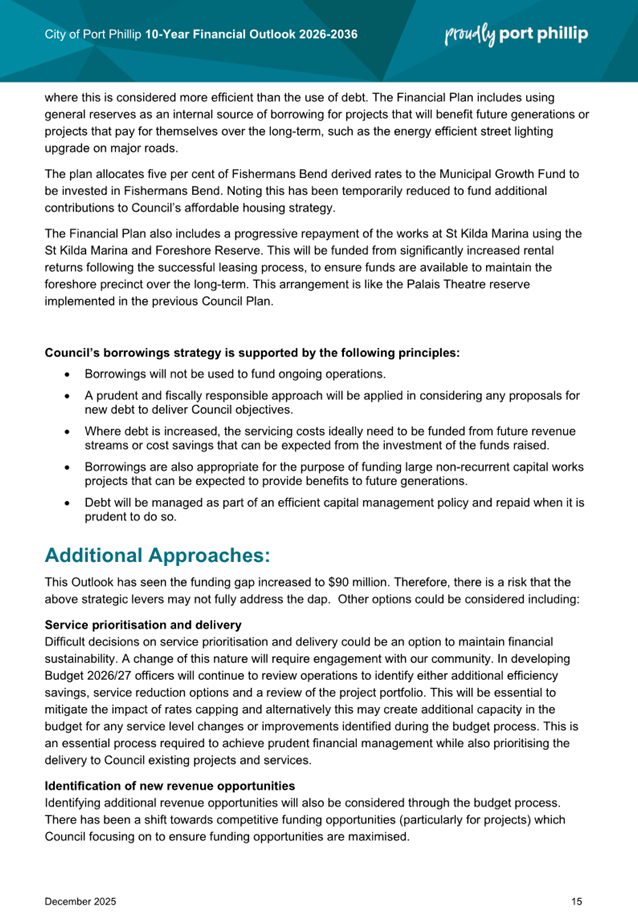
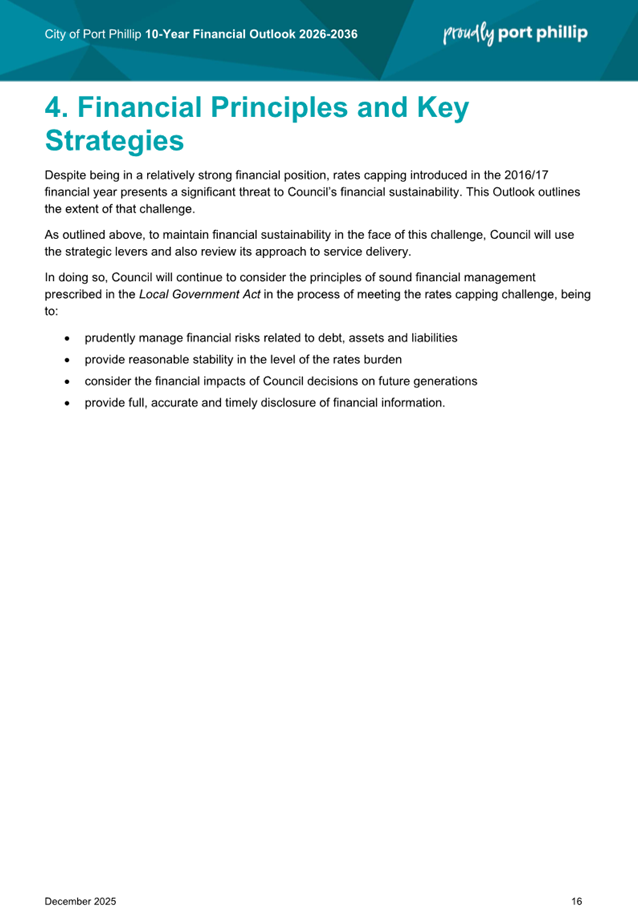
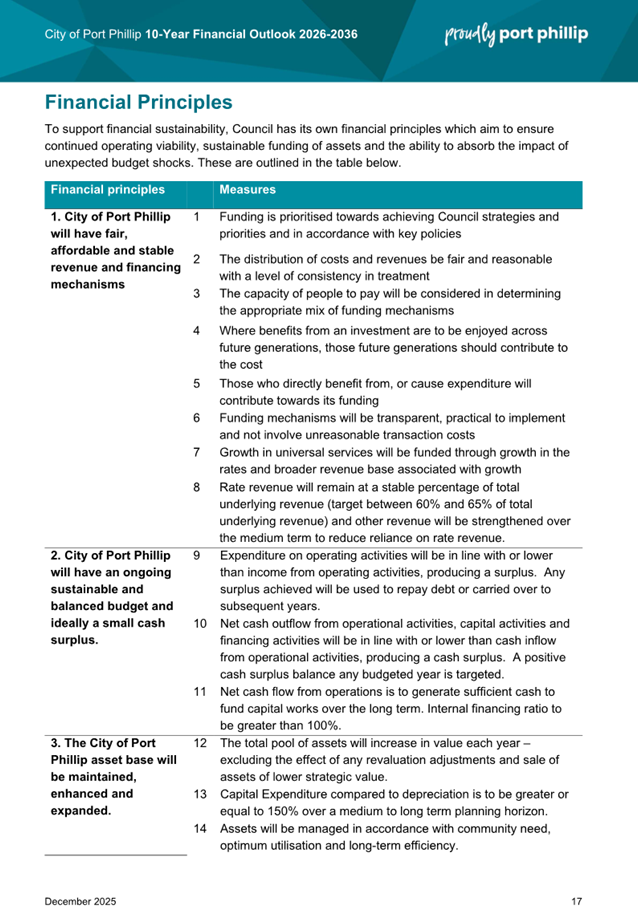
13.1 Council Plan and Budget 2026/27 - Long Term Financial Outlook and Direction Setting 656
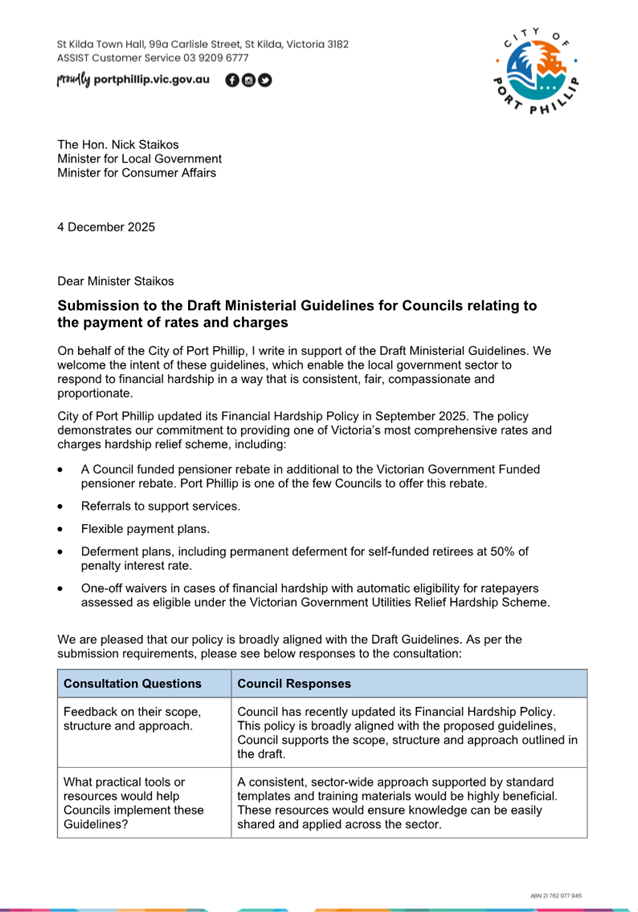
13.2 Submission to the Draft Ministerial Guidelines for Councils relating to the payment of rates and charges............................................................................................................ 708
14 Notices of Motion............................................................................................... 713
14.1 Notice of Motion - Councillor Halliday - 78 Tram Route Extension................ 713
15 Reports by Councillor Delegates
16 URGENT BUSINESS
17 Confidential Matters
The information contained in the following Council reports is considered to be Confidential Information in accordance with Section 3 of the Local Government Act 2020.
17.1 The Avenue Childcare Centre - Appointment of Builder
3(1)(a). Council business information, being information that would prejudice the Council's position in commercial negotiations if prematurely released
3(1)(g(i)). private commercial information, being information provided by a business, commercial or financial undertaking that relates to trade secrets
3(1)(g(ii)). private commercial information, being information provided by a business, commercial or financial undertaking that if released, would unreasonably expose the business, commercial or financial undertaking to disadvantage.
Reason: Contains commerical information that may unfairly advatage competing tenderers. Names the members of the Tender Evaluation Panel. Contains information, the disclosure of which would compromise Council's commercial position with respect to the procurment of works for the subject childcare centre, and other childcare centres.
1. Apologies
2. Minutes of Previous Meetings
|
That the minutes of the Meeting of the Port Phillip City Council held on 3 December 2025 be confirmed. |
3. Declarations of Conflicts of Interest
4. Public Question Time and Submissions
5. Councillor Question Time
6. Petitions, Joint Letters & Deputations
6.1 Petition - Continuation of Social Inclusion Funding 2026-27.............................. 5
Meeting of the Port Phillip City Council
10 December 2025
|
Petition - Continuation of Social Inclusion Funding 2026-27 |
A Petition containing 34 signatures, was received from community members.
The Petition states the following: -
We, the undersigned residents and community members of the City of Port Phillip request that Council continue funding for the Social Inclusion Program in 2026-27.
The City of Port Phillip’s Plan for Port Phillip 2025-35 identifies:
· High and rising social isolation
· Significant economic disadvantage
· Increasing discrimination including racism and antisemitism
· Barriers to participation in people with disability, elder people and diverse cultural groups.
Council’s own strategy commits to:
· Reducing loneliness and isolation
· Strengthening community cohesion
· Supporting community led connection
· Combating discrimination
· Delivering diversity, equity & inclusion outcomes.
The Social Inclusion Program is one of the only community led services in the city of Port Phillip that delivers these outcomes directly to the residents.
These are no specialist Age Care provider that will deliver this program.
|
RECOMMENDATION That Council: 1. Thanks, the petitioner for their petition. 2. Receives and notes the petition, with a formal response to be provided as part of the ‘Positive Ageing in the City of Port Phillip’ report scheduled for Council consideration in early 2026. 3. Notes that officers will advise the lead petitioner of the timeline for Council consideration once confirmed. |
|
Nil |
Meeting of the Port Phillip City Council
10 December 2025
7. Presentation of CEO Report
Nil
8. A Healthy and Connected Community
8.1 Homelessness and Affordable Housing Strategy............................................... 8
Meeting of the Port Phillip City Council
10 December 2025
|
Homelessness and Affordable Housing Strategy |
|
|
Executive Member: |
Kylie Bennetts, General Manager, Community Wellbeing |
|
PREPARED BY: |
Felicity Symons, Coordinator Community & Social Planning Christine Dening, Manager Community Building and Inclusion |
1. PURPOSE
1.1 For Council to endorse the:
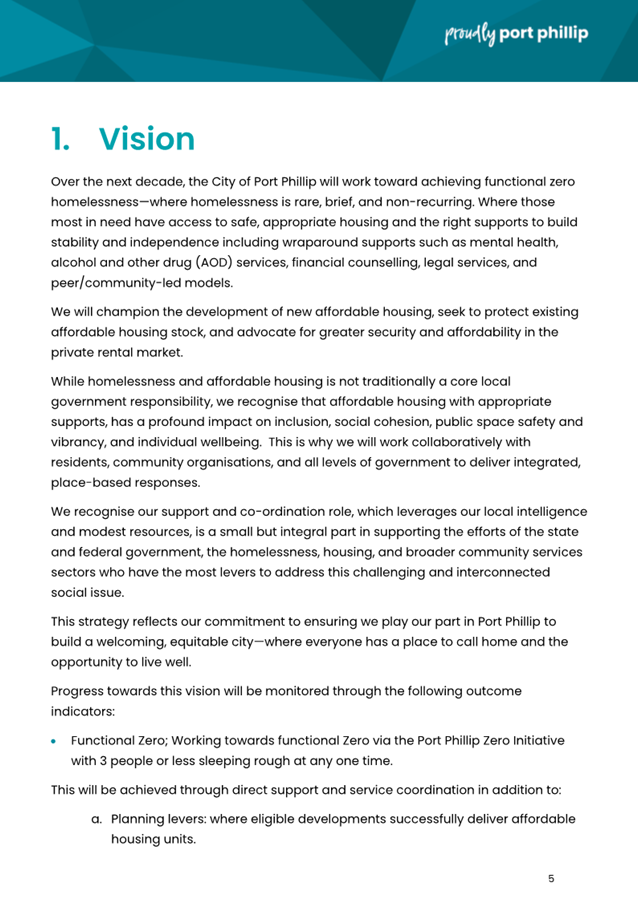
1.1.1 Homelessness and Affordable Housing Strategy (November 2025) and associated implementation plan.
1.1.2 Allocation of homelessness and housing project funding in 2025/26 and 2026/27.
2. EXECUTIVE Summary
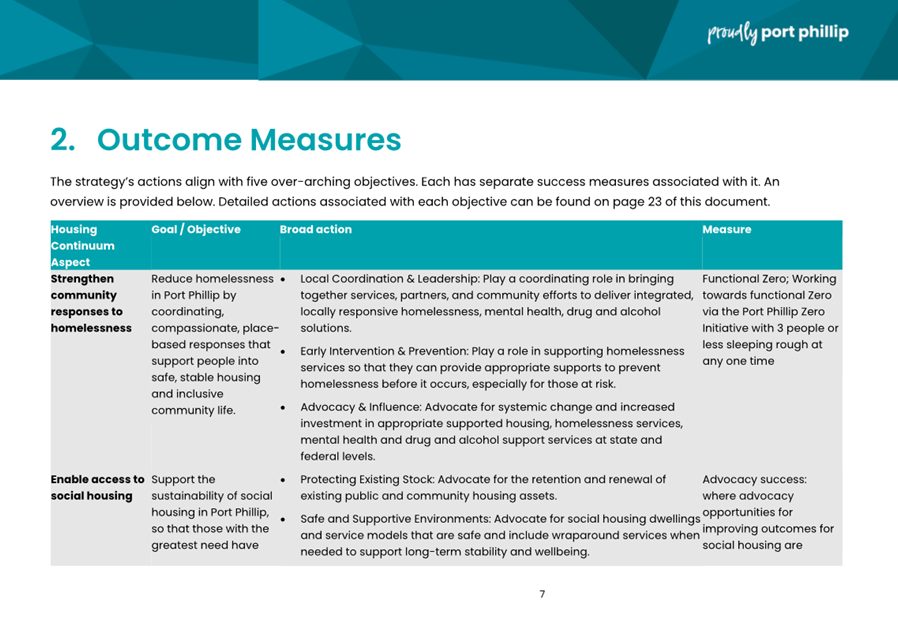
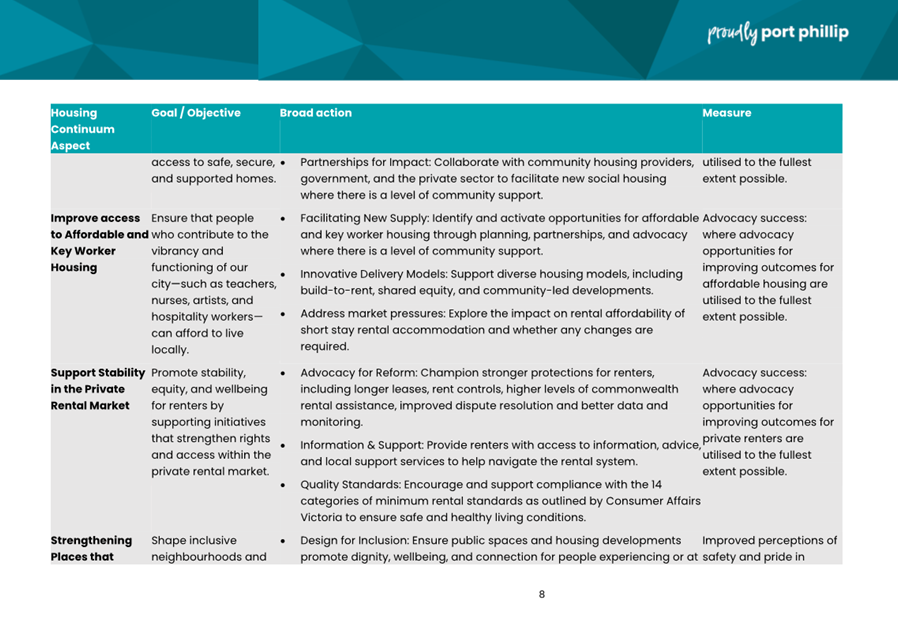
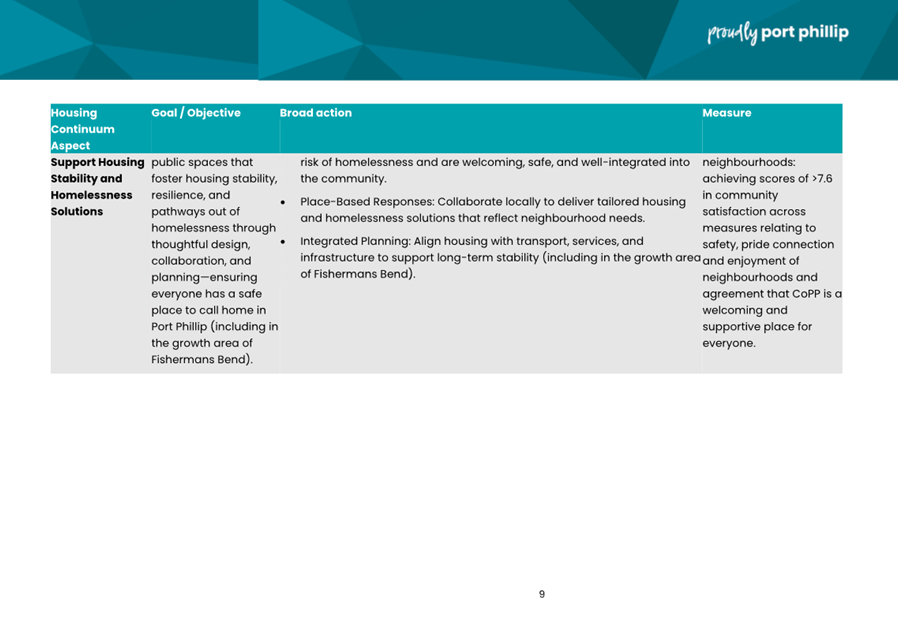
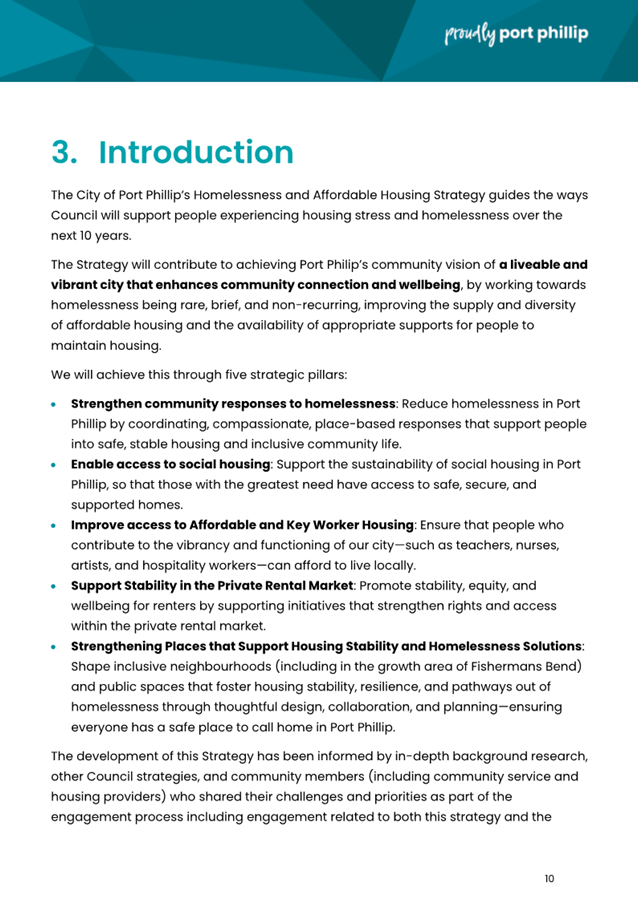
2.1 The Homelessness and Affordable Housing Strategy (November 2025) (the Strategy) will contribute to achieving Port Philip’s community vision of a liveable and vibrant city that enhances community connection and wellbeing, by working towards homelessness being rare, brief, and non-recurring, improving the supply and diversity of affordable housing and the availability of appropriate supports for people to maintain housing (See Attachment 1: Homelessness and Affordable Housing Strategy).
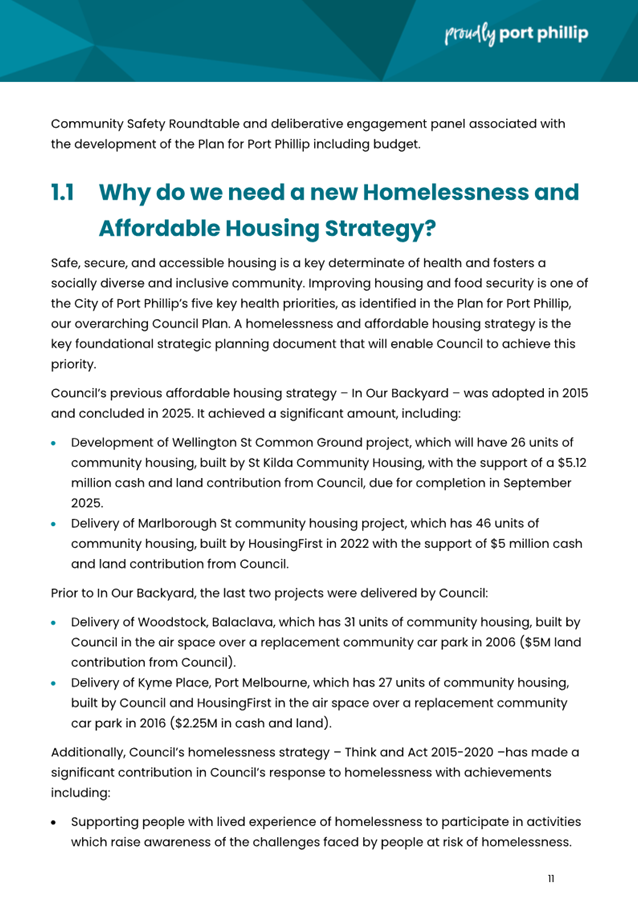
2.2 Safe, secure, and accessible housing is a key determinant of health and fosters a socially diverse and inclusive community across all areas of the City of Port Phillip, including the important growth area of Fishermans Bend. Improving housing and food security is one of the City’s five key health priorities, as identified in the Plan for Port Phillip.
2.3 The Strategy is the key strategic document to focus Council efforts on improving housing security.
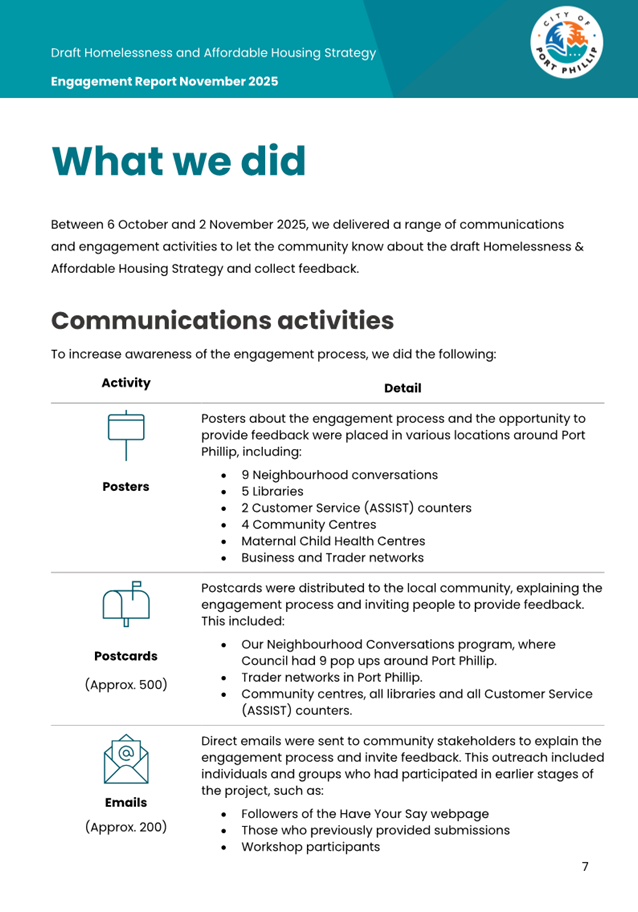
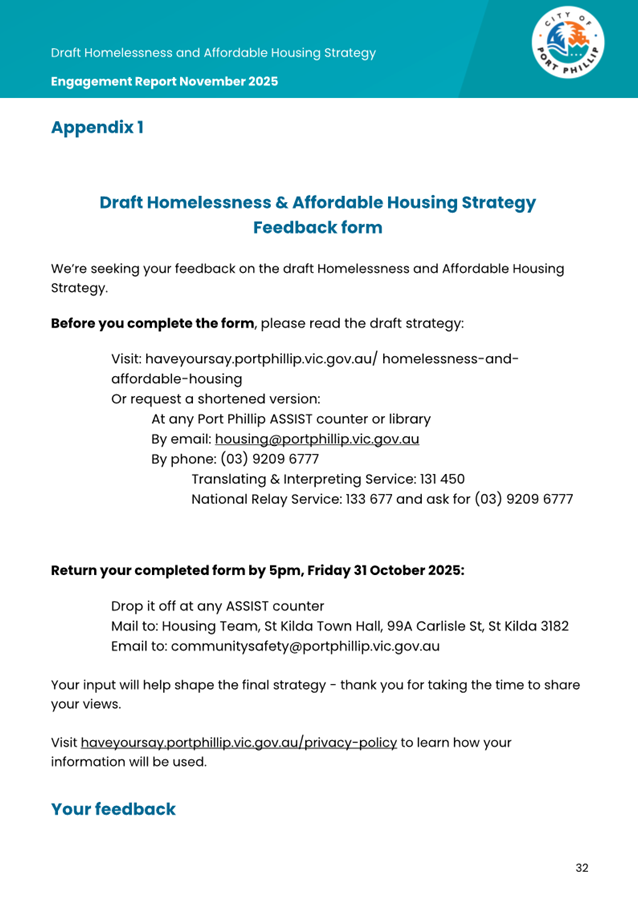
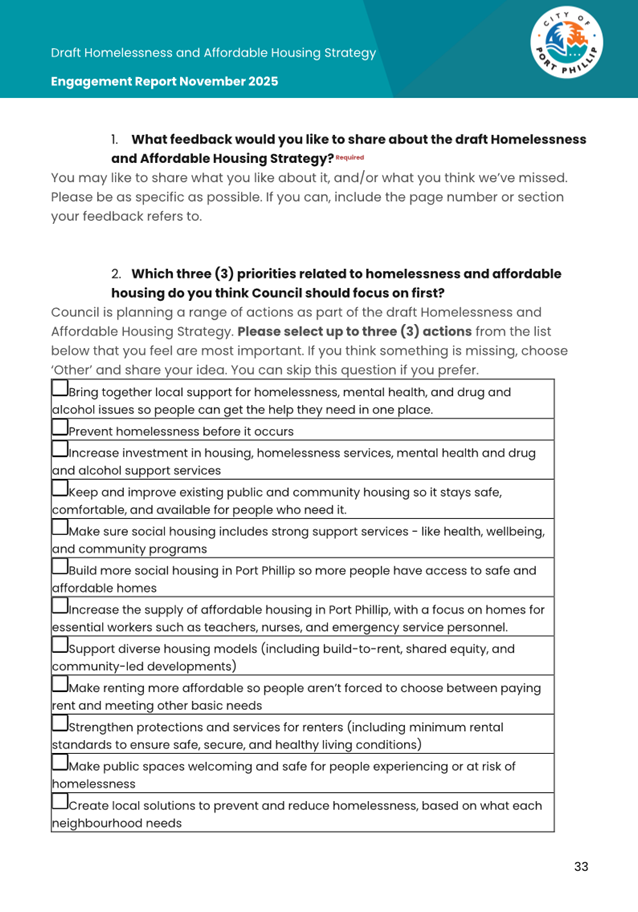
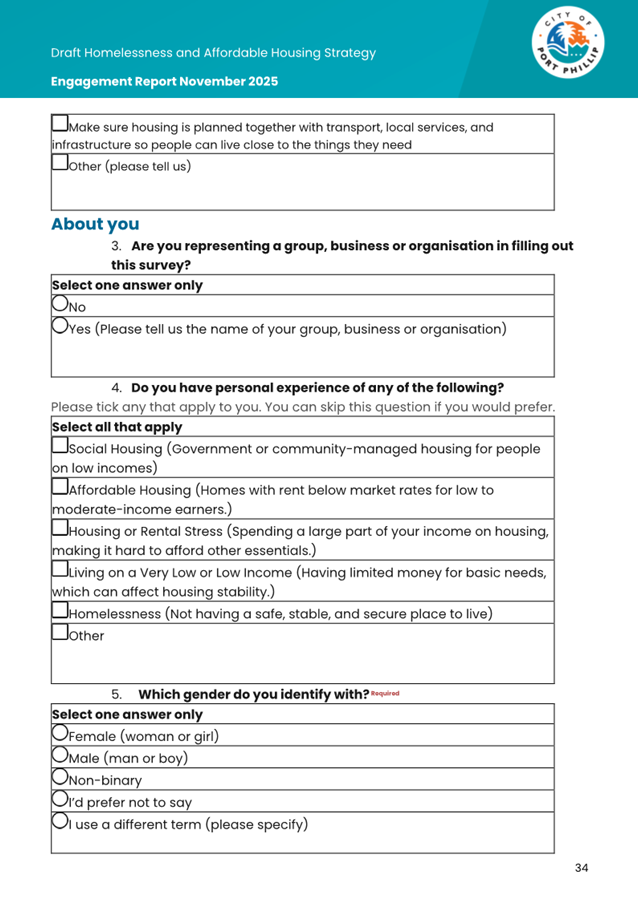
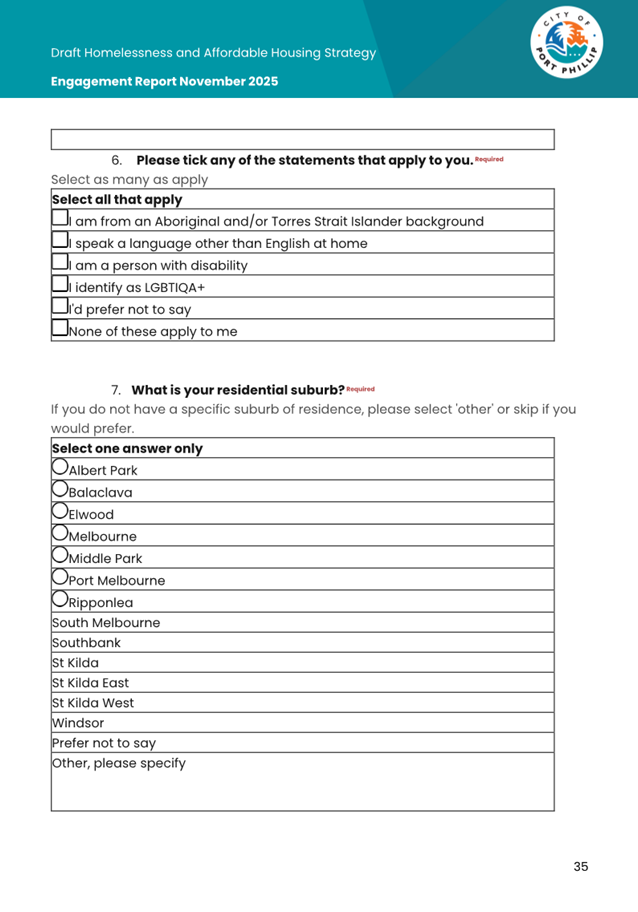
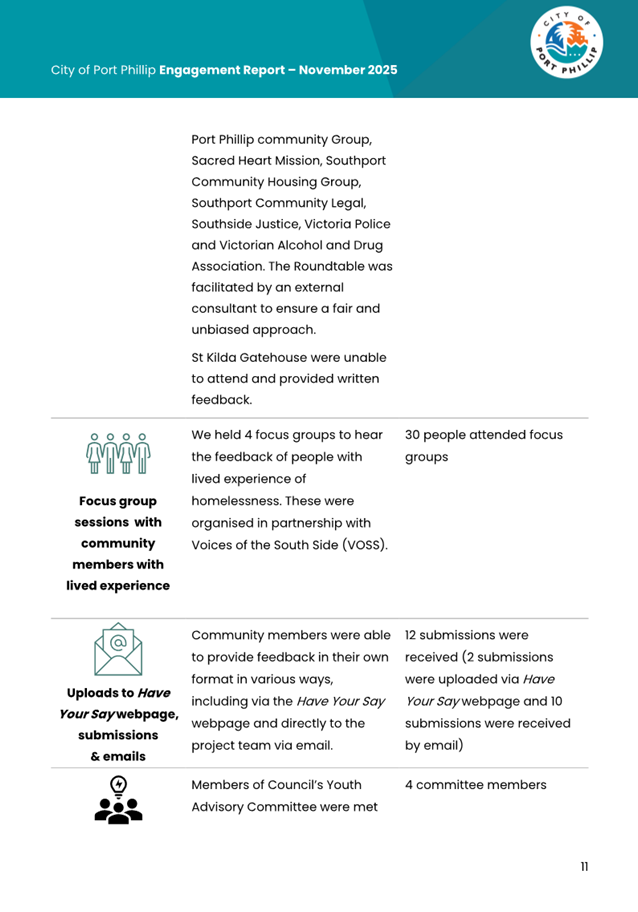
2.4 Phase 2 of the Strategy’s engagement program sought feedback on the draft proposed Strategy and ran from 6 October to 2 November 2025, with community and stakeholder input invited through a range of activities, including:
2.4.1 A 'Have Your Say' survey.
2.4.2 Targeted workshops and discussions, including people with living and lived experiences of homelessness or vulnerability.
2.4.3 Reconvening the Community Safety Roundtable held on 22 October 2025.
2.4.4 Direct engagement with community service providers, which also sought input to support funding considerations.
2.4.5 Direct engagement with community groups, residents and traders who registered for project notifications.
2.4.6 Promotion through Council’s social media and website and through the Neighbourhood Engagement Program.
2.4.7 Distribution of posters and flyers at libraries, community centres, maternal and child health centres, childcare centres, Neighbourhood Engagement “pop ups”, and the Victorian Pride Centre.
2.5 The draft strategy received majority support from those who participated in the engagement, with some suggestions for improvement.
2.6 The feedback broadly sought:
2.6.1 Stronger integration of community health.
2.6.2 Increased importance of co-location of services or hubs.
2.6.3 Stronger incorporation of lived experience.
2.6.4 Strengthened advocacy for renters.
2.6.5 Stronger support for existing commitments, such as Gathering Place(s).
2.7 Through the Council Plan and Budget process, Council committed $600K in project funding per annum for the next four years. Council resolved to allocate a portion of the budget to St Kilda Community Housing ($250k per annum for two years) and BridgeIt ($15k for two years), with $335k remaining unallocated.
2.8 Community service providers were invited to revisit the submissions they lodged through the Phase 1 Engagement Program to include more detailed budget-specific information to support funding considerations. Five submissions were received, discussions took place and an assessment of these across both the Housing and Community Safety Project funding was made.
2.9 Following detailed consideration of these submissions, it is proposed that additional budget allocations are as follows:
2.9.1 South Port Community Housing $150k in each of 2025/26 and 2026/27 to target upstream homelessness and support priority cohorts (including youth, First Nations and those experiencing homelessness), reducing reliance on crisis accommodation and improving long-term stability.
2.9.2 South Side Justice $100k in each of 2025/26 and 2026/27 for embedded lawyers to provide early intervention for private renters at risk of eviction, advocacy for housing rights, and capacity building for frontline workers.
2.9.3 $50k to be allocated in 2025/26 to commence initial feasibility work of sites that could be proposed for development of affordable housing by community housing providers, as determined through an expression of interest process.
2.9.4 Retain any unspent funds in 2025/26 and 2026/27 for future allocation in response to emerging need or an opportunity that arises at any given point in time.
2.10 This report should be read in conjunction with the Community Safety Plan report, particularly budget requests, which were considered to align more closely with Council’s community safety budget allocation.
|
3. RECOMMENDATION That Council: 3.1 Thanks, all community members, organisations and other stakeholders who have contributed to engagement and provided feedback to inform the Homelessness and Affordable Housing Strategy. 3.2 Adopts the Homelessness and Affordable Housing Strategy (Attachment 1) and delegates to the Chief Executive Officer the ability to make amendments that do not materially alter the intent of the Strategy. 3.3 Endorses the Implementation Plan for the Strategy (Attachment 2). 3.4 Releases the Community Safety Engagement Report (Attachment 3). 3.5 Thanks, service providers who submitted further detail on initiatives that Council could make a financial contribution to that would make a contribution to addressing root causes of homelessness and affordable housing in Port Phillip. 3.6 Endorses the allocation of: 3.6.1 $150k in each of 2025/26 and 2026/27 to South Port Community Housing to target upstream homelessness and support priority cohorts (including youth, First Nations and those experiencing homelessness), reducing reliance on crisis accommodation and improving long-term stability. 3.6.2 $100k in each of 2025/26 and 2026/27 to South Side Justice for embedded lawyers to provide early intervention for private renters at risk of eviction, advocacy for housing rights, and capacity building for frontline workers. 3.6.3 $50k in 2025/26 for initial feasibility work of Council sites that could potentially be proposed for development of affordable housing by community housing providers, following an expression of interest process. |
4. KEY POINTS/ISSUES
Strategy Content
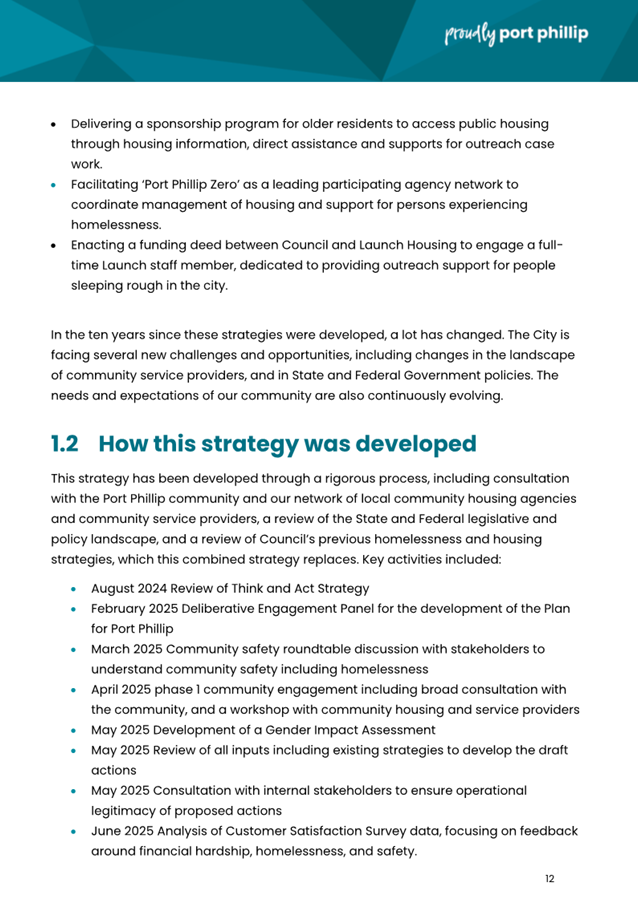
4.1 The Strategy was developed through a thorough and multi-dimensional process, incorporating two key phases of engagement, along with strategic analysis and evidence-based research. Key activities included:
4.1.1 Phase 1 Community Engagement in May 2025: An initial engagement phase was conducted to explore Council’s current and potential role within the broader service system in addressing homelessness and affordable housing. This phase provided early insights into community needs, expectations, and opportunities for Council involvement.
4.1.2 Strategic Alignment and Policy Review: A review of relevant Council and government strategies was undertaken, drawing on insights from previous engagement processes to ensure consistency and alignment with broader policy directions.
4.1.3 Integration of Key Engagement Insights: The draft Strategy incorporates findings from recent engagement activities, including:
· Deliberative engagement conducted as part of the Plan for Port Phillip; and
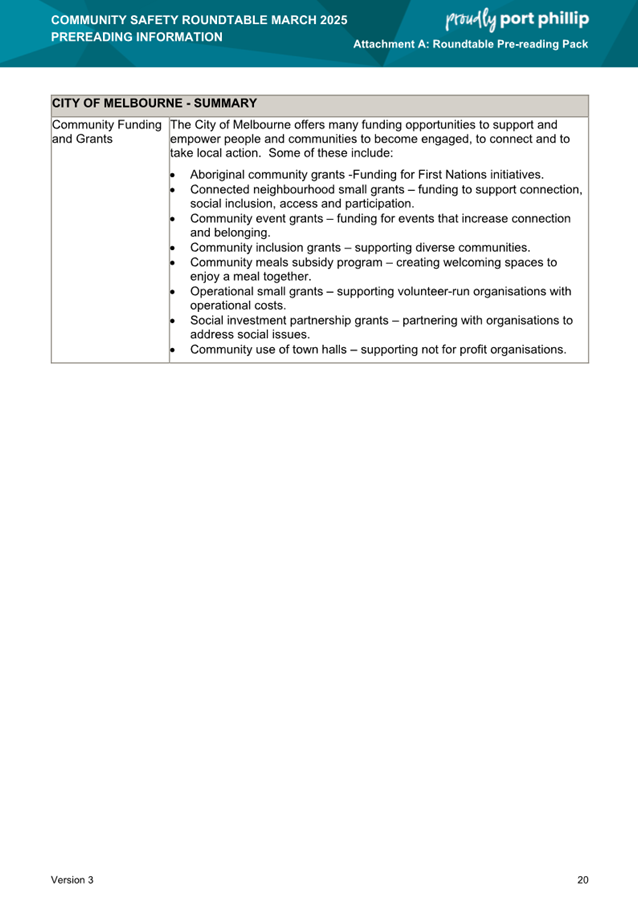
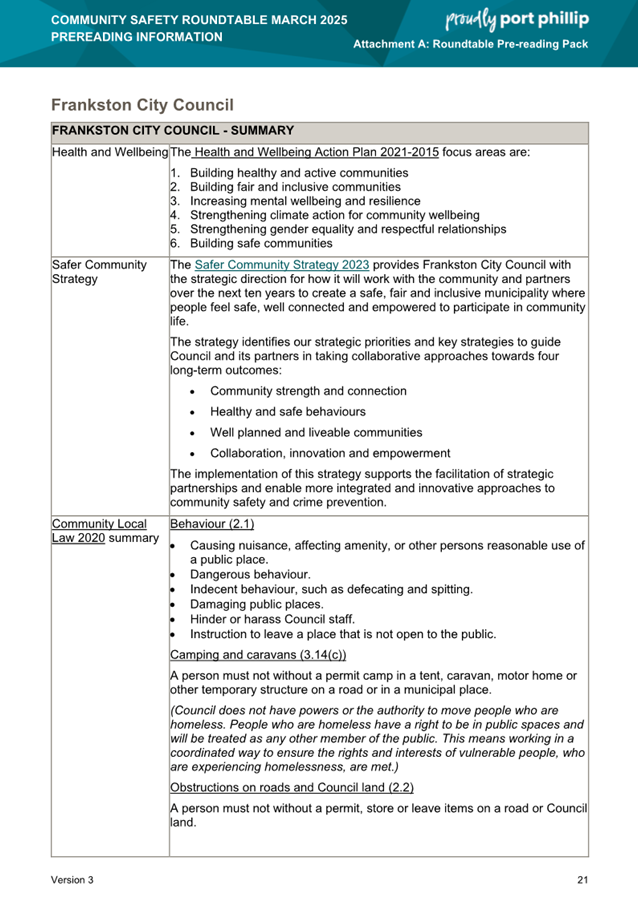
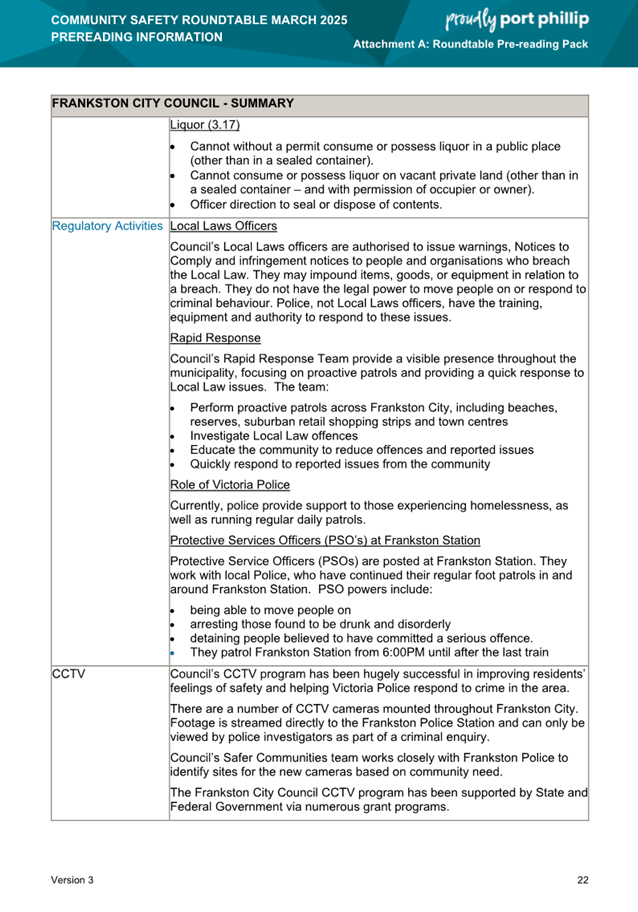
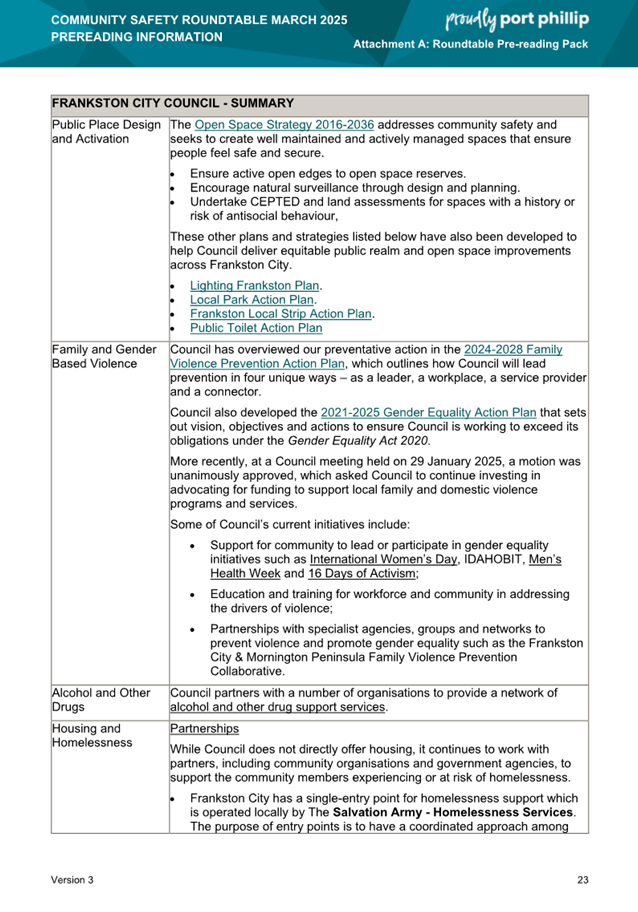
· Recommendations and submissions received through the Community Safety Roundtable.
· Recommendations received through the reconvened Community Roundtable in October 2025.
4.1.4 Evidence and Data Analysis: To support the Strategy’s development, a range of supporting documents and data sources were analysed, including:
· Strategies from other local governments, such as the City of Melbourne’s Think and Act Homelessness Strategy;
· Results from the 2025 Customer Satisfaction Survey, particularly in relation to community wellbeing and safety; and
· A gender impact assessment of the draft Strategy to ensure it is inclusive and equitable.
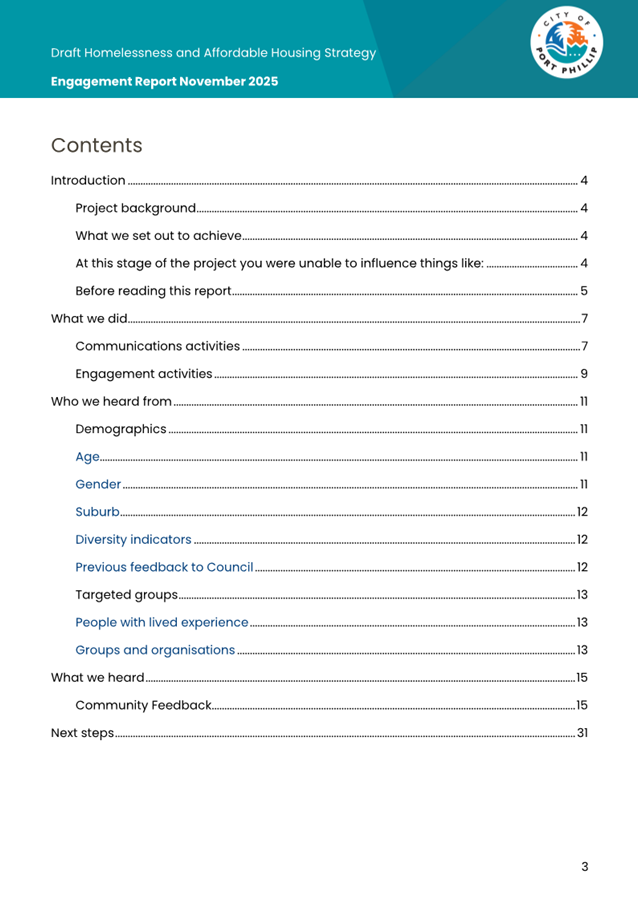
4.2 Phase 2 Community Engagement ran from 6 October to 2 November 2025, focusing on feedback regarding the draft Strategy’s vision, strategic pillars, measures, and actions. The engagement findings are summarised in Attachment 3.
4.3 All feedback received was reviewed and used to inform revisions to the Strategy.
What we heard and proposed amendments to the Strategy
4.4 Following a review of all feedback received through the Phase 2 engagement program, the Strategy has been updated. These changes are identified in Attachment 1, and include changes to the vision, the body text, the wording of some actions, and inclusion of new additional actions. Minor corrections have been made but are not recorded in the Strategy, as they were considered inconsequential.
4.5 Based on feedback received through the Phase 2 engagement program, the following table provides a summary of the amendments made to the Strategy (“red” text denotes the amendments/inclusions to the Strategy):
|
Feedback received through Phase 2 Engagement: |
Amendments made to the Strategy in response to feedback received: |
|
Community Health: Make community health a more prominent focus. |
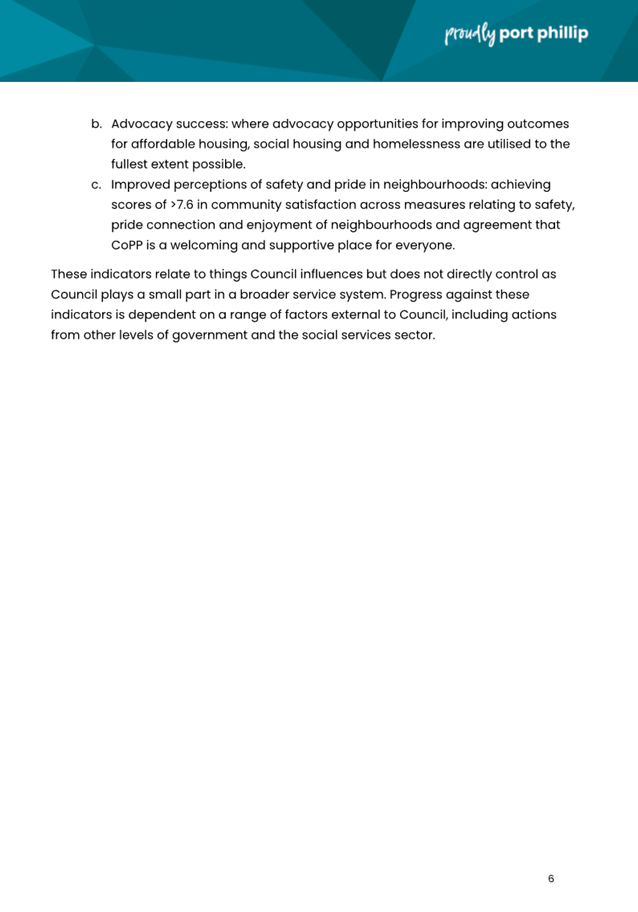
Vision: Over the next decade, the City of Port Phillip will work toward achieving functional zero homelessness—where homelessness is rare, brief, and non-recurring. Where those most in need have access to safe, appropriate housing and the right supports to build stability and independence, including wraparound supports such as mental health, alcohol and other drug (AOD) services, financial counselling, legal services, and peer/community-led models. |
|
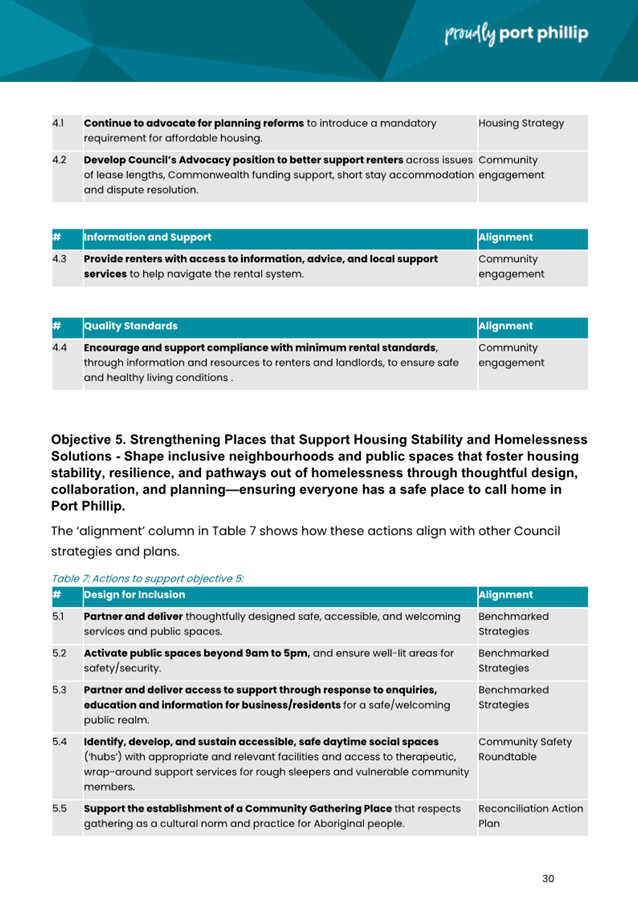
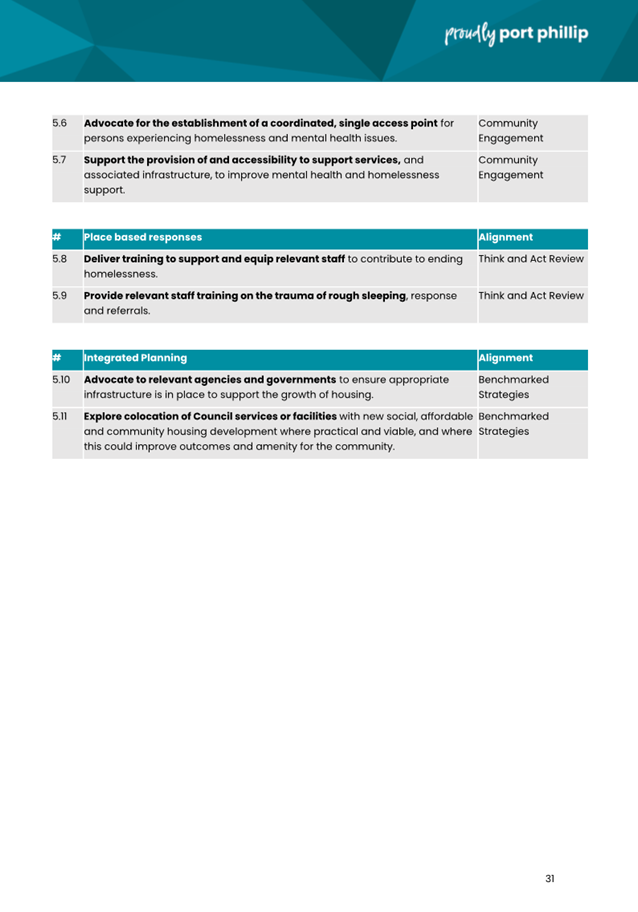
5.7 Support the provision of and accessibility to support services, and associated infrastructure, to improve mental health and homelessness support. |
|
|
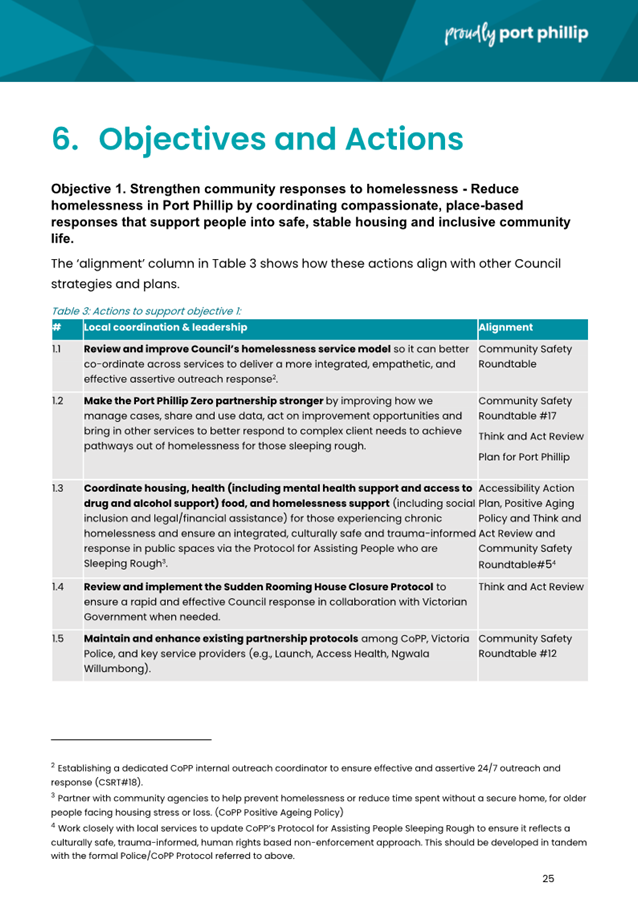
1.3 Coordinate housing, health (including mental health support and access to Drug and Alcohol support) food, and homelessness support (including social inclusion and legal/financial assistance) for those experiencing chronic homelessness and ensure an integrated, culturally safe and trauma-informed response in public spaces via the Protocol for Assisting People who are Sleeping Rough |
|
|
Community Health Service coordination: Create a one-stop shop for easier access to services and make community health a more prominent focus. |
New 5.6 Advocate for the establishment of a coordinated, single access point for persons experiencing homelessness and mental health issues. |
|
1.13: Advocate for better coordination between homelessness, health and justice systems including early intervention/prevention for people leaving institutions |
|
|
Lived Experience: Incorporate direct input from people with lived experience. |
Action 2.5 Ensure housing and infrastructure plans respond to the challenges faced by intersectional groups by including the voices of people with lived experience from the early design phase to completion. |
|
Hub spaces: Create safe daytime hubs with essential facilities. |
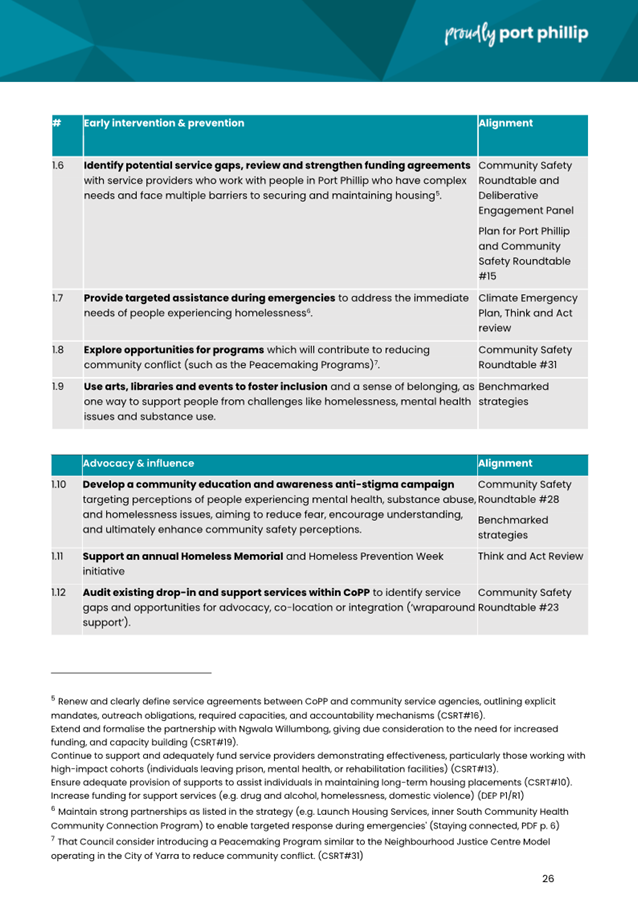
Action 5.4 Identify, develop, and sustain accessible, safe daytime social spaces ("hubs") with appropriate and essential facilities, and access to therapeutic, wrap-around support services for rough sleepers and vulnerable community members. |
|
Rental supports: Develop Council’s Advocacy position to better support renters
|
New Action 3.10 Advocate for local regulatory mechanisms to mitigate displacement caused by short stay rental accommodation. |
|
Action 2.5 Ensure housing and infrastructure plans respond to the challenges faced by intersectional groups by including the voices of people with lived experience from the early design phase to completion. |
|
|
Sponsorship Housing |
Action 2.6 Partner, and deliver prevention, support, and housing for older people through the Sponsorship Housing Program |
Strategy Funding
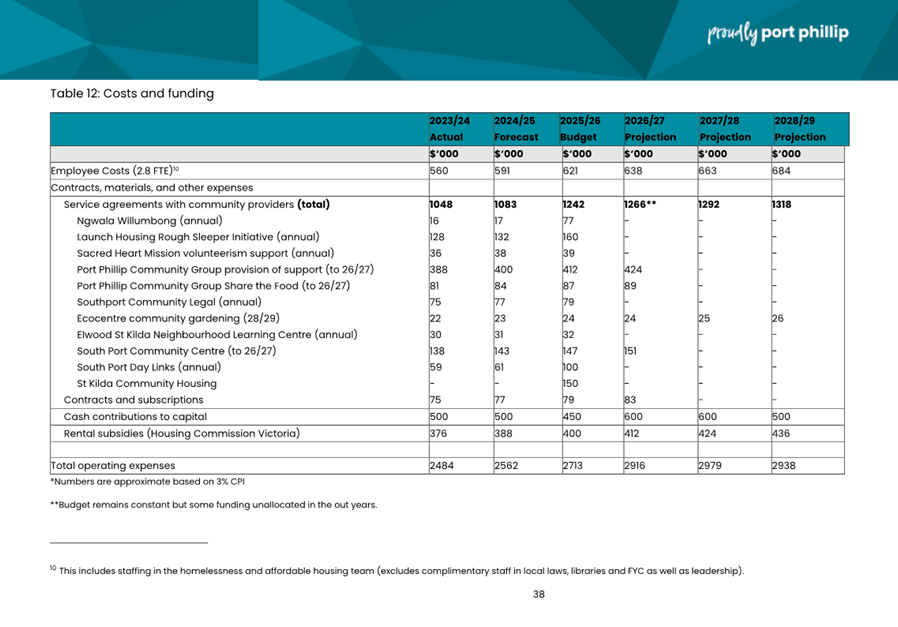
4.6 Council has committed a total of $5.4 million over ten years to support the implementation of the Strategy. This includes:
· $600,000 over the first four years (2025/26–2028/29) as part of the current budget cycle; and
· $500,000 over the following six years (2029/30–2034/35), reflecting Council’s ongoing commitment to long-term action.
4.7 Of the 2025/26 and 2026/27 budget, a total of $265,000 per annum has been allocated to support targeted housing initiatives in Port Phillip, including $250,000 per year for two years for St Kilda Community Housing—conditional on additional external funding—and $15,000 per year for two years for Bridge It to assist with operational costs for safe housing for young women and gender diverse people with lived experience of out-of-home care or homelessness.
4.8 Council sought targeted community consultation to inform the effective allocation of project funds. Feedback was gathered through members of the Community Safety Roundtable and the Port Phillip Zero Executive, both of whom are well-positioned to advise on opportunities for greatest impact.
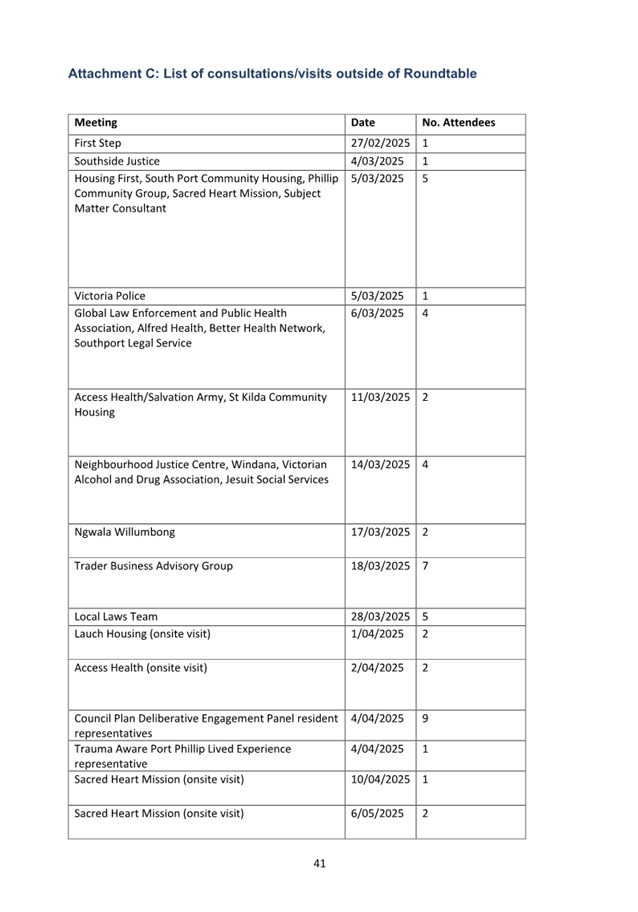
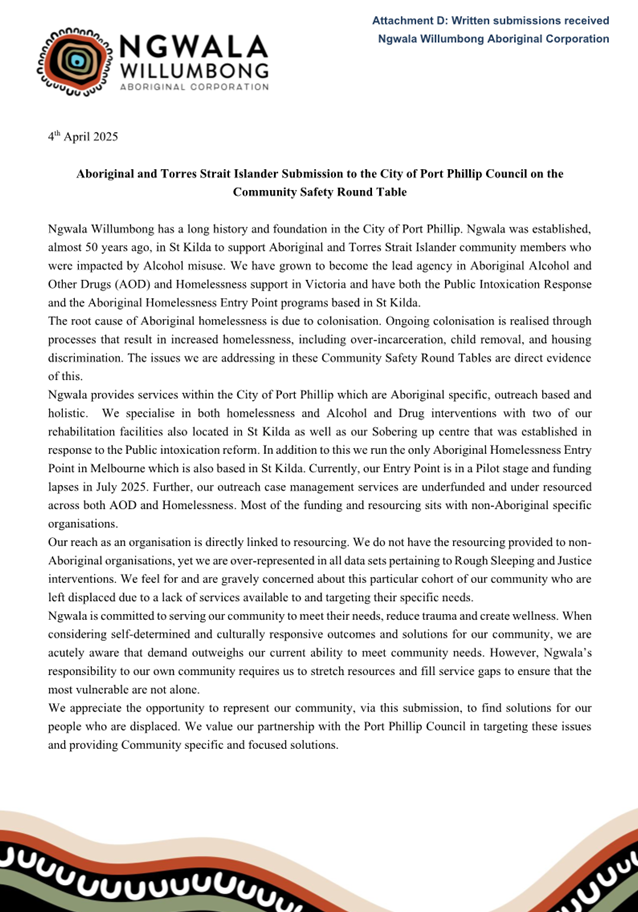
4.9 In addition, Council officers engaged directly with Sacred Heart Mission, Southside Justice, South Port Community Housing and Ngwala Willumbong to further explore their initial submissions to the Community Safety Roundtable and invite input into potential funding allocations, in line with the decision of Council on the release of the draft Strategy. Southside Justice and South Port Community Housing both made more formal budget submissions while Sacred Heart Mission and Ngwala Willumbong did not submit a formal budget proposal but did provide valuable contextual insights into the needs of the Port Phillip community. Through this process Ngwala indicated that the outreach funding provided by Council through the budget process and a Gathering Place(s) were the key areas of support required from Council from their perspective. Sacred Heart Mission highlighted the extent of funding required to support some of their priorities was well beyond what they believed Council would be able to support.
4.10 This feedback, combined with broader community input on priority areas for action, highlighted several key service gaps where Council investment could deliver meaningful outcomes:
4.10.1 Assertive Outreach: Outreach services are under-resourced, limiting their ability to engage individuals with complex needs—such as alcohol and other drug (AOD) issues and mental illness—in public spaces.
4.10.2 Integrated Care Coordination: There is a lack of a central coordinating body or “backbone” organisation to support integrated service delivery for people experiencing long-term homelessness.
4.10.3 Legal and Tenancy Support: Access to early legal intervention remains limited for renters at risk of eviction or living in unsafe housing conditions.
4.11 These budget submissions as well as broader community input have been considered across Council’s available homeless and affordable housing as well as Council’s community safety budgets. As such these two papers should be read in conjunction with each other to understand the proposed response to these submissions in totality.
4.12 Following the consideration of these submissions, it is proposed that additional budget allocations are as follows from Council’s homelessness and affordable housing budget allocation:
4.12.1 South Port Community Housing $150k in each of 2025/26 and 2026/27 to target upstream homelessness and support priority cohorts (including youth, First Nations and those experiencing homelessness), reducing reliance on crisis accommodation and improving long-term stability.
4.12.2 South Side Justice $100k in each of 2025/26 and 2026/27 for embedded lawyers to provide early intervention for private renters at risk of eviction, advocacy for housing rights, and capacity building for frontline workers.
4.12.3 $50k in 2025/26 for early feasibility work of potential Council sites that could be proposed for development of affordable housing by community housing providers, which would be determined through an expression of interest process.
4.13 It is proposed to retain any unspent funds in 2025/26 and 2026/27 for allocation at a future point in time.
4.14 In addition to budgetary support, several community provider submissions identified the need for Council to consider donations of land and/or buildings to enable long-term service delivery and housing solutions. These contributions were seen as critical to unlocking new opportunities for community-led housing and support initiatives.
4.15 As part of Action 3.2[1], Council officers will explore the feasibility of allocating Council-owned land or buildings for donation or partnership opportunities, using the $50k proposed to be allocated earlier in this report. A process to enable these arrangements will also be developed, including an expression of interest for community housing providers. This work will commence in the new year as part of implementing the Housing and Homelessness Strategy.
4.16 Action 3.2 will also work alongside Council’s previously adopted Housing Strategy, which works alongside of Council’s Homelessness and Housing Strategy.
4.16.1 The Housing Strategy commits Council to supporting community housing development on Council land by:
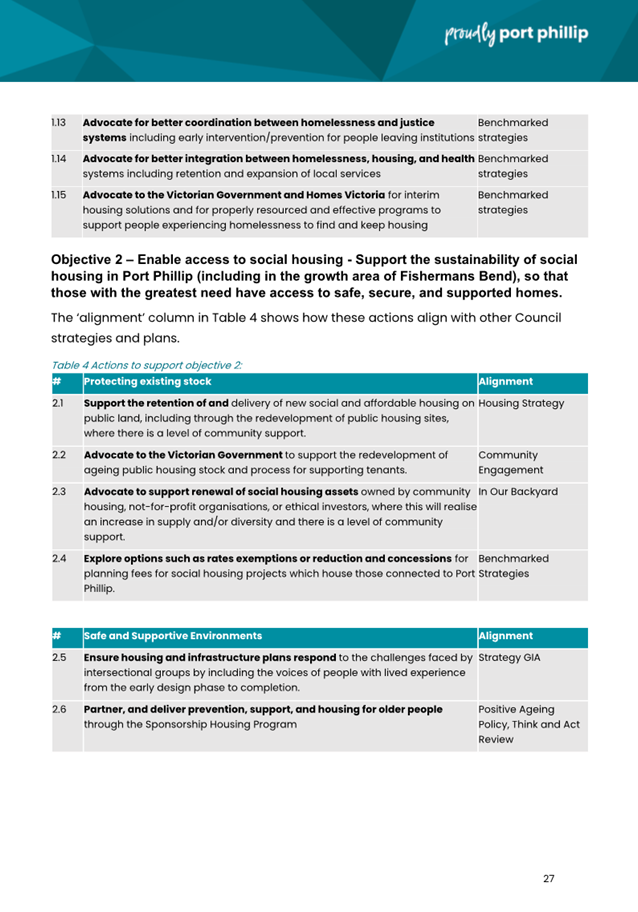
· Providing financial and other assistance to help local organisations access State or Commonwealth funding (Action 2.12).
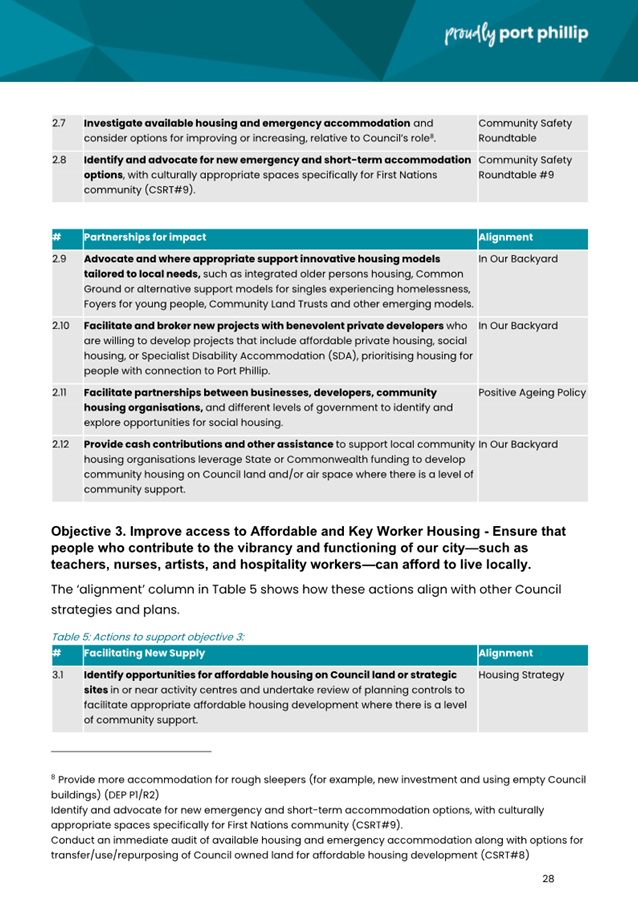
· Identifying suitable Council-owned land or airspace for housing projects, prioritising people with specific needs or a connection to Port Phillip (Action 3.2).
4.16.2 The Housing Strategy also includes actions to amend the Port Phillip Planning Scheme to seek 10% of new dwellings in future developments as affordable housing. This target reflects local need, with 10% of households experiencing severe or moderate rental stress. This 10% target is voluntary, as State policy does not allow mandatory affordable housing requirements in Planning Schemes. The amendment process is scheduled to begin in Q1 2026/27, subject to Council approval. Currently, the Planning Scheme includes a voluntary 6% affordable housing contribution for Fishermans Bend, excluding social housing uplift dwellings.
4.16.3 Consistent with the Homelessness and Affordable Housing Strategy, the Housing Strategy also includes actions to identify opportunities for social and affordable housing on Council land and review planning controls to support affordable housing delivery.
Strategy Implementation and reporting:
4.17 The Strategy will be reviewed in year five to ensure alignment with Council’s budget priorities and commitments.
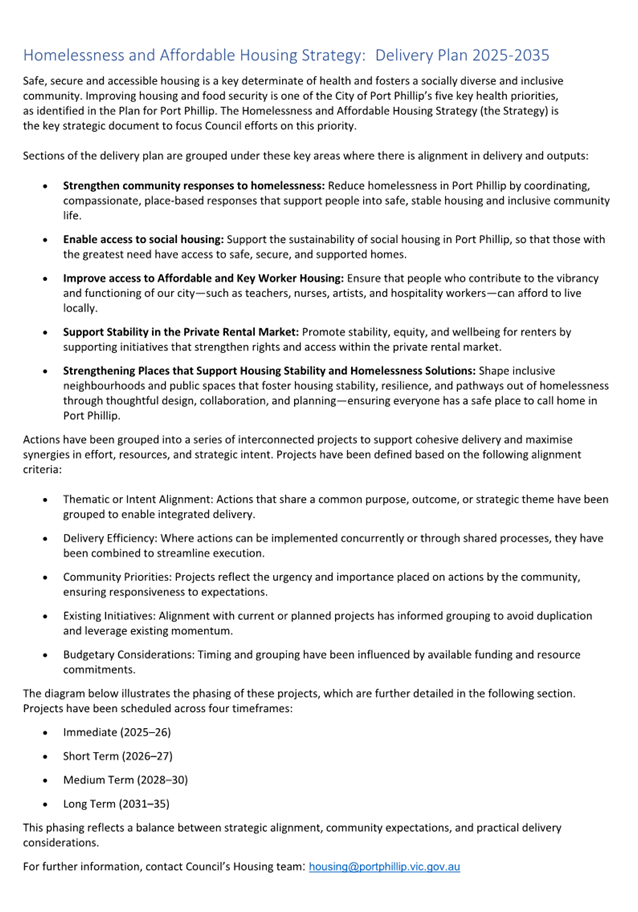
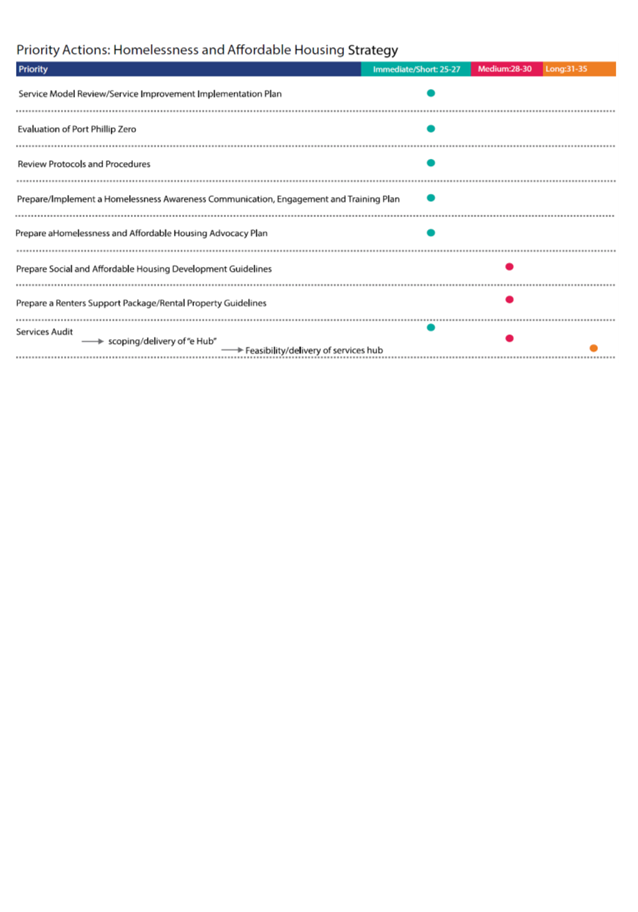
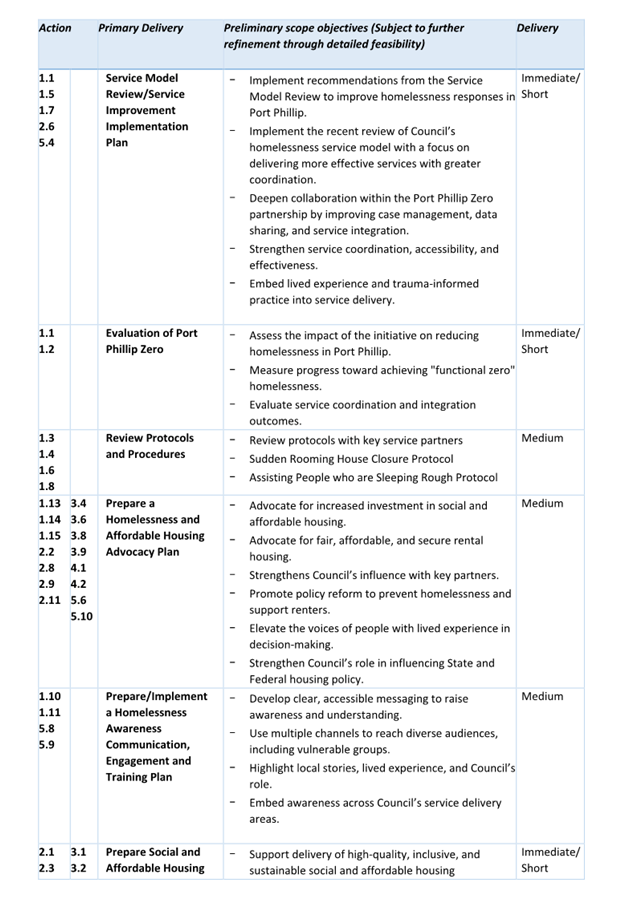
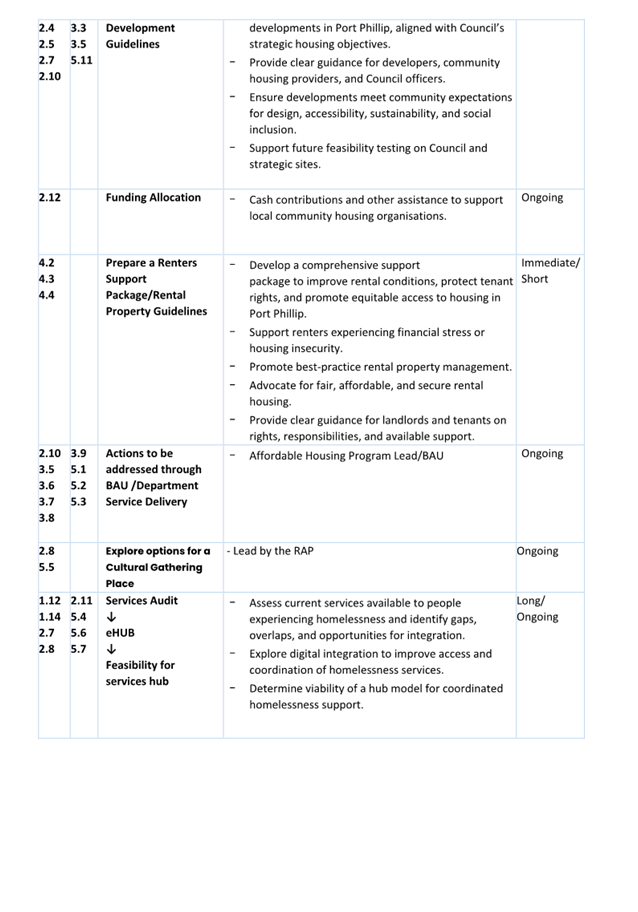
4.18 Feedback from Phase 2 engagement highlighted the need to prioritise delivery across several actions. In response, the following overarching projects have been identified for prioritisation:
4.18.1 Review and implementation of Council’s homelessness service model (underway) (Q2 2025/26)
4.18.2 Evaluation of Port Phillip Zero (underway) (Q2 2025/26)
4.18.3 Review protocols and procedures (such as the Assisting people who are sleeping rough protocol) (commence Q3 2025/26)
4.18.4 Development of a homelessness and affordable housing advocacy plan to seek support across a range of topics and issues (commence Q3 2025/26)
4.18.5 Prepare/Implement a Homelessness Awareness Communication, Engagement and Training Plan (commence Q1 26/27)
4.18.6 Prepare Social and Affordable Housing Development Guidelines (commence Q1 26/27).
4.19 The proposed Strategy delivery plan is at Attachment 2 and outlines the proposed immediate, short term, medium term and long term projects.
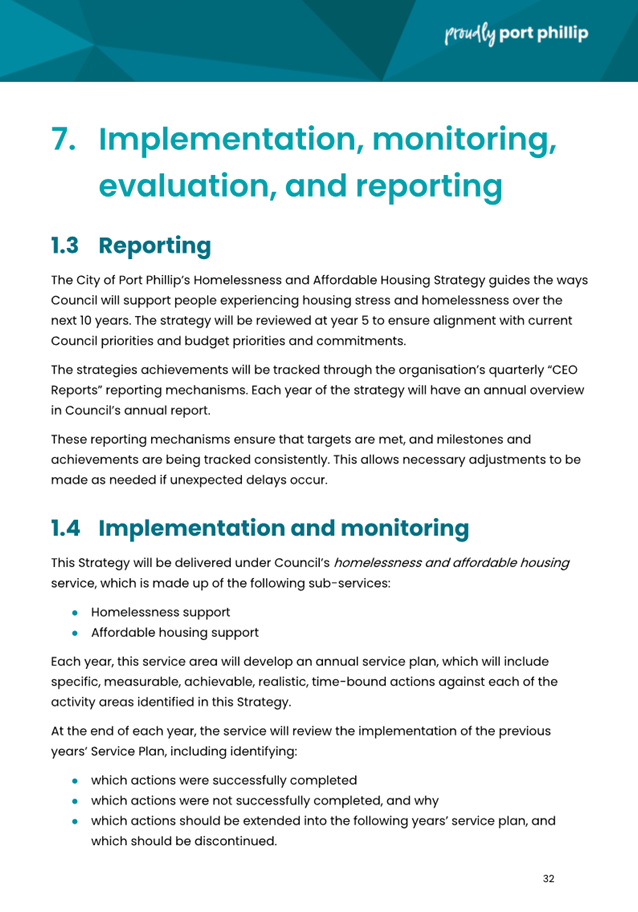
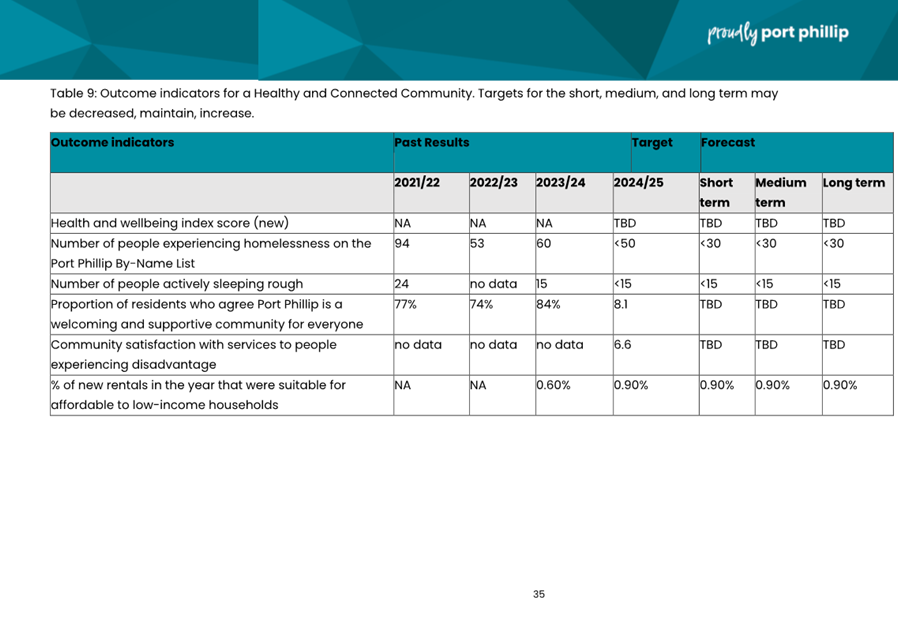
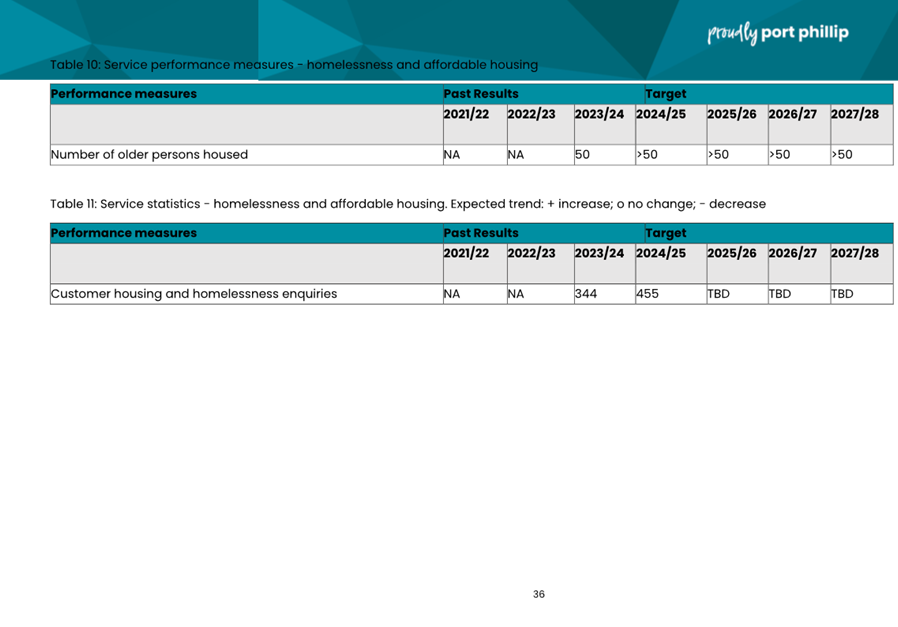
4.20 Implementation of the Strategy will be tracked through Council’s published reports: the quarterly CEO Report and the Annual Council Report.
4.21 These reporting mechanisms will monitor Council’s progress in implementing the Strategy and delivering its actions, while also recording any adjustments to the delivery program in response to unexpected delays.
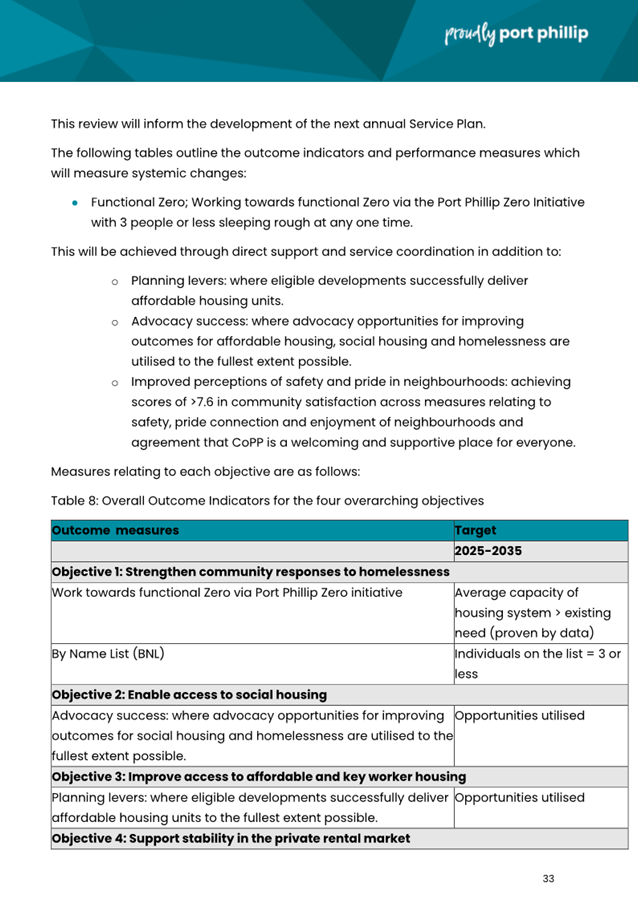
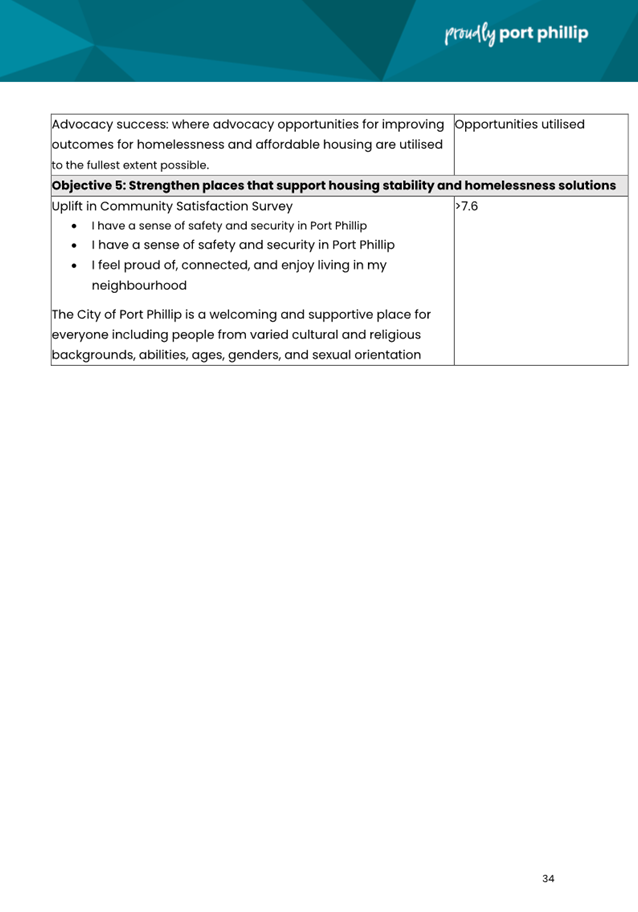
4.22 The Strategy will be delivered under Council’s homelessness and affordable housing service. Each year, this service area will develop an annual Service Plan, which will include specific, measurable, achievable, realistic, time-bound actions against each of the activity areas identified in this Strategy.
4.23 At the end of each year, the homelessness and affordable housing service will review the implementation of the Service Plan, which will inform the development of the next annual Service Plan.
5. Consultation and Stakeholders
Developing the Strategy – Phase 1 engagement
5.1 The Phase 1 Engagement Program commenced in May 2025 and included:
· Surveys.
· Workshops.
· Neighbourhood Pop-ups.
· Written submissions.
· Other interactive methods.
5.2 The engagement methodology targeted both identified stakeholders and the broader community, with a deliberate focus on including people experiencing vulnerability — such as those with lived experience of rough sleeping, homelessness, and other forms of social disadvantage.
Testing the draft Strategy – Phase 2 engagement
5.3 The Phase 2 Engagement Program occurred from 6 October to 3 November 2025 and sought community and stakeholder feedback on the draft strategy and most specifically on the vision, strategic pillars, measures and actions.
5.4 Feedback on the draft strategy was sought over a four-week period and included:
· A survey on Have Your Say.
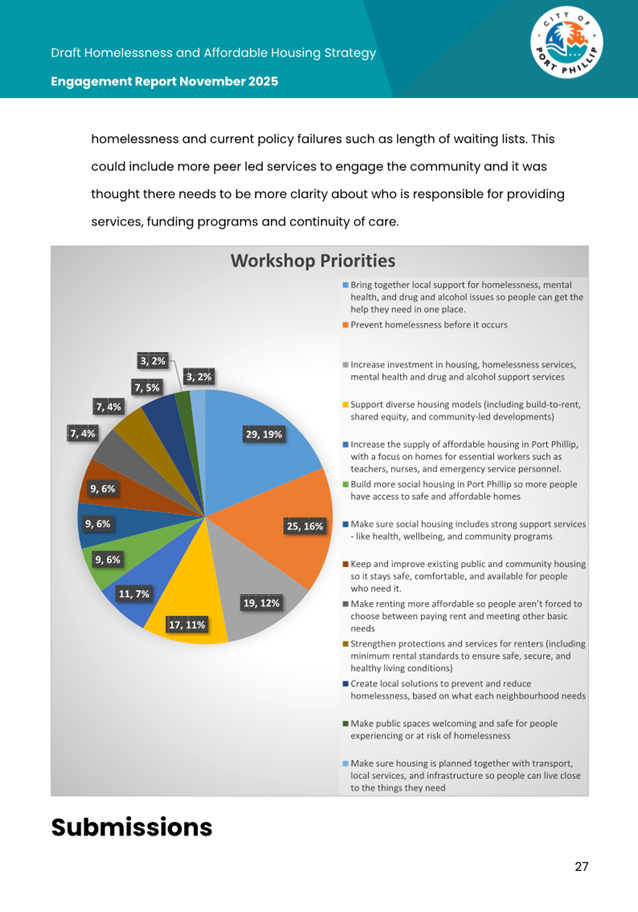
· Three workshops including 30 people with living and lived experiences of homelessness or vulnerability.
· Direct engagement with 104 people who had made submissions or signed up for workshops as part of the Phase 1 engagement program.
· Promotion of the Phase 2 engagement program through Council’s social media and website, and posters and flyers distributed to libraries, community centres, maternal and child health centres, childcare centres and the Victorian Pride Centre.
5.5 The Phase 2 engagement program invited feedback on the draft Strategy and also prioritisation of actions to inform how Council should consider implementation.
5.6 All the feedback received has been considered and the Strategy has been amended in response (Attachment 1).
6. LEGAL AND RISK IMPLICATIONS
6.1 There are no identified legal implications associated with the Strategy.
7. FINANCIAL IMPACT
7.1 The Strategy aims to ensure that Council’s expenditure in homelessness and affordable housing is financially sustainable and achieves best public value.
7.2 If Council wish to explore use of Council land, consulting spend may be required. This can be funded from the project funding Council has allocated; however, this will reduce the amount available to be allocated to other projects, initiatives or services.
7.3 A review of service agreements will ensure current use of spend is effective and distributed for maximum impact.
7.4 Aspects of the implementation program may require future budget allocation, to be determined through more detailed project scoping.
8. COMMUNITY IMPACT
8.1 Housing stress and homelessness have a significant effect on individuals health and wellbeing. Improving supports and housing availability can increase connectedness, social and cultural inclusion and cohesion, preventing/reducing harm, and hardship, in turn potentially preventing and reducing incidents of crime and anti-social behaviours.
8.2 The Strategy ensures Council has a clear and concise position to act on homelessness and affordable housing.
9. ENVIRONMENTAL IMPACT
9.1 There can be an environmental impact of people sleeping rough be this bio-hazardous or harmful waste, rubbish, abandoned material aid or abandoned camps/items are left in hot-spot/high street areas and parks/open spaces. By supporting more persons into housing, this issue may be minimised.
10. SOCIAL IMPACT
10.1 Housing stress and homelessness have a significant effect on individuals health and wellbeing. Improving supports and housing availability can increase connectedness, social and cultural inclusion and cohesion, preventing/reducing harm, and hardship, in turn potentially preventing and reducing incidents of crime and anti-social behaviours.
10.2 The Strategy ensures Council has a clear and concise position to act on homelessness and affordable housing.
10.3 ECONOMIC IMPACTBy supporting Social and Affordable Housing, Council enables a diverse housing stock to be available for community members on very low, low, and moderate incomes. This supports a diverse socio-economic profile of the community and prevents some being priced out of living in the city. Affordable housing also allows those working in the city who may earn very low, low, or moderate incomes to live near to where they work (or live, work, play). This is particularly important for key workers i.e., those who provide an essential service to the community.
11. GENDER IMPACT
11.1 A gender impact assessment has been conducted on the draft strategy.
12. Alighnment to Council Plan and Council Policy
12.1 The Strategy aligns to the strategic direction “a healthy and connected community” and the outcome “our community have stable, safe, and affordable housing”.
13. Implementation Strategy
13.1 Final proposed Strategy will be presented at the Ordinary Meeting of Council for adoption on 10 December 2025.
14. OFFICER MATERIAL OR GENERAL INTEREST
14.1 No officers involved in the preparation of this briefing has declared a material or general interest in the matter.
|
ATTACHMENTS |
1. Proposed Final Homelessness and Affordable Housing
Strategy 2. Implementation Plan 3. Engagement Report |
Meeting of the Port Phillip City Council
10 December 2025
9. An Environmentally Sustainable and Resilient City
Nil
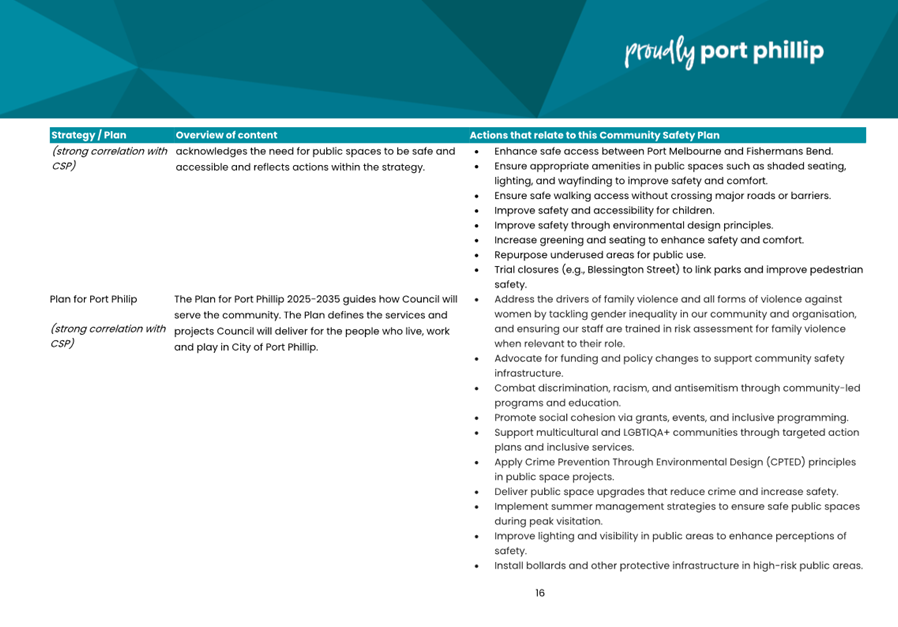
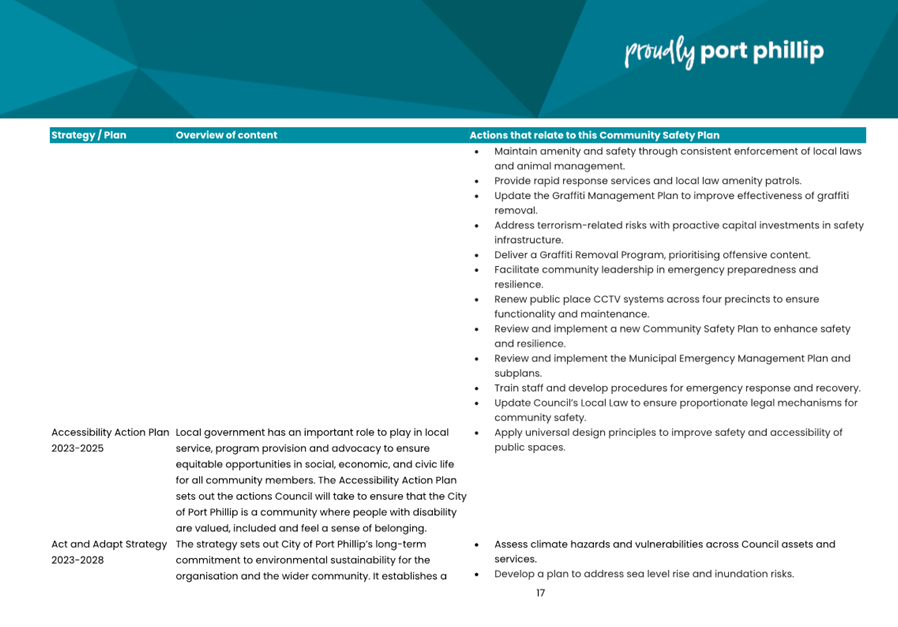
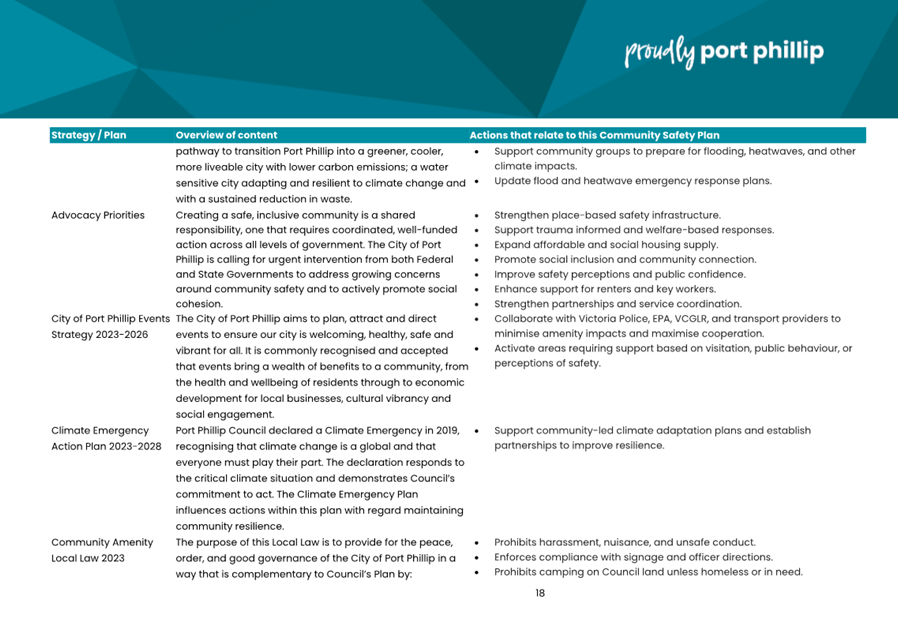
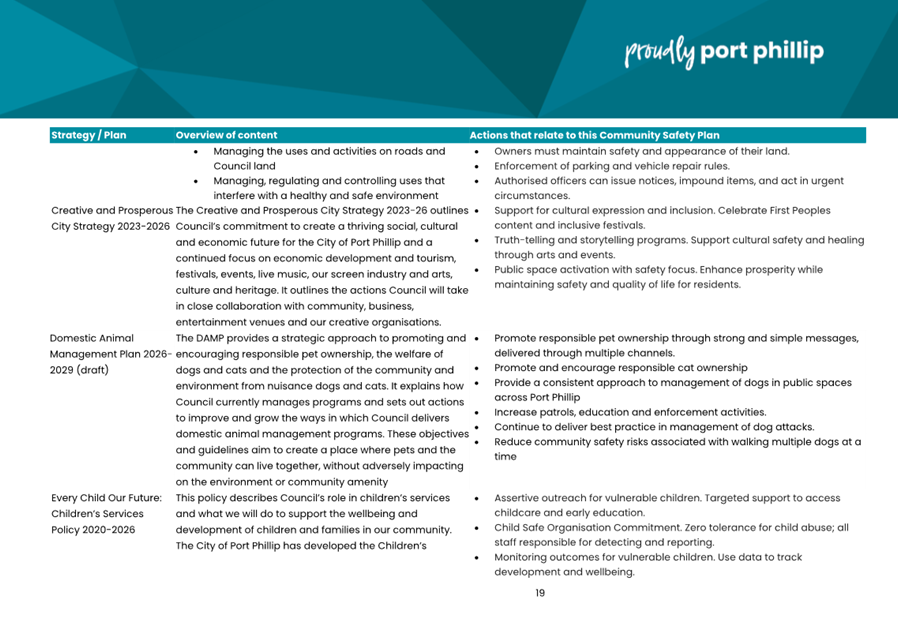
10.1 "Feel Safe. Be Safe. Community Safety Plan 2025-29"................................... 98
10.2 Proposed Local Law Amendment Update and Draft Protocol with Police..... 304
10.3 Changes to Planning Delegations (10 December 2025 until the first sitting of the Ordinary Council meeting in 2026)................................................................. 489
Meeting of the Port Phillip City Council
10 December 2025
|
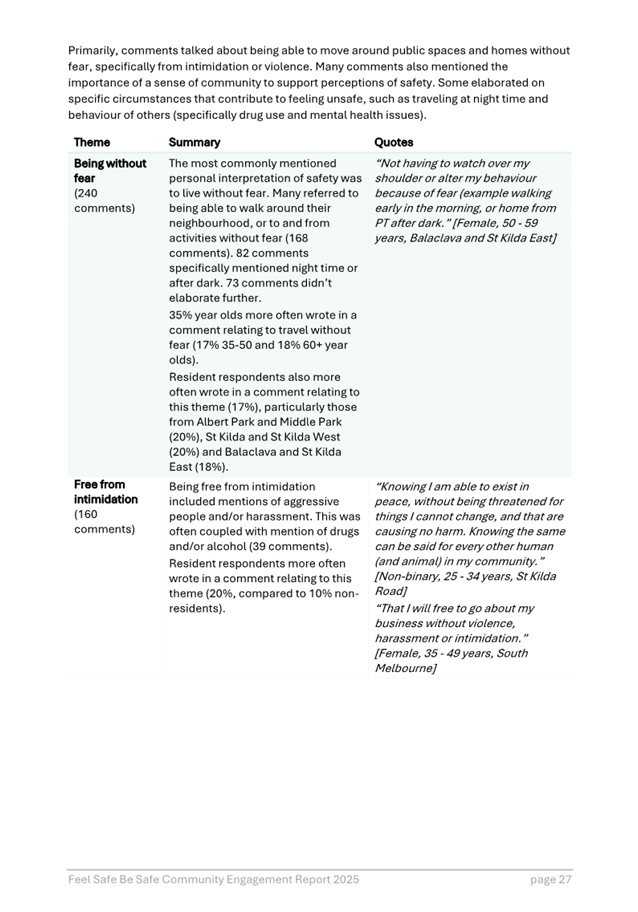
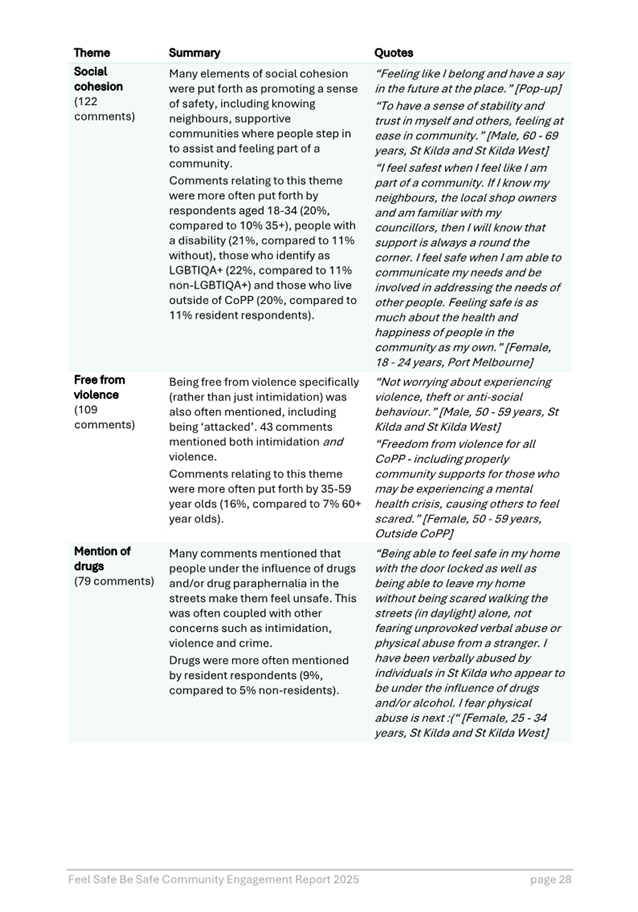
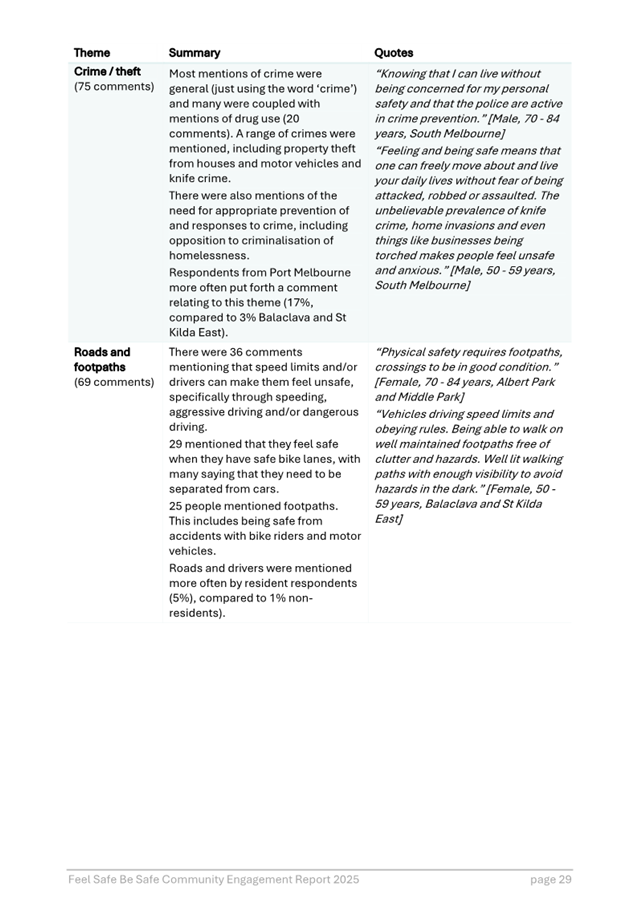
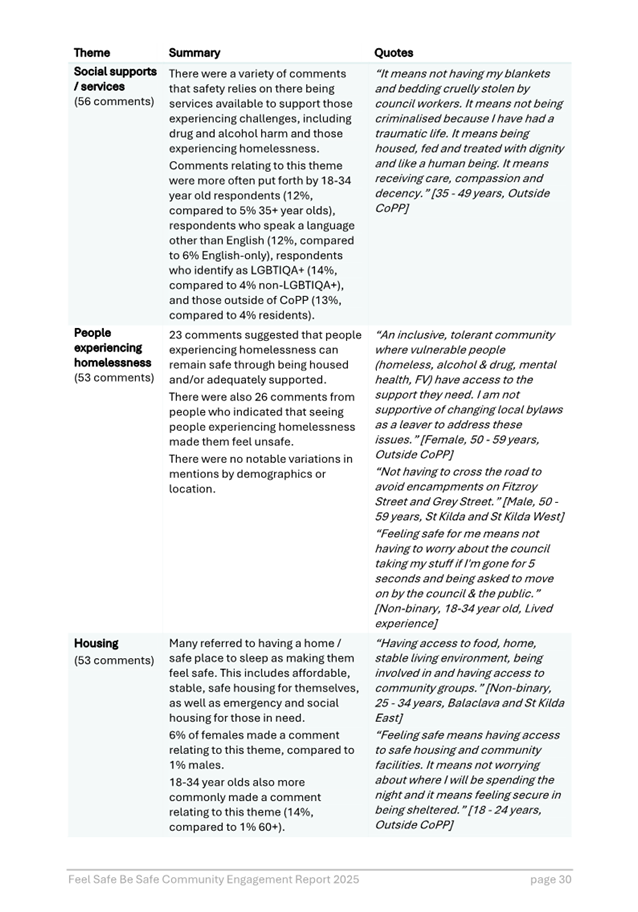
"Feel Safe. Be Safe. Community Safety Plan 2025-29" |
|
|
Executive Member: |
Brian Tee, General Manager, City Development |
|
PREPARED BY: |
Nellie Montague, Manager Safety and Amenity Sandra Khazam, Community Safety Lead |
1. PURPOSE
1.1 To outline the work undertaken in the development of the Community Safety Plan.
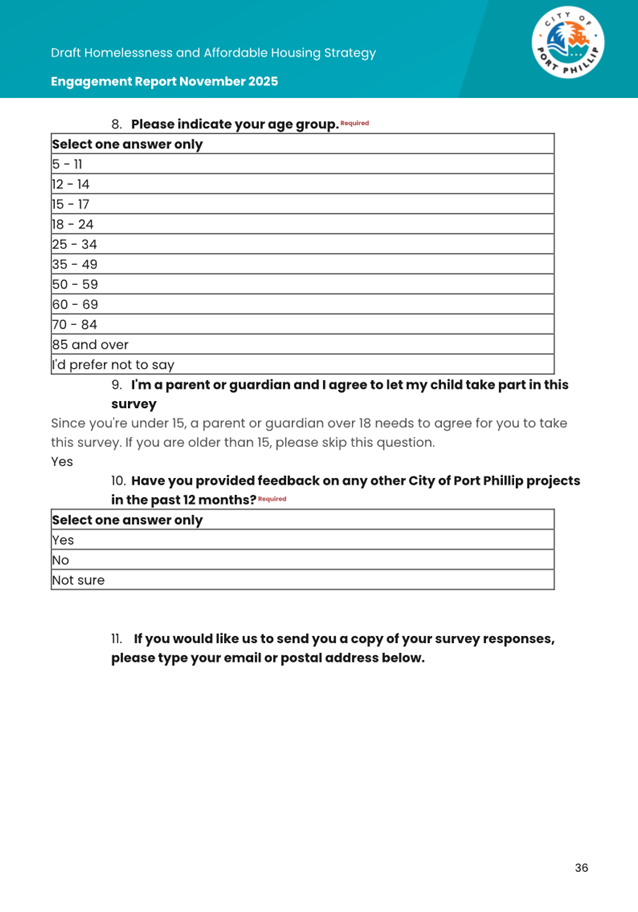
1.2 To present the Engagement Report for the final stage of feedback from the community.
1.3 To present the Community Safety Plan 2025-2029 for endorsement.
2. EXECUTIVE Summary
2.1 Council has identified community safety and social cohesion as priority areas. The Community Safety Plan is a tool to set clear objectives and actions to address these challenges and create positive change.
2.2 As the current Community Safety Plan finishes at the end of 2025, a new Plan has been developed.
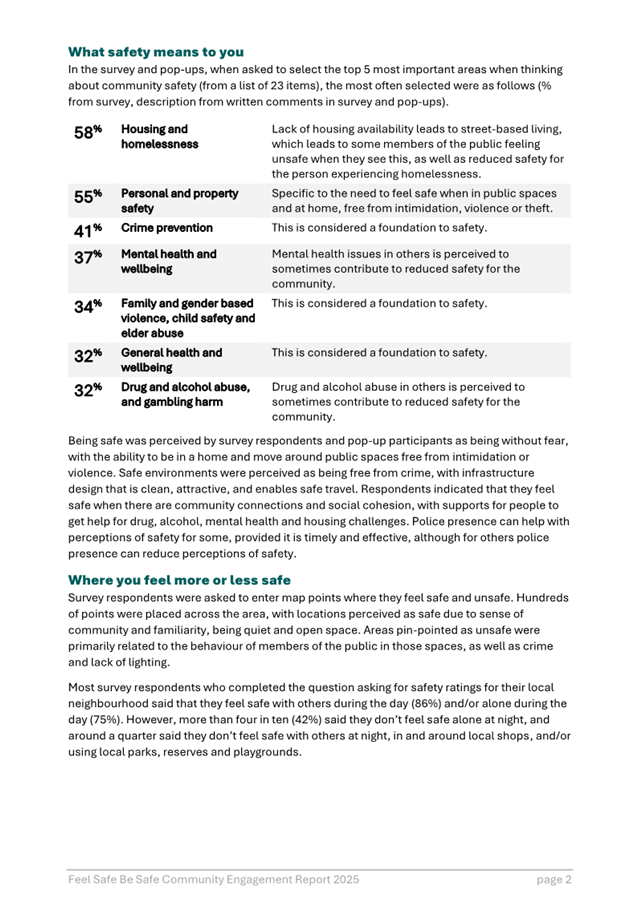
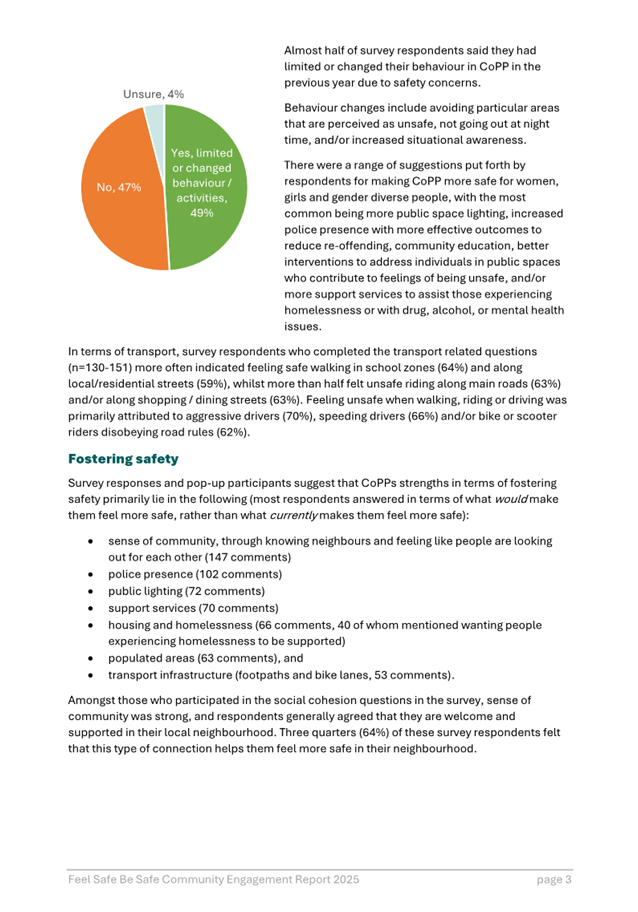
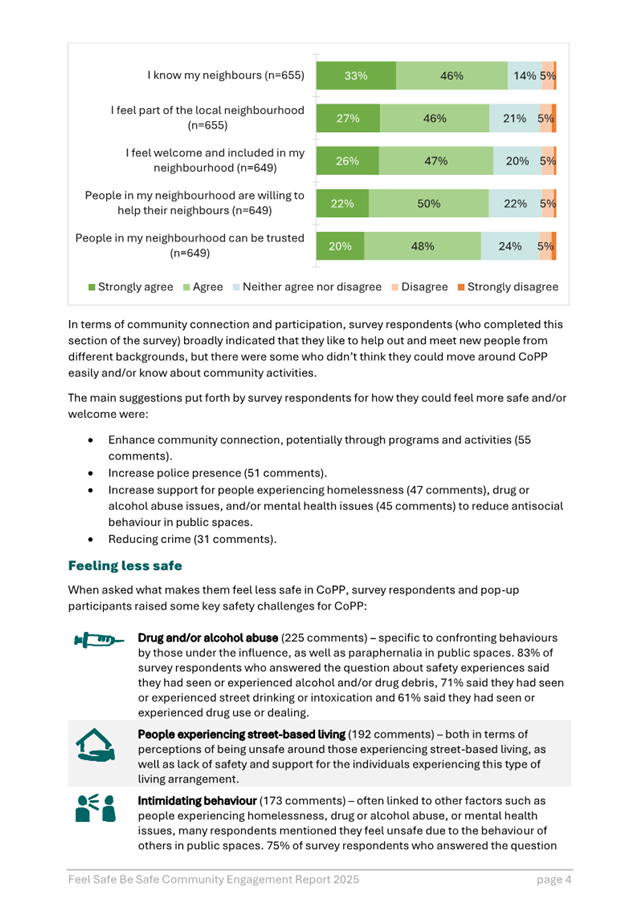
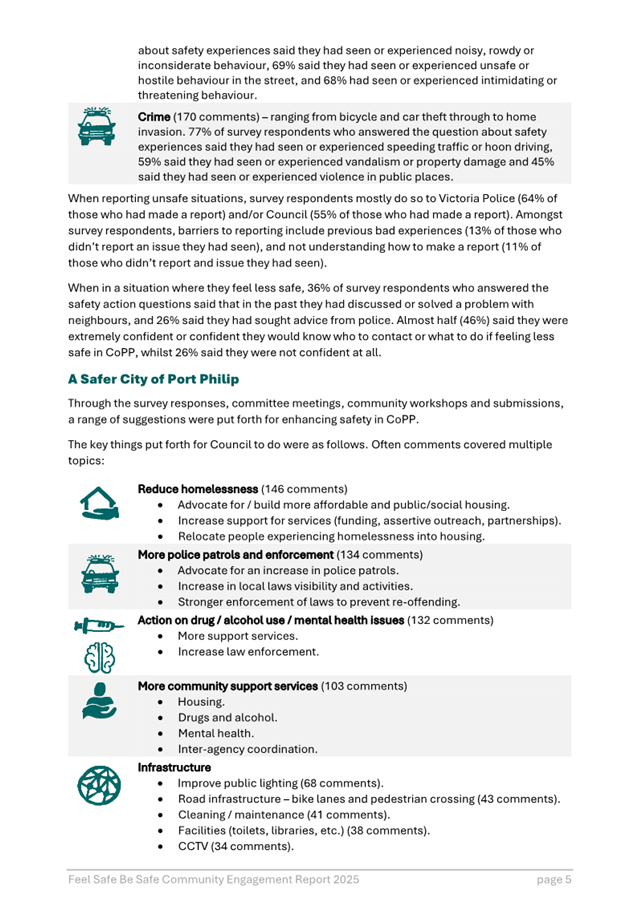
2.3 Feel Safe. Be Safe. Community Safety Plan 2025-2029 (Attachment 1) – is based on extensive feedback from community and local service providers over the last 12 months.
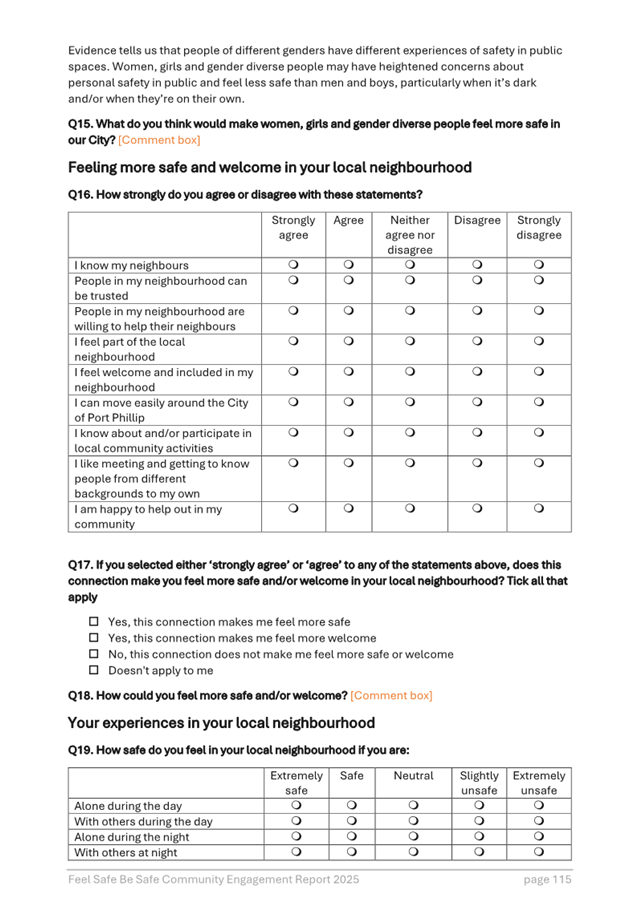
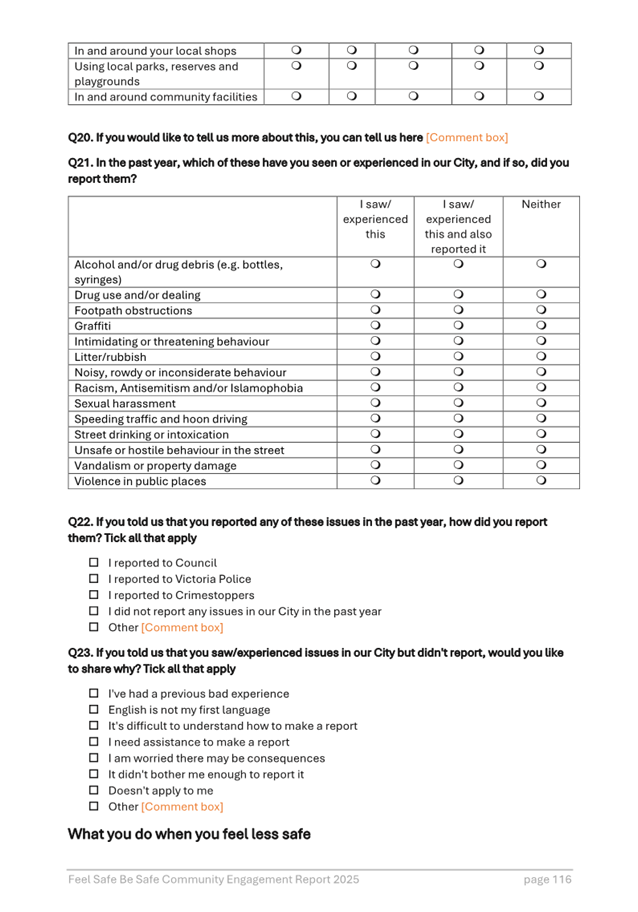
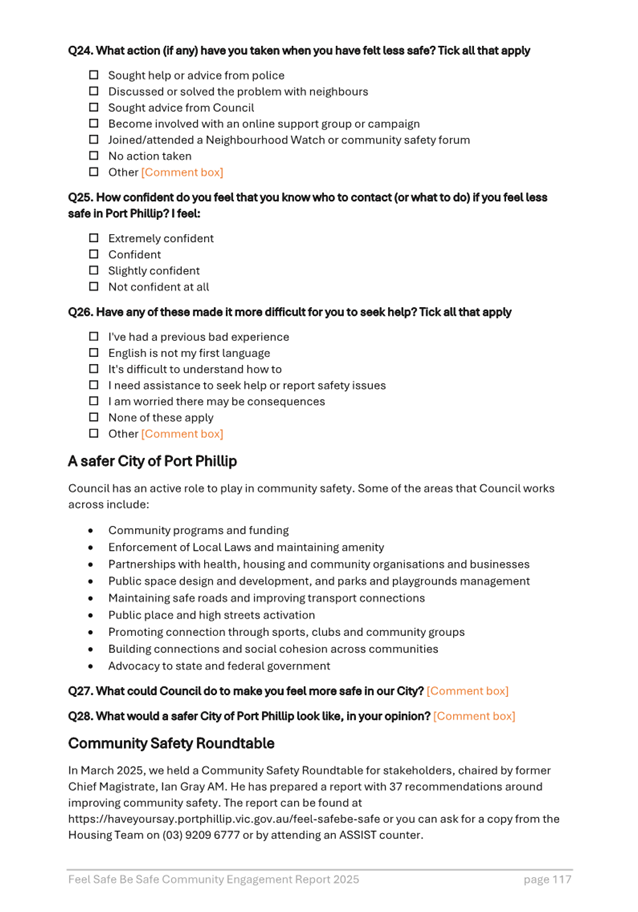
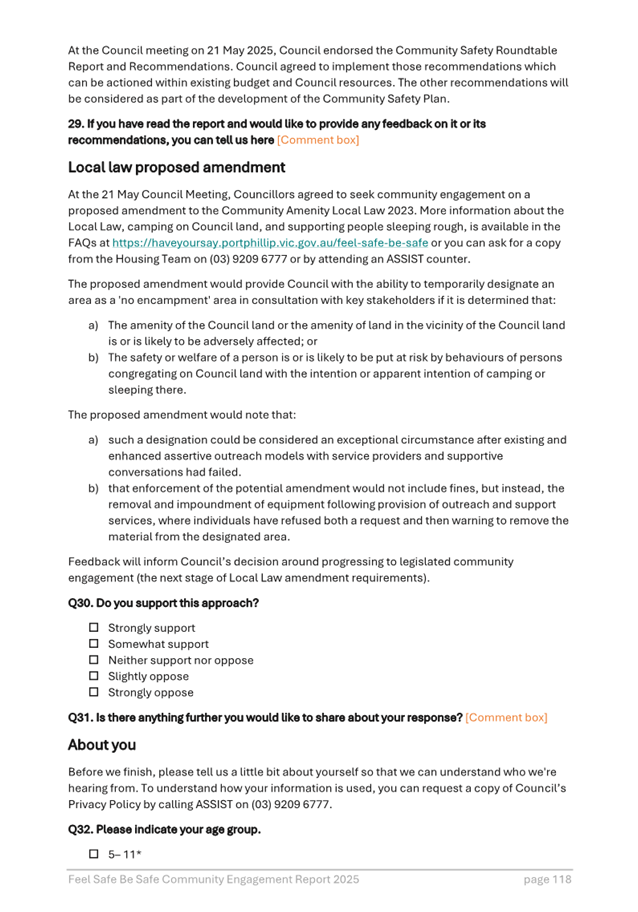
2.4 The draft Plan was developed by recommendations from the Community Safety Roundtable held in March 2025 and initial feedback from five weeks of engagement including surveys, workshops and targeted community conversations from 23 May to 29 June 2025. This first draft was then sent out for a further four weeks of engagement from 6 October to 2 November 2025 (see Engagement Report in Attachment 3.) This feedback period included engagement with residents in our local communities experiencing unsafe environments and those with lived experience of homelessness or disadvantage.
2.5 The second round of feedback was then integrated into the final Community Safety Plan. Key changes include:
· Updating actions to be more tangible.
· Clarity on indicator outcomes and measures.
· Greater reference to family and gender-based violence.
· Reviewing language to strengthen empathy and trauma awareness.
· Support for collaborative and co-designed processes, projects and programs with community and services.
· Streamlining actions by removing Roundtable Report recommendations already included in Homelessness and Affordable Housing Strategy (where they were better located).
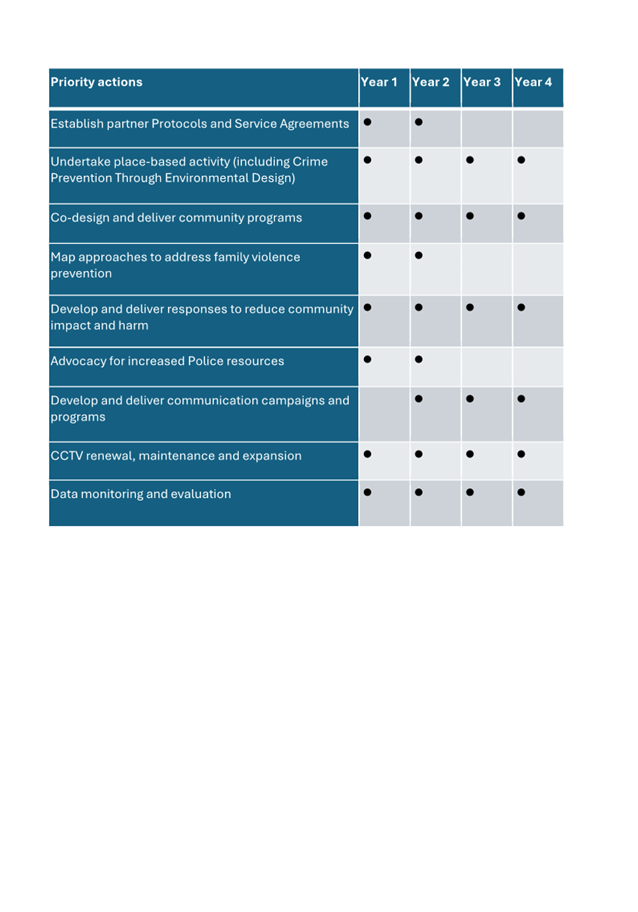
2.6 An Implementation Plan has been developed for the Community Safety Plan to outline the timing for delivery of its listed actions (Attachment 2).
|
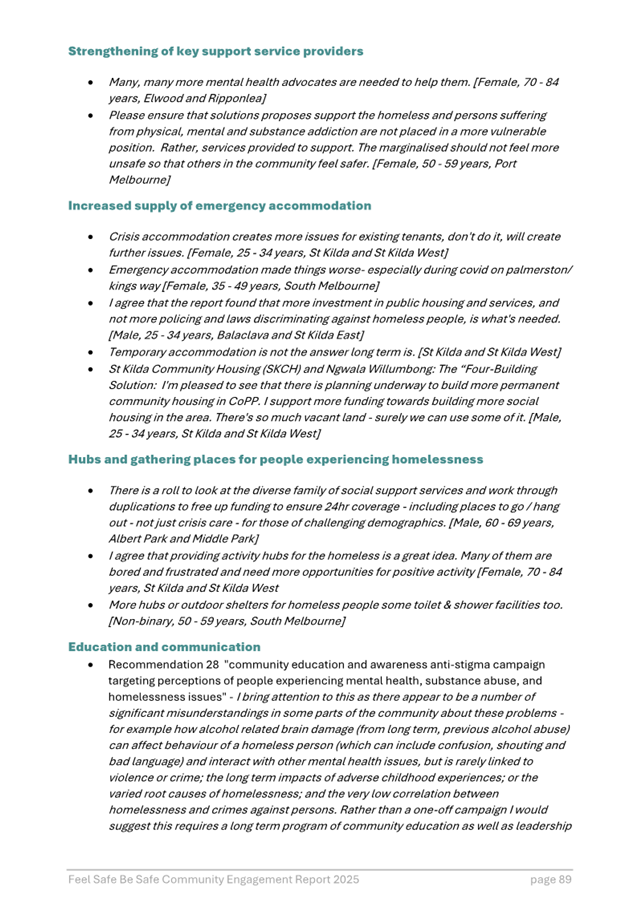
That Council: 3.1 Thanks all community members, organisations and other stakeholders who have contributed to engagement and provided feedback to inform the Community Safety Plan. 3.2 Releases the Community Safety Engagement Report (Attachment 3). 3.3 Endorses the Feel Safe. Be Safe. Community Safety Plan 2025-2029 (Attachment 1) and authorises the Chief Executive Officer (or their delegate) to make minor editorial amendments that do not materially alter the intent of the Plan. 3.4 Endorses the allocation of: 3.4.1 A further $60,000 in 2026/27 in addition to the $60K in 2025/26 already allocated to Ngwala Willumbong Aboriginal Corporation to support delivery of targeted support and outreach to First Nations residents experiencing homelessness improving long-term health and housing outcomes and stability. 3.4.2 $181,000 per annum in 2025/26 and 2026/27 to Better Health Network to fund the Whole of Housing Pre-Housing Model AOD worker or nurse to provide health-led, trauma informed outreach to address complex needs and support those experiencing homelessness for housing. 3.4.3 $50,000 to fund implementation of the Community Safety Plan as determined through the Project Control Group with a focus on advancing priority projects. 3.5 Notes that officers will work with the Salvation Army in relation to the Access Health van outreach to explore opportunities for advocacy or consideration by Council through future reviews of service agreements and budget processes. |
4. KEY POINTS/ISSUES
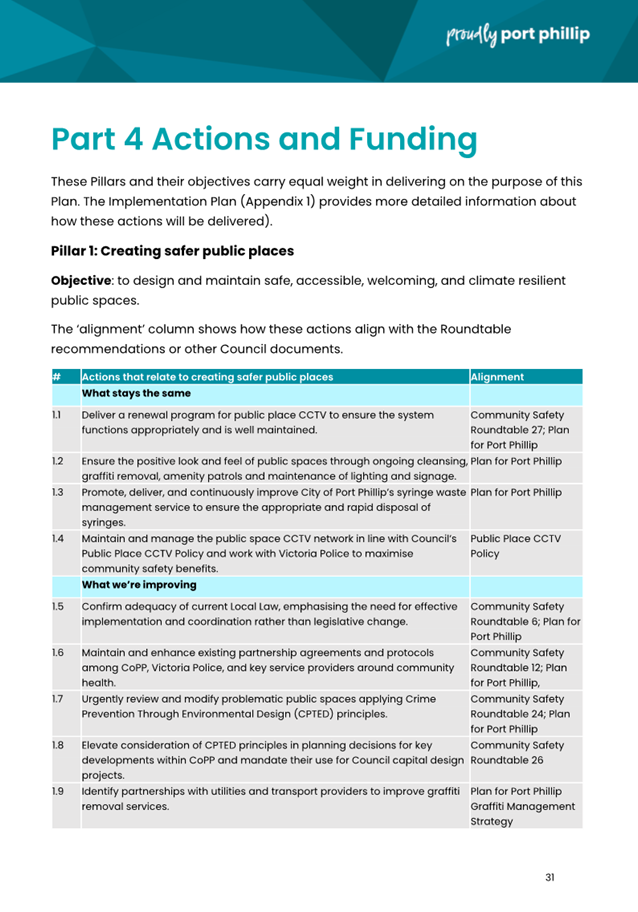
4.1 Council’s current Community Safety Plan is finishing at the end of 2025. A new Plan will outline Council’s priorities and guide actions around community safety for the next four years.
4.2 As reported at the 17 September 2025 Council meeting, extensive community engagement was conducted to develop the draftPlan as well as collating feedback from other reports, policies and strategies ,such as the Community Safety Roundtable Report and the Plan for Port Phillip community engagement.
4.3 The purpose, objectives and actions in the Plan outline the key priority areas and align with other Council strategies and policies. Implementation of the actions sits across several Council teams.
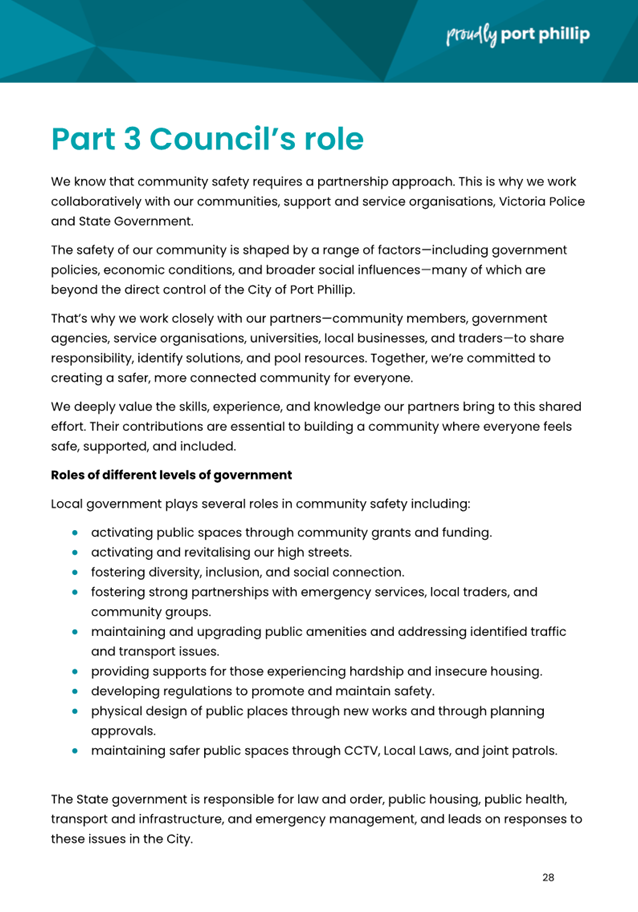
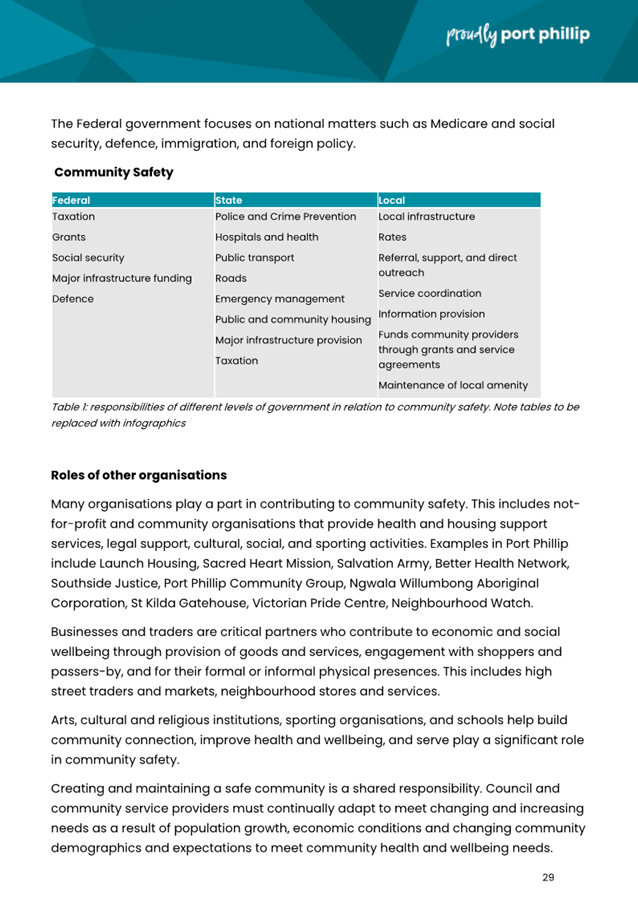
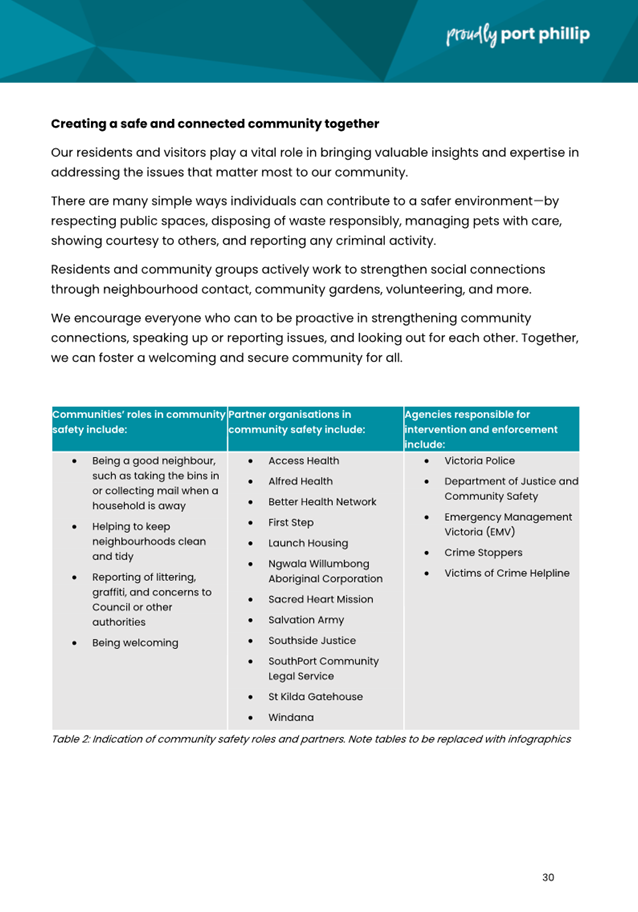
4.4 While community safety is not solely a Council responsibility, Council plays a key part in creating a safer community and collaborating with local stakeholders and government.
4.5 The needs and expectations of the local community are continuously changing. In response, the purpose for the Community Safety Plan is to:
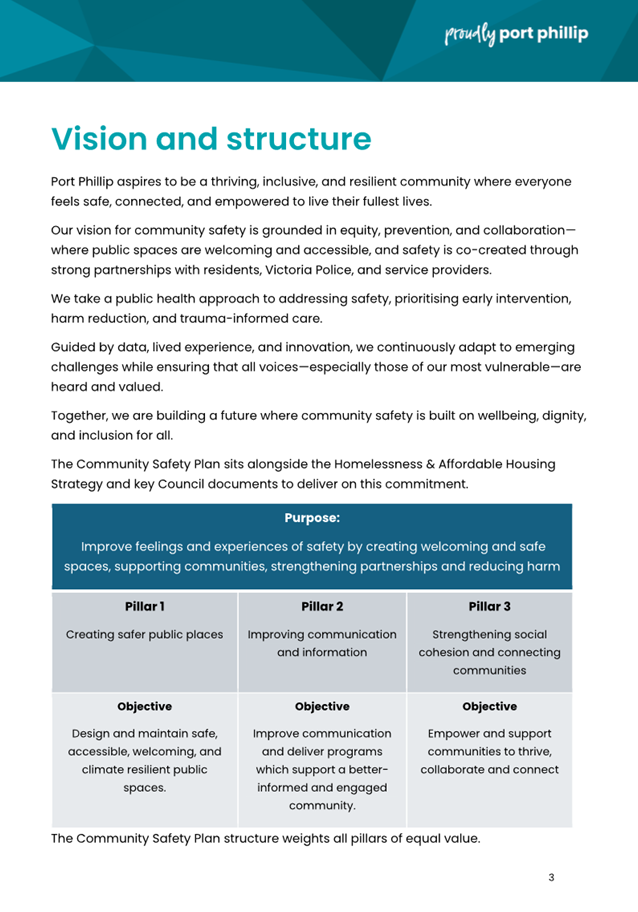
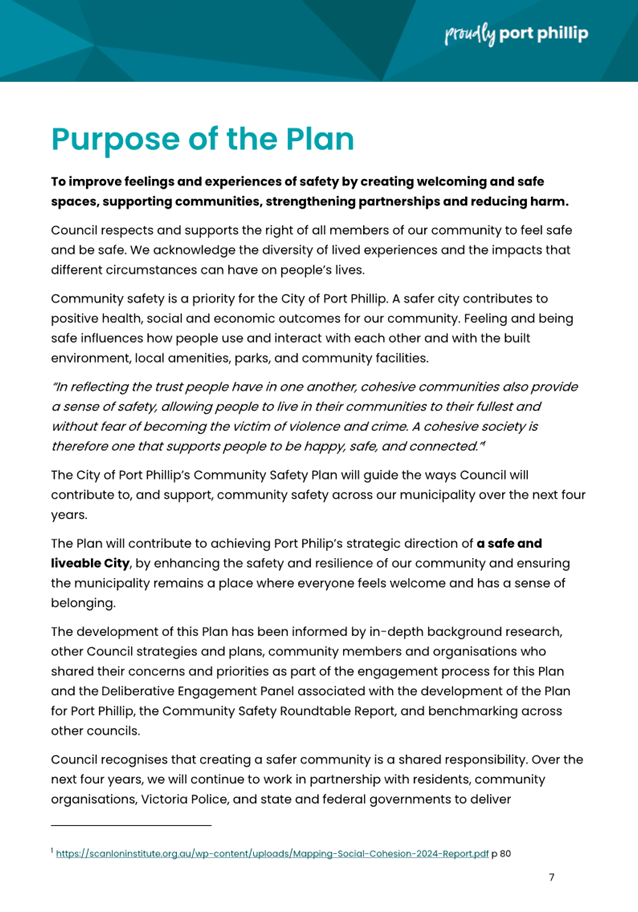
Improve feelings and experiences of safety by creating welcoming and safe spaces, supporting communities, strengthening partnerships, and reducing harm.
4.6 The new Community Safety Plan outlines Council’s intent to strengthen our current approach through working with partners by improving and enhancing service delivery. It builds on previous work and proposes new approaches for current and emerging issues to strengthen responses.
5. CONSULTATION AND STAKEHOLDERS
Informing the Community Safety Plan
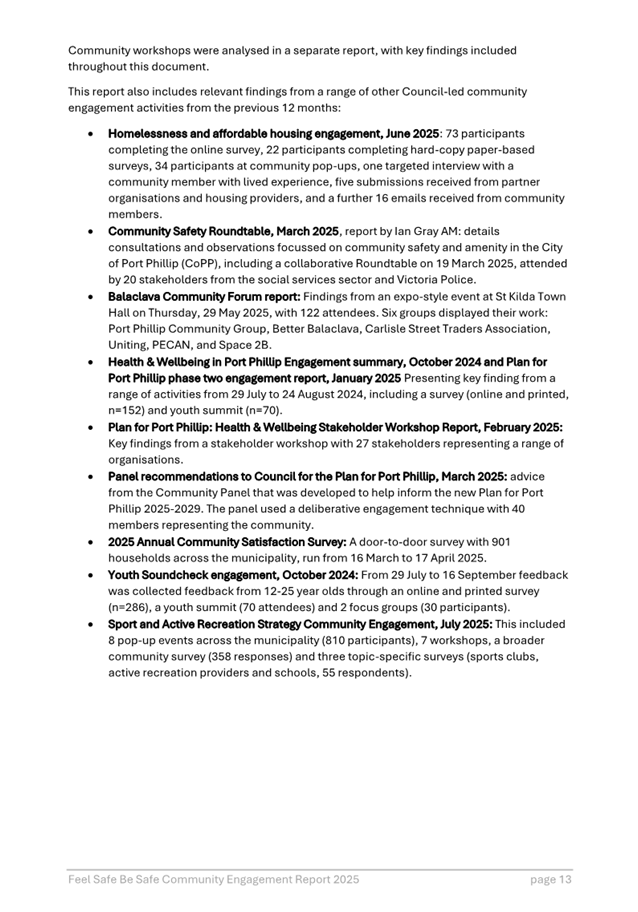
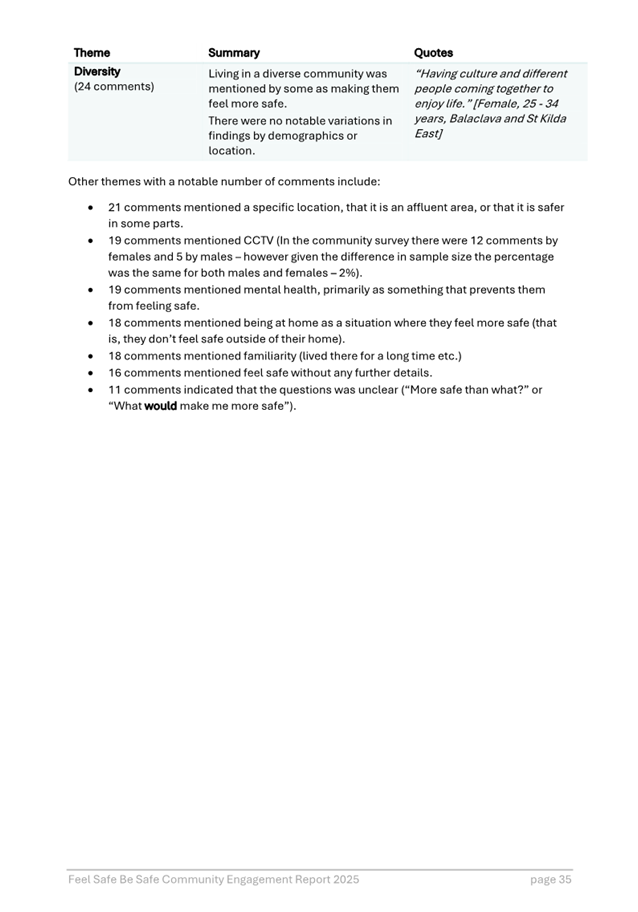
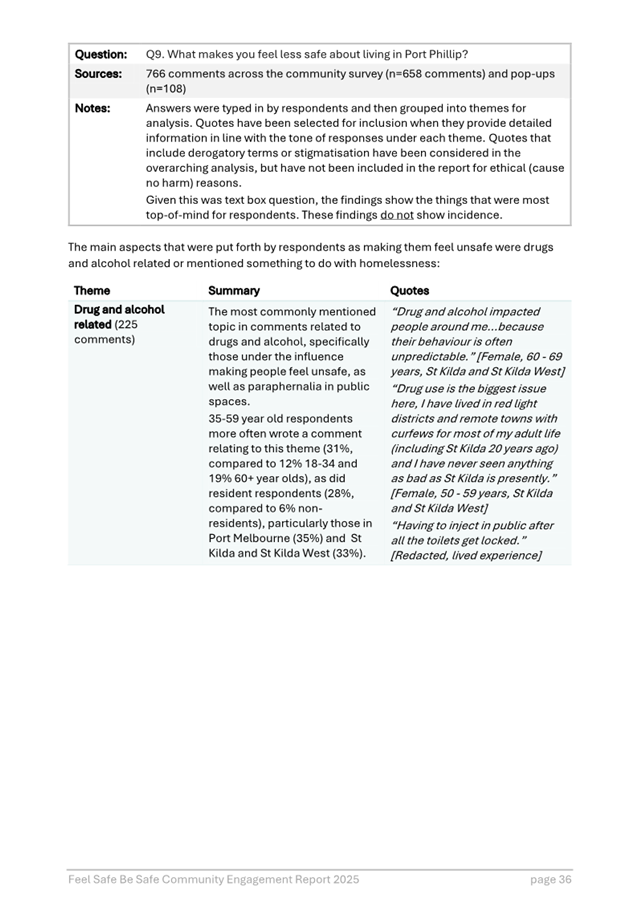
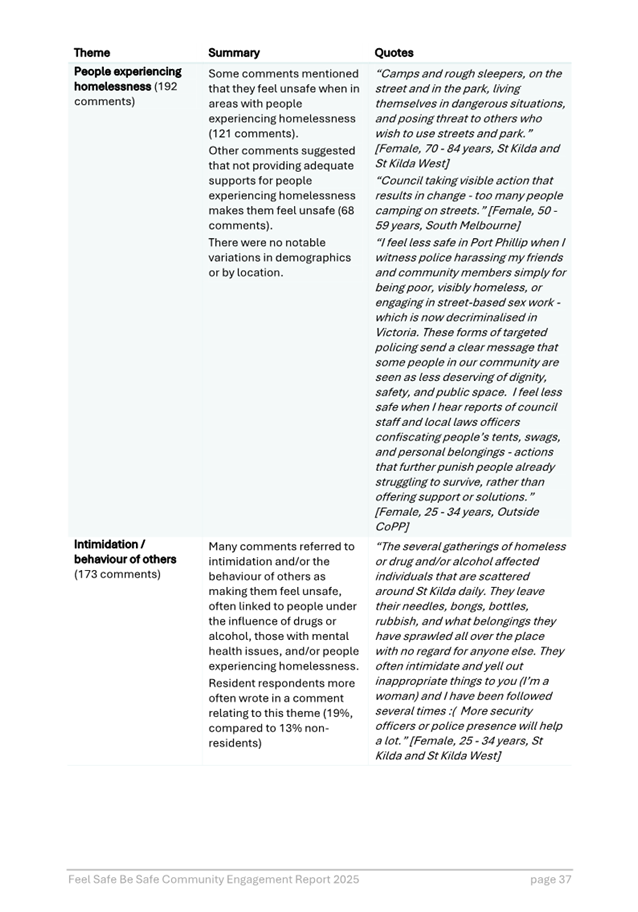
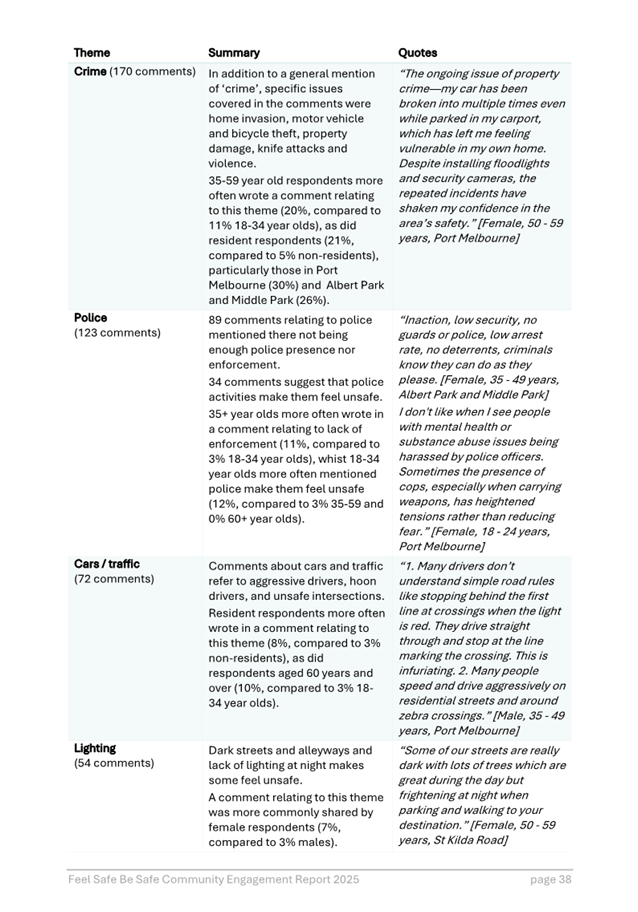
5.1 To identify our community’s key priorities, engagement activities were conducted from 23 May – 29 June 2025 with over 800 people responding, including through surveys, workshops, Neighbourhood Pop-ups, submissions and more. See Attachment 4 for the Engagement Report for this phase.
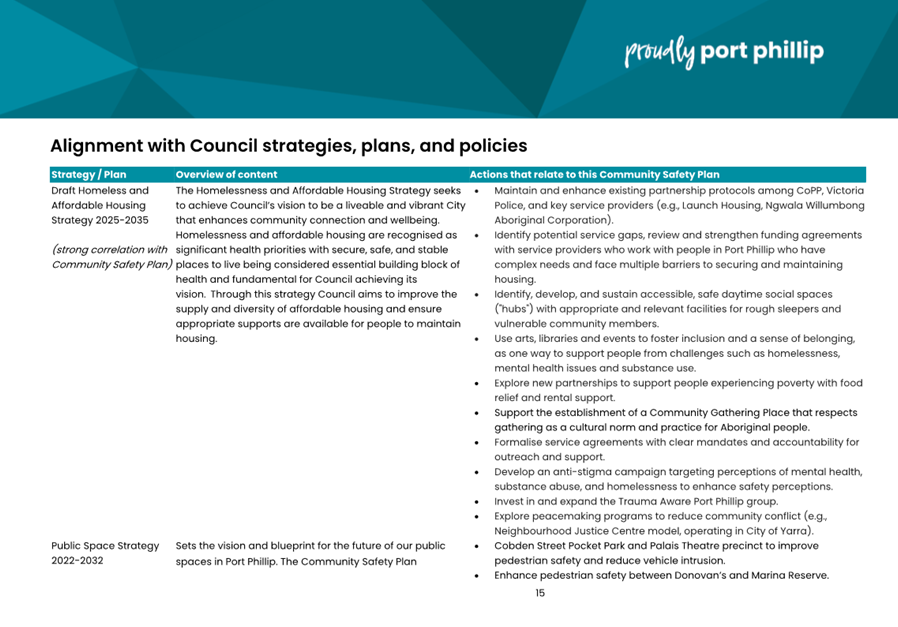
5.2 Most of the Community Safety Roundtable recommendations are addressed in the draft Homelessness and Affordable Housing Strategy and the draft Community Safety Plan. The remainder are advocacy requests to government and have been included in the relevant Advocacy Plan.
5.3 A gender impact assessment for the draft Plan was conducted and its recommendations have been incorporated.
5.4 Given that many of Council’s existing strategies and policies already address elements of community safety, the draft Community Safety Plan primarily concentrates on new or revised approaches, rather than duplicating existing initiatives.
5.5 All feedback from the May – June engagement was considered in developing the draft Community Safety Plan.
Testing the draft Community Safety Plan
5.6 Feedback the draft Plan was then sought over a four-week period from 6 October to 2 November and included:
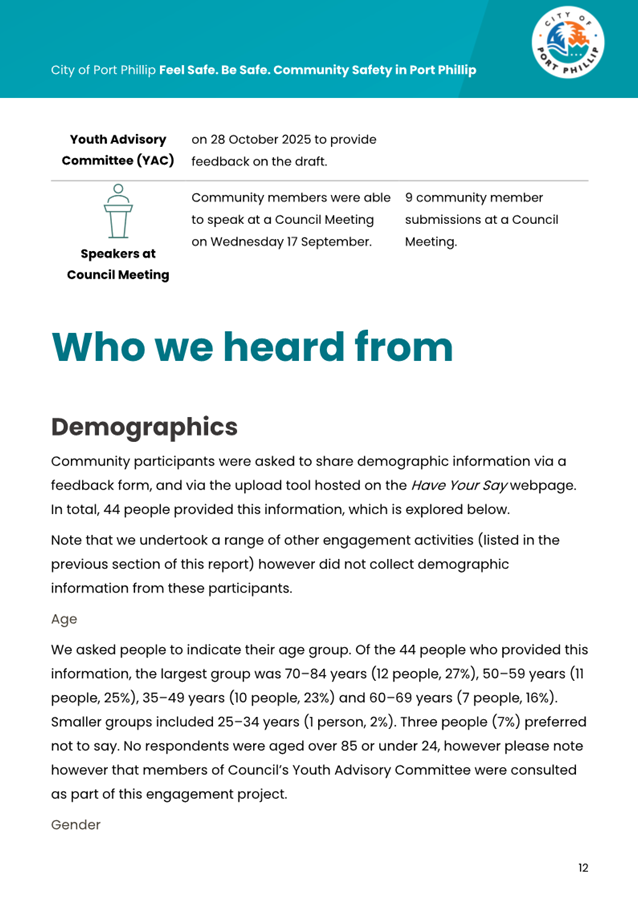
· A survey on Have Your Say
· Three workshops attended by 30 people with living and lived experiences of homelessness or disadvantage and vulnerability.
· A direct invitation to speak to officers for the 104 people who had made submissions or signed up for workshops as part of the earlier engagement period from May to June 2025. This included people with lived experience of the impact of criminal and complex anti-social behaviour.
· Promotion of the opportunity for feedback through Council’s social media and website, posters and flyers distributed to libraries, community centres, maternal and child health centres, childcare centres and the Victorian Pride Centre.
· Targeting Business and trader associations to speak to officers via direct invitation,sharing of links and printed collateral.
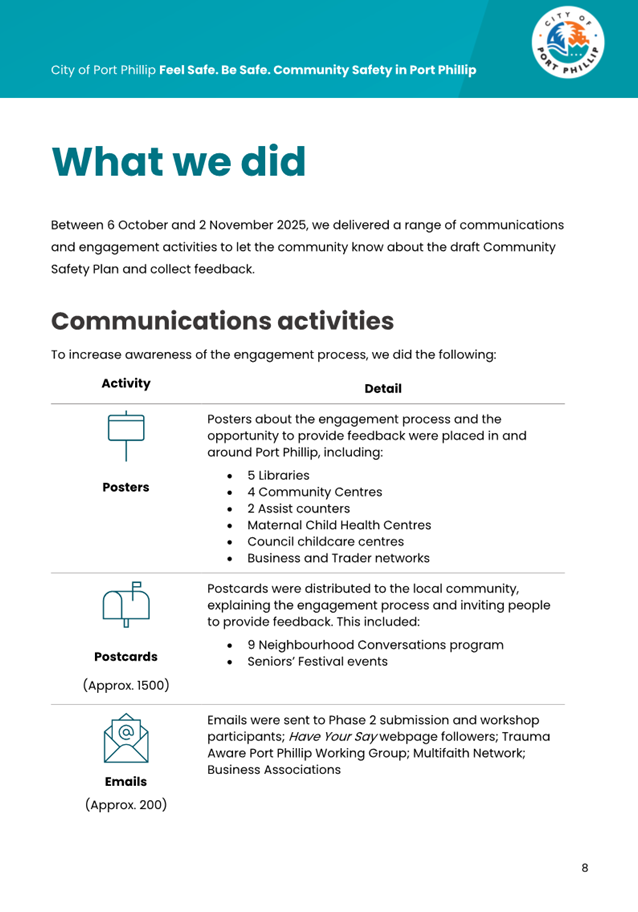
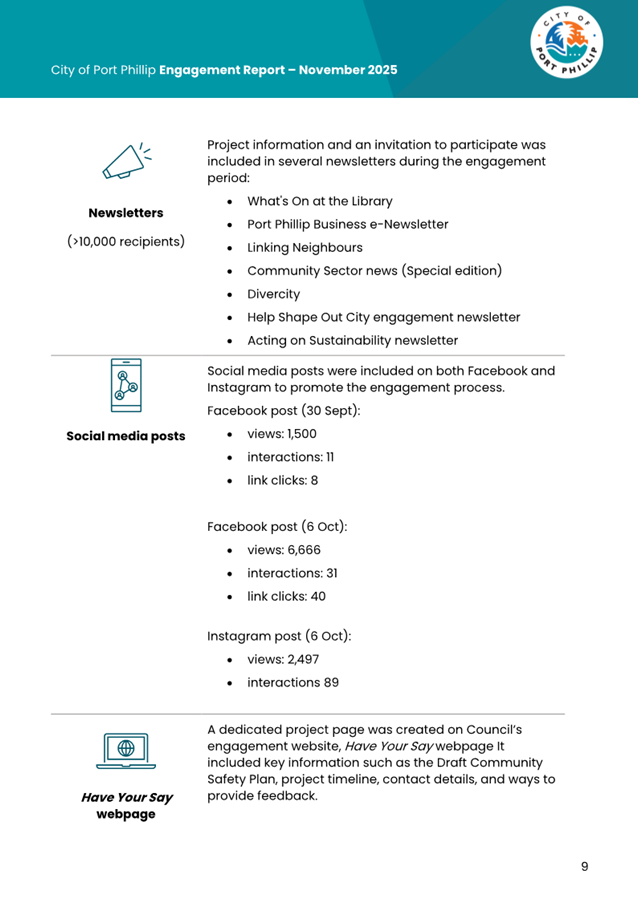
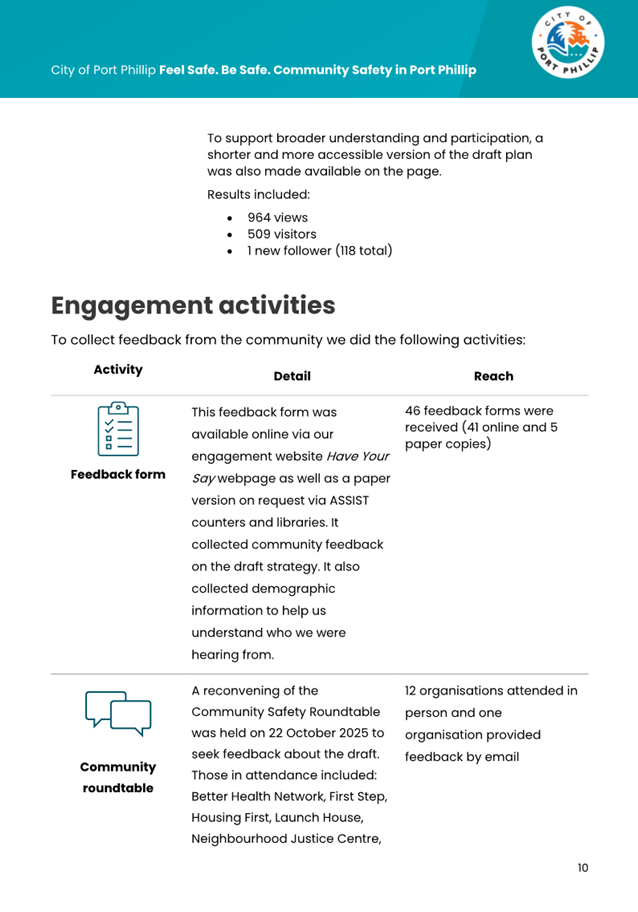
5.7 During the engagement there were over 960 views of the Have Your Say webpage from over 500 visitors.Related social media posts across Facebook and Instagram generated over 10,000 views and 130 interactions, 1500 postcards were distributed and over 200 direct emails and 10,000 email newsletters were sent out with information about the engagement.
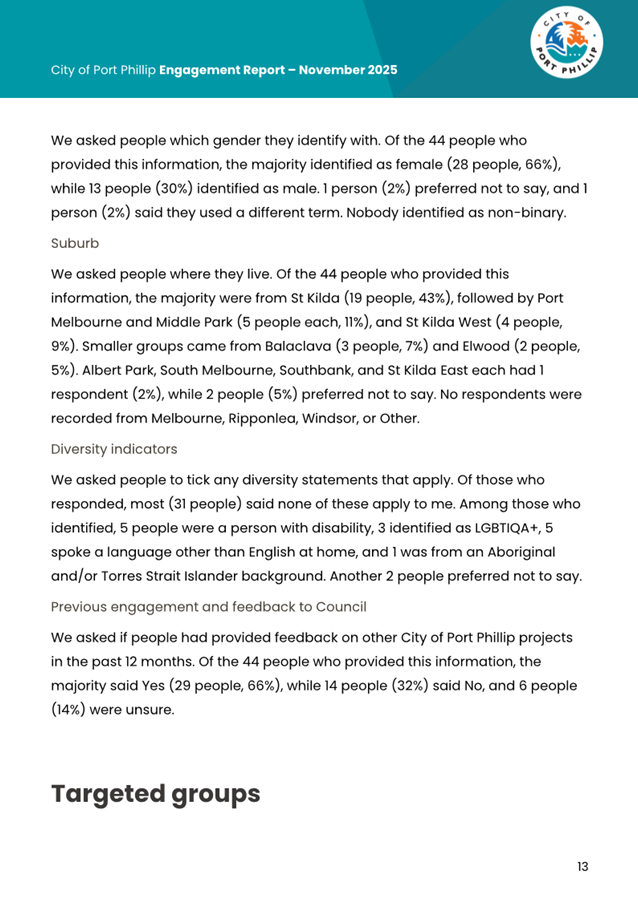
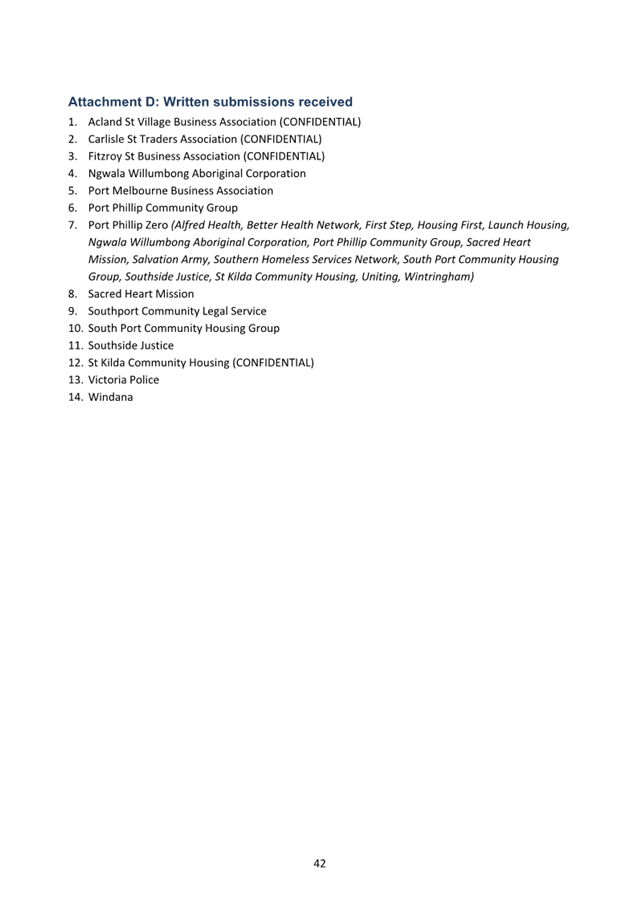
5.8 This reach resulted in 46 feedback forms being filled in on the Have Your Say engagement portal, 12 submissions, 30 people attending focus groups and 13 organisations submitting feedback.
5.9 Council engagements that have multiple touchpoints in the development of a Plan typically see a drop in participation in later rounds of community engagement. This may be due to people feeling they’ve had their say in the first round.
5.10 Detailed information about the feedback received is included in the Phase Four Engagement Report (Attachment 3).
What we heard about the draft Community Safety Plan
Community feedback
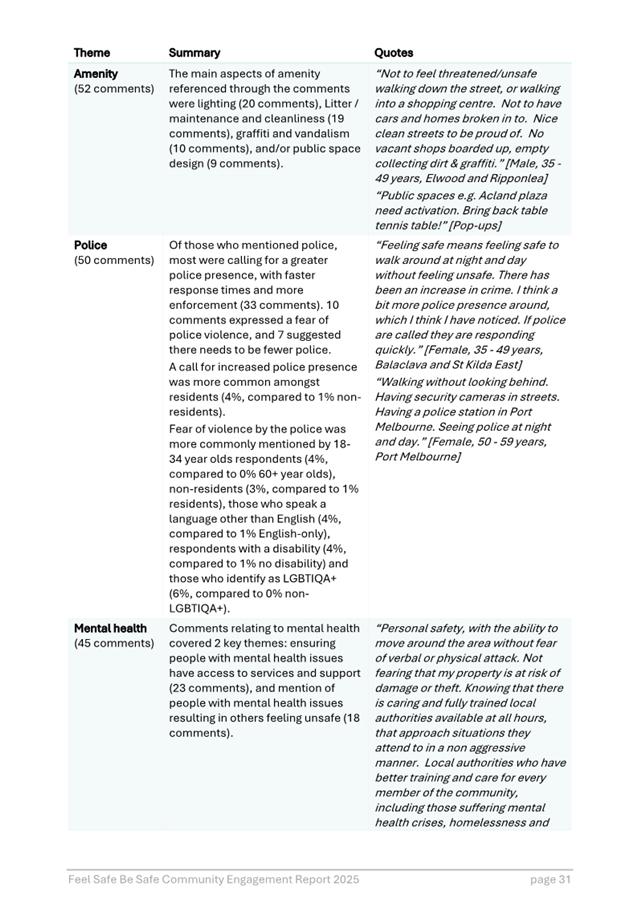
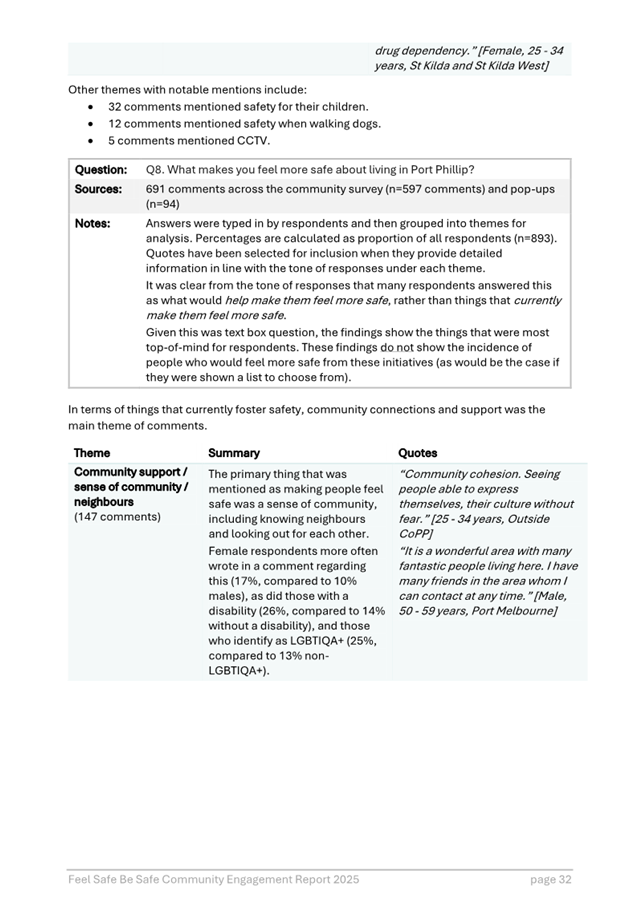
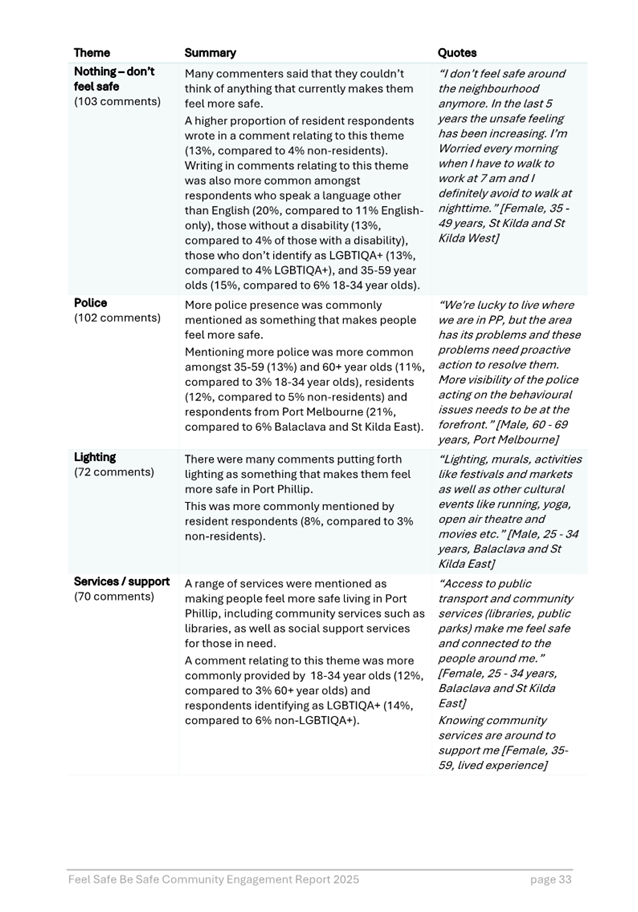
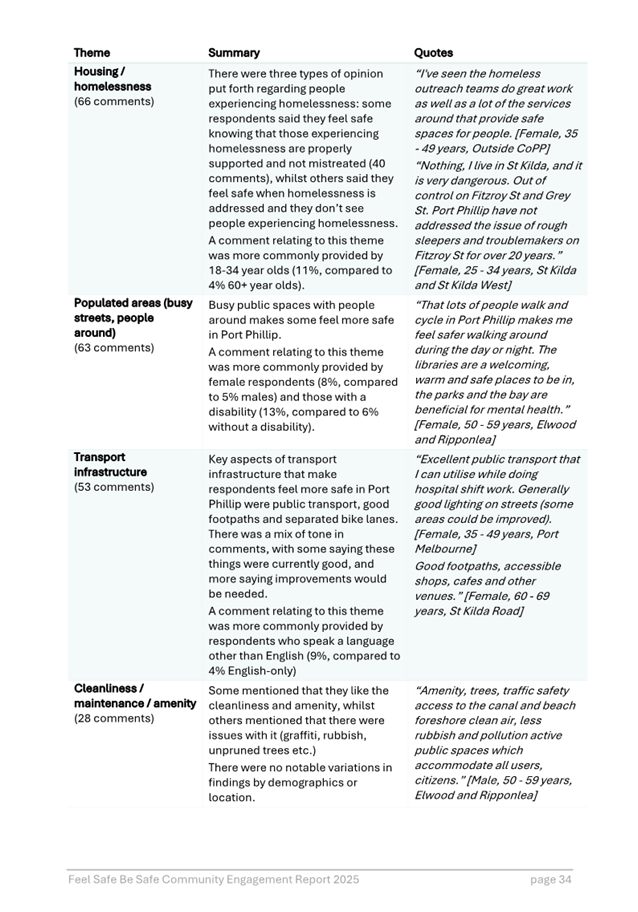
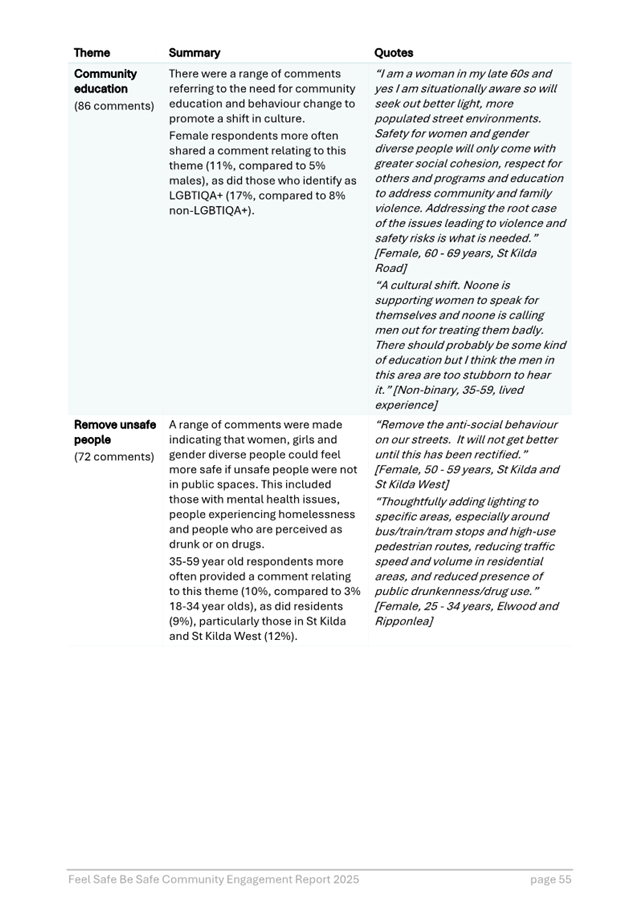
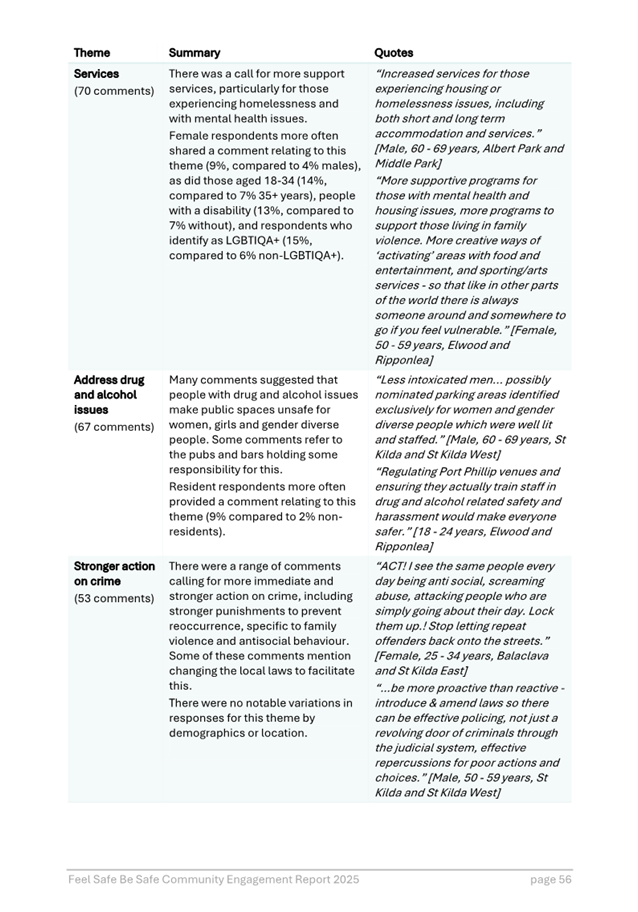
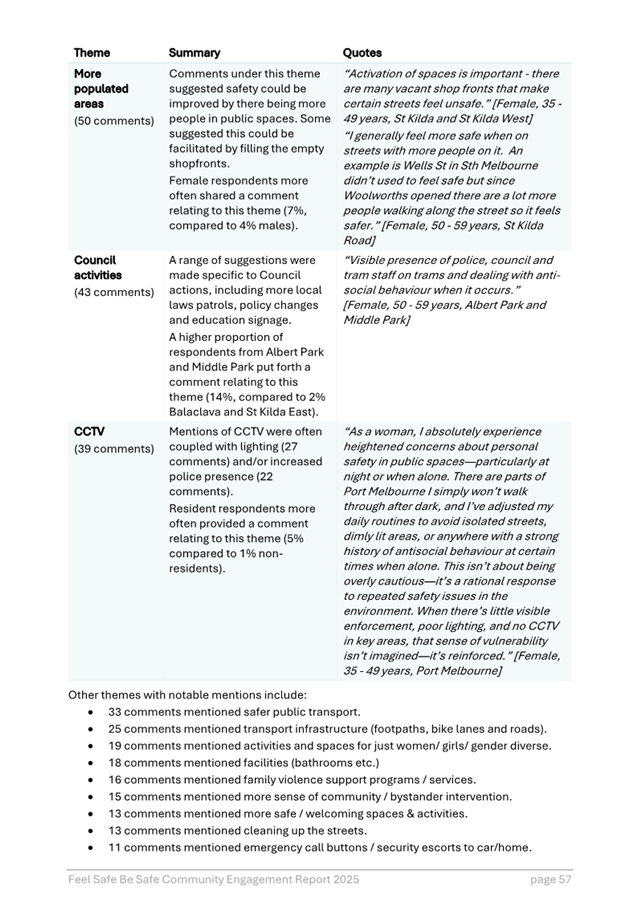
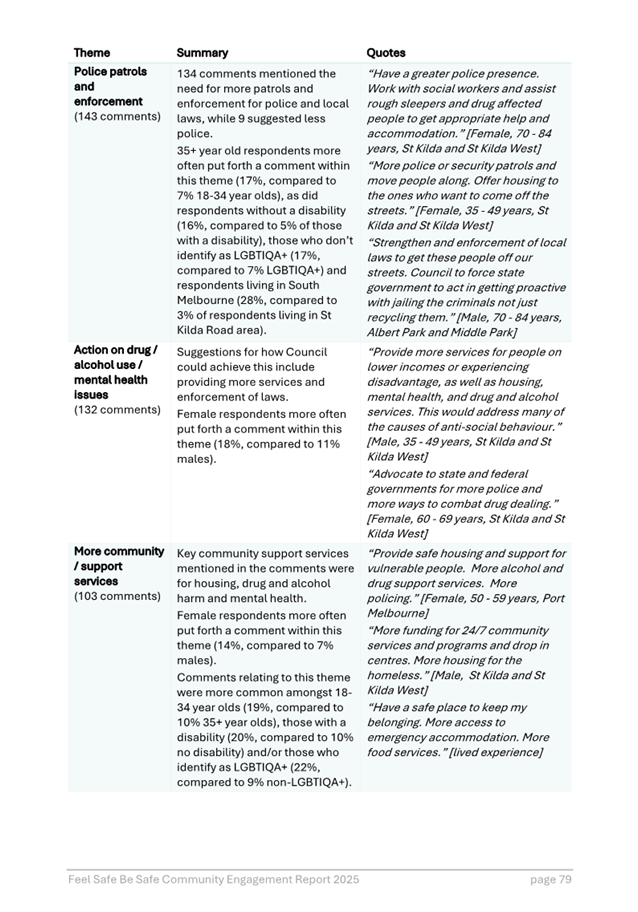
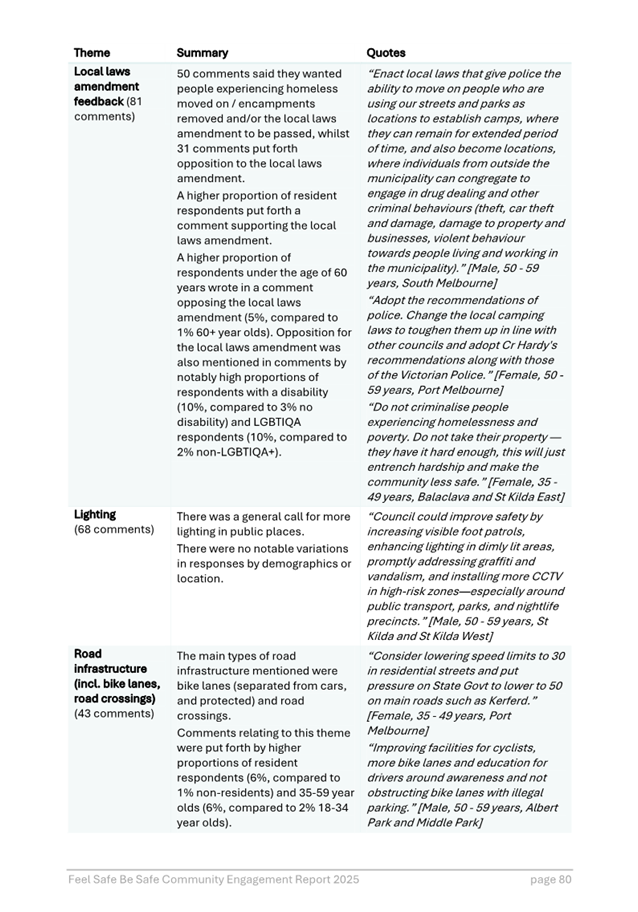
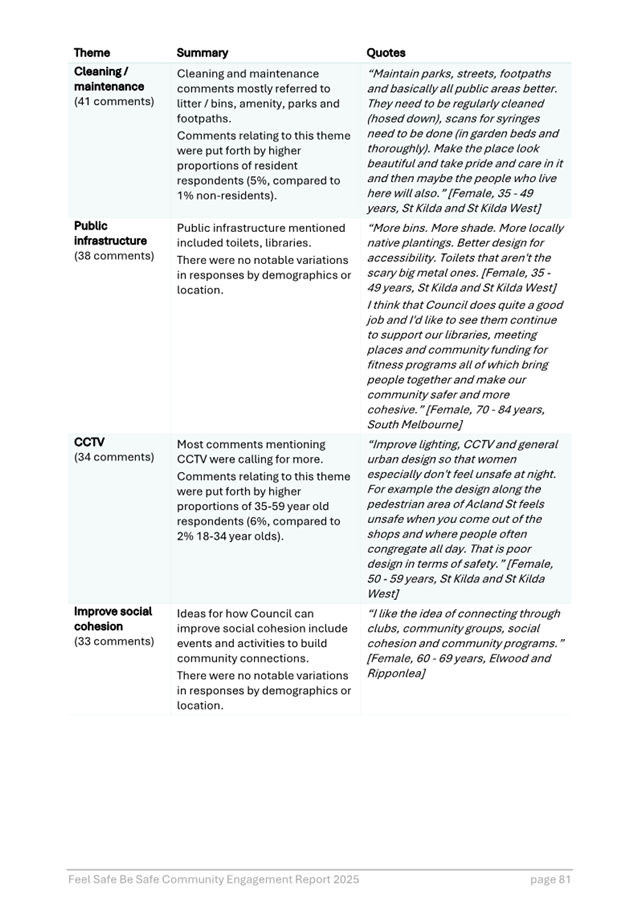
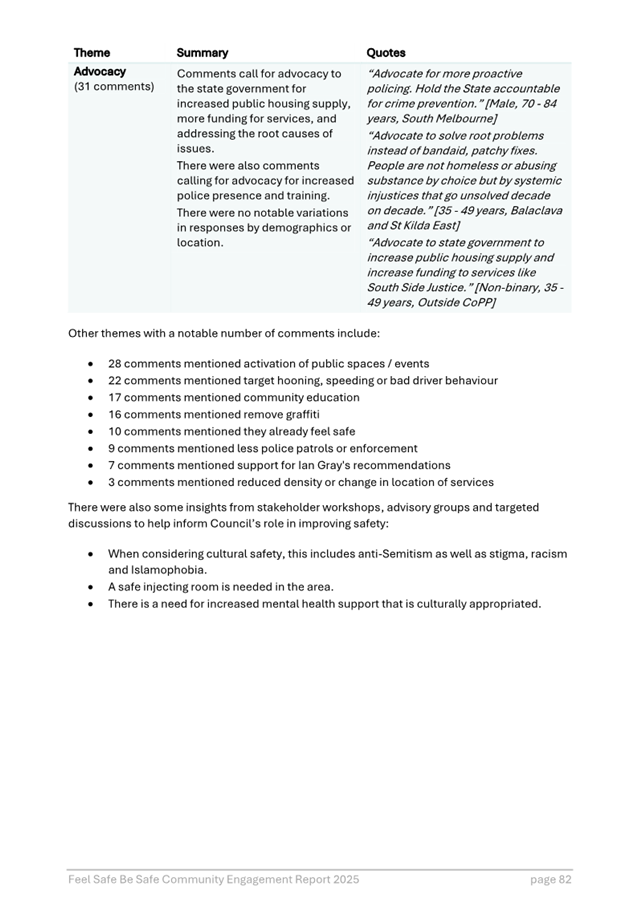
5.11 Feedback from general engagement through Have Your Say supported actions relating to:
· Activating our streets with increased lighting and CCTV.
· Council working collaboratively with local service providers and police.
· Increased access to safety sessions and a variety of perspectives to be presented.
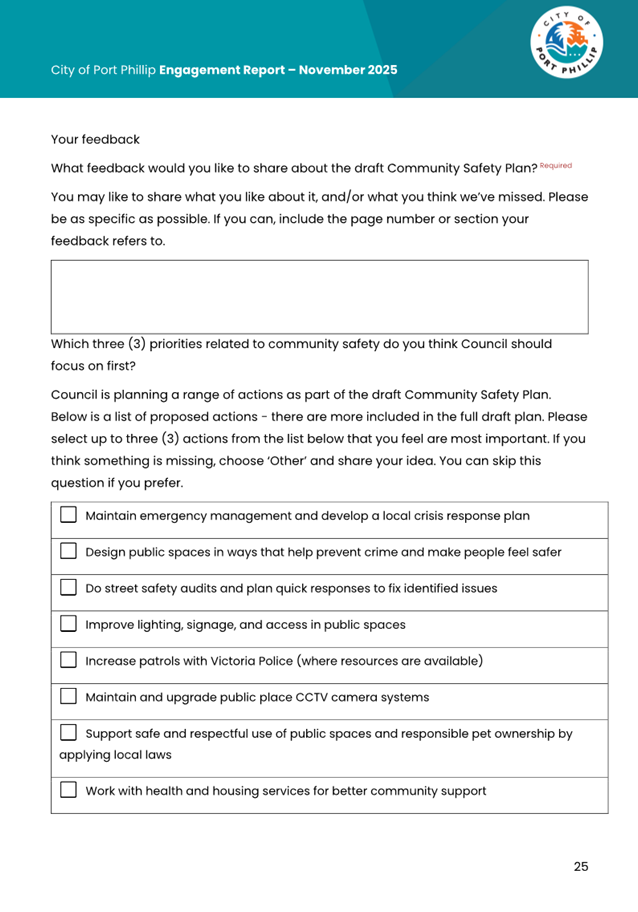
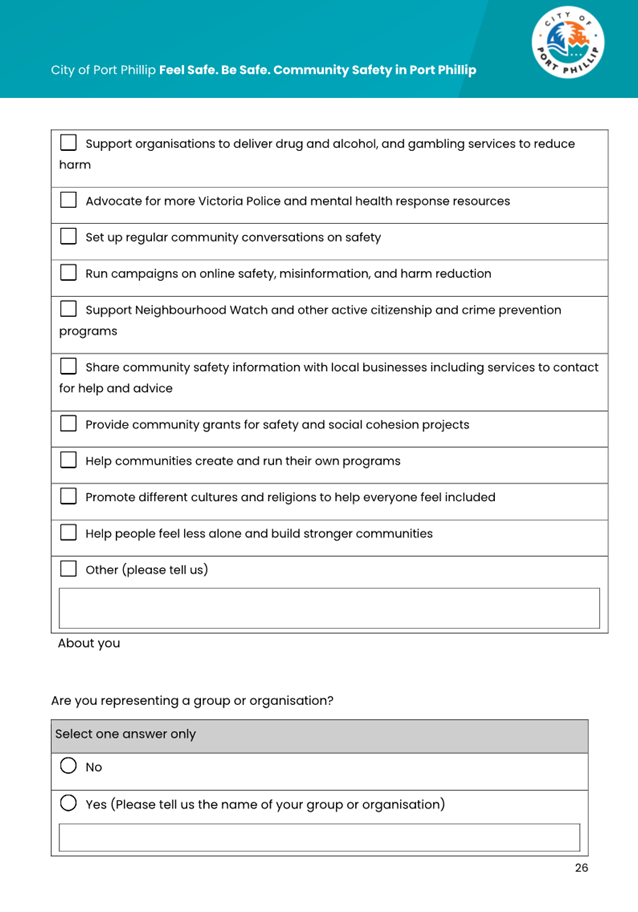
5.12 Community priorities for Council to action were:
· Increase patrols with Victoria Police.
· Design public spaces in ways that help prevent crime and make people feel safe.
· Work with health and housing services for better community support.
5.13 Many respondents that provided submissions and filled in the feedback form reported that they were residents in our local communities, across a range of Port Phillip suburbs, ages and diversity categories. See Attachment 3 for further detail on demographics.
Feedback from people with lived experience as residents in our local communities experiencing unsafe environments
5.14 As endorsed in the Council motion in September, feedback was sought from 104 people with lived experience as residents in our local communities experiencing unsafe environments who had raised experiences from street-based complex behaviour. In addition, business associations were contacted to ensure they had opportunity to provide feedback.
5.15 Responses received via email included feedback around five areas:
· Personal and property safety such as rubbish bins in lanes being used to access properties.
· Concerns around safety on public transport due to antisocial behaviour.
· Community safety events being held during the day to ensure accessibility for older people.
· Concerns from older residents around travelling safely at night.
· Concerns around a lack of social cohesion.
5.16 Concerns expressed by the people who made submissions to the draft Community Safety Plan Report at the Council meeting on 17 September 2025 were also included as feedback. The key concerns raised through this meeting were:
· Ensuing adequate engagement with people experiencing homelessness.
· Strengthening relationships with housing providers and Police to address antisocial behaviour at public and community housing premises.
· The complex role of Police as first responders, and the need to create a health and welfare based first response.
· Support for housing and community support services.
· The importance of safe, inclusive, and activated public spaces.
· Ensuring clear, expert-led data collection and reporting.
· The need to quickly and effectively address place-based community safety concerns.
5.17 These themes have been addressed in the updated Community Safety Plan with relevant actions reviewed and strengthened where required.
Feedback from people with living and lived experiences of homelessness
5.18 As endorsed in the Council motion in September, trauma informed consultation took place through focus groups with people with living and lived experiences of homelessness who supported actions related to addressing social isolation and building community by:
· Increasing community awareness of experiences of vulnerable community members.
· Funding and supporting community programs to help people feel less isolated.
· Collaborative and coordinated support services and assertive outreach.
· Environmental design to increase safety through CCTV, lighting, signage and seating and Inclusive design for people with different abilities
5.19 The focus groups encouraged Council to:
· Provide long-term funding to ensure continuity of community programs
· Focus on actions, support and services that are localised within Port Phillip.
· Continue engagement in collaborative consultation with people with lived and living experience of homelessness, mental health, and alcohol and other substance dependence when rolling out actions.
· Address root causes of unsafe behaviour and focus on prevention rather than punishment.
5.20 Focus group members identified these top priorities for Council:
· Work with health and housing services for better community support.
· Help people feel less alone and build stronger communities.
· Design public spaces to help prevent crime and make people feel safer.
Community Safety Roundtable
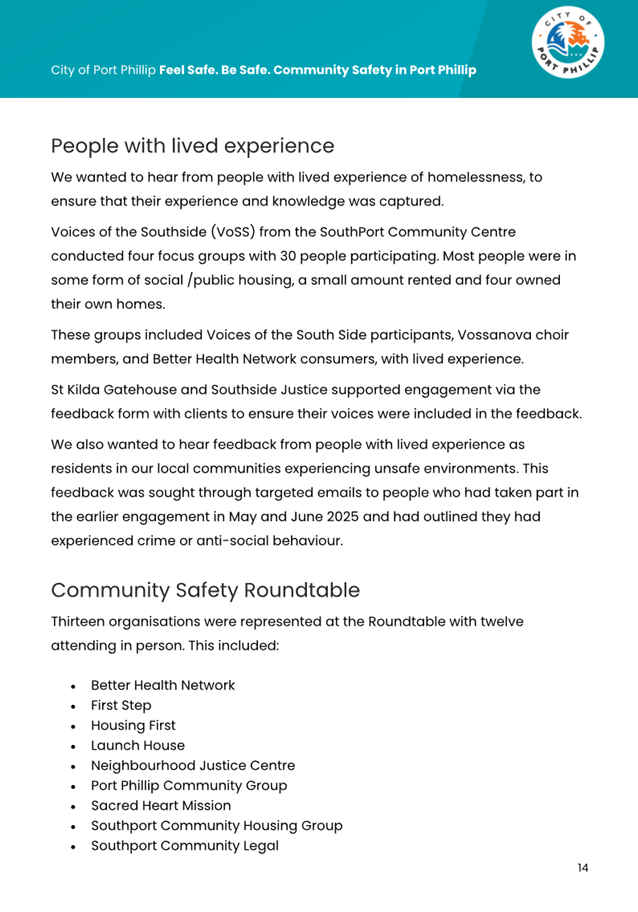
5.21 A follow up Community Safety Roundtable was held on 22 October 2025. Seventeen representatives across fifteen organisations accepted the invitation. Thirteen people attended from twelve organisations (the weather, illness and other commitments depleted numbers on the day). Other invitees provided written feedback.
5.22 The Roundtable strongly endorsed actions relating to:
· Education, awareness and anti-stigma campaigns to increase understanding in community.
· Cleaning, lighting and activation of streets, particularly at night.
· Safety solutions that do not rely on police and local laws.
· Addressing root causes of safety issues.
· Trauma-informed care.
5.23 The Roundtable participants encouraged Council to:
· Explore joint patrol that focused on community health interventions, with a focus on community workers and peer support, without the presence of Victoria Police and Local Laws.
· Consul with people from vulnerable communities, with lived and living experience of homelessness, and with complex mental health issues throughout implementation of plan.
· Focus on fmily violence prevention and support, and alcohol and other drugs support.
5.24 The Roundtable’s top three priorities for Council to action were to:
· Improve lighting, signage and access in public spaces.
· Help people feel less alone and build stronger communities.
· Work with health and housing services for better community support
5.25 Roundtable participants’ feedback has been integrated into the attached Plan (Attachment 1).
Service Providers
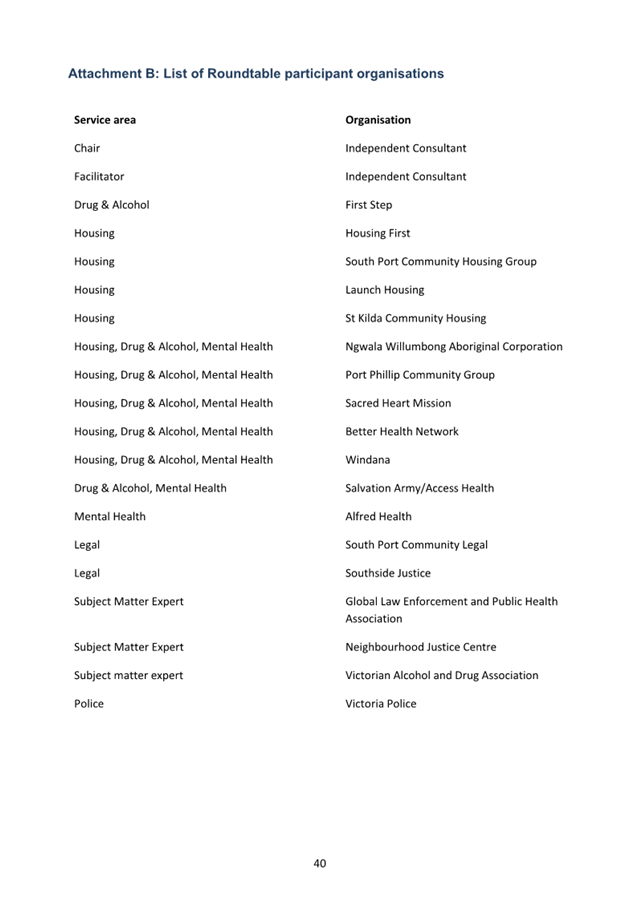
5.26 Feedback was also received from ten service providers or community groups, including some that participated in the Roundtable. The organisations were:
· Vixen
· Progressive Port Phillip
· First Step
· Residents of Port Phillip, Inc.
· Elwood Canal Action Team Inc.
· The Jewish Community Council of Victoria
· Better Health Network
· Port Phillip Community Group
· Southport Community Housing Group
· Southside Justice
5.27 Below is a summary of feedback from these submissions.
· Use of public space: ensuring environmental safety, addressing antisocial behaviour, trauma aware enforcement and policing, improved lighting and CPTED in priority areas, safe, welcoming, activated public spaces.
· Inclusion, Diversity & Cultural Safety: cultural representation and education for diverse communities, support for First Nations gathering spaces and cultural practices, anti-stigma campaigns and community education.
· Homelessness and Housing: homelessness as a safety issue, not just housing, endorsement of assertive outreach and wraparound supports, emergency accommodation and ‘staying housed’ supports needed, daytime and after-hours gathering spaces for unhoused people.
· Health and Harm Reduction: clearer health domain definitions (mental health, AOD, primary care), street-based, peer-led harm reduction models, proposal for medically supervised injecting room, whole-of-person health lens for safety and housing.
· Community-Led and Trauma-Informed Approaches: community-led evaluation and lived experience inclusion, caution around joint patrols with police, advocating for health-led models, peer support and community champions as safety leaders, mapping and visibility of existing support services.
· Governance, Coordination & Accountability: formal protocols between Council, Police, and services, dedicated internal coordination function within Council, need for implementation plans, performance measures, and public reporting, digital inclusion and multi-modal access to services, evidence-based crime data presentation to avoid fear-based narratives.
Overall findings
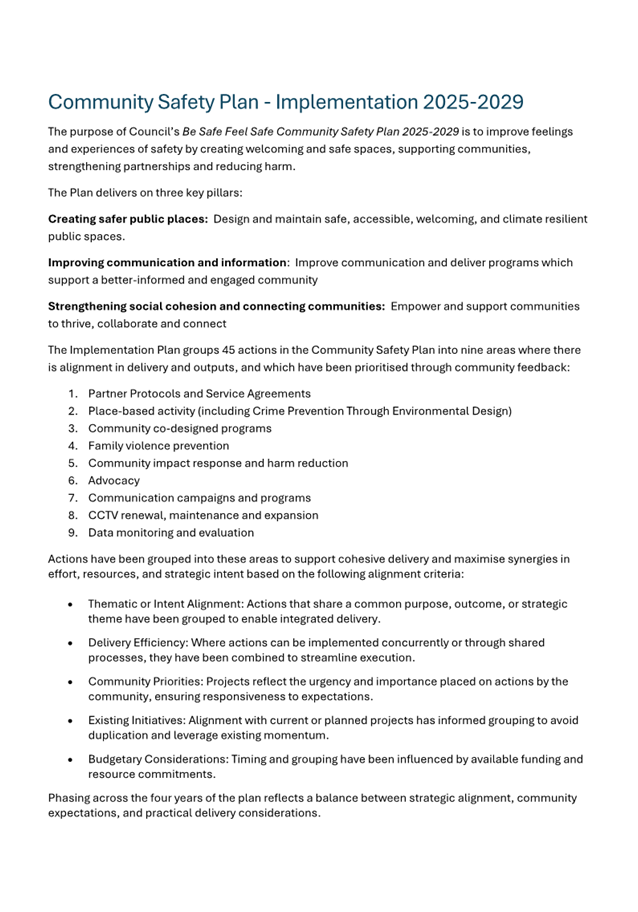
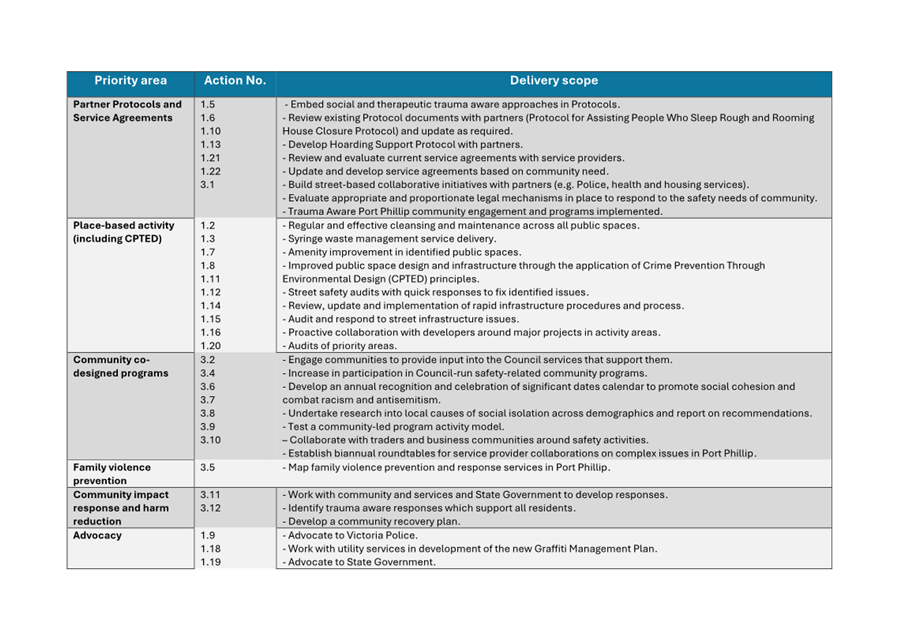
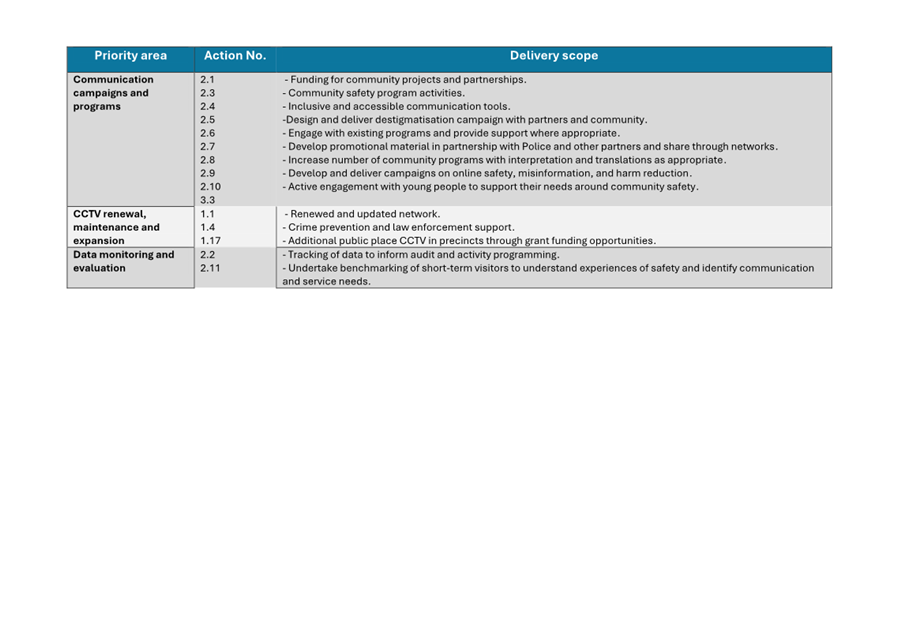
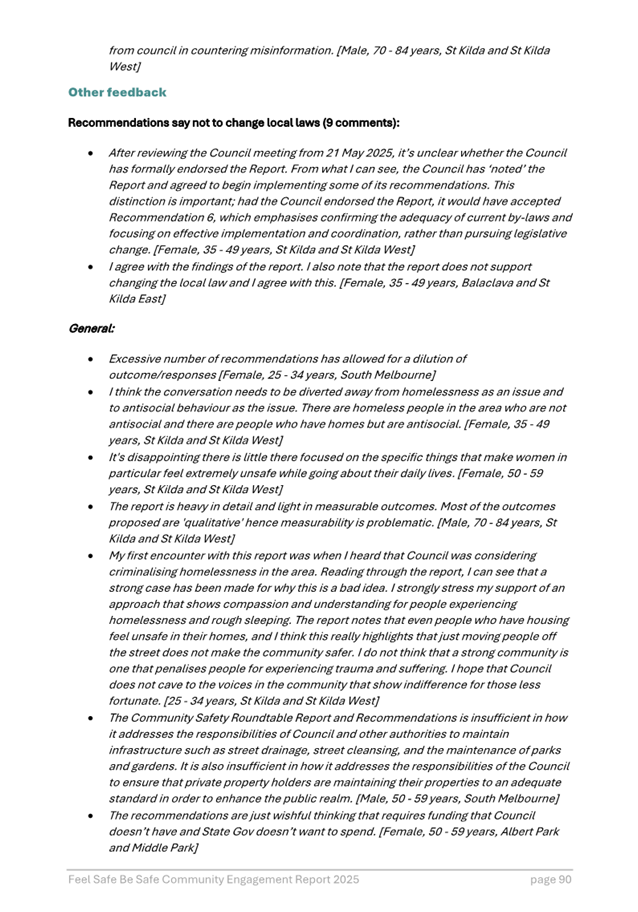
5.28 Overall, feedback was constructive and supportive and indicated high community sentiment for delivery to commence. Based on feedback, actions in the Community Safety Plan have been grouped thematically to reflect the following nine areas and delivery priorities identified through engagement:
· Partner Protocols and Service Agreements
· Place-based activity (including Crime Prevention Through Environmental Design)
· Community co-designed programs
· Family violence prevention
· Community impact response and harm reduction
· Advocacy
· Communication campaigns and programs
· CCTV renewal, maintenance and expansion
· Data monitoring and evaluation
How we have responded to the feedback
|
What we heard |
What we have changed |
|
The language in actions needs to be more tangible. |
Language in six actions has been made more directive. |
|
There was lack of clarity and/or concerns around the robustness of actions around homelessness/ housing responses and support for First Nations peoples.
|
This predominately related to Roundtable Recommendation actions that were initially included in both documents, especially around homelessness, housing and programs as transition to housing supports, service gaps, opportunities and alternate models, hubs, and gathering place. Five actions from the Community Safety Plan have been removed and are in the Homelessness and Affordable Housing Strategy (numbers 1.7, 1.16, 5.4, 5.5). One action is replicated in the Reconciliation Action Plan and has been removed. One action is being delivered through the Advocacy Plan and has been removed. One action relating to nighttime experiences has been integrated into safety audits (Action 1.11). One action relating to social cohesion gaps and opportunities has been removed as it will be a separate project. In total, nine actions have been removed from the Community Safety Plan but replicated in other documents. |
|
There needed to be greater reference to family and gender-based violence as a priority for community safety |
The action around family violence has been strengthened, and greater clarity around how the gender impact assessment underpins the document. |
|
Community wanted to understand how actions will be measured. |
Indicator outcomes and measures have been included in the Community Safety Plan, with targets for tracking in the Implementation Plan. New baseline data will be identified where required. |
|
The Youth Advisory Committee specified online safety as a priority |
Updated to include co-designed program around online safety. |
|
General feedback supported trauma aware and empathetic language. |
The Plan’s language has been reviewed to build on this strength. |
|
Feedback emphasised the importance of co-design around program development and delivery |
Actions around collaborative and co-designed processes, projects and programs have been strengthened.
|
Reporting on the Community Safety Plan
5.29 An Implementation Plan (Attachment 2) has been developed to track progress across the four years of delivery.
5.30 Reporting on actions will be incorporated into the Council’s monthly and quarterly reporting cycle, and the Annual Report.
5.31 Regular reporting allows for a clear overview of actions taken and achieved, as well as to highlight how any lessons learned through the implementation of the Plan are tracking.
5.32 A ‘Plan on a page’ will be designed to have the Community Safety Plan’s key messages and actions available in a simple and accessible format.
6. LEGAL AND RISK IMPLICATIONS
6.1 There are no identified legal implications associated with the draft Community Safety Plan or actions.
7. FINANCIAL IMPACT
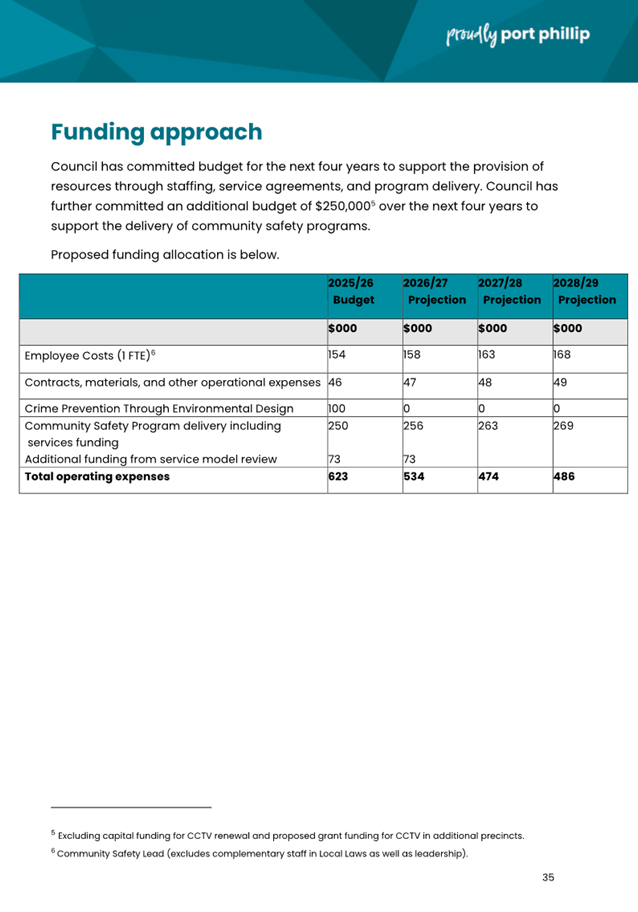
7.1 Council has committed $250,000 per year for 4 years to support community safety including the funding of the Community Safety Roundtable Recommendations and delivery of the Community Safety Plan.
7.2 Of the 2025/26 budget, a total of $92,000 has already been allocated, which has included an allocation of $60,000 to support Ngwala Willumbong to fund an outreach worker to support First Nations residents currently sleeping rough and $32,000 to Launch Housing to enable an uplift of the existing Rough Sleeping Initiative which manages Councils By Name List and provides case management and outreach to those sleeping rough in the City of Port Phillip.
7.3 Council sought targeted community consultation to inform the effective allocation of project funds. Feedback was gathered through members of the Community Safety Roundtable and the Port Phillip Zero Executive, both of whom are well-positioned to advise on opportunities for greatest impact.
7.4 Following the consideration of these submissions, it is proposed that additional budget allocations are as follows from Council’s community safety budget:
7.4.1 A further $60,000 in 2026/27 in addition to the $60,000 in 2025/26 already allocated to Ngwala Willumbong to support delivery of targeted support and outreach to First Nations residents experiencing homelessness improving long-term health and housing outcomes and stability.
7.4.2 $181,000 in 2025/26 and 2026/27 to Better Health Network to fund the Whole of Housing Pre-Housing Model AOD worker or nurse to provide health-led, trauma informed outreach to address complex needs and support those experiencing homelessness for housing.
7.5 Additionally, it is proposed $50,000 be allocated to fund implementation of the Community Safety Plan with a focus on advancing priority projects.
7.6 These allocations would exceed the community safety budget by $73,000. As part of the Community Safety Roundtable recommendations, officers have reviewed Council’s homelessness service model and found efficiency savings, which can be utilised by Council to fund the gap in required funding.
7.7 As the Salvation Army Access Health van project is relatively new, it is recommended that officers seek further information and continue to work with them on opportunities for advocacy or further consideration by Council through future reviews of service agreements and budget processes
Community Safety Program proposed budget priorities for Year 1 2025/26:
|
Priority area |
Program |
Estimate |
|
Partner Protocols and Service Agreements Community impact response and harm reduction Community co-designed programs Family violence prevention Communication campaigns and programs |
Ngwala Service Agreement enhanced homelessness and health outreach for First Nations |
$60,000 |
|
Launch Housing Service Agreement enhanced homelessness outreach |
$32,000 |
|
|
Better Health Network delivery of health-led outreach model |
$181,000 |
|
|
Community Safety Plan implementation |
$50,000 |
|
|
TOTAL |
|
$323,000 |
Crime Prevention Through Environmental Design proposed budget priorities for Year 1 2025/26
|
Priority area |
Project/program |
Estimate |
|
Place-based activity |
Woodstock Street carpark |
$45,000 |
|
Place-based activity |
Cecil Street/Coventry Street |
$15,000 |
|
Place-based activity |
Lighting audit around key activity areas |
$20,000 |
|
Place-based activity |
Site to be confirmed |
$20,000 |
|
TOTAL |
|
$100,000 |
7.8 The Implementation Plan will be reviewed each year of the life of the Plan to guide annual budget spends on actions.
8. ENVIRONMENTAL IMPACT
8.1 An unsafe or unsupported community may see an environmental impact such as increase in waste, rubbish, abandoned items or an increase in graffiti.
8.2 By supporting all members of our community, the general environment, health and wellbeing will be improved.
8.3 There can be an environmental impact of people sleeping rough be this bio-hazardous or harmful waste, rubbish, abandoned material aid or abandoned camps/items are left in hot-spot/high street areas and parks/open spaces. By supporting more persons into housing and supporting their health and wellbeing this issue may be minimised.
9. COMMUNITY IMPACT
9.1 Experiences and feelings of safety have a significant effect on the health and wellbeing of individuals and their sense of belonging and community connection.
9.2 Improving community safety can increase connectedness, social and cultural inclusion and cohesion and prevent or reduce harm, trauma, stigma and hardship. This can have positive impact on reducing incidents of crime and anti-social behaviours.
9.3 The Community Safety Plan will provide Council with clear and achievable directions and actions to improve community safety.
9.4 When people feel safe in their environments—whether in public spaces, at home, or online—they are more likely to engage in civic life, build trust with neighbours, and access services without fear.
9.5 Effective community safety initiatives can reduce criminal or antisocial incidents, while also addressing underlying issues such as inequality, mental health, and substance use. Ultimately, a strong focus on community safety fosters inclusive, vibrant communities where individuals and families can thrive.
10. Gender Impact Assessment
10.1 A gender impact assessment has been conducted on the draft Plan and recommendations have been taken into consideration in the development of the Plan.
11. ALIGNMENT TO COUNCIL PLAN AND COUNCIL POLICY
11.1 The Community Safety Plan aligns to the Council strategic direction of A safe and liveable City.
11.2 It delivers on the priority of “Review and implement a new Community Safety Plan to enhance the safety and resilience of our community”. The Plan also supports the health priorities outlined in the Plan for Port Phillip.
12. IMPLEMENTATION STRATEGY
12.1 TIMELINE
12.1.1 Delivery of some actions following endorsement of Roundtable Recommendations has already commenced.
12.1.2 If Council resolves to endorse the Community Safety Plan, delivery on the actions through the Implementation Plan will commence.
12.2 COMMUNICATION
12.2.1 The new Community Safety Plan, Implementation Plan and Engagement Report will be published on the Council website and shared through Council’s social media channels and Divercity. Hard copies of the Plan will be available at Libraries and Assist counters.
13. OFFICER MATERIAL OR GENERAL INTEREST
13.1 No officers involved in the preparation of this report has declared a material or general interest in the matter.
|
ATTACHMENTS |
1. Feel Safe. Be Safe. Community Safety Plan 2025-2029 2. Community Safety Plan_Implementation Plan December
2025 3. Community Safety Plan Phase Four Engagement Report 4. Community Safety Plan Phase Three Engagement Report |
Meeting of the Port Phillip City Council
10 December 2025
|
Proposed Local Law Amendment Update and Draft Protocol with Police |
|
|
Executive Member: |
Brian Tee, General Manager, City Development |
|
PREPARED BY: |
Nellie Montague, Manager Safety and Amenity |
1. PURPOSE
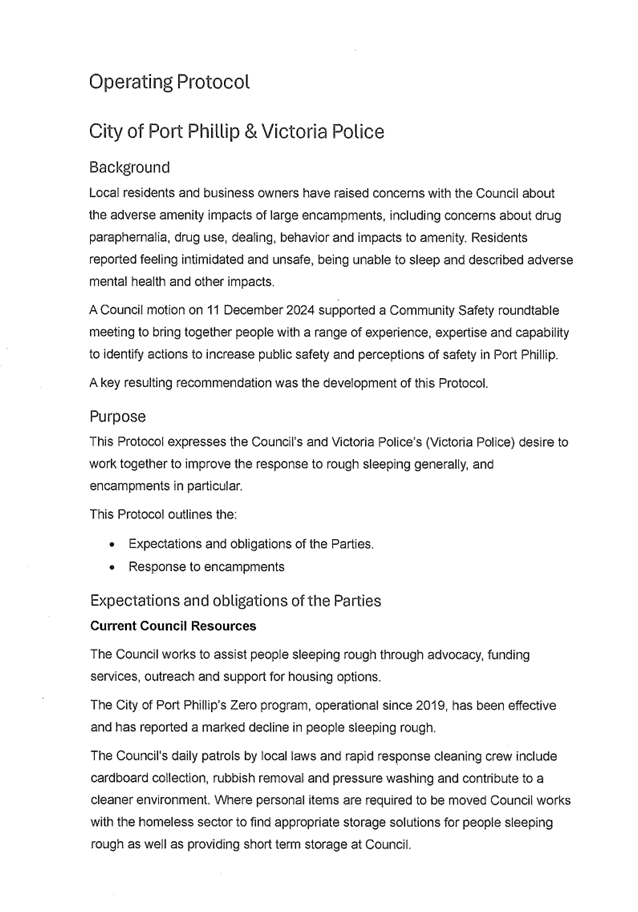
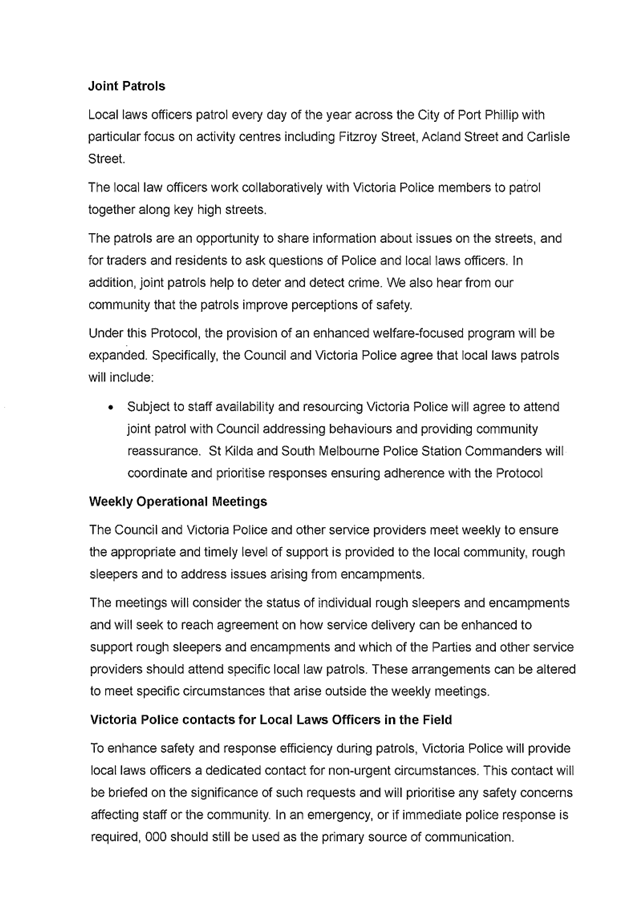
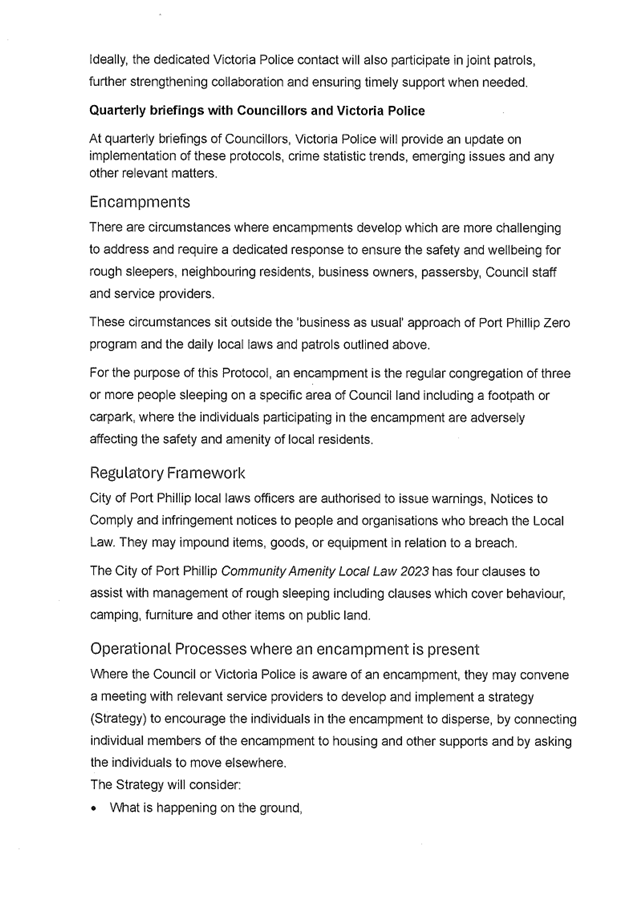
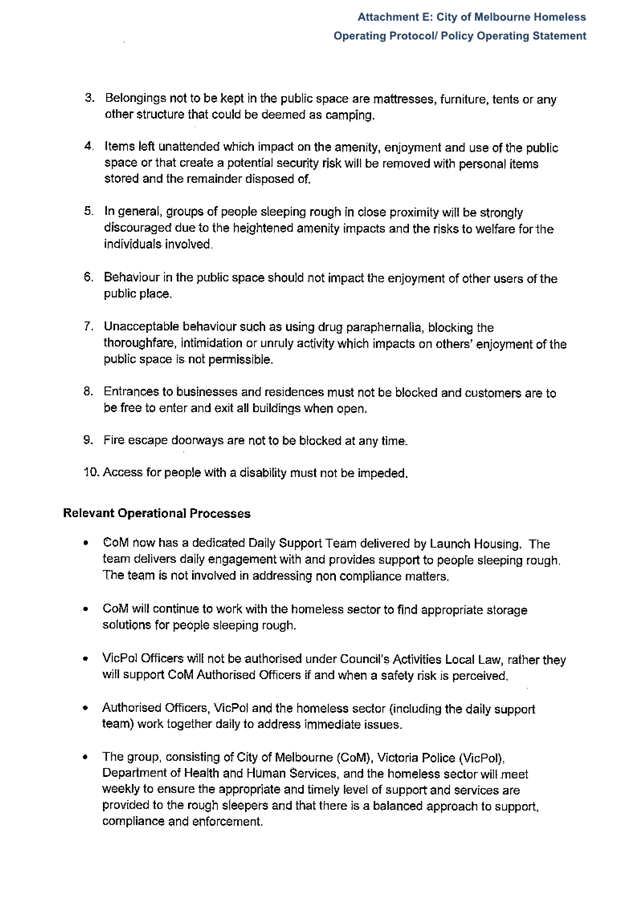
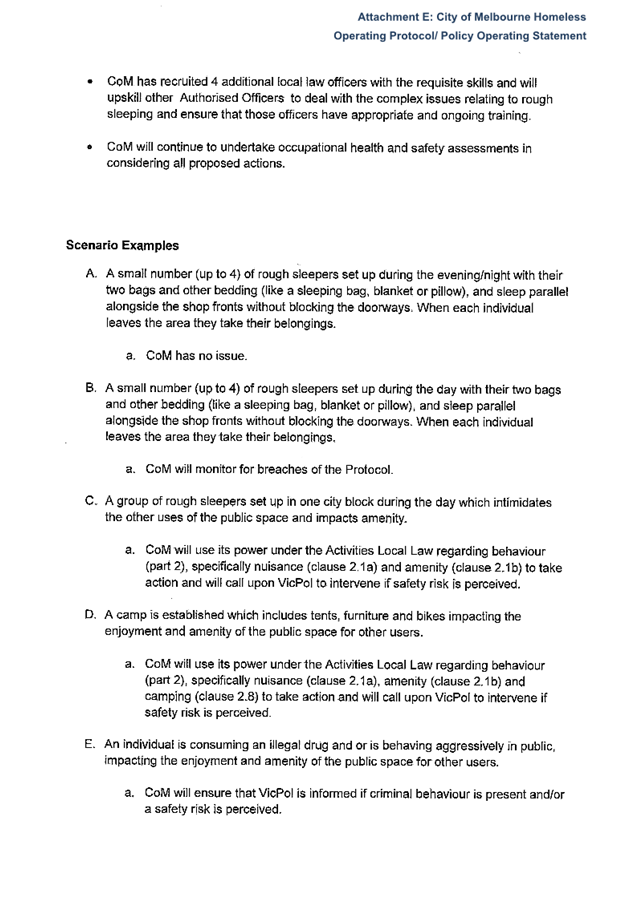
1.1 To update Council on the outcome of community engagement on proposed amendments to the Community Amenity Local Law 2023 (Local Law), consider possible amendments to the Local Law and recommend endorsing an Operating Protocol with Victoria Police (VicPol).
2. EXECUTIVE Summary
2.1 The City of Port Phillip has a proud history of a compassionate approach to assisting the most vulnerable within our community and being a sector leader in working with housing, mental health, drug and alcohol and other services to address the underlying causes of rough sleeping. Many of the Council initiatives are detailed in Council’s Feel Safe. Be Safe. Community Safety Plan 2025-2029 and are also being considered and actioned by Council through the Affordable Housing and Homelessness Strategy, Port Phillip Zero Program and Trauma Aware Port Phillip.
2.2 Throughout October to December 2024, between 10 and 15 individuals camped in a small Council owned carpark 50 metres away from Fitzroy St. Local residents raised concerns with Council about the adverse amenity impacts including people defecating and urinating in nearby residential properties, clearly visible drug paraphernalia, drug use and dealing, the presence of rubbish and what appeared to be stolen goods, yelling and aggressive behaviour including late at night. Residents reported feeling intimidated and unsafe, being unable to sleep and described adverse mental health and other impacts.
2.3 In response, Council increased Local Law patrols and worked with drug and alcohol, housing and other service providers to provide required support. Following ongoing engagement by service providers and patrols with Police support, over time the campers moved away.
2.4 In response to the situation outlined above, there were Council decisions in December 2024, February and May 2025 that:
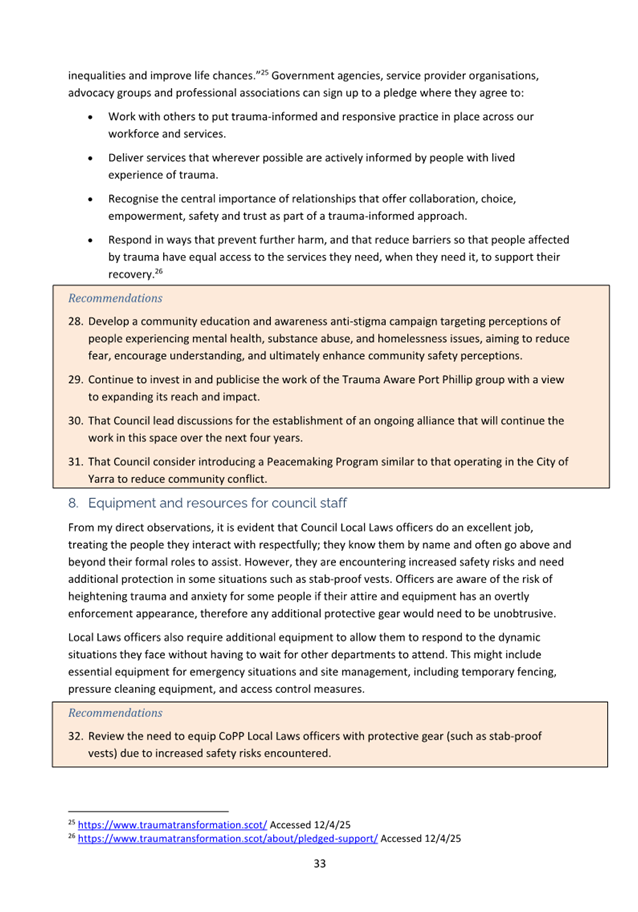
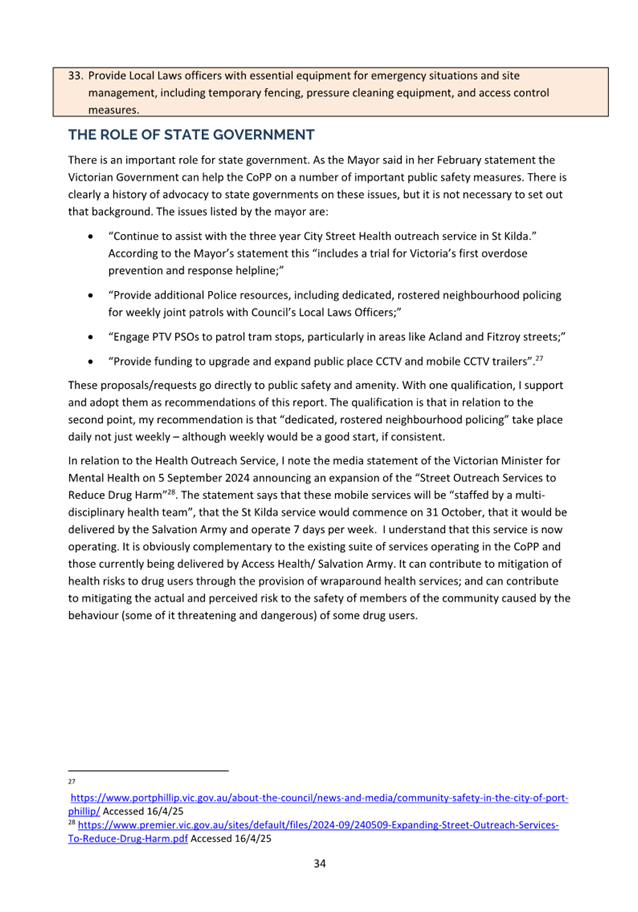
2.4.1 Established a Community Safety Roundtable (the Roundtable) with service providers and Police to identify actions to increase public safety and perceptions of safety. The Roundtable Report (Attachment 4) included a recommendation to establish a protocol between Victoria Police and Council. This report recommends endorsement of the subsequently developed Operating Protocol. (Attachment 1)
2.4.2 Initiated public engagement on a proposed change to Council’s Local Law that would strengthen Council’s powers to dismantle encampments. This report summarises the outcome of that public engagement.
2.4.3 Initiated the investigation of amendments to Council’s Local Laws to address any adverse amenity impacts of the behaviour of rough sleepers. These Local Law options are considered in this report.
2.5 The Local Law amendments would provide an option, where other interventions have failed, to dismantle an encampment through the removal of encampment equipment.
2.6 Dismantling an encampment is important for residents living near an encampment who are impacted by the amenity impacts including noise, threats and illegal behaviour.
2.7 While Victoria Police support the proposed Local Law amendments, community service providers do not support the amendments.
2.8 Service Providers note the potential risk of escalation with police should rough sleepers refuse to move encampment equipment when directed by Council Local Law officers. Instead of a local law change, service providers recommend improved service delivery (drug and alcohol, housing, mental health etc.) to address the underlying causes of rough sleeping.
2.9 Regardless of whether a Local Law amendment option is endorsed, Council will continue to implement the Community Safety Plan Actions and Roundtable Report Recommendations (Attachment 4) and other programs and strategies to improve community safety.
|
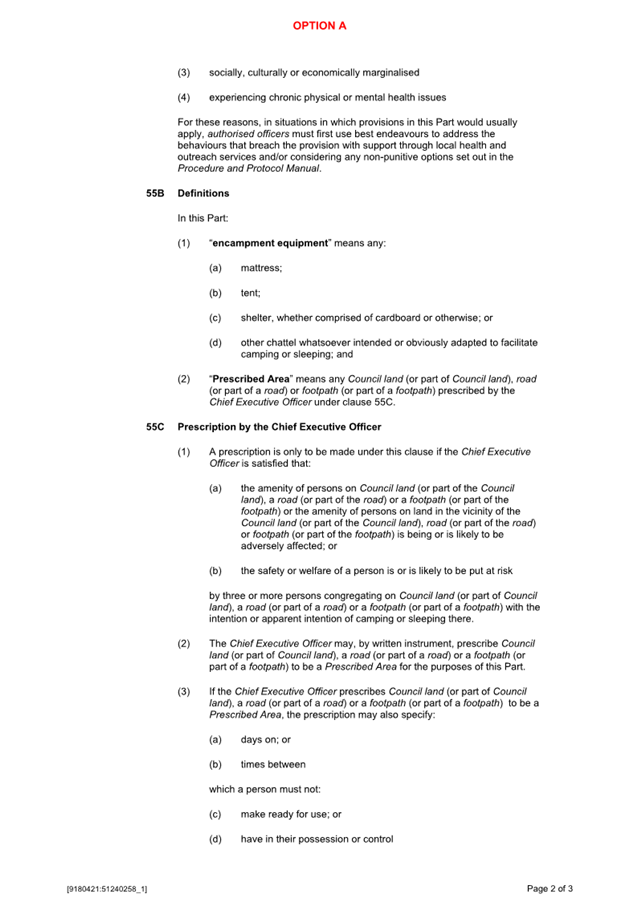
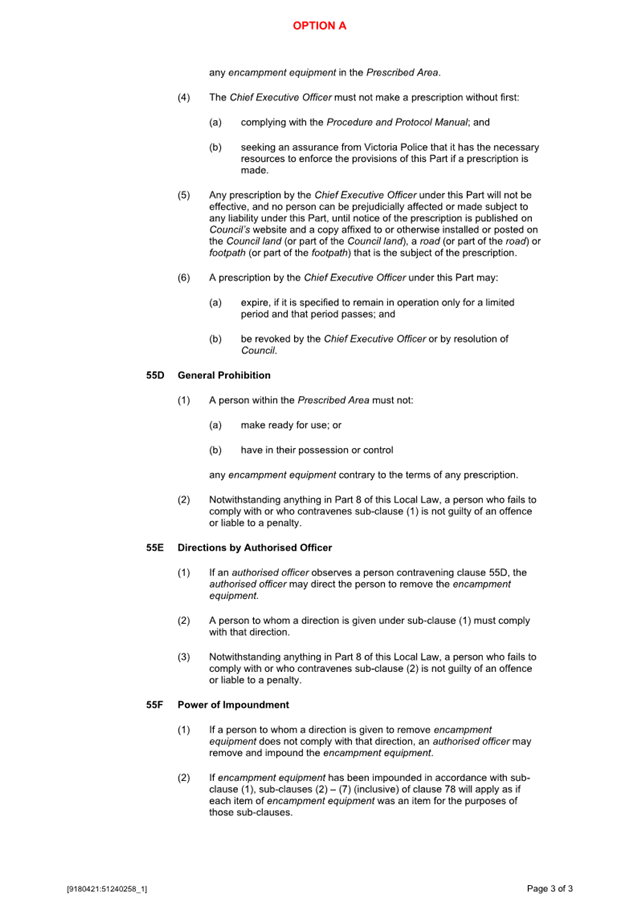
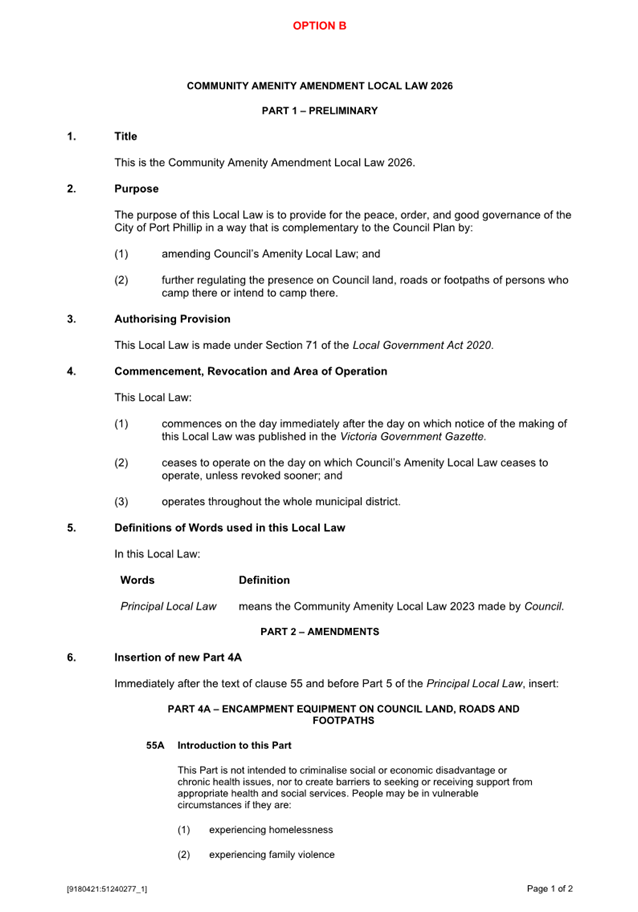
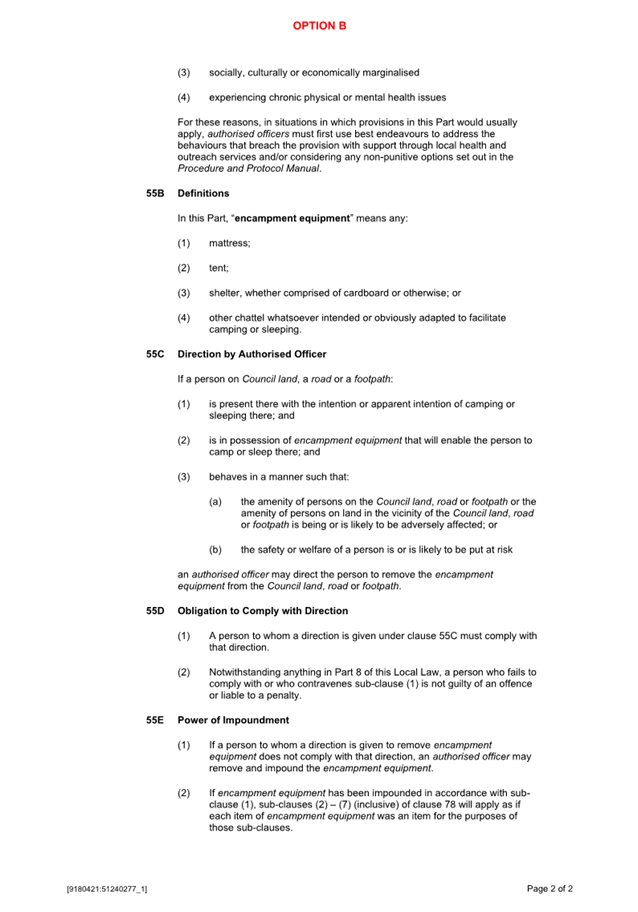
That Council: 3.1 Thanks the community for their feedback during May and June 2025 on the proposed Local Law 'no-encampment designation' amendment. 3.2 Endorses (insert option): Option A 3.2.1 Authorises the Chief Executive Officer, to commence the statutory process for a Local Law amendment to add a new Part 4A Encampment Equipment on Council Land as per Attachment 2 allowing the CEO to designate a “no encampment” area in response to behaviours that have or may have adverse amenity and welfare impacts, provided the conditions in the Local Law (Attachment 2) are met and empowering Council’s Authorised Officers to remove encampment equipment from the no encampment area. 3.2.2 Allocates $60,000 for communications, engagement, reporting, and legal review to fulfil the Local Government Act requirements for a new Local Law amendment. 3.2.3 Authorises the Chief Executive Officer, or their deleage, to sign the Police Protocol (Attachment 1) on behalf of Council. Option B 3.2.4 Authorises the CEO to commence the statutory process for a Local Law amendment to add a new Part 4A Encampment Equipment on Council Land as per Attachment 3 allowing Council’s Authorised Officers to respond to behaviours in camps that have or may have adverse amenity and welfare impacts, provided the conditions in the local law (Attachment 3) are met and empowering Council’s Authorised Officers to remove encampment equipment. 3.2.5 Allocate $60,000 for communications, engagement, reporting, and legal review to fulfil the Local Government Act requirements for a new Local Law amendment. 3.2.6 Authorises the CEO or delegate to renegotiate the Police Protocol (Attachment 1) so that it applies to Option B and requests that any renegotiated Protocol is brought to a future Council meeting for endorsement. Option C 3.2.7 Not amend the Local Law and authorises the CEO or delegate to sign the Police Protocol (Attachment 1) on behalf of Council. |
4. KEY POINTS/ISSUES
Port Phillip in Context
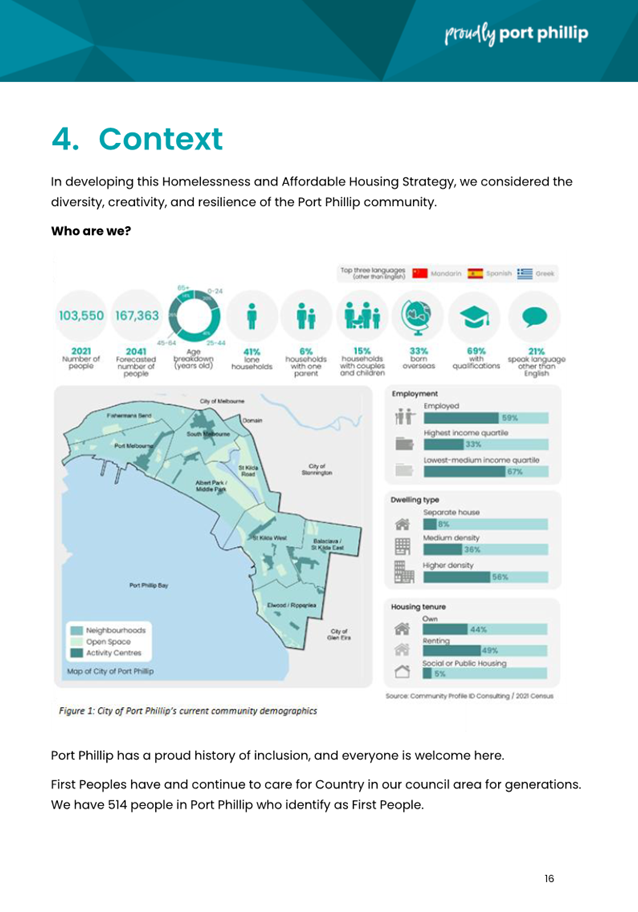
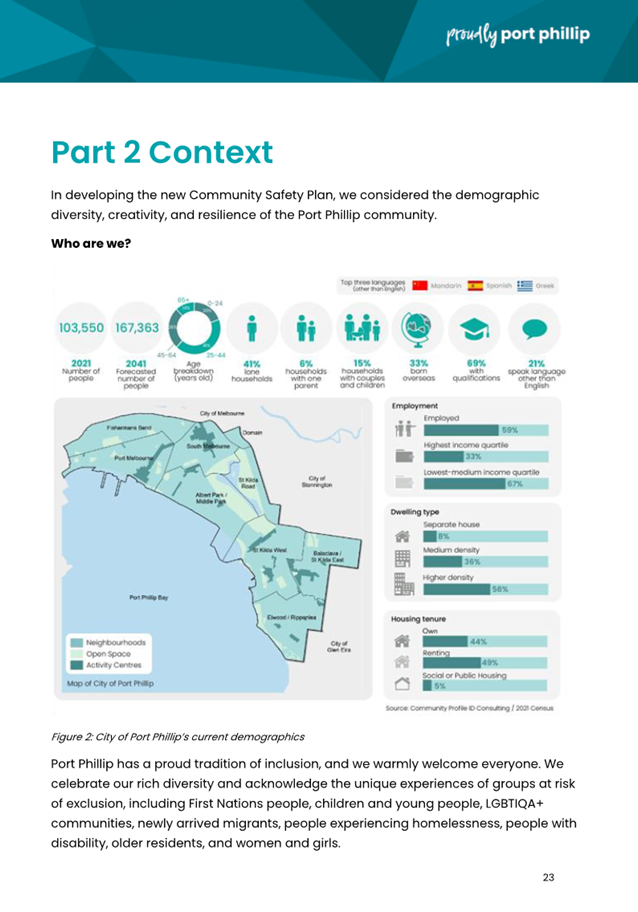
4.1 Port Phillip has 109,515 residents from 163 birthplaces, speaking 114 languages. Most are aged 18–49, but the proportion of residents over 60 is expected to grow. 91% of residents live in medium/high-density housing; 41% of households are singles; 44% are renters. The population of Port Phillip is forecast to grow by 60,000 by 2041. Housing stress is significant, with Council advocating for State and Federal intervention.
4.2 Around 25 people sleep rough nightly; many more are in cars, couch surfing or crisis accommodation. Causes include family violence, housing shortages, unemployment, mental illness and substance abuse.
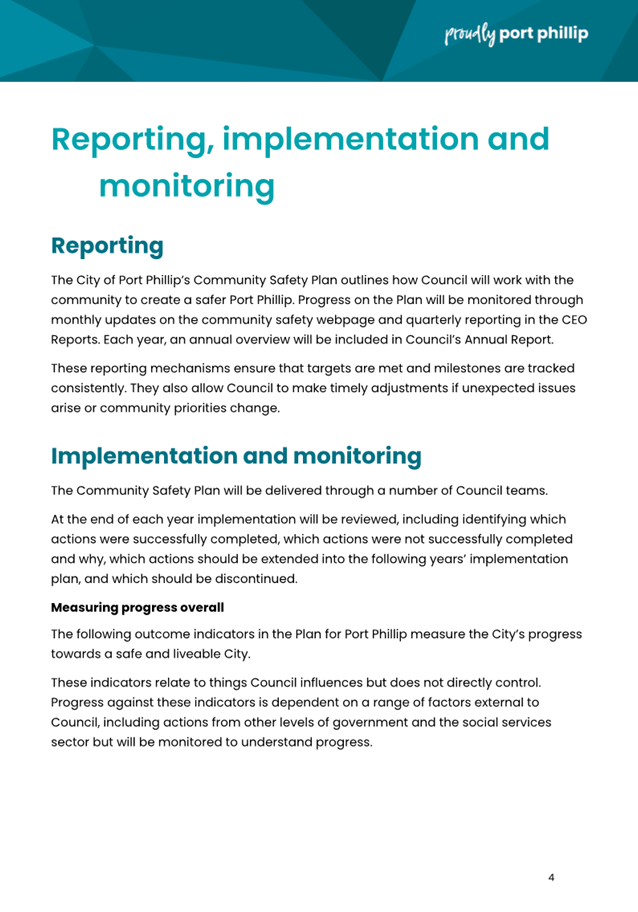
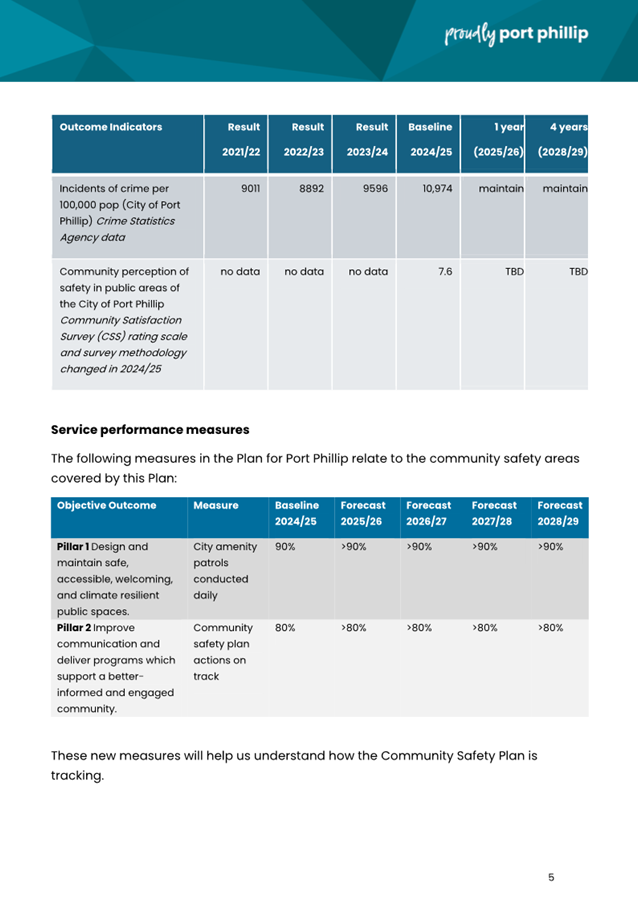
4.3 Crime rates in Port Phillip are higher than the Victorian average. In the year ending June 2025, Port Phillip recorded 10,974 criminal incidents per 100,000 population, compared to the Victorian average of 6,814. Perceptions of safety data from the annual Community Satisfaction Survey 2025 showed perception of safety in public areas was reported as 7.6 on a very unsafe to very safe scale of 1 to 10.
4.4 Port Phillip’s incidence of family violence is below the state average but does fluctuate. June 2025 rate: 1,425 per 100,000 vs Victorian average of 1,499.
4.5 In 2021, alcohol and drug-related hospitalisations were 22.6 per 1,000 residents (Vic avg: 8.73). Drug offences in 2020/21 were 50% higher than the Victorian rate; alcohol-related family violence incidents were 71% higher.
Local Law Amendment in Context
4.6 Between October and December 2024, individuals gathered in the Jackson Street Carpark, a small council owned carpark 50 metres away from Fitzroy St. While the number of individuals varied and could spike, generally there were between 10 and 15 people with items including mattress, trolleys, suitcases, bedding, bicycles, boxes and other articles.
4.7 Local residents raised concerns about the adverse amenity impacts including at a Council meeting on 27 November 2024, when residents presented their experiences of people defecating and urinating in nearby residential properties, clearly visible drug paraphernalia, drug use and dealing, the presence of rubbish and what appeared to be stolen goods, yelling and aggressive behaviour including late at night. Residents reported feeling intimidated and unsafe, being unable to sleep and described adverse mental health and other impacts.
4.8 In response, Council increased Local Law patrols, placed Council’s mobile CCTV camera in the carpark and worked with drug and alcohol, housing and other service providers to try find suitable alternative accommodation and provide required support. Every morning Local Law officers attended and asked campers to leave. Local Law officers were threatened and could not enter the area safely without Police. Local services continued with assertive outreach to support with housing options and links to health supports. Following ongoing concentrated patrols with Police support over a period of time, the campers moved away.
4.9 Following the concerns raised at the 24 November 2024 Council meeting, a notice of motion on 11 December 2024 supported a Community Safety Roundtable to bring together services with a range of experience, expertise and capability to identify actions to increase public safety and perceptions of safety. The motion requested that the Mayor write to Victoria Police seeking advice and recommendations on Local Laws. This occurred on the 24 January 2025 and, in response, Victoria Police proposed a working group to consider Local Law amendments.
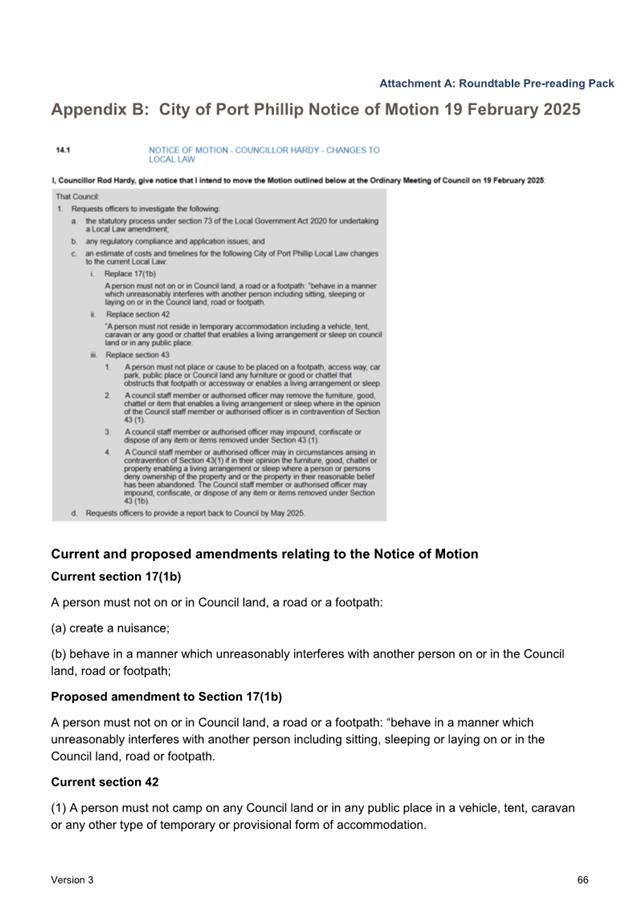
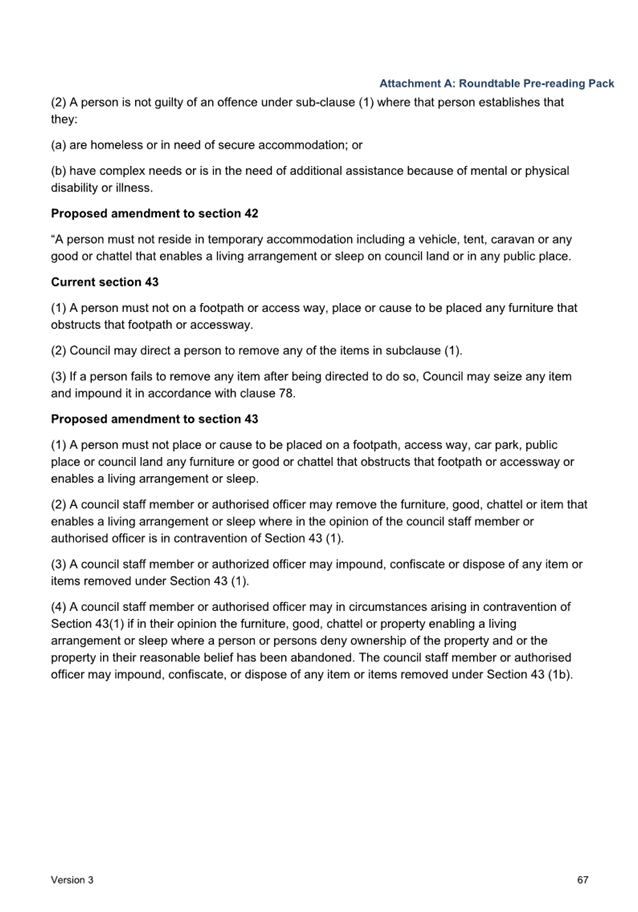
4.10 On 19 February 2025 Council passed a notice of motion to investigate changes to the Council Local Law Clause 17 (Behaviour on Council land), Clause 42 (Camping on Council Land) and Clause 43 (Furniture and other items on Council Land and Footpaths) to see if such changes could help address public safety and amenity concerns while considering human rights and other relevant factors.
Roundtable Report
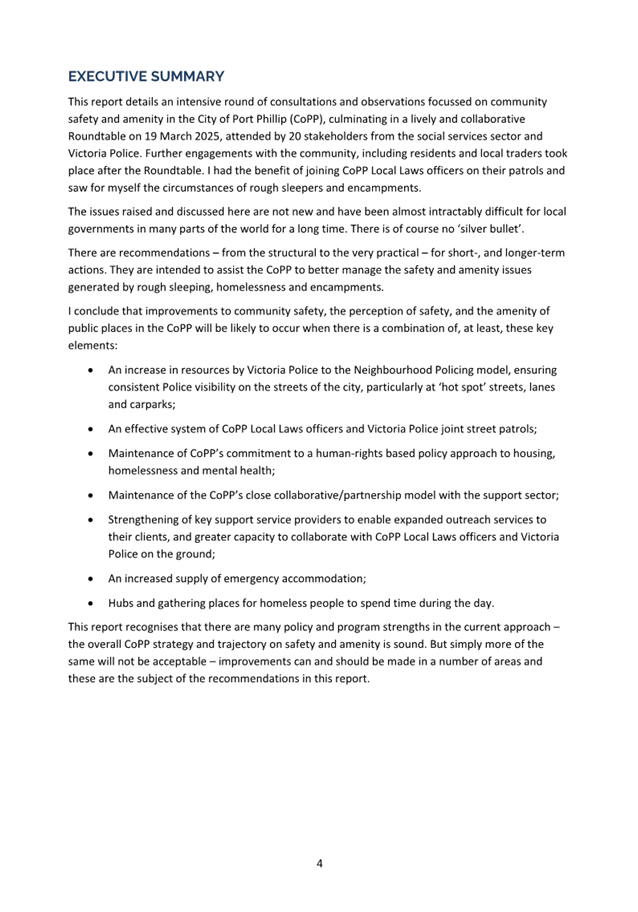
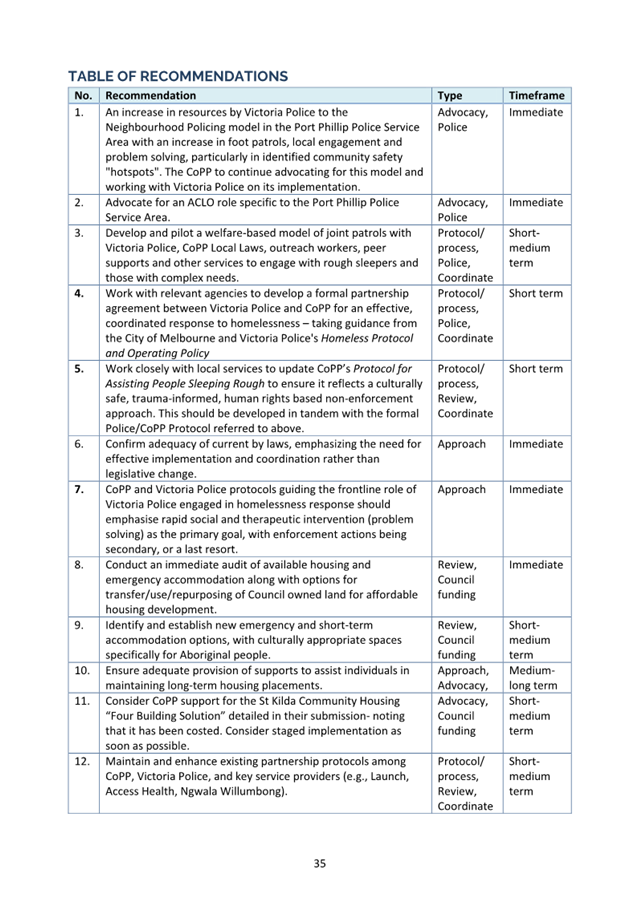
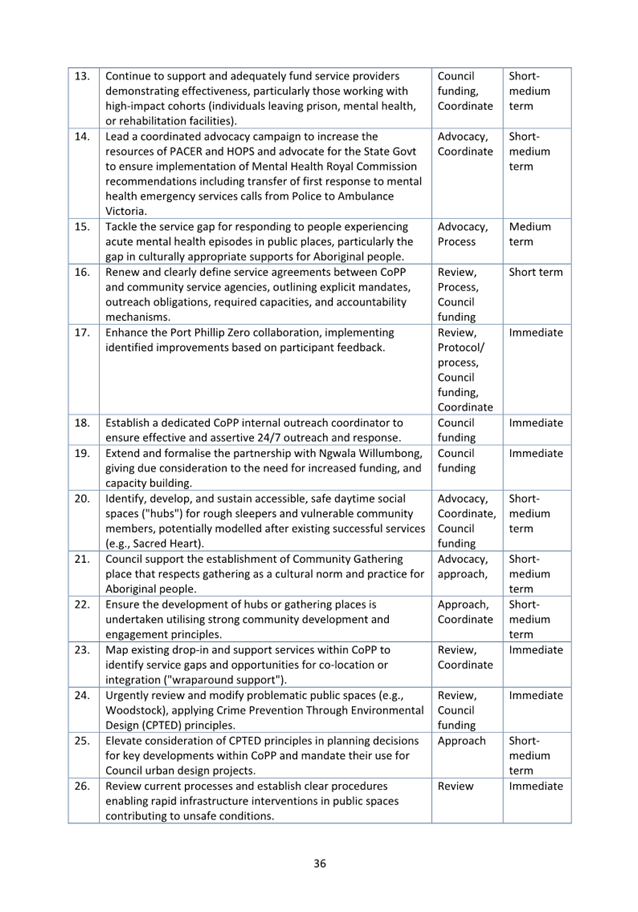
4.11 In response to the December 2024 Notice of Motion, a Community Safety Roundtable was held on 19 March 2025 with twenty stakeholders, including service providers with expertise in drug and alcohol support, housing, mental health, legal and academic expertise and Police, in attendance. It was chaired by Ian Gray AM, a long-time Port Phillip resident with experience in the legal, justice, and community sectors. The roundtable recommendations relevant a consideration of changes to Local Laws, policing and enforcement are:
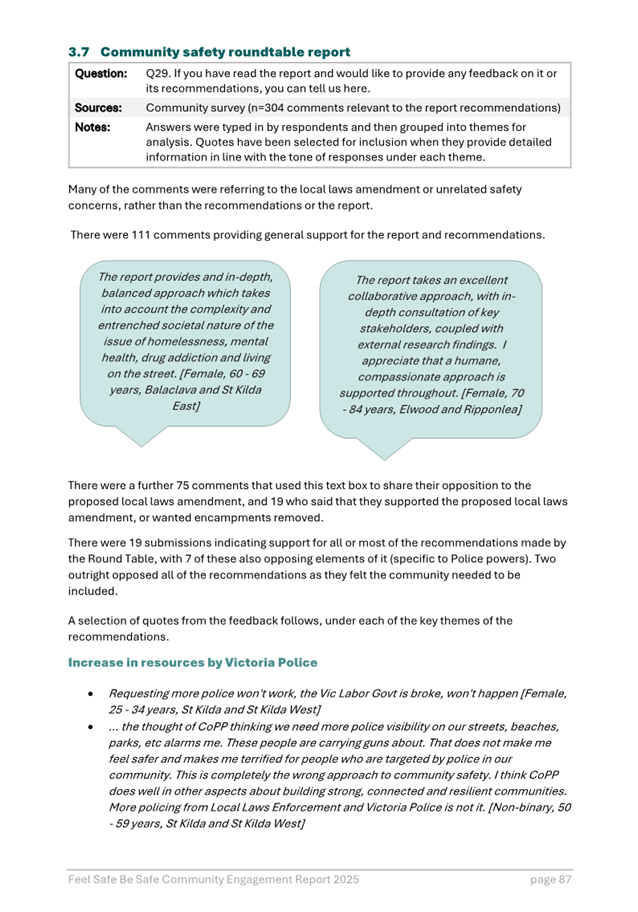
· An increase in Victoria Police resources for the Neighbourhood Policing model, including more foot patrols, local engagement, and problem-solving in identified safety hotspots. CoPP to continue advocating and collaborating.
· Advocate for an Aboriginal Community Liaison Officer dedicated to the Port Phillip Police Service Area.
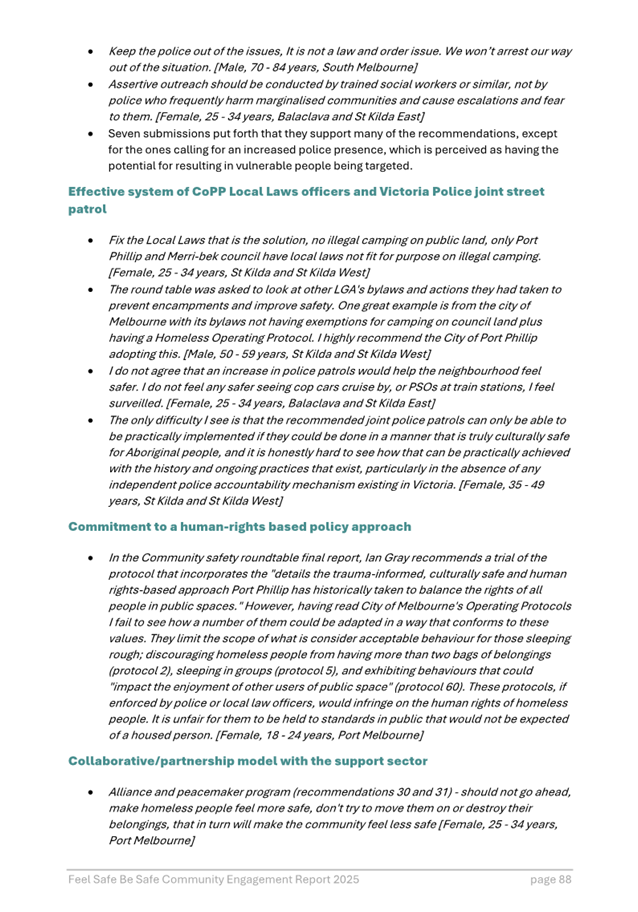
· Develop and pilot a welfare-based joint patrol model involving Victoria Police, CoPP Local Laws, outreach workers, peer support, and other services to engage rough sleepers and people with complex needs.
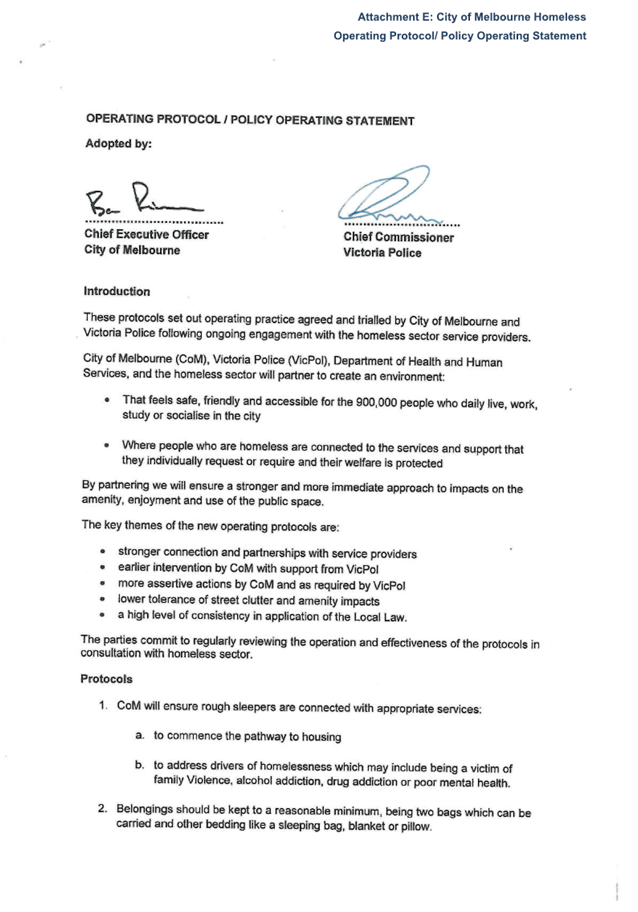
· Establish a formal partnership agreement between Victoria Police and CoPP for a coordinated homelessness response, drawing on the City of Melbourne and Victoria Police Homelessness Operating Protocol.
· Confirm adequacy of current by-laws, focusing on effective implementation and coordination rather than legislative change.
· Ensure CoPP and Victoria Police protocols prioritize rapid social and therapeutic intervention as the primary goal, with enforcement as a last resort.
4.12 In their submission to the Roundtable Report (Attachment 4), the Police recommend Local Law amendments with a tiered response:
· Intervention – Prioritise swift social and therapeutic support, offering alternative living and sleeping arrangements.
· Assessment – Agencies quickly determine needs and implement housing, medical or support solutions.
· Enforcement – If support is refused, Local Laws Officers and Neighbourhood Policing Team dismantle encampments.
4.13 On 2 May Council received a joint letter from service providers opposing the Local Law amendment proposed in the February motion. The letter was signed by the CEOs of Southside Justice, First Step, Justice Connect, Fitzroy Legal Service and Inner Melbourne Community Legal, and was endorsed by 28 other services. The service providers expressed support for investment in services, outreach and prevention, and opposed the proposed changes to the Local Law. The letter was tabled at the 21 May Council meeting.
21 May 2025 Council Meeting
4.14 The Roundtable Report (Attachment 4) was tabled at the 21 May 2025 Council meeting.
4.15 In addition, at the 21 May 2025 Council Meeting an alternative amendment to the Local Law than the one outlined in the February 2025 motion was supported by Council. Instead of the February motion, an amendment to the Local Law targeting encampments was endorsed for community engagement noting that this will include:
4.15.1 The ability to temporarily designate an area as a no encampment area in consultation with key stakeholders so that:
a) The amenity of the Council land or the amenity of land in the vicinity of the Council land is or is likely to be adversely affected; or
b) The safety or welfare of a person is or is likely to be put at risk by behaviours of persons congregating on Council land with the intention or apparent intention of camping or sleeping there.
4.15.2 Notes that:
a) such a designation could be considered an exceptional circumstance after existing and enhanced assertive outreach models with service providers and supportive conversations had failed.
b) that enforcement of the potential amendment would not include fines, but instead, the removal and impoundment of equipment following provision of outreach and support services, where individuals have refused both a request and then warning to remove the material from the designated area.
Community Engagement Outcomes
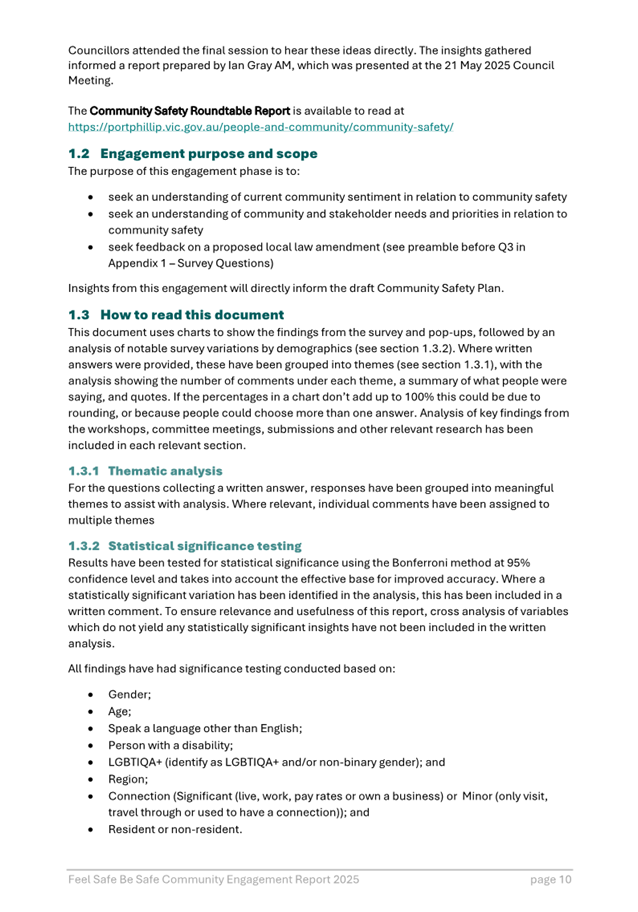
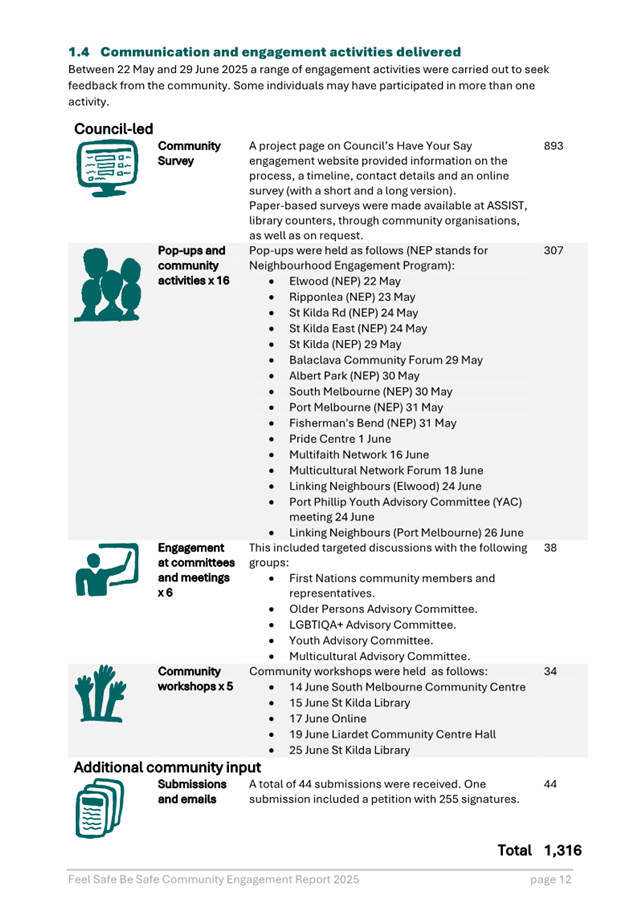
4.16 As resolved in the 21 May 2025 Council meeting, community engagement occurred between 22 May and 29 June 2025. Engagement activities included an online survey, neighbourhood pop ups and 5 community workshops.
Survey
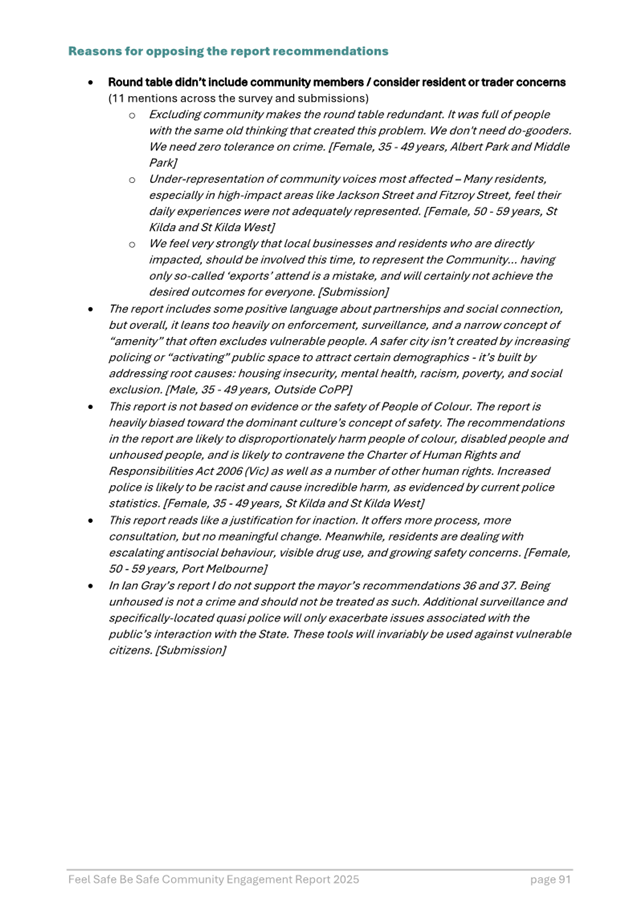
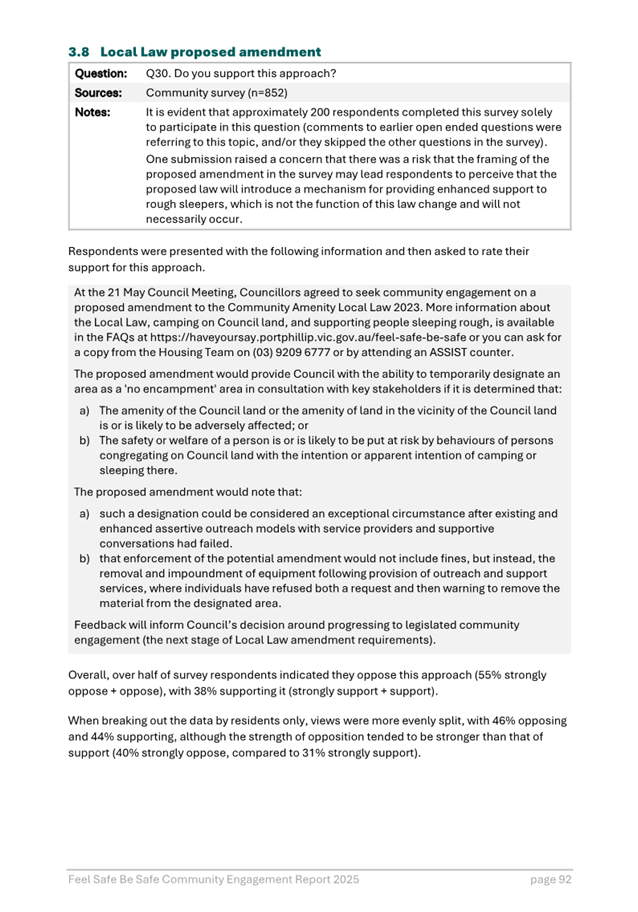
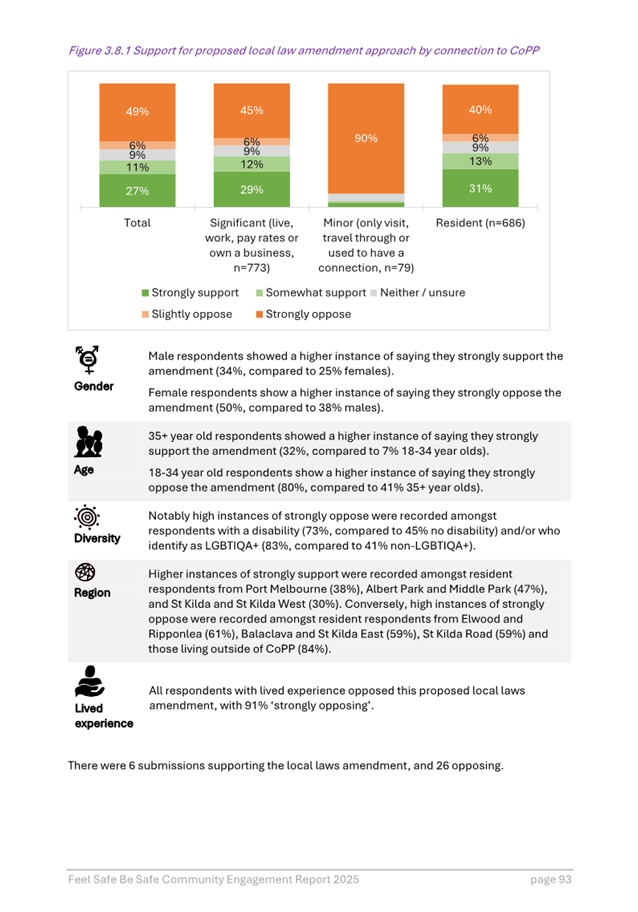
4.17 852 responses to the proposed Local Law amendment were received. 54.3% oppose (48.7% strongly oppose), 37.3% support (26.7% strongly support)
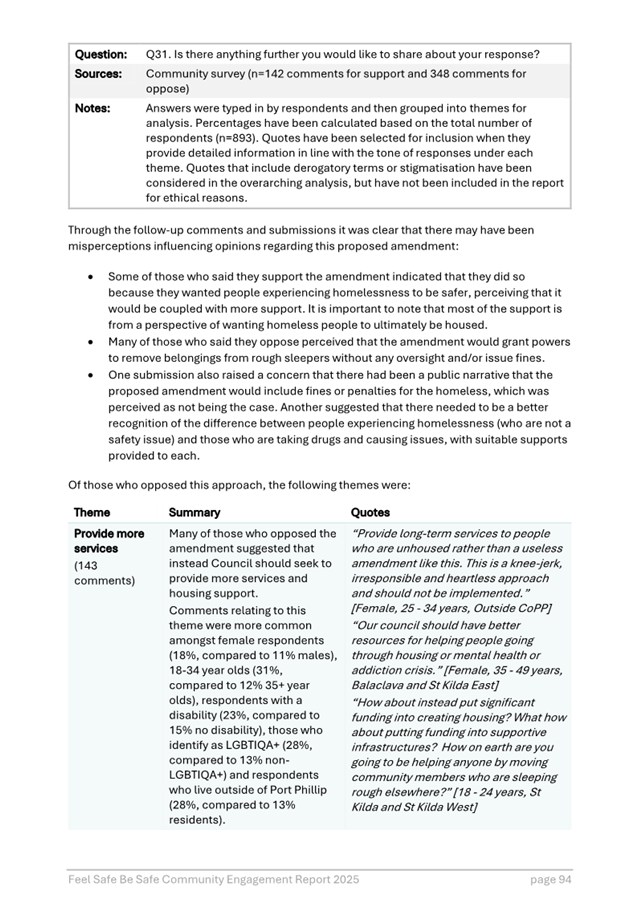
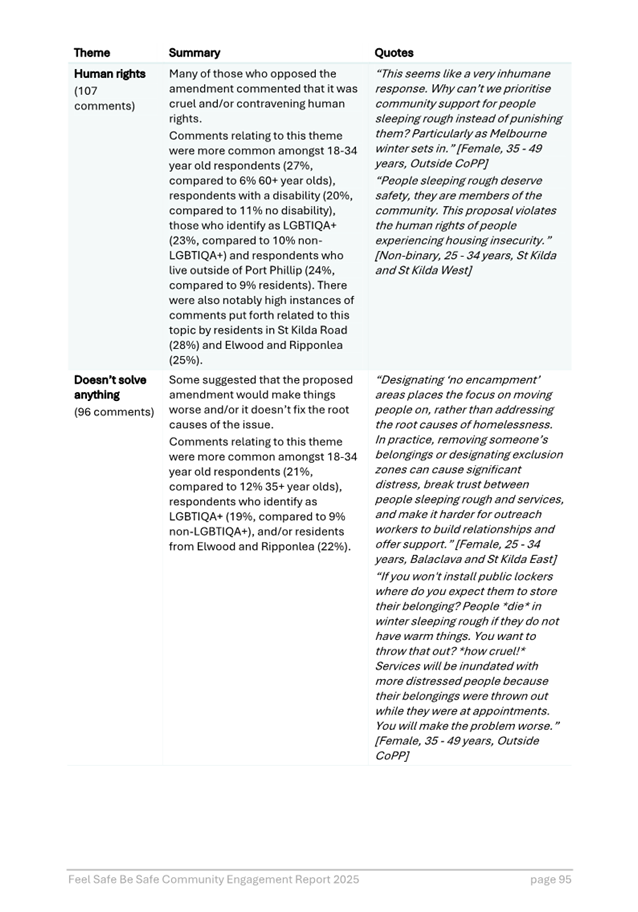
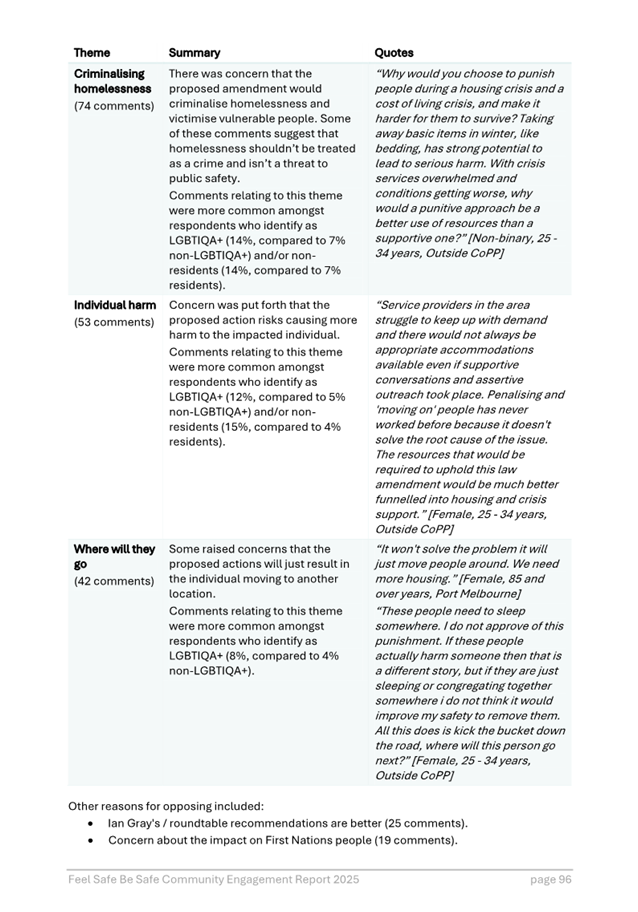
· Opposition themes include human rights concerns, criminalising homelessness, and harm to vulnerable people.
· Support themes include improved safety and consistency with other councils.
Written submissions
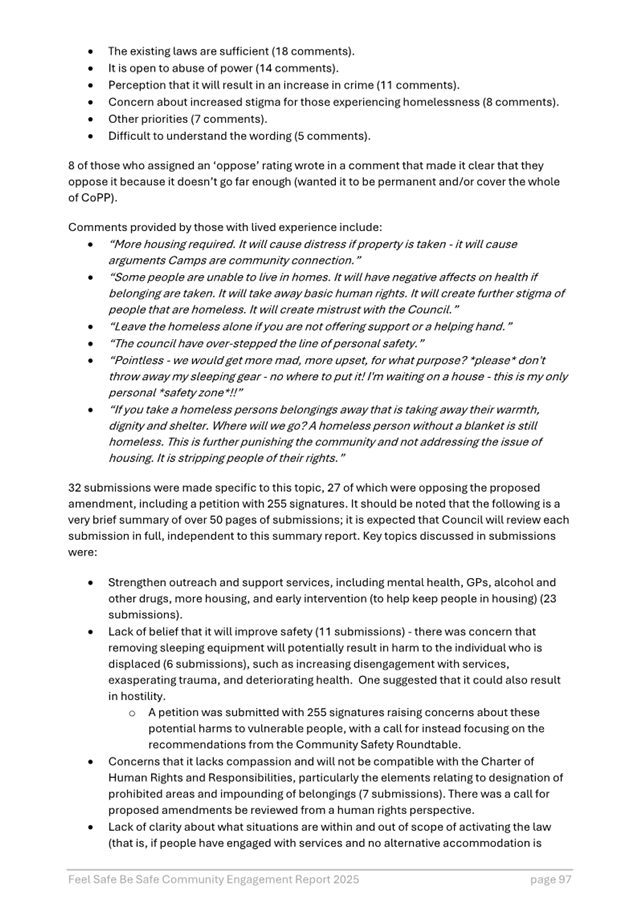
4.18 As part of the engagement process, 11 written submissions were received:
· 8 opposed the proposed Local Law amendment
· 2 supported the proposed Local Law amendment
· 1 suggested the amendment does not go far enough
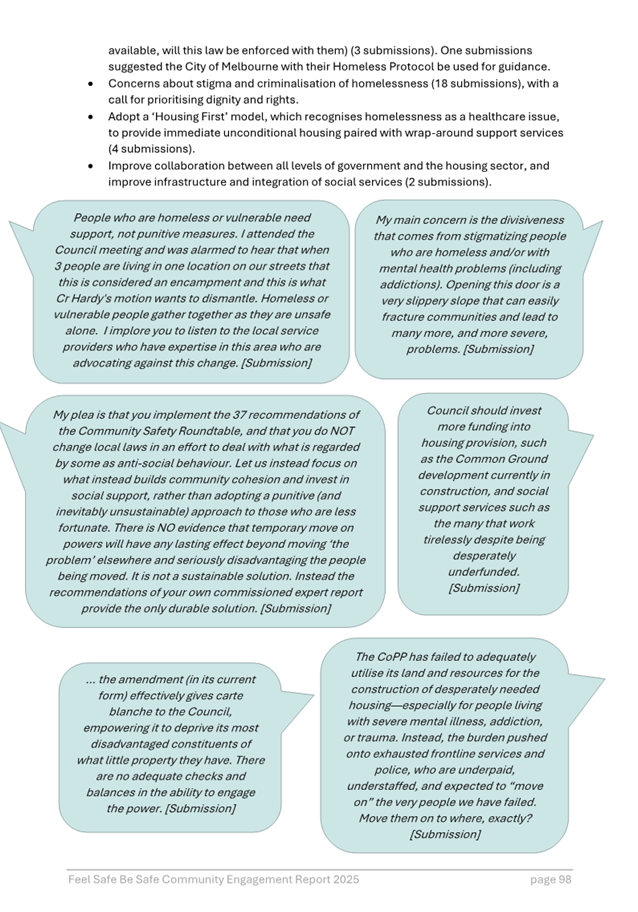
4.19 One submission included a petition with 255 signatures, raising concerns about potential harm to vulnerable people and urging a focus on recommendations from the Community Safety Roundtable.
Workshops
4.20 At five community safety workshops in May and June, 43 participants provided feedback—some supporting the proposal, others expressing concern. Some were disappointed that the Local Law amendment was included in general safety discussions rather than having its own dedicated session, fearing it could skew the broader conversation. Participants wanted more information to understand the amendment and its potential benefits or drawbacks.
Current regulatory framework
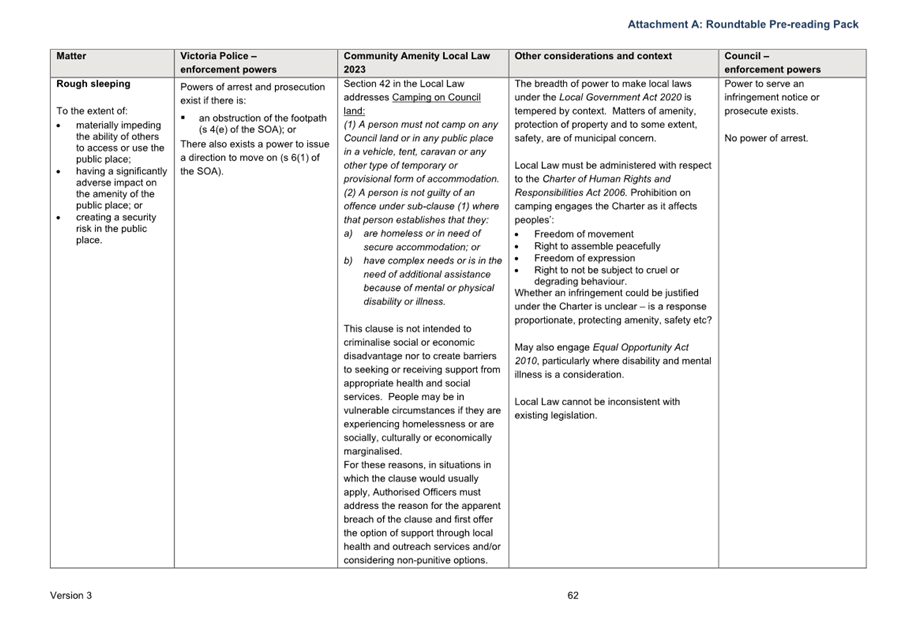
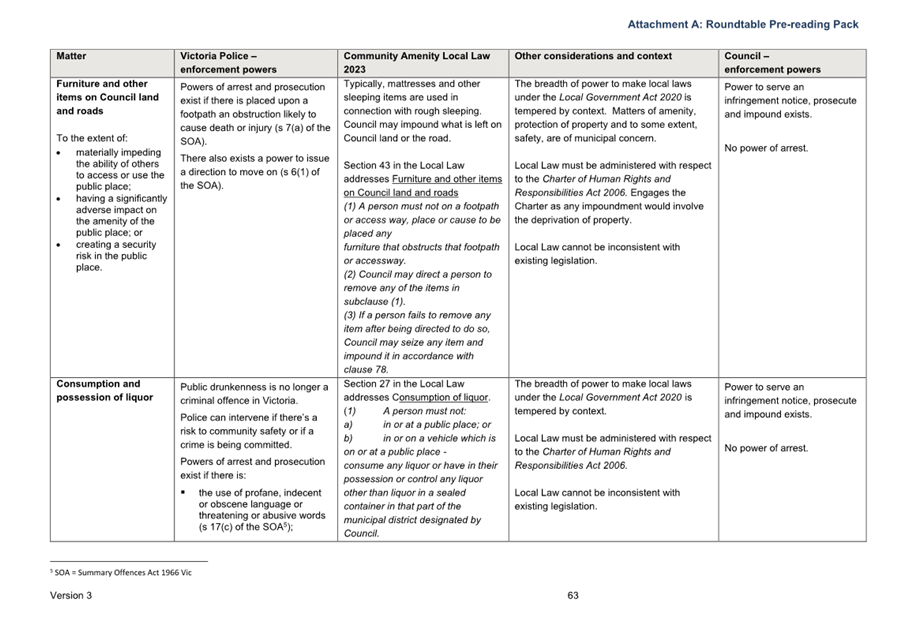
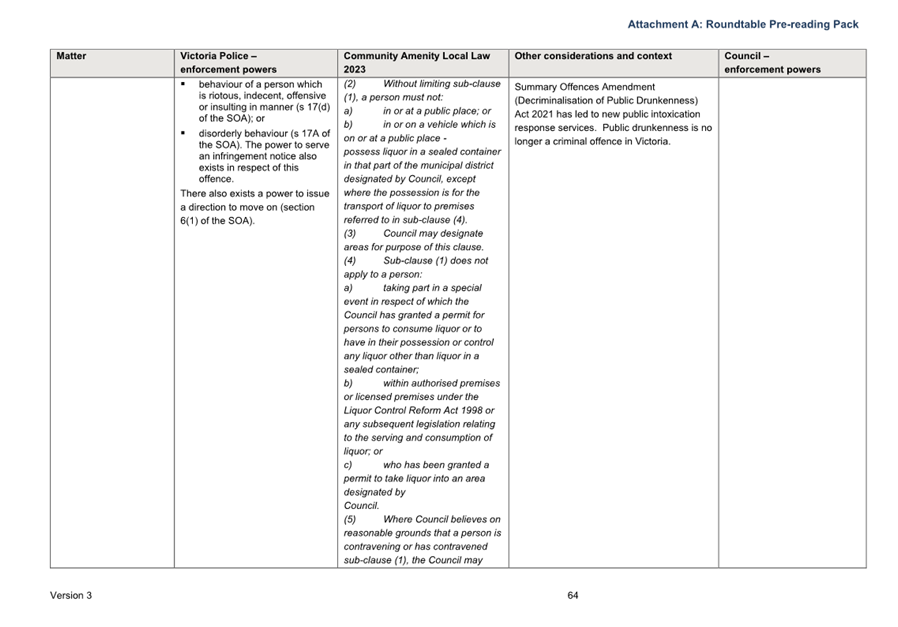
4.21 Several existing clauses in the Community Amenity Local Law 2023 are relevant to the consideration of development of the proposed Local Law amendments including:
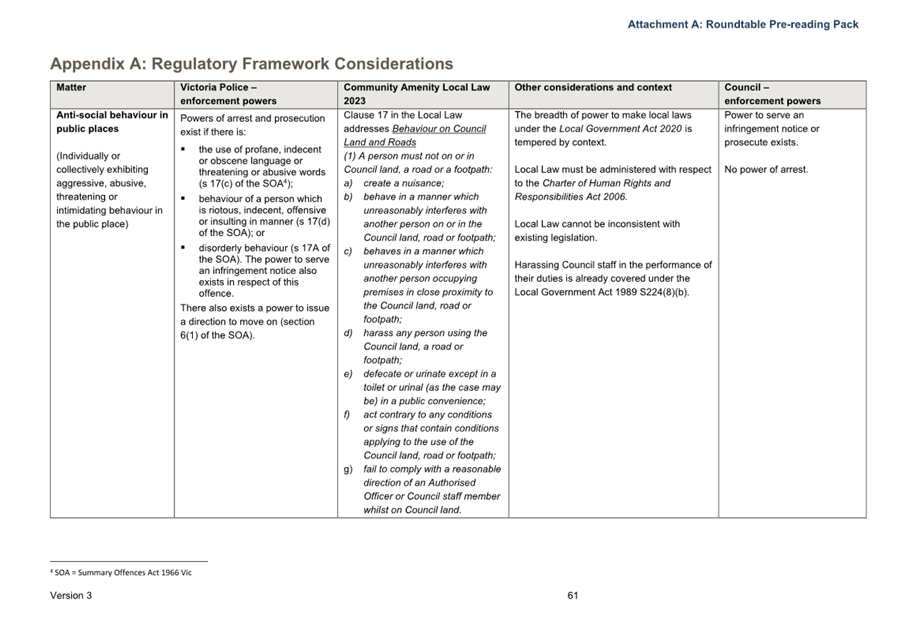
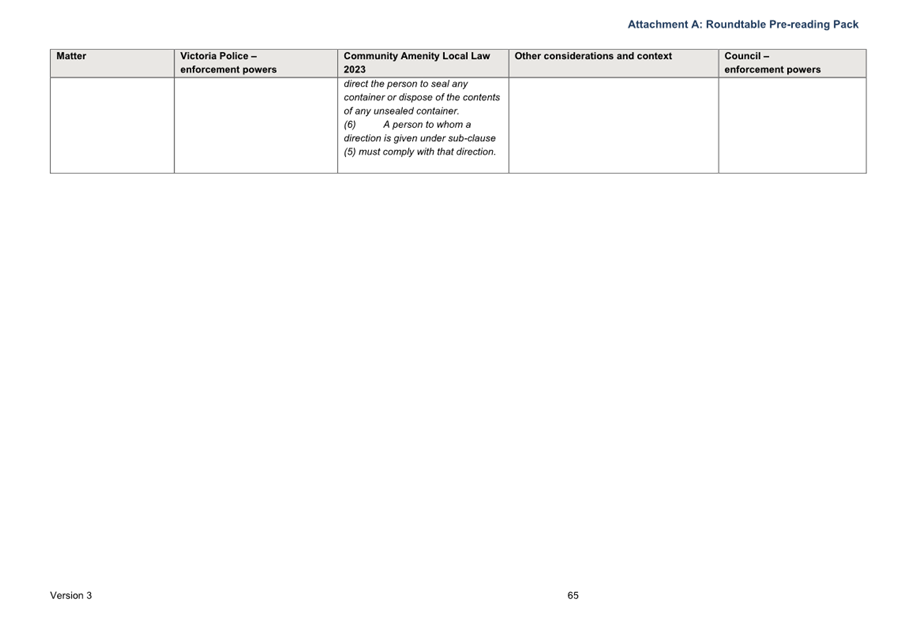
· Clause 17 - Behaviour on Council Land and Roads - a person must not create a nuisance, interfere with others, harass or fail to comply with directions from an Authorised officer.
· Clause 42 - Camping on Council Land - a person must not camp. However, people are exempt if they are homeless or have complex needs or need additional assistance because of mental or physical disability or illness.
· Clause 43 - Furniture and Other Items on Council Land and Roads - a person must not obstruct footpaths or accessway; if items are not removed when asked, items can be seized. Furniture includes bed frames, bed mattresses, chairs, tables, crates, kitchen appliances, and the like.
· Clause 78 - Where a person owning or responsible for items, goods or equipment has ignored a request from an authorised officer to remove them, the items can be removed or impounded.
4.38 In addition, the Procedures and Protocol Manual provides the following in relation to the enforcement of a Local Law;
When conducting any investigations under the Local Law, authorised officers will have regard to their obligations under the Charter for Human Rights and Responsibilities.
The City of Port Phillip recognises that there are many people within the community that are homeless or may have complex needs, such as mental illness, addiction or domestic violence.
Authorised officers will continue to perform their duties with consideration and compassion and provide referrals to other work areas in Council to assist in these circumstances.
4.39 Amendments to Council’s Local Law cannot cover areas already covered by State Legislation. This section of the report summarises the relevant State Legislation.
4.40 VicPol, under the Summary Offences Act (1966), have powers to 'move on' individuals breaching or likely to breach the peace, endanger safety, or damage property. Police have authority, training, and equipment to move people and respond to criminal behaviour. Consequently, Council cannot make a Local Law to “move on” individuals.
4.41 Any new Local Law must also comply with the Charter of Human Rights and Responsibilities Act 2006. Rights protected in the charter include freedom of movement, privacy, peaceful assembly, and property rights.
Local Law Amendment Options A and Option B
4.42 Two options to amend Council’s Local Law are considered in this report. (Options A and B). In addition, Councillors may choose to not amend Council’s Local Laws (Option C).
Local Law Amendment Option A
4.44 In response, Option A has been developed, applying where there is an encampment of 3 or more persons. Option A allows the CEO to temporarily designate “no encampment” areas where camping is prohibited.
4.45 The designation can be made if the CEO is satisfied that the amenity of people on and around the area is adversely impacted, or the safety or welfare of a person is likely to be put at risk by an encampment of three or more persons. Any designation must be published on the Council website and posted on the land where the encampment is taking place.
4.46 Prior to the designation of a “no encampment” area, an assurance from Police must be sought to enforce the provisions if the designation is made.
4.47 If the encampment continues after the designation of a “no encampment” area, authorised officers can direct a person to remove encampment equipment and, if the person fails to do so, authorised officers can impound the encampment equipment.
4.48 Police have been consulted about their ability to have Police resources available to support Council officers in enforcing a “no encampment” clause and this is captured in the Operational Protocol as Appendix 1. (Attachment 1).
4.49 Council has obtained legal advice as to the form and the content of the Local Law change for the purposes of commencing the statutory process to commence the Local Law Amendment. The formal wording for the proposed Local Law Amendment for Option A is Attachment 2.
4.50 In reviewing this option Council officers have considered the community and stakeholder feedback (including Police and Community Service providers), the ability to implement Option A, the impact of implementation and the legal review (including the Human Rights Charter). This review is summarised in Table 1.
|
Measure |
Detail |
Comment |
|
Community Feedback |
Over half of 852 survey respondents oppose the proposed Local Law amendment (54.3% strongly oppose + oppose), with 37.3% supporting it (strongly support + support). Of 11 written submissions, 8 did not support the proposed amendments, 2 submissions were in favour and 1 stated that the proposed amendment did not go far enough. If Council proceeds with this option, there will be further community engagement as part of the statutory engagement process. |
Findings show that while the majority do not support the proposed Local Law, a significant portion of the community do support the proposed amendment. |
|
Service Provider Feedback |
The Roundtable Report outlines that no service provider submissions supported Local Law amendments. Instead, they supported services, outreach and prevention. Action 6 of the Report was to ‘confirm adequacy of current by laws, emphasising the need for effective implementation and coordination rather than legislative change.’ Joint letter received from 32 service providers opposing amendments to the Local Law due to inconsistencies with Council’s obligations under the Charter of Human Rights, lack of support for effectively criminalising rough sleeping and that the amendment would be unproductive and waste community resources. |
Service provider support for services, outreach and prevention rather than amendment to the Local Laws |
|
Police Feedback |
Police submission to the Roundtable outlined support for amendments with a caveat that a tiered approach be undertaken including intervention, assessment and enforcement. |
Police support amendment |
|
Ability to implement and impact |
Prior to the designation of a “no encampment” area, Local Law officers must use their best endeavours to address the behaviours that are adversely impacting amenity or safety with support through local health and outreach services. This designation would occur after a tiered and collaborative approach to dismantling encampments was unsuccessful. The tiered approach is outlined in the protocol (Attachment 1) Enforcement would not include fines. Instead, the focus would be on the removal and impoundment of encampment equipment. The items would be stored and subsequently returned upon request. Smaller personal items such as bags and paperwork will not be removed, unless they are abandoned. The threat of removing encampment equipment may act as a deterrent. The removal will only occur after the individuals have been asked to remove the material from the designated area and then warned that their equipment will be removed. A designation will be posed where the encampment is taking place to advise those in the encampment that they must move encampment equipment. In extreme cases, where encampment equipment is not removed, the removal of encampment equipment by Local Laws officers may require Police support. This support is set out in the Operational Protocol with Police (Attachment 1) and requires that the CEO ask VicPol for support prior to triggering the “no encampment” Local Law. There may be an adverse reputational impact for Council if Police are required to restrain individuals in an encampment so that Local Laws officers can remove encampment equipment. It is not certain that Police will have the resources to help dismantle encampments. The clause may have limited impact if individuals remain after the removal of encampment equipment. (Noting that the Local Law amendment will not prevent individuals from being part of the encampment.) The proposed Local Law applies to encampments of more than 3 individuals camping in a designated area. It does not apply to other areas in the municipality. The proposed Local Law is limited to encampments on Council land near residential or commercial areas. It does not apply to other areas in the municipality. The proposed Local Law is limited to areas specified and, potentially, for the period specified by the CEO. The proposed Local Law does not apply after the designation ends. |
Designation would depend on if Police have the resources to implement.
Designation would temporarily remove the current exemption to camping in the Local Law
Removal of the current camping exemptions would allow items to be removed. |
|
Legal review Human Rights Charter |
A legal review of the proposed Local Law amendment has found the amendment is legally able to be added to the Local Law following required community engagement and gazetting. From a legal perspective, while there is a basic level of confidence about the compliance of provision with the Charter the issue is not completely beyond doubt. In implementing the “no encampment clause” officers will need to comply with all State Legislation and the Human Rights Charter. |
Legal review on the proposed amendment has been undertaken |
Table 1. Review of Option A
Protocol with VicPol
4.51 The Roundtable Report (Attachment 4) tabled at the 21 May 2025 Council meeting recommended the development of an Operation Protocol (Attachment 1). Officers have worked with Police on an Operating Protocol that was signed by Police on 21 November 2025. This report recommends that Council endorse the Protocol to strengthen collaboration between City of Port Phillip and VicPol.
4.52 The Protocol documents (and builds on) existing practices of CoPP, service providers and Police to work together to deliver coordinated responses connecting individuals to housing, mental health, and drug and alcohol and other support. The Protocol adopts a trauma-informed, culturally safe, and human rights-based approach, balancing the rights of individuals in public spaces with community safety.
Joint Patrols
4.53 The Protocol provides that Local Law Officers will work with VicPol to jointly patrol key high streets. These joint patrols depend on the availability of Police resources, and competing Police priorities may limit attendance.
4.54 The Joint patrols provide opportunities to share street-level information and allow traders and residents to raise concerns with Police and Local Laws Officers. They also help deter, detect, and resolve crime and improve perceptions of safety.
Weekly Operational Meetings with Service Providers
4.55 The Protocol provides that Council officers and VicPol will attend weekly meetings with service providers to coordinate the delivery of support to address community, rough sleepers and encampment issues.
Encampments
4.56 Under the Protocol, when an encampment is identified, Council and VicPol will convene a meeting of service providers to create a strategy to disperse the individuals in the encampment by connecting the individuals to housing and other supports and requesting that those in the encampment leave the encampment.
4.57 Meetings will continue as needed to review progress and adjust the strategy until the encampment is resolved.
The protocol Appendix 1 dealing with Encampment
4.58 The Appendix 1 of the protocol will only apply if Council amends the Local Law to include a “no encampment clause” (Option A).
4.59 It provides that the Council CEO will consult with Victoria Police before making a “no encampment” designation to seek assurance that the necessary resources are available to implement the “no encampment” clause.
4.60 Under the Protocol, Victoria Police agree that, if available, they will support the safe removal of “encampment equipment” by attending the encampment and ensuring that Council officers are not prevented from exercising the powers to remove “encampment equipment”.
Local Law Amendment Option B
4.61 Working with Councillors, officers have developed another Local Law Amendment Option (Option B). Option B provides that, where person or persons are camping with encamping equipment and behaving in a manner that has adverse amenity impacts or may risk safety or wellbeing, an authorised officer can direct the person to remove the encampment equipment from council land. If the person does not comply with the direction, the council officer can remove and impound the encampment equipment.
4.62 Prior to authorised officers directing items to be removed, authorised officers must use their best endeavours to address the behaviours that are adversely impacting amenity or safety with support through local health and outreach services. The formal wording for the proposed Local Law Amendment is contained in Attachment 3.
4.63 In reviewing this option Council officers have considered stakeholder views (Police and Community Service providers), the ability to implement Option B and the impact of implementation and the legal review (including the Human Rights Charter). This review is summarised in Table 2.
|
Measure |
Detail |
Comment |
|
Community Views |
While Option A has been subject to detailed community engagement, there has been no community consideration of Option B. However, if Council proceeds with this option, there will be community engagement as part of the statutory process. |
Engagement will occur if Council approves commencement of the statutory process to change a Local Law. |
|
Service Provider Feedback |
Service providers have advised that they do not support Option B. Instead, they support improved services, outreach and prevention rather than changes to the Local Law. |
Service providers support services support outreach and not Option B. |
|
Police Feedback |
Police have advised Council that they do support Option B. |
Police support Option B |
|
Ability to implement and impact |
Option A has a more restricted operation compared to Option B. Specifically, · Option A applies to areas designated by the CEO and allows for period of designation. Option B applies across the municipality at all times. · Enforcement of Option A will require a decision of the CEO whereas the decision to commence enforcement under Option B will be made by authorised officers. · Option A has a focus on an encampments with three or more people whereas Option B can apply to any number of persons. · Option A requires that the CEO requests Police support prior to enforcement of the Option. While Option B does not have a formal requirement to request Police support, in practice, authorised officers will not implement Option B if it is not safe to do so. · Both option A and B require authorised officers to use their best endeavours to address behaviours that are having adverse amenity impacts. Prior to the removal of encampment equipment, Option B requires that authorised officers must first use best endeavours to address the behaviours that breach the provision with support through local health and outreach services. This approach is summarised in the protocol with Police (Attachment 1). The Appendix to the protocol includes a request for Police to support officers in the removal of “encampment equipment”. The Appendix does not apply to Option B. However, if Option B is progressed, this report recommends seeking a similar commitment for Option B from Police. Enforcement would not include fines. Instead, the focus is on the removal and impoundment of encampment equipment. The items would be stored and subsequently returned upon request. Smaller personal items such as bags and paperwork will not be removed, unless they are abandoned. The threat of removing encampment material may act as a deterrent. The proposed Local Law is limited to the removal of equipment, it does not require the removal of the individual. This may inhibit the effectiveness of this clause. |
Option B has broader application compared to Option A.
This option will only enable removal of encampment equipment.
|
|
Legal review Human Rights Charter |
A legal review of the proposed Local Law amendment has found the amendment is legally able to be added to the Local Law following required community engagement and gazetting. From a legal perspective, while there is a basic level of confidence about the compliance of provision with the Charter the issue is not completely beyond doubt. In implementing the “no encampment clause” officers will need to comply with all State Legislation and the Human Rights Charter. |
Legal review on the proposed amendment has been undertaken |
Table 2. Review of Option B
Option C to not proceed with Local Law changes
4.64 Option C is to not proceed with any Local Law changes.
4.65 While there are mixed views, the outcome of Council’s engagement process is that the majority of the community do not support the Local Law amendment Option A. There has been no engagement on Option B.
4.66 While Options A and B are to be applied as a last resort after supports through local health and outreach services have failed, there is a risk that council will be criticised because the removal of encampment equipment does not address the underlying causes of rough sleeping.
4.67 While Options A and B will require the provision of notice or direction that encampment equipment must be removed. However, if the equipment is not removed, the implementation of Options A and B may require Police to restrain people so that Council officers can safely remove encampment equipment.
4.68 Council’s new Community Safety Plan (pending approval in December 2025) was developed through extensive engagement, will expand services, programs, and partnerships. This enhanced service delivery may provide early intervention that will avoid or disperse encampments without the need for a Local Law change. Not proceeding with a Local Law change at this time would allow the enhanced service delivery model to be implemented and for Council to subsequently review the impact of those additional services, programs and partnerships on encampments.
Process for Addition of Proposed Local Law
4.69 Pursuant to the Local Government Act 2020, to change a Local Law, Council must,
· Publish a notice outlining objectives, draft law, and engagement process.
· Undertake a minimum of 4 weeks community engagement.
· Obtain a legal certificate confirming compliance with the Charter of Human Rights and other legislation.
· Table the certificate and proposed law at a Council meeting.
· Publish the final law in the Government Gazette and on the Council website.
· Restart the process if substantial wording changes occur after consultation.
5. CONSULTATION AND STAKEHOLDERS
5.1 Engagement on the proposed Local Law amendment Option A was integrated into the Community Safety Plan consultation, running from 22 May to 29 June 2025.
5.2 Questions about the amendments were included in the online Have Your Say survey and in-person sessions through Council’s Neighbourhood Engagement Program. Hard copy surveys were also available at Customer Service Centres and Libraries. The outcome of the engagement has been detailed elsewhere in this report.
5.3 Separate to the engagement period on the proposed Local Law Amendment Option A two petitions were received regarding Local Laws.
Petition One
On 13 May 2025, Council received a petition with 1,194 signatures Petition No fines for homelessness - City of Port Phillip - Australia · Change.org which was tabled at the 21 May Meeting and stated the below:
FINES WON’T END HOMELESSNESS. SECURE HOUSING AND SOCIAL SUPPORTS WILL.
Homelessness is not a crime - but new local laws being considered by Port Phillip Council would change that. These laws would authorise Council officers to fine people for sitting, sleeping or lying on any public land.
We, the people who live and/or work in the city of Port Phillip, oppose this for these reasons:
1. Issuing fines would be an inefficient use of council staff and money;
2. The laws would target people experiencing homelessness;
3. The laws have been put forward as a way to promote community safety – issuing fines to people experiencing homelessness will not make our community safer;
4. Issuing fines to people experiencing homelessness will not address their unmet health, housing and support needs – it will add to them;
5. Issuing fines would be an act of pointless cruelty against our most vulnerable community members.
Our Council has a proud history of responding in practical and compassionate ways to people who are experiencing homelessness, especially those sleeping rough. They need secure housing and compassionate social supports, not fines and punishment. People experiencing homelessness are themselves at very high risk of being the victims of crime.
We say NO to fines for rough sleeping. We say YES to more social housing, more permanent supported housing and expanded community support services.
Please sign below and share this petition with your neighbours, colleagues and friends to let Port Phillip Council know we stand against the criminalisation of homelessness.
Some further context for those interested:
On 19 February 2025, Port Phillip Council unanimously passed a motion to investigate the process for introducing a draft local law amendment. This was presented as addressing community concerns about safety in our city. If the draft local law amendment were adopted, it would:
o Give local laws officers the power to fine people for: “sitting, sleeping or laying on” any public land in Port Phillip;
o Remove existing protection from being fined for people who are homeless and have complex needs including disability and mental illness;
o Allow local laws officers to confiscate any property and fine people for placing any item that “enables a living arrangement or sleep”.
It is common sense that people experiencing homelessness are not going to be able to pay fines, and that being fined will do nothing to address the underlying issues leading to people sleeping rough in Port Phillip and would only make their lives harder.
Our Council has a strong track record of fostering collaboration between different community support services and levels of government to work towards ending homelessness in Port Phillip. Port Phillip Zero is an important initiative that has had great success in getting people sleeping rough into secure and supportive housing and reducing homelessness in Port Phillip.
Petition Two
On 1 December 2025 Council received a petition with 2357 signatures (555 on paper and 1802 online) Petition · Sign the petition for SAFER STREETS in Port Phillip - Australia · Change.org which outlined the below
PETITION FOR SAFE STREETS - END THE CAMPING LAW EXEMPTION IN PORT PHILLIP
It's About Safety — Not Punishment.
Enough Is Enough. Support Councillor Rod Hardy’s Motion. Demand Action Now.
Port Phillip is one of only two councils in Victoria still clinging to a failed exemption in local camping laws — and we are paying the price. Businesses are suffering. Public safety is deteriorating. Vulnerable residents are at risk.
This Isn’t Compassion — It’s Chaos.
Every single day, residents and business owners in the City of Port Phillip face:
o Open drug use in broad daylight
o Verbal abuse and intimidation
o Street-level drug dealing
o Discarded needles and furniture littering our parks and footpaths
o Public spaces overtaken by dangerous, illegal encampments
This is not about punishing the homeless — it's about protecting everyone, including the most vulnerable.
This Law Change Will Help:
o Dismantle dangerous drug camps
o Stop open drug use and dealing
o Connect people to housing, rehab, and mental health services
o Clean up and reclaim public spaces
o Empower police to act — safely and compassionately
Many individuals occupying these encampments are not homeless — they come here to use and sell drugs, placing legitimate homeless and mentally unwell individuals in further danger.
What We’re Calling For:
We urge the City of Port Phillip to:
1. Pass the Camping Law Amendment in line with Community Roundtable and Victoria Police recommendations
2. Cut through the false claims about “fines for the homeless” — this is about safety, not spin
3. Give police the tools they need to act lawfully and effectively
4. Stand with residents and businesses suffering the daily consequences of inaction
The Facts:
o In February, councilors unanimously backed a review of Clause 42 (‘Camping on Council Land’).
o The amendment seeks to remove outdated exemptions and clarify enforcement.
o It is backed by Victoria Police, and community representatives.
o It will help enforce the law without criminalising genuine homelessness.
6. LEGAL AND RISK IMPLICATIONS
6.1 The Local Government Act (2020) outlines the process for reviewing a Local Law, with further detail provided in the Department of Planning and Community Development’s Guidelines for Local Laws Manual. These provisions restrict what can be included in a Local Law. For example, it must not duplicate, conflict with, or be inconsistent with existing legislation or planning schemes
6.2 As required under the Act, Council must obtain a certificate from a qualified person confirming the proposed Local Law complies with legislative requirements. External legal advice will be engaged for this purpose following community engagement.
7. FINANCIAL IMPACT
7.1 Implementation of Options A or B will require further community engagement and legal advice at an estimated cost of $60,000 budget. This cost is based on previous similar Local Law amendments.
8. ENVIRONMENTAL IMPACT
8.1 Where possible, the Local Law engagement will minimise the use of paper products.
9. COMMUNITY IMPACT
9.1 Community safety is a significant concern, reflected in submissions and information received by Councillors and Council officers directly. Engagement on community safety—and any Local Law amendments—ensures all community members can provide feedback.
10. Gender Impact Assessment
10.1 Research shows that women and gender diverse people can experience safety and perceptions of safety differently. A gender impact assessment will be undertaken prior to community engagement if a Local Law amendment progresses.
11. ALIGNMENT TO COUNCIL PLAN AND COUNCIL POLICY
11.1 The Local Law supports the delivery of A safe and liveable City and An engaged and empowered community strategic directions.
12. IMPLEMENTATION STRATEGY
12.1 TIMELINE
12.1.1 If at the meeting on 10 December, Council decides to commence the statutory engagement process prescribed by the Local Government Act to change a Local Law, the following timeline could take place:
Feb – March 2026 – Statutory process commences with a minimum of four weeks of community engagement (outside school holidays) with notice.
March – May 2026 – Analysis of community engagement, obtaining of a legal certificate and preparation of Council papers.
June – July 2026 – Council briefing and then public meeting with findings, legal certificate and meeting to decide whether to endorse amendment to Local Law.
August 2026 - Published Local Law gazetted and comes into effect if endorsed.
12.2 COMMUNICATION
12.2.1 Community safety remains a key concern, with feedback already received from the community. Further engagement on community safety—and any Local Law amendments—will ensure all community members can provide input.
13. OFFICER MATERIAL OR GENERAL INTEREST
13.1 No officers involved in the preparation of this report has declared a material or general interest in the matter.
|
ATTACHMENTS |
1. Signed Operational Protocol with Police November
2025 2. Option A Proposed Local Law Amendment - December
2025 3. Option B Proposed Local Law Amendment - December
2025 4. CoPP Community Safety Roundtable Final Report May
2025 |
Meeting of the Port Phillip City Council
10 December 2025
|
Changes to Planning Delegations (10 December 2025 until the first sitting of the Ordinary Council meeting in 2026) |
|
|
Executive Member: |
Brian Tee, General Manager, City Development |
|
PREPARED BY: |
Scott Parkinson, acting Manager Building and Planning Services |
1. PURPOSE
1.1 To delegate to the Chief Executive Officer (including the power to on delegate), the power to enable specific planning activities to be undertaken between the last Ordinary Council meeting being 10 December 2025 and the first Council meeting in February 2026.
2. EXECUTIVE Summary
2.1 The final Ordinary Council meeting for 2025 is being held on Wednesday, 10 December 2025 with a gap before the first Ordinary Council meeting in February 2026.
2.2 Certain planning processes require decisions by Council that cannot be deferred. These include negotiating settlements or responding to appeals where a permit applicant has lodged an application for review with the Victorian Civil and Administrative Tribunal (VCAT). Delegation to the CEO will enable these planning matters at VCAT to be resolved prior to the first sitting of the new Ordinary Council meeting in February 2026.
|
That Council: 3.1 Delegates to the Chief Executive Officer (including the power to on delegate), effective for the period 10 December 2025 until the first sitting of the new Ordinary Council meeting in February 2026, the power to: 3.11 To instruct Council’s Statutory Planners and/or Council’s advocates in relation to any application lodged with VCAT under Part 4, Division 2 or 3 of the Planning and Environment Act 1987. 3.12 All determinations made during the period 10 December 2025 through the exercise of these delegations until the first sitting of the new Planning Committee will be reported to an Ordinary Council Meeting or Planning Committee before the end of March 2026. |
4. KEY POINTS/ISSUES
4.1 Planning matters are considered by Council’s Planning Committee or an Ordinary Council meeting where:
· 16 or more objections are received, and the application has not been refused under delegation.
· In the opinion of Council officers, the application raises any strategic or substantive policy issue that should be debated at Council including a substantive noncompliance with the Port Phillip Planning Scheme, adopted Council policy, or is in the public interest.
· A Councillor requests the application be determined by the Council or Planning Committee Meeting, other than an application defined as a Vic Smart application.
· It relates to land which is owned by a Councillor member, member of the Council Leadership Network, or member of the City Development Department.
4.2 The final Ordinary meeting for 2025 is on Wednesday, 10 December 2025. It is anticipated that the next Ordinary Council meeting will be in February 2026.
4.3 During this period, Council may be required to negotiate a settlement or respond to an appeal where a permit applicant has lodged an application for review with VCAT.
4.4 Delegation to the CEO will enable specific planning matters related to VCAT, detailed in this report to be determined prior to first sitting of the new Ordinary Council meeting in February 2026.
4.5 To protect Council’s interests a delegation is requested to the Chief Executive Officer (including the power to on delegate), to instruct Council’s Statutory Planners and / or Council’s advocates to act on Council’s behalf at VCAT. The recommended delegation is consistent with what has been provided previously, over the December/January period and through previous election periods.
5. CONSULTATION AND STAKEHOLDERS
5.1 Not applicable
6. LEGAL AND RISK IMPLICATIONS
6.1 Without delegation for VCAT matters, Council risks losing its ability to influence decisions and properly represent its position, exposing itself to legal and reputational consequences.
7. FINANCIAL IMPACT
7.1 These matters are provided for in Council’s current budget.
8. ENVIRONMENTAL IMPACT
8.1 These matters will be considered as part of the decision making for individual items.
9. COMMUNITY IMPACT
9.1 Council’s input in applications ensures appropriate conditions around affordable housing, housing diversity and community infrastructure are included on any approval.
9.2 If the recommendation is not supported, Council’s reputational risk may increase.
10. Gender Impact Assessment
10.1 Not applicable
11. ALIGNMENT TO COUNCIL PLAN AND COUNCIL POLICY
11.1 The proposed delegations to the Chief Executive Officer (including the power to on delegate), specifically supports the strategic direction ‘A safe and Liveable City’ in the Plan for Port Phillip 2025-35 by ensuring Council’s interests are adequately represented and protected during the period where there are no formal Council meetings or Planning Committee meetings scheduled.
12. IMPLEMENTATION STRATEGY
12.1 TIMELINE
12.1.1 The proposed delegations to the Chief Executive Officer (including the power to on delegate), will only be effective for the period 10 December 2025 until the first sitting of the Ordinary Council Meeting in February 2026.
12.1.2 All determinations made during the period 11 December 2025 until the first sitting of the Ordinary Council Meeting in 2026, will be reported to an Ordinary Council Meeting or Planning Committee before the end of March 2026.
13. OFFICER material OR general INTEREST
13.1 No officers involved in the preparation of this report has declared a material or general interest in the matter.
|
ATTACHMENTS |
Meeting of the Port Phillip City Council
10 December 2025
11. A Vibrant and Thriving Community
11.1 South Melbourne Special Rate and Charge – 2026-2031 Intention To Declare 493
11.2 Port Melbourne Special Rate and Charge – 2026-2031 Intention To Declare 532
11.3 Port Melbourne Netball Infrastructure Project................................................ 568
11.4 St Kilda Esplanade Market Annual Report 2024-25, Recommendations for the Reference Group Members & Updates to Terms of Reference....................................... 585
Meeting of the Port Phillip City Council
10 December 2025
|
South Melbourne Special Rate and Charge – 2026-2031 Intention To Declare |
|
|
Executive Member: |
Brian Tee, General Manager, City Development |
|
PREPARED BY: |
Susie Filleti, Business Engagement Coordinator Mike Fisher, Manager City Planning and Sustainability |
1. PURPOSE
1.1 To commence the statutory process to introduce the South Melbourne Special Rate and Charge, for the 1 July 2026 to 30 June 2031 period, for the purpose of marketing, tourism, promotion, business development and centre management of the South Melbourne Business Precinct.
2. EXECUTIVE Summary
2.1 The City of Port Phillip currently has four special rate and charge schemes in operation.
2.2 All Port Phillip special rate and charge schemes incorporate the collection of a levy from commercial properties within a defined geographic area for marketing, promotion, business development and centre management of the specified Activity Centre. All funds are distributed to the incorporated Business Association under a funding agreement with Council.
2.3 Special rate and charge declarations are a statutory process governed by Part 8 of the Local Government Act 1989.
2.4 On 30 September 2025, Council received a letter from Clarendon and Coventry Streets Business Association (CCSBA) requesting that Council begin the statutory process to introduce the South Melbourne Special Rate and Charge for five years, from 1 July 2026 to 30 June 2031 (Attachment 1).
2.5 In August and September 2025, CCSBA contacted all open businesses in the precinct (226 businesses) and undertook a poll to gauge support for the Special Rate. CCSBA received signed support from 129 out of the 226 properties currently occupied, open and available for comment for the Special Rate, which represented 57 percent.
2.6 The special rate and charge would levy a maximum amount of $1,518,612.36 over the five-year period which equates to up to $280,000 in the 2026–2027 financial year.
|
That Council: 3.1 Notes the letter received the Clarendon and Coventry Streets Business Association (CCSBA) requesting the implementation of the special rate and charge scheme (Scheme) for the South Melbourne Business Precinct (Precinct) (Attachment 1). 3.2 Having otherwise considered all relevant matters, commences the statutory process under the Local Government Act 1989 (Act) to implement the Scheme to and for the properties within the Precinct. The Scheme will - (a) Be used for the purposes of defraying expenses for advertising, marketing, business development and centre management, associated with the encouragement of commerce, retail and professional activity and employment in the Precinct; (b) provide collected funds to CCSBA, to be used solely for the purposes outlined above, subject to the approval, direction, and control of Council; (c) raise up to $280,000 in the 2026–2027 financial year; (e) operate for a five-year period, commencing 1 July 2026 and concluding 30 June 2031; and (f) have a total maximum funding cap of $1,518,612.36 for the five-year period of the Scheme. 3.3 In accordance with the Act, publish a Public Notice (Attachment 3) in The Age and on Council’s website, advising of Council’s intention to declare a special rate and charge. The notice will outline the objection process and provide a minimum of 28 days for any person liable for the special rate and charge to lodge an objection. 3.4 In accordance with the Act, send individual letters to all affected property owners and occupiers within the proposed South Melbourne Business Precinct boundary (Attachment 4), advising of the intention to declare the special rate and charge, the commencement of the statutory process including a copy of the Public Notice and an estimation of the special rate or special charge payable, based on FY2025-26 Net Annual Value (NAV) valuations that would be applied to the property. 3.5 Considers the proposed Scheme at two further Council Meetings in 2026: (g) Following the objection period outlined in the Public Notice, review all written objections and submissions; and (h) decide to declare the Scheme for 1 July 2026 to 30 June 2031. 3.6 Advises the CCSBA of the matters specified in this resolution. 3.7 Authorises the Chief Executive Officer or his delegate to – (i) Make any minor amendments to the Public Notice that do not change the material intent of the that Public Notice to ensure legislative compliance; (j) carry out any and all other administrative procedures necessary to enable Council to carry out its functions under section 163A and section 163(1A), (1B) and (1C) and sections 163B and 223 of the Act. |
4. KEY POINTS/ISSUES
Background
4.1 The City of Port Phillip currently has four special rate and charge schemes in operation – Fitzroy Street, Port Melbourne, Acland Street Village and Carlisle Street. The schemes incorporate the collection of a levy from commercial properties within a defined geographic area for the sole purpose of marketing, promotion, business development and centre management of the specified activity centre. All funds collected are distributed to the incorporated business association under a funding agreement with Council.
4.2 Special rate and charge scheme declarations are a statutory process governed by Part 8 of the Local Government Act 1989. Despite the enactment of the Local Government Act 2020, the special rate and charge provisions of the 1989 legislation are still in force. In declaring a special rate and charge scheme, Council must be satisfied that:
4.2.1 the proposal relates to the performance of a function authorised under Section 163 of the Act;
4.2.2 there will be a special benefit to those persons liable to pay the special rate or special charge; and
4.2.3 there is a reasonable distribution of the rate amongst those persons liable to pay the special rate or special charge.
4.3 Council’s Rates team collects the special rate and charge through the normal rating process, whilst compliance and reporting are managed by Economic Development. All funds collected are distributed to the relevant incorporated Business Association under a funding agreement with Council.
4.4 To implement a special rate and charge, Council will follow the below process:
4.4.1 Council decides to commence the statutory process and issue notices of intent to impacted rate payers;
4.4.2 Council considers objections and submissions regarding the proposed special rate and charge; and
4.4.3 Council determines whether to declare the special rate and charge.
4.5 On 30 September 2025, Council received a letter from CCSBA requesting that Council begin the statutory process to introduce the South Melbourne Special Rate and Charge Scheme (Scheme) for five years, from 1 July 2026 to 30 June 2031 (Attachment 1).
4.6 The proposed Scheme has 318 properties within the South Melbourne Business Precinct boundary (Attachment 4). The Scheme will levy a maximum amount of $1,518,612.36 over the five-year period. This equates to up to $280,000 in the 2026–2027 financial year and indexed for each subsequent year of the Scheme using CPI, with a minimum increase of two percent and a maximum increase of four percent.
4.7 In August and September 2025, CCSBA contacted all open businesses in the precinct (226 businesses) and undertook a business poll to gauge support for introducing the Scheme. CCSBA received signed support from 129 out of the 226 properties currently occupied, open and available for comment for the Scheme, which represented 57 percent.
4.8 If redevelopments occur within the proposed Scheme boundary any new eligible properties that have not previously been levied will be added to the Scheme. Any property that changes from commercial, retail, leisure, tourism or light industrial to residential use will be removed from the Scheme. Amendments to the Scheme will occur from the date the supplementary valuation takes effect.
4.9 Properties exempt from paying the special rate and charge include:
· Dedicated car parking lots;
· Automatic Teller Machines;
· advertising signs;
· telecommunication towers and power substations;
· all residential properties; and
· non rateable properties.
4.10 To distribute the special rate and charge across the commercial properties within the South Melbourne Business Precinct boundary the current three benefit areas will remain – primary, secondary and tertiary. Details of the benefit areas and Scheme boundary are specified in the Proposed Declaration of a Special Rate and Charge (Attachment 2).
4.11 Properties that are used, or reasonably capable of being used, for retail, commercial, leisure, tourism, entertainment, light industrial or professional purposes that fall into the below address ranges are included proposed Scheme boundary:
· 1 and 2 Alfred Place;
· 165 – 236 Bank Street (odd and even inclusive);
· 117 – 181 Cecil Street (odd and even inclusive);
· 2 – 10 Charles Street (even inclusive);
· 206 – 380 Clarendon Street (odd and even inclusive);
· 238 –321 Coventry Street (odd and even inclusive);
· 228 – 254 Dorcas Street (even inclusive);
· 69 Emerald Hill Place;
· 1 – 5 Francis Street (odd inclusive);
· 1 – 16 Hotham Street (odd and even inclusive);
· 1 – 5 John Street (odd inclusive);
· 1 – 4 Layfield Street (odd and even inclusive);
· 8 Palmer Street;
· 225 – 294 Park Street (odd and even inclusive);
· 4 – 23 Union Street (odd and even inclusive);
· 1 – 7 Wynward Street (odd and even inclusive); and
· In the opinion of Council receive a special benefit from the Special Rate and Charge.
4.12 The rates in the dollar applicable to each benefit area for the purposes of assessing and levying the special rate and charge will be determined having regard to the Net Annual Value (NAV) of all properties within each benefit area. This is determined at the beginning of each financial year to raise a total of up to $280,000 for 2026-2027 financial year and an indexed total for each subsequent year of the Scheme using CPI, with a minimum increase of two percent and a maximum increase of four percent.
4.13 The FY2026-2027 NAV valuations are not yet available at the time of this report. An indicative calculation below shows rates in the dollar based on the 2025-2026 NAV valuations that would have been applied to collect the special rates and charges and total up to $280,000 for 2026-2027 financial year:
· Primary benefit rate – 0.0138
· Secondary benefit rate – 0.0069
· Tertiary benefit rate – 0.0035
4.14 The actual special rates to be applied in 2026-2027, and in each subsequent year of the Special Rate Period, will be determined having regard to reassessed NAV figures prepared annually by Valuer-General Victoria.
4.15 In addition to the rate in the dollar being adjusted each financial year, maximum and minimum special charges will also apply. For the 2026-27 rating year, the following maximum and minimum special charges will apply:
· Primary benefit rate – maximum charge of $400 and a minimum charge of $6,000 per year.
· Secondary benefit rate – maximum $200 and a minimum charge of $3,000 per year.
· Tertiary benefit rate – maximum charge of $100 and a minimum charge of $1,500 per year.
4.16 The maximum and minimum special charges will be adjusted at the beginning of each financial year during the operation of the Scheme, having regard to:
· any change to the special rate in each of the benefit areas (which, as above, will determined having regard to the movement of NAV to ensure that $280,000 will be collected for the 2026–2027 financial year and indexed annually using CPI, with a maximum increase of four percent and a minimum of two percent for each subsequent year of the Special Rate scheme);
· the inclusion or removal of any properties from the Scheme; and
· any change in the number of properties that will pay a special charge (as opposed to a special rate), having regard to the changed special rates in each benefit area, as above.
4.17 An estimate based on FY2025–26 NAV valuations indicates that the median levy for individual ratepayers affected by the proposed special rate and charge is $682 per year, while the average levy is $881 per year.
4.18 Council will provide CCSBA with the collected levy every six months, on receipt of an accepted Activity Report and valid tax invoice. Prior to CCSBA issuing a valid tax invoice, Council will confirm the total levy collected for the six-month period, which will be no more than $140,000 for 2026-2027 financial year and indexed for each subsequent year of the Scheme using CPI, with a minimum increase of two percent and a maximum increase of four percent to include on the tax invoice. Should the collected levy be less than the expected levy, Council will not supplement payments to cover the balance; Council will only issue funds received.
4.19 CCSBA has developed its Business Plan for the proposed 2026 – 2031 Special Rate and Charge as well as a Budget and Action Plan for FY2026/2027 (Attachment 5). The Business Plan and Budget and Action Plan will form part of the new funding agreement with Council.
4.20 Funds raised by the Scheme will be for the sole purpose of marketing, promotion, business development and centre management of the Precinct. It is considered that the value of the properties included in the Scheme area, their desirability as a letting proposition and their general amenity could be enhanced by the activities generated from the Scheme funds.
4.21 Any submissions and objections in relation to the Scheme will be presented to Council for consideration at a Council Meeting in 2026.
4.22 Section 163B(6) of the Act states that Council cannot make a declaration of a special rate and charge if it receives objections from a majority of the rateable properties in respect of which the special rate and charge would be imposed (that being greater than 50 percent).
4.23 Council must consider all submissions and objections received in relation to the Scheme in accordance with the Act prior to making a decision regarding the declaration of the proposed Scheme.
Key Information
4.24 CCSBA was established as an incorporated association in December 2021. This Scheme will be the first to be implemented since the Association’s incorporation.
4.25 CCSBA is successfully engaged with its traders and local community. Recent initiatives and achievements include:
· Founded and delivered the South Melbourne Porsche and Coffee Festival, now in its third year, with growing participation and attendance each year.
· Successfully planned, managed, and delivered the restoration of Clarendon Street’s heritage verandahs, supported by a $250,000 Victorian Government grant secured to fund the project.
· Delivered lighting enhancements along Clarendon Street with Council support, significantly improving evening visibility and ambience. Enhancements included architectural uplighting on building facades and fairy lights installed on heritage verandahs.
· Developed the Experience South Melbourne brand, supported by a dedicated website and social media channels to promote events, activations and businesses within the precinct.
5. CONSULTATION AND STAKEHOLDERS
5.1 Council has worked closely with CCSBA throughout the pre-intention to declare stage of this proposed Scheme.
5.2 Council is bound by the statutory process and cannot promote the benefits or achievements of the Scheme to those affected by it. CCSBA is responsible for securing support for the Scheme and communicating its benefits to the property and business owners.
5.3 Council, through the Economic Development team, will communicate the statutory process to those affected property and business owners through the stages dictated by the Act.
6. LEGAL AND RISK IMPLICATIONS
6.1 The risks associated with the proposal are limited by the following:
6.1.1 If the Scheme is declared CCSBA will enter into a formal funding agreement with Council for the duration of the Scheme which outlines the specific purposes for which the funds can be spent.
6.1.2 Under the terms of the proposed funding agreement, CCSBA:
6.1.2.1 will be required to submit an Activity Report that includes financial reporting documentation every six months (profit and loss, balance sheet, general ledger, and marketing activity report). Scheme monies will not be paid to the Association until all reporting is received and approved.
6.1.2.2 must be an incorporated entity through the life of Scheme and must act in accordance with the Associations Incorporation Reform Act 2012.
6.1.2.3 will be required to adopt their five-year Business Plan to guide expenditure of the funds.
6.1.3 CCSBA will expend the monies raised by the Scheme on behalf of Council as an administrator of the funds. At all times CCSBA will be bound by the funding agreement with Council and under the direction of Council. Council retains exclusive authority to determine how the funds from the Scheme will be allocated. Section 164 of the Act enables Council to discontinue the Scheme if there is any inappropriate expenditure.
6.1.4 If Council does not wish to support the South Melbourne Special Rate and Charge, there may be an expectation from the commercial precinct that Council will fund marketing and promotion activities for the precinct.
7. FINANCIAL IMPACT
7.1 Council incurs administrative costs for the implementation of the Scheme. These have been included in the FY2025/2026 budget.
7.2 Council administers the collection of the funds for the life of the Scheme and distributes the Scheme funds to CCSBA in two half-yearly instalments after they submit an Activity Report.
8. ENVIRONMENTAL IMPACT
8.1 A financially sustainable business association allows Council to work with businesses in the Precinct on leading practice sustainable best practice programs that will reduce emissions, waste and energy usage amongst other outcomes.
8.2 Vibrant local activity centres provide residents with the opportunity to shop locally and sustainably by walking, cycling or taking public transport to access their centre rather than driving elsewhere.
9. COMMUNITY IMPACT
9.1 Vibrant activity centres are critical to the health and development of the local community. Centres provide employment, community meeting places, resources, leisure opportunities and essential services to the community.
10. ALIGNMENT TO COUNCIL PLAN AND COUNCIL POLICY
10.1 Special rate and charge schemes align with:
10.1.1 A healthy and connected community - Our Council fosters collaboration and mutual support within the community:
· Business and retail precincts play a vital role in supporting community wellbeing by offering diverse services. These precincts act as hubs of connection, where people gather, interact, and feel a sense of belonging. Through collaboration with Business Associations, Council helps ensure these precincts remain inclusive, accessible, and responsive to community needs.
10.1.2 An environmentally sustainable and resilient City - Our Council engages the community in enhancing environmental outcomes:
· Council can collaborate with Business Associations to promote and support environmentally sustainable practices across precincts.
10.1.3 A safe and liveable City - Our City values the distinct character and identity of local neighbourhoods:
· Successful business precincts underpin the liveability of a high-density city such as Port Phillip and are pivotal in creating a city of diverse and distinctive neighbourhoods and public spaces.
10.1.4 A vibrant and thriving community - Our City has a strong, resilient economy:
· Special rate funds empower the business community to actively and creatively market, promote and develop their precinct to maintain vibrancy and economic viability and to provide the community with a well-resourced business precinct that provides excellent services, gathering places and employment.
10.1.5 An engaged and empowered community - Our residents and businesses are well informed:
· Business Associations serve as a vital conduit between Council and the business community, helping to identify precinct needs and communicate priorities effectively.
10.1.6 A trusted and high-performing organisation - Port Phillip Council is financially sustainable, cost effective, and efficient:
· Special Rate funds enable cost-sharing models for marketing, events and activations of business precincts, improving financial efficiency.
11. IMPLEMENTATION STRATEGY
11.1 TIMELINE
If Council resolves to commence the statutory process:
· From 15 December, Council gives rate payers notice by the nominated postal address and the street address in the designated Scheme area regarding:
o the proposed implementation of the Scheme;
o the statutory process; and
o their estimated levy amounts.
· Public notice published in The Age on 15 December 2025 and displayed on the City of Port Phillip website.
· The Local Government Act 1989 states that proposed declaration must be available for public inspection, consideration and submissions for at least 28 days after the publication of the notice, and that any objections must be received within 28 days of the public notice. To accommodate the holiday season, it is recommended that the objection and submission period conclude at 5pm on 30 January 2026, providing additional time for feedback during this time of year.
· Council officers review and collate submissions and objections once the objection period has concluded at 5pm on 30 January 2026.
· Council considers submissions and objections at a Council Meeting in 2026.
· Council considers whether to declare (or not) the Scheme for 2026-2031 at a Council Meeting on the 15 April 2026 or nearest date closest to that date, following the confirmation of the 2026 Council Meeting schedule.
· Council gives rate payers notice by the nominated postal address and the street address in the designated Scheme area of the decision regarding the Scheme following the decision at the April 2026 Council Meeting.
· If Council resolves to declare the proposed Scheme:
o A person on whom a special rate or special charge is imposed then has 30 days from the date of issue of the Notice of the Special Rate and Charge to apply to VCAT for a review of a decision of Council to impose a special rate or special charge on that person, on limited grounds under section 185 of the Act.
o Section 185AA of the Act provides a separate right to apply to VCAT for a declaration as to the validity of Council’s decision. An application for a declaration can be made at any time.
o If an application is lodged at VCAT, Council would consider whether to:
§ proceed with the implementation of any special rate and charge scheme; and
§ provide any monies raised to CCSBA;
until the application has been heard and there is a VCAT decision on the matter.
o Council will advise the CCSBA of its decision.
o If no application is made to VCAT, Council will commence the Scheme on 1 July 2026.
o Affected rate payers will receive their levy notification to make payment via their Council rates notice in September 2026.
· If Council resolves not to declare the proposed Scheme at its Council Meeting in April 2026, Council will advise the CCSBA and all affected rate payers in writing of this decision and the proposed Scheme will not proceed.
11.2 COMMUNICATION
11.2.1 Intention to Declare process:
· Council gives rate payers notice by the nominated postal address and the street address in the designated Scheme area of the proposed Scheme, the statutory process and their estimated levy amounts from 15 December 2025.
· A Public notice is published in The Age 15 December 2025 and displayed on the City of Port Phillip website.
11.2.2 Declaration:
· Council gives rate payers notice by the nominated postal address and the street address in the designated Scheme area of the decision regarding the declaration of the proposed Scheme following the decision at the April 2026 Council Meeting.
· If Council resolves to declare the proposed Scheme at a Council Meeting in April 2026, affected rate payers will receive their levy notification to make payment via their Council rates notice in September 2026.
12. OFFICER material or general INTEREST
12.1 No officers involved in the preparation of this report have any material or general interest in the matter.
|
ATTACHMENTS |
1. Clarendon and Coventry Streets Business Association
Letter 2. South Melbourne Special Rate and Charge Proposed
Declaration 3. South Melbourne Special Rate and Charge Public
Notice 4. Proposed South Melbourne Business Precinct Boundary 5. Clarendon and Coventry Streets Business Association
Five-Year Business Plan and FY26-27 Budget and Action Plan |
|
Clarendon and Coventry Streets Business Association Five-Year Business Plan and FY26-27 Budget and Action Plan |
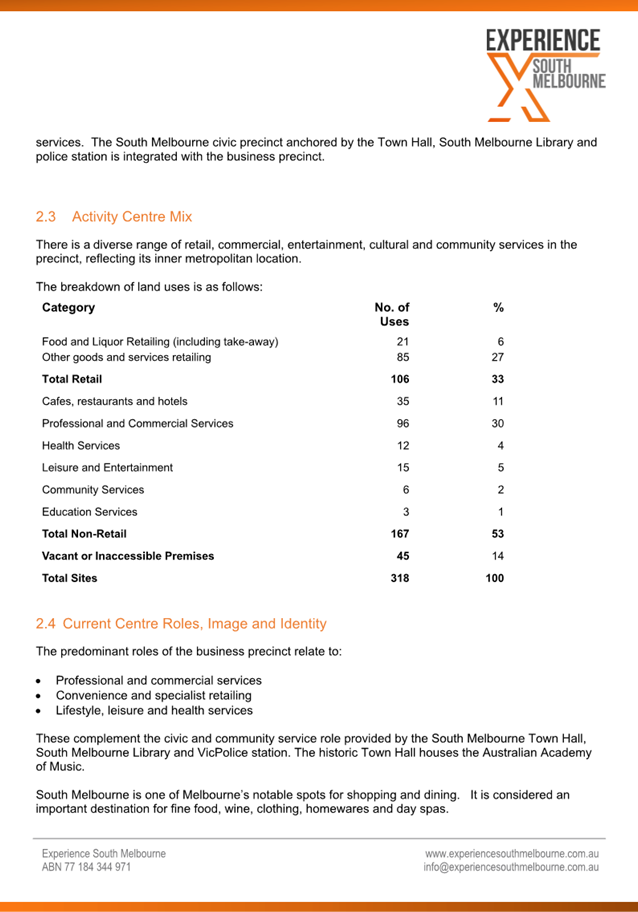
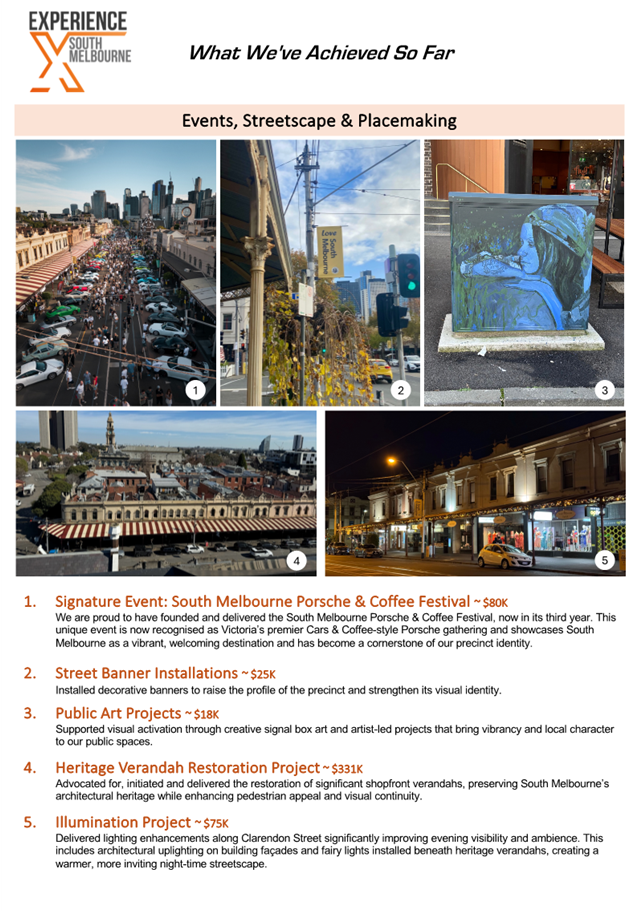
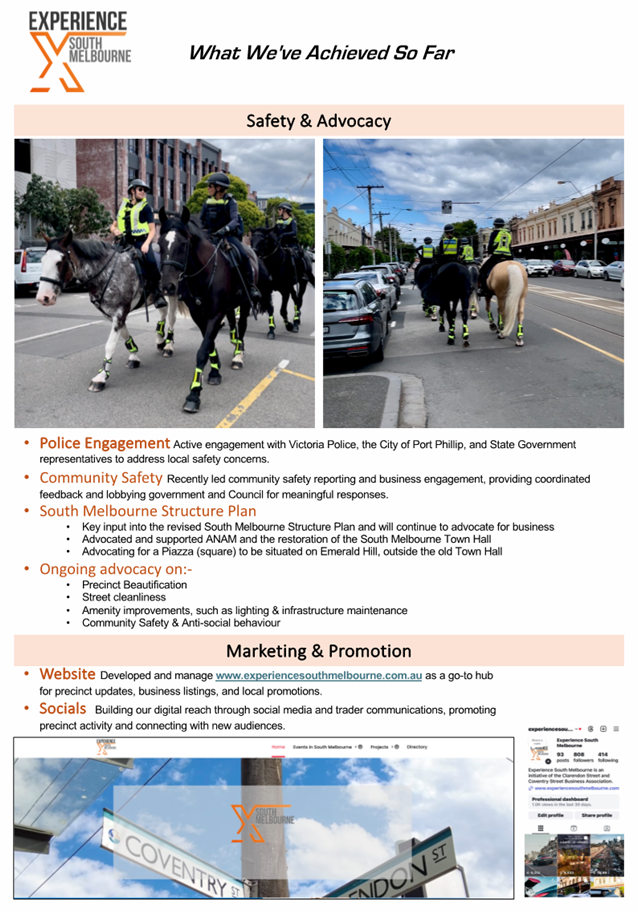
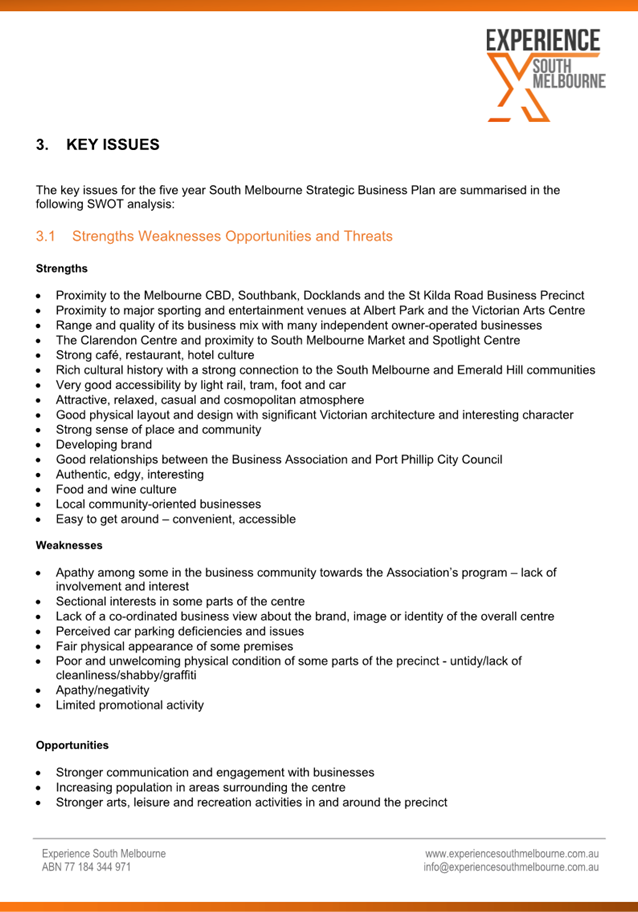
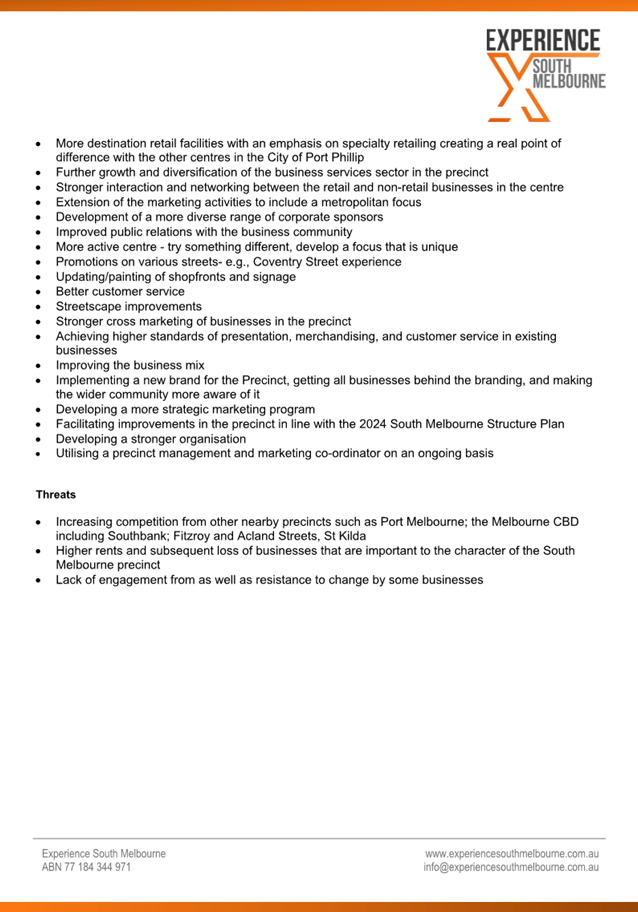
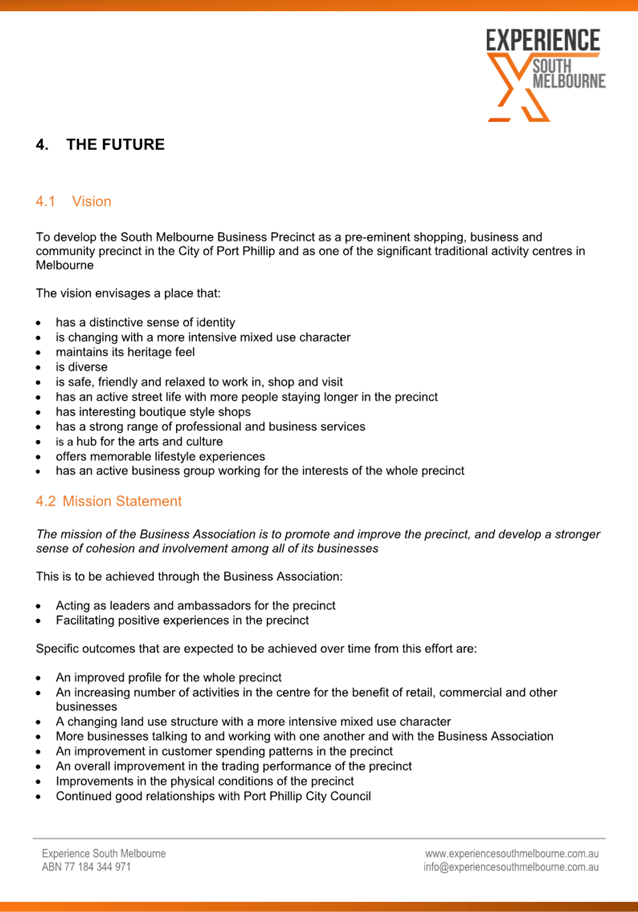


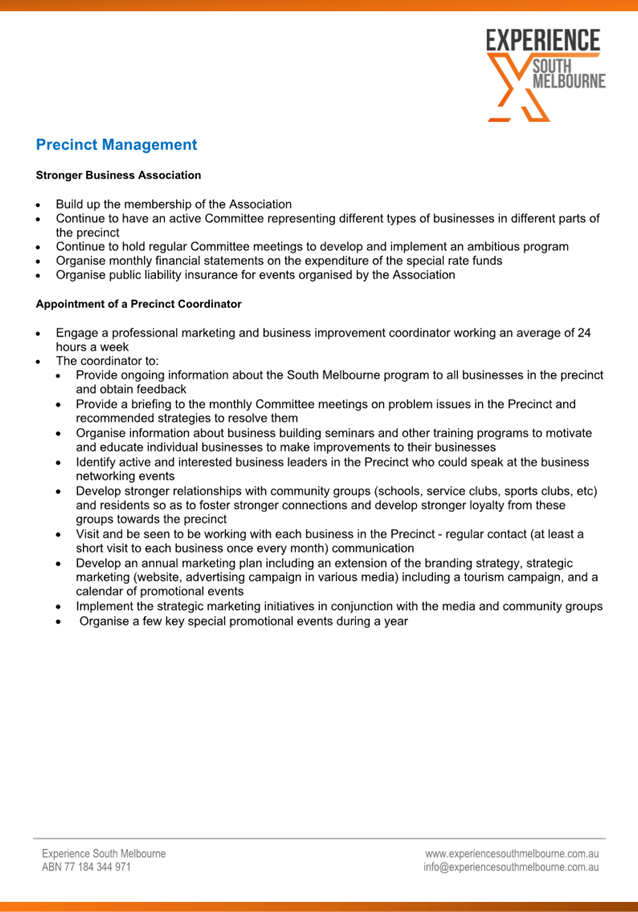
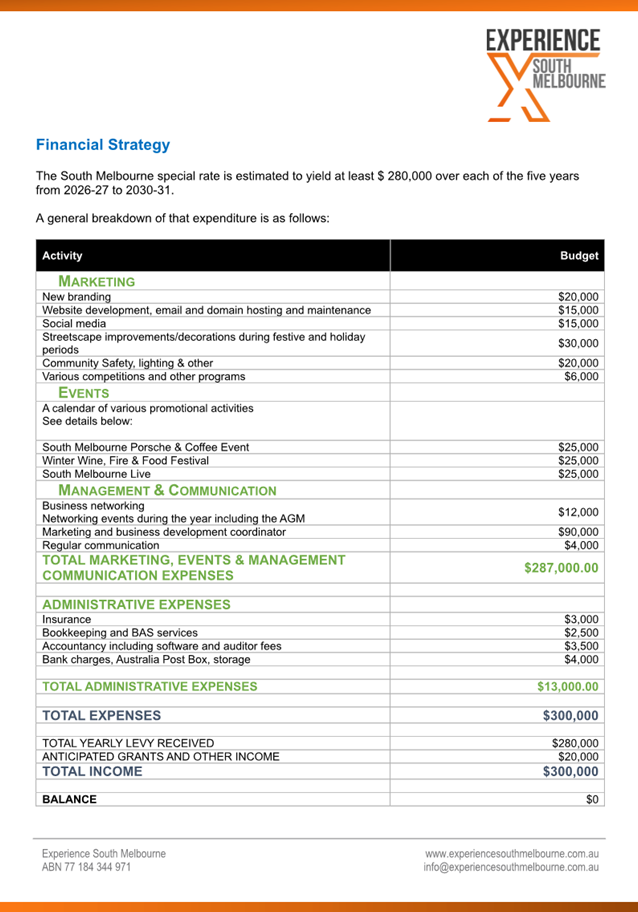
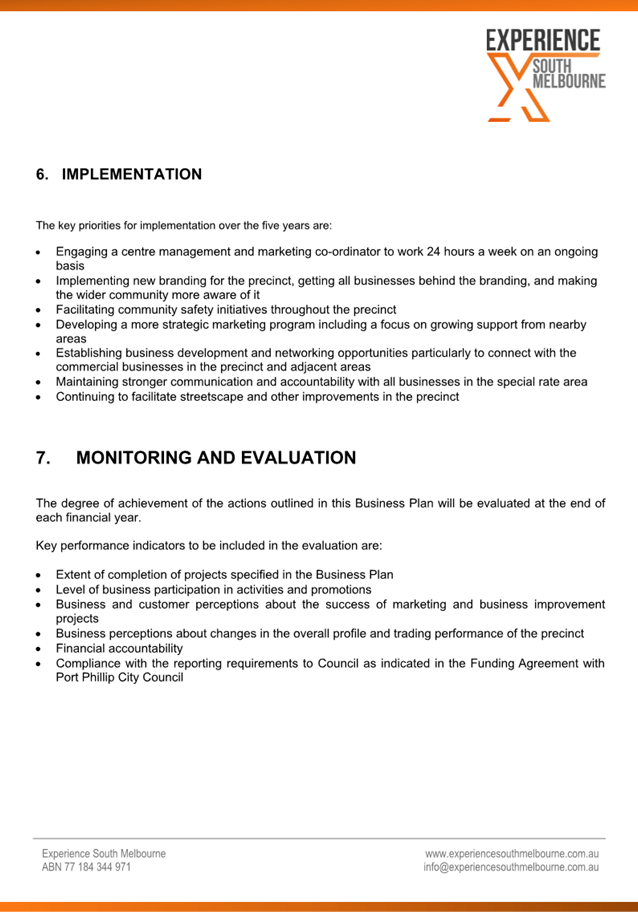
Meeting of the Port Phillip City Council
10 December 2025
|
11.2 |
Port Melbourne Special Rate and Charge – 2026-2031 Intention To Declare |
|
Executive Member: |
Brian Tee, General Manager, City Development |
|
PREPARED BY: |
Susie Filleti, Business Engagement Coordinator Mike Fisher, Manager City Planning and Sustainability |
1. PURPOSE
1.1 To commence the statutory process to implement the Port Melbourne Special Rate and Charge, for the 1 July 2026 to 30 June 2031 period. The Special Rate and Charge is for marketing, tourism, promotion, business development and centre management of the Port Melbourne Business Precinct.
2. EXECUTIVE Summary
2.1 The City of Port Phillip currently has four special rate and charge schemes in operation – Fitzroy Street, Port Melbourne, Acland Street Village and Carlisle Street.
2.2 The Port Phillip special rate and charge schemes incorporate the collection of a levy from commercial properties within a defined geographic area for marketing, promotion, business development and centre management of the specified Activity Centre. Funds are distributed to the incorporated Business Association under a funding agreement with Council.
2.3 Special rate and charge declarations are a statutory process governed by Part 8 of the Local Government Act 1989.
2.4 On 30 September 2025, Council received a letter from Port Melbourne Business Association (PMBA) requesting that Council begin the statutory process to implement the Port Melbourne Special Rate and Charge for five years, from 1 July 2026 to 30 June 2031 (Attachment 1).
2.5 In October and November 2025, PMBA contacted all open businesses in the Precinct (266 businesses) to gauge support for the Special Rate. PMBA received support from 182 out of the 266 properties which represented 68 percent.
2.6 The special rate and charge would levy a maximum amount of $1,600,000 over the five years, which equates to up to $320,000 in the 2026–2027 financial year.
|
That Council: 3.1 Notes the letter received the Port Melbourne Business Association (PMBA) requesting the implementation of the special rate and charge scheme (Scheme) for the Port Melbourne Business Precinct (Precinct) (Attachment 1). 3.2 Having otherwise considered all relevant matters, commences the statutory process under the Local Government Act 1989 (Act) to implement the Scheme to, and for the properties within the Precinct. The Scheme will – (a) Be used for the purposes of defraying expenses for advertising, marketing, business development and centre management, associated with the encouragement of commerce, retail and professional activity and employment in the Precinct; (b) provide collected funds to PMBA, to be used solely for the purposes outlined above, subject to the approval, direction, and control of Council; (c) raise a maximum amount of up to $320,000 per annum for a total of up to $1,600,000; and (d) operate for a period of five years, commencing on 1 July 2026 and ending on 30 June 2031. 3.3 In accordance with the Act, publish a Public Notice (Attachment 3) in The Age and on Council’s website, advising of Council’s intention to declare a special rate and charge. The notice will outline the objection process and provide a minimum of 28 days for any person liable for the special rate and charge to lodge an objection. 3.4 In accordance with the Act, send individual letters to all affected property owners and occupiers within the proposed Port Melbourne Business Precinct boundary (Attachment 4), advising of the intention to declare the special rate and charge, the commencement of the statutory process including a copy of the Public Notice and an estimation of the special rate or special charge payable, based on FY2025-26 Net Annual Value (NAV) valuations that would be applied to the property. 3.5 Considers the proposed Scheme at two further Council Meetings in 2026: (e) Following the objection period outlined in the Public Notice, review all written objections and submissions; and (f) decide to declare the Scheme for 1 July 2026 to 30 June 2031. 3.6 Advises the PMBA of the matters specified in this resolution. 3.7 Authorises the Chief Executive Officer or his delegate to – (g) Make any minor amendments to the Public Notice (Attachment 3) that do not change the material intent of the that Public Notice to ensure legislative compliance. (h) carry out all other administrative procedures necessary to enable Council to carry out its functions under section 163A and section 163(1A), (1B) and (1C) and sections 163B and 223 of the Act |
4. KEY POINTS/ISSUES
4.1 The City of Port Phillip currently has four special rate and charge schemes in operation – Fitzroy Street, Port Melbourne, Acland Street Village and Carlisle Street. All Port Phillip special rate and charge schemes incorporate the collection of a levy from commercial properties within a defined geographic area for marketing, promotion, business development and centre management of the specified activity centre. All funds collected are distributed to the incorporated business association under a funding agreement with Council.
4.2 Special rate and charge scheme declarations are a statutory process governed by Part 8 of the Local Government Act 1989. Despite the enactment of the Local Government Act 2020, the special rate and charge provisions of the 1989 legislation are still in force. In declaring a special rate and charge scheme, Council must be satisfied that:
4.2.1 the proposal relates to the performance of a function authorised under Section 163 of the Act;
4.2.2 there will be a special benefit to those persons liable to pay the special rate or special charge; and
4.2.3 there is a reasonable distribution of the rate amongst those persons liable to pay the special rate or special charge.
4.3 Council’s Rates team collects the special rate and charge through the normal rating process, whilst compliance and reporting are managed by the Economic Development team. All funds collected are distributed to the relevant incorporated Business Association under a funding agreement with Council.
4.4 To implement a special rate and charge, Council will follow the below process:
4.4.1 Council decides whether to commence the statutory process and issue notices of intent to impacted rate payers;
4.4.2 Council considers objections and submissions regarding the proposed special rate and charge; and
4.4.3 Council determines whether to declare the special rate and charge.
4.5 On 30 September 2025, Council received a letter from Port Melbourne Business Association (PMBA) requesting that Council begin the statutory process to implement the Port Melbourne Special Rate and Charge Scheme (Scheme) for five years, from 1 July 2026 to 30 June 2031 (Attachment 1).
4.6 The proposed Scheme has 377 properties within the Port Melbourne Business Precinct boundary (Attachment 4). The Scheme will levy a maximum amount of $1,600,000 over the five years which equates to up to $320,000 per annum.
4.7 In October and November 2025, PMBA contacted all open businesses in the Precinct (266 businesses) and undertook a business poll to gauge support for the Scheme. The PMBA received signed support from 182 out of the 266 properties currently occupied, open and available for comment for the Scheme, which represented 68 percent.
4.8 If redevelopments occur within the proposed Scheme boundary, any new eligible properties that have not previously been levied will be added to the Scheme. Any property that changes from commercial, retail, leisure, tourism or light industrial to residential use will be removed from the Scheme. Amendments to the Scheme will occur from the date the supplementary valuation takes effect.
4.9 Properties exempt from paying the special rate and charge include:
· Dedicated car parking lots;
· telecommunication towers and power substations;
· all residential properties; and
· non rateable properties.
4.10 To distribute the special rate and charge across the commercial properties within the Port Melbourne Business Precinct boundary the current two benefit areas will remain – primary and secondary. Details of the benefit areas and Scheme boundary are specified in the Proposed Declaration of a Special Rate and Charge (Attachment 2).
4.11 Properties that are used, or reasonably capable of being used, for retail, commercial, leisure, tourism, entertainment, light industrial or professional purposes that fall into the below address ranges are included proposed Scheme boundary:
· 1-476 Bay Street (odd and even inclusive);
· 1-105 Beach Street (odd and even inclusive);
· 28-40 Beaconsfield Parade (inclusive);
· 92-141 Bridge Street (odd and even inclusive);
· 1-86 Crockford Street (odd and even inclusive);
· 69 Cruickshank Street;
· 146 Evans Street;
· 97 and 214-252 Graham Street (inclusive);
· 5 Ingles Street;
· 21 Johnston Street;
· 21 and 8-30 Lalor Street (inclusive);
· 141-147 Liardet Street (inclusive);
· 1-174 Nott Street (odd and even inclusive);
· 2-4 Princes Street (inclusive);
· 2–4 and 33-107 Raglan Street (inclusive);
· 46-224 Rouse Street (odd and even inclusive);
· 100 Spring Street North;
· 192 Station Street;
· 18-42 Stokes Street (inclusive); and
· 1-13 Waterfront Place (inclusive); and
· In the opinion of Council receive a special benefit from the Special Rate and Charge.
4.12 The rates in the dollar applicable to each benefit area, for the purposes of assessing and levying the special rate and charge, will be determined having regard to the Net Annual Value (NAV) of all properties within each benefit area. This is determined at the beginning of each financial year to raise a total of up to $320,000 per annum.
4.13 The FY2026-2027 NAV valuations are not yet available at the time of this report. An indicative calculation below shows rates in the dollar based on the 2025-2026 NAV valuations that would have been applied to collect the special rates and charges totalling up to $320,000 per annum:
· Primary benefit rate – 0.00858
· Secondary benefit rate – 0.00429
4.14 The actual special rates to be applied in 2026-2027, and in each subsequent year of the Special Rate Period, will be determined having regard to reassessed NAV figures prepared annually by Valuer-General Victoria.
4.15 In addition to the rate in the dollar being adjusted each financial year, maximum and minimum special charges will also apply. For the 2026-27 rating year, the following maximum and minimum special charges will apply:
· Primary benefit rate – maximum charge of $20,664 and a minimum charge of $708 per year.
· Secondary benefit rate – maximum $10,332 and a minimum charge of $449 per year.
4.16 The maximum and minimum special charges will be adjusted at the beginning of each financial year during the operation of the Scheme, having regard to:
· any change to the special rate in each of the benefit areas (which, as above, will be determined having regard to the movement of NAV to ensure that $320,000 will be collected in that year);
· the inclusion or removal of any properties from the Scheme; and
· any change in the number of properties that will pay a special charge (as opposed to a special rate), having regard to the changed special rates in each benefit area, as above.
4.17 An estimate based on FY2025–26 NAV valuations indicates that the median levy for individual ratepayers affected by the proposed special rate and charge is $685 per year, while the average levy is $839 per year.
4.18 Council will provide PMBA with the collected levy every six months, on receipt of an accepted Activity Report and valid tax invoice. Prior to PMBA issuing a valid tax invoice, Council will confirm the total levy collected for the six-month period, which will be no more than $160,000 to include on the tax invoice. Should the collected levy be less than the expected levy, Council will not supplement payments to cover the balance; Council will only issue funds received.
4.19 PMBA has developed its Business Plan for the proposed 2026 – 2031 Special Rate and Charge as well as a Budget and Action Plan for FY2026/2027 (Attachment 5). The Business Plan and Budget and Action Plan will form part of the new funding agreement with Council.
4.20 Funds raised by the Scheme will be for the sole purpose of marketing, promotion, business development and centre management of the Precinct. It is considered that the value of the properties included in the Scheme area, their desirability as a letting proposition and their general amenity could be enhanced by the activities generated from the Scheme funds.
4.21 Any submissions and objections in relation to the Scheme will be presented to Council for consideration at a Council Meeting in 2026.
4.22 Section 163B(6) of the Act states that Council cannot make a declaration of a special rate and charge if it receives objections from a majority of the rateable properties in respect of which the special rate and charge would be imposed (that being greater than 50 percent).
4.23 Council must consider all submissions and objections received in relation to the Scheme in accordance with the Act prior to making a decision regarding the declaration of the proposed Scheme.
Key Information
4.24 The Port Melbourne Special Rate and Charge scheme was first declared in 2001 and was renewed in 2006, 2011, 2016 and 2021.
4.25 PMBA is successfully engaged with its traders and local community. Recent initiatives and achievements include:
· Developed and implemented a 12-month calendar of events and campaigns to attract visitation to the Port Melbourne Business Precinct.
· Successfully introduced and delivered the inaugural Port Melbourne Music Crawl in 2024, a free all-day music festival held over the King’s Birthday weekend and built on its success in 2025.
· Continued to deliver the annual Howl-o-ween event, featuring the popular dog parade.
· In partnership with the State Government and the City of Port Phillip, commissioned public art installations celebrating First Peoples and Port Melbourne’s migration story.
5. CONSULTATION AND STAKEHOLDERS
5.1 Council has worked closely with PMBA throughout the pre-intention to declare stage of this proposed Scheme.
5.2 Council is bound by the statutory process and cannot promote the benefits or achievements of the Scheme to those affected by it. PMBA is responsible for securing support for the Scheme and communicating its benefits to the property and business owners.
5.3 Council, through the Economic Development team, will communicate the statutory process to those affected property and business owners through the stages dictated by the Act.
6. LEGAL AND RISK IMPLICATIONS
6.1 The risks associated with the proposal are limited by the following:
6.1.1 If the Scheme is declared PMBA will enter into a formal funding agreement with Council for the duration of the Scheme which outlines the specific purposes for which the funds can be spent.
6.1.2 Under the terms of the proposed funding agreement, PMBA:
6.1.2.1 will be required to submit an Activity Report that includes financial reporting documentation every six months (profit and loss, balance sheet, general ledger, and marketing activity report). Scheme monies will not be paid to the Association until all reporting is received and approved.
6.1.2.2 must be an incorporated entity through the life of Scheme and must act in accordance with the Associations Incorporation Reform Act 2012.
6.1.2.3 will be required to adopt their five-year Business Plan to guide expenditure of the funds.
6.1.3 PMBA will expend the monies raised by the Scheme on behalf of Council as an administrator of the funds. At all times PMBA will be bound by the funding agreement with Council and under the direction of Council. Council retains exclusive authority to determine how the funds from the Scheme will be allocated. Section 164 of the Act enables Council to discontinue the Scheme if there is any inappropriate expenditure.
6.1.4 If Council does not wish to support the Port Melbourne Special Rate and Charge, there may be an expectation from the commercial precinct that Council will fund marketing and promotion activities for the precinct.
7. FINANCIAL IMPACT
7.1 Council incurs administrative costs for the implementation of the Scheme. These have been included in the FY2025/2026 budget.
7.2 Council administers the collection of the funds for the life of the Scheme and distributes the Scheme funds to PMBA in two half-yearly instalments after they submit an Activity Report.
8. ENVIRONMENTAL IMPACT
8.1 A financially sustainable business association allows Council to work with businesses in the Precinct on leading practice sustainability programs that will reduce emissions, waste and energy usage amongst other outcomes.
8.2 Vibrant local activity centres provide residents with the opportunity to shop locally and sustainably by walking, cycling or taking public transport to access their centre rather than driving elsewhere.
9. COMMUNITY IMPACT
9.1 Vibrant activity centres are critical to the health and development of the local community. Centres provide employment, community meeting places, resources, leisure opportunities and essential services to the community.
10. ALIGNMENT TO COUNCIL PLAN AND COUNCIL POLICY
10.1 Special rate and charge schemes align with:
10.1.1 A healthy and connected community - Our Council fosters collaboration and mutual support within the community:
· Business and retail precincts play a vital role in supporting community wellbeing by offering diverse services. These precincts act as hubs of connection, where people gather, interact, and feel a sense of belonging. Through collaboration with Business Associations, Council helps ensure these precincts remain inclusive, accessible, and responsive to community needs.
10.1.2 An environmentally sustainable and resilient City - Our Council engages the community in enhancing environmental outcomes:
· Council can collaborate with Business Associations to promote and support environmentally sustainable practices across precincts.
10.1.3 A safe and liveable City - Our City values the distinct character and identity of local neighbourhoods:
· Successful business precincts underpin the liveability of a high-density city such as Port Phillip and are pivotal in creating a city of diverse and distinctive neighbourhoods and public spaces.
10.1.4 A vibrant and thriving community - Our City has a strong, resilient economy:
· Special rate funds empower the business community to actively and creatively market, promote and develop their precinct to maintain vibrancy and economic viability and to provide the community with a well-resourced business precinct that provides excellent services, gathering places and employment.
10.1.5 An engaged and empowered community - Our residents and businesses are well informed:
· Business Associations serve as a vital conduit between Council and the business community, helping to identify precinct needs and communicate priorities effectively.
10.1.6 A trusted and high-performing organisation - Port Phillip Council is financially sustainable, cost effective, and efficient:
· Special Rate funds enable cost-sharing models for marketing, events and activations of business precincts, improving financial efficiency.
11. IMPLEMENTATION STRATEGY
11.1 TIMELINE
If Council resolves to commence the statutory process:
· From 15 December 2025, Council gives rate payers notice by the nominated postal address and the street address in the designated Scheme area regarding:
o the proposed implementation of the Scheme,
o the statutory process; and
o their estimated levy amounts.
· Public notice published in The Age on 15 December 2025 and displayed on the City of Port Phillip website.
· The Local Government Act 1989 states that proposed declaration must be available for public inspection, consideration and submissions for at least 28 days after the publication of the notice, and that any objections must be received within 28 days of the public notice. To accommodate the holiday season, it is recommended that the objection and submission period conclude at 5pm on 30 January 2026, providing additional time for feedback during this time of year.
· Council officers review and collate submissions and objections once the objection period has concluded at 5pm on 30 January 2026.
· Council considers submissions and objections at a Council Meeting in 2026.
· Council considers whether to declare (or not) the Scheme for 2026-2031 at a Council Meeting on the 15 April 2026 or nearest date closest to that date, following the confirmation of the 2026 Council Meeting schedule.
· Council gives rate payers notice by the nominated postal address and the street address in the designated Scheme area of the decision regarding the Scheme following the decision at the April 2026 Council Meeting.
· If Council resolves to declare the proposed Scheme:
o A person on whom a special rate or special charge is imposed then has 30 days from the date of issue of the Notice of the Special Rate and Charge to apply to VCAT for a review of a decision of Council to impose a special rate or special charge on that person, on limited grounds under section 185 of the Act.
o Section 185AA of the Act provides a separate right to apply to VCAT for a declaration as to the validity of Council’s decision. An application for a declaration can be made at any time.
o If an application is lodged at VCAT, Council would consider whether to:
§ proceed with the implementation of any special rate and charge scheme; and
§ provide any monies raised to PMBA;
until the application has been heard and there is a VCAT decision on the matter.
o Council will advise the PMBA of its decision.
o If no application is made to VCAT, Council will commence the Scheme on 1 July 2026.
o Affected rate payers will receive their levy notification to make payment via their Council rates notice in September 2026.
· If Council resolves not to declare the proposed Scheme at its Ordinary Council Meeting in April 2026, Council will advise the PMBA and all affected rate payers in writing of this decision and the proposed Scheme will not proceed.
11.2 COMMUNICATION
11.2.1 Intention to Declare process:
· Council gives rate payers notice by the nominated postal address, and the street address in the designated Scheme area of the proposed Scheme, the statutory process and their estimated levy amounts from 15 December 2025.
· Public notice published in The Age 15 December 2025 and displayed on the City of Port Phillip website.
11.2.2 Declaration:
· Council gives rate payers notice by the nominated postal address and the street address in the designated Scheme area of the decision regarding the declaration of the proposed Scheme following the decision at the April 2026 Council Meeting.
· If Council resolves to declare the proposed Scheme at a Council Meeting in April 2026, affected rate payers will receive their levy notification to make payment via their Council rates notice in September 2026.
12. OFFICER material or general INTEREST
12.1 No officers involved in the preparation of this report has declared a material or general interest in the matter.
|
ATTACHMENTS |
1. Port Melbourne Business Association Letter 2. Port Melbourne Business Precinct Special Rate and
Charge Proposed Declaration 3. Port Melbourne Business Precinct Special Rate and
Charge Public Notice 4. Proposed Port Melbourne Business Precinct Boundary 5. Port Melbourne Business Association Five-Year
Business Plan and FY26-27 Budget and Action Plan |
|
Port Melbourne Business Association Five-Year Business Plan and FY26-27 Budget and Action Plan |
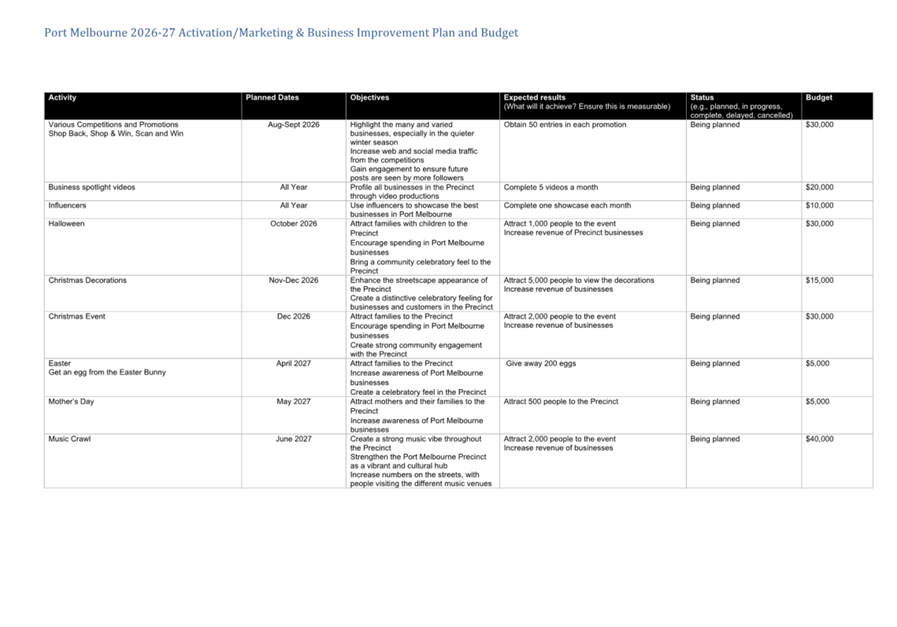
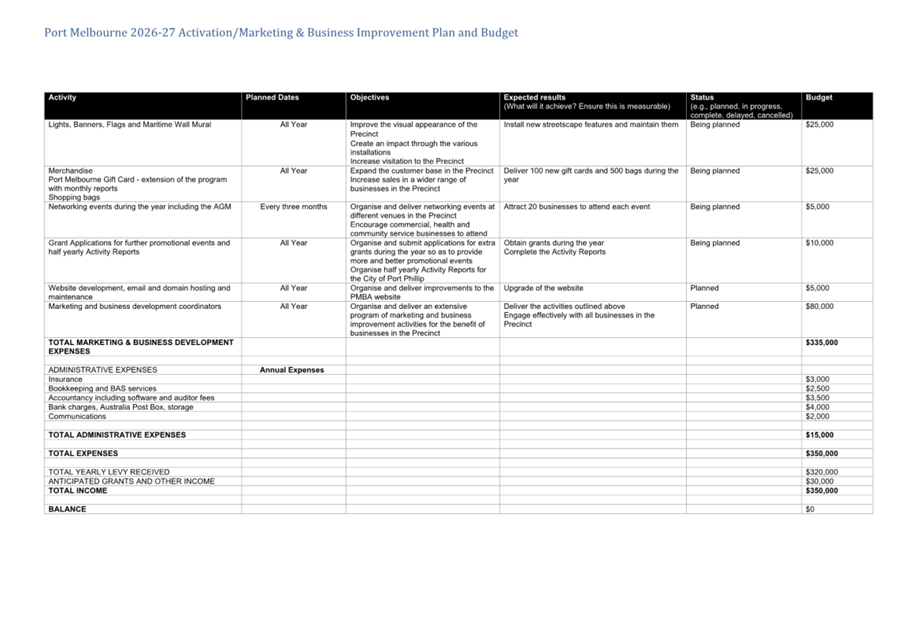
Meeting of the Port Phillip City Council
10 December 2025
|
Port Melbourne Netball Infrastructure Project |
|
|
Executive Member: |
Kylie Bennetts, General Manager, Community Wellbeing |
|
PREPARED BY: |
Natalie Handcock, Coordinator Recreation Capital Portfolio Glen Hickey, Manager, Portfolio Projects Susan Cannell, Coordinator Sport and Recreation Jessica Sewell, Project Manager |
1. PURPOSE
1.1 To outline options for the Port Melbourne Netball Infrastructure project based on recent feasibility investigations and seek Council approval for preferred next steps.
2. EXECUTIVE Summary
2.1 The Port Melbourne Netball Infrastructure Project aims to address the municipality’s growing shortfall in netball facilities and deliver on Council’s commitment to gender equity and inclusive recreation under the Fair Access in Sport Policy. Council has secured $2 million in State Government funding and committed $5.2 million for this new netball infrastructure.
2.2 Netball participation in the City of Port Phillip was estimated at 3,396 in 2021 and is projected to grow to 5,419 by 2041. To meet this demand, it is estimated that an additional 13 netball courts are required by 2041.
2.3 Current facilities cannot accommodate required growth, with existing courts operating at capacity. Each outdoor court with lighting provides 40 hours of use per week, and without lighting 15 hours, creating a gap in available playing time.
2.4 The Port Melbourne Netball Club and Port Melbourne Colts Football Netball Club have driven advocacy for this project to ensure equitable access and support for women and girls in sport.
2.5 Plans to deliver the project at Elder Smith Reserve have encountered significant infrastructure, financial, and legal risks due to multiple high-pressure pipelines and underground assets, requiring complex agreements and additional costs (approx. $2.5M to construct and then acceptance of future unable to be quantified risk that the courts may need to be lifted and then reinstated at Council cost if utilities required access to the site). These risks prompted extended feasibility investigations into alternate options.
2.6 The four delivery options assessed were:
2.6.1 Option 1: Continue delivery at Elder Smith Reserve.
2.6.2 Option 2: Investigate delivery at JL Murphy Reserve.
2.6.3 Option 3: Cancel the project.
2.6.4 Option 4: Explore new sites or hybrid delivery.
2.7 All options present a range of benefits and risks that were considered as part of the assessment process. JL Murphy Reserve is considered the most viable option, offering reduced infrastructure risk and alignment with strategic objectives.
2.8 Council previously considered and deemed JL Murphy Reserve unsuitable for the project. A reassessment of this position has been undertaken. This assessment considered updated feasibility findings, previously identified site constraints, and changes in site conditions following recent developments within the precinct.
2.9 Updated spatial analysis and concept testing, undertaken following the construction of Port Melbourne Secondary School (an element not considered in the original assessment) confirm that four netball courts and a pavilion could be accommodated within the south-east corner of JL Murphy Reserve. The completed construction of the school has provided greater certainty around spatial boundaries and operational requirements, ensuring that the proposed netball infrastructure can be integrated without impacting school functionality or limiting community access.
2.10 Recent projects and planning advancements, including the JL Murphy Reserve pitch upgrades, have improved understanding of precinct requirements – specifically regarding water retention, and would inform any updated design solutions.
2.11 There is still risk with this option. Community consultation and engagement will need to be undertaken as progressing at this site will reduce passive open space within JL Murphy Reserve and may generate additional traffic and parking pressures during peak periods. Appropriate mitigation strategies will be essential to ensure safe and efficient access for all users. Further work in relation to flood management and water retention particularly in the context of the Fishermans Bend urban renewal project is also required.
2.12 In light of the complexities and history of the project, an independent stage gate review will be undertaken. This will occur once community consultation has concluded and further work in relation to water retention has been undertaken but prior to Council making a final decision to progress at a particular site.
2.13 If Council ultimately resolves not to progress at Elder Smith Reserve, alternative uses could be considered in future planning, including options such as dog off-leash areas, to offset potential loss of open space at JL Murphy Reserve while supporting community access to green space and broader objectives for urban biodiversity and recreational amenity.
|
That Council: 3.1 Notes that further feasibility studies were required for the Port Melbourne Netball Infrastructure project in response to significant infrastructure, financial and legal risks at Elder Smith Reserve arising from multiple high-pressure pipelines and underground assets, which require complex agreements and additional funding. 3.2 Endorses undertaking community engagement on Option 2: investigate delivery of the project at JL Murphy Reserve. 3.3 Notes that community engagement will commence in early 2026. 3.4 Notes further work in relation to flood and water retention management will be undertaken, particularly in the context of the Fishermans Bend Urban Renewal project. 3.5 Notes an independent stage gate review will be undertaken following community consultation and flood / water retention management work being undertaken to help inform Council’s decision making on the most appropriate final pathway for this project. 3.6 Notes that once engagement outcomes are known, Council endorses a proposed way forward, and the design development process is progressed, if additional budget is required to deliver Council’s preferred option this will be considered at a quarterly budget review. 3.7 Notes that alternative uses at Elder Smith Reserve could be considered in future planning, including options such as dog off-leash areas, to offset potential loss of open space at JL Murphy Reserve. 3.8 Authorises the Chief Executive Officer (or their delegate) to formally advise the State Government of the proposed change in scope and negotiate associated grant funding variation requirements for Ministerial approval as required. |
4. KEY POINTS/ISSUES
Background
4.1 In November 2018, the State Government announced Election Commitment funding for $2M for new netball facilities, to support the Port Melbourne Netball Club (PMNC).
4.2 The Election Commitment project to deliver new netball facilities utilising the State funding began with the intention to deliver the courts at JL Murphy Reserve.
4.3 At the time investigations on JL Murphy Reserve deemed the location unsuitable due to water retention and flooding on the hard-court surface and subsequently Councillors and the State Minister agreed to consider alternative locations that could service PMNC.
4.4 RF Julier Reserve was subsequently assessed as the potential site due to it being the existing home of PMNC.
4.5 Further investigations showed constraints at this site including lack of available space for more courts and a larger pavilion, and potential impacts to neighbourhood character and amenity.
4.6 Elder Smith Reserve was identified as a possible new location and further feasibility assessment commenced.
4.7 The Elder Smith Reserve feasibility study examined the following items:
4.7.1 Geotechnical investigation of the site, including recommendations for groundworks to support courts and carparking.
4.7.2 Soil Contamination investigation of the site.
4.7.3 Initial Service location and Feature Level Survey.
4.7.4 Site investigations, including Heritage and Aboriginal cultural heritage assessment as well as Planning Overlays.
4.7.5 Traffic assessment of the preliminary carpark capacity and its effect on the existing road infrastructure.
4.7.6 Assessment of underground infrastructure, including engagement with Utility companies.
4.7.7 Preliminary mapping of netball courts, supporting infrastructure (pavilion and car park) and paths of travel to the courts.
4.8 The site received support from PMNC and the State Minister to direct the Election Commitment funding and be the new home base for PMNC.
4.9 At a Council Meeting on 1 December 2021, Councillors endorsed progressing with a concept design for four new netball courts, pavilion, car park and improved greening at Elder Smith Reserve.
4.10 At a Council meeting on 6 September 2023, Council approved additional funding of $1.8M to increase delivery to a sub-regional facility as per Netball Victoria Facility Guidelines. The additional budget included scoreboards and court side seating as discretionary items.
4.11 Subsequently, the design for Elder Smith Netball Courts and Pavilion progressed, including liaising with Utility companies that identified the project was impacted by the alignment of high-pressure transmission pipelines running east-west across the site.
4.12 Council initially understood that the proposed development was clear of underground infrastructure, however, as planning for Elder Smith Reserve progressed, the discovery of complex site conditions emerged, leading to significant third-party risks and potential cost escalation, specifically:
4.12.1 APA high-pressure, natural gas transmission pipeline.
4.12.2 VIVA Energy high-pressure, crude oil transmission pipeline.
4.12.3 CitiPower high-voltage underground cables.
4.12.4 Unknown conduits; and
4.12.5 A utility easement including in-ground services and overhead powerlines, which also extends along the northern boundary of the site.
4.13 The presence of major third-party infrastructure within the proposed project area introduced substantial unidentified costs and risks to Council, including the:
4.13.1 Requirement to construct over a high-pressure transmission pipeline.
4.13.2 Need to relocate high-voltage power conduits.
4.13.3 Requirement for Council to enter into complex Commercial Agreements with asset owners.
4.14 Furthermore, Council would be required to formally accept residual risks, including ongoing liability to permit asset owners unrestricted access to their infrastructure and to fund reinstatement works should access be required.
4.15 Compliance with asset owner specifications and construction directives was anticipated to increase project delivery costs by approximately $2.5 million, reflecting additional resourcing, Commercial Agreement obligations, and contingency allowances.
4.16 In response to the significant delivery challenges identified at Elder Smith Reserve, Councillors were briefed in February 2025 on potential pathways for the project.
4.17 Four options were presented for Councillor consideration and feedback:
4.17.1 Option 1: Proceed with the project as per the current design at Elder Smith Reserve.
4.17.2 Option 2: Reduce project scope to limit encroachment on underground infrastructure and services.
4.17.3 Option 3: Investigate project delivery at an alternate location.
4.17.4 Option 4: Conclude the project.
4.18 Councillors provided feedback that while pursuing delivery at Elder Smith Reserve was unlikely to be a viable option, this location would not be discounted until alternative options were fully investigated. Councillors also requested further work focus on exploring delivery at alternate sites, including JL Murphy Reserve.
4.19 Officers undertook enhanced feasibility investigations at JL Murphy Reserve and a reassessment of the Elder Smith Reserve site to establish a pathway forward for the project.
4.20 Officers presented to Councillors via briefing on 24 September 2025 on the following options:
4.20.1 Option 1: Continue delivery at Elder Smith Reserve.
4.20.2 Option 2: Investigate delivery at JL Murphy Reserve
4.20.3 Option 3: Cancel the project.
4.20.4 Option 4: Explore new sites or hybrid delivery.
Project Delivery Options
Option 1: Proceed with the project at Elder Smith Reserve
4.21 Delivering the project at Elder Smith Reserve remains technically feasible; however, it presents significant infrastructure, financial and delivery risks, as well as long-term residual risk to the built facility.
4.22 To proceed, Council would be required to enter into formal Commercial Agreements with multiple asset owners, permitting construction over or adjacent to critical infrastructure and granting asset owners unrestricted access for future maintenance, emergency works, and inspections. This introduces ongoing liability for reinstatement costs and potential operational disruptions.
4.23 Key asset owners, including VIVA and APA, require formal Access Agreements granting full access to pipelines for all works - planned, unplanned, and emergency.
4.24 Inspection intervals vary based on pipeline material, age, and composition, and may include direct assessments (dig-ups) informed by non-intrusive or in-line inspections.
4.25 Data from Energy Safe Victoria’s Gas and Pipeline Infrastructure Safety Performance Reports (2019–20 and 2020–21) indicate an average of 20.5 direct assessments annually across Victoria’s 3,700 km of licensed natural gas transmission pipelines and 55 direct assessments across 1,600 km of non-gas licensed pipelines.
4.26 These reports also note that pipelines are ageing assets, with an increased frequency of repairs and inspections anticipated.
4.27 Evidence of build-over scenarios is limited, typically occurring in roadways, green spaces, and carparks, with minimal data available to assess construction impacts on licensed pipelines. The likelihood and timing of access requirements remain ambiguous, and officers cannot provide a confident assessment of whether these risks will materialise in the short, medium, or long term.
4.28 Financially, an additional funding commitment of approximately $2.5 million would be required to address third-party infrastructure compliance, design amendments, and contingency allowances.
4.29 A formal scope variation to the State Government funding agreement would also be necessary.
4.30 Despite these risks, delivery at Elder Smith Reserve would:
4.30.1 Fulfil the project scope, including four outdoor netball courts, lighting, parking and a pavilion.
4.30.2 Align with Council’s policy and strategic objectives for gender equity, sport, active recreation and the Fishermans Bend Draft Development Contributions Plan (DCP).
4.30.3 Meet expectations of key stakeholders, including PMNC and the State Government.
4.30.4 Maximise the value of completed design work and avoid further sunk costs.
4.30.5 Enable future investment in and expansion of netball facilities at one location, in response to increased demand and population growth
4.31 This option offers the strongest alignment with strategic objectives and stakeholder expectations but carries substantial infrastructure, financial, and residual risks.
Option 2: Investigate delivery at JL Murphy Reserve
4.32 Delivering the project at JL Murphy Reserve presents a technically viable alternative to Elder Smith Reserve, with what has been determined at this stage to be lower infrastructure risk and fewer third-party constraints.
4.33 Enhanced feasibility investigations undertaken in March 2025 confirm the site’s suitability for netball infrastructure, subject to further planning, community engagement and detailed design development.
4.34 Unlike Elder Smith Reserve, the JL Murphy Reserve site is not impacted by high-pressure transmission pipelines or critical underground electrical assets. While some existing services such as irrigation infrastructure, communications cabling, and electrical supply will require relocation, at this stage these do not pose prohibitive risks to project delivery.
4.35 Soil structure and water table assessments indicate suitability for construction, with any contamination anticipated to be managed through standard practices.
4.36 As part of the Fishermans Bend Framework, the site is earmarked for distributed water storage, requiring additional investigation and integration into the project scope where practicable to mitigate potential risks. This means that the design and delivery of the project at JL Murphy needs to factor in the essential role of the site to the future of water management in Fishermans Bend.
4.37 Continued investigations at JL Murphy Reserve have identified the total storage volume along with the minimum stormwater service level requirements for consideration in the project.
4.37.1 In 2023, an external consultant completed integrated water management (IWM) planning for the Fishermans Bend precinct guided by strategic directions around flood protection, flow conveyance and water quality objectives for the area.
4.37.2 Through the IWM planning, public realm infrastructure strategies have been proposed to meet these objectives including distributed water storage areas.
4.37.3 The proposed netball infrastructure project site has an indicative storage area located within JL Murphy Reserve. The proposed total volume capacity of the storage is 2,512 m3.
4.38 Integrating distributed water storage within the netball infrastructure at JL Murphy Reserve could present an opportunity to advance precinct-wide sustainability objectives under the Fishermans Bend Water Sensitive City Strategy.
4.39 A Traffic Impact Assessment (TIA) conducted in mid-2025 concluded that the proposed facility could be accommodated within the current road network without requiring off-street parking or traffic capacity upgrades. Anecdotal evidence within the TIA suggests occasional parking and traffic challenges, however, the TIA does not account for long-term impacts of the Fishermans Bend urban renewal precinct, which is expected to significantly increase population density and parking demand through to 2050, introducing uncertainty regarding future access conditions.
4.40 The introduction of new courts at JL Murphy Reserve was not included in the 2011 Masterplan and is absent from DCP. Delivery at JL Murphy Reserve represents a departure from these strategic plans, and as a result is unlikely to attract funding under the draft DCP.
4.41 If Council was to pursue this option, the inclusion of netball facilities would increase the sport offerings at JL Murphy Reserve; however, this would also utilise all available large passive open space within the area. This may impact current and future user groups and limit opportunities for passive recreation and events.
4.42 Due to existing assets, such as trees, the playground, etc., the footprint is considered large enough to house four netball courts, but there would be limited capacity to increase beyond this footprint.
4.43 Financially, initial costings suggest the project can be delivered within the current budget allocation, however if Council progressed with this option, once community engagement outcomes are known and the design development progressed, if additional budget is required it would be considered by Council at a quarterly budget review.
4.44 A scope variation request to the State Government in relation to the funding agreement would be necessary.
4.45 This option at this stage is considered to offer a lower-risk pathway to delivering the project, with greater certainty around construction feasibility and reduced long-term residual risk compared to Elder Smith Reserve. The key:
4.45.1 Technical consideration for this option relates to stormwater drainage and runoff management in line with the Fishermans Bend framework and integrated water management plan. Stormwater management is not associated with on-going third-party risks. Beyond standard drainage solutions, the site could present an opportunity to integrate distributed water storage within the netball infrastructure. Incorporating water-sensitive design will be a key focus of the project design.
4.45.2 Community consideration is whether this site is acceptable now and into the future, given it consolidates sports infrastructure at one site, however this reduces available passive public space at this site and may create traffic and amenity concerns in the short and longer term.
Option 3: Cancel the project
4.46 Ending the project would bring closure to a complex and high-risk initiative; however, it would result in financial loss and community impact, as new netball infrastructure would not be delivered to meet community needs.
4.47 If Council opts to discontinue the project, it would be required to forfeit the $2 million funding from the State Government, including repayment of $1.6 million already received.
4.48 Council would incur approximately $584,000 in sunk costs (total expenditure of $749,000 less the cost of lighting at RF Julier Reserve), reflecting investments made in design, feasibility, stakeholder engagement, and infrastructure upgrades.
4.49 While ending the project could release approximately $4.8M in unspent Council funds, which could be reallocated to other capital priorities, it would not deliver on the Council Plan to deliver Port Melbourne netball infrastructure to expand netball facilities in and around Port Melbourne for the growing and inclusive sport and would fail to meet the expectations of key stakeholders, including PMNC.
4.50 This outcome may be perceived as a missed opportunity to deliver inclusive infrastructure and support women and girls’ participation in sport, based on high participation rates in netball.
4.51 Should Council seek to reinvestigate netball provision in the future, a significantly increased budget would likely be required due to industry cost escalations.
4.52 This option offers immediate financial relief and eliminates long-term infrastructure liabilities but comes at the cost of responding to community need.
Option 4: Explore new sites or hybrid delivery.
4.53 This option proposes that Council initiate further feasibility investigations into previously unexplored delivery models for the project.
4.54 It acknowledges the limitations and risks associated with current sites and seeks to identify innovative solutions that better align with strategic objectives, community needs, long-term planning frameworks, and improved site conditions.
4.55 Three potential sub-options under this pathway include:
4.55.1 a) Acquire a New Site within the Municipality
· High acquisition costs estimated at $12–$17 million for approximately 5,500 sqm (assuming an industrial site).
· Rezoning and planning approvals, which may extend timelines by 12–18 months.
· Uncertainty around site availability and suitability, particularly within the Fishermans Bend precinct.
· High risk of forfeiting the State Government funding due to deviation from the original scope and inability to meet current grant timelines.
4.55.2 b) Multi-level facility with undercover parking at JL Murphy Reserve
· Address future parking demand and enhance site usability.
· Support broader strategic planning and precinct activation.
· Include an elevated facility to mitigate flooding risk while accommodating water detention measures.
· Requires new feasibility investigations, design, engineering and geotechnical assessments, and updated Traffic Impact Assessments.
· It introduces substantial additional costs (estimated at $15 million), potential land-use conflicts, and extended delivery timelines.
4.55.3 c) Hybrid Delivery Model Across Elder Smith Reserve and RF Julier Reserve
· Pursue construction of a reduced scope at Elder Smith Reserve (e.g. two-three netball courts only, no pavilion) which, combined with the existing two courts at RF Julier Reserve, would provide an increase in netball court provision.
· Increase geographic access to netball facilities.
· Reduce pressure on a single site (RF Julier Reserve) and mitigate infrastructure risks (Elder Smith Reserve).
· Introduce operational complexity, including duplication of amenities and coordination across multiple locations.
· While this option may not deliver the full scope at a single site, it offers a pragmatic compromise that balances infrastructure constraints with community benefit.
4.56 Option 4 preserves the opportunity to deliver netball infrastructure aligned with long-term strategic goals but would significantly extend project timelines and likely require forfeiture of the State Government grant funding.
Reassessment of JL Murphy Reserve
4.57 Noting Council’s former position that JL Murphy Reserve was deemed unsuitable for the project, a reassessment of this position and its underlying justification has been undertaken.
4.58 This assessment considered updated feasibility findings, previously identified site constraints, and changes in site conditions to determine whether JL Murphy Reserve now represents a viable alternative for project delivery following recent developments within the precinct.
4.59 Updated spatial analysis and concept testing, undertaken following the construction of Port Melbourne Secondary School (an element not considered in the original assessment) confirm that four netball courts and a pavilion could be accommodated within the south-east corner of JL Murphy Reserve.
4.60 The completed construction of the school has provided greater certainty around spatial boundaries and operational requirements, ensuring that the proposed netball infrastructure can be integrated without impacting school functionality or limiting community access.
4.61 If Council was to progress with this site, the final layout would be refined during the design phase to optimise space through efficient court orientation, shared-use principles, and integration with existing infrastructure.
4.62 While the total project area at JL Murphy Reserve is approximately 1,000 sqm smaller than Elder Smith Reserve, its rectangular shape provides an equivalent usable area compared to Elder Smith Reserve triangular configuration. This means the project would still meet local competition standards, enabling PMNC and others to meet growth demands.
4.63 Connectivity and accessibility to JL Murphy Reserve are significantly greater than Elder Smith Reserve, enhancing community access.
4.64 Any proposal at this site would need to align with Fishermans Bend water management objectives including:
4.64.1 The minimum level of service required for stormwater management is to accommodate a 5% Annual Exceedance Probability (AEP) event.
4.64.2 The total indicative distributed water storage volume earmarked for JL Murphy Reserve is 2,512 m3. To be managed across JL Murphy Reserve and within the Graham Street streetscape.
4.64.3 Design and construction would need to incorporate urban water-sensitive features, such as permeable surfaces, integrated drainage, holding tanks, and retention zones. Strategic landscaping and infrastructure planning would need to further enhance water management capacity. Subject to further investigations, design process, associated costs and operational impacts the proposal would potentially see:
· Surface storage over the court surface or storage beneath the netball facility including, pavements and pavilion.
· Facility interfacing incorporating wetland and/or raingarden style landscaping.
· Inclusion of permeable pavements for path network and circulation space around the court pavement.
· Integration of the drainage network along Poolman Street.
4.65 Recent projects and planning advancements, including the JL Murphy Reserve pitch upgrades, have improved understanding of precinct requirements – specifically regarding water retention, and would inform updated design solutions.
4.66 Feasibility assessments have considered open space impacts associated with relocating the project to JL Murphy Reserve. While green space would be reduced due to hardcourts, the project would contribute to a more vibrant and inclusive precinct. Landscaping and greening works would preserve surrounding open space areas and enhance amenity with new seating and lighting.
4.67 Elder Smith Reserve site constraints make it more suitable for future passive open space improvements, supporting broader recreational and environmental outcomes for the precinct. Alternative uses for Elder Smith Reserve could be considered in future planning.
Recommendation
4.68 Based on updated feasibility investigations, strategic alignment, and risk assessment, Officers recommend that further exploration of Option 2: Investigate delivery of the project at JL Murphy Reserve is undertaken.
4.69 At this stage, JL Murphy Reserve offers a more viable solution to achieve the project’s objectives and presents lower infrastructure and residual risks compared to Elder Smith Reserve.
4.70 While this option will require additional planning and community engagement, it provides greater certainty around construction feasibility and financial management than other available options.
4.71 Given the history of this project the recommended pathway is:
4.71.1 Undertake community engagement on the prospect of utilising JL Murphy Reserve as the preferred site.
4.71.2 Undertake further work in relation to flood and water retention management, particularly in the context of the Fishermans Bend Urban Renewal project.
4.71.3 Commission an independent stage gate review of the project to support Council’s final decision on a preferred pathway for this project in 2026.
5. CONSULTATION AND STAKEHOLDERS
5.1 Officers have been in regular conversation with the State Government to inform of the project status, proposed relocation and extension to the project.
5.2 In response, the State Government have been supportive of Council’s approach and have advised that a scope variation request to the existing funding agreement will need to be submitted for Ministerial consideration upon endorsement of an Option by Council.
5.3 Officers have kept Port Melbourne Netball Club informed of project progression, including the issues identified at Elder Smith Reserve. PMNC are aware of the consideration for relocation to JL Murphy Reserve and support the project location.
5.4 PMNC and Port Melbourne Colts Football Netball Club will continue to be involved as the project progresses.
5.5 Community engagement for delivery at JL Murphy Reserve, including existing sports clubs, will need to be undertaken to inform the community of the potential change in scope and seek support. Community engagement is scheduled to be undertaken in early 2026.
6. LEGAL AND RISK IMPLICATIONS
6.1 If Council progresses further with Option 2:
6.1.1 Delivery at JL Murphy Reserve requires standard approvals and integration with Fishermans Bend planning, including assessment of open space impacts and integration of distributed water storage requirements.
6.1.2 Ministerial approval would be required to vary the State Government funding agreement for relocation of the project, introducing a risk of funding delay or potential loss if the approval if not granted.
6.1.3 Community acceptance would need to be determined particularly in relation to the loss of passive open space increased sports activations and traffic and parking impacts at this site as well as potential opportunities to offset public open space at Elder Smith.
6.1.4 Traffic and parking risks identified in the TIA and internal review would need to be addressed through traffic management plans and alignment with long-term precinct planning.
6.1.5 Environmental compliance would be required for stormwater management and distributed water storage integration, ensuring alignment with sustainability objectives and regulatory standards.
6.2 At Elder Smith Reserve, significant legal and financial risks remain due to multiple high-pressure pipelines and underground assets, requiring complex Commercial Agreements with APA, VIVA Energy, and CitiPower for build-over permissions and ongoing access rights. These Commercial Agreements would impose long-term liabilities on Council, including reinstatement costs and operational disruptions for emergency or planned maintenance, making ESR a high-risk option.
6.3 Given the history of this project an independent stage gate review will be conducted to help inform Council’s final decision on this matter following community engagement and flood management / water retention investigations in light of the Fishermans Bend urban renewal requirements.
7. FINANCIAL IMPACT
7.1 The State Government has committed $2M in grant funding to support the delivery of this project. This funding is currently tied to the Elder Smith Reserve Netball Project under the existing funding agreement.
7.2 The State Government have been supportive of Council’s approach to the project and have advised that a scope variation request to the existing funding agreement will need to be submitted for Ministerial consideration upon endorsement of an Option by Council.
7.3 Whilst the funding is an important consideration for this project, given the level of risk and ambiguity, this should be one but not the driving consideration.
8. ENVIRONMENTAL IMPACT
8.1 Delivery at JL Murphy Reserve would require the existing green space to be converted to a hard surface netball court with a pavilion and lighting. This change would alter the current landscape character and reduce open turf areas.
8.2 An alternate use of Elder Smith Reserve could be considered in future years to enhance passive open space within the precinct. This approach could support community access to green space and align with broader objectives for urban biodiversity and recreational amenity.
8.3 Drainage and flooding have been considered as part of the initial feasibility and will need to be further considered including: -
8.3.1 The minimum stormwater service level required by the netball facility is to accommodate a 5% AEP event.
8.3.2 Total indicative storage volume nominated in the Fishermans Bend integrated water management plan to be incorporated into the netball facility design is 2,512 m3.
8.3.3 Options for stormwater management will be further explored through the design process including consideration of functionality, operational impacts and costs.
8.4 If, Council ultimately resolves to progress the project at JL Murphy in 2026:
8.4.1 The design would integrate enhanced greening initiatives, including new planting and landscape improvements to offset the loss of open space.
8.4.2 Sustainability initiatives would be pursued through the design taking into consideration opportunities for efficiencies with energy and water use, stormwater management and material selection. Furthermore, the design would consider ways to incorporate opportunities for distributed water storage and stormwater harvesting, supporting sustainable water management and environmental considerations.
8.4.3 The facility would be designed to minimise impacts on existing vegetation. Where removal is unavoidable, replacement planting would occur in collaboration with the Greening Port Phillip program, however current assessments indicate that the development may avoid significant tree removal, subject to arborist review during detailed design.
8.4.4 Netball court lighting would be designed to meet Netball Victoria Facility Guidelines and Australian Standards, ensuring safe play conditions. The design would incorporate measures to provide sustainable lighting (e.g. LEDs) and minimise light spill and impact outside of the facility.
9. COMMUNITY IMPACT
9.1 Officers undertook sport and recreation data analysis in 2024. This identified the following demand for netball across the municipality:
9.1.1 Estimated netball participation in the City was estimated at 3,396 in 2021 and is projected to increase to 5,419 by 2041.
9.1.2 To meet this projected demand, additional infrastructure is required to support an increase of 360 hours per week. Outdoor netball courts have a capacity of 40 hours of use per week with lighting and only 15 hours without lighting.
9.1.3 An increase of 13 netball courts is required by 2041 to meet demand.
9.2 Port Melbourne Netball Club drove the advocacy with the State Government to fund the project to provide new netball facilities in Port Melbourne.
9.3 The delivery of this project would support ongoing delivery of netball infrastructure and participation, supporting the operations of both Port Melbourne Netball Club and Port Melbourne Colts Football Netball Club.
9.4 The two existing multi-lined netball/basketball courts and amenity building at RF Julier Reserve would remain for community use and continue to support the projected growth in netball participation.
9.5 Community and user experience would be prioritised through a lighting design approach that enhances safety, promotes visibility, and ensures seamless integration with adjoining spaces.
9.6 The Traffic Impact Assessment confirmed that the proposed netball facility at JL Murphy Reserve could be accommodated within the existing road network without requiring major upgrades or additional off-street parking.
9.6.1 Internal review highlighted that while current capacity is adequate, peak usage periods may create localised congestion and parking pressures that need proactive management.
9.6.2 Future growth associated with the Fishermans Bend urban renewal project will increase population density and visitation, reducing on-street parking availability and increasing traffic demand over time.
9.7 Given a proposed change in location of the project and impacts on traffic, parking and available public space at JL Murphy, it is appropriate for Council to engage with the community prior to making a final decision on this site.
10. Gender Impact Assessment
10.1 If Council agree to progress at JL Murphy Reserve:
10.1.1 A Gender Impact Assessment for delivery of the project to reflect the new site context and expand on previous findings would be undertaken.
10.1.2 To be confirmed in the design, All-gender, individual cubicles would be considered for toilet amenities to ensure inclusivity and reduce idle amenities.
10.1.3 Cubicles would likely be individual, externally facing with clear sightlines from courts to enhance safety and accessibility.
10.1.4 Change room facilities would be designed with clear sightlines from courts to improve security and comfort.
10.1.5 Clear, inclusive, and culturally sensitive signage and wayfinding would be implemented throughout the facility.
10.1.6 Facility lighting would incorporate enhanced design elements beyond Australian Standards to improve visibility and safety.
10.1.7 Safe and equitable access routes would be included, with well-lit pathways and universal design principles captured for all users.
10.1.8 Accessible seating and viewing areas would be integrated into the design to accommodate all genders and abilities.
10.1.9 Privacy and dignity features such as lockable storage and adequate space for families and carers would be incorporated into change rooms and toilets.
10.1.10 Engagement with local sporting clubs and community groups would be undertaken to validate inclusivity and address gender-specific needs.
10.1.11 Programming and scheduling policies would be considered to promote equitable access for women and girls, consistent with the Fair Access in Sport Policy.
11. ALIGNMENT TO COUNCIL PLAN AND COUNCIL POLICY
11.1 This project aligns directly with the Council Plan 2025-2035 to build a vibrant and thriving community by offering lifelong learning, arts, culture, sport and recreation. Specifically, it aims to deliver Port Melbourne netball infrastructure, to expand netball facilities in and around Port Melbourne for the growing and inclusive sport.
11.2 Delivery of this project aligns directly with Council’s Fair Access in Sport Policy, particularly to support participation in a sport that traditionally provides for high numbers of women and girls.
11.3 It responds directly to the Sport and Recreation Strategy 2015-2025 (in review) that states:
11.3.1 Participation in traditional organised sport (such as soccer, cricket, netball, etc.) will grow and increase the demand placed on existing facilities. These facilities need to be effectively planned, maintained and upgraded to ensure they are used at optimal levels; and
11.3.2 Our community is provided with a range of sport and recreation infrastructure that is of high quality and meets a diverse range of needs.
12. IMPLEMENTATION STRATEGY
12.1 Indicative target dates are indicative and remain subject to change, contingent upon the progress of key project deliverables, approvals and stakeholder and community engagement outcomes.
|
Milestone |
Indicative Date |
|
Council Endorsement to undertake community engagement |
December 2025 |
|
Stakeholder & Community Engagement |
February 2026 |
|
Development of Engagement Report |
March 2026 |
|
Present engagement outcomes and seek Council decision on next steps * |
April 2026 |
|
Concept Design Development & Cost Planning * |
May 2026 – July 2026 |
|
Stakeholder & Community Engagement – Concept Design * |
September 2026 |
|
Development of Engagement Report * |
October 2026 |
|
External Gateway Review and Council Decision * |
November 2026 |
|
Submission of State Government Scope Variation and Extension Request * |
November 2026 |
|
Detailed Design * |
November 2026 – March 2027 |
|
Permit Applications * |
FY26/27 – Q3 |
|
Council Endorsement of contract award * |
FY26/27 – Q4 |
|
Construction Commencement * |
FY27/28 – Q1 |
* Subject to Council decision.
12.2 Timely delivery is important; however, the project is complex and will require a cautious approach to ensure quality outcomes, meaningful stakeholder engagement, and alignment with broader precinct planning, noting that opportunities to accelerate key phases will be actively pursued.
COMMUNICATION
12.3 Undertake community engagement on a potential change of location for this project. Provide Councillors with a summary of community feedback and key themes to inform decision-making.
12.4 Develop and implement a comprehensive communication and engagement plan to support a final decision on the project by Council.
13. Proposed Next Steps
13.1 Develop and implement a targeted engagement plan for local residents, sporting clubs, precinct stakeholders and the community.
13.2 Continued engagement with the Port Melbourne Netball Club to keep them informed of project developments, design progress and anticipated commencement of works.
13.3 Report back to Council on engagement findings and external gateway review to seek a decision on the next steps of the project. If Council resolve to progress at a particular site this would then include:
13.3.1 Integration of engagement feedback in to detailed design.
13.3.2 Establishment of key milestones with confirmed scope, budget and alignment with strategic objectives and community feedback.
13.3.3 Obtain permits and approvals, including assessment of open space impacts and integration within Fishermans Bend.
13.3.4 Incorporation of environmental sustainability measures, including Distributed Water Storage requirements into design documentation.
13.3.5 Integrate traffic management strategies into design, including improved pedestrian connections and alignment with long-term precinct planning.
13.4 Submit a variation request in relation to the funding agreement and seek Ministerial approval.
14. OFFICER MATERIAL OR GENERAL INTEREST
14.1 No officers involved in the preparation of this report has declared a material or general interest in the matter.
|
ATTACHMENTS |
Nil |
Meeting of the Port Phillip City Council
10 December 2025
|
St Kilda Esplanade Market Annual Report 2024-25, Recommendations for the Reference Group Members & Updates to Terms of Reference |
|
|
Executive Member: |
Kylie Bennetts, General Manager, Community Wellbeing |
|
PREPARED BY: |
Gabi Alleyne, St Kilda Esplanade Market Manager |
1. PURPOSE
1.1 To present the:
1.1.1 St Kilda Esplanade Market Annual Report 2024-25 and customer survey report for Council to note.
1.1.2 Recommended panel members for the St Kilda Esplanade Market Reference Group 2026 -2028 for Council endorsement.
1.1.3 Updated St Kilda Esplanade Market Reference Group Terms of Reference for Council endorsement.
2. EXECUTIVE Summary
2.1 The St Kilda Esplanade Market Annual Report contains a summary of activities and achievements in 2024 to 2025 and includes financial performance (Attachment 1).
2.2 The St Kilda Esplanade Market is a well-known hub for small creative businesses, the community and tourism and so far, has operated for 55 years in its iconic beachside location.
2.3 The Market has always been a starting platform for new artists to begin their creative careers and provides not only visual enhancement for the area but is a respected tourist destination that supports the local economy.
2.4 Key Insights from IER Intercept Survey (See Attachment 2):
· 41% of market visitors live within 10km, highlighting a strong local following.
· 22% were international visitors, primarily from New Zealand, the UK, and USA.
· Women aged 26–35 formed the largest single demographic group.
· Visitors with children rated the market highest for satisfaction and likelihood to return.
· Dog owners cited the pet-friendly atmosphere as a key attendance motivator.
|
That Council: 3.1 Receives the St Kilda Esplanade Market Annual Report as outlined in Attachment 1. 3.2 Receives the St Kilda Esplanade Market Customer Survey Report as outlined in Attachment 2. 3.3 Thanks members of the St Kilda Esplanade Market Reference Group for their service to the Market and the broader Port Phillip community. 3.4 Appoints members to the St Kilda Esplanade Market Reference Group as outlined in confidential Attachment 3. 3.5 Authorises the CEO (or delegate) to release from confidence the composition of the St Kilda Esplanade Market Reference Committee once all nominees have been advised of the outcome of the selection process. 3.6 Adopts the updated Terms of Reference for the St Kilda Esplanade Market Reference Group as outlined in Attachment 4. |
4. KEY POINTS/ISSUES
St Kilda Esplanade Market Annual Report
4.1 Highlights included:
· Ongoing collaboration through social media sharing with local events and precinct activities, including Pride March, 2XU Series and Ferris Wheel Events, which supported increased visitation and cross-promotion of programming within the precinct.
· A consistently curated food offering throughout the year, with a variety of street food vendors selected to enhance the visitor experience and extend dwell time at the market.
· A Halloween weekend with free treasure hunt, which added to and complemented other Halloween activations in the St Kilda area (e.g. Luna Parks ‘Luna Dark’ activation and roving street performers in Fitzroy St).
· A fully programmed Christmas-themed Sunday in December, encouraging visitors to purchase gifts from the stallholders and then stay and play in St Kilda.
· Easter Bunny visit and chocolate giveaway.
· A Mother’s Day activation where customers received a complimentary, reusable, market-branded folding bag with purchases, designed to support sustainability and encourage local gift-buying.
· A ‘Winter Warmer’ activation across June featuring heated undercover seating areas, roasted chestnut giveaways, and hot food specials, complemented by Animals on the Move’s free Mini Pets Program to attract families. The campaign was amplified through a KIIS FM radio partnership and poster campaign as designed by the CoPP Communications and Brand unit.
· A partnership with independent research company IER to conduct intercept surveys across five consecutive weeks, providing key data on customer demographics, motivations, spend behaviour, and satisfaction. Findings show strong performance in terms of market appeal and intention to return.
· An internally led branding refresh, resulting in the design and installation of flags and posters to improve market visibility and connect with a wider local audience.
The St Kilda Esplanade Market Reference Group
4.2 Previously the Esplanade Market Reference committee was composed of:
· Two Councillor representatives
· Up to four Esplanade Market stallholders who have not previously been appointed to the previous Committee
· Up to two Port Phillip community members (who are not St Kilda Esplanade Market stallholders)
· Up to two people with expertise in markets, arts and craft, marketing or another relevant field.
4.3 In July it was raised that the Committee no longer had stallholder representation to meet quorum requirements as three of the four stallholder members had departed from the market. As the Terms of Reference were endorsed in December 2024, the two-year term for stallholder representatives also concluded at the end of October so new stallholder representation was sought.
4.4 An expression of interest process was undertaken to seek new stallholder representatives. The EOI was open until 10 August and was communicated via weekly Stallholder newsletter and on Esplanade Market webpage. There were four stallholder applications received, all of which met eligibility criteria, and all are subsequently recommended for committee inclusion.
Terms of Reference Updates
4.5 In accordance with the Council Committee Framework, endorsed at the 19 November Council meeting, there have been updates to the governance and operations of Council’s Reference Groups (formerly Reference Committees) which have been included in the reference group’s terms of reference. Updates include:
· Naming convention: The St Kilda Esplanade Market Reference Group (formerly Reference Committee) to more clearly distinguish between reference groups and advisory committees which perform different functions.
· Councillor sponsor: Reference Groups will no longer have a Councillor Delegate appointed to them. Instead, a Councillor sponsor will assigned to each reference group as the key Councillor contact point.
· Attendance: Councillor attendance at reference group meetings is at the discretion of the Councillor sponsor.
· Meeting frequency: Meetings to be held on as required, instead of at regularly scheduled intervals, to reflect the informal nature of reference groups.
· Reporting: An annual report to Council is no longer required.
5. CONSULTATION AND STAKEHOLDERS
5.1 The St Kilda Esplanade Market has been managed by The City of Port Phillip since 2010 and reports to a Reference Group that meet as required.
5.2 As part of its commitment to good governance, quality decision-making and community participation, the City of Port Phillip has a St Kilda Esplanade Market Reference Group.
5.3 The Reference Group receives updates on the strategic direction of the Market, the implementation of this direction, the marketing and advertising plan, on communication mechanisms with stallholders and on business results.
6. LEGAL AND RISK IMPLICATIONS
6.1 The presentation of this Report fulfils the reporting obligations of the Market’s Strategic Plan 2023- 2028.
6.2 The presentation of this Report represents good governance of the Market.
6.3 There are no known risks to Council in adopting these recommendations.
7. FINANCIAL IMPACT
7.1 Total expenditure for the 2024/2025 financial year was $340K vs total income $411K. This has seen an operating surplus of $71K for the year 2024/25.
7.2 2024/25 has seen the total market fee income increase substantially from the prior financial year due to improved bookings and market utilisation and due to market fees increasing consistent with benchmarking.
7.3 Both improved income and conservative expenditure have contributed to a favourable performance overall for the market in 24-25 financial year. This has helped solidify the market to its pre-COVID financial position.
7.4 As set out in the St Kilda Esplanade Market Strategic Plan 2023-2028, the asset and financial management of the Market budget will meet forecast annual targets with no over-spend. This has been achieved.
7.5 The Reference Group positions are voluntary, and Group members are not paid for their contribution.
8. ENVIRONMENTAL IMPACT
8.1 Many of the Market stallholders use recycled or upcycled materials to make their products. From saving scrim signage and turning that into messenger bags, to upcycled fabric into the 12-way dress and recycled timber made into chopping boards.
8.2 Throughout the year, the Market actively promoted sustainable and eco-friendly practices. From encouraging the use of reusable bags, no plastic straws, and eco-friendly packaging to be used by traders, these initiatives aligned with the Market's commitment to environmental responsibility.
8.3 The Market operates with no power. All excess rubbish is removed by stallholders at the end of every market. The market encourages and promotes how stallholders can be more sustainable via the market website and newsletter.
9. COMMUNITY IMPACT
9.1 The St Kilda Esplanade Market offers an inclusive and welcoming space for people of all ages and abilities to enjoy free of charge. It continues to champion local makers of all backgrounds and generations by providing a platform to sell their creations—honouring the original purpose for which the Market was officially opened by Councillor Manning in 1970, 55 years ago.
9.2 The Market brings the Esplanade to life every Sunday, creating a vibrant physical connection between the foreshore, Fitzroy Street, and Acland Street. It is recognised as a popular tourist attraction and a celebrated Makers’ Market.
9.3 During the 2024/25 financial year, the Market supported over $9K worth of fee waivers:
· Four under the age of 18 bookings.
· Six charity and community group bookings.
· 128 First Peoples artist bookings.
9.4 The St Kilda Scouts have been welcomed to participate in the Market without incurring any fees. Events with community performers saw longer stay times and higher satisfaction.
9.5 The St Kilda Community Choir, ‘With One Voice’, performed at the last Christmas market.
9.6 The Reference Groups contribute feedback to Council and help foster community networks that build on local strengths, keeping residents informed and connected which:
· Enhances community consultation practices to promote open and inclusive decision-making.
· Builds public trust in Council decisions through active community involvement in the process.
10. ALIGNMENT TO COUNCIL PLAN AND COUNCIL POLICY
10.1 The St Kilda Esplanade Market aligns with the strategic direction ‘A Vibrant and Thriving Community’ in the adopted Plan for Port Phillip 2025-35.
10.2 The St Kilda Esplanade Market is a community space where people can meet and socialise with friends and family. It is a pet-friendly market and a space for art and craft makers to exhibit and sell their works.
10.3 The Market provides both social and economic opportunities to creative businesses.
10.4 The Market contributes to St Kilda’s economic footprint by attracting tourists and visitors on Sundays throughout the year.
11. IMPLEMENTATION STRATEGY
11.1 TIMELINE AND COMMUNICATION
· All Stakeholders will be notified of the Report by the Market Manager prior to the Council Meeting via the weekly newsletter.
· Reference Group Applicants will be notified individually by email by the Market Manager after the Council Meeting.
12. OFFICER MATERIAL OR GENERAL INTEREST
12.1 No officers involved in the preparation of this report has declared a material or general interest in the matter.
|
ATTACHMENTS |
1. St Kilda Esplanade Market Annual Report 2024- 2025 2. St Kilda Esplanade Market IER Survey Report 2025 3. Confidential- Confidential St Kilda Esplanade Market Reference Committee Members Nov 2025 4. St Kilda Esplanade Market Reference Group- Updated
Terms of Reference 2025 |
Meeting of the Port Phillip City Council
10 December 2025
12. An Engaged and Empowered Community
12.1 Appointments of Council Delegates to Committees....................................... 642
12.2 Quarterly reporting of Records of Informal Meetings of Council - 1 July - 30 September 2025................................................................................................................. 647
Meeting of the Port Phillip City Council
10 December 2025
|
Appointments of Council Delegates to Committees |
|
|
Executive Member: |
Robyn Borley, General Manager, Governance and Performance |
|
PREPARED BY: |
Mitchell Gillett, Coordinator Councillor and Executive Support |
1. PURPOSE
1.1 To update appointments of Councillors to advisory committees, reference groups and external bodies.
2. EXECUTIVE Summary
2.1 This report facilitates Council’s appointment of Councillor representatives to advisory committees, reference groups and external bodies
|
That Council: 3.1 Appoints Councillor representatives to advisory committees, reference groups and external bodies as per Attachment 1, effective from the date of this resolution until the end of the Council Term (unless otherwise resolved by Council) and publishes the respective appointments to Council’s website. |
4. KEY POINTS/ISSUES
4.1 Council participates in various advisory committees, reference groups and boards of external bodies. Unless in the case of a statutorily required appointments, Councillors self-nominate representation to the various committees, groups and bodies.
4.2 The Local Government Act 2020 (the Act) specifies three types of committees, and the powers and administrative arrangements related to those committees. These committees include delegated committees, joint delegated committees and Community asset committees.
4.3 Council currently has one delegated committee, being the Planning Committee, comprised solely of Councillors.
4.4 The Act also specifies that Council must establish and maintain an:
4.4.1 Audit and Risk Committee
4.5 Membership of the Audit and Risk committee must comprise of the mayor of the day and at least one other Councillor.
4.6 Council also has the ability to participate in:
4.6.1 Advisory Committees
4.6.2 Reference Groups
4.6.3 Boards of external bodies
4.7 Advisory committees have no delegated authority. They are established by Council resolution to support the achievement of strategic priorities outlined in the Council Plan. They offer advice that complements the expertise of Council officers by contributing diverse perspectives and specialised knowledge. These Committees enhance decision-making by drawing on insights that may not otherwise be available through internal channels.
4.8 Council currently has six endorsed advisory committees:
4.8.1 South Melbourne Market Advisory Committee
4.8.2 Disability Advisory Committee (DAC)
4.8.3 LGBTIQA+ Advisory Committee (Rainbow AC)
4.8.4 Multicultural Advisory Committee (MAC)
4.8.5 Older Persons Advisory Committee (OPAC)
4.8.6 Youth Advisory Committee (YAC)
4.9 While this report facilitates the appointment of Councillor delegates to these advisory Committees, there is not an explicit requirement for a Councillor/s to attend each committee meeting. The role of Councillor delegates is to participate in the meetings (when possible) and listen to stakeholder and community views (as relevant) and act as the spokesperson for the respective committees when reporting back to Council.
4.10 Reference Groups are established by Council resolution to provide specialised advice aligned with ongoing objectives. Comprised of members with recognised subject matter expertise, typically gained through formal education, professional experience, or technical proficiency. These groups contribute focused insights towards ongoing subject-specific objectives.
4.11 Following the adoption of the Council Committee Framework on 19 November 2025, there is no longer a requirement to appoint Councillor delegates to Council’s reference groups. Instead, a Councillor sponsor will be assigned to each reference group. The role of a Councillor sponsor is to act as the spokesperson for the respective groups when reporting back to Council.
4.12 A Councillor sponsor will be assigned to:
4.12.1 Art Acquisition Reference Group
4.12.2 Business Reference Group
4.12.3 Cultural Heritage Reference Group
4.12.4 Esplanade Market Reference Group
4.12.5 Friends of Suai/ Covalima Reference Group
4.12.6 Rupert Bunny Visual Arts Fellowship Ref Group
4.12.7 Interfaith Reference Group
4.13 External bodies are convened and administered independently of Council but have Councillor representation due to their significance to the Port Phillip community.
4.14 Council currently is member of the following external bodies:
4.14.1 Association of Bayside Municipalities
4.14.2 Bubup Womindjeka Family and Children’s Centre Board
4.14.3 Gasworks Arts Inc. Board of Management
4.14.4 HousingFirst Board
4.14.5 Linden New Art Board of Management
4.14.6 Metropolitan Transport Forum (MTF)
4.14.7 Municipal Association of Victoria (MAV) and any MAV sub-groups
4.14.8 M9
4.14.9 South East Councils Climate Change Alliance (SECCCA)
4.15 While a Councillor Delegate will be appointed to the Metropolitan Transport Forum (MTF), this external body hosts their meetings on Wednesday evenings, clashing with the City of Port Phillip’s own Council Meetings. As such, Councillor attendance at MTF meetings may not be possible. The Councillor Delegate to the MTF will still receive calendar invites, meeting agendas and minutes from the forum’s meetings.
5. CONSULTATION AND STAKEHOLDERS
5.1 Community consultation is not required as a result of this report.
6. LEGAL AND RISK IMPLICATIONS
6.1 Council maintains an Audit and Risk Committee in accordance with its requirements under Section 53 of the LGA 2020.
7. FINANCIAL IMPACT
7.1 There are no financial impacts arising as a result of this report
8. ENVIRONMENTAL IMPACT
8.1 Membership of the Association of Bayside Municipalities involves the identification, resolution and advice on matters of common interest to bayside councils to improve the overall management of the Port Phillip Bay environment.
8.2 The South East Councils Climate Change Alliance (SECCCA) supports member councils and their communities in the south east region to respond and adapt to the impacts of climate change. SECCA collaborates with all levels of government to deliver regional climate change projects. They exist to advocate, educate and deliver targeted projects in the areas of greenhouse gas abatement, sequestration and adaptation.
9. COMMUNITY IMPACT
9.1 Appointments to external bodies is at the discretion of the Council, however, there is a possibility that Council, and the community, would lose a significant voice in an important forum, for example, the Municipal Association of Victoria, the Metropolitan Transport Forum, etc., if Council was not appropriately represented.
10. Gender Impact Assessment
10.1 A GIA is not required as a result of this report.
11. ALIGNMENT TO COUNCIL PLAN AND COUNCIL POLICY
11.1 An Engaged and Empowered Community
11.2 The establishment and operation of advisory committees is consistent with the Council’s strategic direction of being an Engaged and Empowered Community by providing an additional forum to community cohorts who are generally under-represented when it comes to traditional community engagement activities.
12. IMPLEMENTATION STRATEGY
12.1 TIMELINE
12.1.1 Appointments to the various committees, groups and bodies will take effect from the date of this resolution.
12.2 COMMUNICATION
12.2.1 Once the appointments are determined, Council officers will advise the respective committees, groups and external bodies of the appointments made.
13. OFFICER MATERIAL OR GENERAL INTEREST
13.1 No officers involved in the preparation of this report has declared a material or general interest in the matter.
|
ATTACHMENTS |
1. Councillor Committee Appointments 2026 |
Meeting of the Port Phillip City Council
10 December 2025
|
Quarterly reporting of Records of Informal Meetings of Council - 1 July - 30 September 2025 |
|
|
Executive Member: |
Robyn Borley, General Manager, Governance and Performance |
|
PREPARED BY: |
Joshua Vearing, Council Business Advisor |
1. PURPOSE
1.1 This report presents the quarterly Records of Informal Meetings of Councillors held between 1 July and 30 September 2025 in accordance with chapter 6 of the City of Port Phillip Governance Rules.
2. EXECUTIVE Summary
2.1 An Informal meeting of Council record is required by chapter 6.1 of the Governance Rules if there is a meeting of Council that, is,
2.1.1 scheduled or planned for the purpose of discussing the business of Council or briefing Councillors;
2.1.2 is attended by at least one member of Council staff; and
2.1.3 is not a Council meeting, Delegated Committee meeting or Community Asset Committee meeting.
|
That Council: 3.1 Receives and notes the Records of Informal Meetings of Council held from 1 July to 30 September 2025: 3.1.1 Records of Informal meetings of Council July 2025 (Attachment 1) 3.1.2 Records of Informal meetings of Council August 2025 (Attachment 2) 3.1.3 Records of Informal meetings of Council September 2025 (Attachment 3) |
4. ALIGNMENT TO COUNCIL PLAN AND COUNCIL POLICY
4.1 Reporting on the Informal Meetings of Council records delivers on Strategic Direction 5 of the Plan for Port Phillip 2025-35 (An engaged and Empowered Community)
5. OFFICER MATERIAL OR GENERAL INTEREST
5.1 No officers involved in the preparation of this report have declared a material or general interest in the matter.
|
ATTACHMENTS |
1. Informal Meetings of Council Records - July 2025 2. Informal Meetings of Council Records - August 2025 3. Informal Meetings of Council Records - September
2025 |
Meeting of the Port Phillip City Council
10 December 2025
13. A Trusted and High Performing Organisation
13.1 Council Plan and Budget 2026/27 - Long Term Financial Outlook and Direction Setting 656
13.2 Submission to the Draft Ministerial Guidelines for Councils relating to the payment of rates and charges............................................................................................ 708
Meeting of the Port Phillip City Council
10 December 2025
|
Council Plan and Budget 2026/27 - Long Term Financial Outlook and Direction Setting |
|
|
Executive Member: |
Robyn Borley, General Manager, Governance and Performance |
|
PREPARED BY: |
Peter Liu, Chief Financial Officer |
1. PURPOSE
1.1 To provide an update on Council’s strategic and operating environment and to provide an overview of the assumptions and the parameters for the review of the Council Plan and development of the Budget 2026/27 and the Long-Term Financial Plan.
2. EXECUTIVE Summary
2.1 The Plan for Port Phillip including Budget 2025/26 was adopted on 23 June 2025. It sets a ten-year direction for the city, with a ten-year focus on the specific actions Council will undertake to work towards achieving this direction.
2.2 Each year, Council prepares an updated 10-Year Financial Outlook (the Outlook). This includes a thorough review of Council operating environment and considers the impact of factors both internal and external to Council including responding and mitigating Strategic Risks.
2.3 The objectives of the Outlook are to:
2.3.1 Set the direction and parameters to help guide the development of the annual budget and long-term financial plan.
2.3.2 Test the long-term financial implications of the current forecasts in revenue and expenditure and update the plan accordingly.
2.3.3 Propose and model scenarios to be considered as part the development of the annual budget.
2.4 The Outlook has highlighted that Council continues to operate in a challenging and uncertain environment.
2.5 Despite service delivery cost outpacing inflation over the last 5 years by a cumulative 11 per cent (inflation 20.3 per cent, construction 25.6 per cent with rates increasing only 11.8 per cent), Council have absorbed these pressures through robust financial strategy.
2.6 Council’s ongoing efficiency program which has been in place since 2014, has delivered over $110m cumulatively of savings, noting also that staffing levels remains below 2019/20 levels, by less than 40 FTEs.
2.7 Council also continues to be leader in Customer Experience, with early adoption of new technology and the associated realization of benefits.
2.8 Despite these prior achievements, Council continues to face significant and growing risk exposure with both the nature and cost of strategic and financial risks expanding. Additionally, Council’s financial position is likely to be impacted by multiple unfunded commitments including:
2.8.1 Ongoing uncertainty surrounding the Fishermans Bend Urban Renewal Area Developer Contribution Plan with Council likely playing a role in funding and delivering some of the projects.
2.8.2 The development and outcomes of the community infrastructure plan.
2.8.3 Rising costs with asset renewal needs in a growing city with ageing infrastructure (e.g., drainage, sustainability etc).
2.8.4 Responding to the changing climate, particularly along Council’s foreshore areas.
2.9 Council continues to face significant financial pressures due to persistently high inflation, escalating costs for projects and major contract renewal, as well as documented cost shifting from other levels of government.
2.10 Council has significantly drawdown on its cash reserve over prior years to fund major projects and land acquisitions for open space. We need to continue to operate as efficiently as possible, a compounded $90m financial challenge without intervention projected in this 10-year outlook.
2.11 Based on Council’s risk profile, a rates increase is proposed in line with the state government rates cap to manage risk and maintain financial sustainability. This is within the context of Council having to absorb the shortfall between the rates cap and inflation over the last five years.
|
Rates Increase |
Inflation (Melbourne All Groups) |
Shortfall (Rates increase vs inflation) |
|
|
2021/22 |
1.50 per cent |
2.90 per cent |
(1.40 per cent) |
|
2022/23 |
1.75 per cent |
6.10 per cent |
(4.35 per cent) |
|
2023/24 |
2.80 per cent (3.5 per cent Rates Cap) |
5.60 per cent |
(2.80 per cent) |
|
2024/25 |
2.75 per cent |
3.70 per cent |
(0.95 per cent) |
|
2025/26 |
3.00 per cent |
2.00 per cent |
1.0 per cent |
|
2026/27 |
2.75 per cent (projected) |
2.80 per cent (projected) |
(0.05 per cent) |
2.11.1 While Council has to operate within the cap, it is a growing financial challenge to maintain existing service levels and cater for growth in the municipality. Council has had to absorb over 8.50 per cent (difference between inflation and the rates cap) over the last four budget years.
2.11.2 The shortfall gap between the annual rates cap and actual inflation for the year is significant. For every 1 per cent gap is equivalent to approximately $1.4 million of revenue loss or unfunded expenditure. Projected over the 10-year period this is greater than $17.5 million.
2.11.3 In 2023/24, Council endorsed a rates increase of 2.8 per cent which was 0.7 per cent below the annual rates in recognition of the cost-of-living pressures that the community are facing. This was funded through the 2023/24 surplus due to the significant improvement in parking income, investment income and Council reserves. These financial improvements have been utilised.
2.12 In addition to general rates, a key priority for Council is ensuring that the waste charge, which recovers the cost of direct waste service, is affordable for the community.
2.12.1 The State Government has been shifting significant costs to the Local Government Sector. The cost of landfill is a prime example of cost shifting. Over the past 4 years, State landfill levy has increased by 96 per cent.
2.12.2 For our Budget 2026/27, the State Budget confirmed that this levy will increase by a further 4.1 per cent, at an approximate additional cost of $0.05 million. This brings the estimated State landfill levy cost to over $3.1 million per annum, accounting for 16.6 per cent of the total waste charge.
2.12.3 Combined landfill levy and recently renewed waste collection contract, initial modelling projects a $19.70 (8.6 percent) increase to the waste charge.
2.13 The Outlook – Base Case includes:
2.13.1 A rates cap of 2.75 percent
2.13.2 An increase in employee costs of 3.0 percent linking to the Enterprise Agreement
2.13.3 Forecast inflation of 2.75 percent
2.14 The Outlook projects a financial deficit of $90 million over the next ten years. It is expected that continued delivery of organisational efficiencies and cost savings will play a key role in addressing the rates cap challenge along with other strategic levers such as setting fair and appropriate user charges, careful management and prioritisation of expenditure, and appropriate use of borrowing and reserves.
2.15 That said, there is significant underlying risk in the Base Case Outlook due to the uncertainty caused by:
2.15.1 Future enterprise agreements. Current agreement ends 30 June 2029. The Outlook projects wage increase in the outyears aligned to the rates cap. Every 0.5 per cent increase above the rates cap will cost an additional $0.64 million from 2029/30 per annum.
2.15.2 Difficulty achieving efficiency savings - The Outlook incorporates annual efficiency targets as outlined in the endorsed Council Plan, with a 0.7 per cent efficiency target per annum for this Council Term. This target was temporarily reduced from 1.0 per cent due to increasing challenges in identifying new operational efficiencies, compounded by persistently high inflation.
Council remains committed to operating efficiently and will pursue new revenue streams, with a particular focus on cost recovery for services. In addition, Council will update its core IT Strategies to prepare for the next wave of technology and automation led innovation. These initiatives are expected to deliver better customer service and efficiencies over the medium term.
2.15.3 A rates increase below the projected 2.75 per cent – For example, every 1 per cent decrease in rates cap is equivalent to approximately $1.4 million of revenue, which over the 10-year period is greater than $17.5 million
2.15.4 Cost shifting - The transfer of responsibilities and costs from other levels of government has been well documented and continues to be a significant issue. It has been raised into the recent inquiry into Local Government Funding and Services (published November 2024) which includes several recommendations to restore previous funding arrangements such as library and school crossing supervisor funding and mitigate the impacts of rising waste costs (e.g., landfill levy, contaminated land).
In additional to substantial increases passed on by the State Government through the congestion levy and waste levy in 2025/26, both rising well above inflation and the rates cap, Council has been notified of further cost shifts, including:
· A 16% increase in Parking Lodgement Fee payable to Fines Victoria is expected, resulting in an estimated additional cost of $0.36 million per annum.
· A 100% increase in Animal Registration Fee payable to State Government Agency, equating to approximately $0.06 million per annum.
· Impacts of recently announced Planning legislative changes to be reviewed.
2.16 In developing Budget 2026/27, Officers will complete a detailed review to identify either additional efficiency savings, service change options, a review of the project portfolio and identification of potential new income streams.
2.16.1 This will be essential to mitigate the risk of inflation continuing to trend above the rates cap for 2026/27.
2.16.2 Alternatively, this may create additional capacity in the budget for any service level changes or improvements identified during the budget process.
2.16.3 This is an essential process required to achieve prudent financial management while also prioritising the delivery of Council existing projects and services.
2.17 Detailed assumptions and paraments of the Outlook can be found in section 4 of this report and in further detail in Attachment 1.
|
That Council: 3.1 Notes the outcomes from a preliminary review of the operating environment and strategic risks (Attachment 1 – Section 2) highlights the increasing external pressures including climate change adaption, economic resilience, technology disruptions (opportunities and threats), rising community expectations and financial sustainability. 3.2 Notes our strategic response is to maintain current risk levels. This will require reprioritisation of resources, trade-offs in service delivery, and continuous monitoring and review. 3.3 Notes that the Victorian Government continues to set the rates cap on forecast inflation well below actual inflation to mitigate cost of living pressures while requiring Council to absorb this shortfall gap. Council has absorbed up to 9.20 per cent over the last five budget years. 3.4 Endorses NOT applying to the Essential Services Commission for a higher rate cap for 2026/27. 3.5 Notes the 10-Year Financial Outlook and key parameters (outlined in Attachment 1) and the existing financial strategy which will be reviewed as part of the development of Budget 2026/27. 3.6 Notes that without intervention, Officers project a cumulative financial deficit of $90 million (rates capping challenge) over ten years at existing service levels while maintaining our $3.7 billion of infrastructure and community assets and responding to population growth particularly in Fishermans Bend. 3.7 Notes that financial risks may further add to this financial deficit including uncertainty around projected inflation rates and future rates increase, growing difficulty in achieving 1% efficiency savings target and ongoing cost shifting from other levels of Government. 3.8 Notes that to address this projected deficit and provide capacity/contingency for unbudgeted service requests, the following parameters will be used to guide the development of the draft Budget 2026/27: 3.8.1 Organisational efficiency target of 0.7 per cent of operating expenditure (excluding depreciation). 3.8.2 Review the project portfolio to ensure deliverability and value for money. 3.8.3 Development of options to generate new or additional revenue stream. 3.8.4 A global user fee increase assumption of 3.00 per cent (inflation plus 0.25 per cent) with consideration of benchmarking, fee cost recovery and affordability for the community. 3.9 Delegates authority to the CEO, or their delegate, to reflect any changes made by Council at tonight’s meeting, and to make minor typographical corrections (including in any attachments to this report) before final publication. |
4. KEY POINTS/ISSUES
Our operating environment
4.1 The Plan for Port Phillip identified the key opportunities and challenges that our municipality faces. These will continue to influence financial planning and budgeting decisions over the coming year including:
4.1.1 A safe city
4.1.2 Community cohesion and connection
4.1.3 Climate change and the environment
4.1.4 Changes in waste management
4.1.5 The strength and diversity of our local economy
4.1.6 Advances in technology
4.1.7 Resourcing for the future
4.2 In addition to the challenges that our municipality faces, Council maintains a Strategic Risk Register (Attachment 1 – Section 2) which highlights the risks we are monitoring. Council’s Risk Management Framework is aligned to the International Organisation for Standardisation (ISO) standard on risk and is applied to all activities of council.
4.3 As per the Risk Management Policy and Risk Management Framework, Officers review the organisation’s strategic risks periodically to ensure we capture and manage our risk profile appropriately and to ensure we are ready to adapt and respond quickly to any changes.
4.4 Mitigating risk, including financial risks requires maintaining financial discipline. This remains a key focus, as reflected in our financial strategy, particularly during periods of high inflation and as new changes impacting our operating environment.
4.5 A review of our strategic risks highlights the increasing external pressures:
4.5.1 Climate impacts – foreshore assets face ongoing degradation and flooding risks unlikely to subdue
4.5.2 Economic resilience – local economy is encountering headwinds with shifting trends and cyclical challenges (a number of council rental properties facing tenancy challenges)
4.5.3 Technology disruption – Emerging technologies present both opportunities and threats, with security remaining under constant pressure.
4.5.4 Rising community expectation – Despite CX investments, the community continues to demand better value for money, which is difficult amid rising costs.
4.5.5 Financial sustainability – Increasing investments in the above risks will further strain financial sustainability, compounded by cost shifting from the State
4.6 Strategic Response:
4.6.1 Objective: Maintain and keep current risk levels steady as conditions worsen – revised targets reflect this defensive approach.
4.6.2 Budget planning: must prioritise risk mitigation investments to manage uncertainty.
4.7 Maintaining risk levels will require reprioritisation of resources, trade-offs in service delivery, and continuous monitoring.
4.8 The strategic risks help inform our Operational Risks. Specific to the Financial Outlook and Budget Process we have developed a series of Financial Risks.
4.9 Financial Risks are those that could impact short-term financial performance and financial sustainability over the long-term. Mitigations are outlined for each risk. Noting that several risks have not yet been addressed.
4.10 A comprehensive listing of Council’s financial risks is attached (Attachment 1 – Section 2). There are several new and emerging risks included this year:
4.10.1 Aged Care Act – New compliance and governance demands, increased financial and reputational risk, and greater need for councillor training—balanced by opportunities to strengthen provider partnerships.
4.10.2 Increasing complexity and frequency of planning reforms challenging service delivery and planning revenue: Opportunities (e.g., increased fee revenue, reduced complaints) and Risks (e.g., legislative uncertainty, resource strain, community backlash, legal exposure).
4.10.3 Economic downturn impacting commercial tenants / cyclical impacts, lease relief requests, early exits.
4.10.4 General increase in business operational costs flagged by councillors (e.g., Bay Street Port Melbourne), flow-on effects to budget.
4.11 The transfer of responsibilities and costs from other levels of government has been well documented and continues to be a significant issue for council. Cost shifting continues to put significant pressure on Council’s financial sustainability. There are several new elements of cost shifting that have occurred since the last budget:
4.11.1 proposed increase to Fines Victoria parking infringement lodgement fees by 16 per cent in 2026/27
4.11.2 proposed increase to State Government animal registration fees by 100 per cent in 2026/27.
4.11.3 additional increase to the congestion levies effective 1 January ($0.8m increase across 2025/26 and 2026/27)
Parameters for Council Plan and Budget 2026/27
4.12 The 10-Year Financial Outlook provide context for setting high-level future expenditure and revenue flows based on Council’s current policy settings and will be the baseline for the review of the Council Plan and the development of Budget 2026/27.
4.13 The Outlook aligns with the strategic directions set in the Council Plan. Refinements to the Council Plan will only include adjustments due to:
4.13.1 Strategic works revealing a need for refinement in the long-term outcomes, strategies, or initiatives,
4.13.2 Better and updated information to measures and targets,
4.13.3 Our updated strategic risk profile.
4.14 The development of Budget 2026/27 will be within the key financial targets set in the Outlook including updated assumptions, better information, and Council decisions.
The 10-Year Financial Outlook Assumptions
4.15 The Outlook is provided in Attachment 1, assumptions have been updated since the adoption of the updated 10-Year Financial Plan in June 2025. The significant changes include:
4.15.1 A forecast increase in Melbourne Consumer Price Index (CPI) of 2.75 per cent which relates to majority of Council’s contracted services. Noting it is likely that this will be greater following current trends.
4.15.2 A forecast projected rates increase of 2.75 per cent based on the State Government Budget 2025-26 Strategy and Outlook. Noting that this is subject to the formal announcement of the 2026/27 rates cap.
4.15.3 Updated rates cap challenge of $90 million.
4.15.4 Updated interest income projections based on the September 2025 Deloitte Access Economic Business Outlook 90-day bank bill rate plus 50 basis points.
4.15.5 Employee costs based on the City of Port Phillip Enterprise Agreement with a 3 per cent increase or rates cap in 2026/27.
4.15.6 Update capital portfolio based on the latest timing and prioritisation of project delivery. Noting the portfolio deliverability review will be a key aspect of budget development.
4.16 Consistent with the endorsed Budget 2025/26 and Long-Term Financial Plan the following assumptions have been retained in the Outlook:
4.16.1 Not applying to the Essential Services Commission for a variation to the rates cap over the life of the Outlook unless there are sound justifications such as large funding gap for FBURA.
4.16.2 Non-rate revenue to increase by CPI plus 0.25 per cent to reduce reliance on rates funding whilst keeping fees affordable. This is a global assumption however fees and charges will be reviewed, benchmarked, and consulted on as part of the Budget 2026/27 – some may be more or less.
4.16.3 Expenditure increasing by the projected consumer price index.
4.16.4 Parking infringement revenue capped at 2 per cent due to uncertainty.
4.16.5 The cost-of-service growth is equivalent to the increase in rates revenue attributable to increase in the rates base.
4.16.6 An overall low risk rating on the Victorian Auditor General Office’s Financial Sustainability Indicators.
4.16.7 Capital investment at a minimum of 150 per cent of annual depreciation. From 2029/30 the capital portfolio includes a notional amount of capacity to achieve the required capital replacement ratios. This capacity may be allocated towards the above identified other priorities as they are developed.
4.17 The projected financial result for the 2025/26 financial year is based on current information and forecasts. This will be updated regularly throughout 2025/26 as new information becomes available.
Responding to the Rates Capping Challenge
4.18 The 10-Year Financial Outlook includes a $90 million rates cap challenge which we plan to close the rates cap gap by adjusting the following strategic levers:
4.18.1 Delivering efficiency and cost savings – Opportunities to further reduce Council’s cost base without impacting service levels (such as efficiencies identified through improvements in processes, procurement, sale of surplus properties, and project planning and delivery).
4.18.2 Setting fair and appropriate user charges - Opportunities to ensure that user fees and charges reflect the benefit that individual community members receive (that is, rates funding is not unreasonably subsidising services that provide private benefit). The application and impact of this policy setting will be viewed annually to ensure affordability and fairness.
4.18.3 Careful management and prioritisation of expenditure - Service delivery options, including fundamental changes to the way services are currently delivered and consideration of service level reductions in areas of lower strategic priority.
4.18.4 Appropriate use of reserves and borrowings - A prudent and fiscally responsible approach towards the use of new debt for strategic property acquisitions, funding community capital works that will provide inter-generational community benefit and work that deliver revenue streams to repay debt. Reserves will be used where appropriate to invest in one-off new or improved assets where this is considered more efficient than the use of debt.
4.19 Officers believe the rates cap challenge is unlikely to be addressed by the above strategic levers alone. Other options will need to be considered including:
4.19.1 Service prioritisation and delivery – difficult decisions on service prioritisation and delivery may be considered through the annual budget process in order to maintain financial sustainability.
4.19.2 New revenue opportunities – Identifying additional revenue opportunities will also be considered through the budget process. There has been a shift towards competitive funding opportunities (particularly for projects) which Council focusing on to ensure funding opportunities are maximised.
4.20 There is also significant underlying risk in the Base Case Outlook due to uncertainty caused by:
4.20.1 Future Enterprise agreements. Current agreement ends 30 June 2029. The Outlook projects wage increase aligned to the rates cap. Every 0.5 per cent increase the rates cap will cost an additional $0.64 million from 2029/30 per annum.
4.20.2 Difficulty achieving efficiency savings - The Outlook incorporates annual efficiency targets as outlined in the endorsed Council Plan, with a 0.7 per cent efficiency target per annum for this Council Term. This target was temporarily reduced from 1.0 per cent due to increasingly challenges in identify new operational efficiencies, compounded by persistently high inflation.
Council remains committed to operating efficiently and will pursue new revenue streams, with a particular focus on cost recovery for services. In addition, Council will update its core IT Strategies to prepare for the next wave of technology and automation led innovation. These initiatives are expected to deliver better customer service and efficiencies over the medium term.
4.20.3 Rates increase below the projected 2.75 per cent – For example, a every 1 per cent decrease in rates cap is equivalent to approximately $1.4 million of revenue, which over the 10-year period is greater than $17.5 million
4.21 There are also likely be several other priorities developed by Council during the budget process for 2026/27 which have not yet been considered.
4.22 While predominately unfunded, these other priorities may be funded using reserves, external funding (where advocacy is possible) and using capacity from within the future years of the capital portfolio.
5. CONSULTATION AND STAKEHOLDERS
5.2 This year, the community will be provided with opportunity to provide feedback earlier in the budget development process between 17 November 2025 and 1 February 2026 through Council’s Have Your Say Page. Feedback received during this period will help to inform the development of the draft Council Plan and Budget 2026/27.
5.3 The community will be provided with opportunity to provide feedback on the draft Council Plan and Budget between April and May 2026. Feedback received during this period will help to inform the development of the final Council Plan and Budget 2026/27.
6. LEGAL AND RISK IMPLICATIONS
6.1 Whilst Council has a strong focus on continually improving the efficiency and effectiveness of its service delivery, a rates capping framework that unreasonably restricts rate revenue may result in councils being forced to reduce the scope of services valued by the community, or to assume an inappropriate level of financial risk.
6.2 Council does not control a large portion of our income and expenditure. Rates income is capped annually, statutory fees capped or set by the Victorian Government and a significant portion of our expenses are contracted to deliver services (waste, cleaning, maintenance etc).
6.3 This creates a delicate balance between rates affordability and Council’s financial sustainability must be considered as part of the 2026/27 annual budget development alongside review of our financial hardship policy.
6.4 In addition to this, detailed financial risks are outlined in Attachment. Some of these risks in addition to rates capping include the ongoing funding gap shortfall for Fishermans Bend, managing site contamination risks, impact of planning reforms, resource recovery centre options, rising costs of services, potential unfunded defined benefits superannuation call, legislative reforms including cost shifting towards local government, build to rent developments and participation in joint ventures.
7. FINANCIAL IMPACT
7.1 Rates capping presents a significant threat to Council’s financial sustainability. This Outlook outlines the extent of the challenge and the approach to managing the impact of rates capping.
7.2 Attachment 1 sets out in comprehensive terms the financial impact of the Outlook including a breakdown of all identified financial risks.
7.3 In developing Budget 2026/27 Officers will complete detailed review to identify either additional efficiency savings or service reduction options.
7.3.1 This will be essential to mitigate the risk of inflation continuing to trend above the rates cap for 2026/27.
7.3.2 Alternatively, this may create additional capacity in the budget for any service level changes or improvements identified during the budget process.
7.3.3 This is an essential process required to achieve prudent financial management while also prioritising the delivery to Council existing projects and services.
8. ENVIRONMENTAL IMPACT
8.1 The Council Plan has a focus on sustainability. Sustainability attention is given in the Community Vision, within the strategic directions, is captured in many initiatives and performance indicators. This focus aims to underpin Council’s resolution of calling a climate emergency.
8.2 The Act and Adapt Strategy 2023-28 on 1 November 2023. The strategy established a pathway to transition Port Phillip into a greener, cooler, more liveable city with lower carbon emissions, a water sensitive city that is adapting and resilient to climate change and with a sustained reduction in waste.
8.3 Council adopted its Don’t Waste It! Waste and Recycling Strategy 2025-28 on 19 November 2025 to meet its obligations under the Environmental Protection Act (2021). The strategy will improve our diversion from landfill and increase our recycling rates.
9. COMMUNITY IMPACT
9.1 The community impact of the Outlook has been considered in alignment with the strategic directions of Council:
9.1.1 Direction 1 of the Council Plan ‘Inclusive Port Phillip’ supports outcomes related to making the community supported and comfortable being themselves and expressing their identities.
9.1.2 Direction 2 of the Council Plan ‘Liveable Port Phillip’ ensures the city is a great place to live, where the community has access to high quality public spaces, development and growth are well-managed, and it is safe and east to connect and travel within.
9.1.3 Direction 3 of the Council Plan ‘Sustainable Port Phillip’ ensures the city has a sustainable future, where out environmentally aware and active community benefits from living in a bay-side city that is greener, cooler, cleaner and climate resilient.
9.1.4 Direction 4 of the Plan ‘Vibrant Port Phillip’ envisage a city that has a flourishing economy, where the community and local businesses thrive, and we maintain and enhance our reputation as one of Melbourne’s cultural and creative hubs.
9.2 The delicate balance between rates affordability and Council’s financial sustainability would be considered when increasing both rates, the waste charge and user and statutory fees and charges. Our Financial Hardship policy retains an emphasis on targeted support for financially disadvantaged members of the community.
9.3 The development of the draft budget 2026/27 will include extensive opportunities for community engagement and comment. This will likely include online and in-person channels, the ability to make written budget submissions, engagement with advisory groups, and feedback through Council meetings.
10. Gender Impact Assessment
10.1 Gender Impact Assessments (GIA) will be completed as part of the budget process where required (e.g., for service changes or budget requests).
11. ALIGNMENT TO COUNCIL PLAN AND COUNCIL POLICY
11.1 This report sets the direction for Council’s annual review of the Council Plan, the Strategic Resource Plan and development of the Budget 2026/27.
11.2 Council’s Risk Policy requires Council to consider a summary of strategic risks, controls, and improvement actions at the commencement of the annual planning process.
11.3 The 10-Year Financial Outlook provide context for the development of the Strategic Resource Plan. It quantifies the impact of rates capping and identifies the financial levers for responding to the rates cap gap and other challenges.
12. IMPLEMENTATION STRATEGY
12.1 TIMELINE
12.1.1 Key dates in the annual planning process for the development of Budget 2026/27 are:
· November 2025 to February 2026 – early community engagement period to inform the development of the draft budget.
· April 2026 – draft Council Plan and Budget for 2026/27 released for community engagement.
· April to May 2026 – community engagement period of the draft updated Council Plan and Budget 2026/27. Community members will be invited to review the document and make public submissions.
12.1.2 June 2026 – Adoption of the updated Council Plan and Budget 2026/27. Adoption is statutorily required by 30 June 2026.
12.2 COMMUNICATION
12.2.1 The 10-Year Financial Outlook provides context for setting high-level future expenditure and revenue flows based on Council’s current policy settings and will be the baseline for the review of the Council Plan and the development of Budget 2026/27.
12.2.2 Overall, Council has a relatively sound financial position in the short term, which means we have been able to accommodate priorities and manage emerging risks. However, over the medium and long term, fundamental changes to the way Council operates will be required to meet the rates cap challenge.
13. OFFICER MATERIAL OR GENERAL INTEREST
13.1 No officers involved in the preparation of this report has declared a material or general interest in the matter.
|
ATTACHMENTS |
1. 10 Year Financial Outlook 2026-2036 |
Meeting of the Port Phillip City Council
10 December 2025
|
Submission to the Draft Ministerial Guidelines for Councils relating to the payment of rates and charges |
|
|
Executive Member: |
Robyn Borley, General Manager, Governance and Performance |
|
PREPARED BY: |
Peter Liu, Chief Financial Officer |
1. PURPOSE
1.1 To note the submission to the Draft Ministerial Guidelines for Councils relating to the payment of rates and charges.
2. EXECUTIVE Summary
2.1 Council’s Financial Hardship Policy was updated in September 2025.
2.2 The policy demonstrates that Council continues to offer one of Victoria’s most comprehensive rates and charges hardship relief schemes, including:
2.2.2 Referrals to support services.
2.2.3 Flexible payment plans/
2.2.4 Deferments for self-funded retirees.
2.2.5 One-off waivers in cases of extreme financial hardship.
2.3 As Council’s policy is broadly aligned with the draft Ministerial Guidelines, Council supports the proposed Guidelines.
|
That Council: 3.1 Notes the City of Port Phillip’s submission to the Draft Ministerial Guidelines for Councils relating to the payment of rates and charges (attachment 1). 3.2 Notes that Council updated its Financial Hardship Policy in September 2025. 3.3 Notes that the policy is broadly aligned with the draft ministerial guidelines, Council supports the Guidelines. 3.4 Recommends the Department of Government Services: 3.4.1 Adopt a consistent, sector-wide approach supported by standard templates and training materials. These resources would ensure knowledge can be easily shared and applied across the sector. 3.4.2 Make it easier for those needing support the most. For example, the Victorian Government Utilities Relief Hardship Scheme provides a grant to help with overdue electricity, gas and water bills. Port Phillip Council recognises eligible applicants automatically without requiring duplicate applications, reducing administrative burden and improving access. |
4. KEY POINTS/ISSUES
4.1 In 2023, the Victorian Government consulted on its draft guidelines relating to payment of rates and charges.
4.2 The Victorian Government is consulting on its revised Draft Ministerial Guidelines for the consultation period 10 November to 5 December 2025.
4.3 Council’s submission on the three questions is summarised below:
|
Council Responses |
|
|
Feedback on their scope, structure and approach. |
Council has recently updated its Financial Hardship Policy. This policy is broadly aligned with the proposed guidelines, Council supports the scope, structure and approach outlined in the draft. |
|
What practical tools or resources would help Councils implement these Guidelines? |
A consistent, sector-wide approach supported by standard templates and training materials would be highly beneficial. These resources would ensure knowledge can be easily shared and applied across the sector. |
|
What is the biggest opportunity to improve how Councils support people experiencing hardship and financial hardship in your area? |
Making it easier for those who need it the most. For example, the Victorian Government Utilities Relief Hardship Scheme provides a grant to help with overdue electricity, gas and water bills. Port Phillip Council recognises eligible applicants automatically without requiring duplicate applications, reducing administrative burden and improving access. |
5. CONSULTATION AND STAKEHOLDERS
5.1 Council’s updated Financial Hardship Policy was considered by Councillors and the Executive Leadership Team as part of the development of the Council Plan and Budget.
6. LEGAL AND RISK IMPLICATIONS
6.1 As Council recently updated its Financial Hardship Policy in September 2025 which broadly aligned with the draft guidelines, Council will meet its obligations with the Guidelines.
7. FINANCIAL IMPACT
7.1 Council will continue to provide targeted support to ratepayers that need it.
8. ENVIRONMENTAL IMPACT
8.1 There are no environmental impacts regarding this submission.
9. COMMUNITY IMPACT
9.1 The outcomes from the Ministerial Guidelines will support the community to understand the rates relief available to them.
9.2 Council is committed to provide targeted support to those that need relief.
10. Gender Impact Assessment
10.1 This submission will impact all ratepayers equally.
11. ALIGNMENT TO COUNCIL PLAN AND COUNCIL POLICY
11.1 Council’s submission supports the direction of a healthy and connected community.
12. IMPLEMENTATION STRATEGY
12.1 TIMELINE
12.1.1 Submission date was 5 December 2025.
12.2 COMMUNICATION
12.2.1 All submissions are expected to be made public on the Engage Victoria website.
13. OFFICER MATERIAL OR GENERAL INTEREST
13.1 No officers involved in the preparation of this report has declared a material or general interest in the matter.
|
ATTACHMENTS |
1. City of Port Phillip Submission to Draft Ministerial
Guidelines on rates payment |
Meeting of the Port Phillip City Council
10 December 2025
14.1 Notice of Motion - Councillor Halliday - 78 Tram Route Extension................ 710
Meeting of the Port Phillip City Council
10 December 2025
|
Notice of Motion - Councillor Halliday - 78 Tram Route Extension |
I, Councillor Justin Halliday, give notice that I intend to move the Motion outlined below at the Ordinary Meeting of Council on 10 December 2025:
|
1. Request the Mayor of the City of Port Phillip write to the Mayor of the City of Yarra confirming Council’s support for their advocacy campaign to extend the Route 78 Tram, including, that the Mayor of Port Phillip offer to be a co-signatory or provide a formal signature of support on any correspondence from the City of Yarra to the State Government regarding this matter. |
Supporting Information
The 78 Tram Route (Balaclava-Prahran/South Yarra-Richmond) operates in a north/south direction along Chapel and Church Streets travelling through the cities of Port Phillip, Yarra and Stonnington.
The City of Yarra has an existing advocacy request for the addition of tracks so that the tram can be extended along Victoria Street, with a turn, to the Fitzroy interchange at Brunswick Street, to create a north-south shuttle link that avoids the CBD.
This new route would partner with the Metro tunnel for the inner eastside of the North-South link, at a small fraction of the cost.
Meeting of the Port Phillip City Council
10 December 2025
15. Reports by Councillor Delegates
16. Urgent Business
17. Confidential Matters
The information contained in the following Council reports is considered to be Confidential Information in accordance with Section 3 of the Local Government Act 2020.
17.1 The Avenue Childcare Centre - Appointment of Builder
3(1)(a). Council business information, being information that would prejudice the Council's position in commercial negotiations if prematurely released
3(1)(g(i)). private commercial information, being information provided by a business, commercial or financial undertaking that relates to trade secrets
3(1)(g(ii)). private commercial information, being information provided by a business, commercial or financial undertaking that if released, would unreasonably expose the business, commercial or financial undertaking to disadvantage.
Reason: Contains commerical information that may unfairly advatage competing tenderers. Names the members of the Tender Evaluation Panel. Contains information, the disclosure of which would compromise Council's commercial position with respect to the procurment of works for the subject childcare centre, and other childcare centres.
[1] Action 3.2: “Identify suitable Council-owned land and/or air space for community housing projects, prioritising individuals with specific needs and/or connection to Port Phillip, where there is a level of community support.”