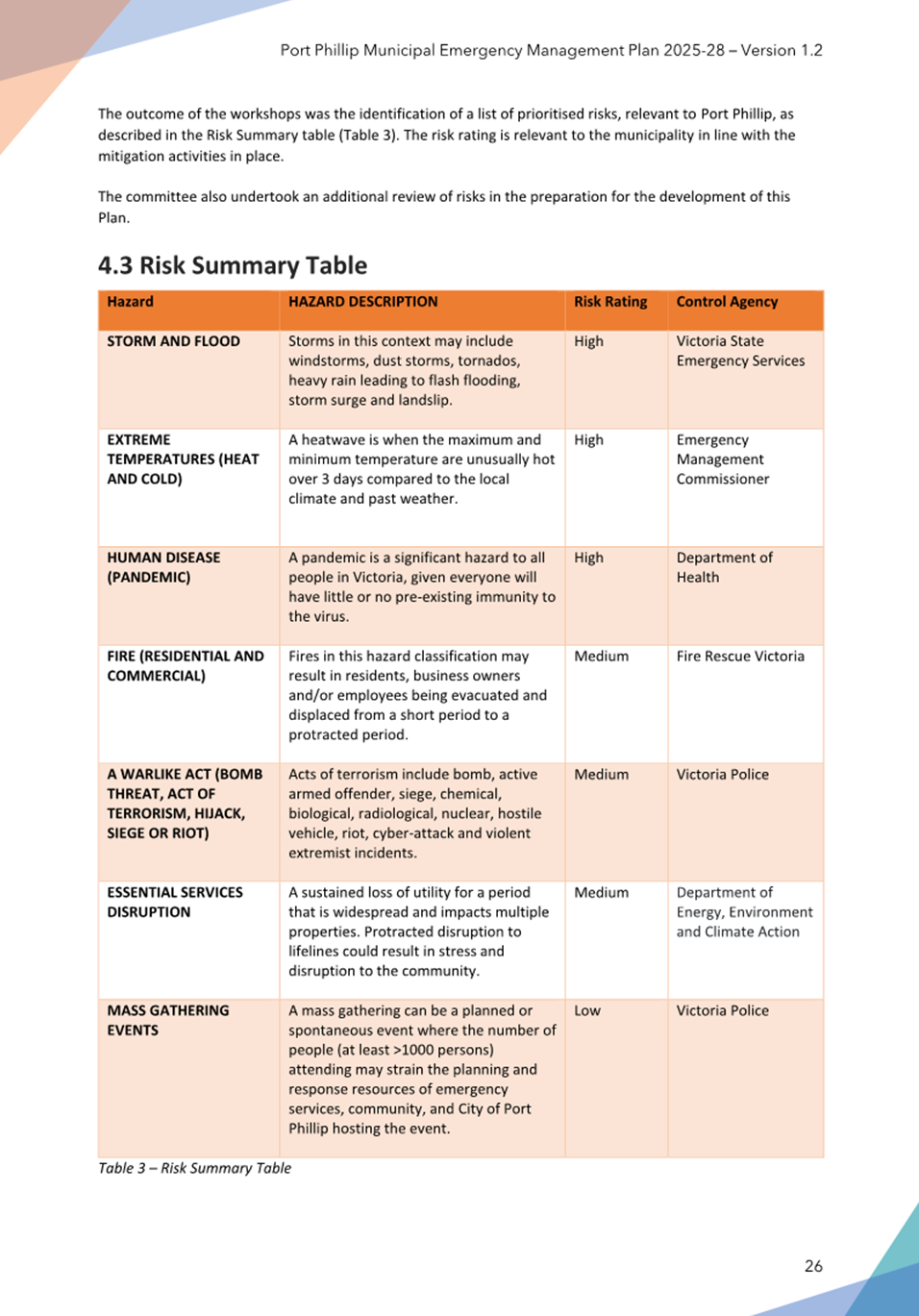
Meeting of the Port Phillip City Council
4 March 2026
|
Welcome Welcome to this Meeting of the Port Phillip City Council. Council Meetings are an important way to ensure that your democratically elected representatives are working for you in a fair and transparent way. They also allow the public to be involved in the decision-making process of Council.
About this meeting There are a few things to know about tonight’s meeting. The first page of tonight’s Agenda itemises all the different parts to the meeting. Some of the items are administrative and are required by law. In the agenda you will also find a list of all the items to be discussed this evening. Each report is written by a Council officer outlining the purpose of the report, all relevant information and a recommendation. Council will consider the report and either accept the recommendation or make amendments to it. All decisions of Council are adopted if they receive a majority vote from the Councillors present at the meeting. |
Public Question Time and Submissions Provision is made at the beginning of the meeting for general question time from members of the public. All contributions from the public will be heard at the start of the meeting during the agenda item 'Public Questions and Submissions.' Members of the public have the option to either participate in person or join the meeting virtually via Teams to ask their questions live during the meeting. If you would like to address the Council and /or ask a question on any of the items being discussed, please submit a ‘Request to Speak form’ by midday on the day of the meeting via Council’s website: Request to speak at a Council meeting - City of Port Phillip |
|
|
|
|
Meeting of the Port Phillip City Council |
To Councillors
Notice is hereby given that a Meeting of the Port Phillip City Council will be held in St Kilda Town Hall and Virtually via Teams on Wednesday, 4 March 2026 at 6:30 PM. At their discretion, Councillors may suspend the meeting for short breaks as required.
AGENDA
1 APOLOGIES
2 MINUTES OF PREVIOUS MEETINGS
Minutes of the Meeting of the Port Phillip City Council 18 February 2026.
3 Declarations of Conflicts of Interest
4 Public Question Time and Submissions
5 Councillor Question Time
6 Petitions, Joint Letters & Deputations
Nil
7 Presentation of CEO Report
Nil
8 A Healthy and Connected Community
Nil
9 An Environmentally Sustainable and Resilient City 5
9.1 Elster Creek Litter Action Plan...................................... 6
10 A Safe and Liveable City........................................... 114
10.1 Municipal Emergency Management Plan (MEMP).. 115
11 A Vibrant and Thriving Community
Nil
12 An Engaged and Empowered Community........... 175
12.1 Submission to the Victorian Government's Electric Line Clearance Review..................................................... 176
13 A Trusted and High Performing Organisation 185
13.1 Submission to the Federal Parliamentary Inquiry into Local Government Funding and Fiscal Sustainability.................................................................................. 186
13.2 Proposed Discontinuance and Sale of Laneway R3052, off Kings Way, South Melbourne Vic 3205.. 203
14 Notices of Motion........................................................ 211
14.1 Notice of Motion - Councillor Cunsolo - Hooning..... 211
14.2 Notice of Motion - Councillor Halliday - Public Active Transport Election Commitments............................. 212
15 Reports by Councillor Delegates
16 URGENT BUSINESS
17 Confidential Matters................................................ 216
The information contained in the following Council reports is considered to be Confidential Information in accordance with Section 3 of the Local Government Act 2020.
17.1 Collaborative HVHR - Parking Infringement Management Services
3(1)(a) Council business information, being information that would prejudice the Council's position in commercial negotiations if prematurely released.
Reason: This report presents the findings of the Tender Evaluation Panel for the collaborative HVHR procurement conducted jointly with the Cities of Stonnington and Glen Eira. While the evaluation process was undertaken collaboratively, each Council is required to make its own independent decision regarding the tender outcome. To protect the integrity of the procurement process and prevent any Council’s decision from influencing the others, this information must remain confidential until all three Councils have formally awarded the tender.
17.2 HR Solution Project
3(1)(a) Council business information, being information that would prejudice the Council's position in commercial negotiations if prematurely released.
Reason: This report is required to remain confidential as it forms part of an active procurement and tender process for selcting a new HR system. Releasing its contents at this stage could disadvantage Council and may compromise the integrity of Council’s procurement activities.
17.3 South Melbourne Town Hall – Funding and Contract Variation
3(1)(a) Council business information, being information that would prejudice the Council's position in commercial negotiations if prematurely released.
Reason: This report contains contractural information, including project and construction contract contingency provisions, that if released at this time would disadvantage Council in its ability to manage its construction contract in the best interests of the community.
1. Apologies
2. Minutes of Previous Meetings
|
That the minutes of the Meeting of the Port Phillip City Council held on 18 February 2026 be confirmed. |
3. Declarations of Conflicts of Interest
4. Public Question Time and Submissions
5. Councillor Question Time
6. Petitions, Joint Letters & Deputations
7. Presentation of CEO Report
8. A Healthy and Connected Community
9. An Environmentally Sustainable and Resilient City
9.1 Elster Creek Litter Action Plan............................ 6
Meeting of the Port Phillip City Council
4 March 2026
|
Elster Creek Litter Action Plan |
|
|
Executive Member: |
Brian Tee, General Manager, City Development |
|
PREPARED BY: |
Julian Donlen, Principal Sustainability Partnerships Officer |
1. PURPOSE
1.1 To
present the final Elster Creek Litter Action Plan (ECLAP) for Council
endorsement following community engage ment.
ment.
2. EXECUTIVE Summary
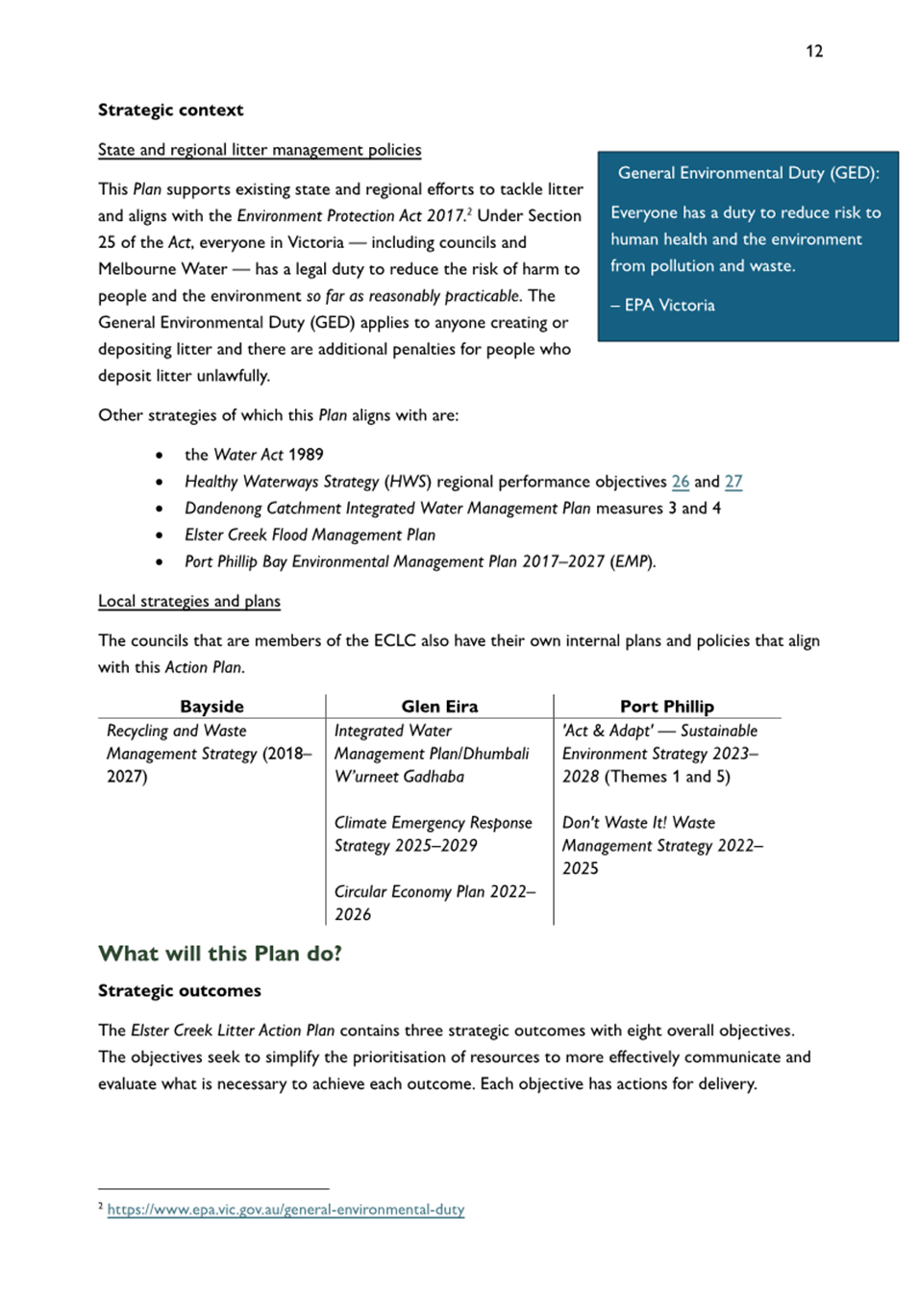
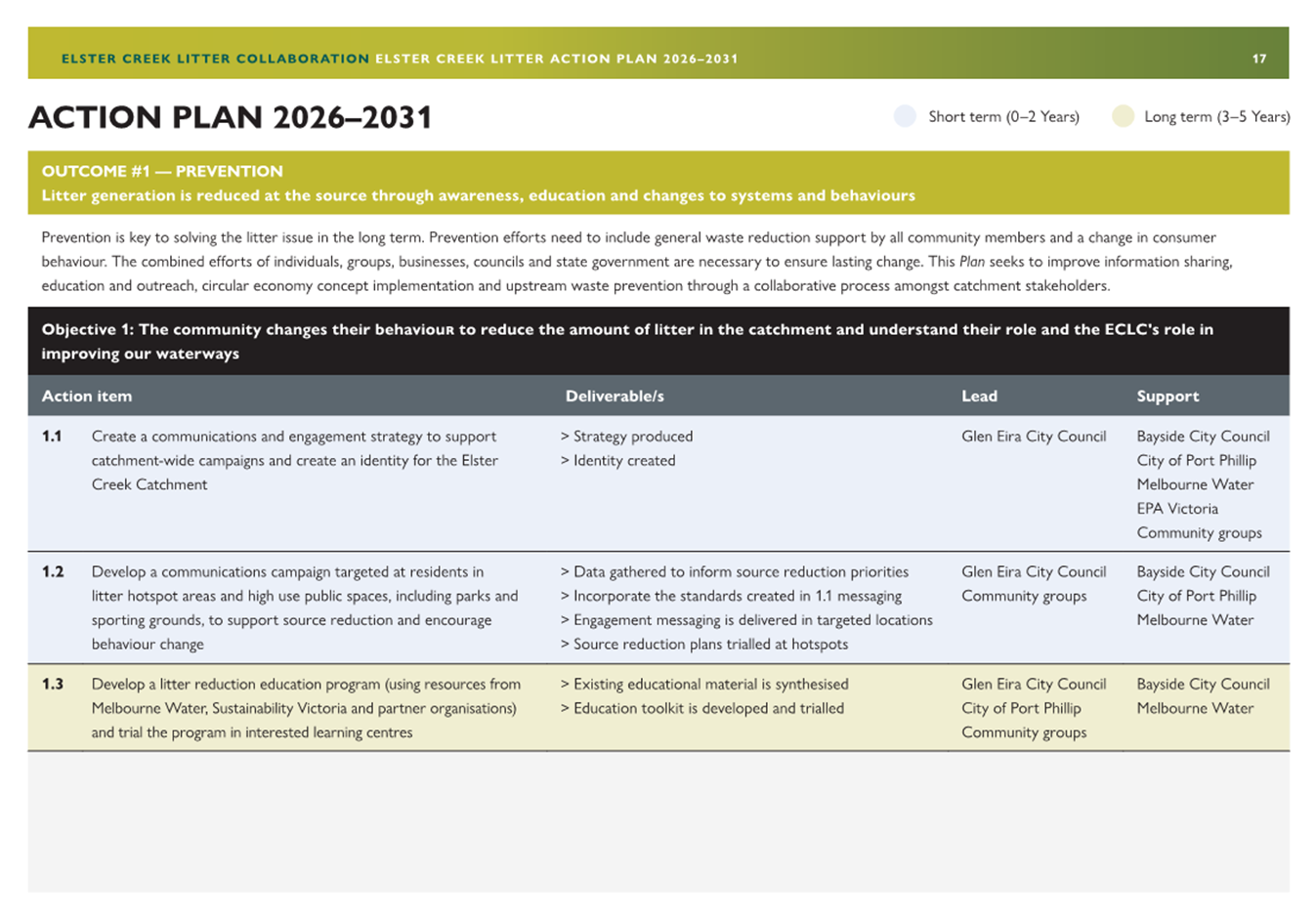
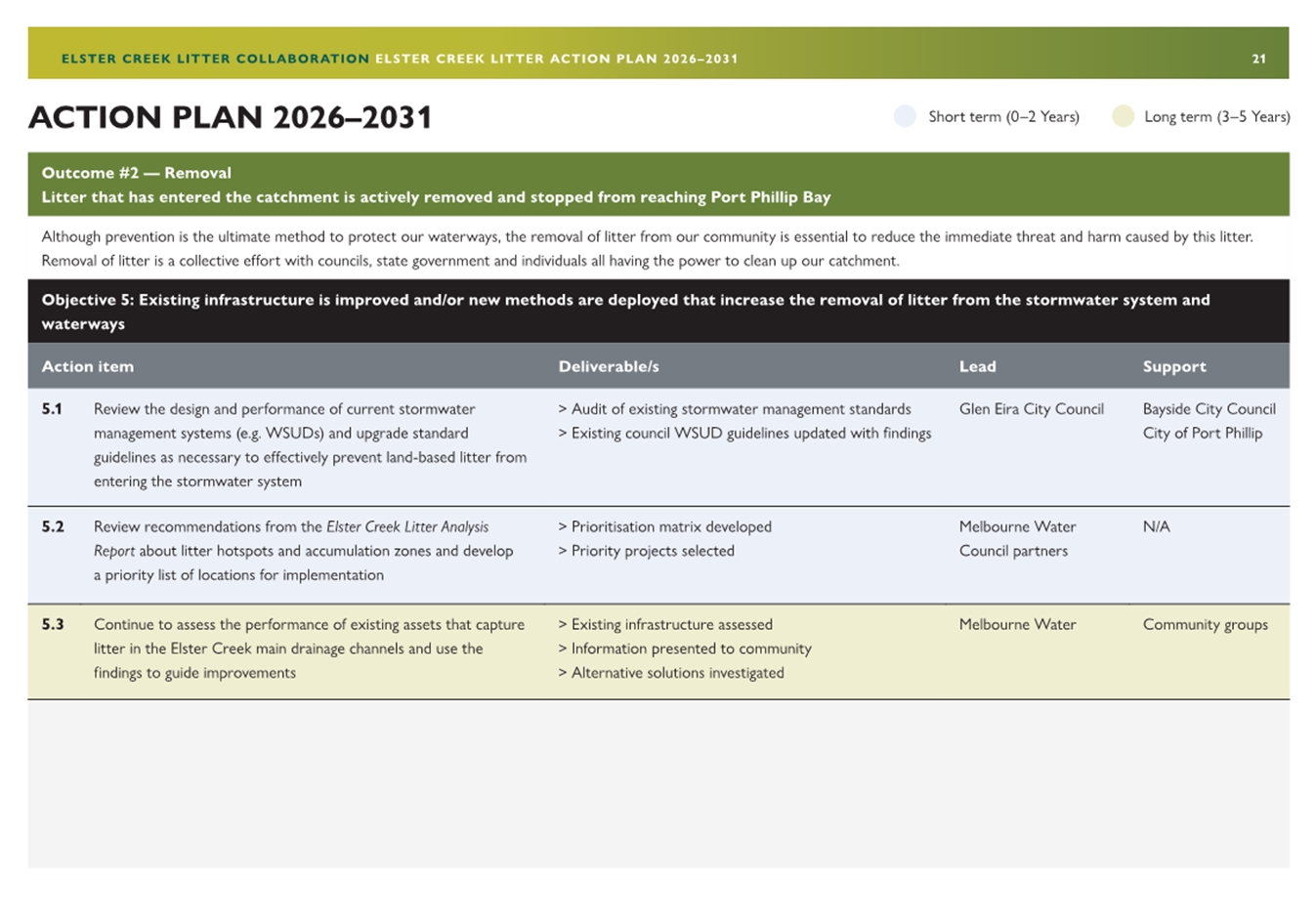
2.1 The draft Elster Creek Litter Action Plan (ECLAP) represents a collaborative, catchment-wide approach to reducing litter in the Elster Creek catchment through source reduction, infrastructure improvements, and ongoing monitoring.
2.2 Developed with input from key stakeholders and community groups, the Action Plan aligns with Council’s strategic objectives and climate response commitments.
2.3 Following a period of community engagement, changes have been made to improve the final draft Action Plan, which is presented for endorsement.
|
That Council: 3.1 Notes the Community Engagement report on the draft Elster Creek Litter Action Plan. (Attachment 1). 3.2 Notes the changes to the draft Elster Creek Litter Action Plan following community engagement. 3.3 Thanks the community members involved in the development of the Action Plan, and the group of organisations in the Elster Creek Litter Collaboration. 3.4 Endorses the Elster Creek Litter Action Plan (Attachment 3) for implementation. 3.5 Authorises the Chief Executive Officer, or their delegate to make minor amendments to the plan that do not materially alter it’s the plans intent. |
4. KEY POINTS/ISSUES
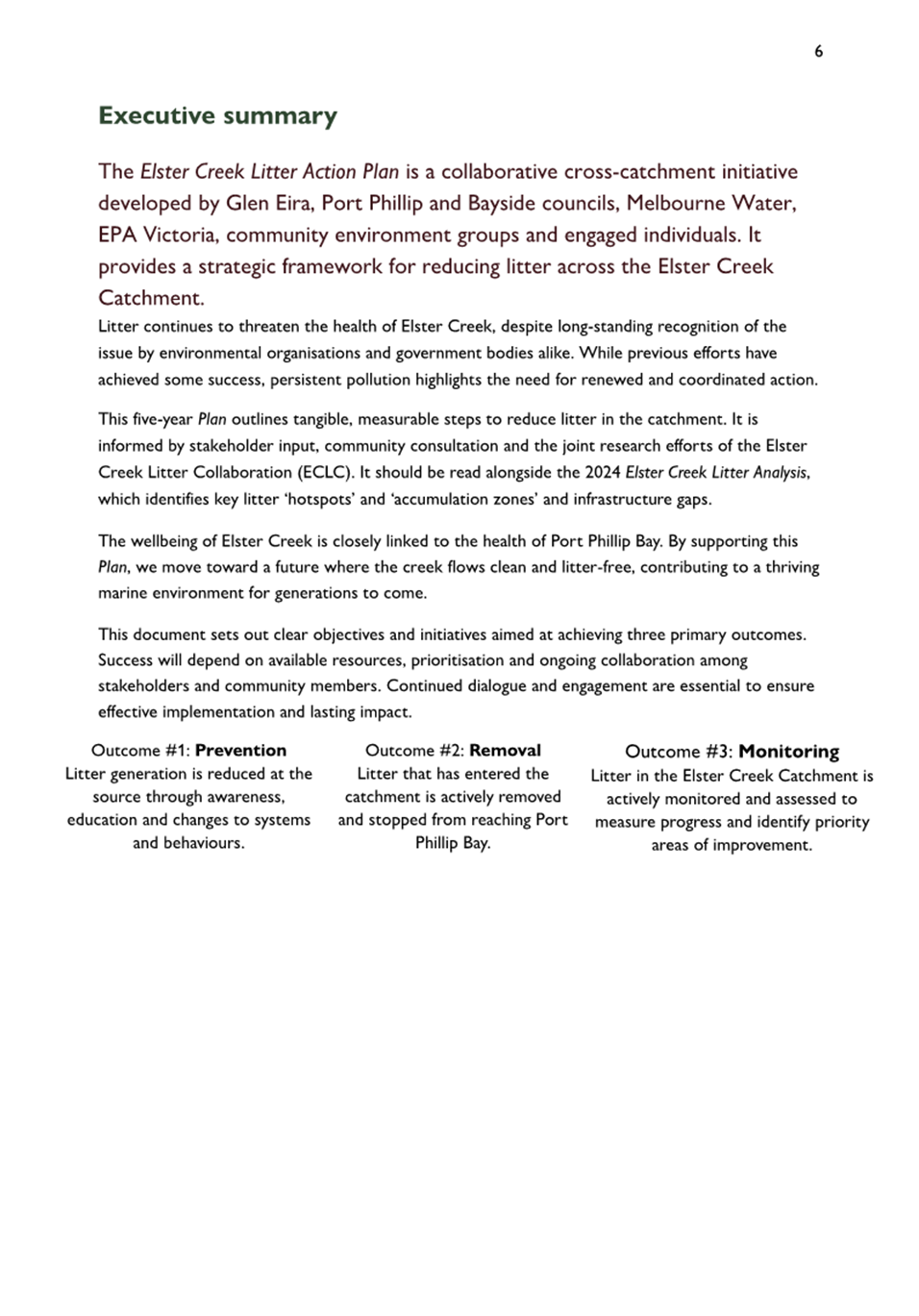
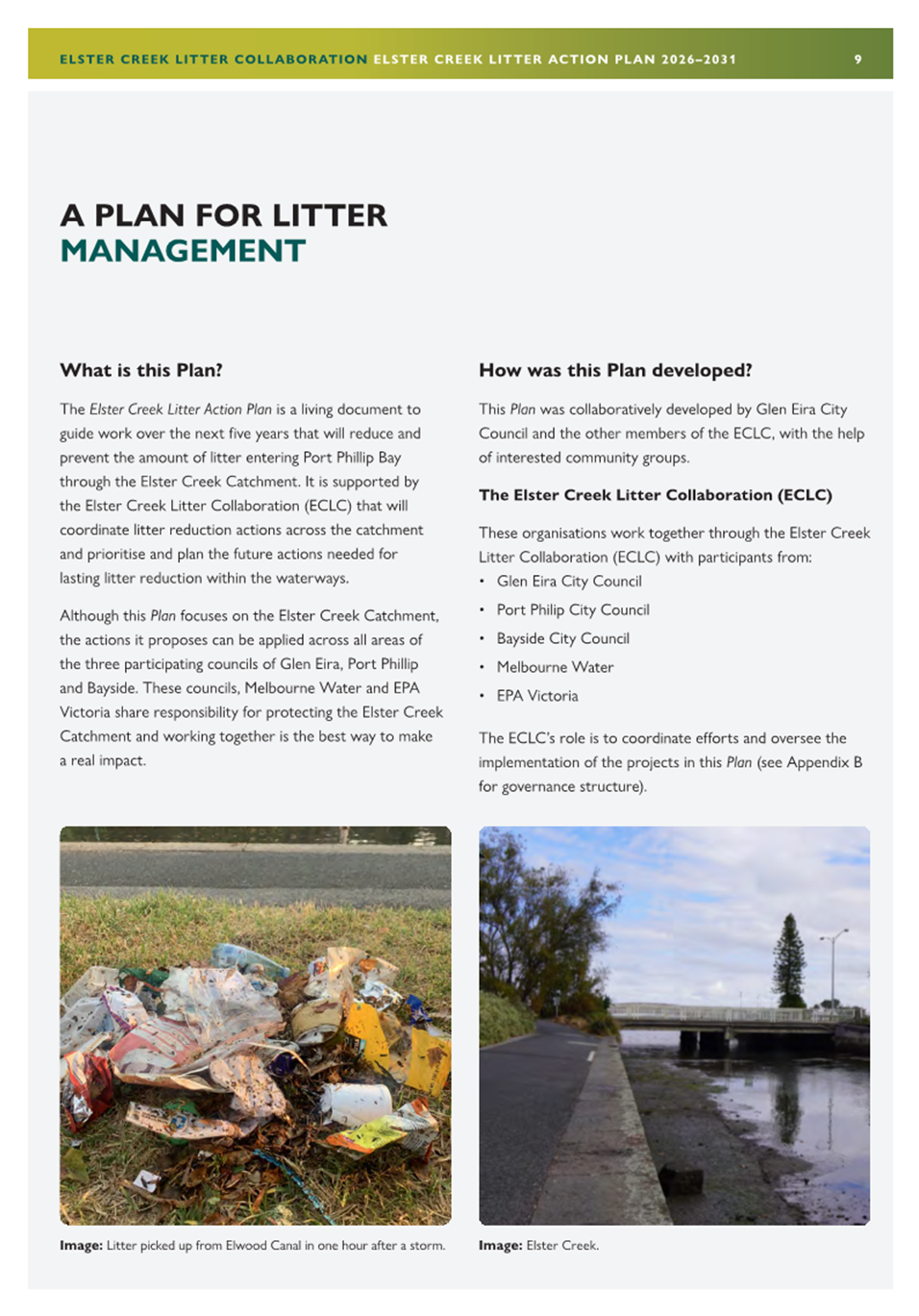
4.1 The Elster Creek Litter Action Plan (ECLAP) has been developed in response to increasing community concern about litter generation and accumulation within the Elster Creek Catchment.
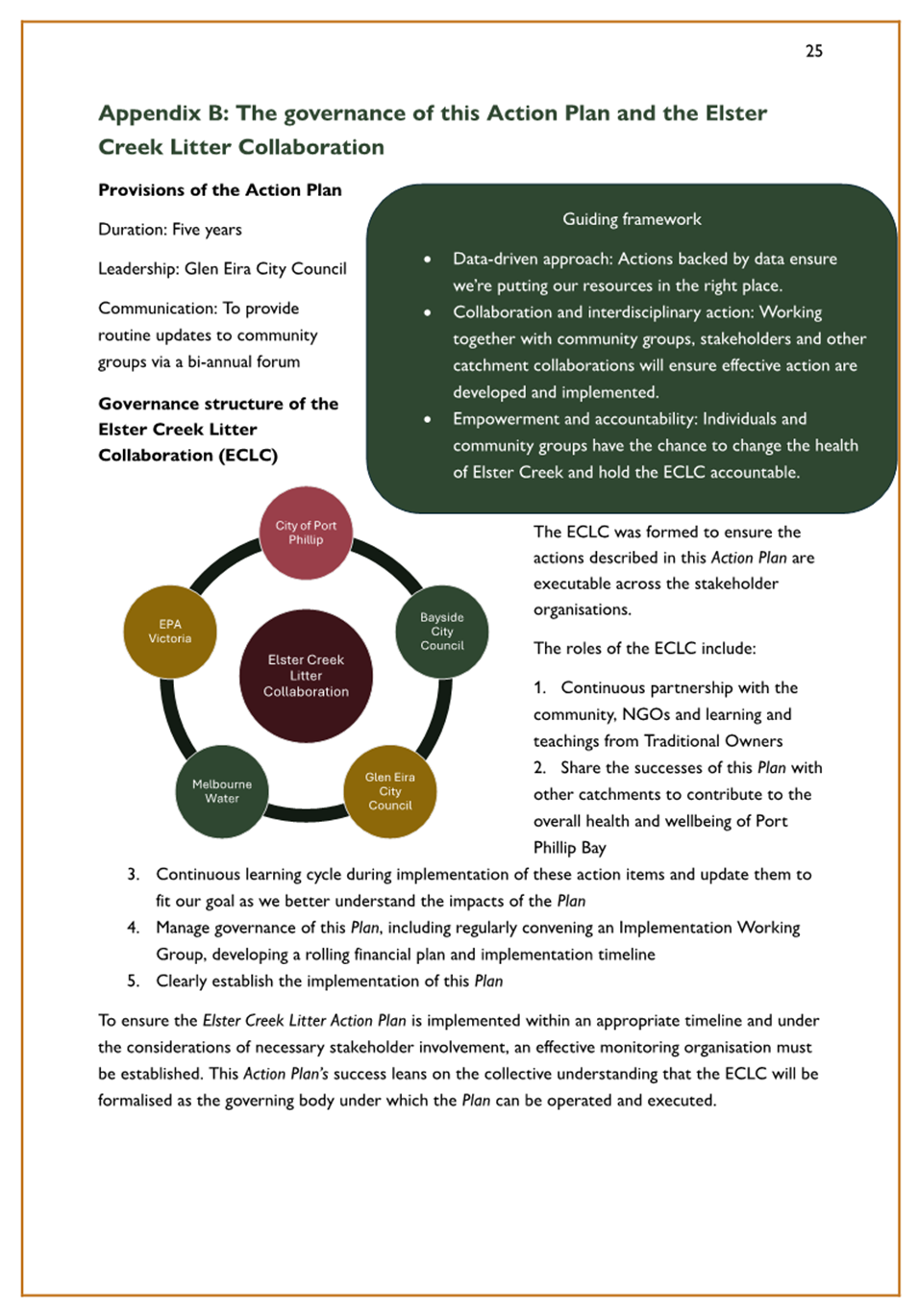
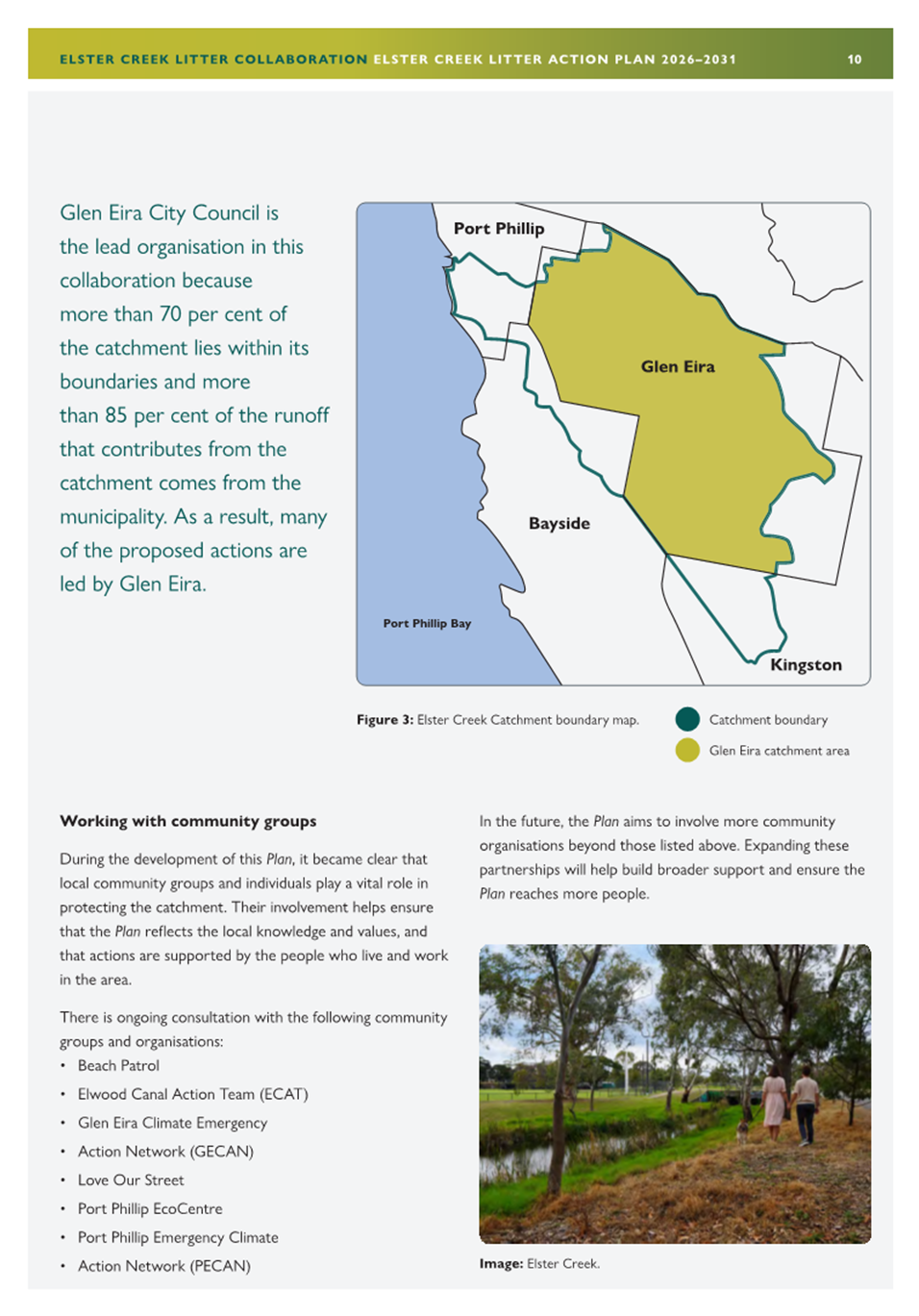
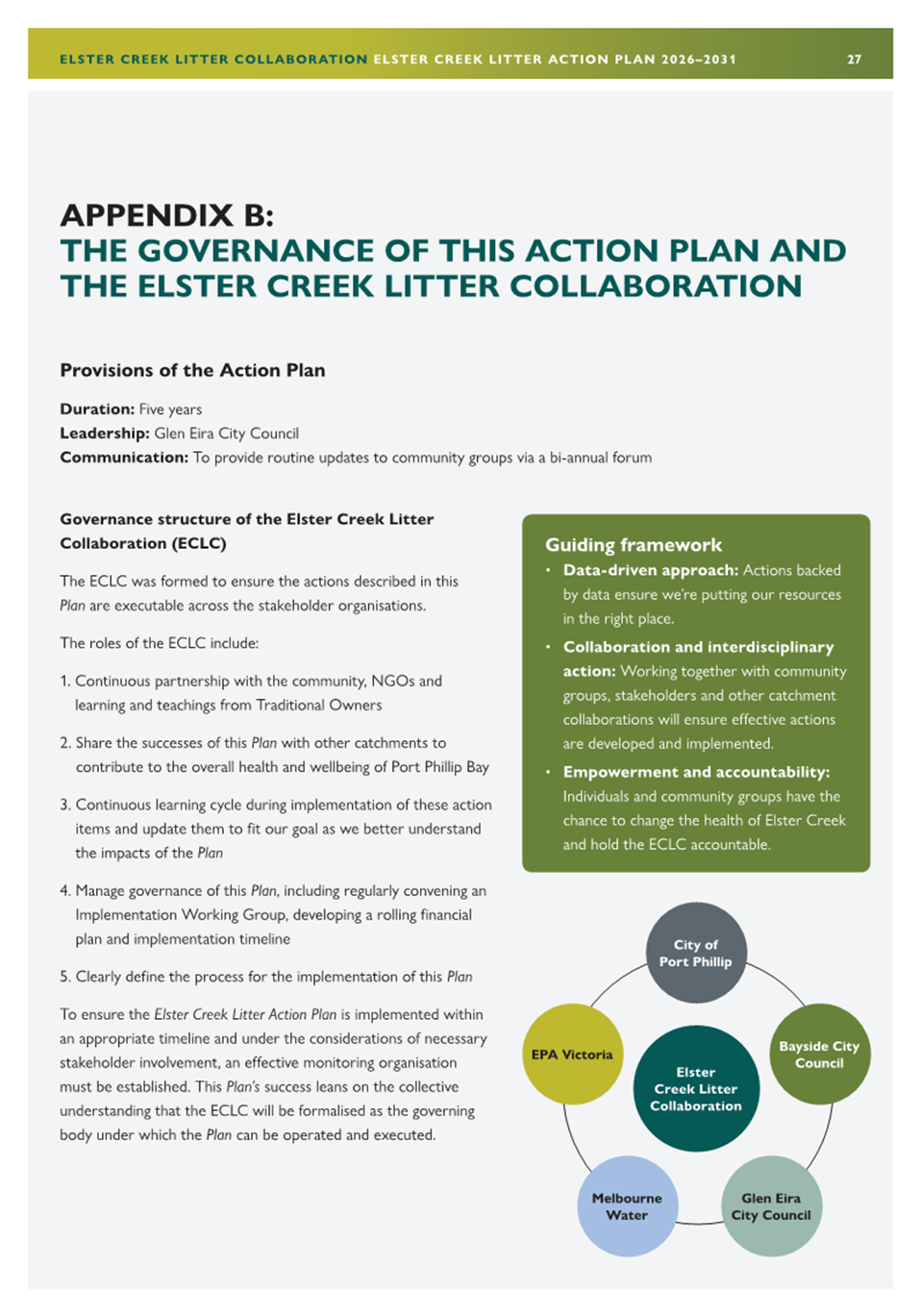
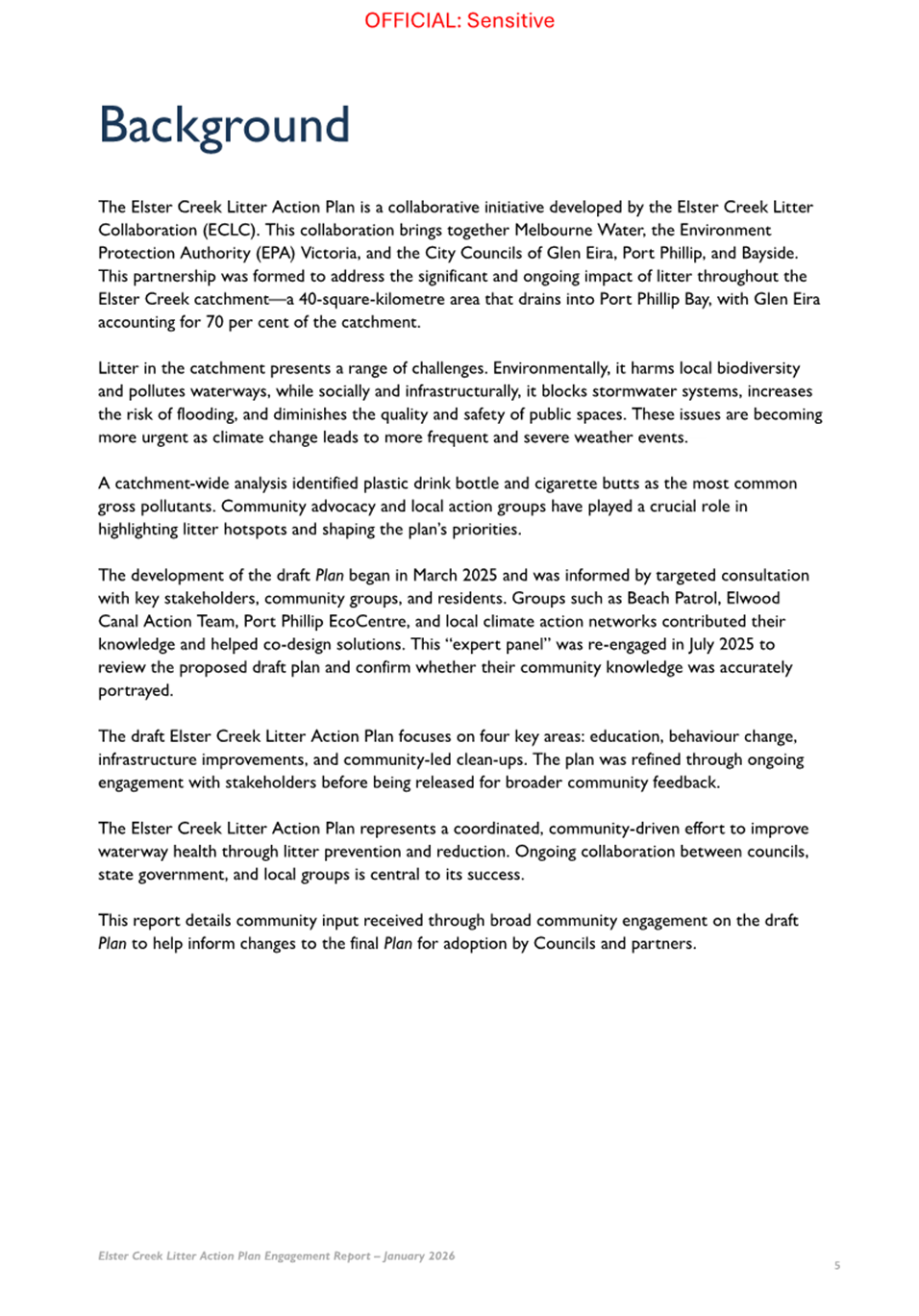
4.2 This five-year plan is a collaborative initiative developed in partnership with Melbourne Water, Bayside City Council, Glen Eira City Council, City of Port Phillip, EPA Victoria, and community groups.
4.3 The ECLAP sets out a strategic framework to reduce litter at its source, actively remove litter from the catchment, and monitor progress through robust data collection and community involvement.
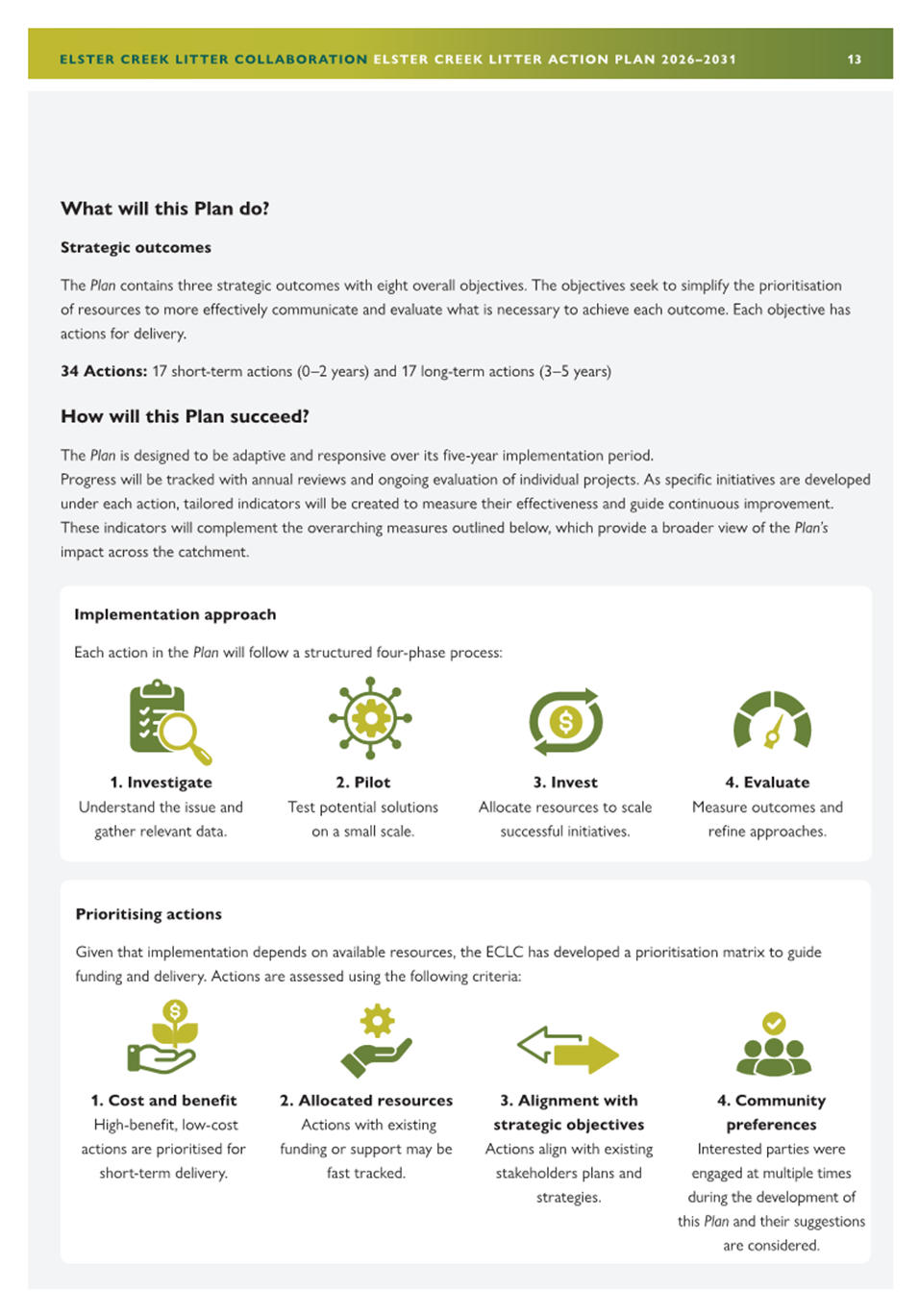
4.4 The 5-year Elster Creek Litter Action Plan has three outcomes:
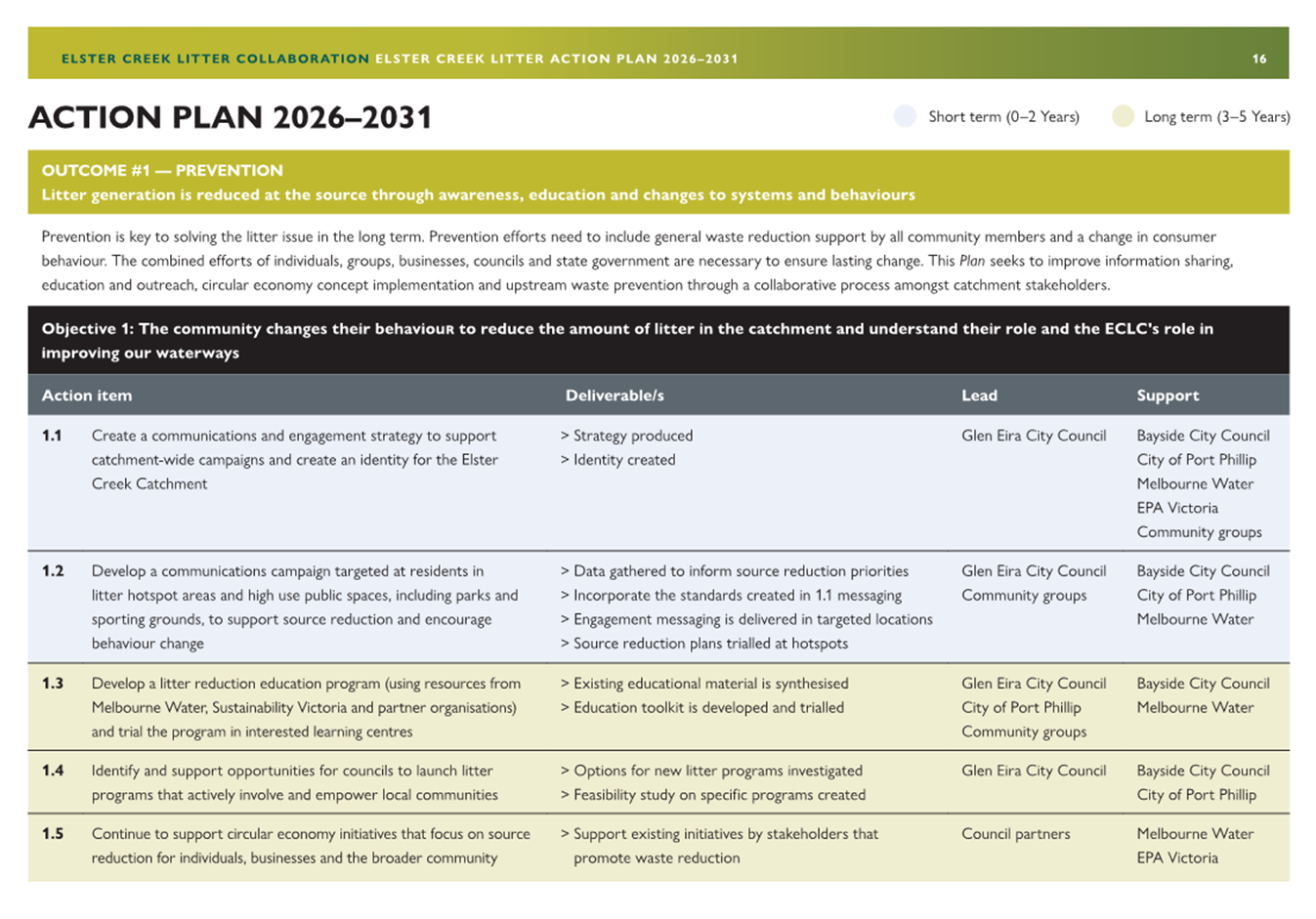
1. Prevention
Litter generation is reduced at the source through awareness, education, and
changes to systems and behaviours.
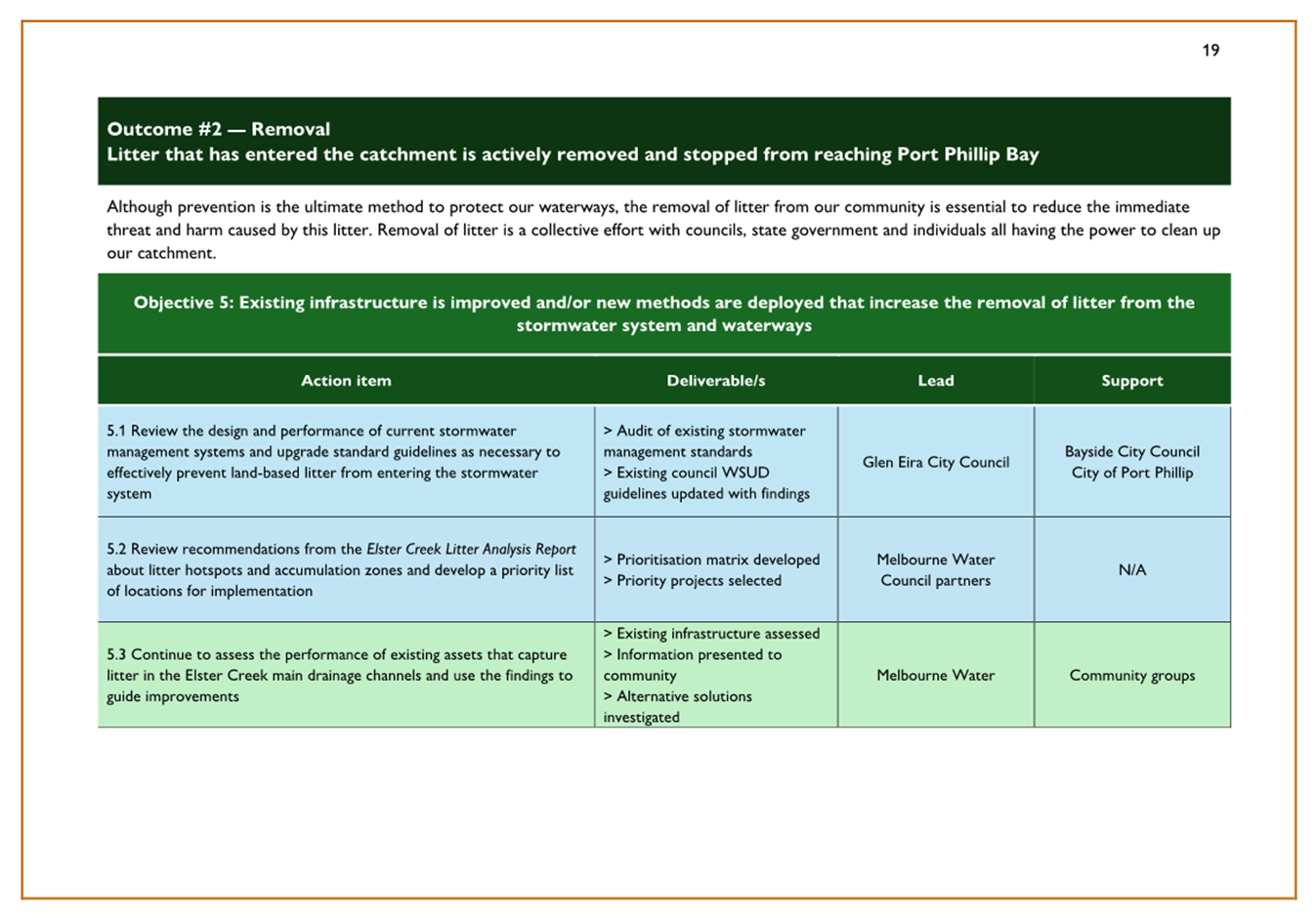
2. Removal
Litter that has entered the catchment is actively removed and managed to stop
it reaching Port Phillip Bay.
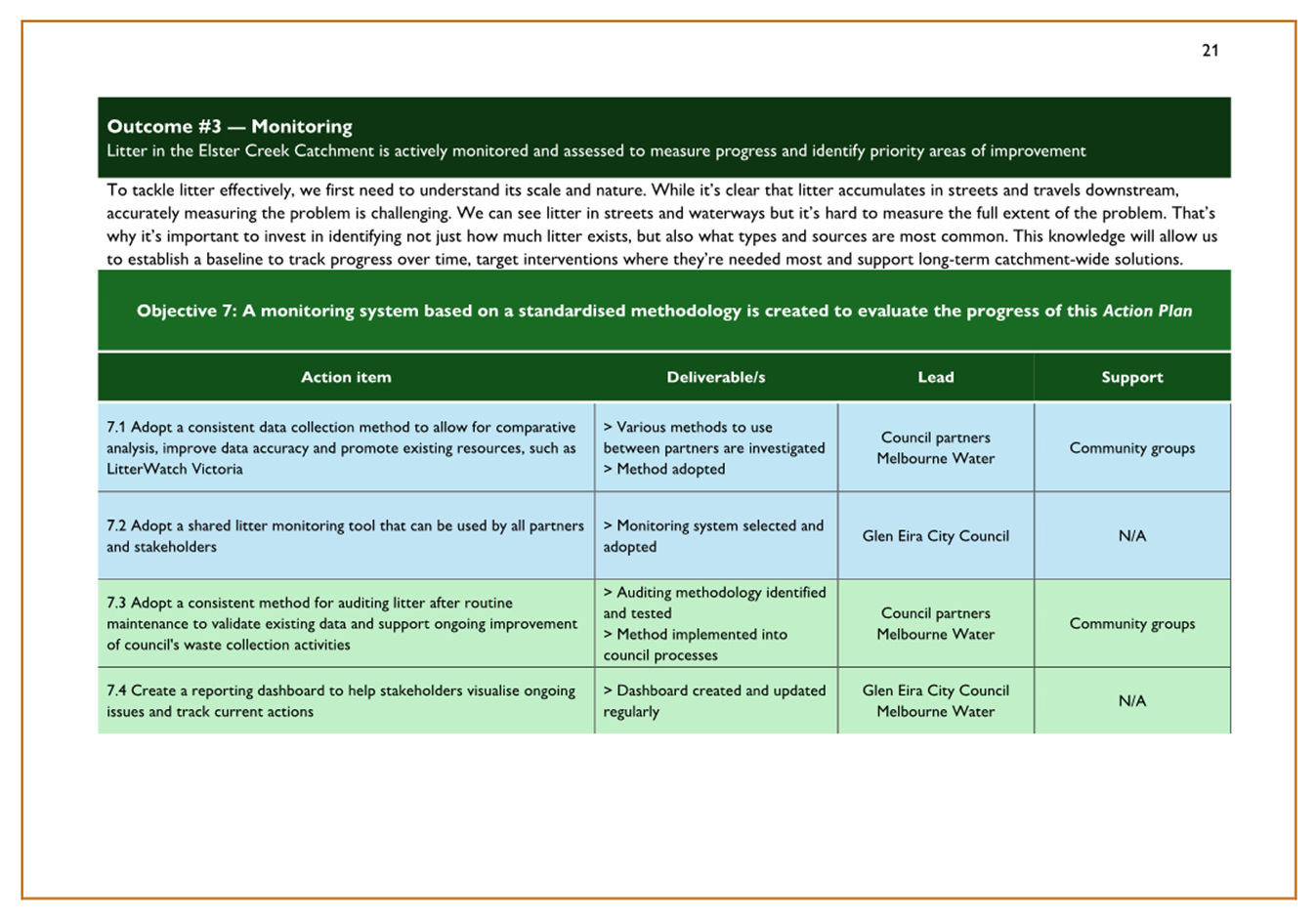
3. Monitoring
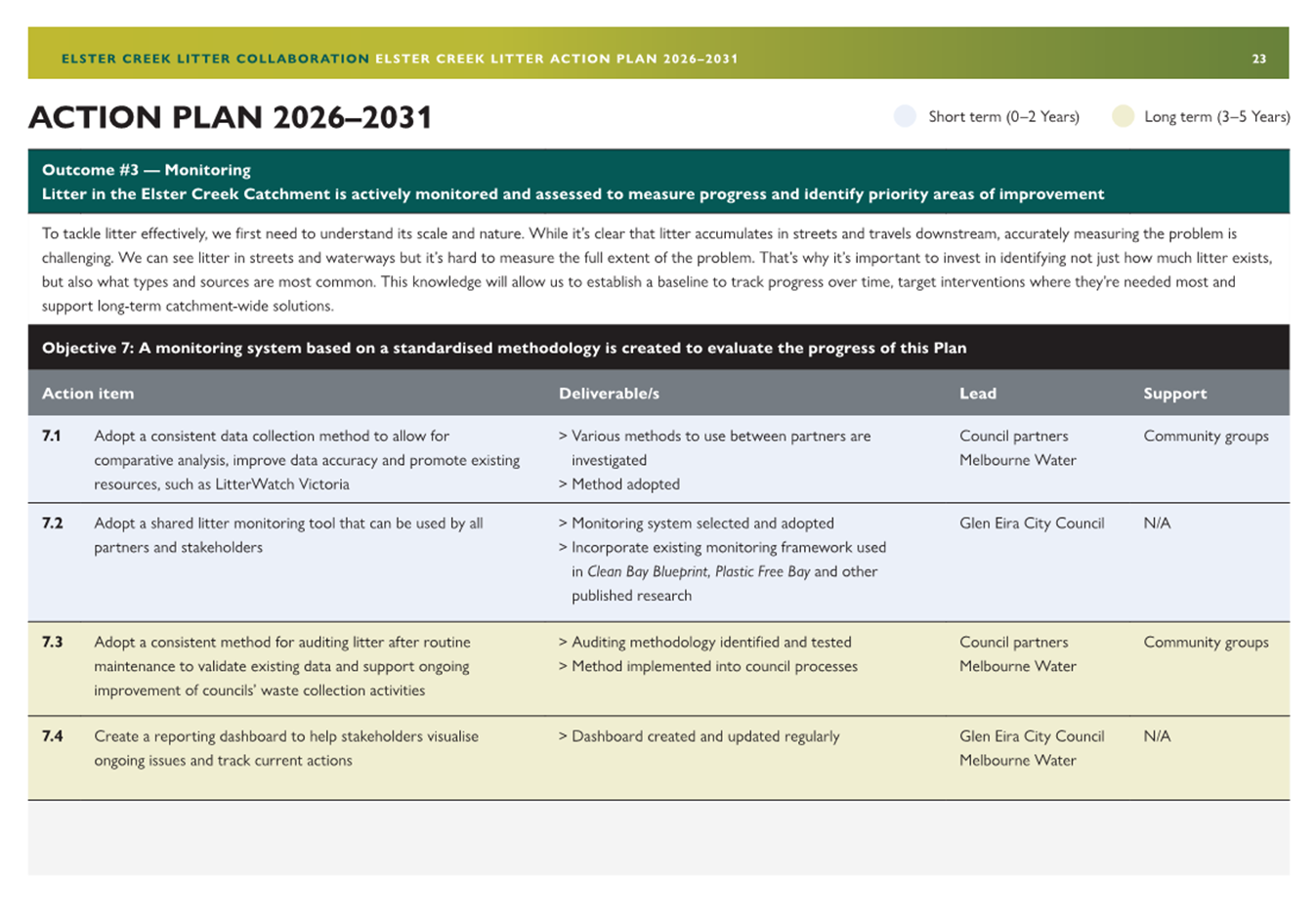
Litter in the Elster Creek Catchment is actively monitored and assessed to
measure progress and identify priority areas of improvement.
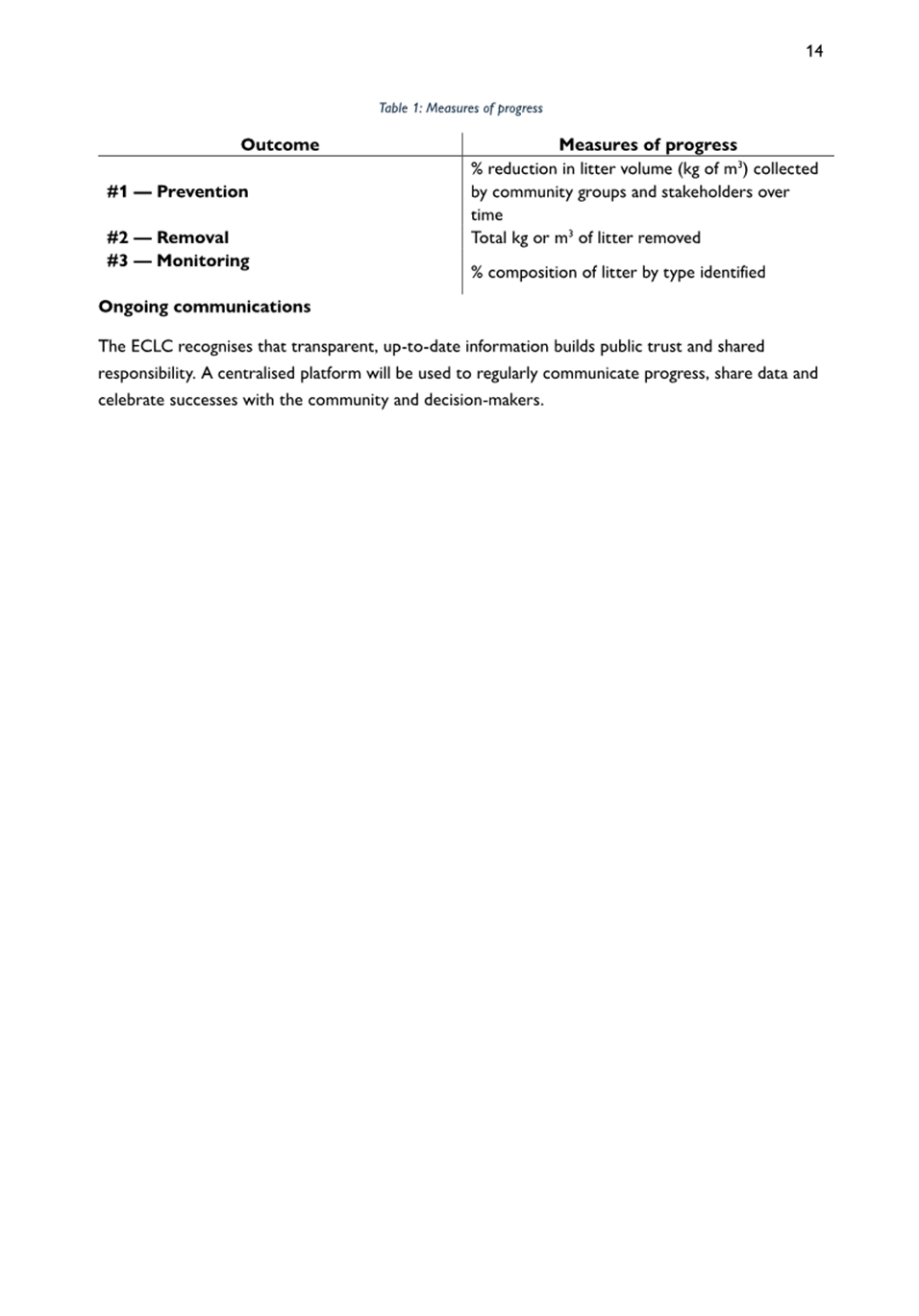
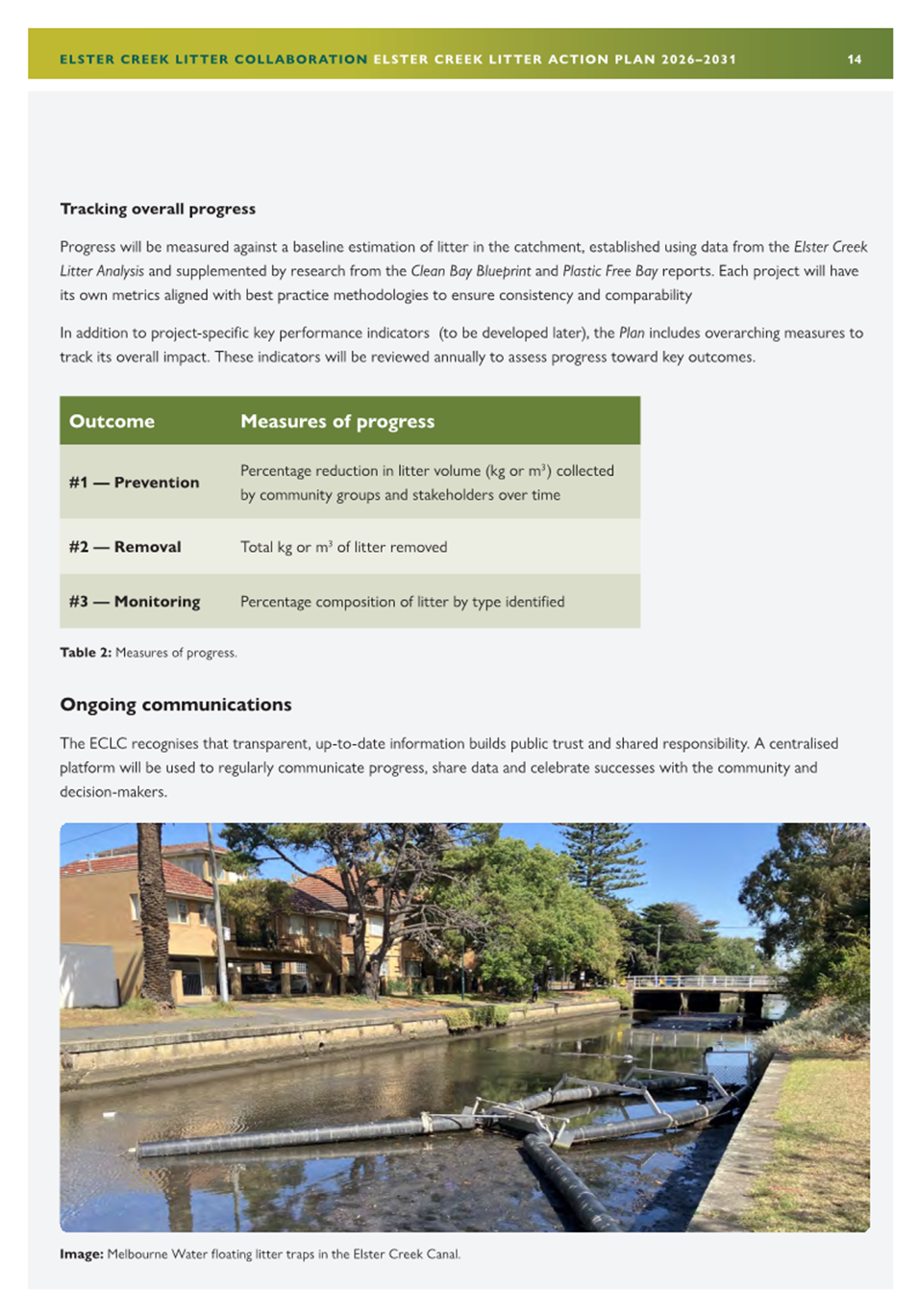
4.5 Progress on the three outcomes of the ECLAP will be measured by:
1. Prevention
% reduction in litter volume (kg or m3) collected by community
groups and stakeholders
2. Removal
Total kg or m3 of litter removed
3. Monitoring
% composition of litter by type identified
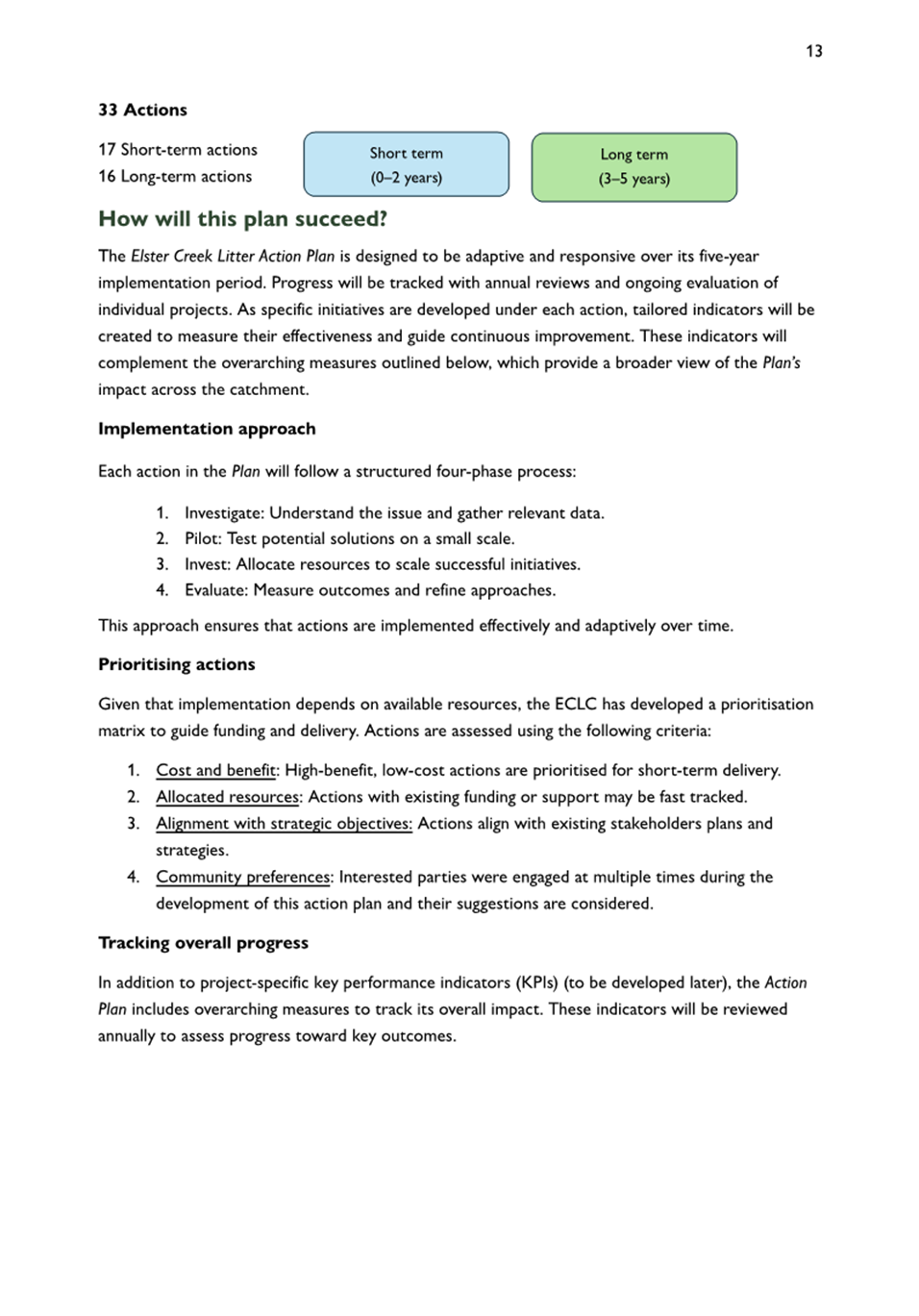
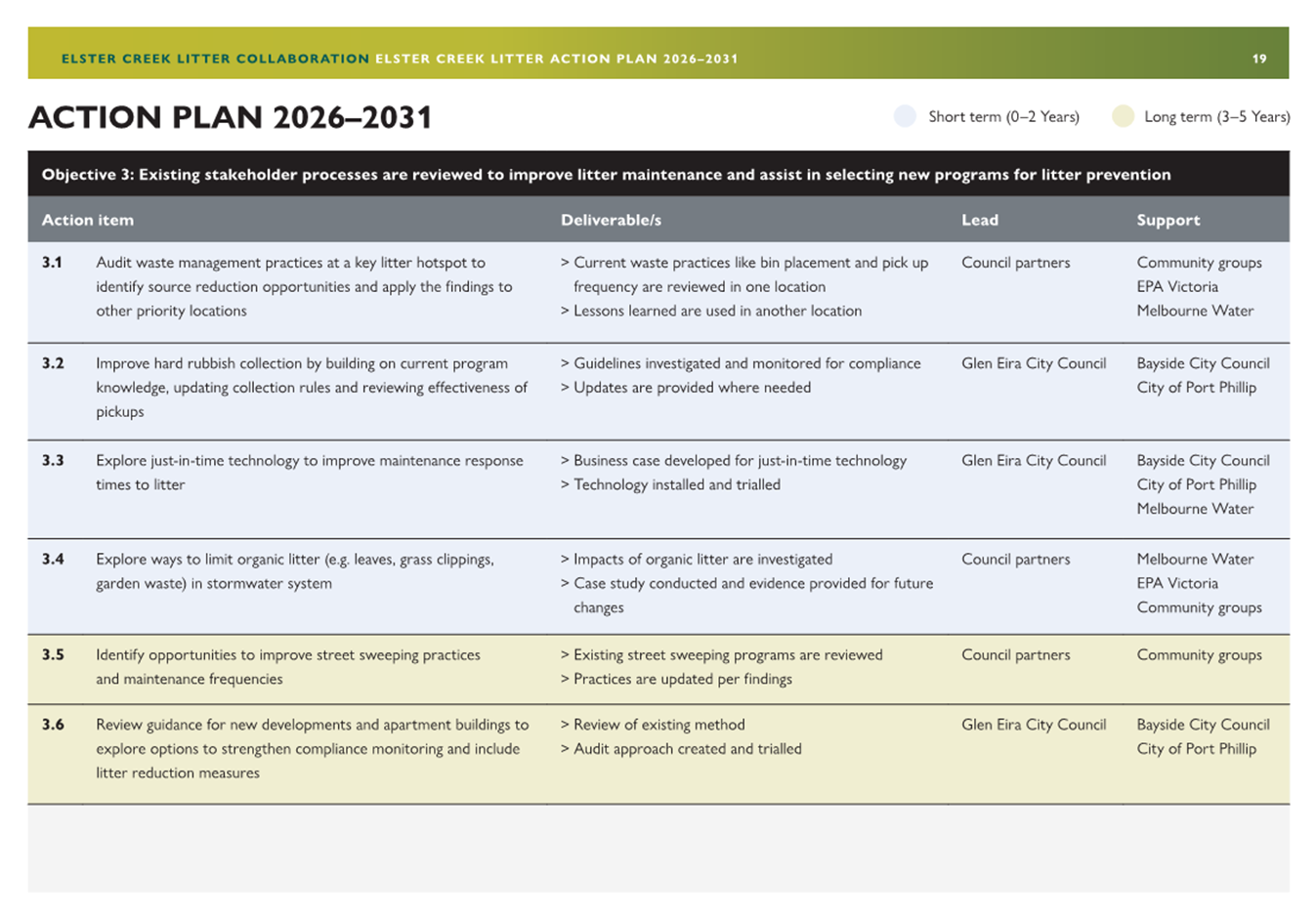
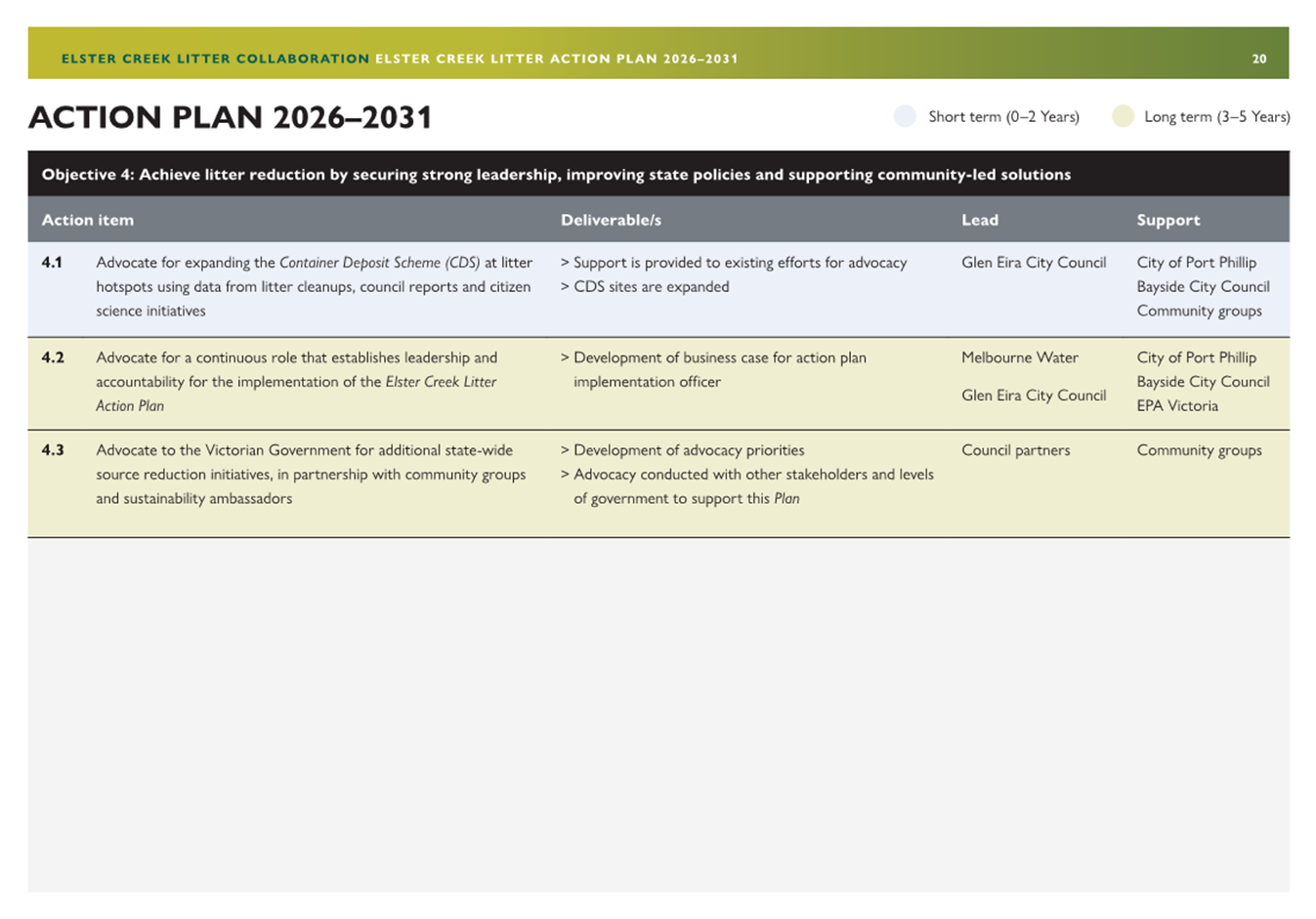
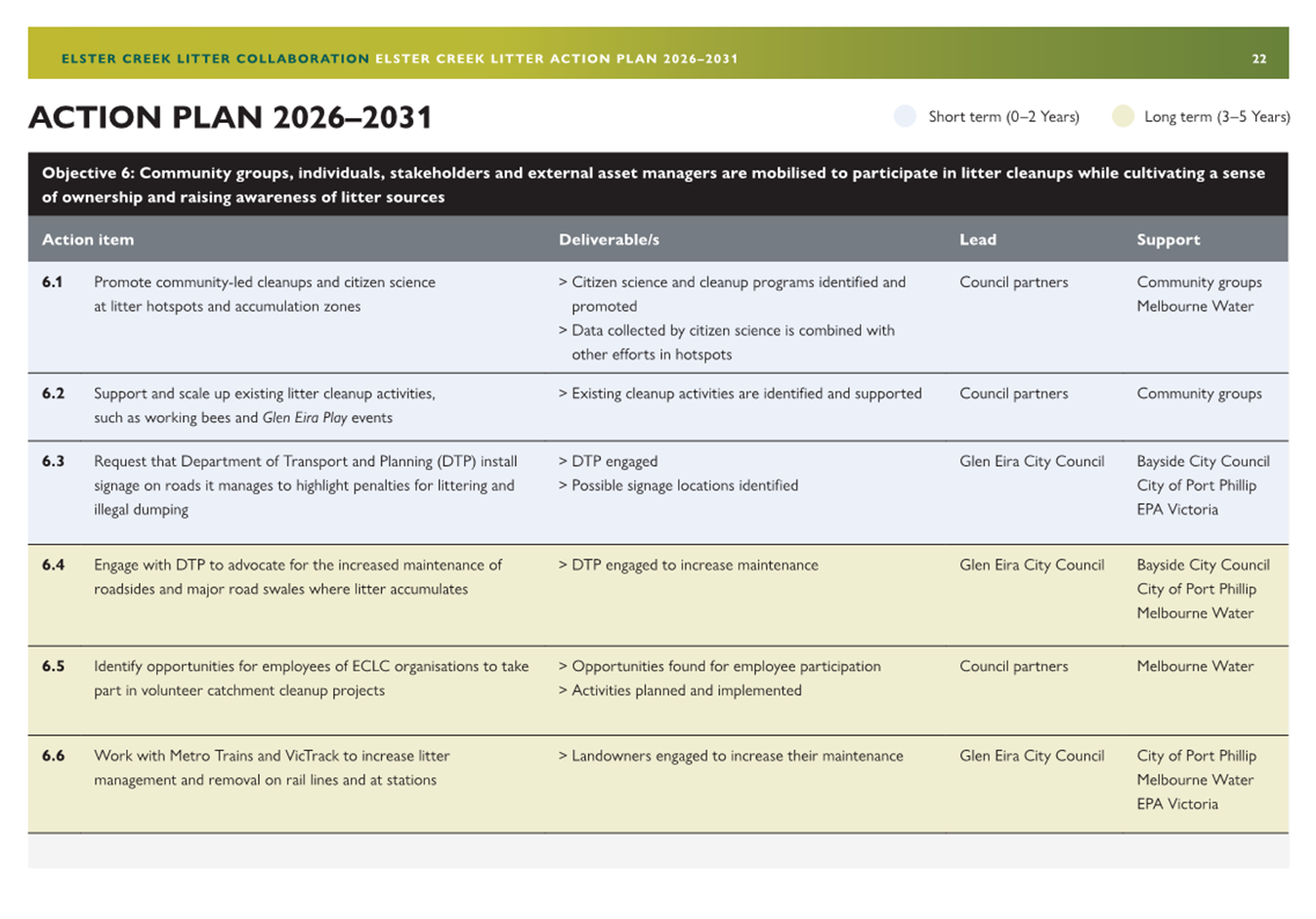
4.6 There are 34 actions in the draft Action Plan including 17 short-term (0-2 years) and 17 long-term (3-5 years).
4.7 Responsibility for actions are divided between different stakeholders. Most actions in the ECLAP that are infrastructure related are led by City of Glen Eira and Melbourne Water. Other actions involve community education, advocacy and process improvement.
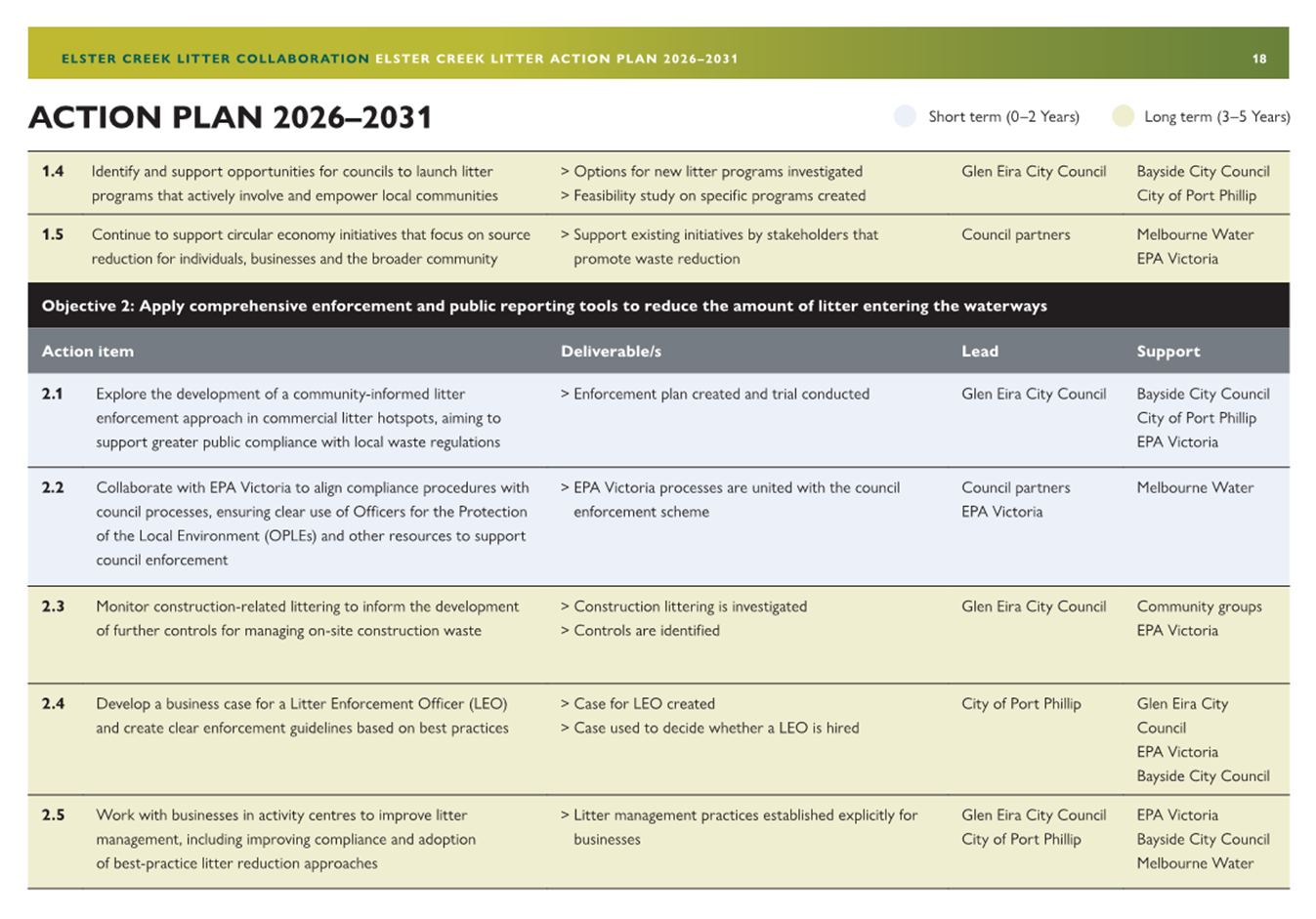
4.8 Key actions led by City of Port Phillp are:
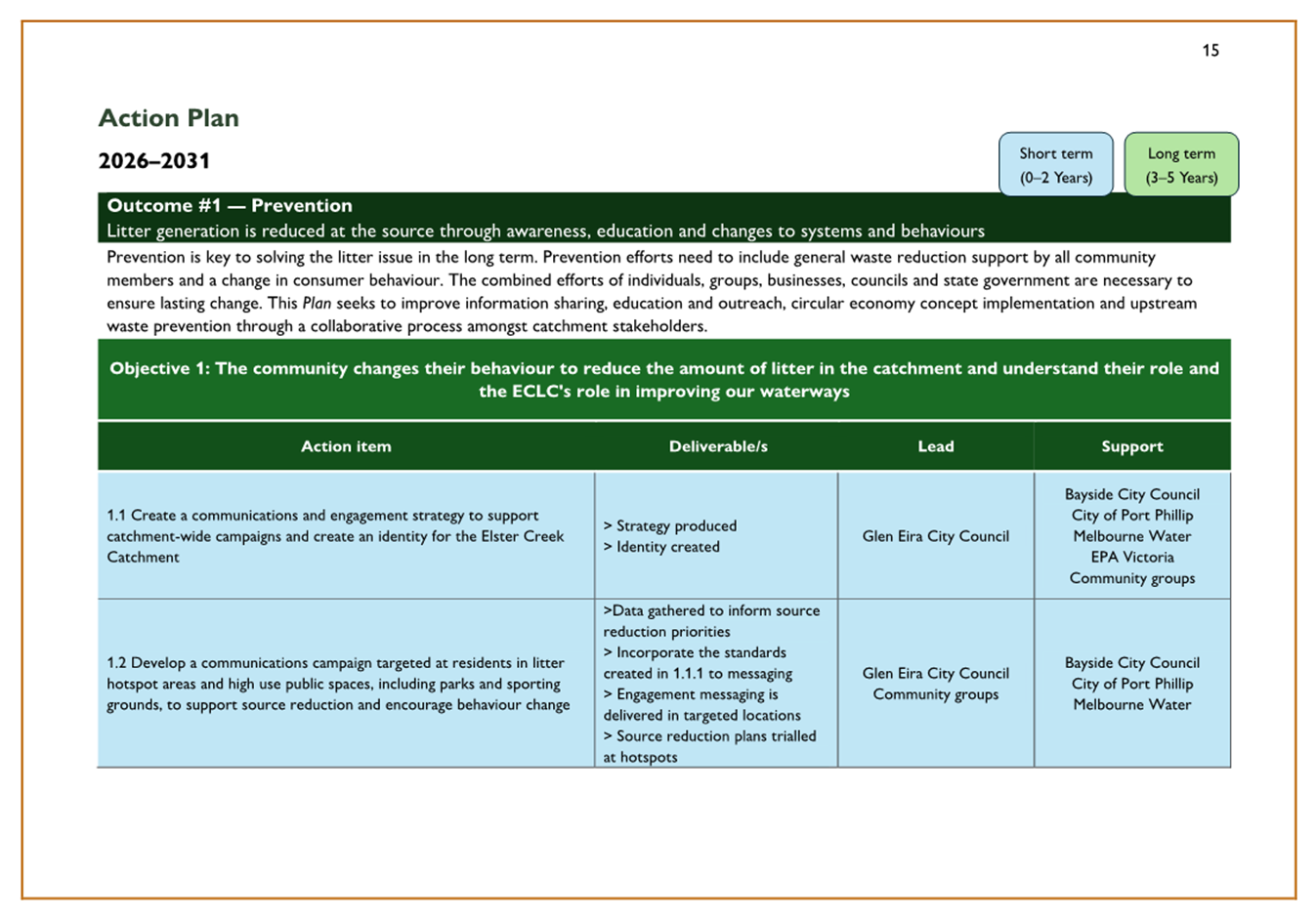
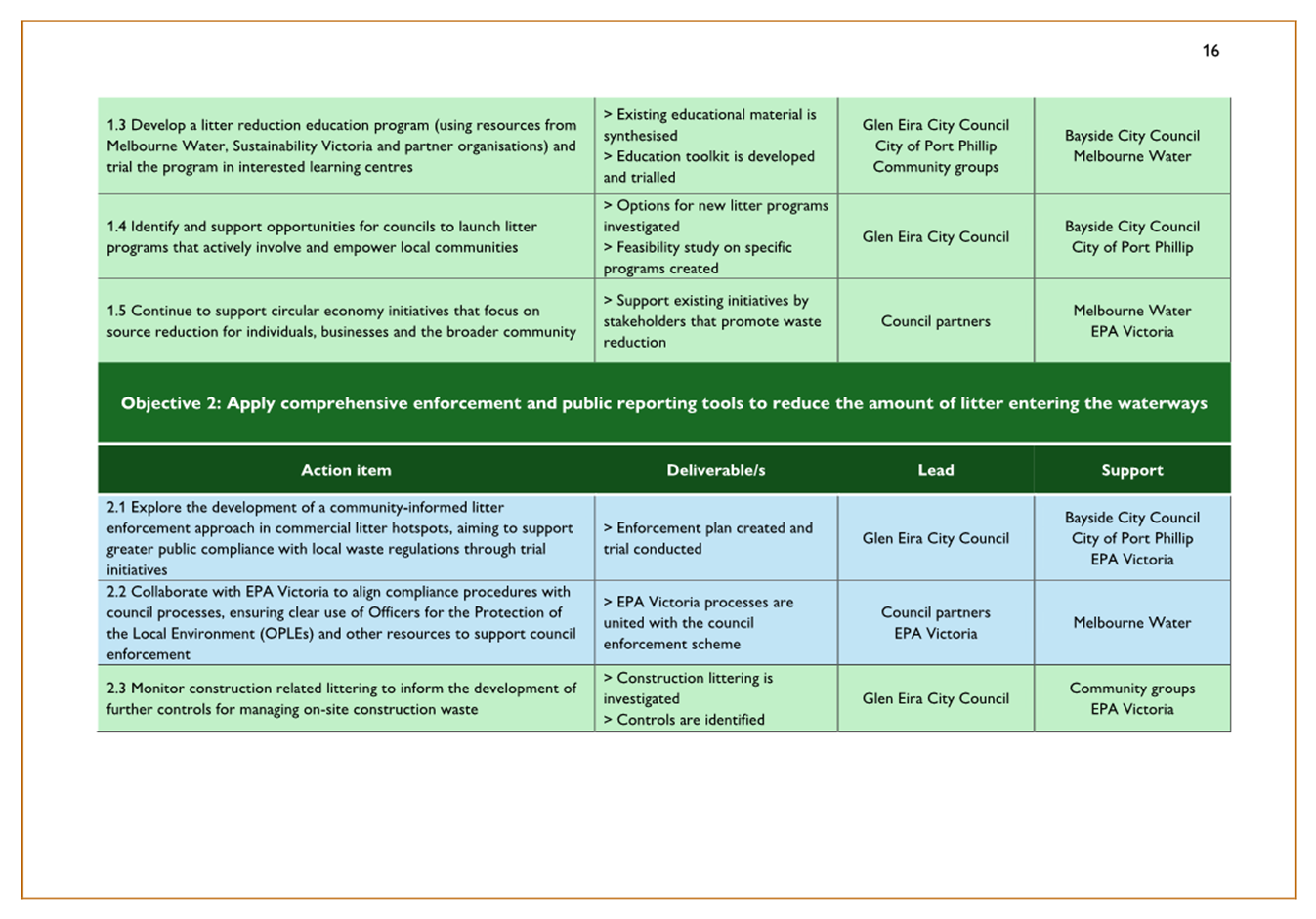
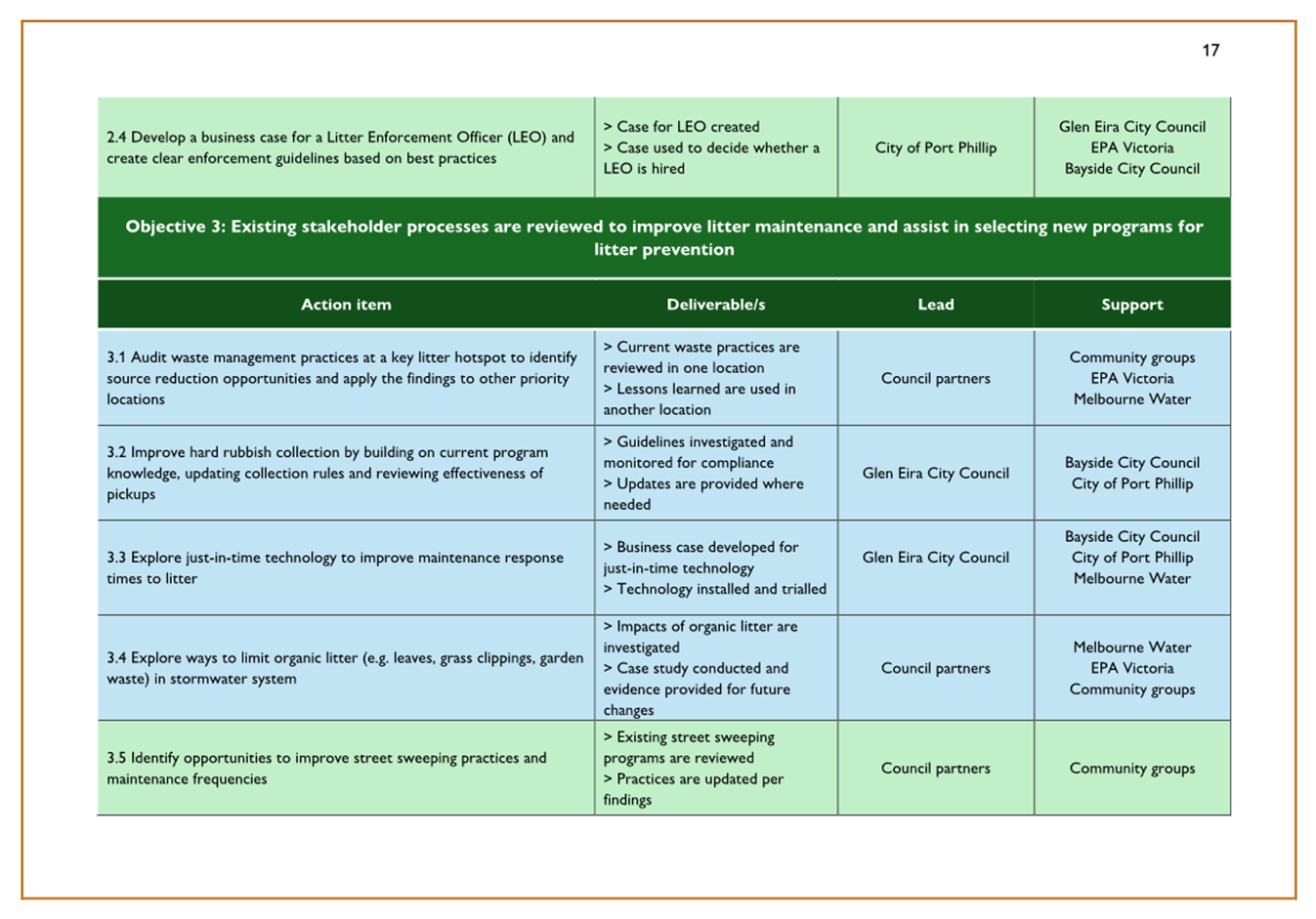
· 2.4 Develop a business case for a Litter Enforcement Officer (LEO) and create clear enforcement guidelines based on best practices.
· 3.5 Identify opportunities to improve street sweeping practices and maintenance frequencies.
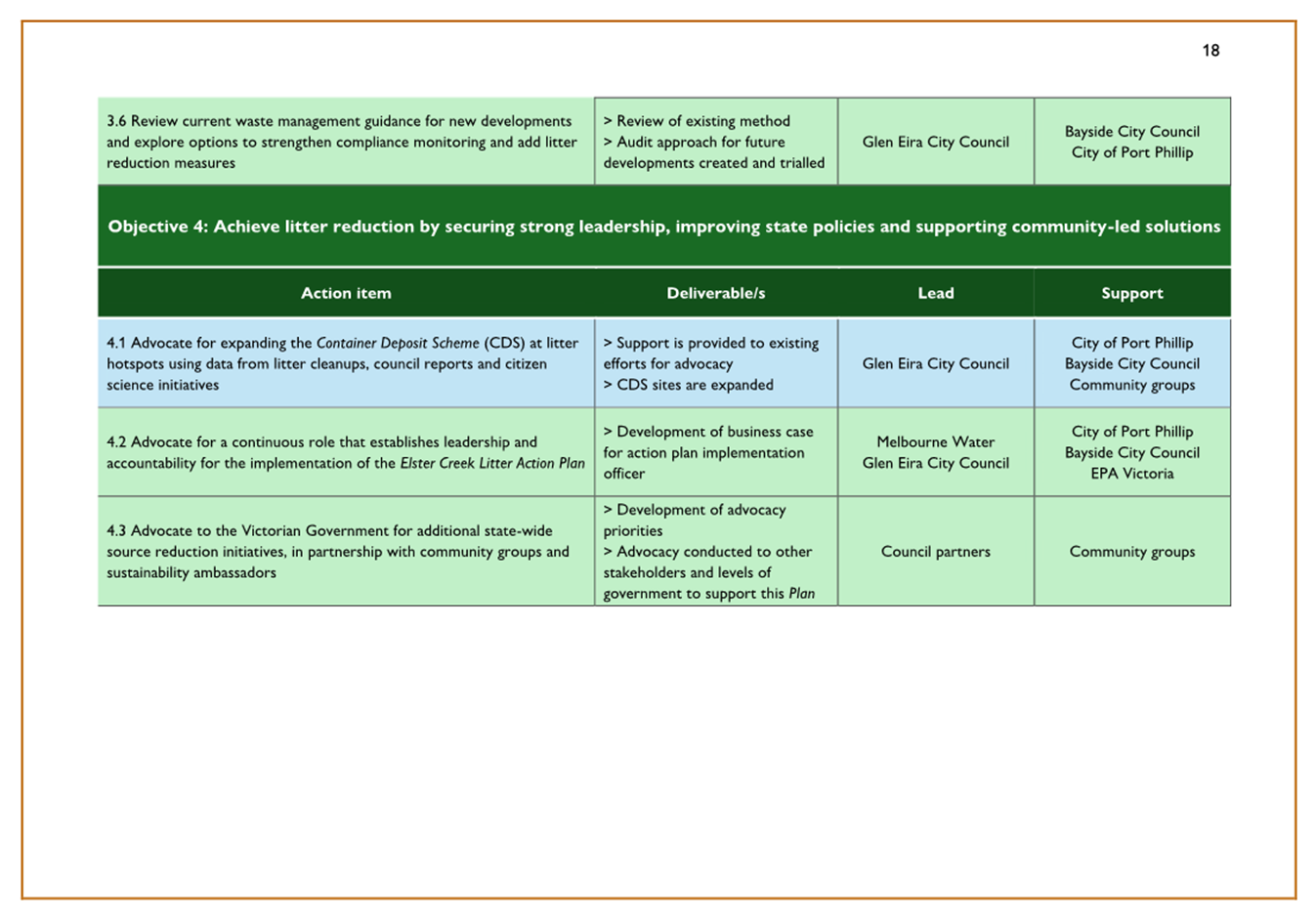
· 6.1 Promote community-led cleanups and citizen science at litter hotspots and accumulation zones.
· 7.1 Adopt a consistent data collection method to allow for comparative analysis, improve data accuracy and promote existing resources.
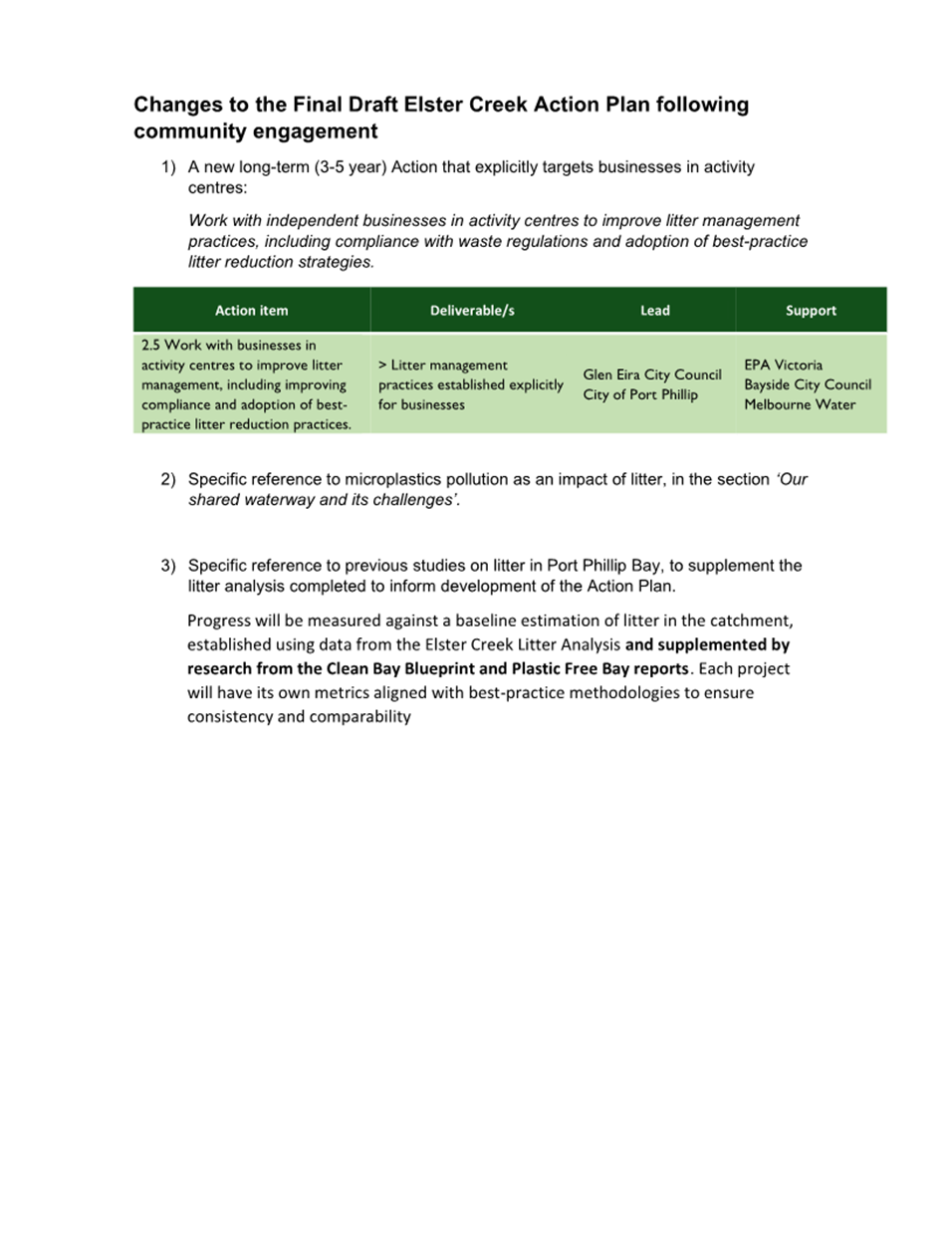
Changes made to the draft ECLAP following community engagement
4.9 The main changes to the Draft Elster Creek Litter Action Plan following community engagement include:
4.9.1 A new long-term (3-5 year) action that explicitly targets businesses in activity centres. City of Port Phillip would lead this action with the City of Glen Eira.
Action 2.5 Work with businesses in activity centres to improve litter management, including improving compliance and adoption of best-practice litter reduction practices.
4.9.2 Specific reference to microplastics pollution as an impact of litter, in the section ‘Our shared waterway and its challenges’.
4.9.3 Specific reference to previous studies on litter in Port Phillip Bay, to supplement the litter analysis completed to inform development of the Action Plan.
Progress will be measured against a baseline estimation of litter in the catchment, established using data from the Elster Creek Litter Analysis and supplemented by research from the Clean Bay Blueprint and Plastic Free Bay reports. Each project will have its own metrics aligned with best-practice methodologies to ensure consistency and comparability.
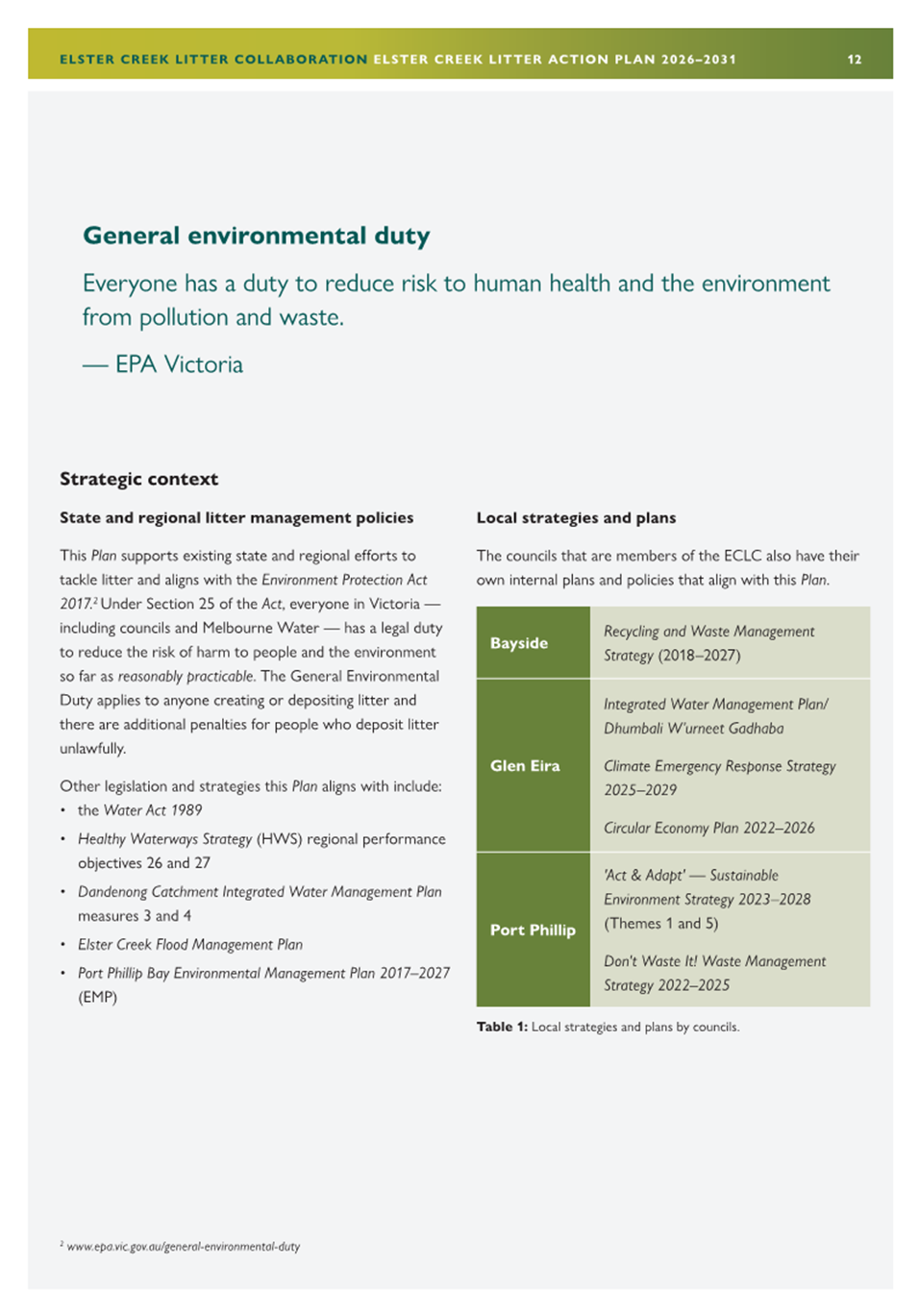
4.10 The Draft Elster Creek Litter Action Plan for community engagement is attached as Attachment 1. Changes to the draft ECLAP are detailed in Attachment 2.
4.11 Following changes to the draft ECLAP based on community engagement, the final ECLAP (Attachment 3) has been prepared for endorsement.
5. CONSULTATION AND STAKEHOLDERS
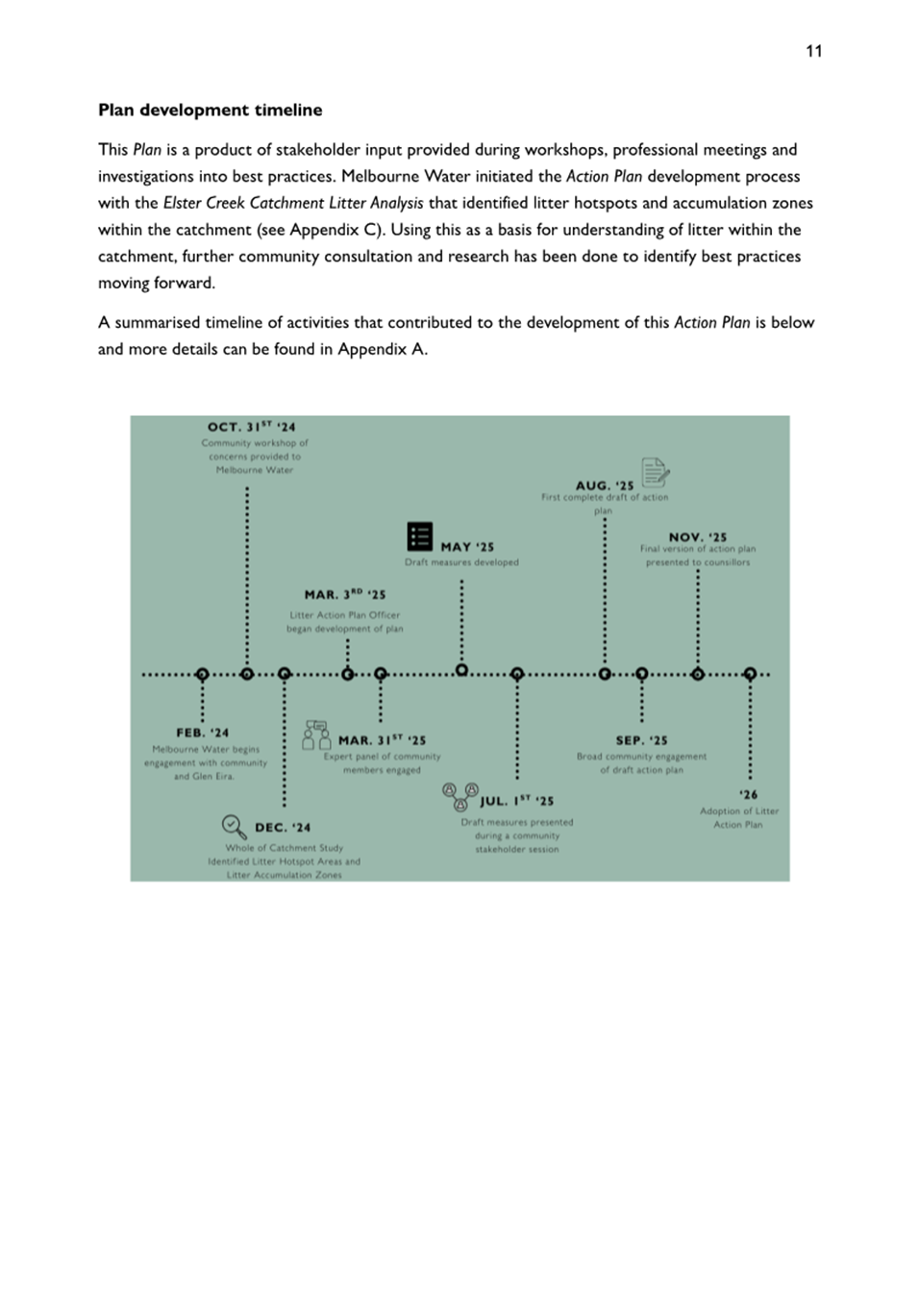
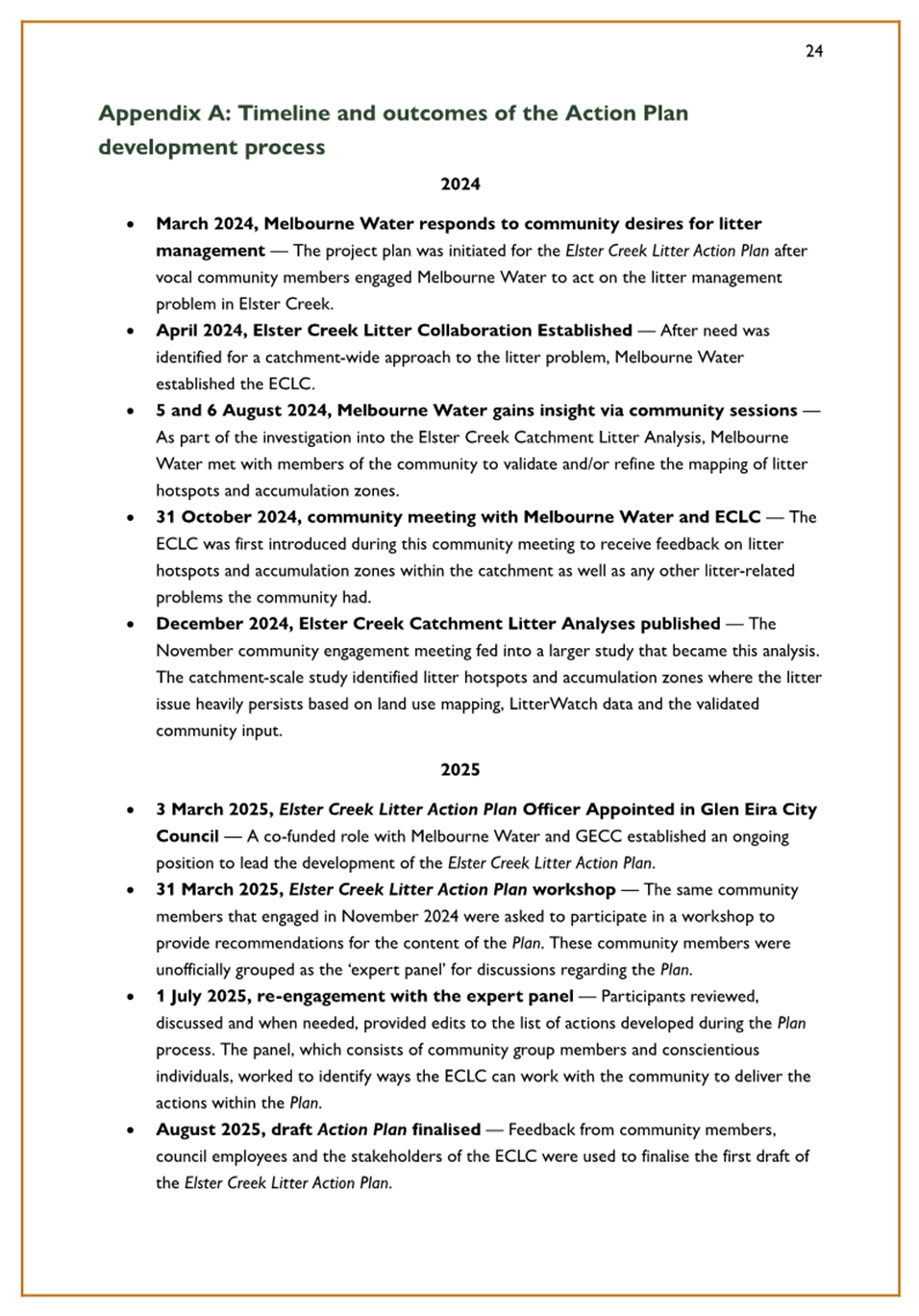
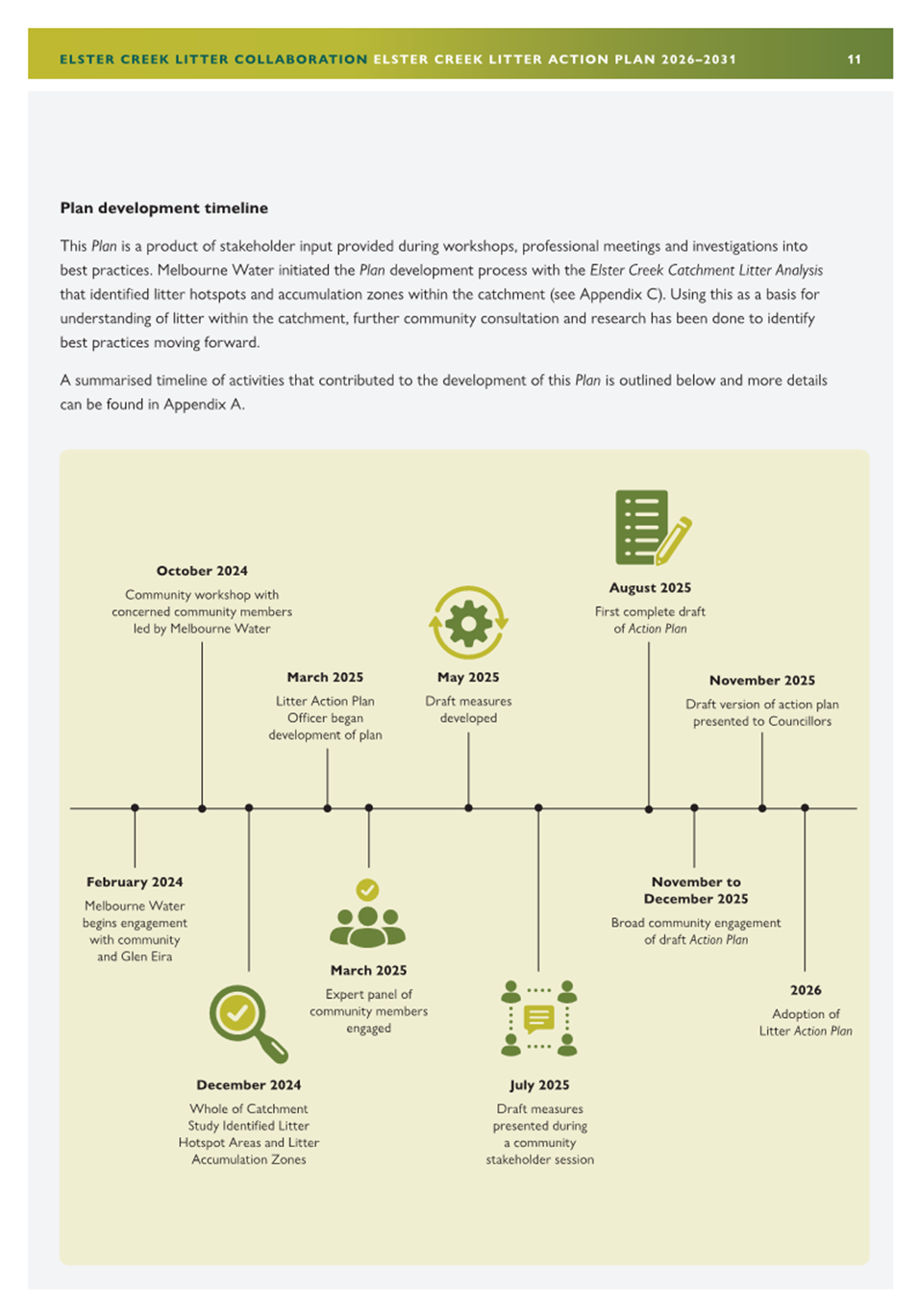
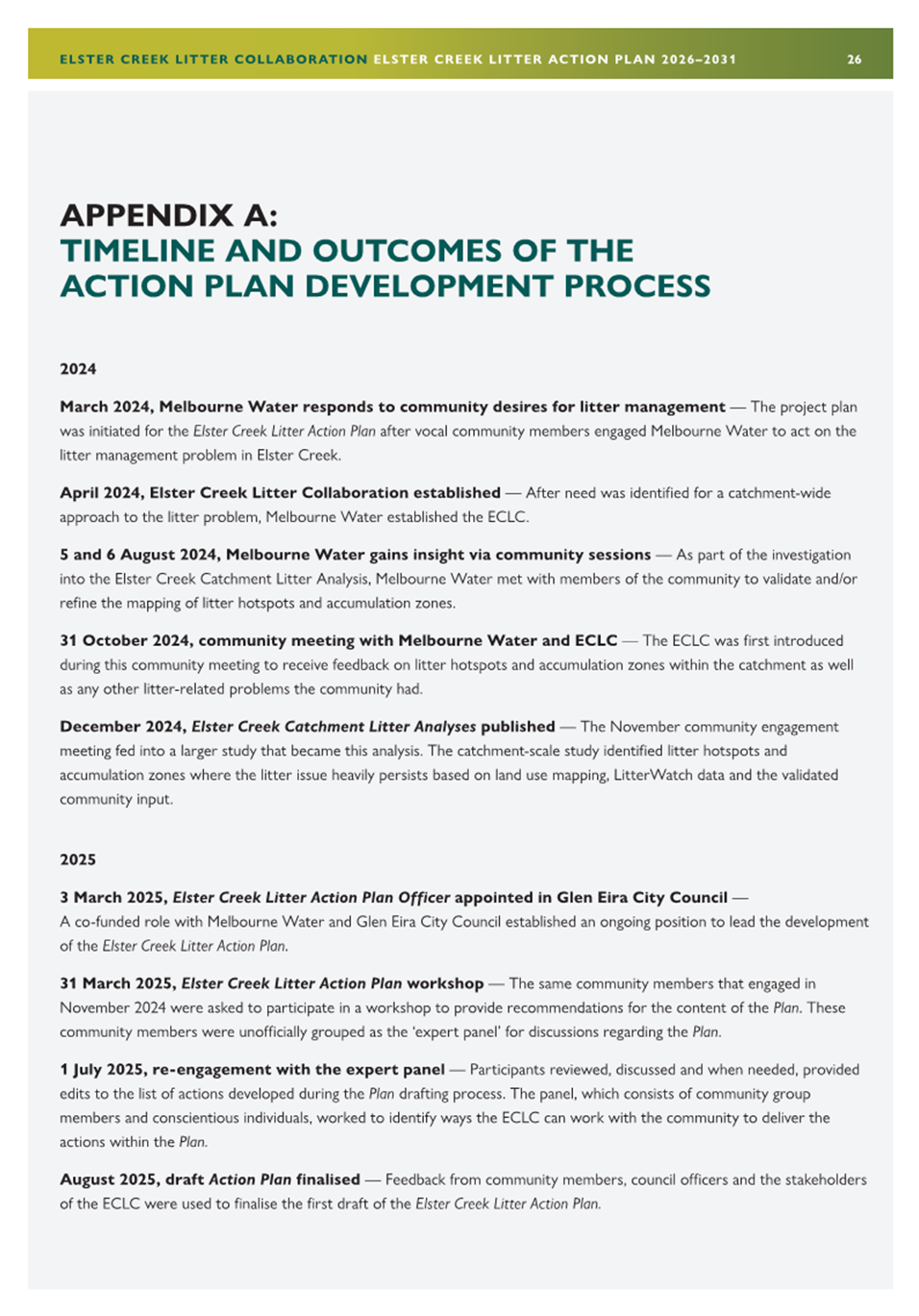
5.1 Two targeted deliberative engagement workshops in March and July 2025 shaped the development of the draft ECLAP. Representatives from the following community groups attended, from across the Elster Creek Catchment:
· Elwood Canal Action Team
· Beach Patrol
· Love Our Street
· Port Phillip EcoCentre
· Port Phillip Emergency Climate Action Network
· Glen Eira Climate Action Network
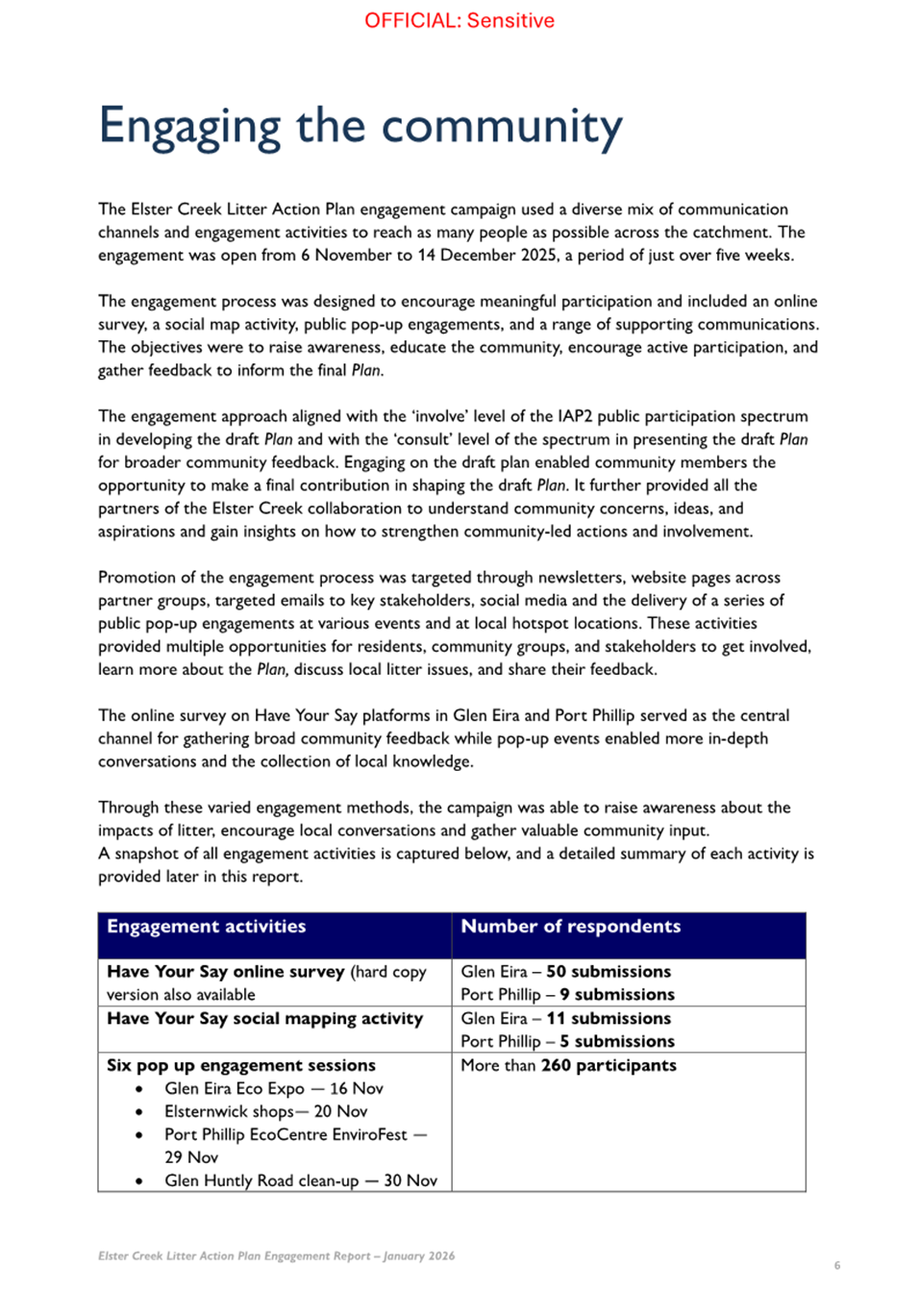
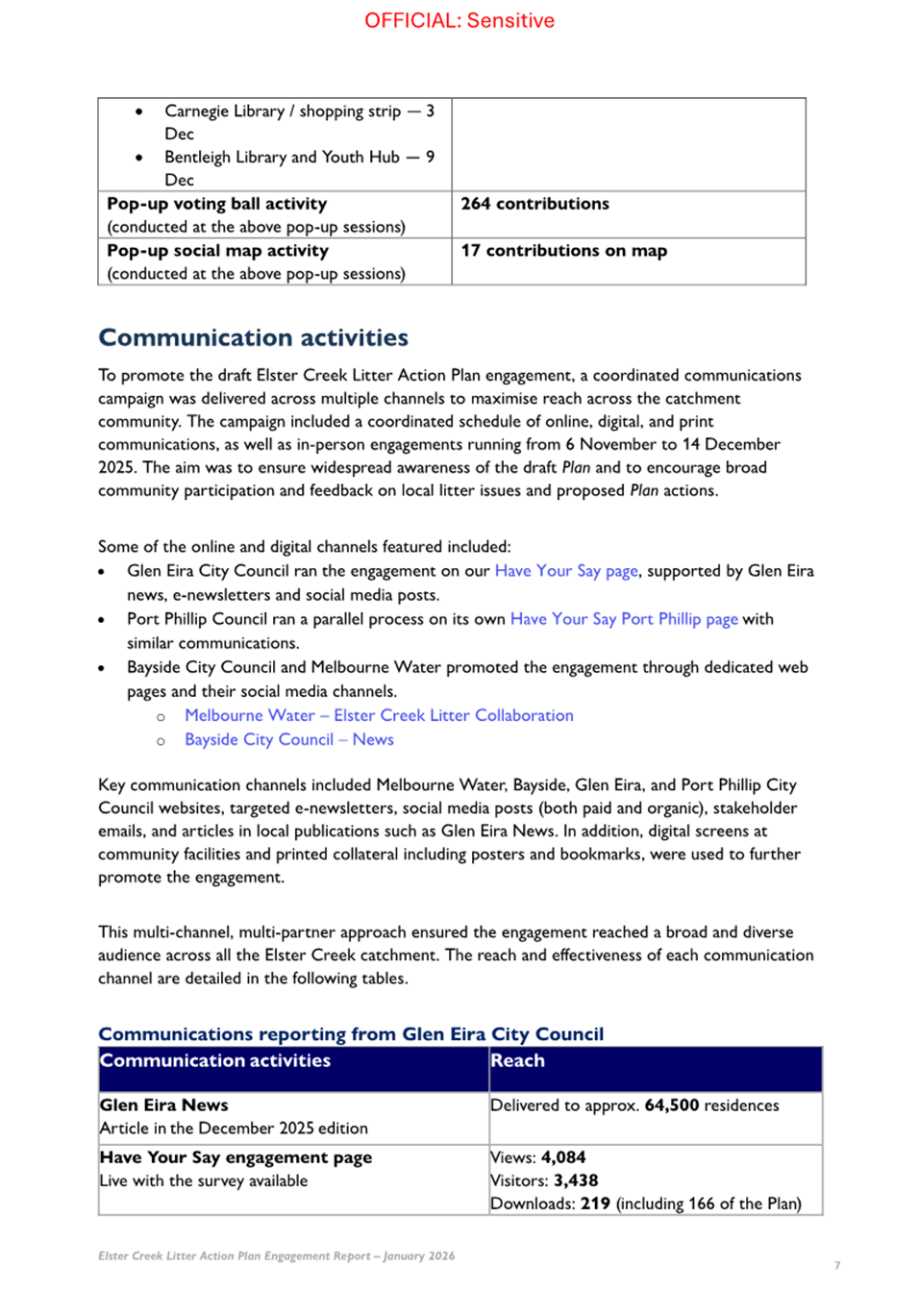
5.2 A broad community engagement and communications campaign was undertaken in November – December 2025 to gather further feedback, raise awareness of litter issues, and inform the final ECLAP.
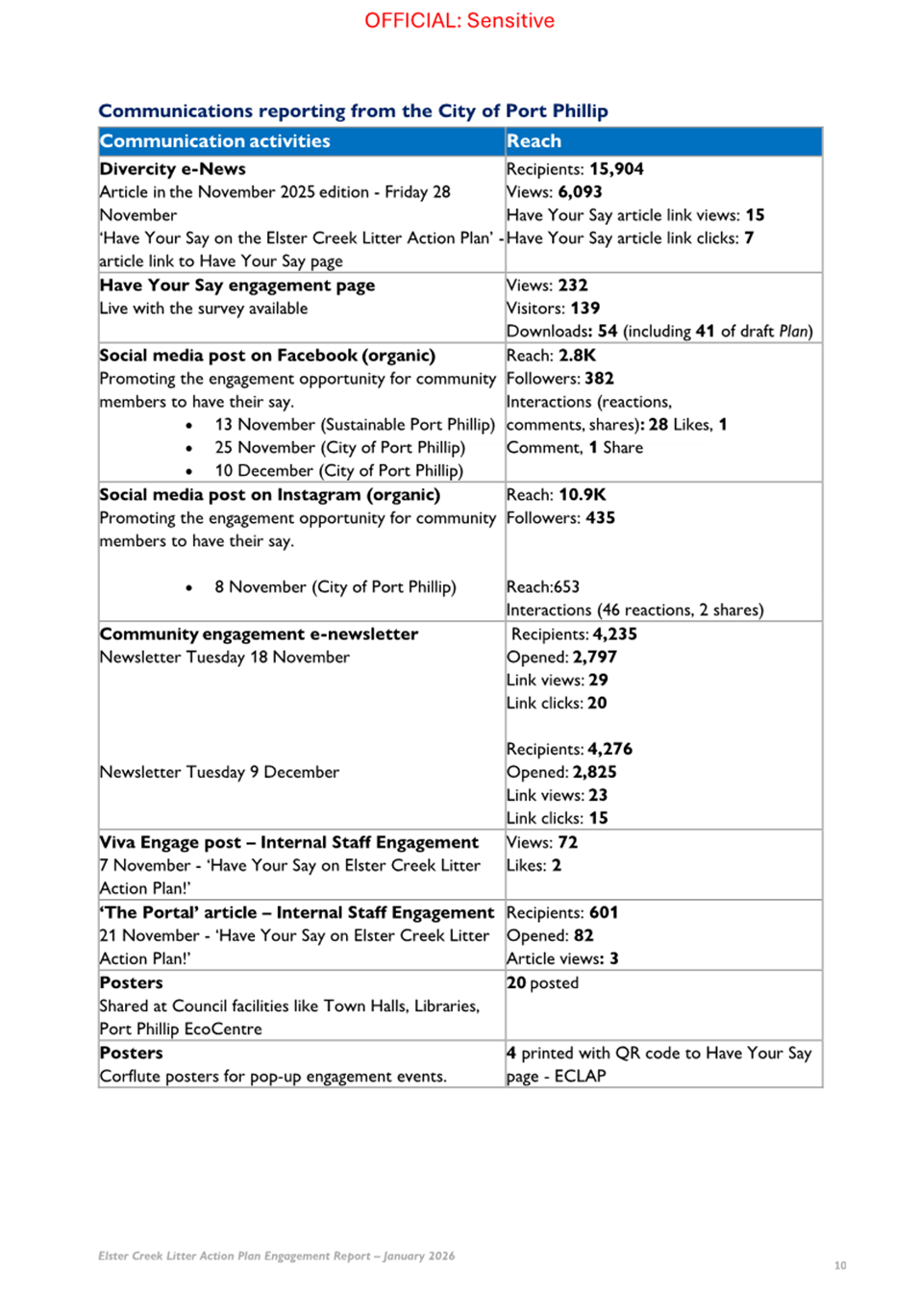
5.3 Collaborative engagement was conducted by all partners in the Elster Creek Litter Collaboration. The same content was shared by Glen Eira, Melbourne Water, Bayside and Port Phillip.
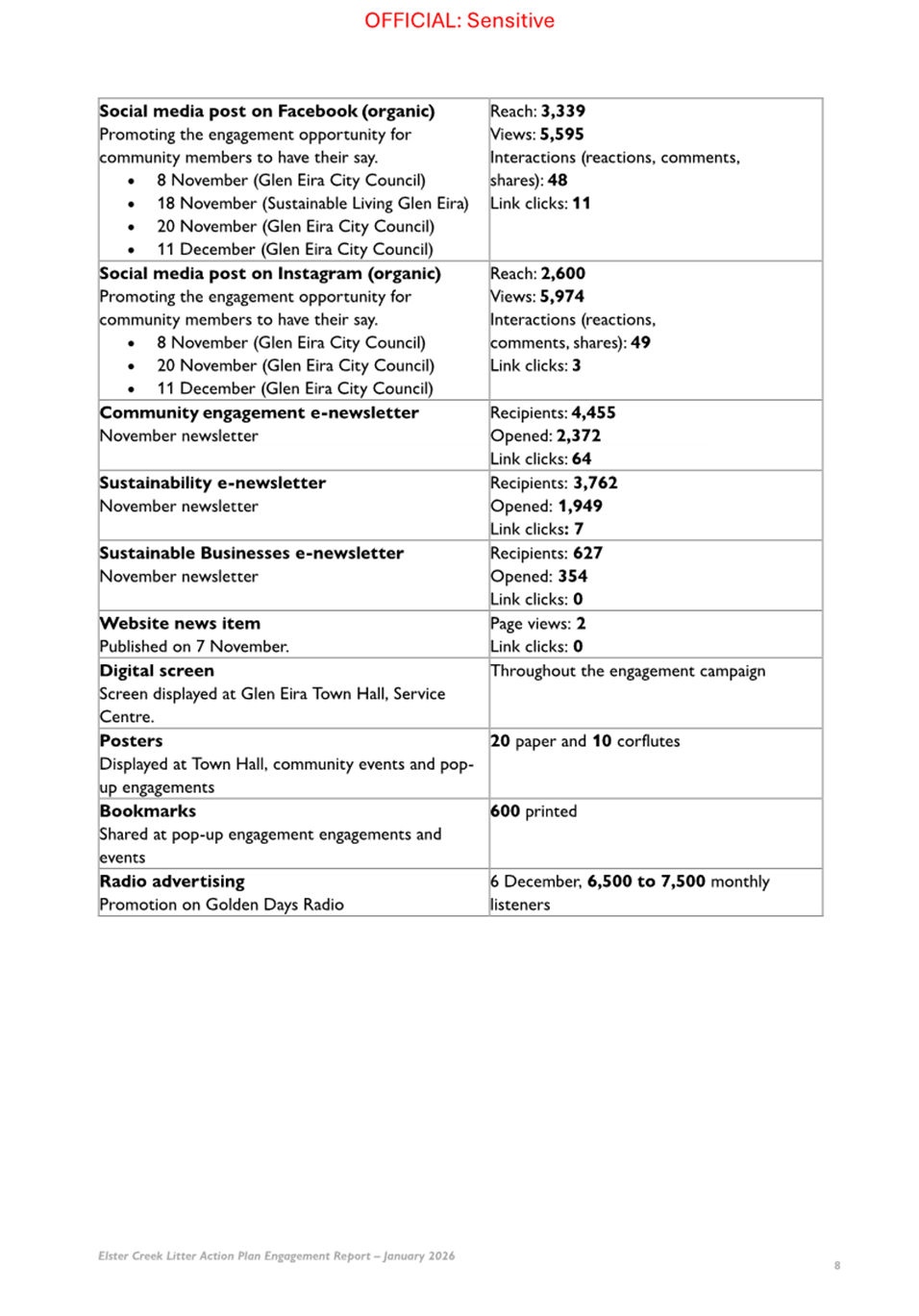
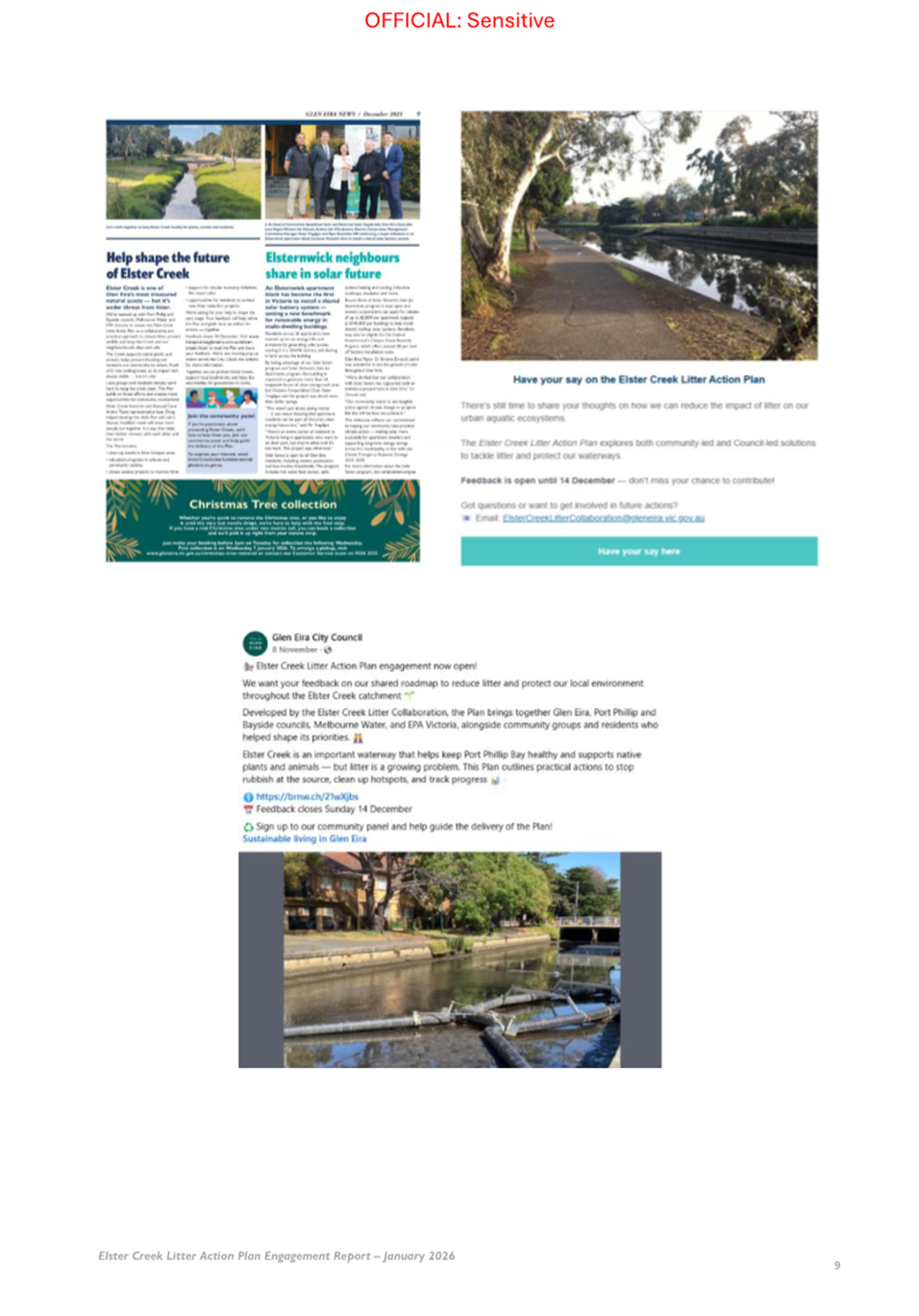
5.4 Promotion of the engagement was via posters, flyers, Council newsletters, Council’s digital channels, and targeted outreach through community and stakeholder networks.
5.5 The Draft ECLAP was exhibited on Council’s Have Your Say page from 6 November to 14 December 2025. Feedback was provided through an online survey on the actions within the Plan and reporting litter ‘hotspots’ on a map.
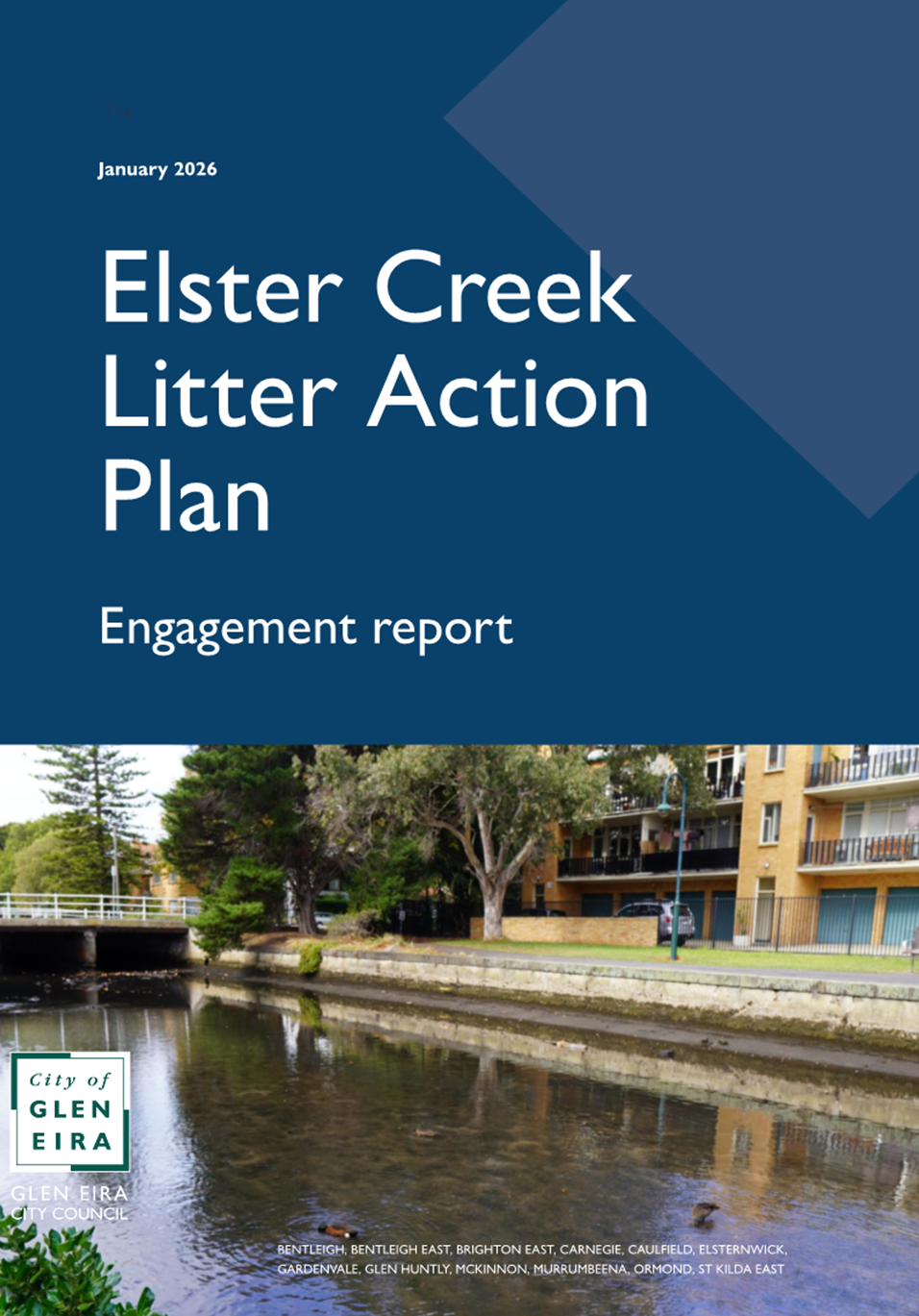
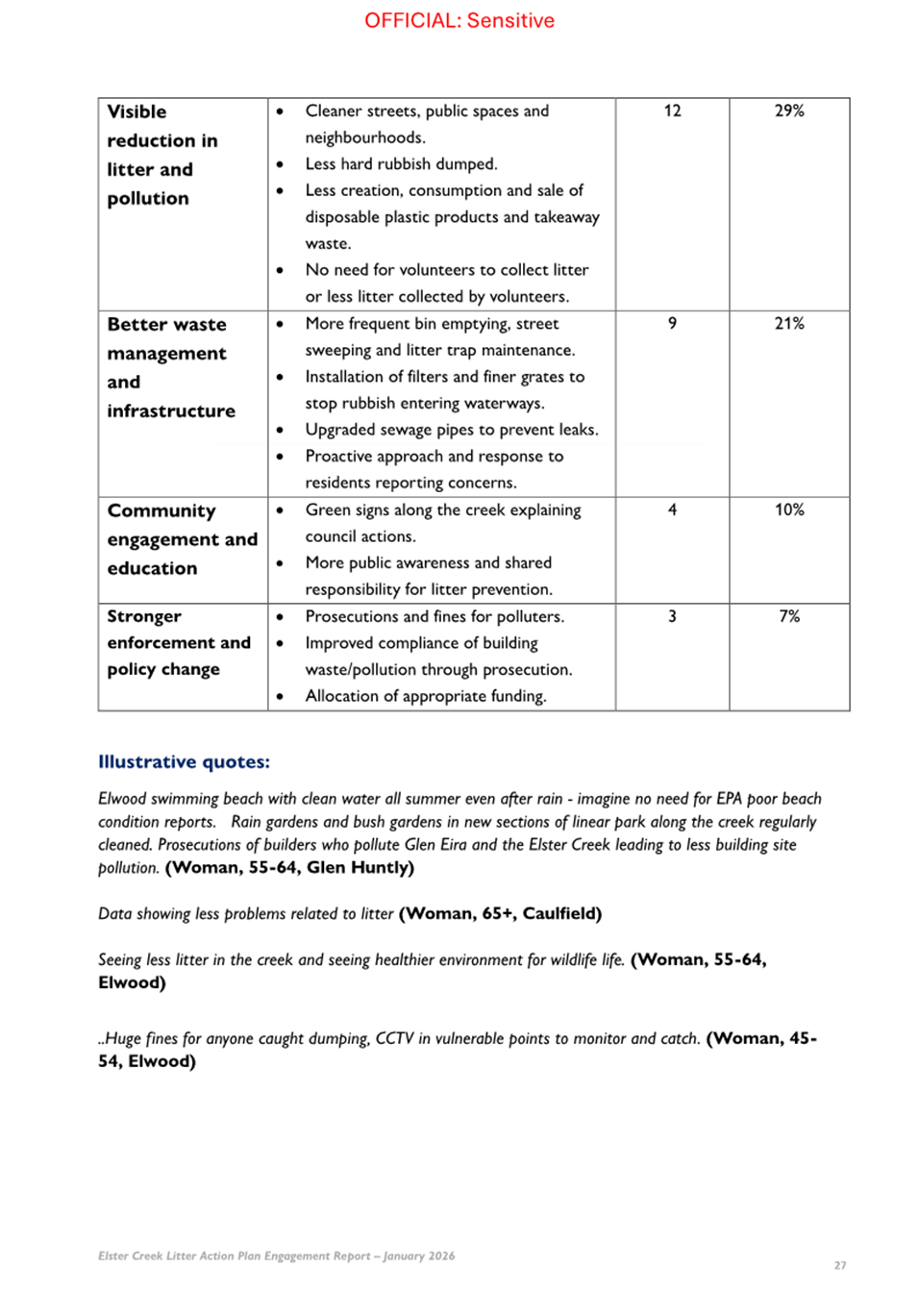
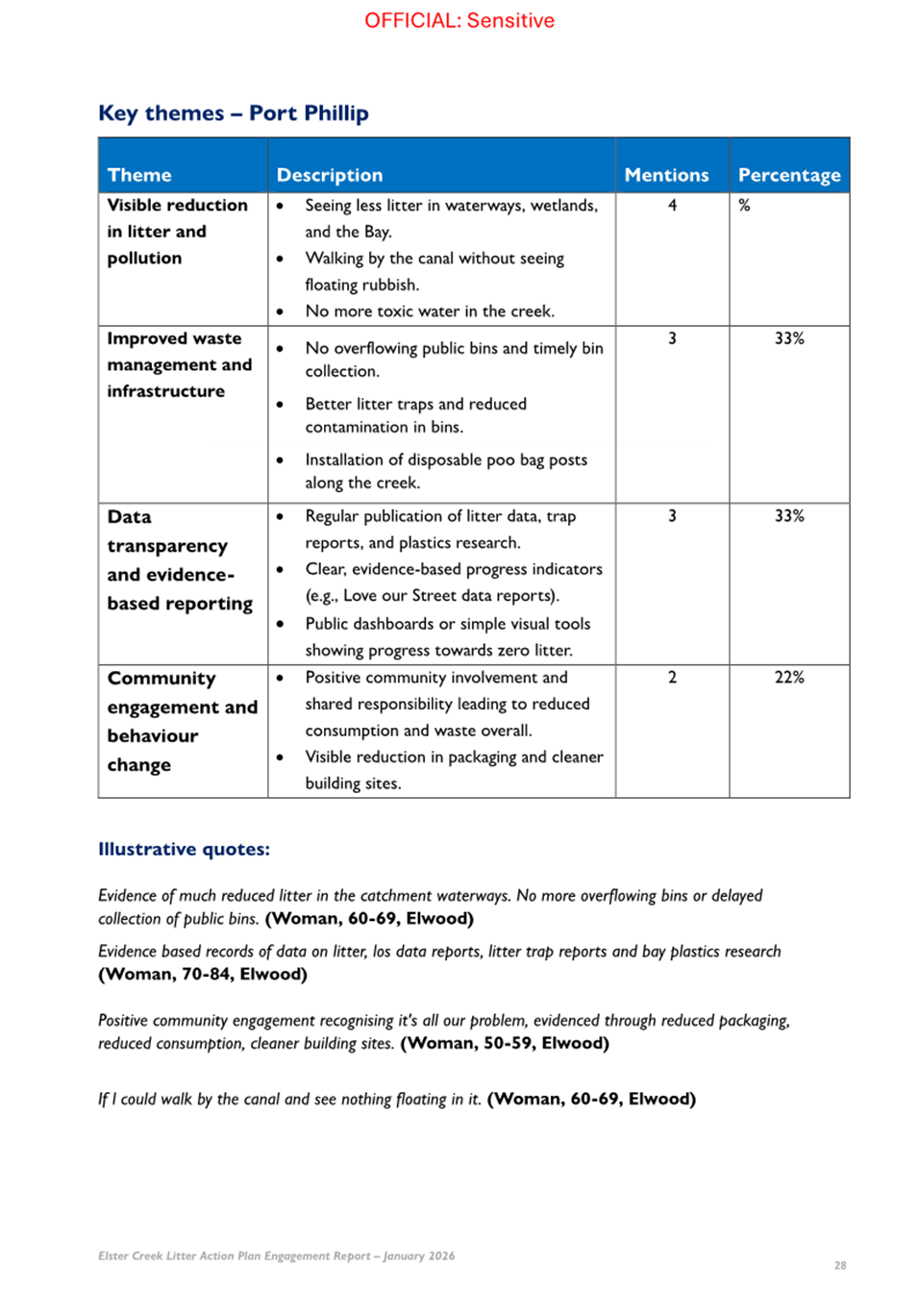
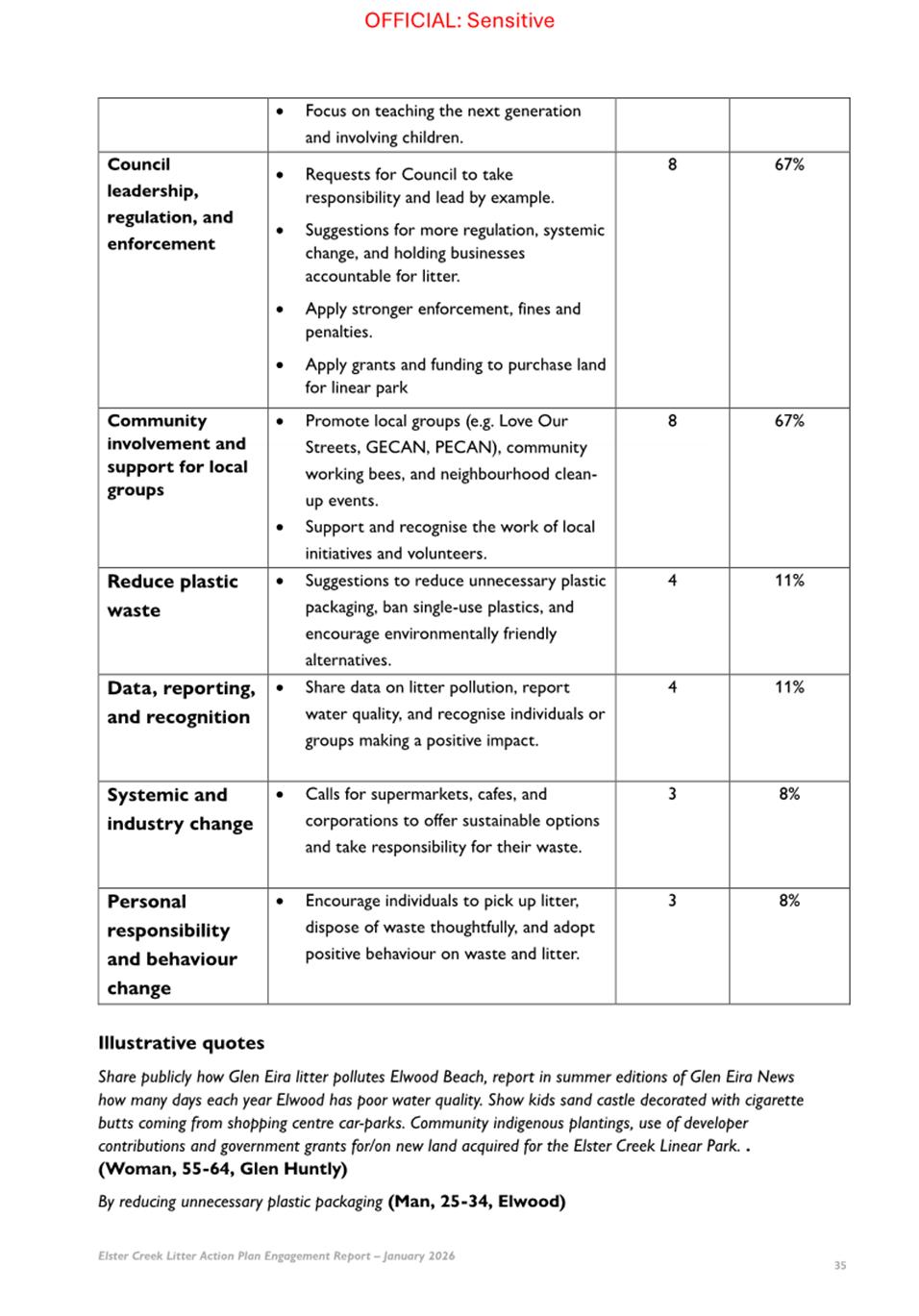
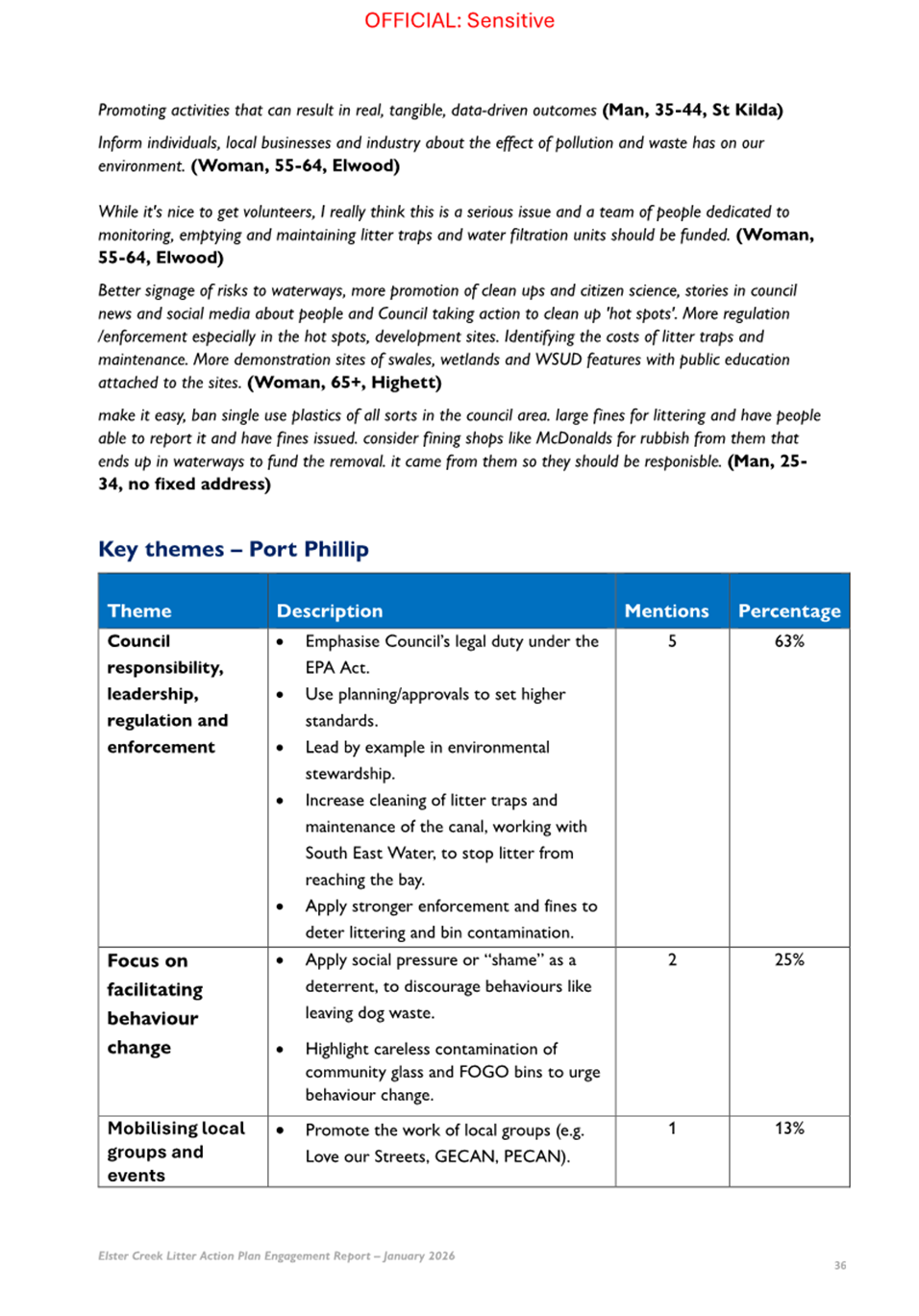
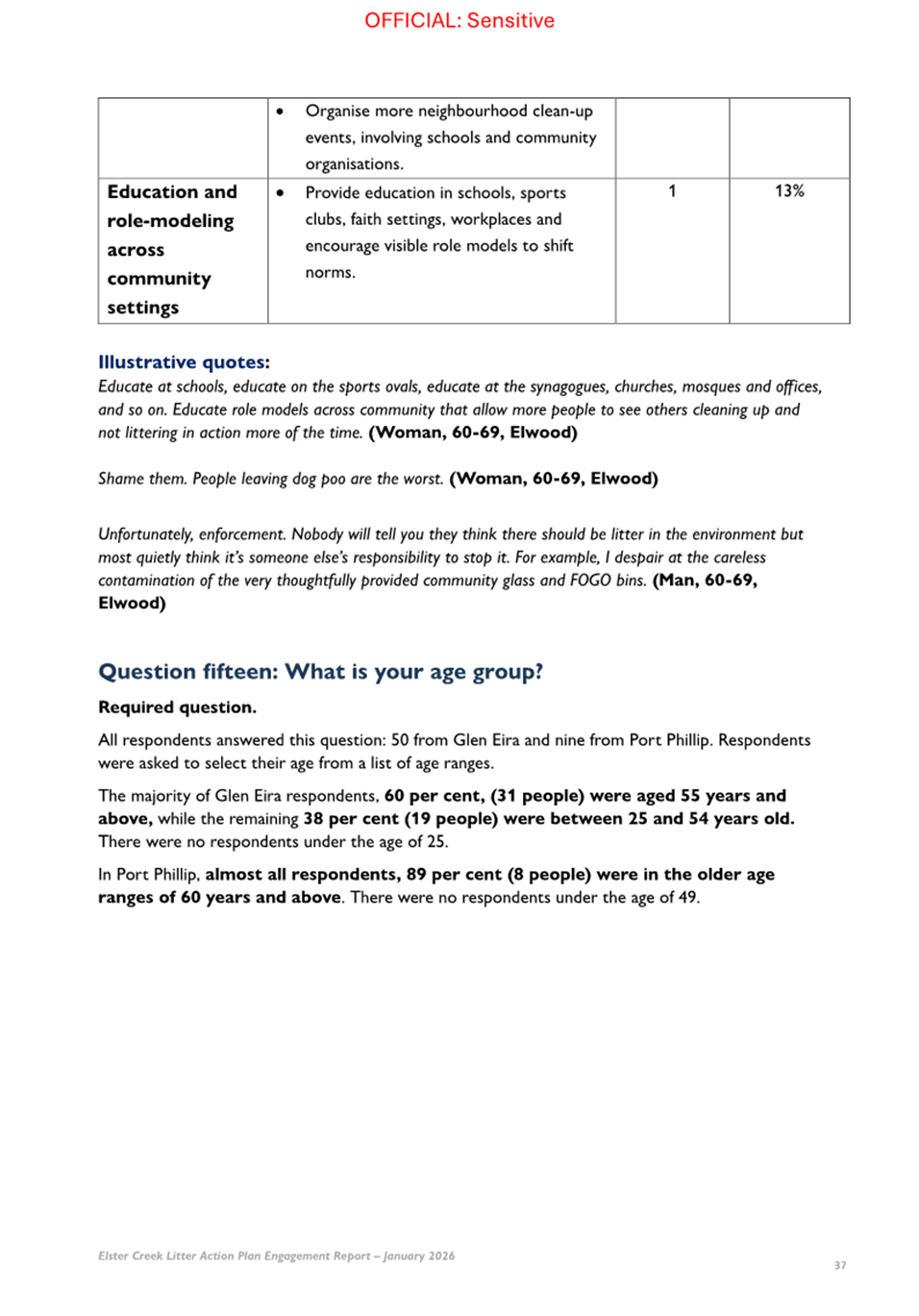
5.6 The attached Community Engagement summary report (Attachment 4) has collated and analysed the community’s feedback across City of Port Phillip and the Catchment.
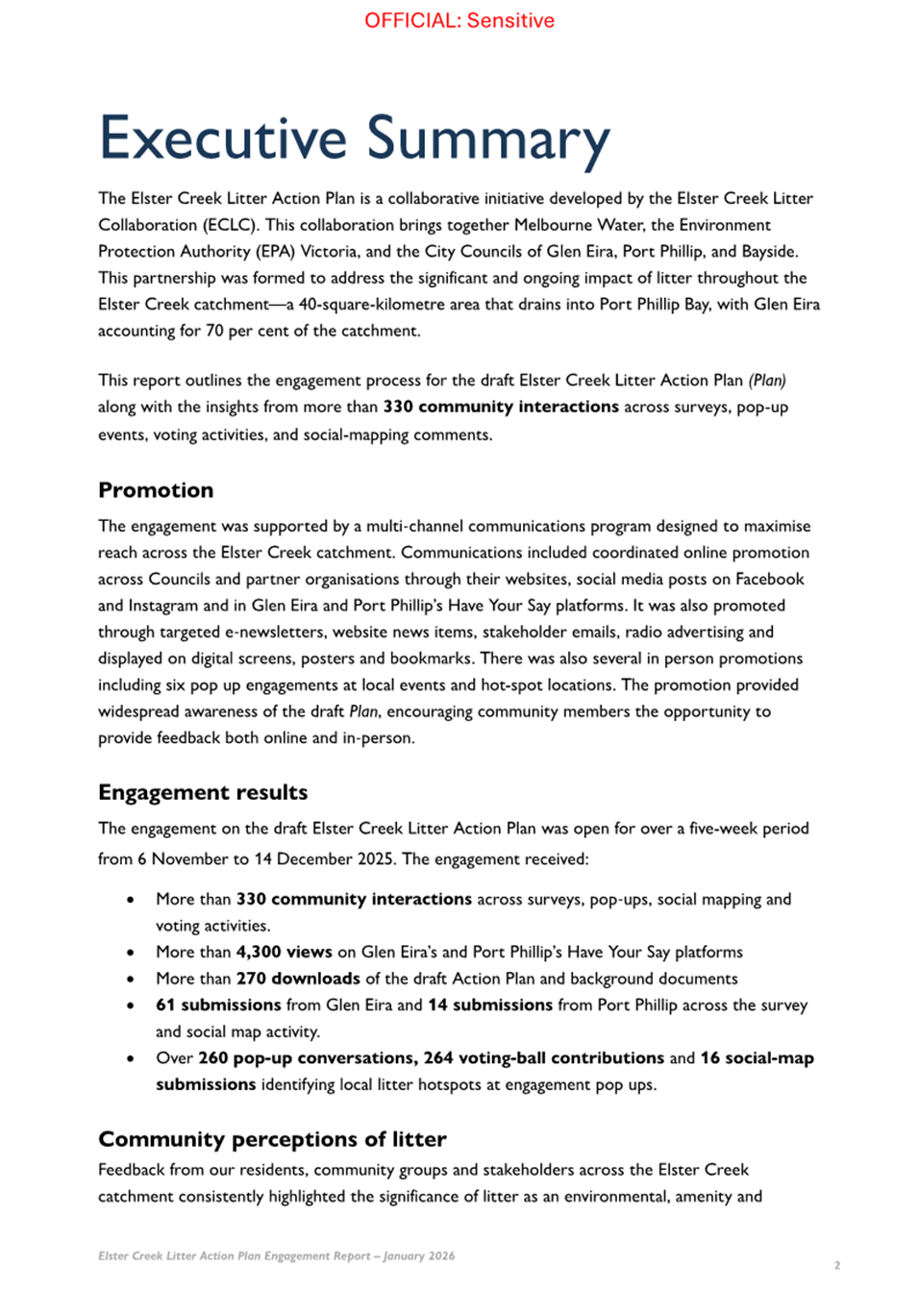
5.7 The collaborative community engagement received:
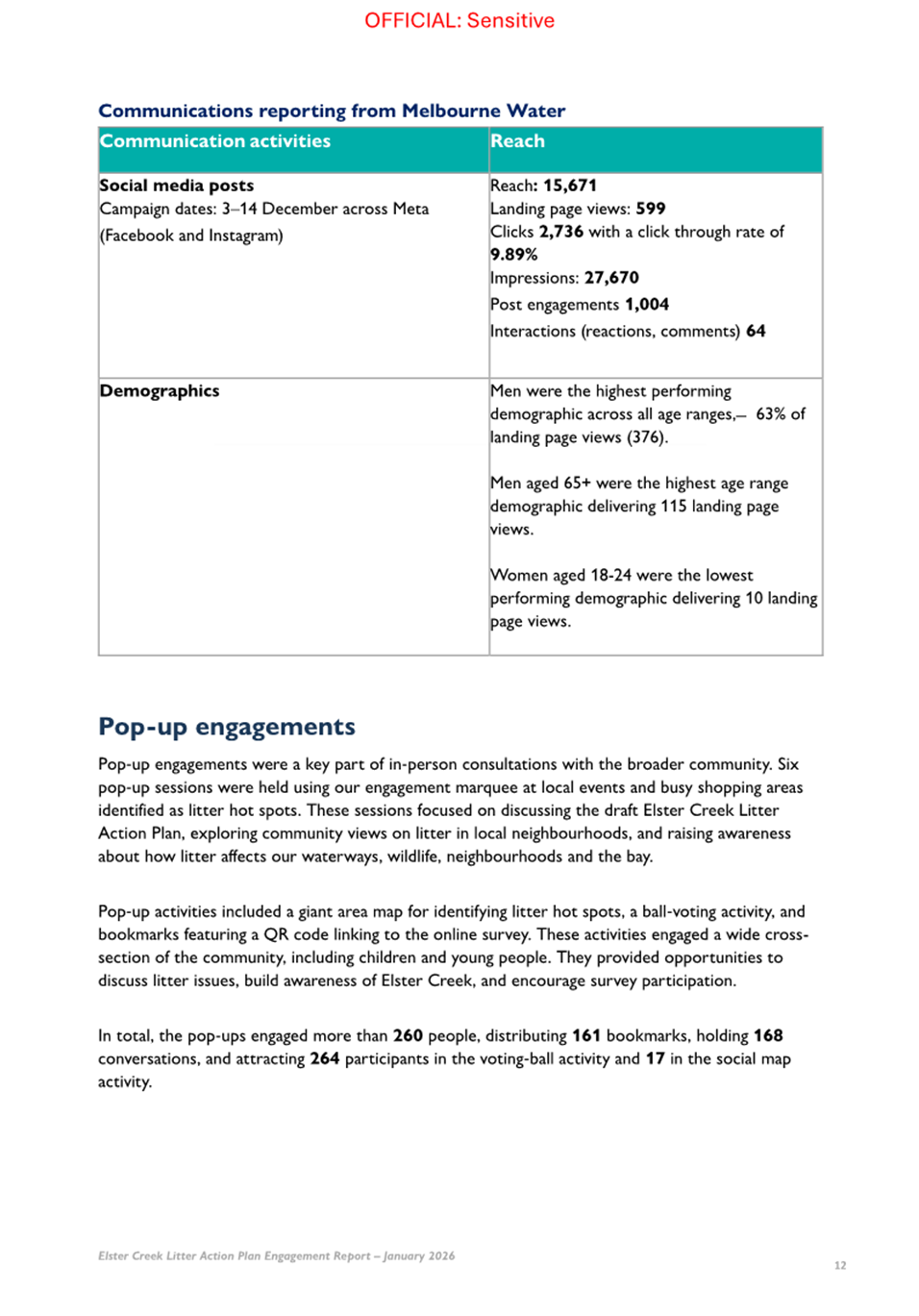
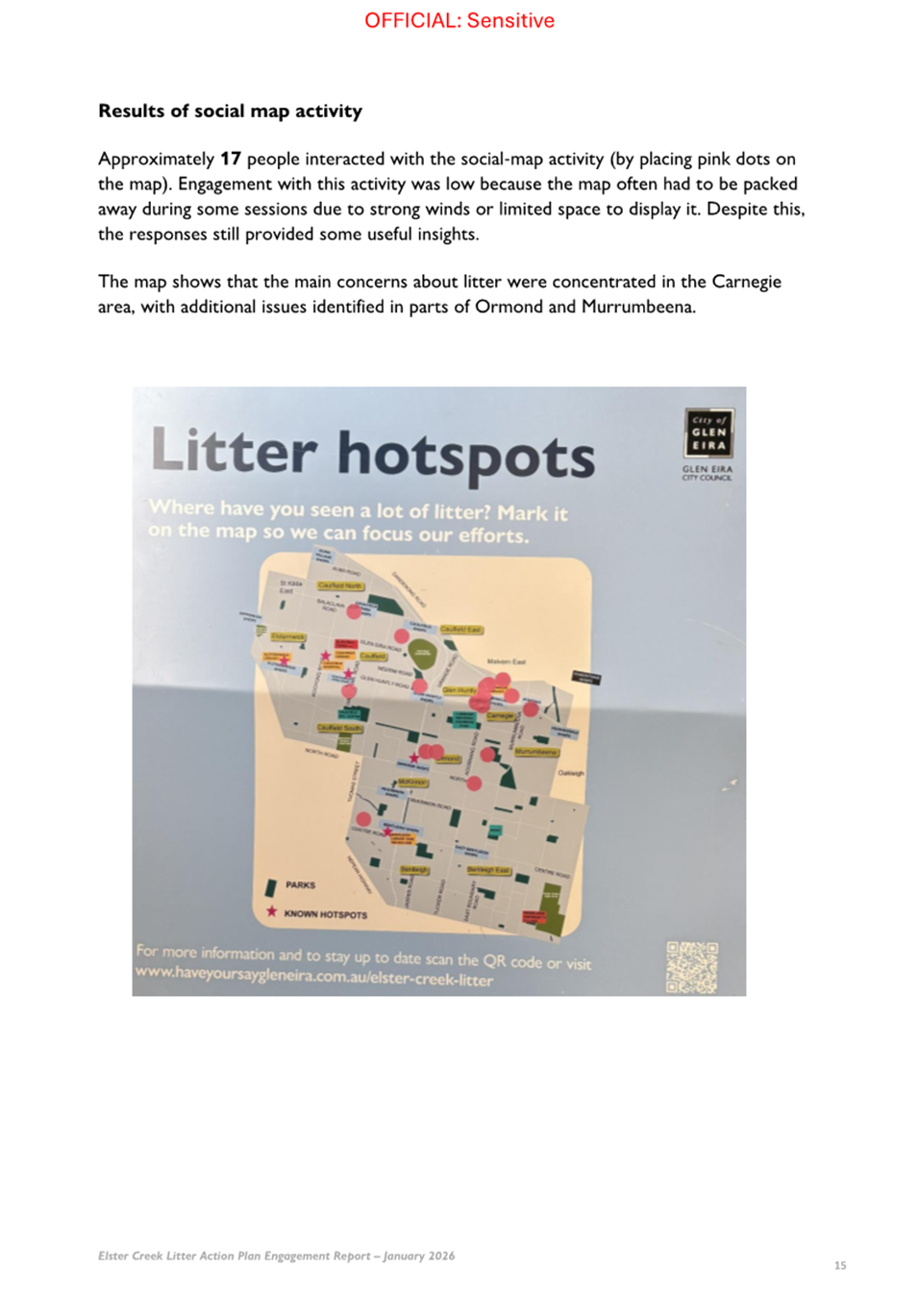
· More than 330 community interactions across surveys, pop‑ups, social mapping and voting activities.
· More than 4,300 views on Glen Eira’s and Port Phillip’s Have Your Say platforms
· More than 270 downloads of the draft Action Plan and background documents
· 61 submissions from Glen Eira and 14 submissions from Port Phillip across the survey and social map activity.
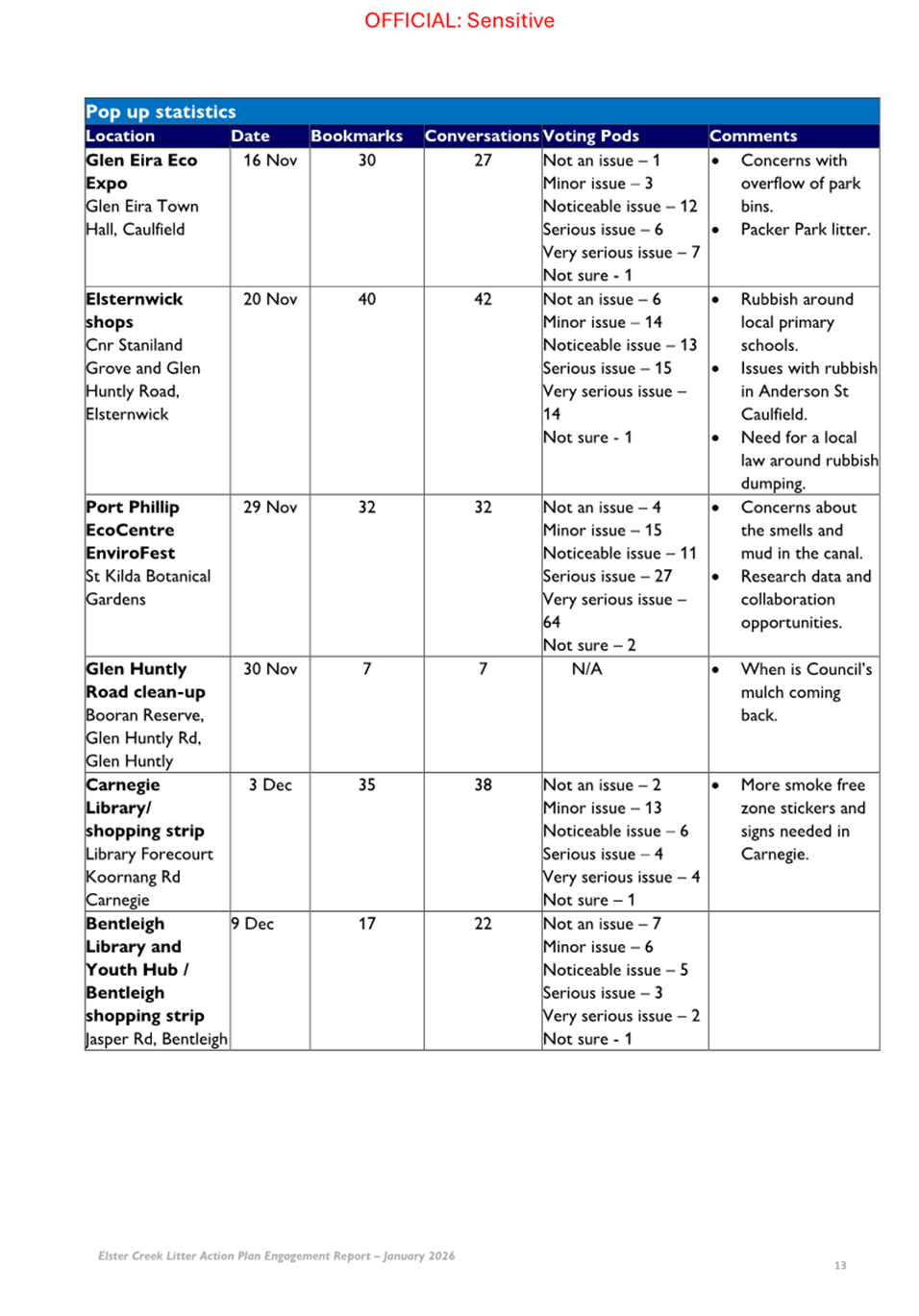
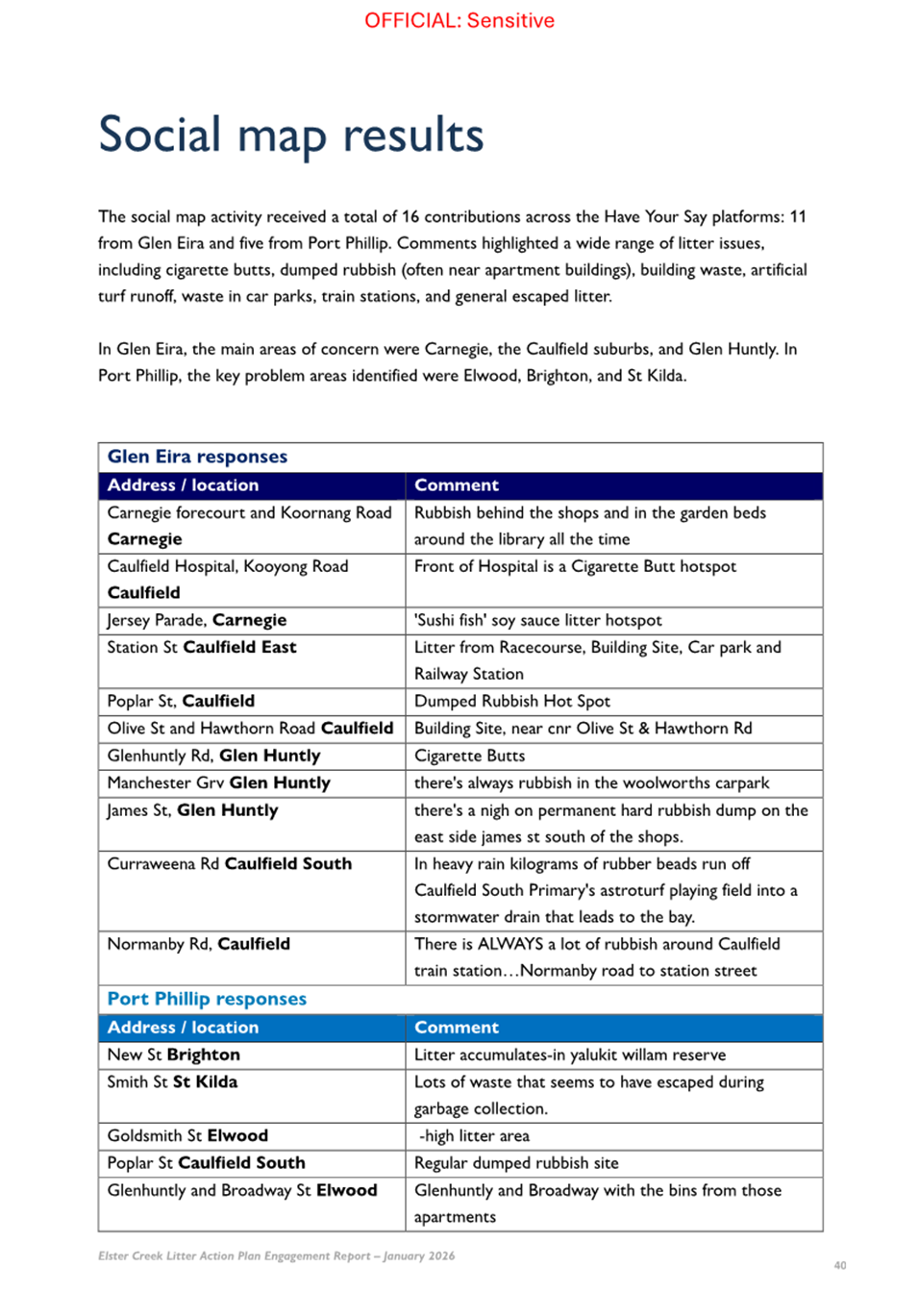
· Over 260 pop‑up conversations, 264 voting‑ball contributions and 16 social‑map submissions identifying local litter hotspots at engagement pop ups.
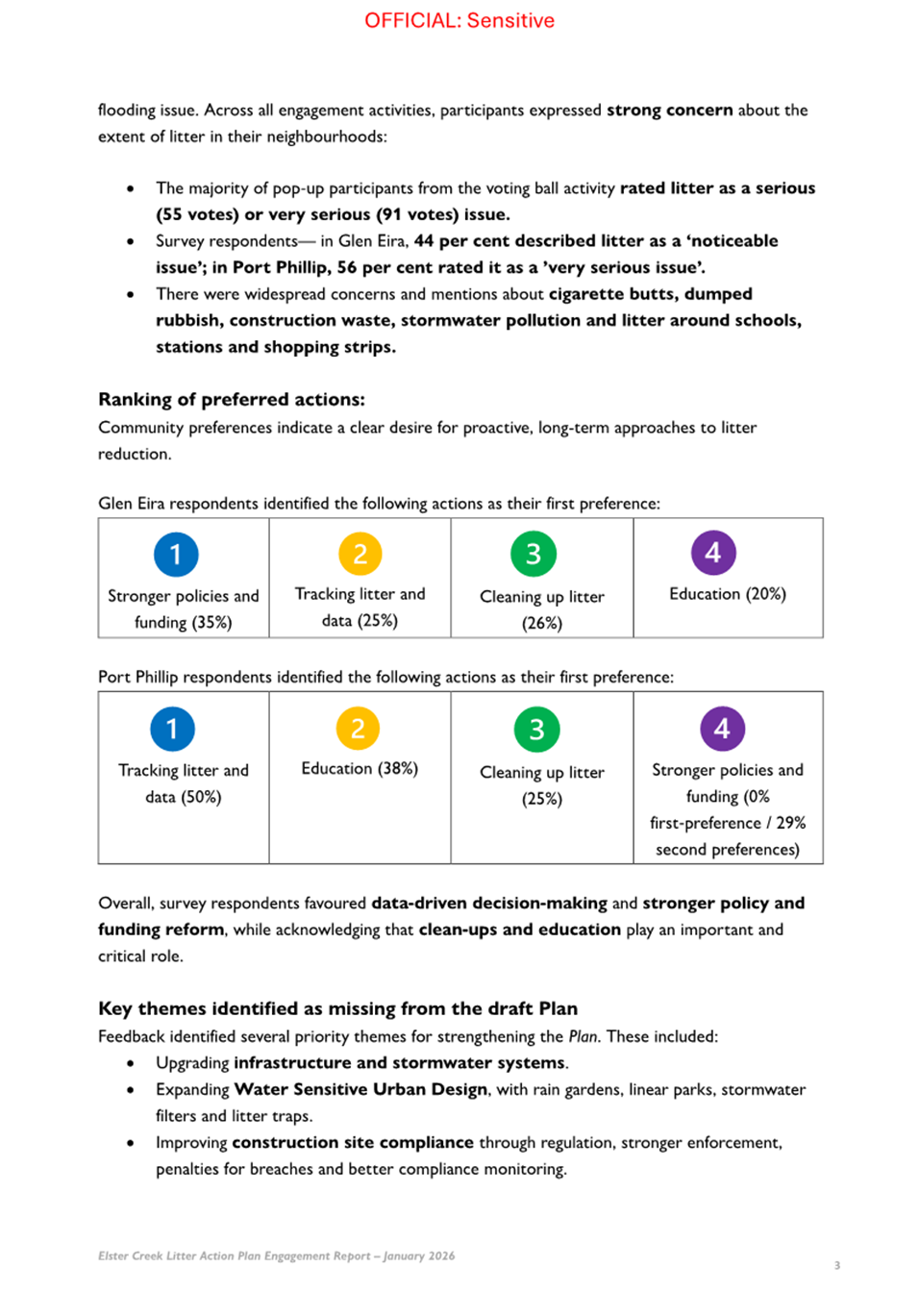
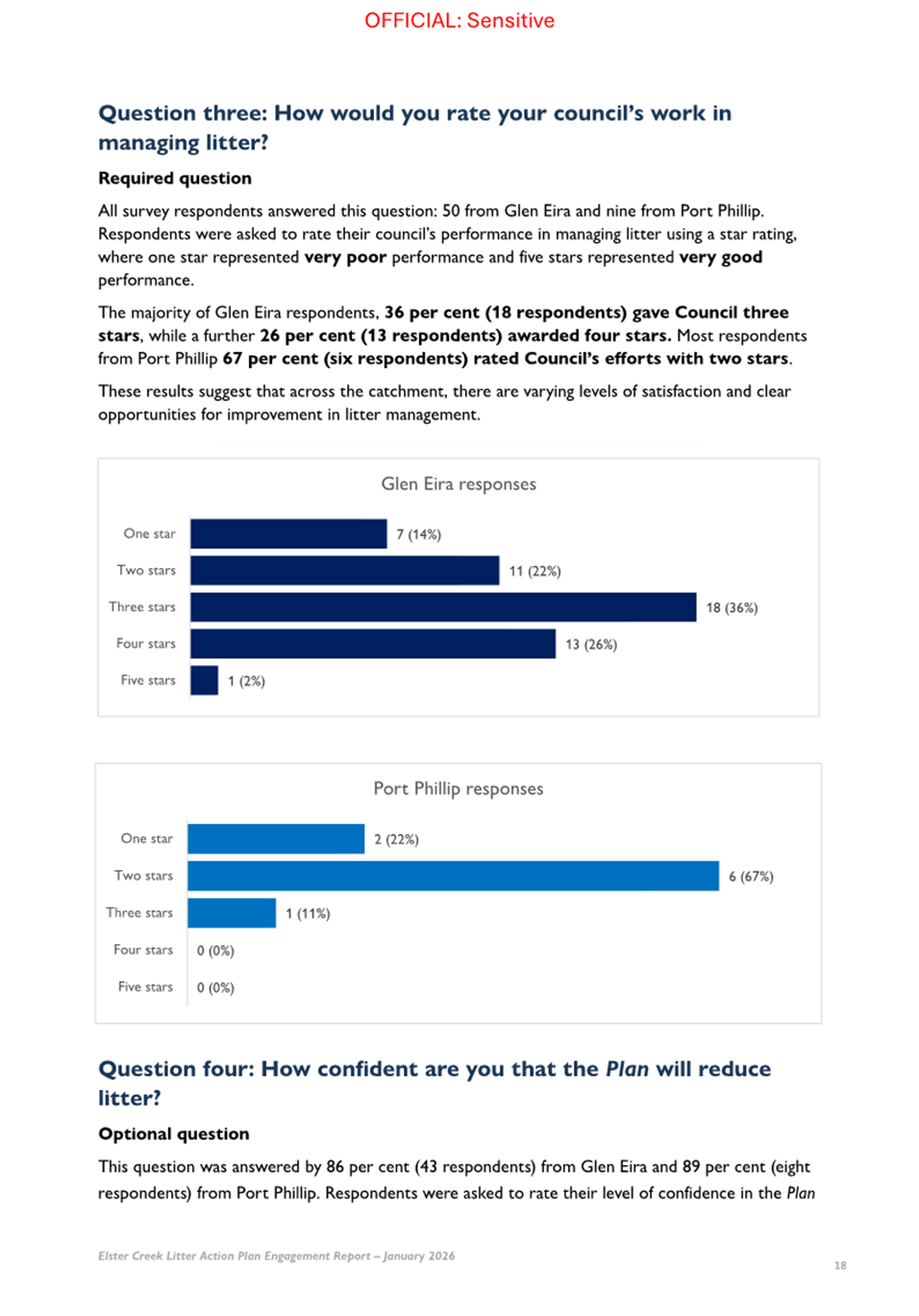
5.8 Feedback from our residents, community groups and stakeholders across the Elster Creek catchment consistently highlighted the significance of litter as an environmental, amenity and flooding issue. Across all engagement activities, participants expressed strong concern about the extent of litter in their neighbourhoods:
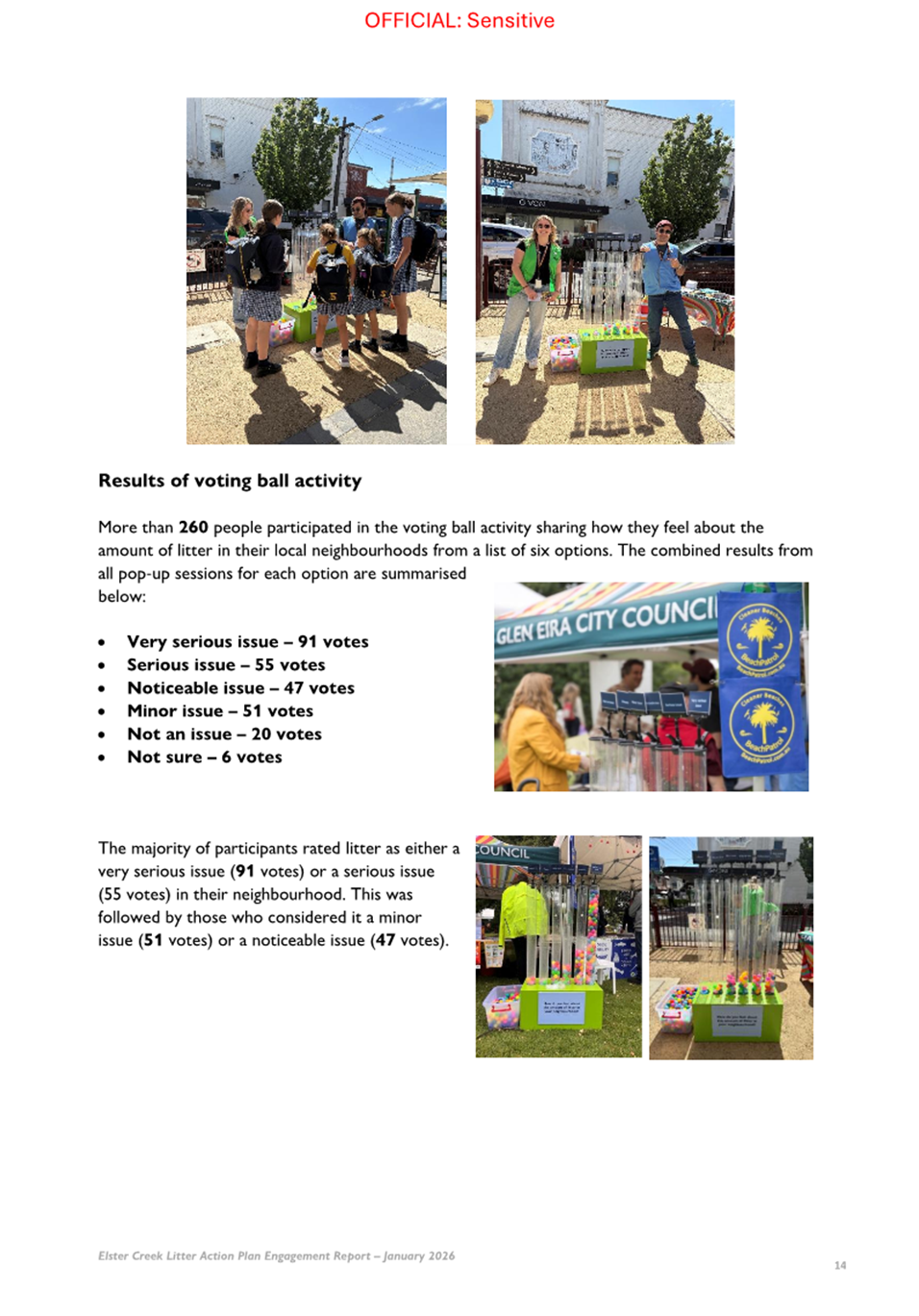
· The majority of ‘pop‑up’ activity participants rated litter as a serious (55 votes) or very serious (91 votes) issue.
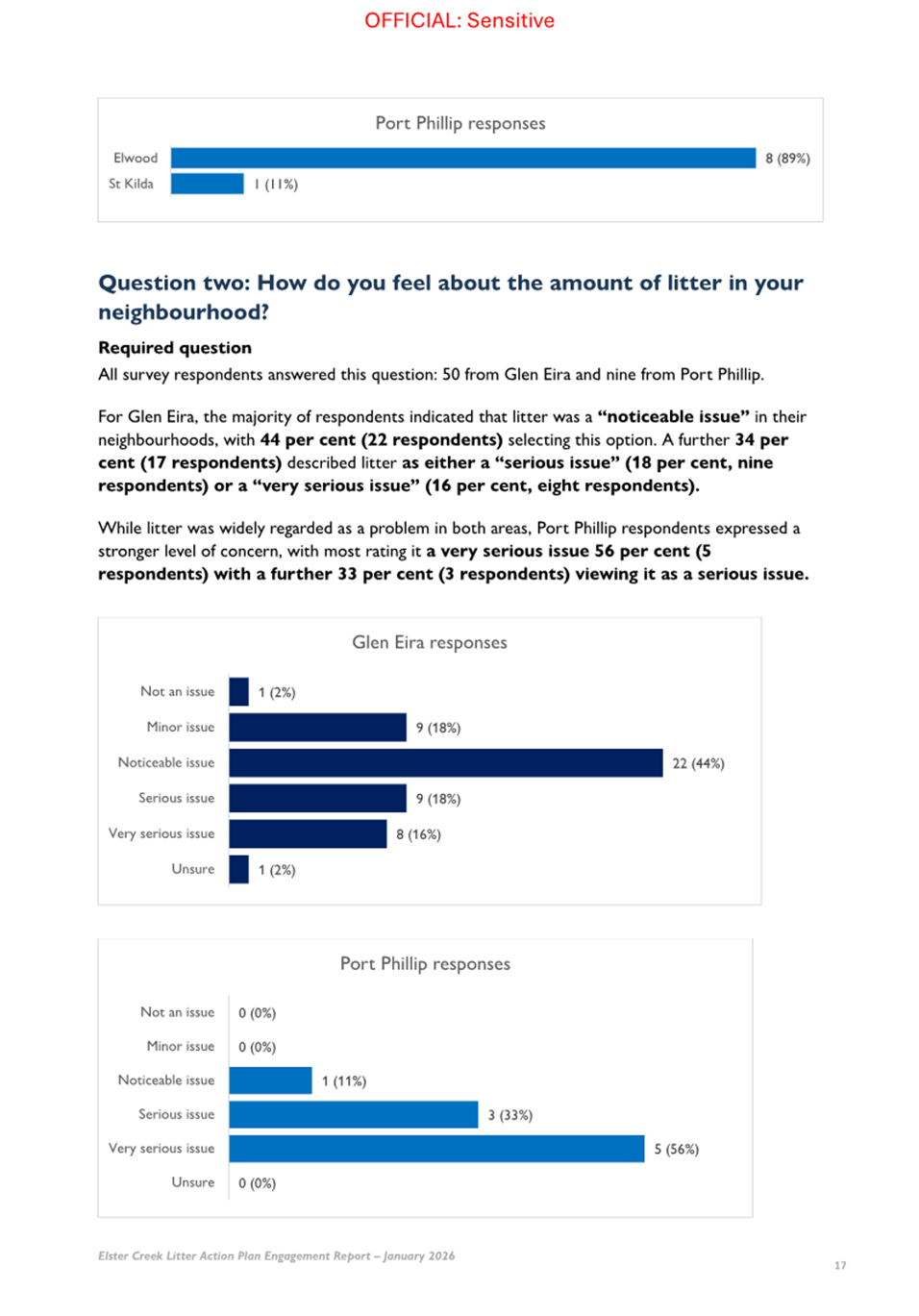
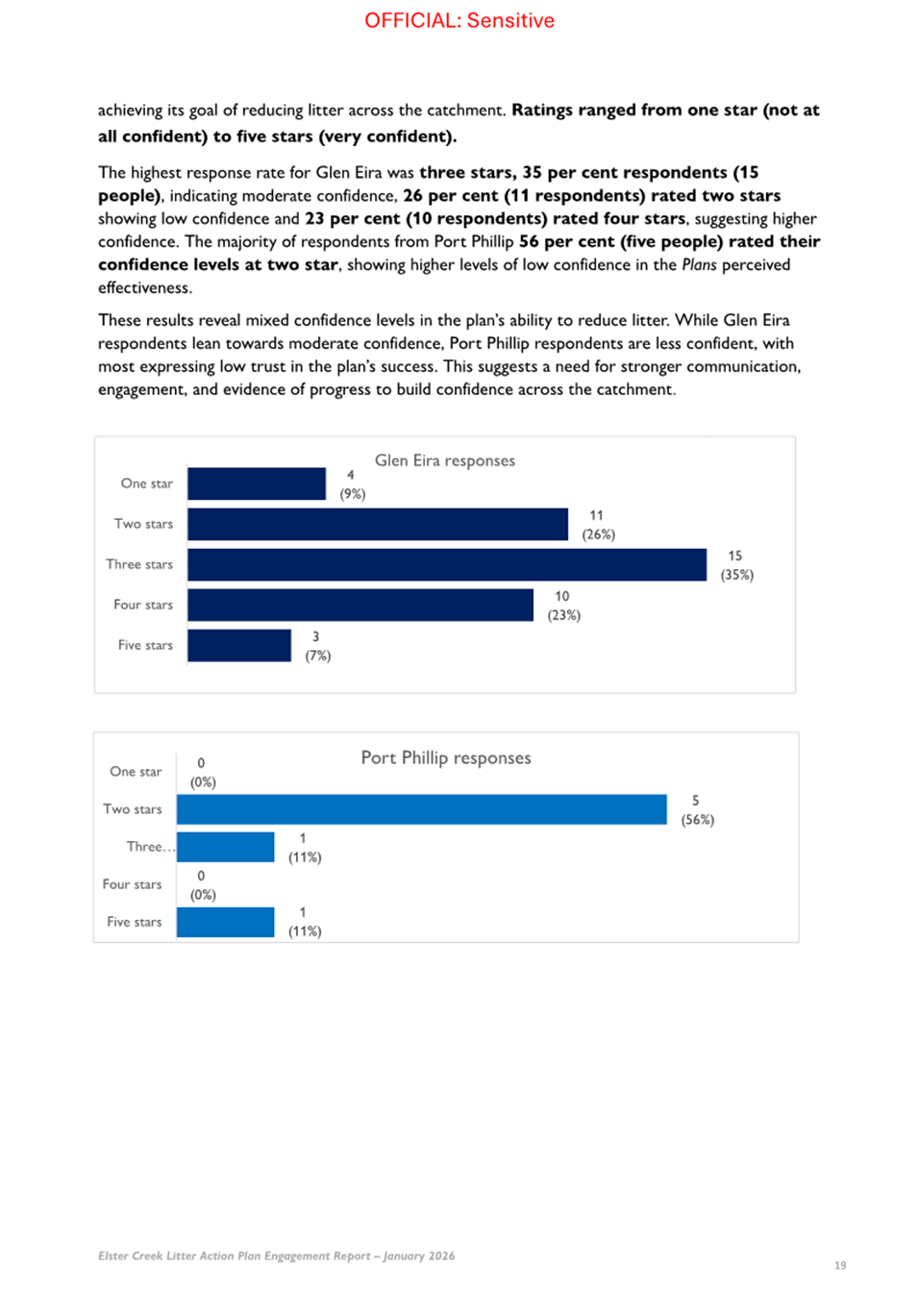
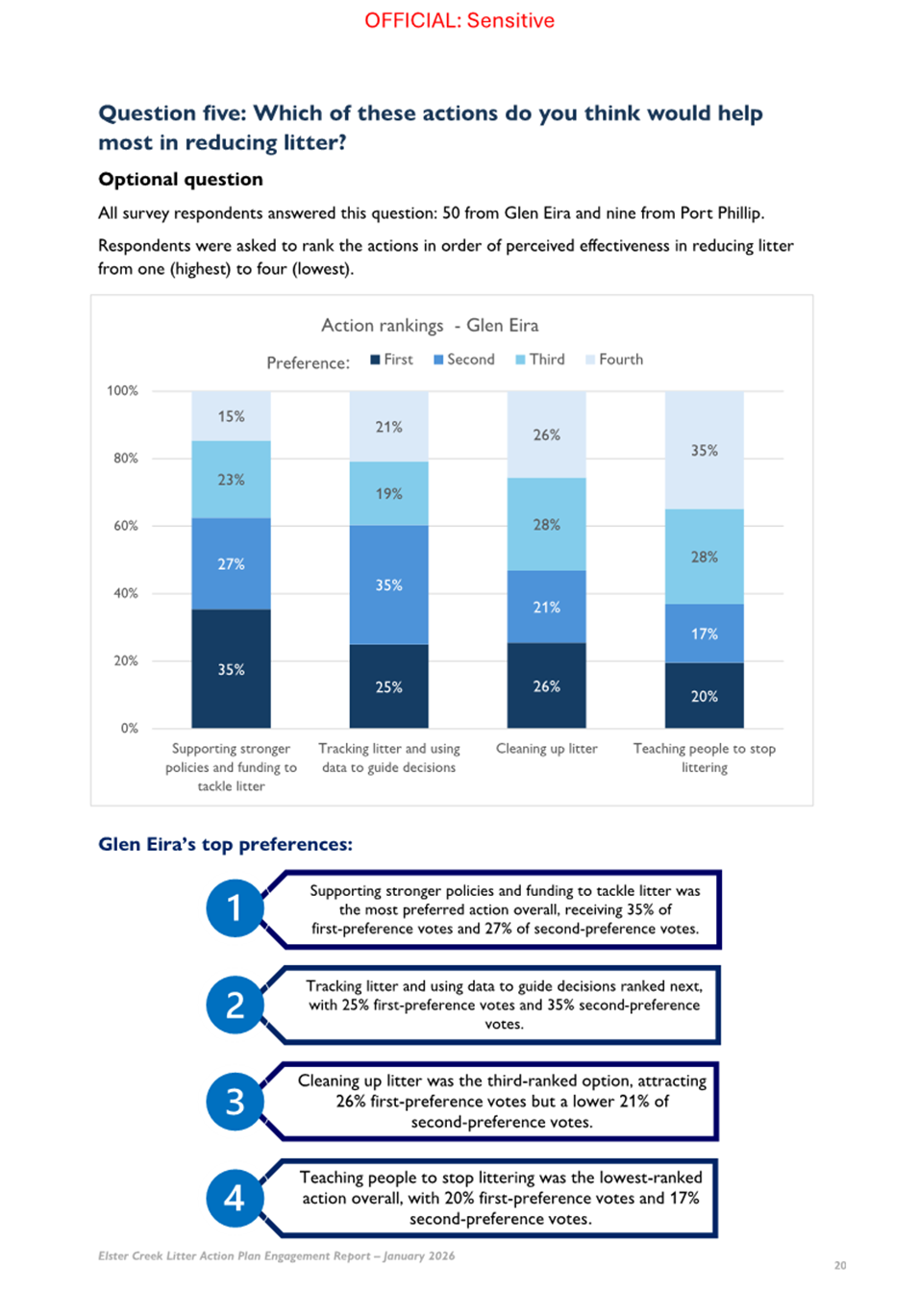
· Survey respondents—in Port Phillip, 56 per cent rated it as a ’very serious issue’; in Glen Eira, 44 per cent described litter as a ‘noticeable issue’.
· There were widespread concerns and mentions about cigarette butts, dumped rubbish, construction waste, stormwater pollution and litter around schools, railway stations and shopping strips.
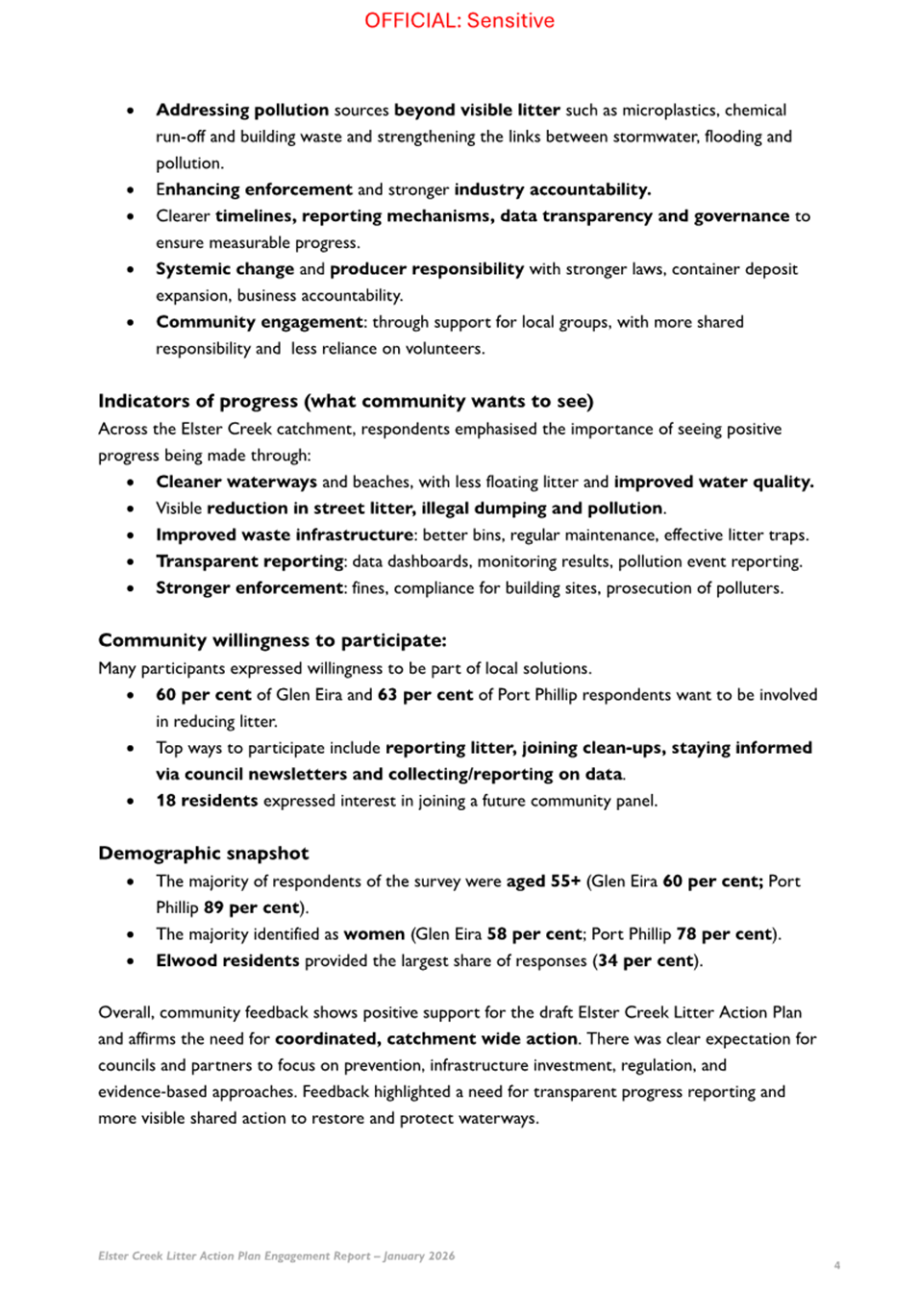
5.9 Many participants expressed willingness to be part of local solutions:
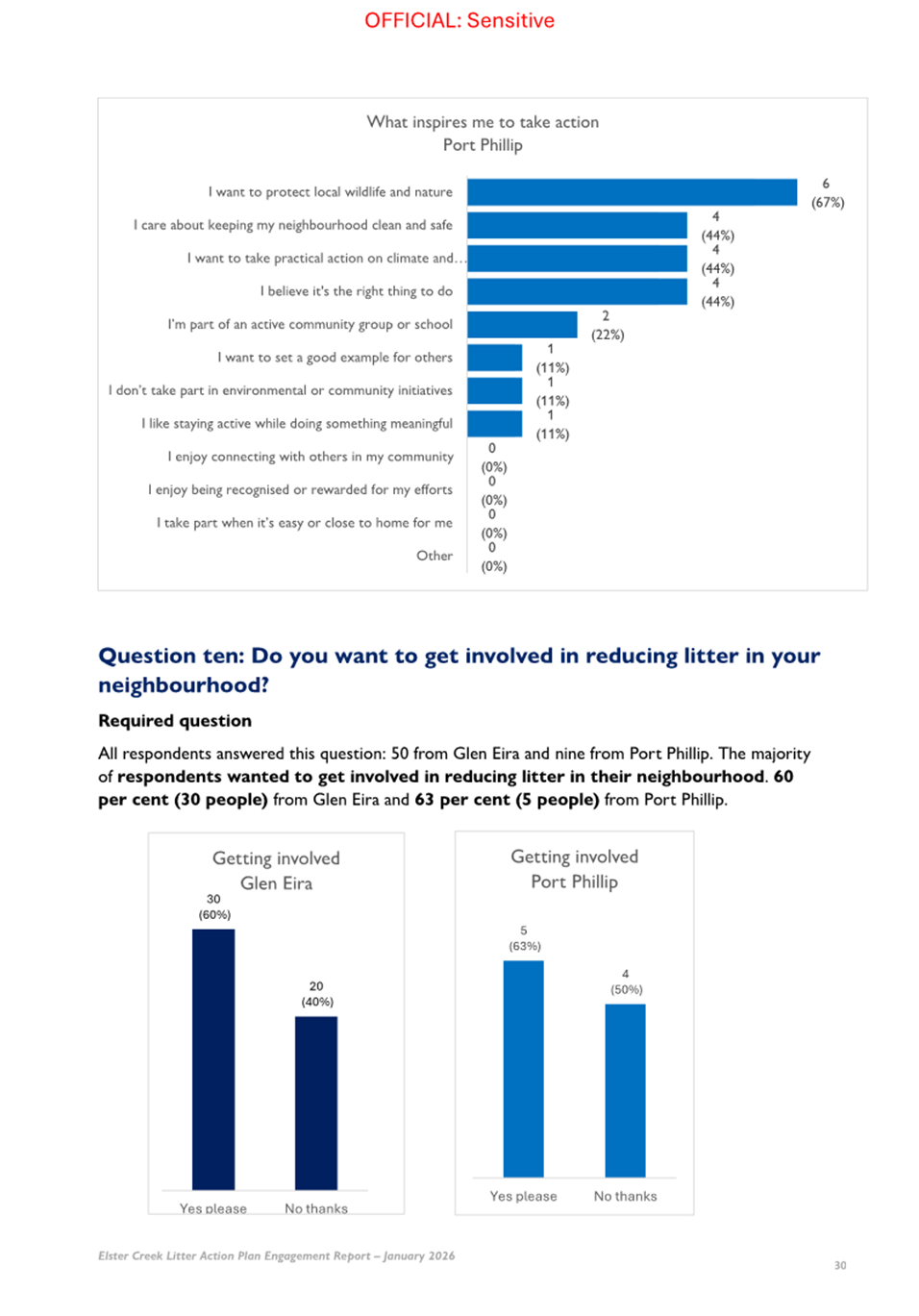
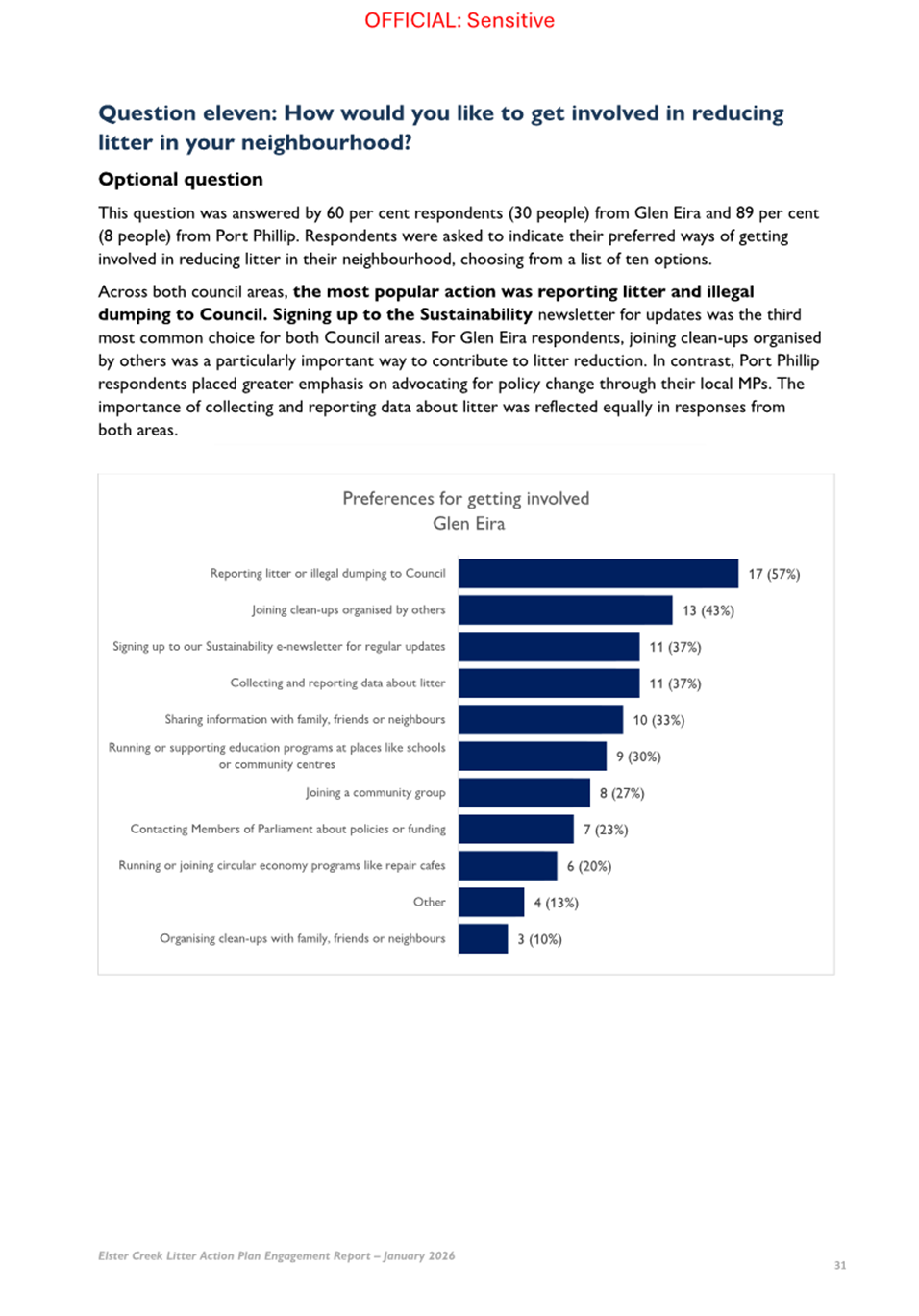
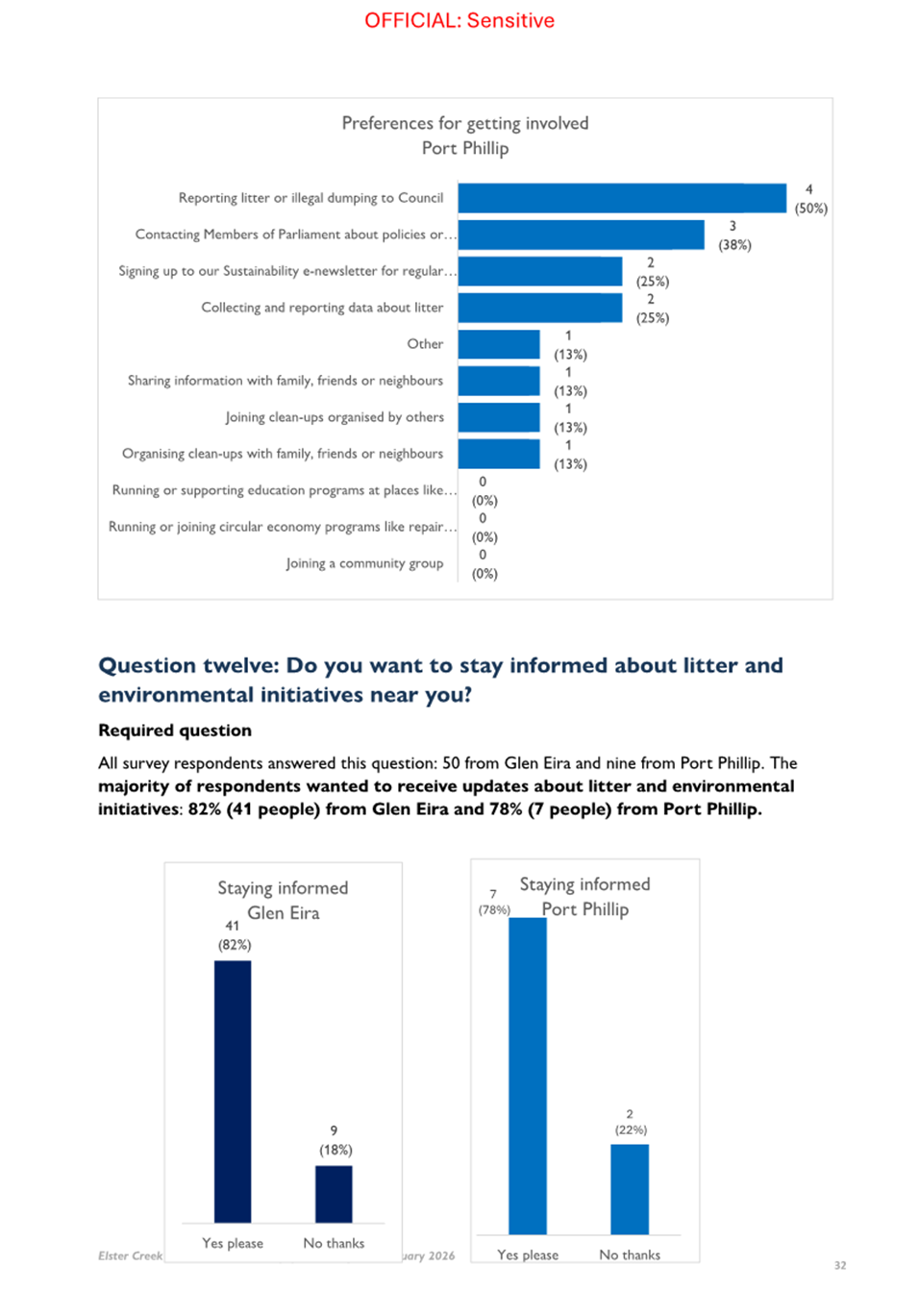
· 63 per cent of Port Phillip and 60 per cent of Glen Eira respondents want to be involved in reducing litter.
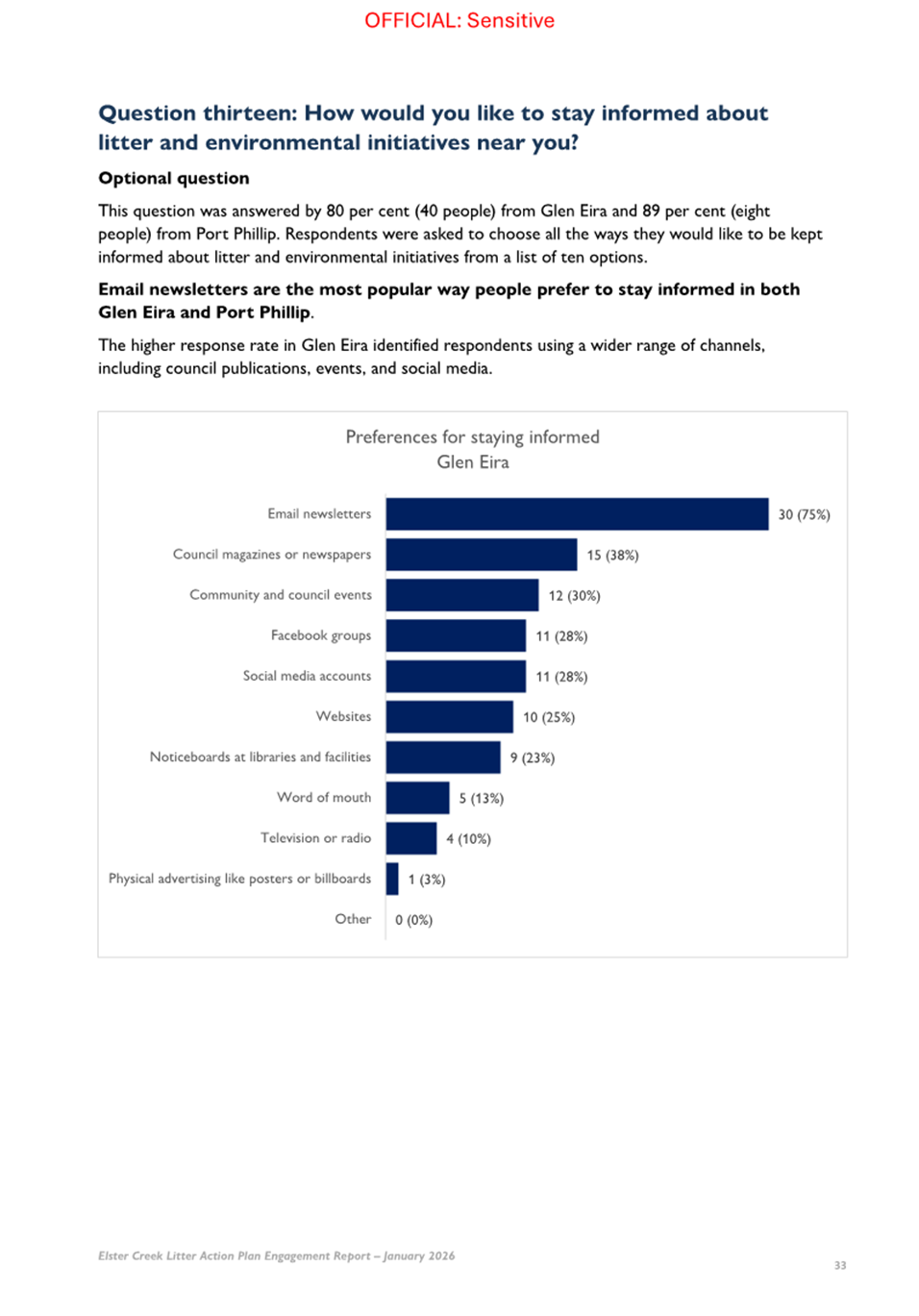
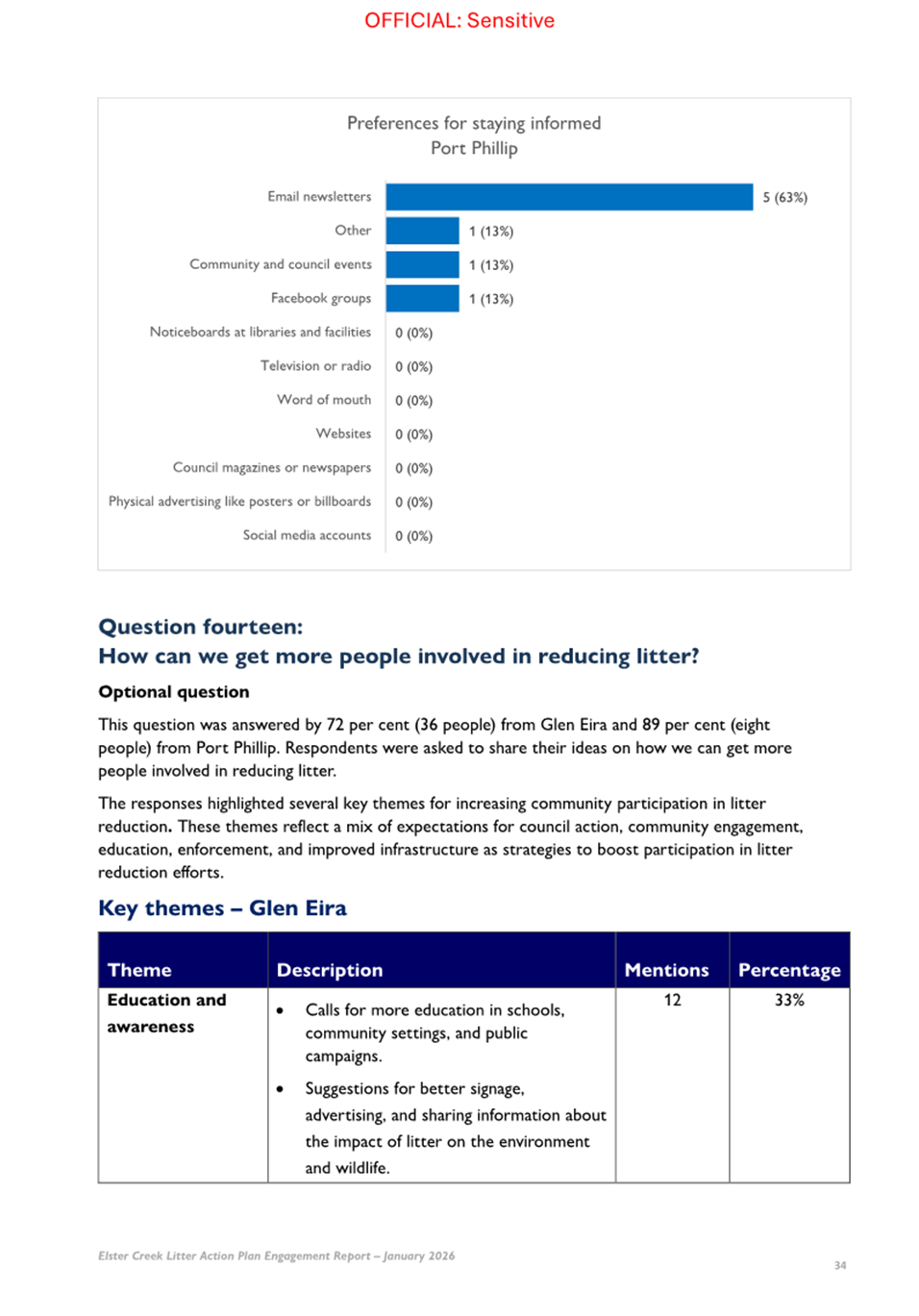
· Top ways to participate include reporting litter, joining clean‑ups, staying informed via council newsletters and collecting and reporting on data.
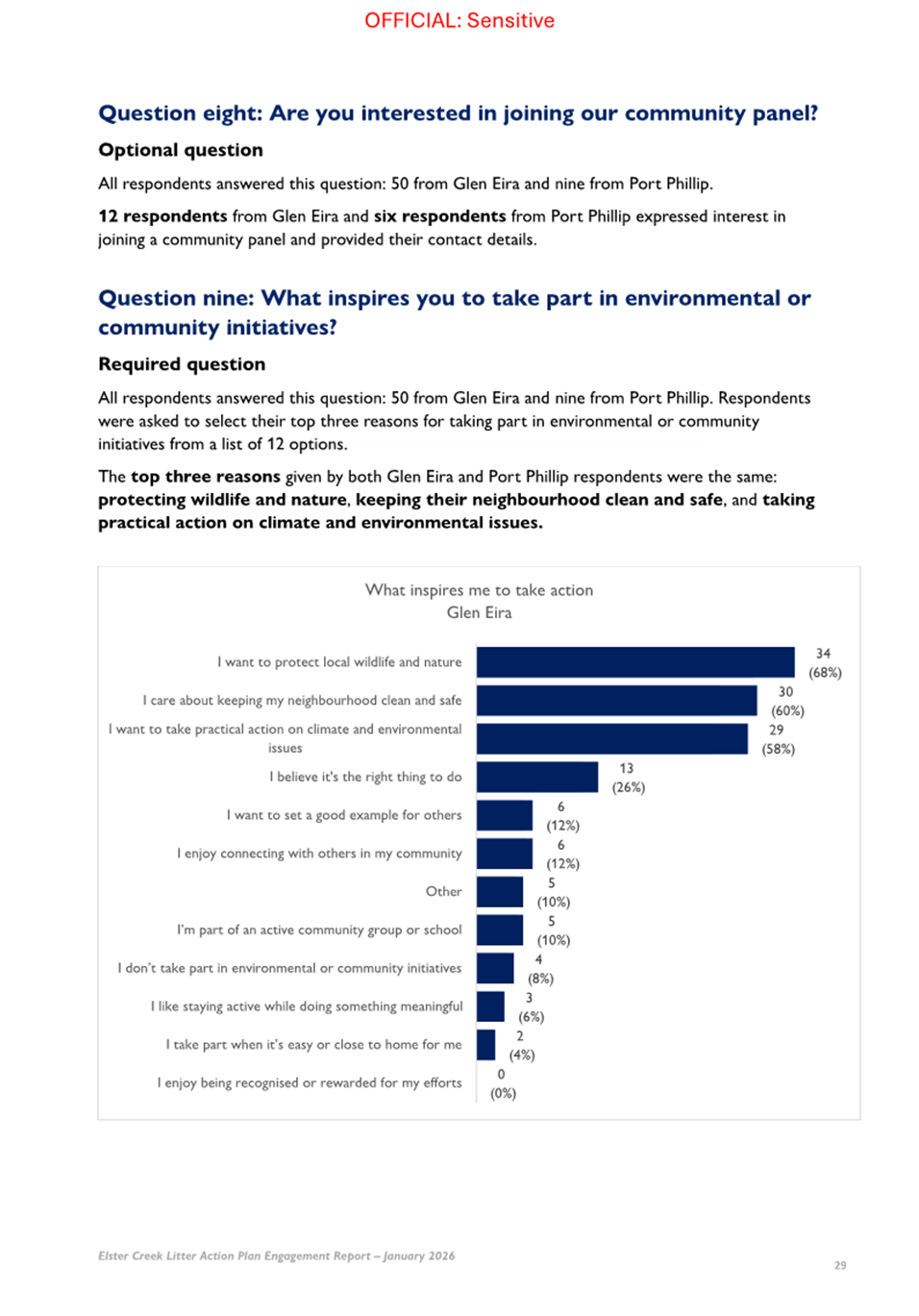
· 18 residents expressed interest in joining a future community panel.
5.10 Demographic snapshot
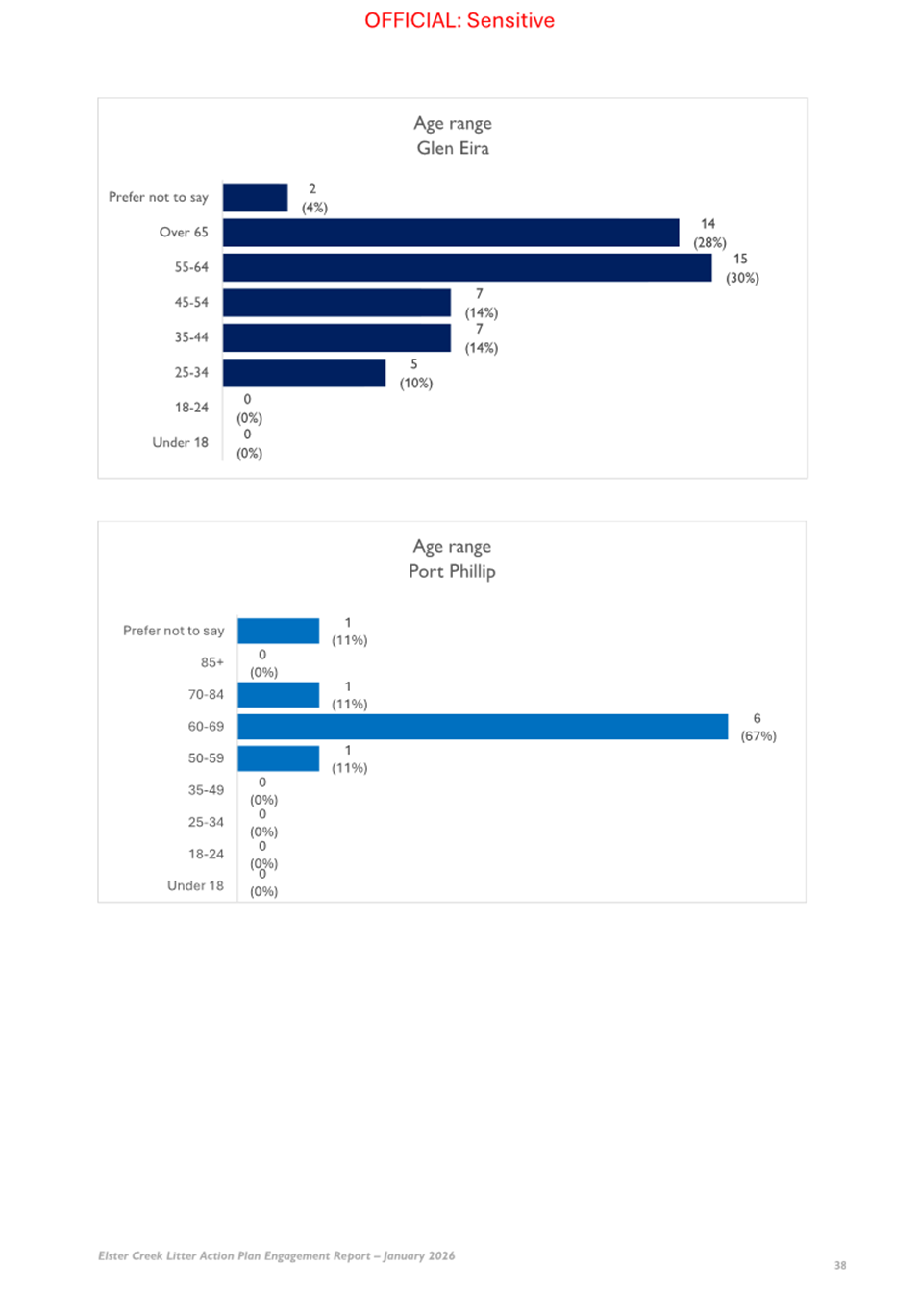
· The majority of respondents of the survey were aged 55+ (Port Phillip 89 per cent, Glen Eira 60 per cent).
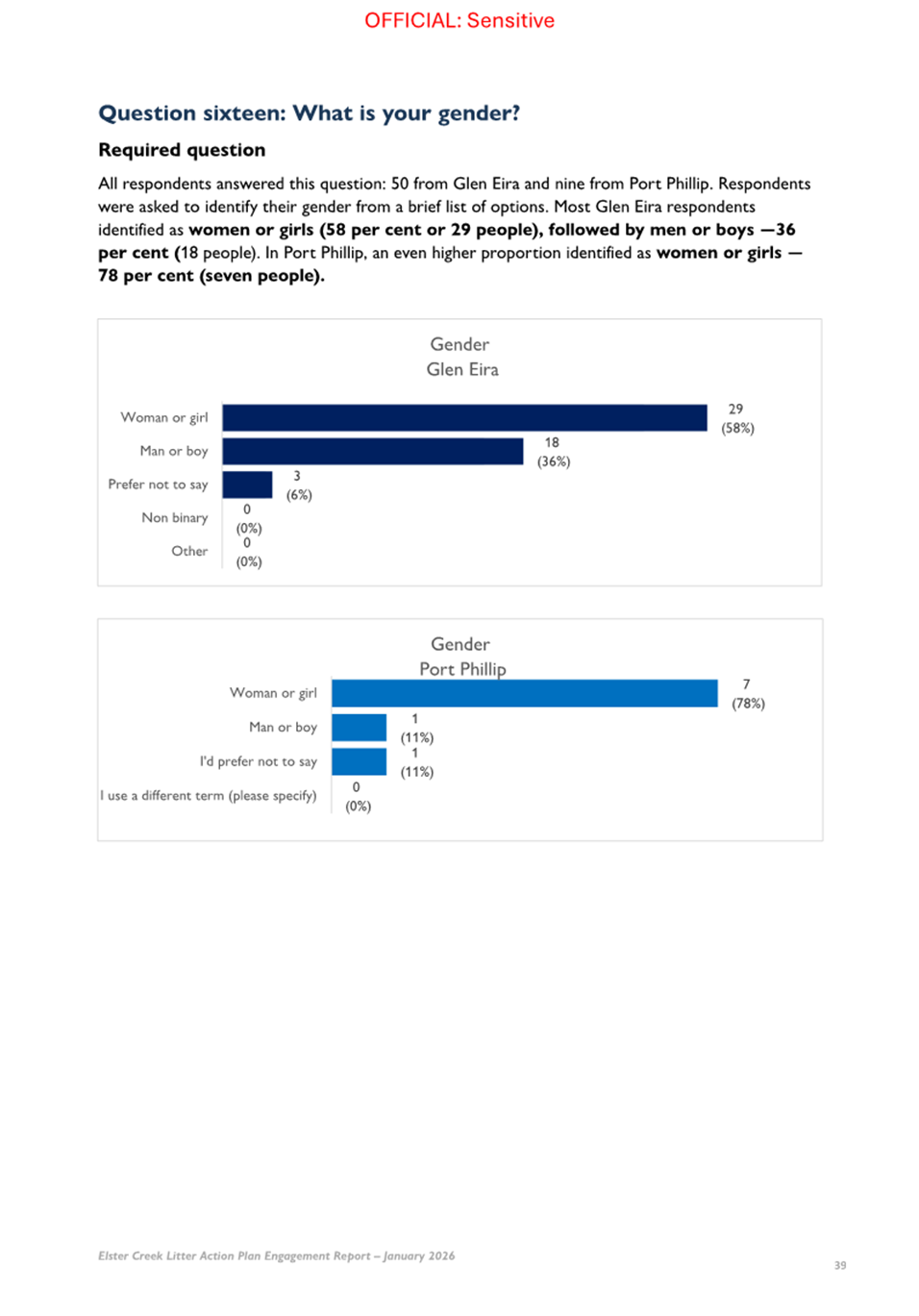
· The majority identified as women (Port Phillip 78 per cent; Glen Eira 58 per cent)
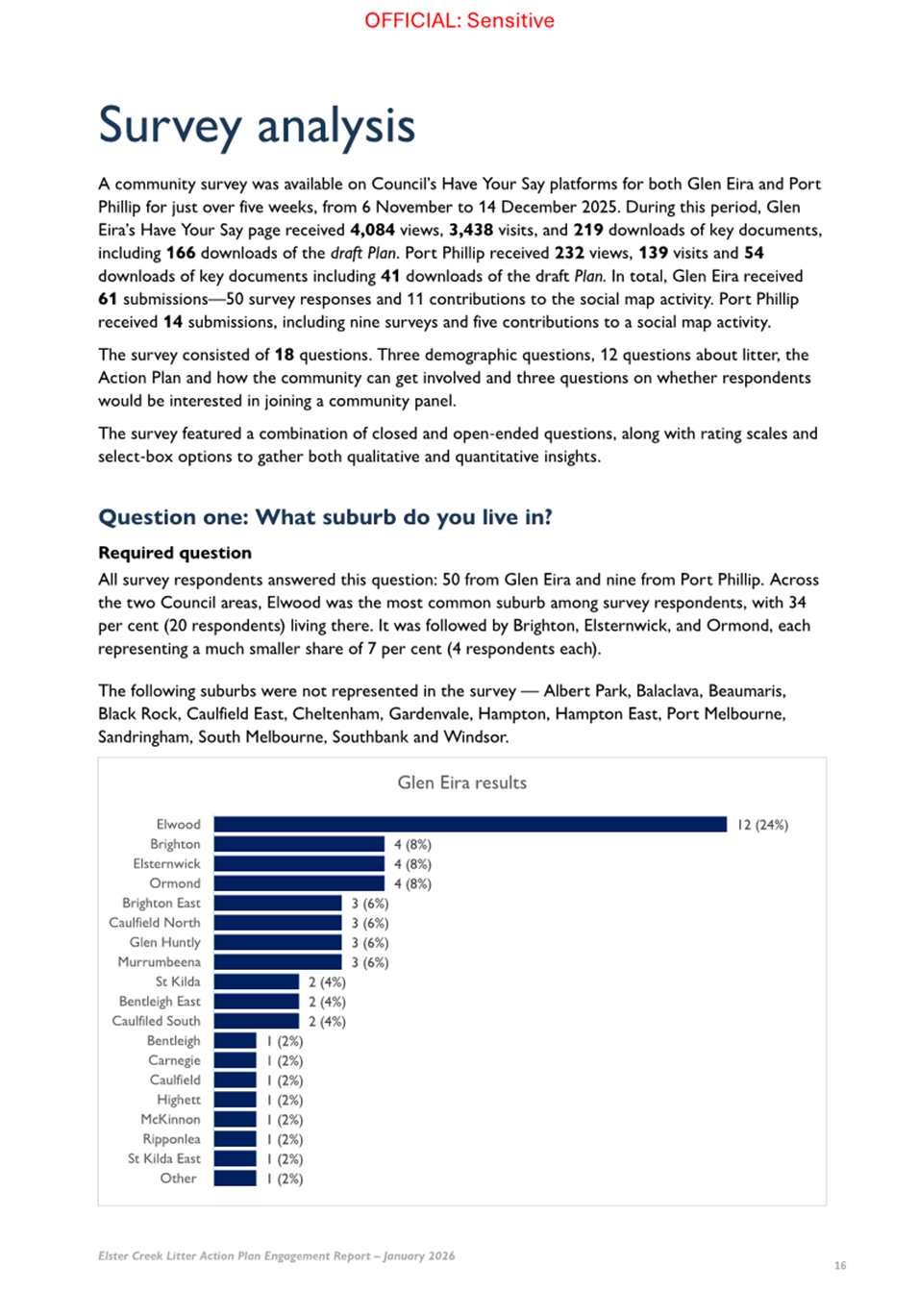
· Elwood residents provided the largest share of responses (34 per cent).
5.11 Overall, community feedback shows positive support for the draft Elster Creek Litter Action Plan and affirms the need for coordinated, catchment wide action.
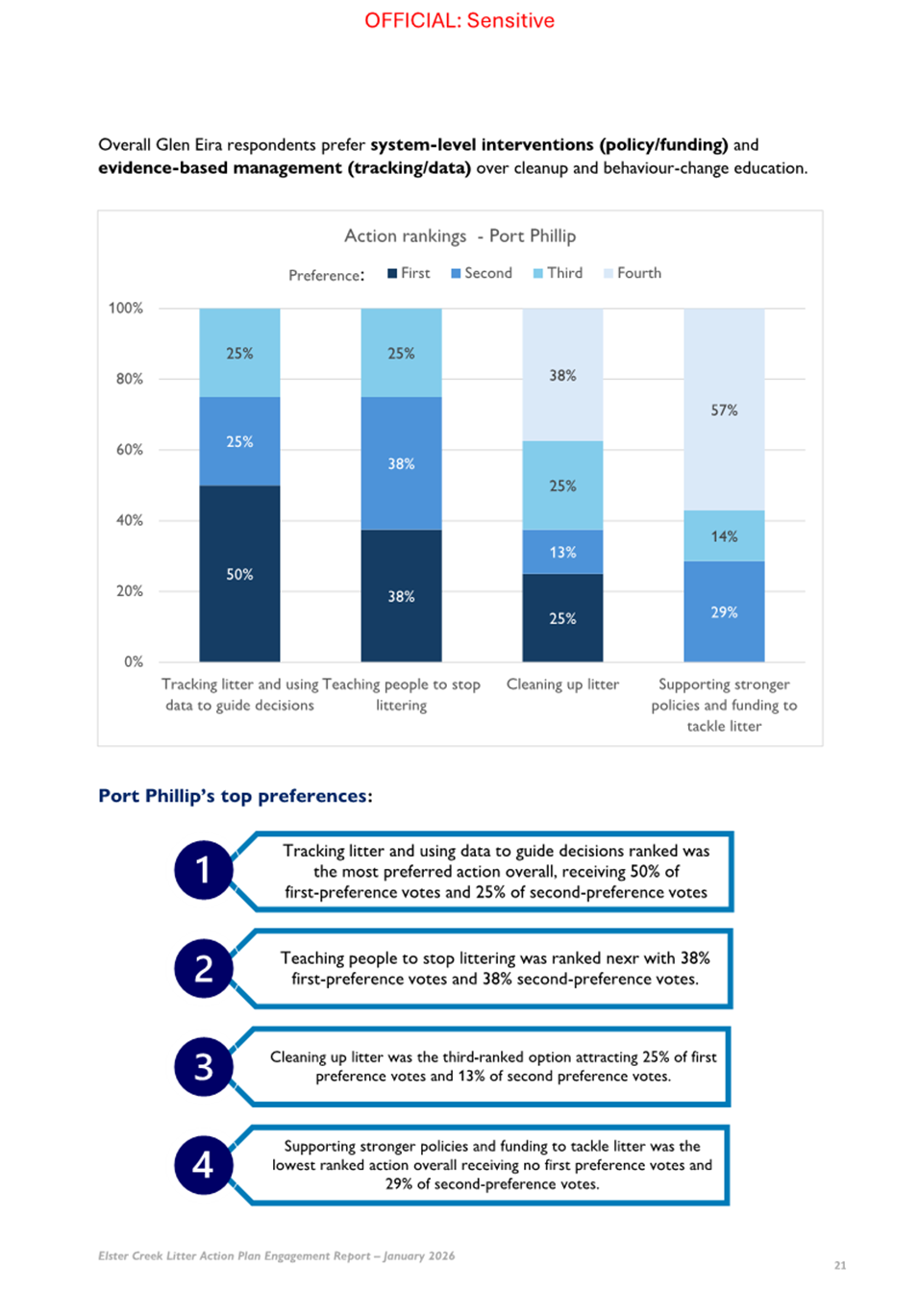
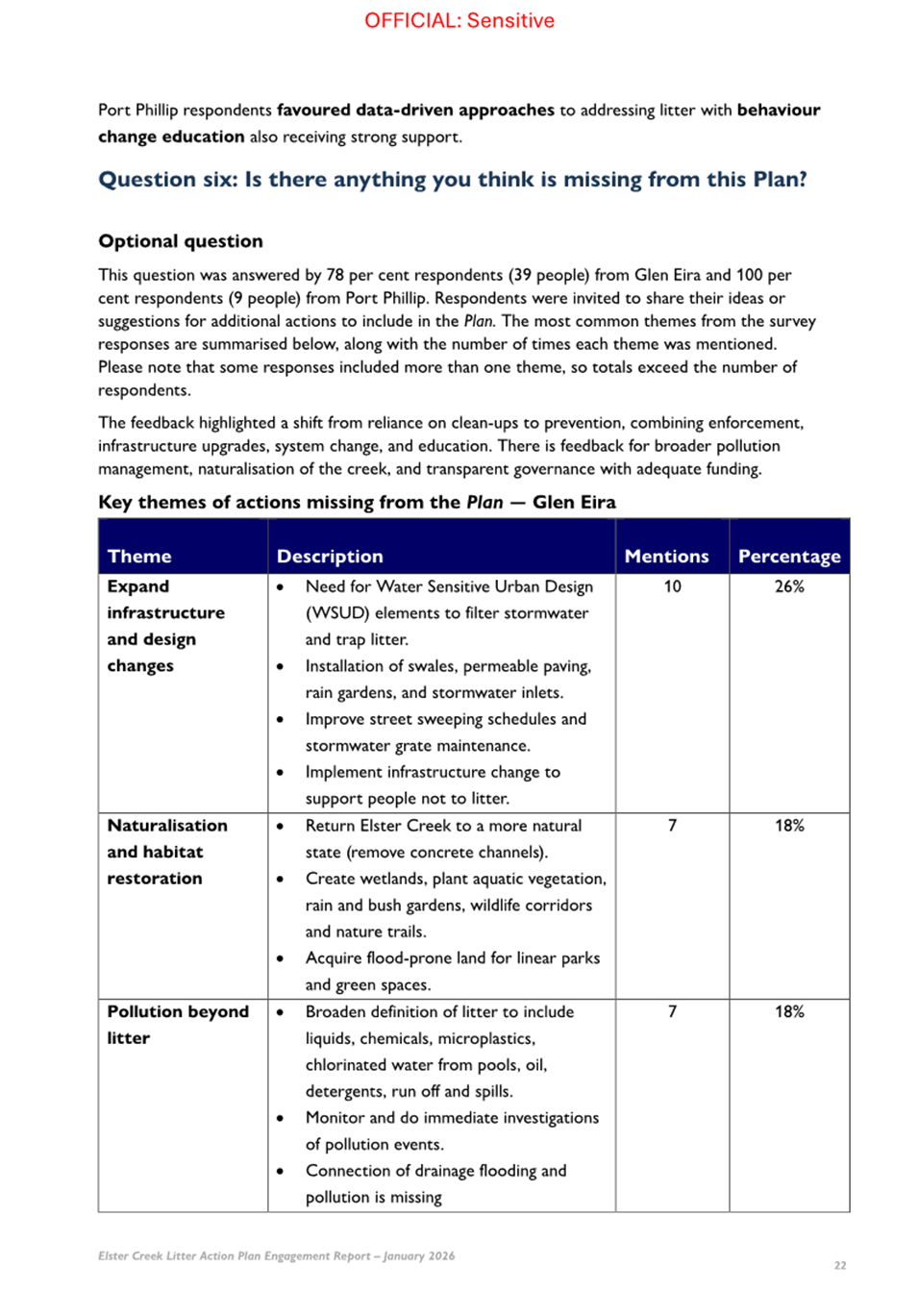
5.12 There was clear expectation for councils and partners to focus on prevention, infrastructure investment, regulation, and evidence‑based approaches. Feedback highlighted a need for transparent progress reporting and more visible shared action to restore and protect waterways.
6. LEGAL AND RISK IMPLICATIONS
6.1 The Elster Creek Litter Action Plan addresses key risks by targeting litter’s impact on waterway health, biodiversity, and public amenity, including the risk of flooding and pollution in Port Phillip Bay.
6.2 The Plan responds to high community expectations and statutory compliance requirements, helping safeguard Council’s reputation. Financial and resource pressures are managed through prioritisation and annual review, ensuring actions remain cost-effective and adaptable. Effective governance and collaboration through the Elster Creek Litter Collaboration underpin delivery, accountability, and continuous improvement.
7. FINANCIAL IMPACT
7.1 An
assessment of the budget required for each partner is shown in Table 1 below.
This has identified a total of approximately $45,810 over 5 years for City of
Port Phillip.
Table 1. Budget required for implementation of Elster Creek Action Plan
|
FY 25/26 |
FY 26/27 |
FY 27/28 |
FY 28/29 |
FY 28/29 |
Total |
|
|
Total Overall |
$16,667 |
$121,872 |
$199,356 |
$178,190 |
$87,912 |
$603,997 |
|
Glen Eira |
$14,111 |
$66,445 |
$100,613 |
$114,373 |
$44,373 |
$339,915 |
|
Melbourne Water |
$1,033 |
$37,612 |
$57,456 |
$47,984 |
$36,678 |
$180,763 |
|
Port Phillip |
$4,011 |
$9,058 |
$21,019 |
$6,167 |
$5,556 |
$45,810 |
|
Bayside |
$0 |
$11,859 |
$20,269 |
$4,667 |
$1,306 |
$38,100 |
7.2 The larger budget required by City of Glen Eira and Melbourne Water reflects their leadership in delivery of infrastructure related actions. EPA Victoria is not included in financial calculations as their contribution will solely be via internal staff time. The calculations assume that for each action, the leads share 80 percent of the total cost of that action, with supporting organisations sharing the remaining 20 percent of the cost.
7.3 The estimated budget for City of Port Phillip to deliver its actions is approximately $45,810 over 5 years. This estimate includes actions added to the draft ECLAP.
7.4 Budget for community actions involving City of Port Phillip in 25/26 and all future years can be allocated from the existing Community Sustainability Programs budget ($4k of total $90k) with no new allocation of funding.
7.5 No new staff resources are required to deliver the Action Plan.
7.6 Should the Action (2.4) to ‘Develop a business case for a Litter Enforcement Officer (LEO)’ recommend that a LEO should be employed, this will be a financial decision for Council to make at a future Council meeting.
8. ENVIRONMENTAL IMPACT
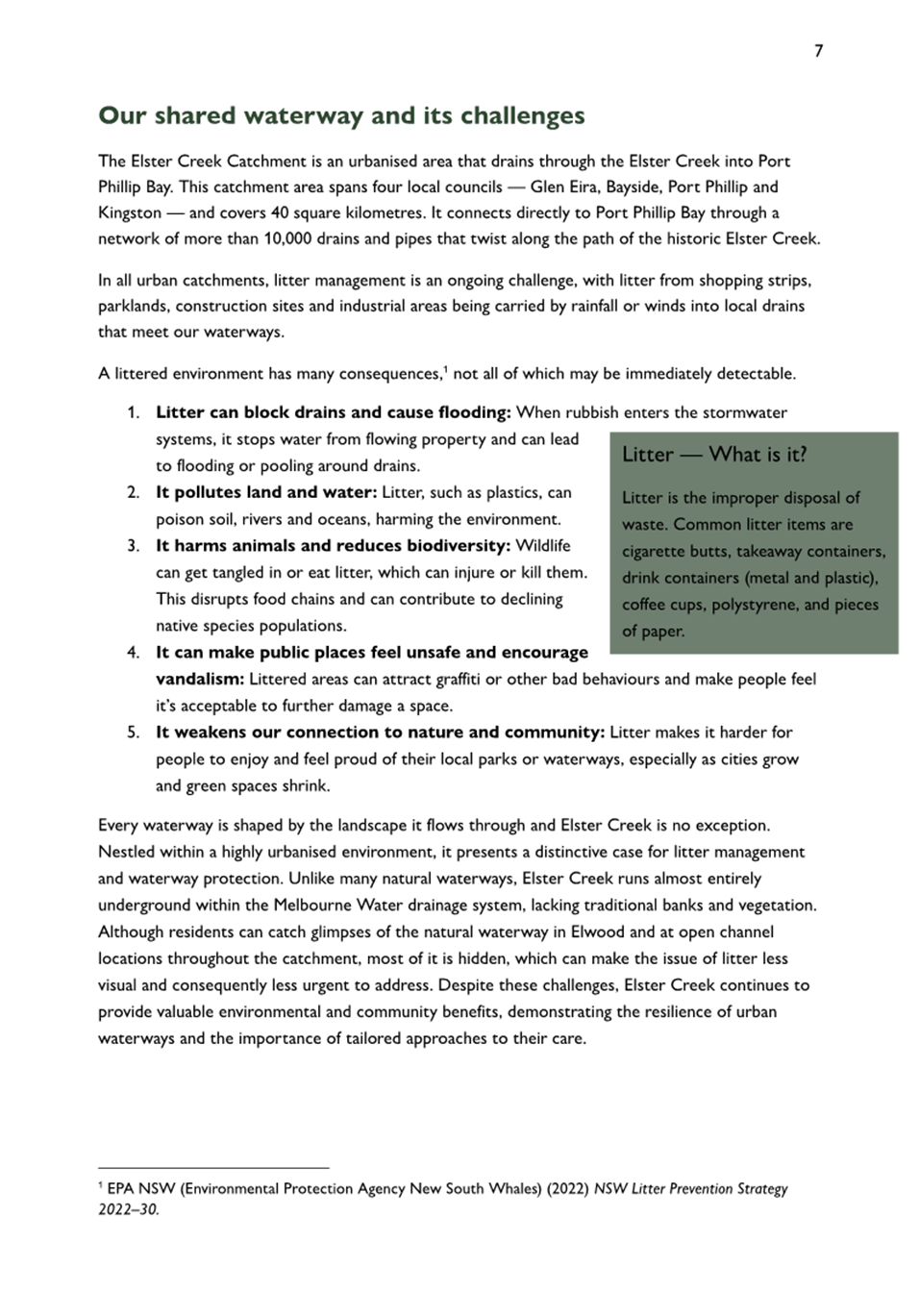
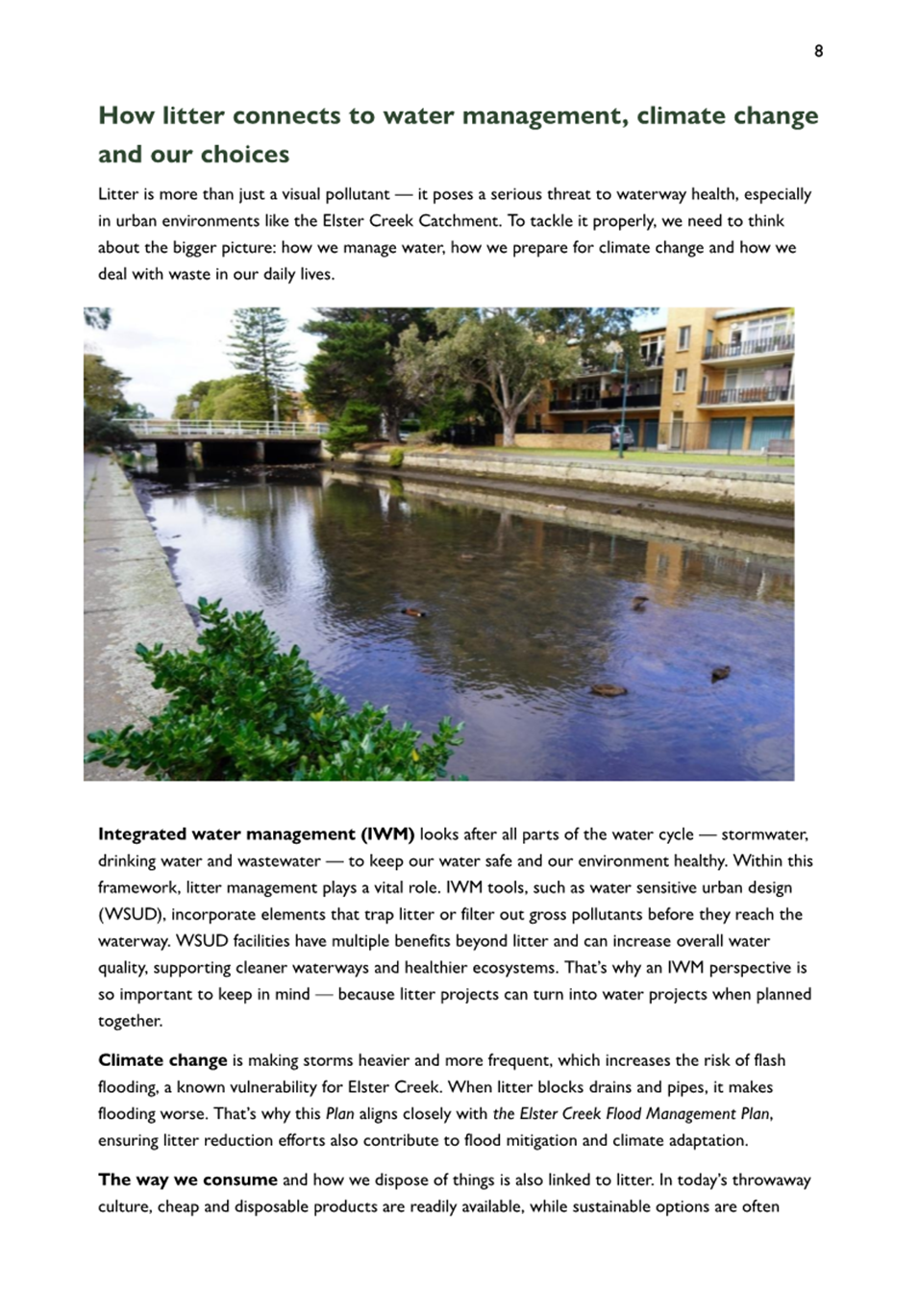
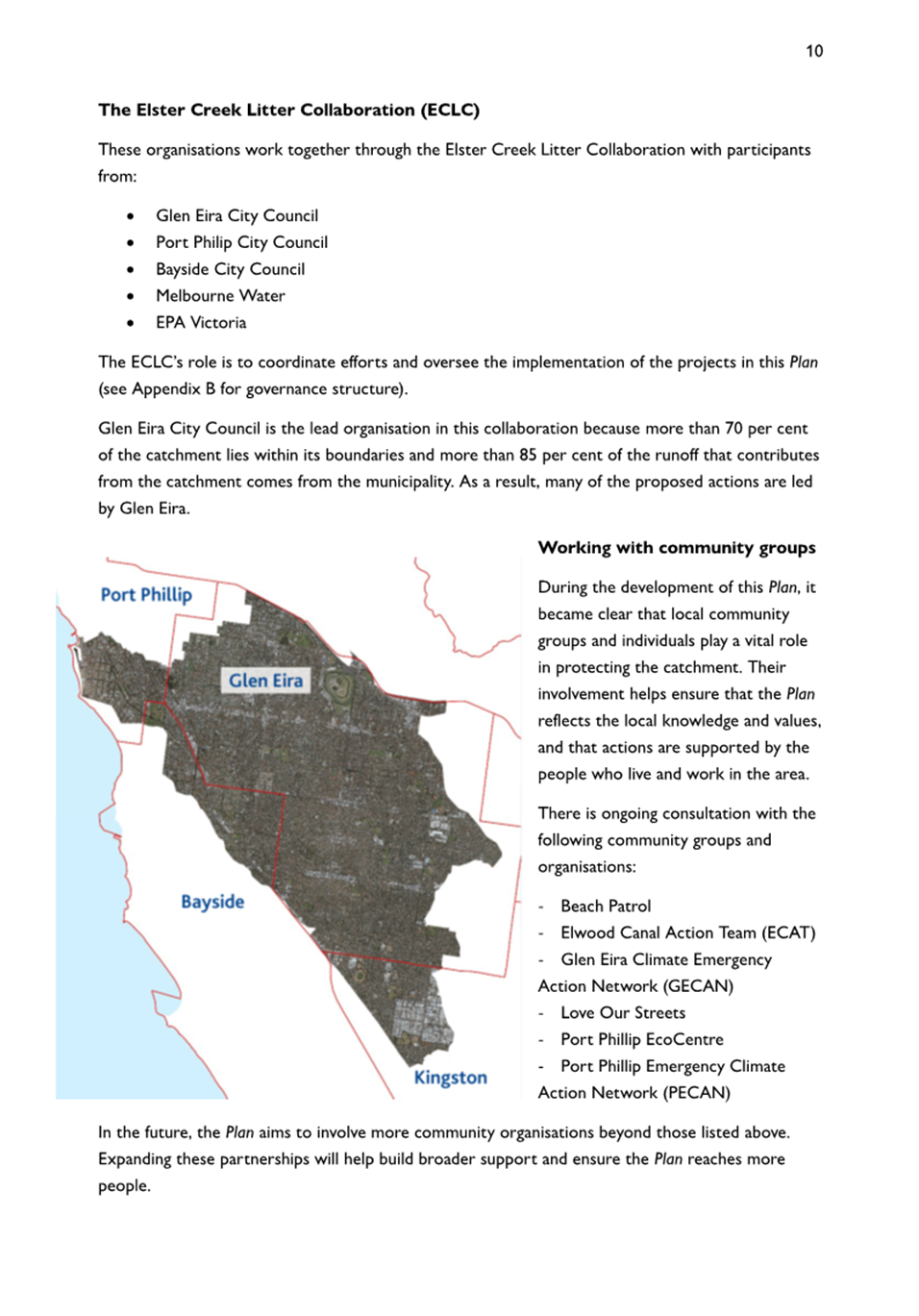
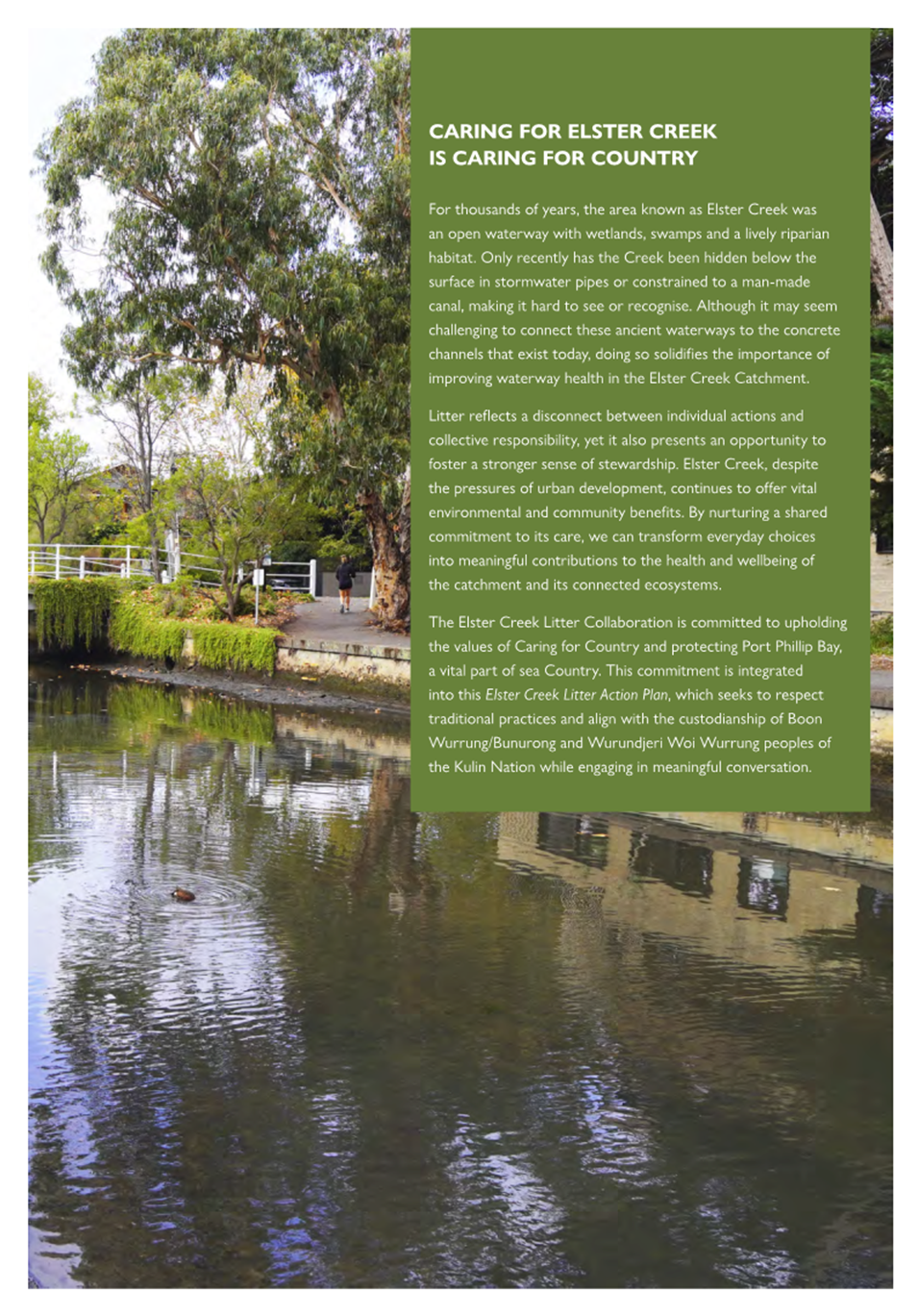
8.1 Elster Creek is the primary waterway collecting rainwater from streets across the municipality of Glen Eira and parts of Port Phillip, Bayside and Kingston. Most of the catchment is in City of Glen Eira. The Creek winds through suburbs like Elsternwick, Carnegie and Bentleigh, before draining into Port Phillip Bay via the Elwood Canal.
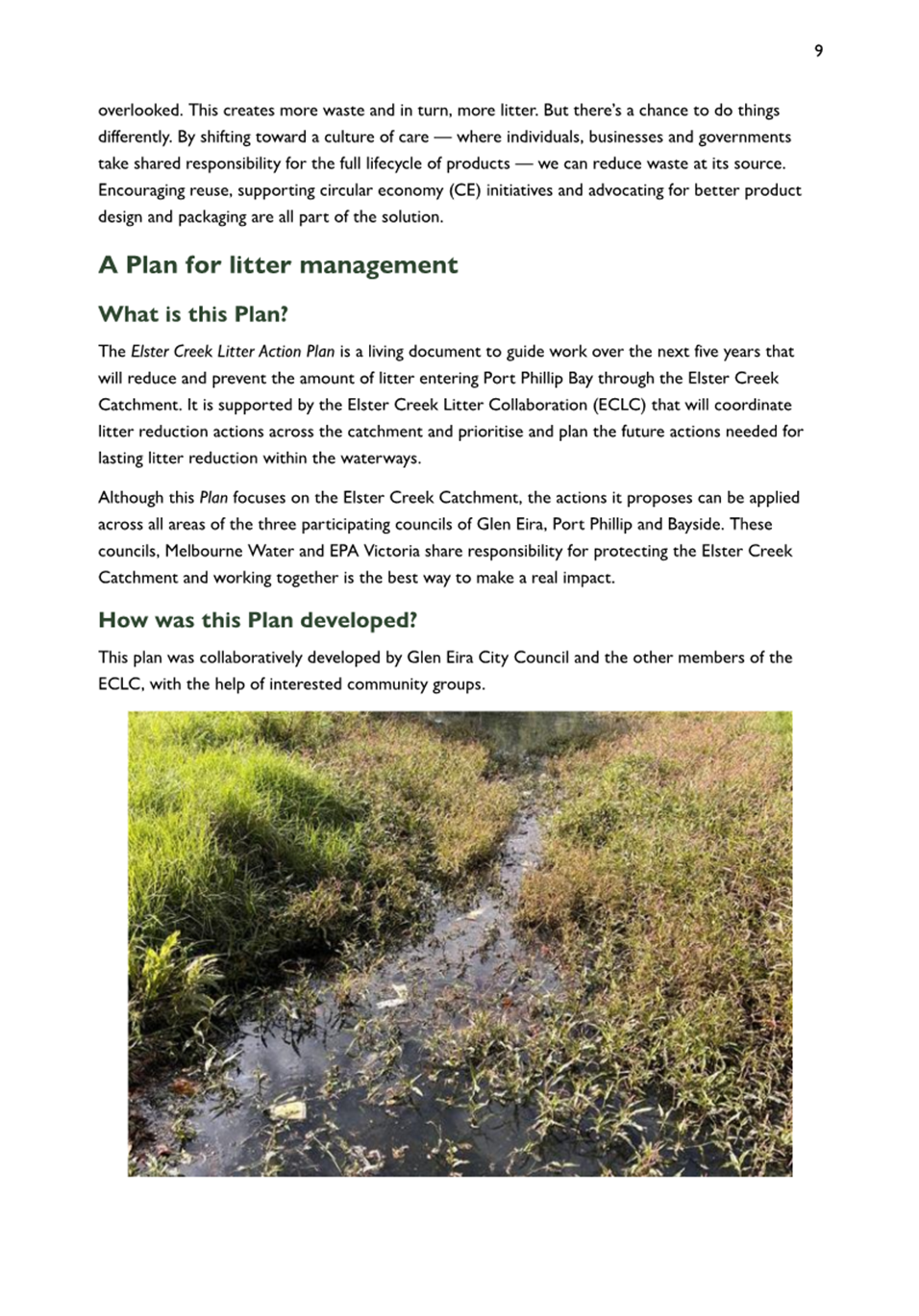
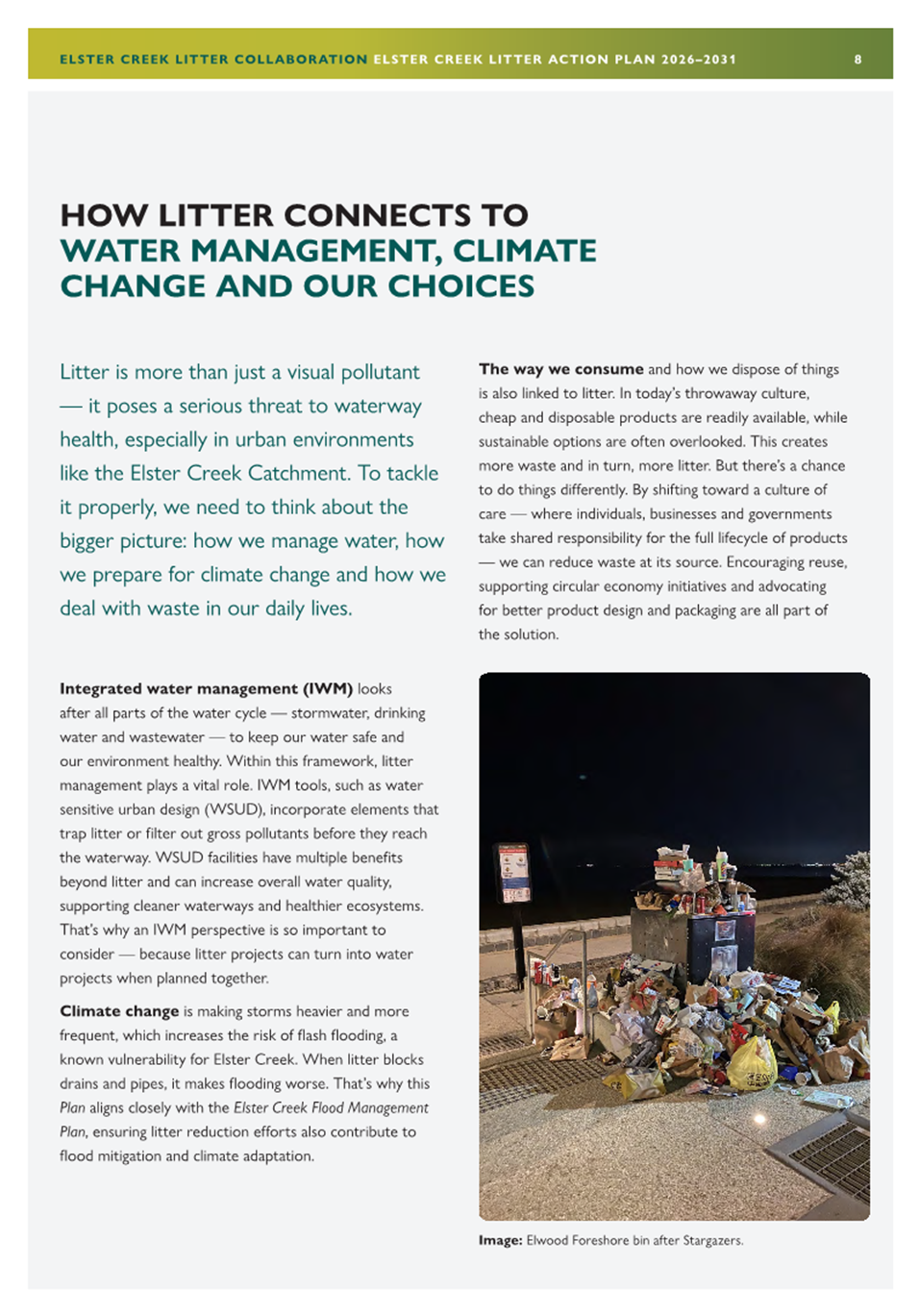
8.2 Litter is more than just a visual pollutant, it poses a threat to waterway health, especially in urban environments like the Elster Creek Catchment. The wellbeing of Elster Creek is closely linked to the health of Port Phillip Bay.
8.3 Litter continues to threaten the health of Elster Creek, despite long-standing recognition of the issue by environmental organisations and government bodies alike. While previous efforts have achieved some success, persistent pollution highlights the need for renewed and coordinated action.
8.4 Progress on the 3 outcomes of the ECLAP will be measured by:
· Prevention
% reduction in litter volume (kg or m3) collected by community
groups and stakeholders
· Removal
Total kg or m3 of litter removed
· Monitoring
% composition of litter by type identified
SOCIAL IMPACT
8.5 During the development of the ECLAP, it was evident that local community groups and individuals play a vital role in protecting the catchment. Their involvement helps ensure that the ECLAP reflects the local knowledge and values, and that actions are supported by the people who live and work in the area.
8.6 Promotion and involvement in litter clean-ups and citizen science activities by residents, schools, and Elster Creek Litter Collaboration (ECLC) partner organisations is expected to generate awareness and ownership of the need to prevent litter in Elster Creek catchment.
9. COMMUNITY IMPACT
9.1 The ECLAP has been developed after local residents formed the Elster Creek Action Team (ECAT) to highlight the litter issue in 2024. After ECAT removed many kilograms of litter from Elster Creek drain to prevent this from entering the Bay, City of Port Phillip support to address the issue and collaborate on an Action Plan was sought and approved.
9.2 Actions in the ECLAP have been developed in collaboration engaged community groups, i.e. Elwood Canal Action Team, Port Phillip EcoCentre, Beach Patrol / Love Our Street, Port Phillip Emergency Climate Action Group (PECAN), along with partners City of Glen Eira, Melbourne Water, Bayside City Council and EPA Victoria.
9.3 Engagement has focussed on actions involving community members more than actions relating to improved infrastructure. This is because the ECLAP requires effective community ownership to achieve changes in awareness and behaviour.
9.4 Several key objectives in the ECLAP are targeted at harnessing community involvement.
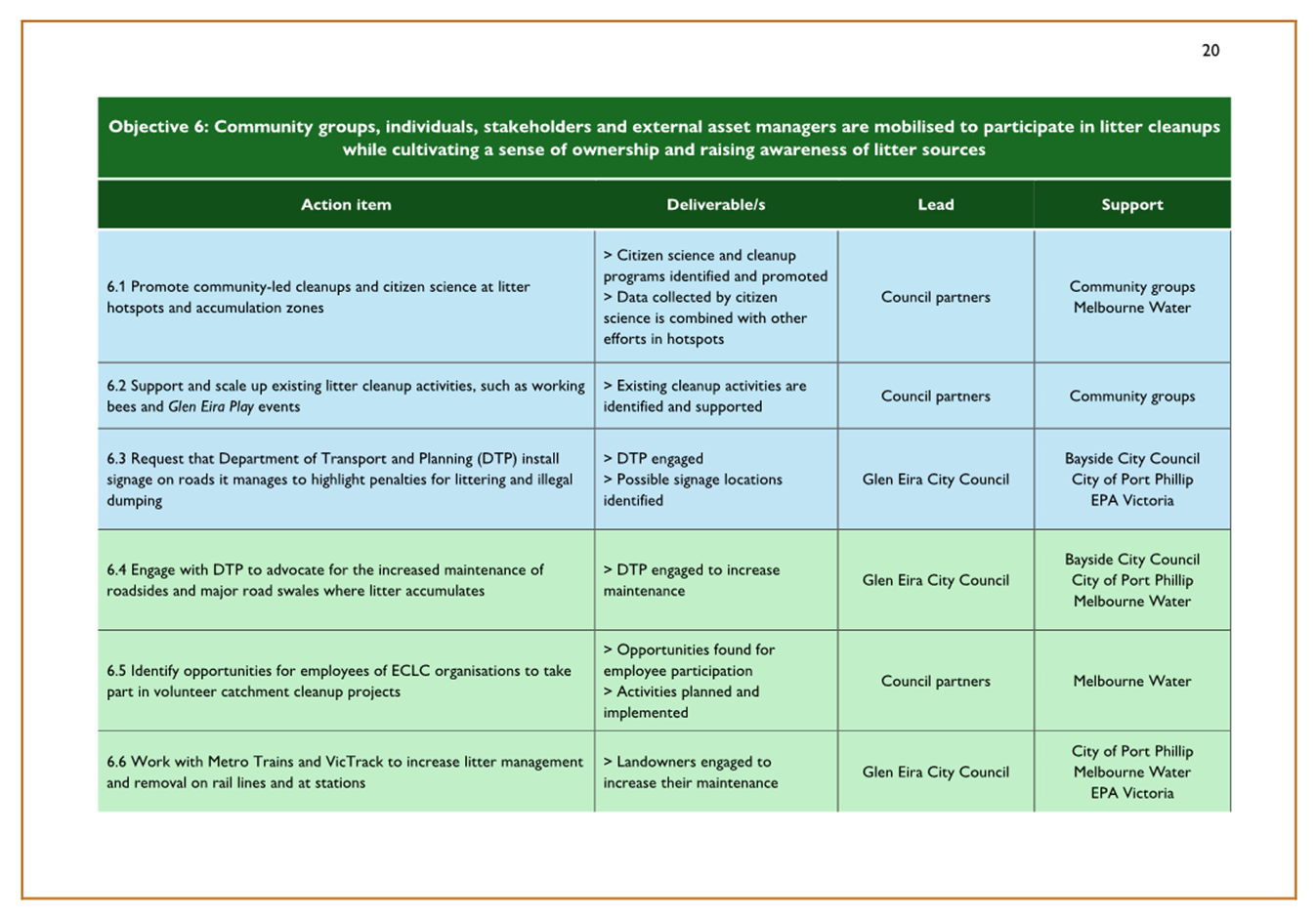
Objective 1: The community changes their behaviour to reduce the amount of litter in the catchment and understand their role and the ECLC's role in improving our waterways.
Objective 4: Achieve litter reduction by securing strong leadership, improving state policies and supporting community-led solutions.
Objective 6: Community groups, individuals, stakeholders and external asset managers are mobilised to participate in litter cleanups while cultivating a sense of ownership and raising awareness of litter sources.
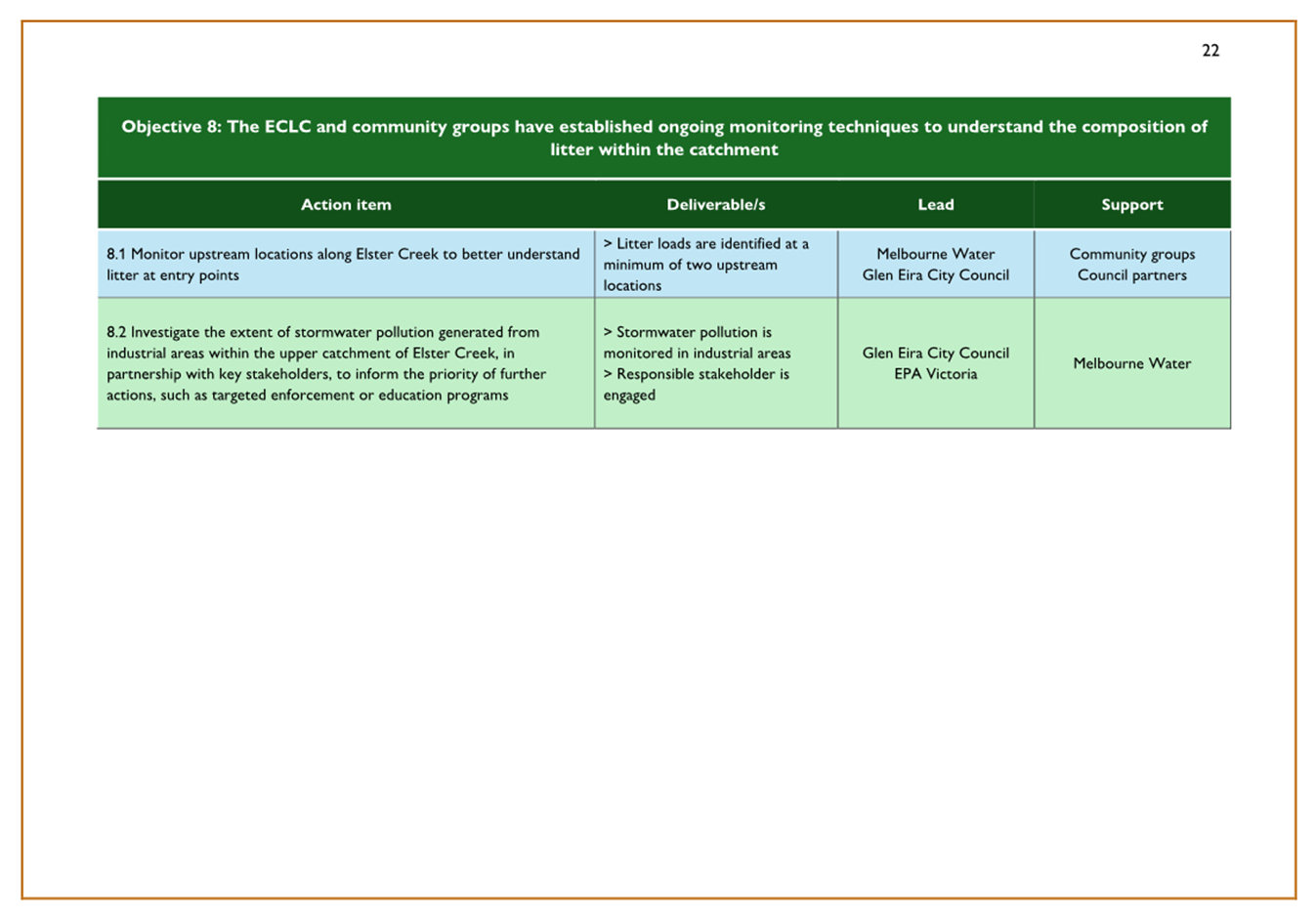
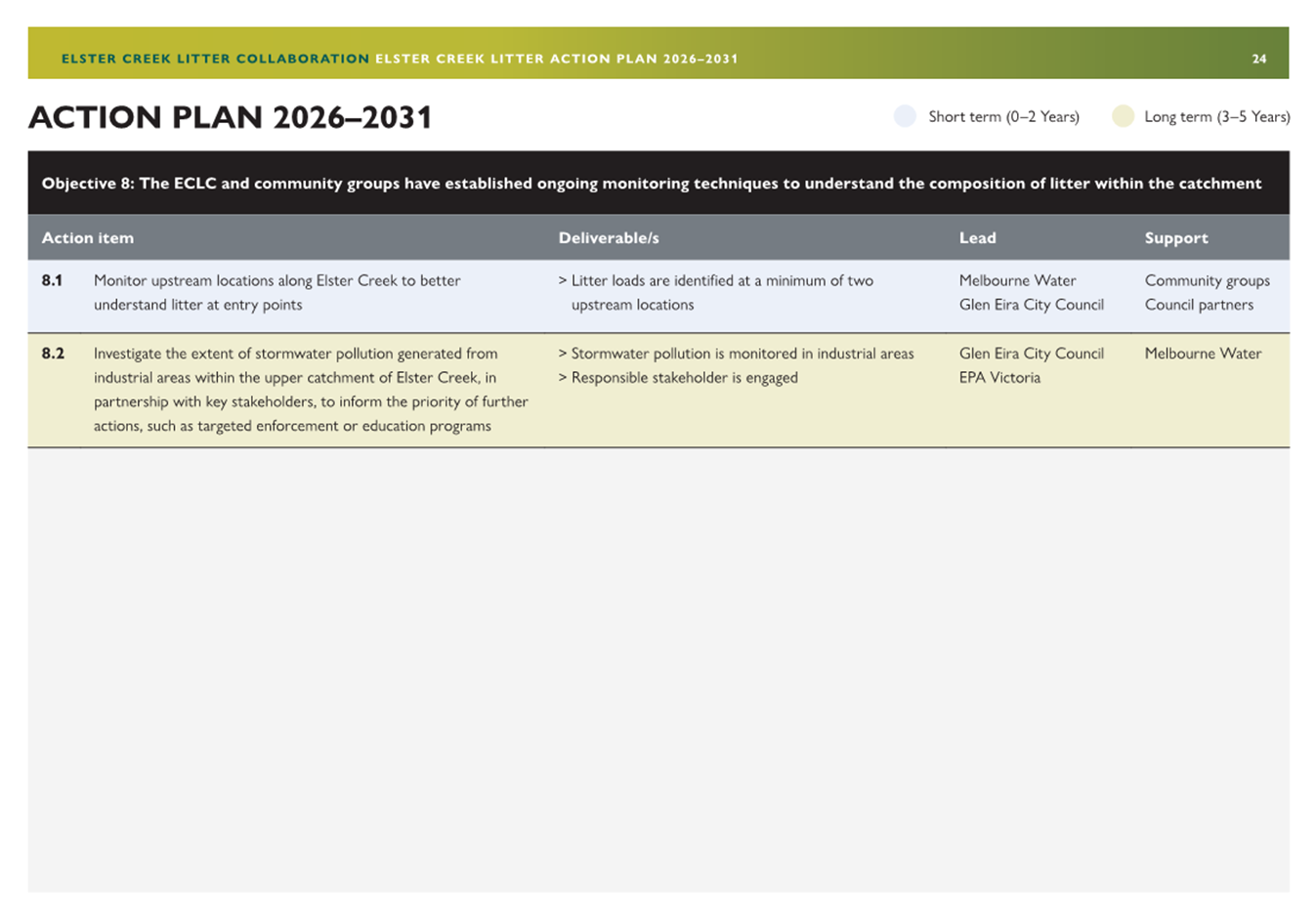
Objective 8: The ECLC and community groups have established ongoing monitoring techniques to understand the composition of litter within the catchment.
9.5 Involvement of community groups and individuals will help to ensure that the Plan reflects the local knowledge and values, and that actions are supported by the people who live and work in the area.
10. Gender Impact Assessment
10.1 A Gender Impact Assessment has been completed for delivery of the Action Plan by City of Glen Eira, on behalf of the Elster Creek Litter Collaboration, and in consultation with all partners.
11. ALIGNMENT TO COUNCIL PLAN AND COUNCIL POLICY
11.1 The Elster Creek Action Plan aligns with the Council Plan Strategic Objective of ‘An Environmentally Sustainable and Resilient City’.
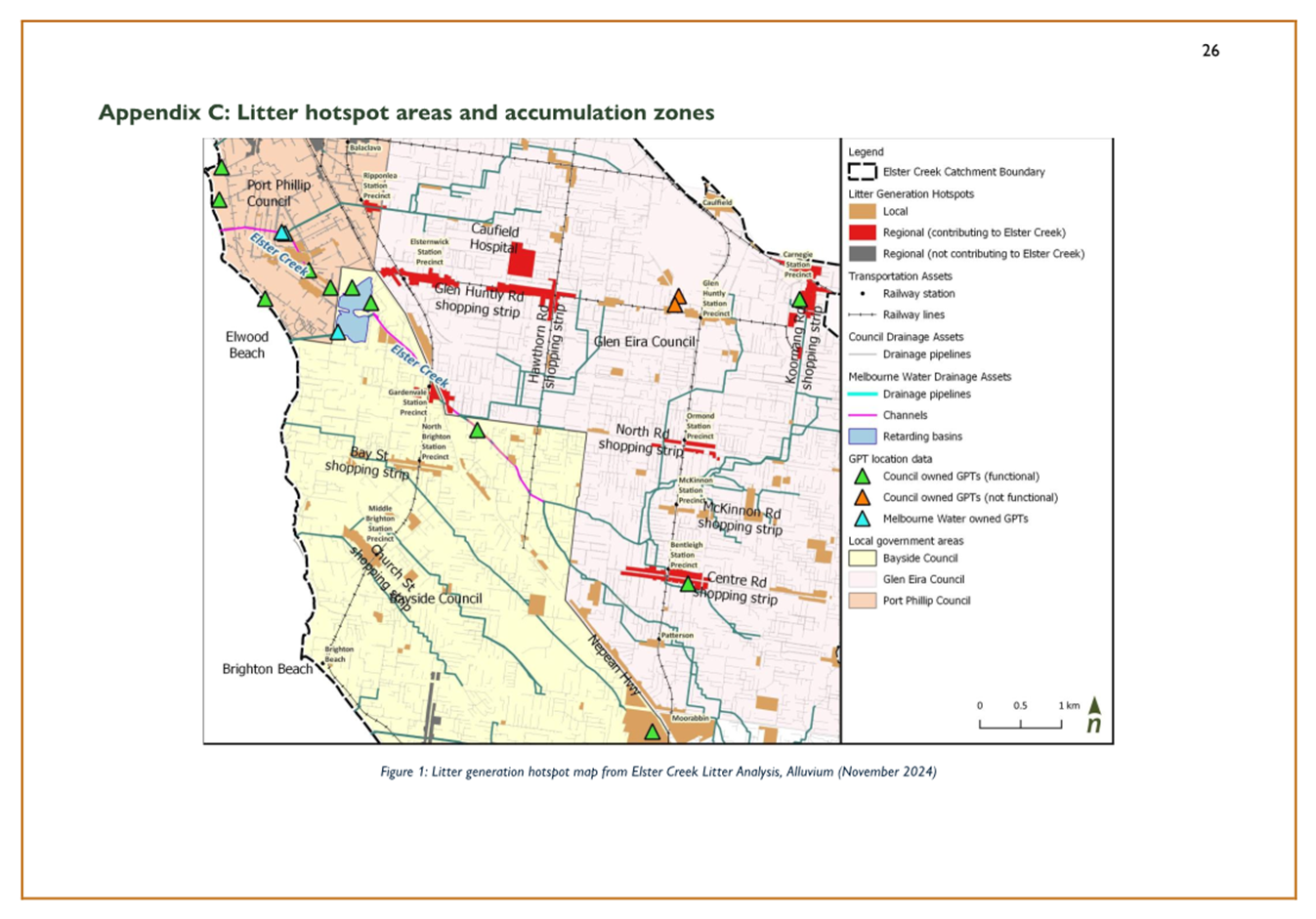
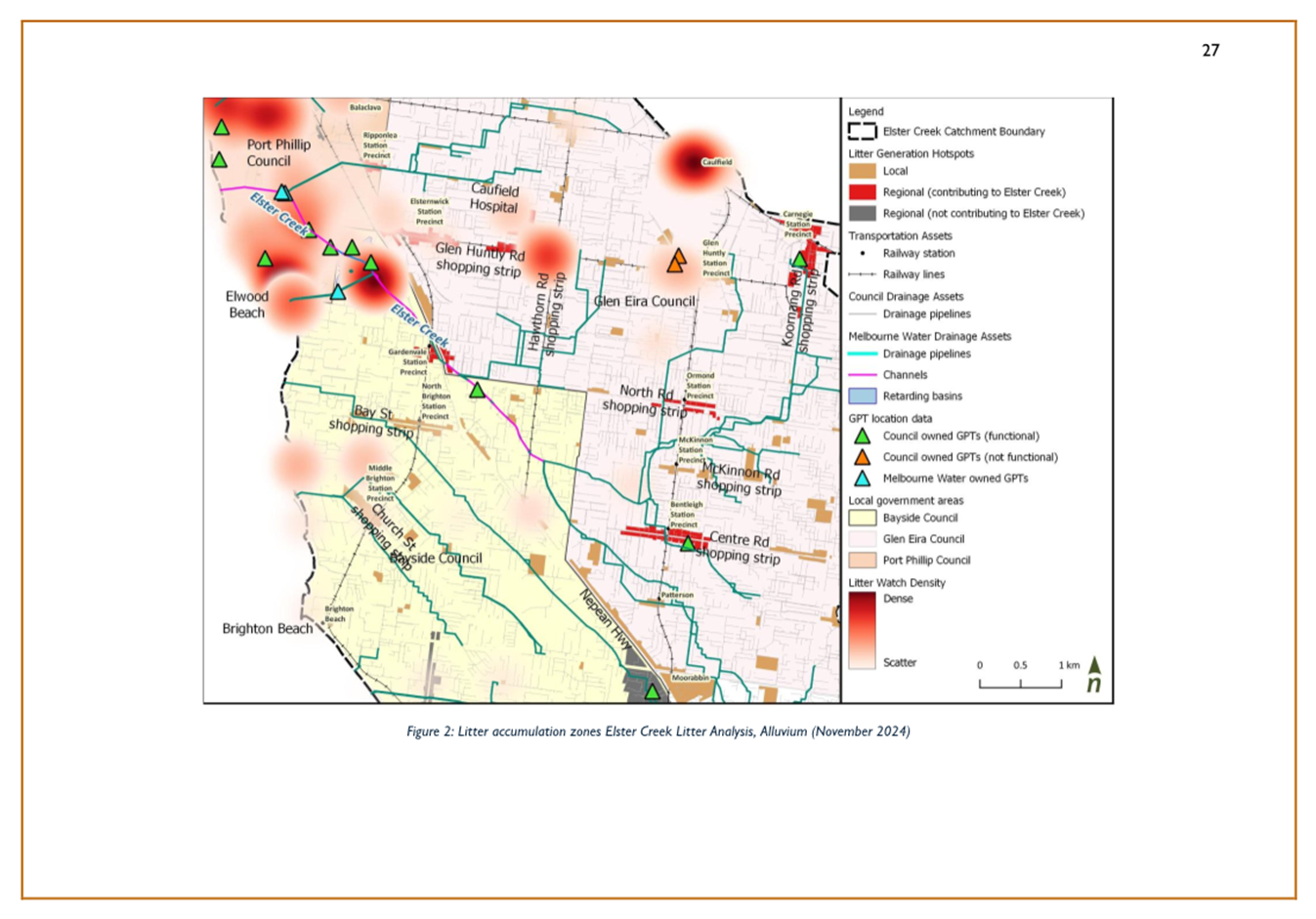
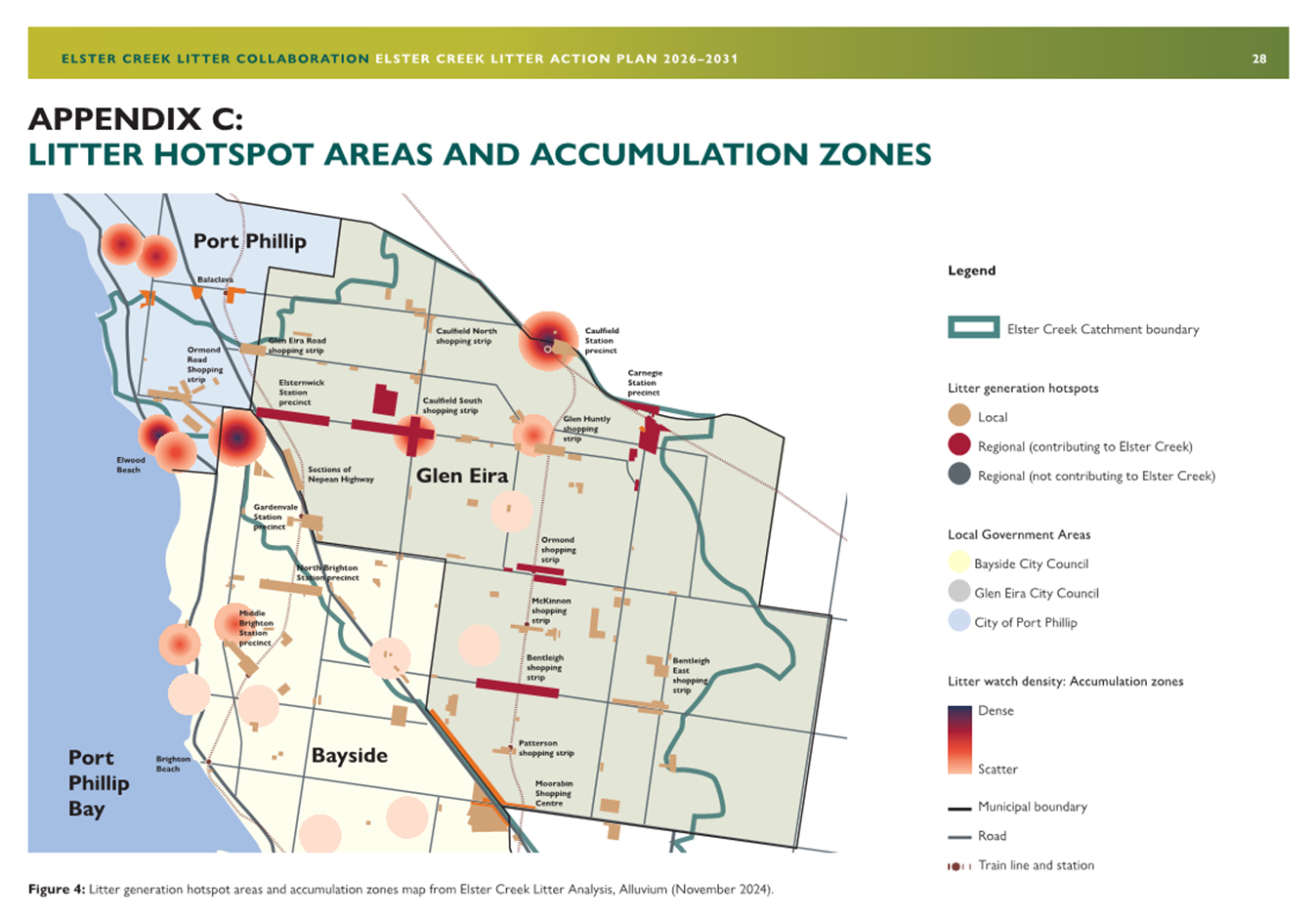
11.2 The rationale for the ECLAP is underpinned by recent analysis and community feedback, which identified significant litter hotspots and accumulation zones, as well as gaps in previous management approaches. The plan’s objectives and actions are designed to address these challenges, restore public confidence, and protect the health of Elster Creek and Port Phillip Bay.
12. IMPLEMENTATION STRATEGY
12.1 TIMELINE
12.1.1 Following endorsement of the ECLAP, the Elster Creek Litter Collaboration and ECLAP officer will direct the identified leads for short-term actions to commence short-term (1-2 year) actions, as per the ECLAP Implementation Plan.
12.1.2 Partners leading longer term (3-5 year) actions may require budget submissions for actions delivered in 26-27 and beyond.
12.2 COMMUNICATION
12.2.1 Community Information Sessions will be held every 6 months to inform the community on progress with the Elster Creek Litter Action Plan, and other projects within the Elster Creek Catchment. A Community information Session will be scheduled in March 2026.
12.2.2 The final endorsed Elster Creek Litter Action Plan will be published on Council’s ‘Have Your Say’ page with notification included in the Engagement newsletter.
12.2.3 A news article on the endorsed Elster Creek Litter Action Plan will be published in communications channels of the partner Councils and Melbourne Water, including websites, newsletters and social media.
13. OFFICER MATERIAL OR GENERAL INTEREST
13.1 The officer involved in the preparation of this report has declared the following general interest in the matter. Principal Sustainability Partnerships Officer, Julian Donlen, is the co-organiser of a volunteer clean-up group within the Elster Creek catchment (Love Our Street 3162), based in City of Glen Eira.
|
ATTACHMENTS |
1. Draft Elster Creek Litter Action Plan - for
engagement 2. Changes to Draft Elster Creek Litter Action Plan -
post engagement 3. Elster Creek Litter Action Plan - for endorsement 4. Elster Creek LItter Action Plan Engagement Report |
Meeting of the Port Phillip City Council
4 March 2026
10.1 Municipal Emergency Management Plan (MEMP)........................................................... 114
Meeting of the Port Phillip City Council
4 March 2026
|
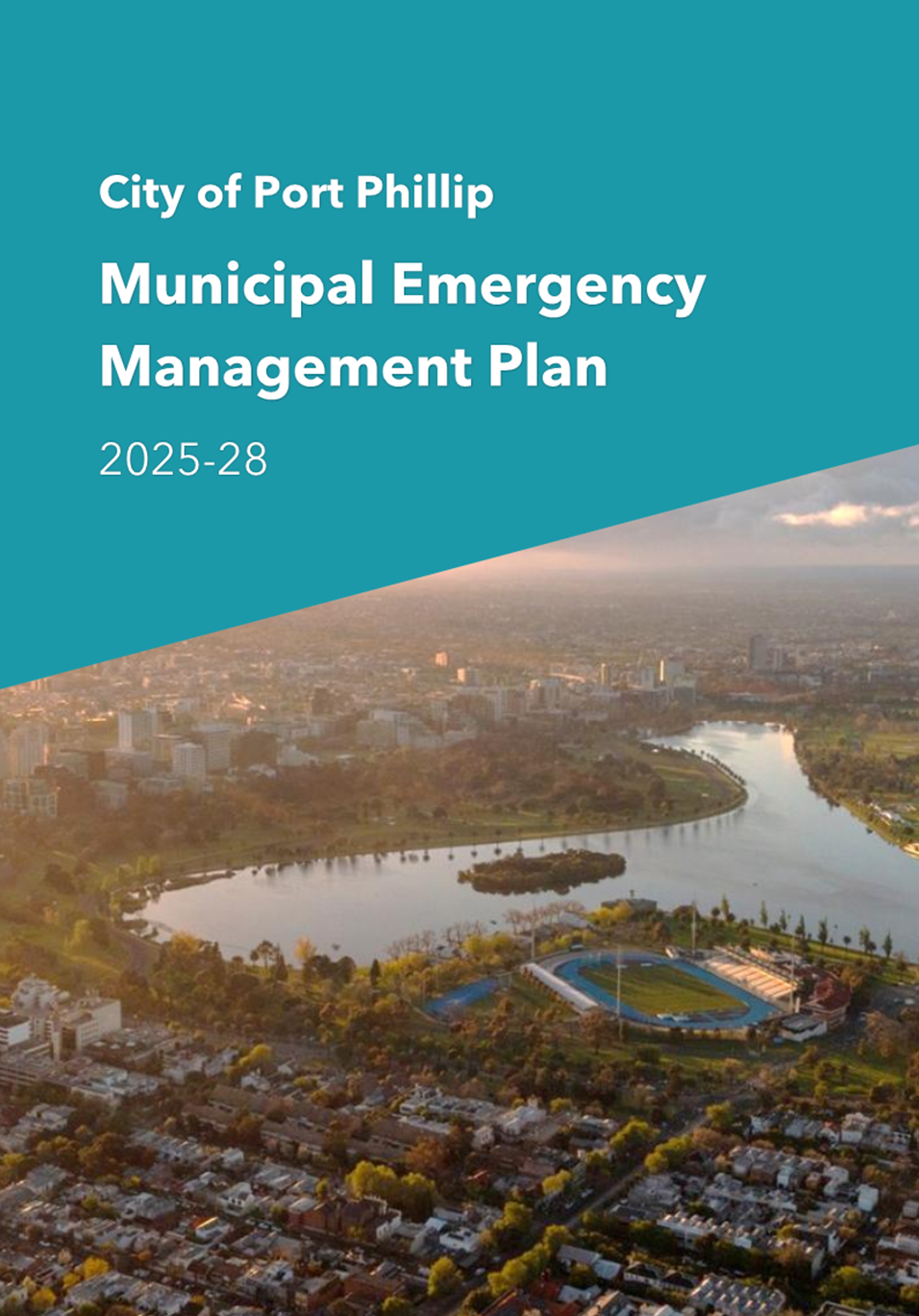
Municipal Emergency Management Plan (MEMP) |
|
|
Executive Member: |
Kylie Bennetts, General Manager, Community Wellbeing |
|
PREPARED BY: |
Amanda Clark, Emergency Management Officer Ryan Plunkett, Coordinator Emergency Management Dana Pritchard, Manager Open Space Recreation and Community Resilience |
1. PURPOSE
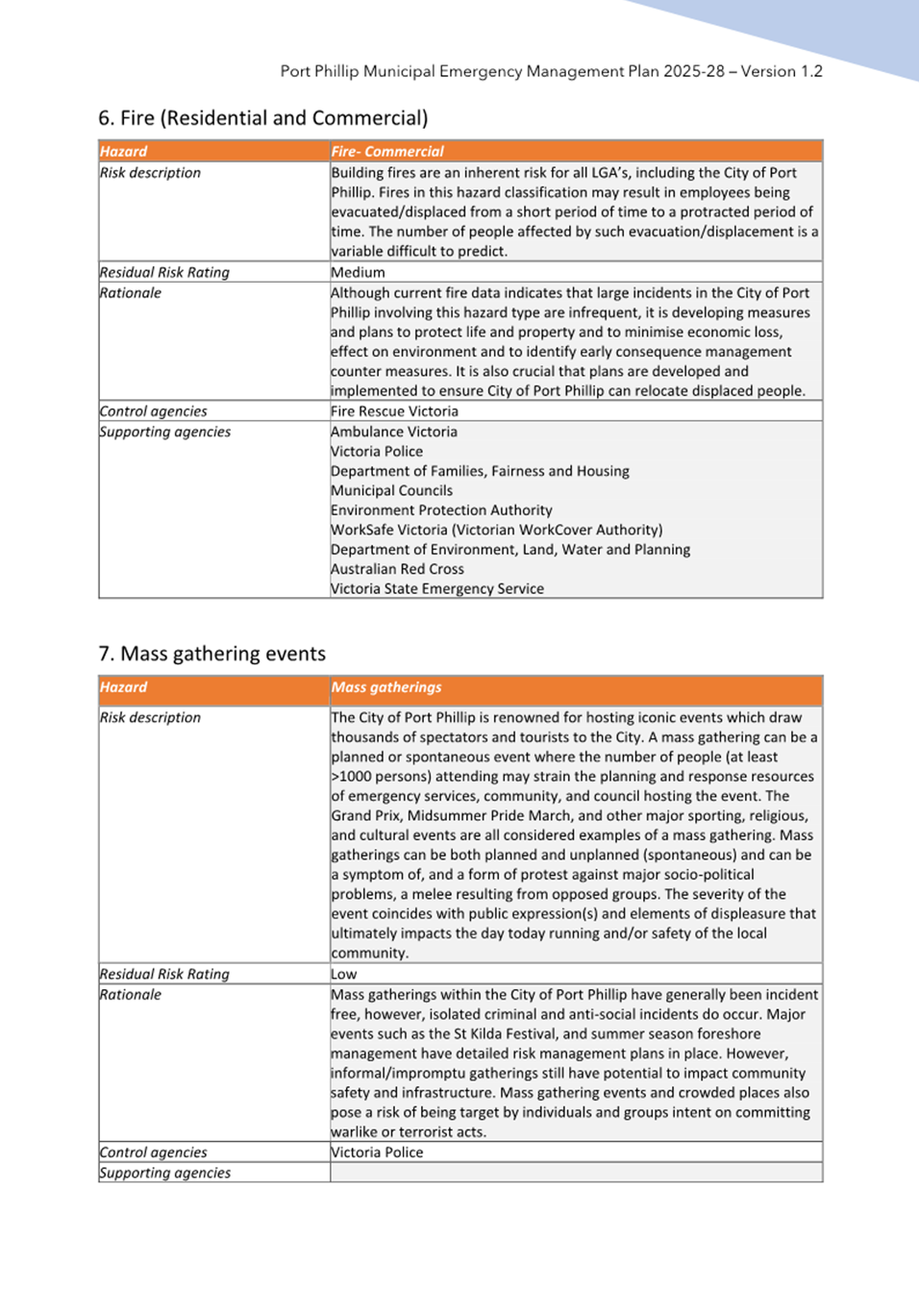
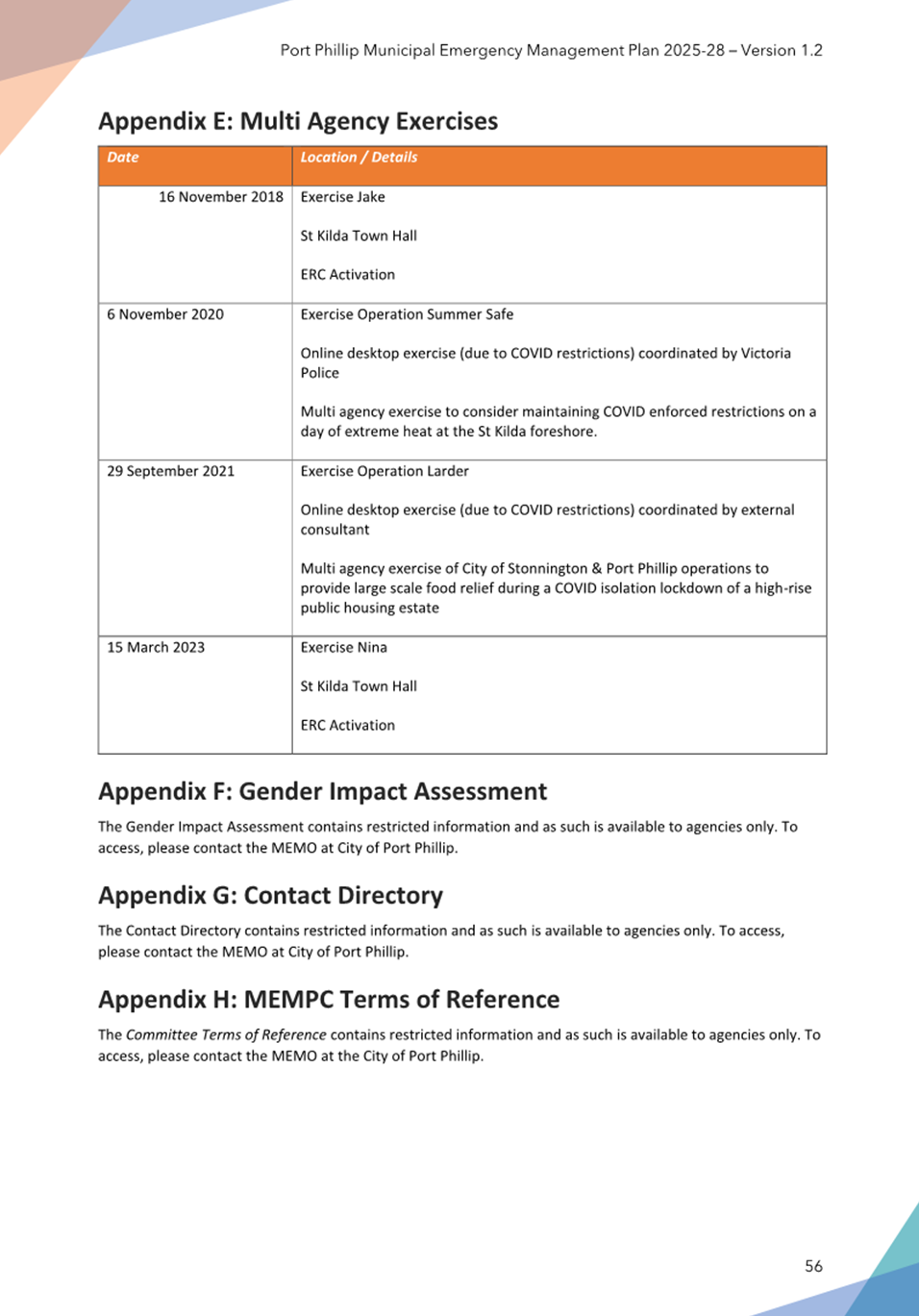
1.1 For Council to note the Port Phillip Municipal Emergency Management Plan (MEMP) which has recently been updated by the Municipal Emergency Management Planning Committee (MEMPC) in accordance with the Emergency Management Act.
2. EXECUTIVE Summary
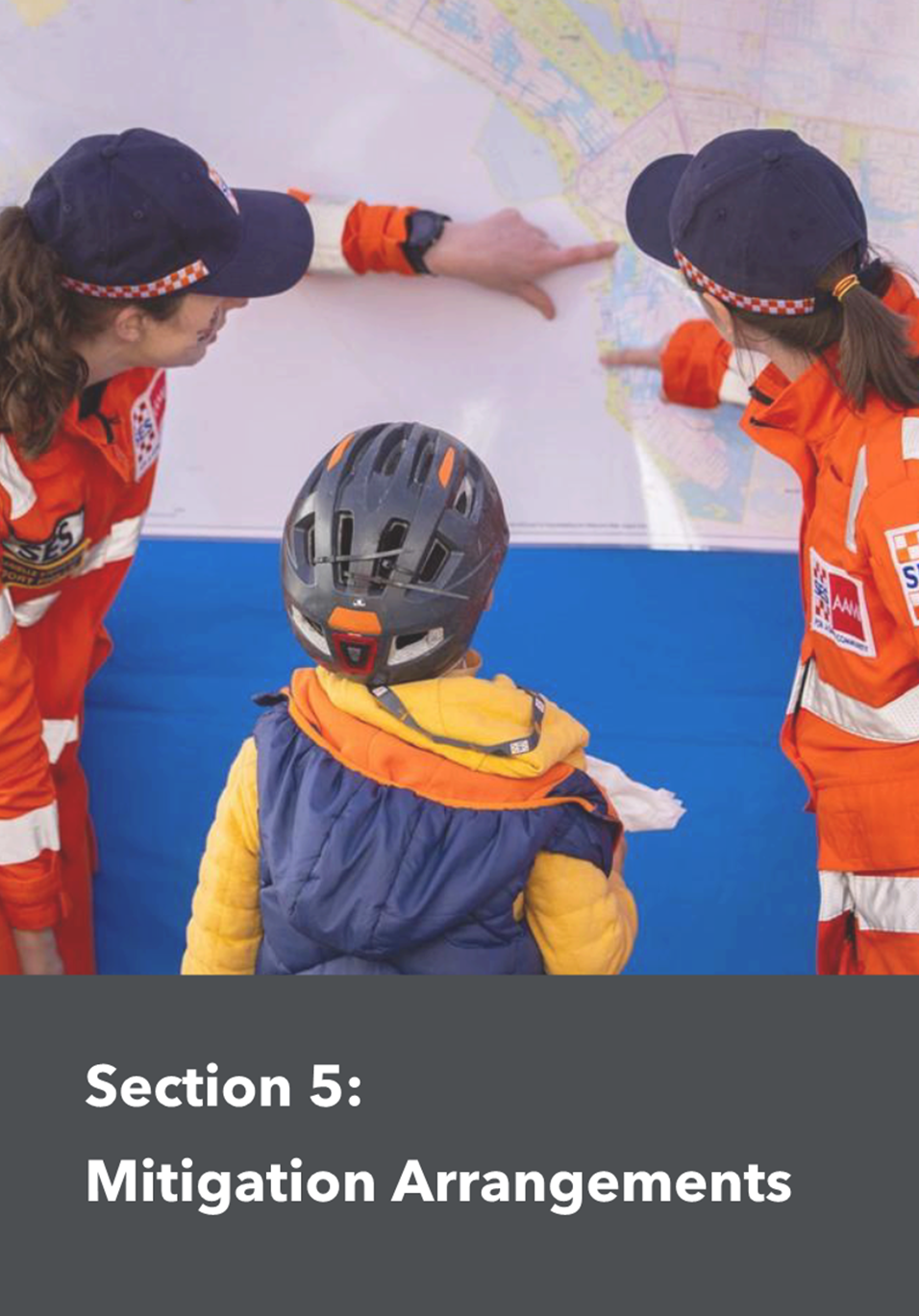
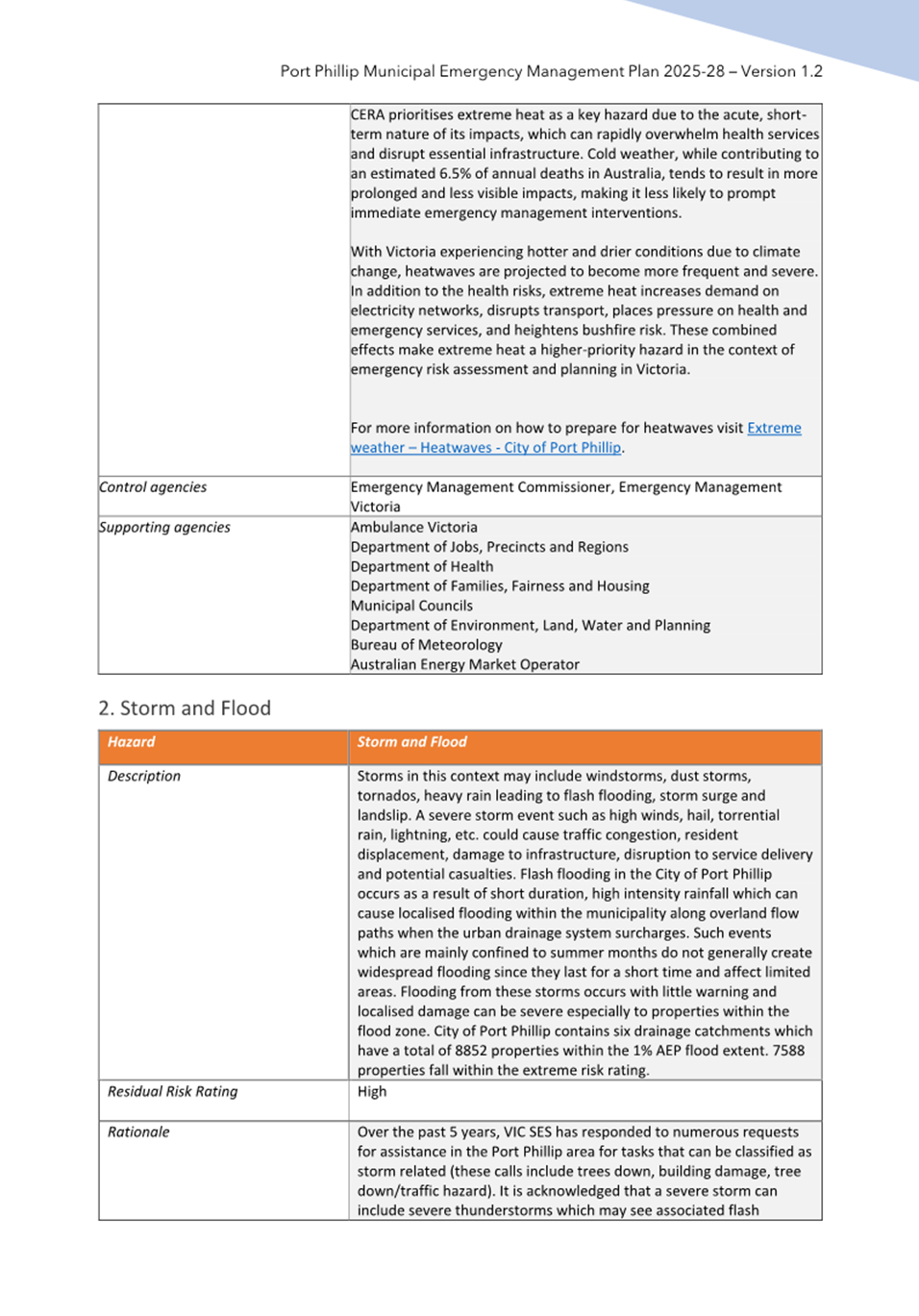
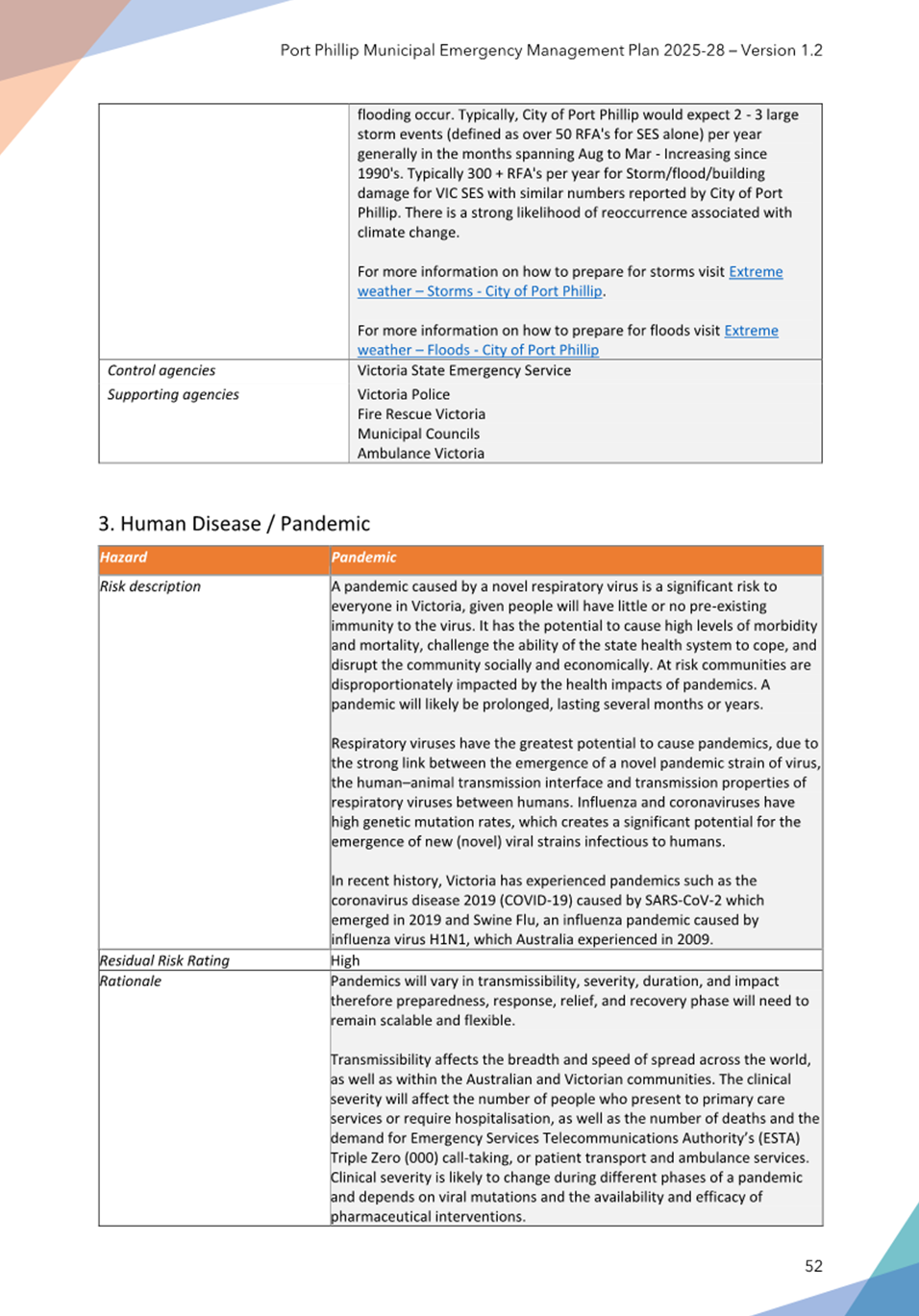
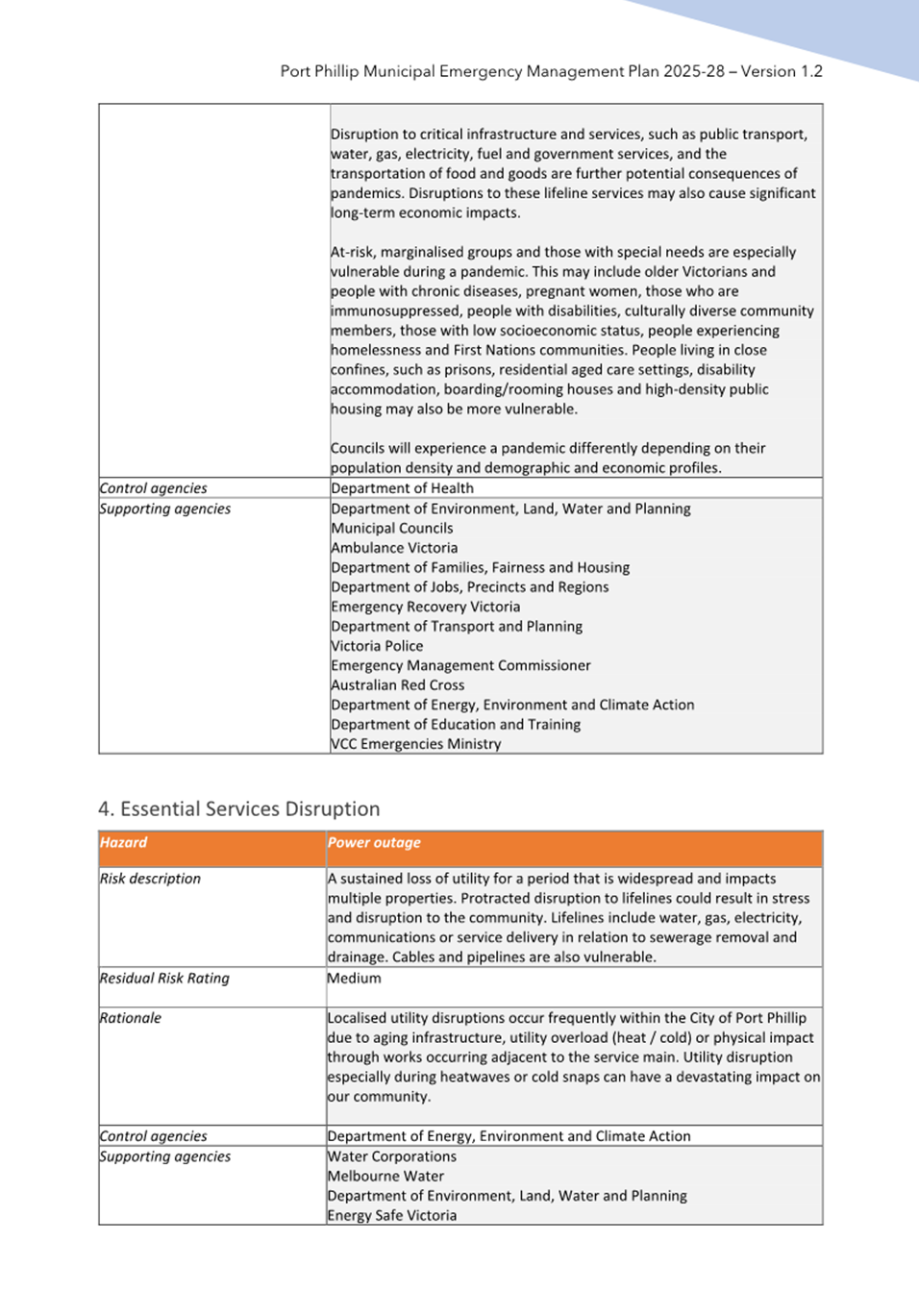
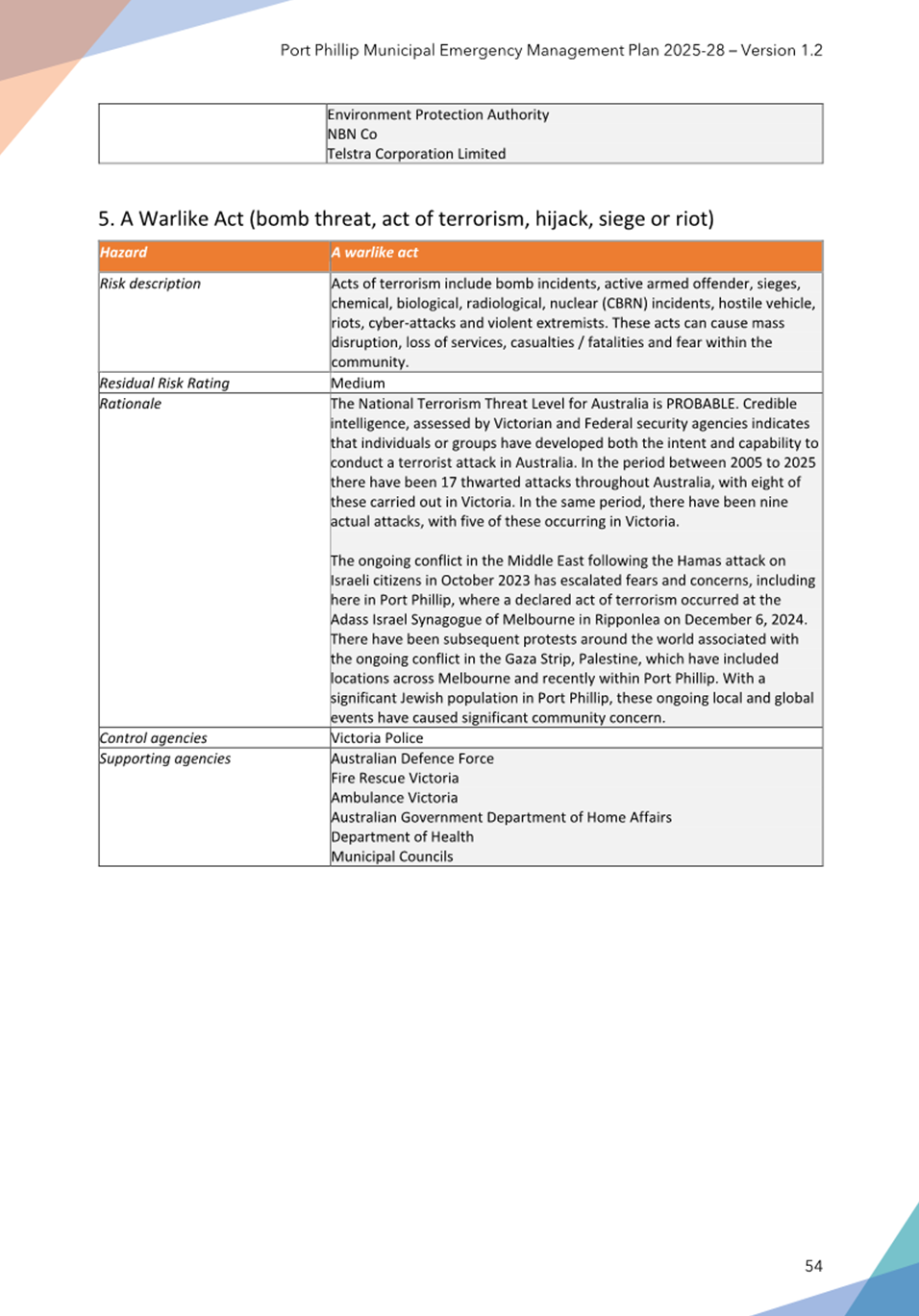
2.1 The MEMP is a legislated, multi‑agency plan that sets out municipal arrangements for prevention, preparedness, response, relief and recovery.
2.2 The MEMPC has completed a scheduled revision and update of the MEMP to ensure it is contemporary, locally suitable and aligned to State and Regional planning.
2.3 Key updates include the integration of a Gender Impact Assessment, clearer and more accessible language throughout the plan, and refined Sub‑Plans that strengthen Council’s ability to support effective emergency response and recovery.
2.4 The MEMP is not formally adopted by Council because it is not a Council owned plan. Instead, the Plan is prepared, assured and owned by the Municipal Emergency Management Planning Committee (MEMPC) and then undergoes a legislated assurance process and is approved by the Southern Metro Regional Emergency Management Planning Committee (REMPC).
|
That Council: 3.1 Thanks, the Municipal Emergency Management Planning Committee for their work in supporting emergency response, preparedness and the review and implementation of the Municipal Emergency Management Plan and associated sub-plans in accordance with the Emergency Management Act 2013. 3.2 Notes the revised Municipal Emergency Management Plan – Port Phillip Municipal District (2025) as outlined in Attachment 1. |
4. KEY POINTS/ISSUES
Context
4.1 The Emergency Management Legislation Amendment Act 2018 amended the Emergency Management Act 2013 (‘the Act’) to provide for new integrated arrangements for emergency management planning in Victoria at the State, Regional and Municipal levels, starting in December 2020.
4.2 Under the Act, Council has a statutory responsibility to manage resources and coordinate community support services during the response and recovery phase of an emergency, including:
· providing information to the community about risk and recovery;
· assisting emergency response agencies;
· providing emergency relief to affected residents;
· coordinating response and recovery works;
· chairing the Municipal Emergency Management Planning Committee (MEMPC) which sits separate to Council.
4.3 The Act also requires each municipal district to maintain a MEMP prepared and assured by the MEMPC and approved by the relevant REMPC.
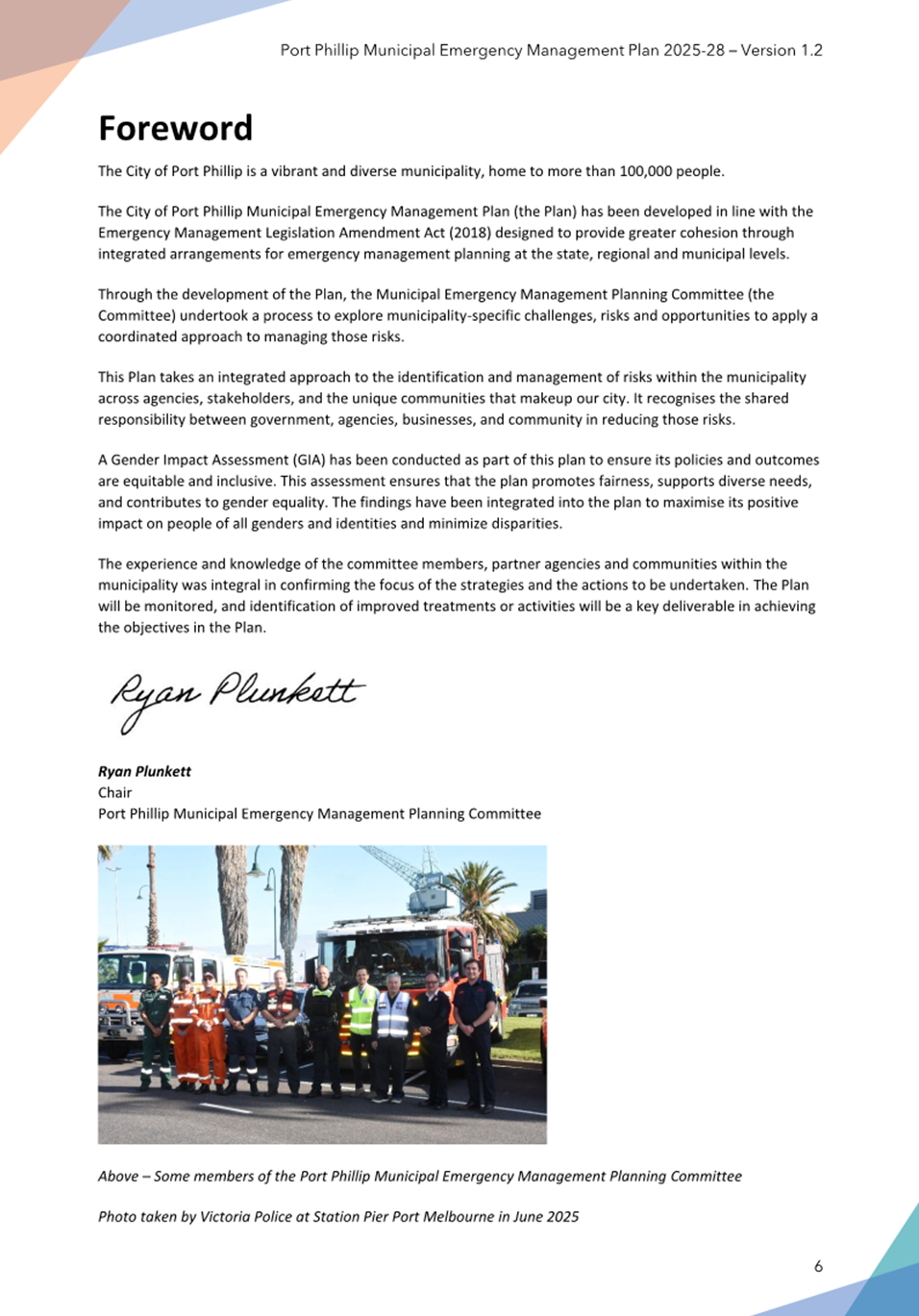
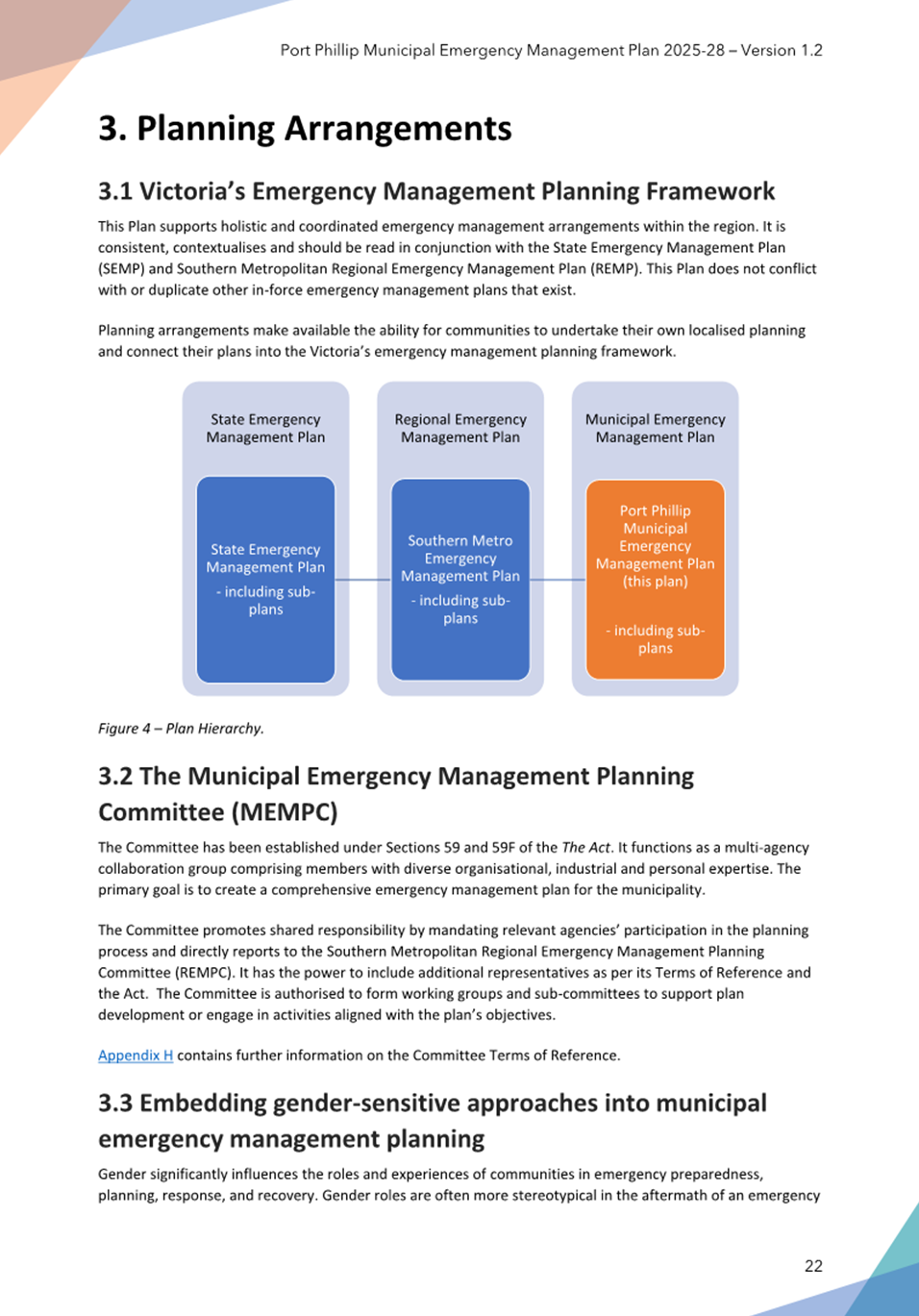
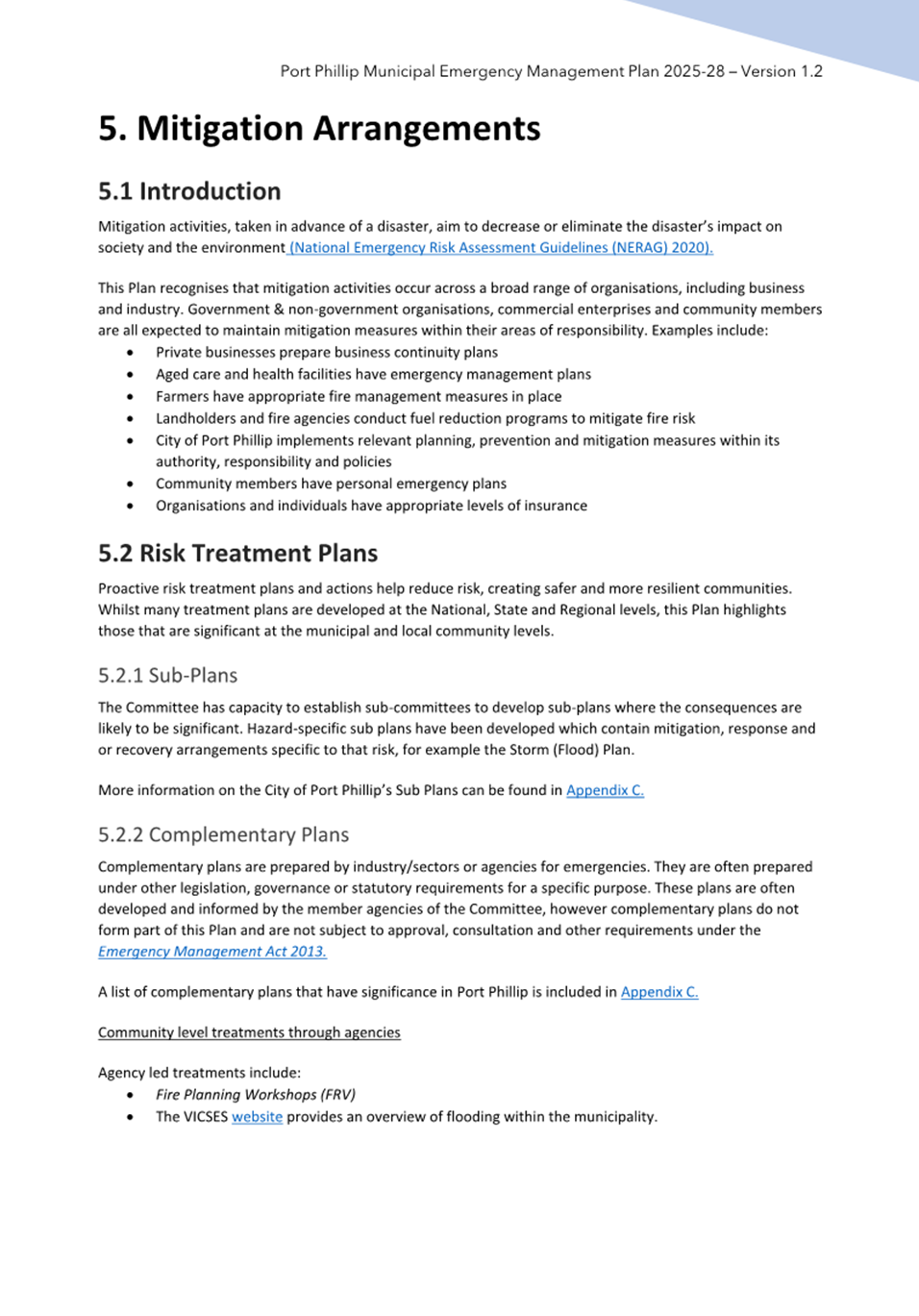
4.4 The City of Port Phillip MEMPC has been established under Sections 59 and 59F of the The Act. It functions as a multi-agency collaboration group comprising members with diverse organisational, industrial and personal expertise. The primary goal is to create a comprehensive emergency management plan for the municipality.
4.5 The MEMPC includes representatives from: Victoria Police, Victoria State Emergency Service (VICSES), Fire Rescue Victoria (FRV), Ambulance Victoria, Department of Health, Department of Families, Fairness and Housing (DFFH), Australian Red Cross and Council, among other partners as appropriate.
4.6 City of Port Phillip convenes and chairs the MEMPC, facilitating local governance and inter agency coordination; however, the MEMPC is not a Council committee under the Act.
4.7 The MEMPC oversees the creation and maintenance of Port Phillip’s MEMP.
Municipal Emergency Management Plan (MEMP)
4.8 The MEMP sets out how Port Phillip agencies, including Council will prevent and mitigate the impact of local emergencies.
4.9 The MEMP is designed to:
· minimise the effects of;
· coordinate the response to; and
· ensure the recovery from;
· a disaster or emergency affecting the City of Port Phillip municipality.
4.10 Every three years the MEMP is required to be reviewed and externally audited.
4.11 While Council has led the review of the MEMP, the responsibility for the development of the document sits with the MEMPC.
4.12 The MEMP has been developed through a series of workshops which included MEMPC members, Council officers and community contributors.
4.13 In developing the MEMP, the MEMPC undertook a process to explore municipality-specific challenges, risks and opportunities to apply a coordinated approach to managing those risks.
4.14 What’s new in this Municipal Emergency Management Plan
· Gender
Impact Assessment (GIA) incorporated:
The plan has been strengthened through the inclusion of a Gender Impact
Assessment, ensuring that equity, safety and accessibility considerations are
embedded in our emergency relief and recovery arrangements. This work reflects
Council’s commitment to inclusive planning and leading positive change
across the sector.
· Clearer,
more accessible language:
The document has been rewritten in plainer, easier‑to‑read language
to ensure the community can more easily understand the municipalities emergency management arrangements.
· Updated and streamlined Sub‑Plans:
Sub‑Plans have been reviewed and refined to
ensure they align with current risk advice, support clear responsibilities, and
provide practical guidance for
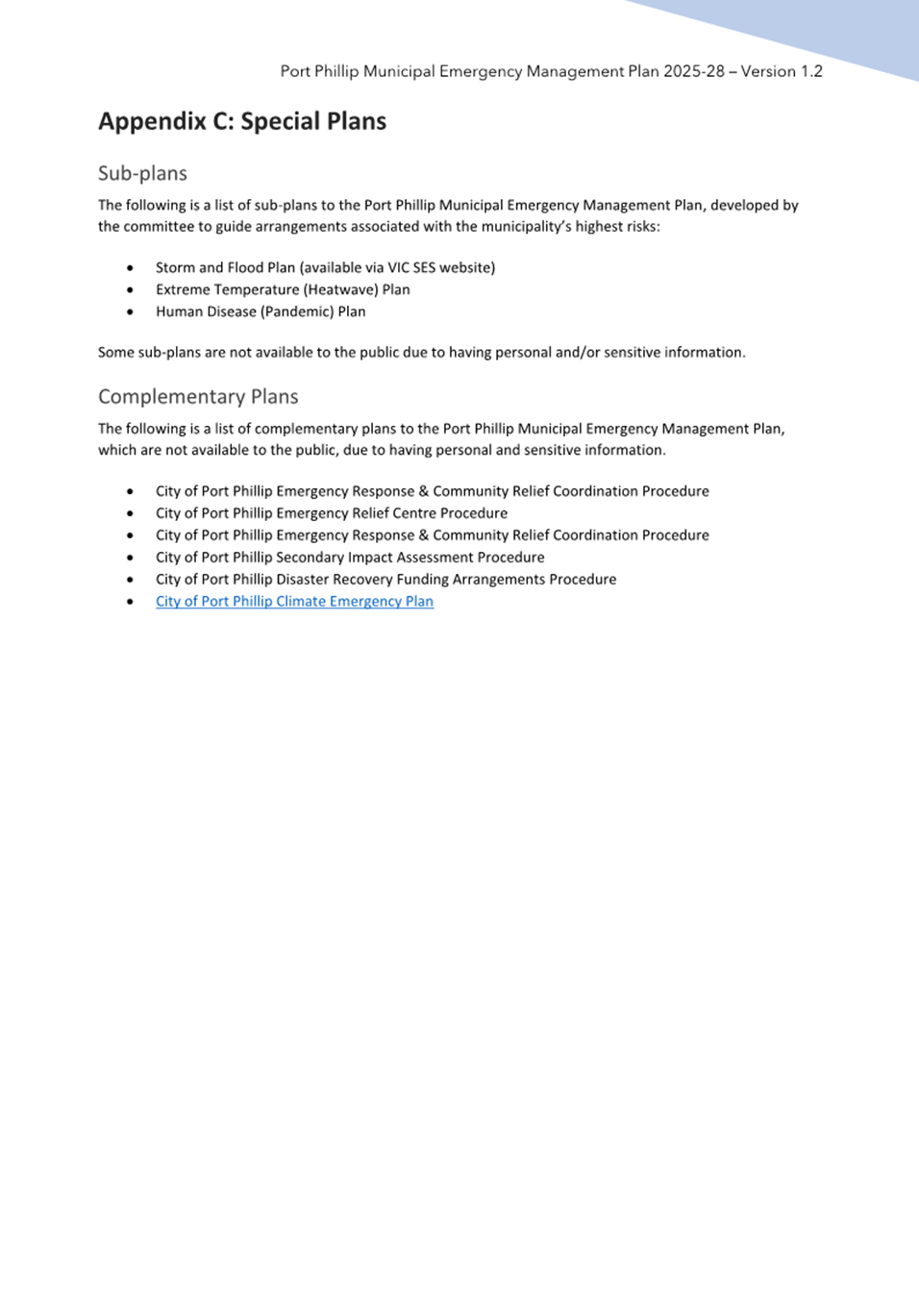
emergency response and recovery. The MEMP is currently supported by
Pandemic, Heatwave and Flood Sub-Plans.
Approvals
4.15 The revised MEMP has progressed through the MEMPC assurance process to confirm it is suitable for local preparedness and consistent with State and Regional planning documentation.
4.16 Following assurance, the MEMP was submitted to the Southern Metro REMPC for approval, as required by legislation. Approval was provided on 1 August 2025.
5. CONSULTATION AND STAKEHOLDERS
5.1 Consultation has been undertaken through the MEMPC with agency partners including Victoria Police, VICSES, FRV, Ambulance Victoria, Department of Health, DFFH, Australian Red Cross and Council.
6. LEGAL AND RISK IMPLICATIONS
6.1 The Emergency Management Act 2013 prescribes the roles of the MEMPC and REMPC in preparing, assuring and approving the MEMP.
7. FINANCIAL IMPACT
7.1 All activities required to maintain and implement the MEMP are funded within existing operational budgets for emergency management, relief and recovery.
7.2 Disaster Recovery Funding Arrangements (DRFA)
· DRFA is a State and Commonwealth program that can help Councils cover eligible costs after a declared emergency. In the MEMP, DRFA is highlighted as one of the ways recovery activities may be supported.
· When activated, the program helps communities by assisting with the restoration of essential assets and services and reducing the financial burden on local residents.
· Council’s role is to record eligible expenses and submit them for consideration under the program, helping ensure our community’s recovery is well supported and financially sustainable.
8. ENVIRONMENTAL IMPACT
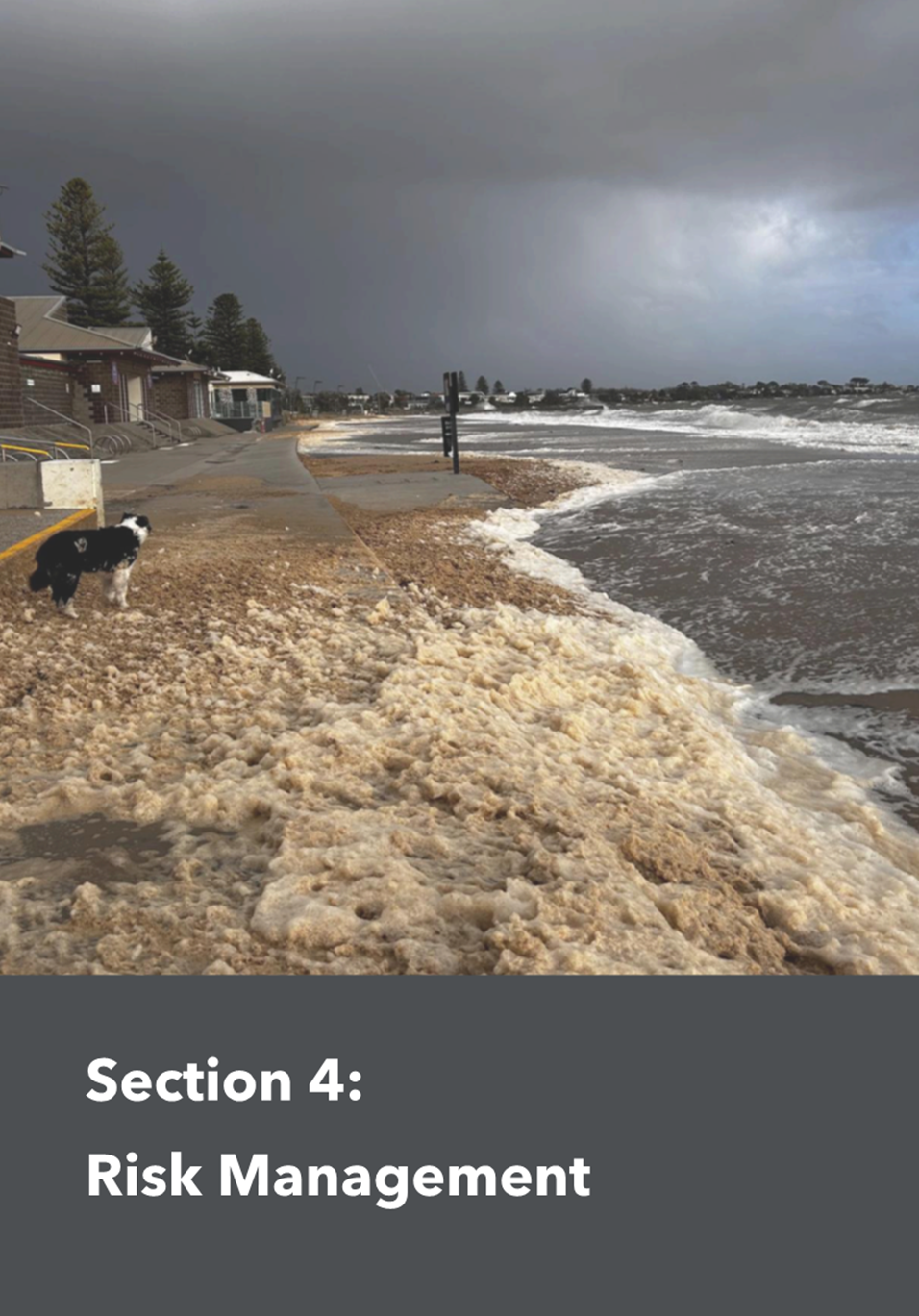
8.1 The MEMP supports environmentally responsible emergency management and aligns with climate resilience objectives, including measures that minimise secondary environmental impacts during emergencies.
9. COMMUNITY IMPACT
9.1 The updated MEMP strengthens Council’s ability to coordinate preparedness, relief and recovery, support vulnerable community members and provide timely, accessible information during emergencies.
10. Gender Impact Assessment
10.1 A Gender Impact Assessment (GIA) has been incorporated into the revised MEMP where applicable, improving equity, accessibility and safety considerations in relief and recovery arrangements.
10.2 The findings of the GIA were integrated into the plan to maximise its positive impact on all genders and minimize disparities.
10.3 This is the first MEMP in the State of Victoria to undergo a GIA. An example of how the City of Port Phillip is aiming to be a leader in making positive change for all our community.
11. ALIGNMENT TO COUNCIL PLAN AND COUNCIL POLICY
11.1 The MEMP supports A Safe and Liveable City through coordinated preparedness, relief and recovery arrangements.
12. IMPLEMENTATION STRATEGY
12.1 TIMELINE
12.1.1 MEMP endorsed by Southern Metro REMPC 1 August 2025.
12.2 COMMUNICATION
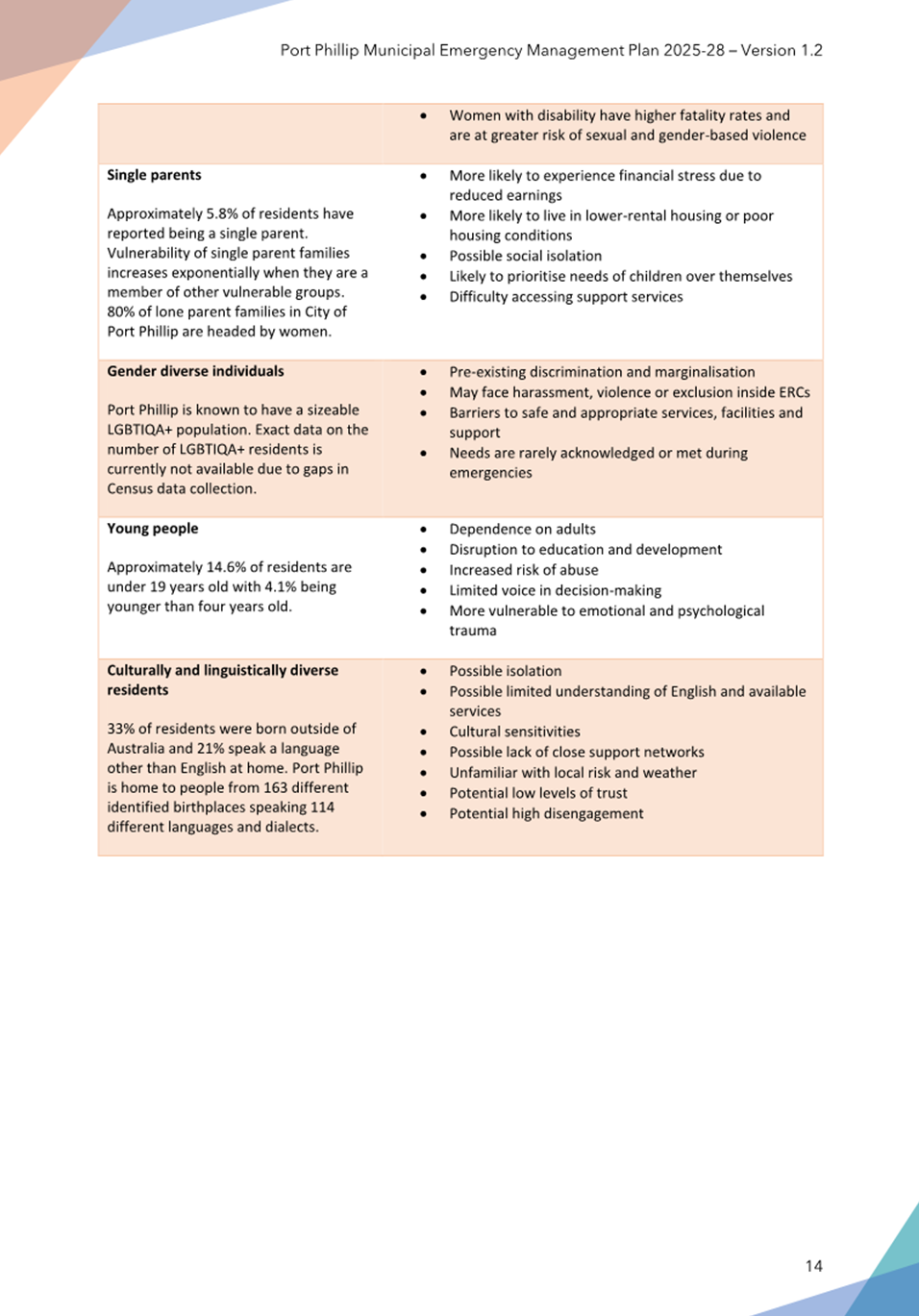
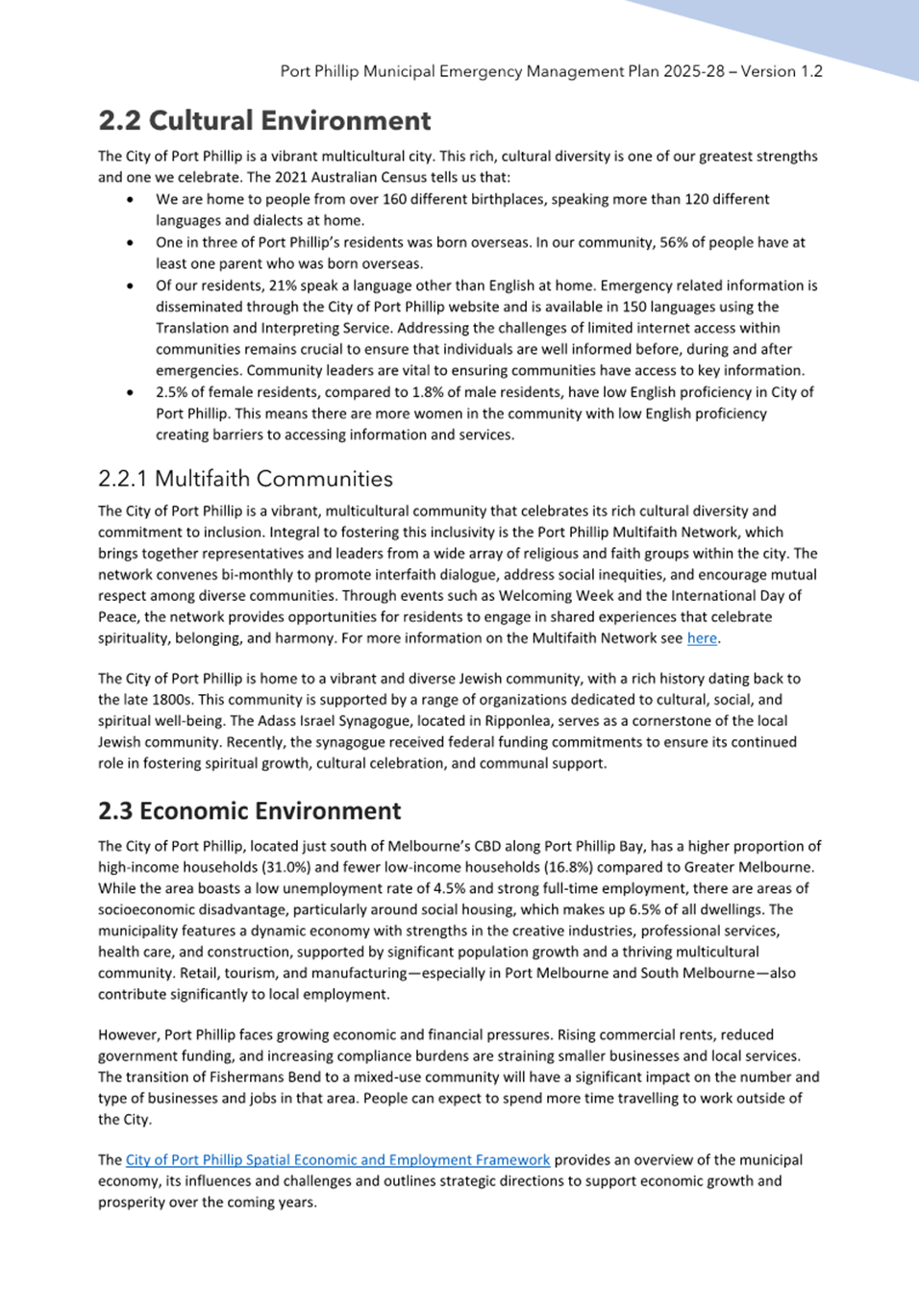
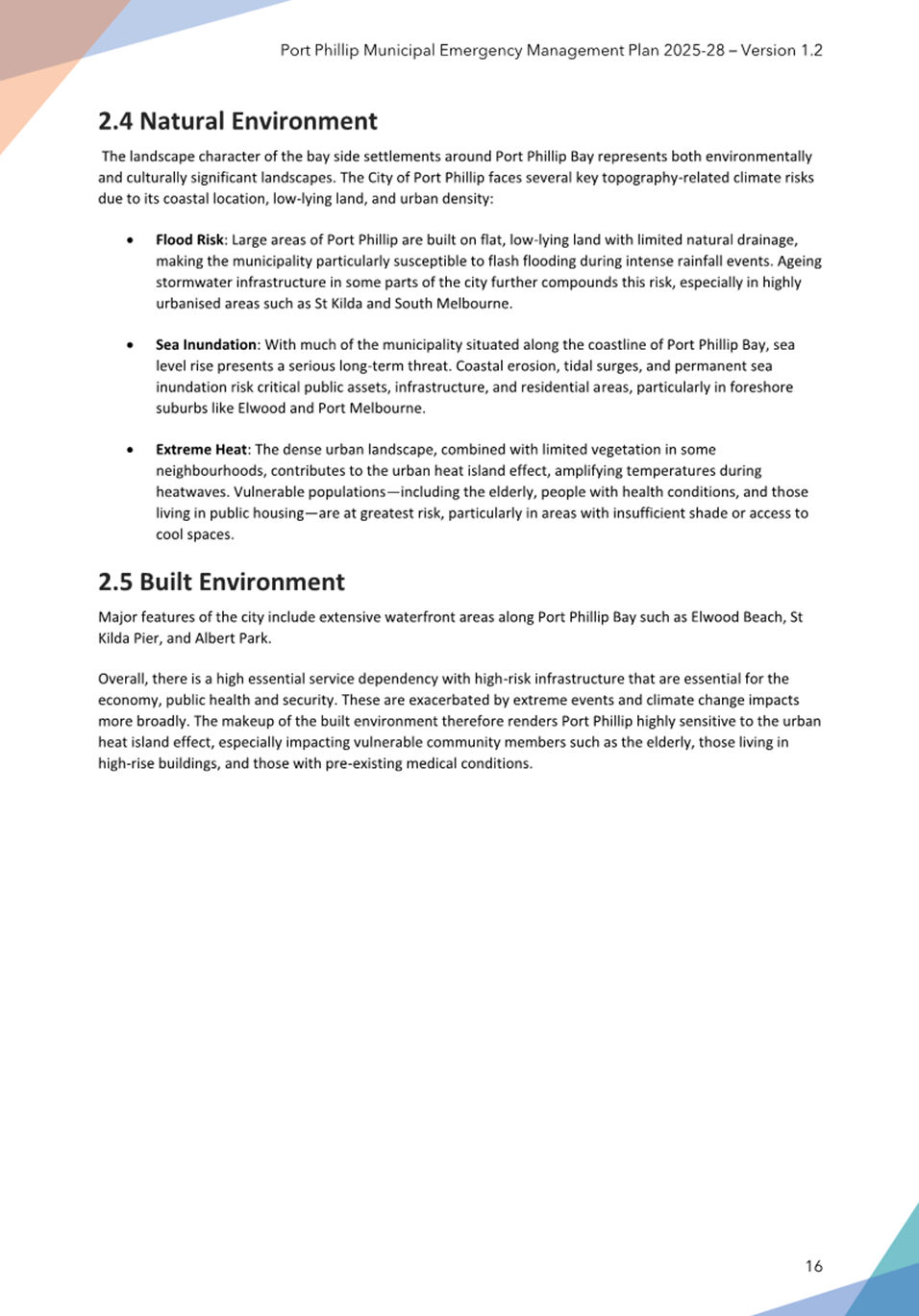
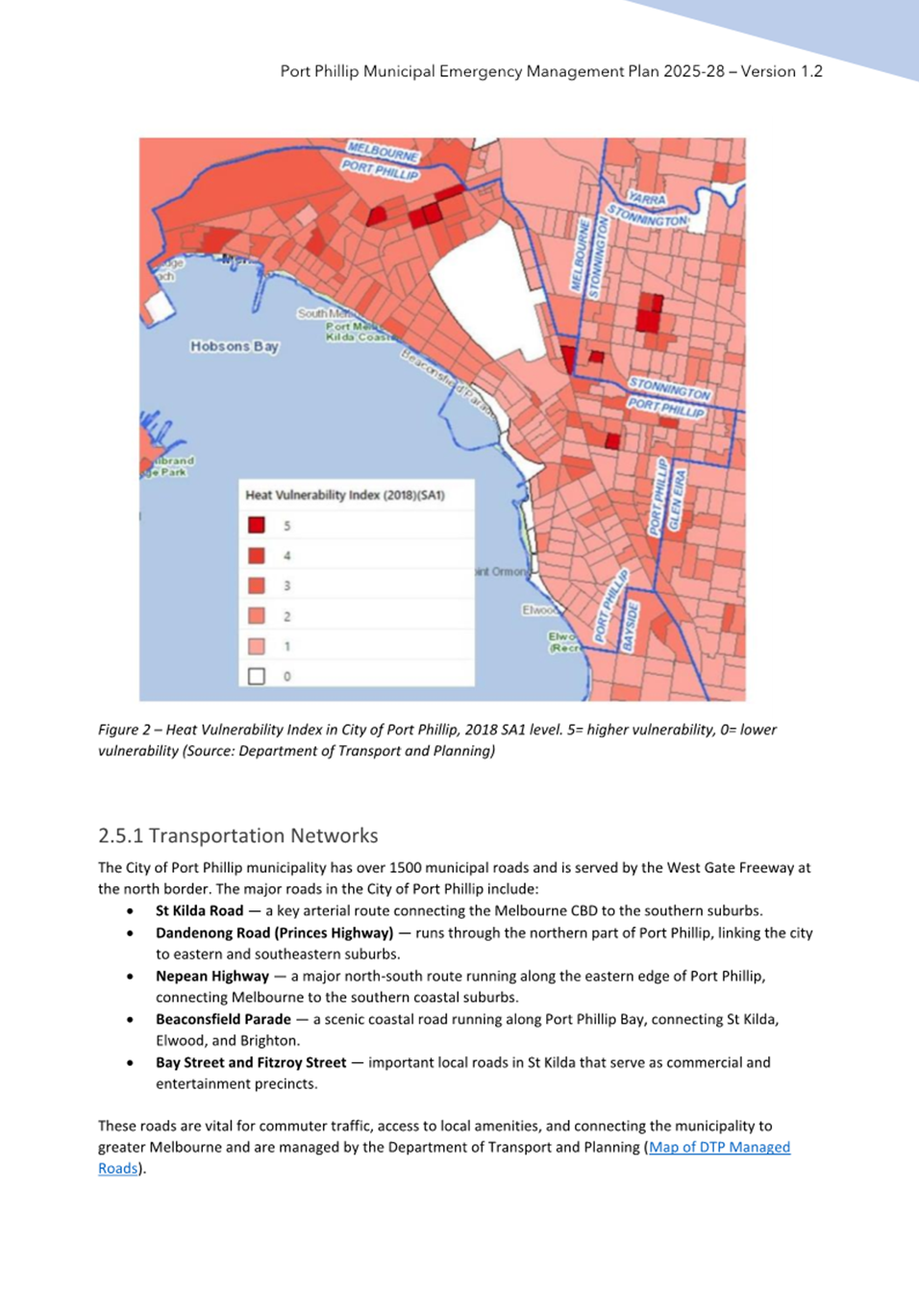
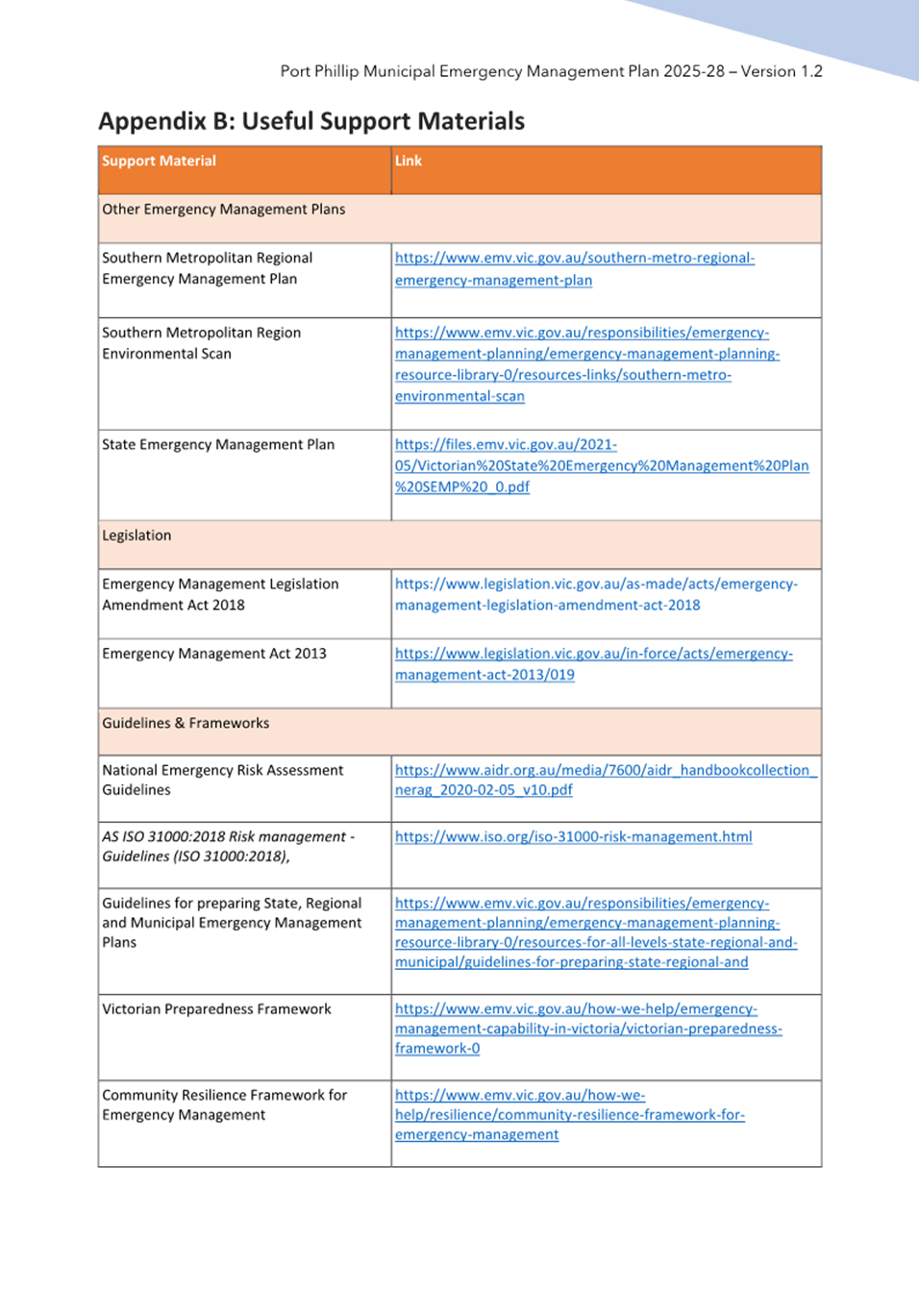
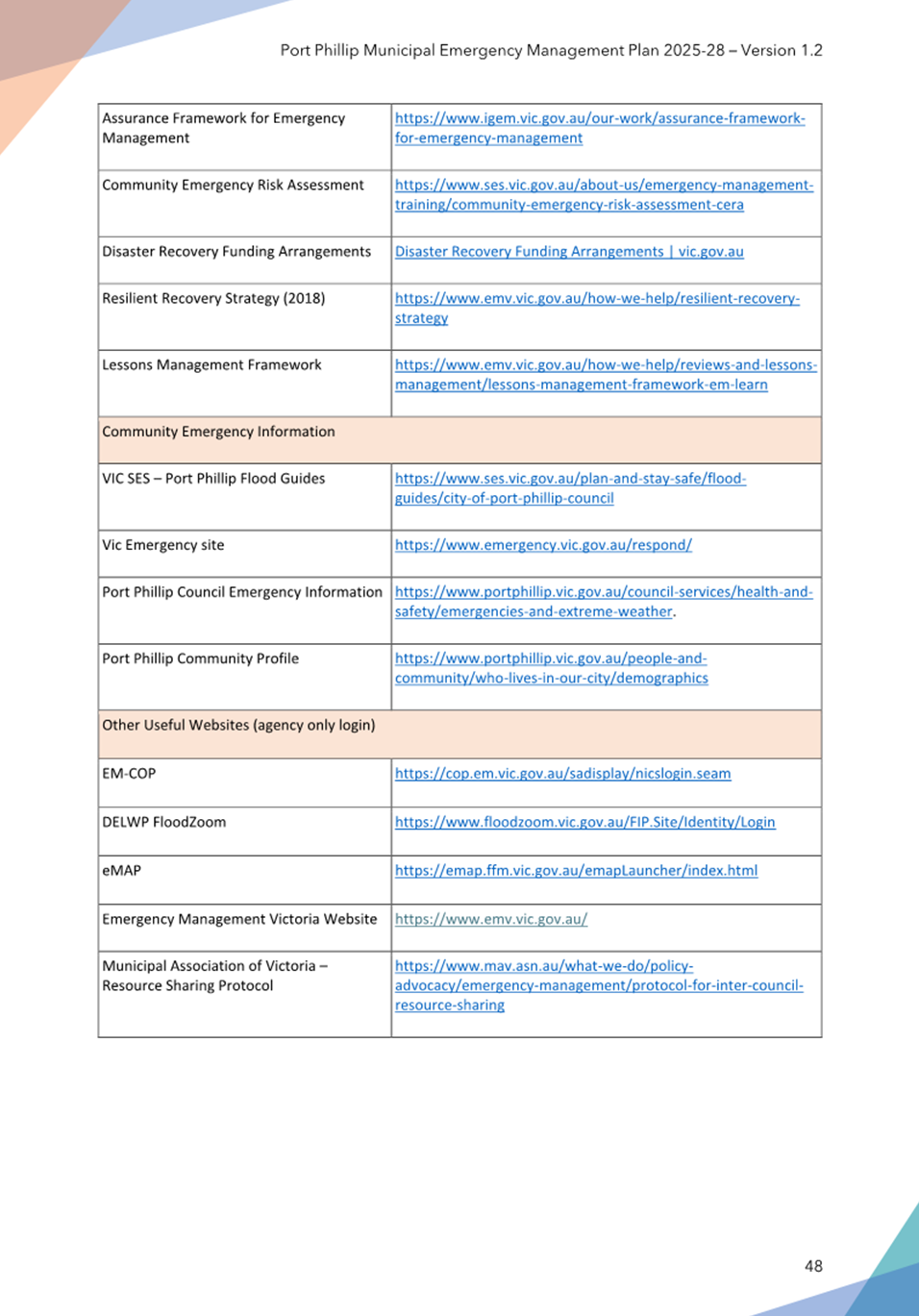
12.2.1 The MEMP has been published on Council’s website to ensure community access to current emergency management arrangements. Refer attachment.
13. OFFICER MATERIAL OR GENERAL INTEREST
13.1 No officers involved in the preparation of this report has declared a material or general interest in the matter.
|
ATTACHMENTS |
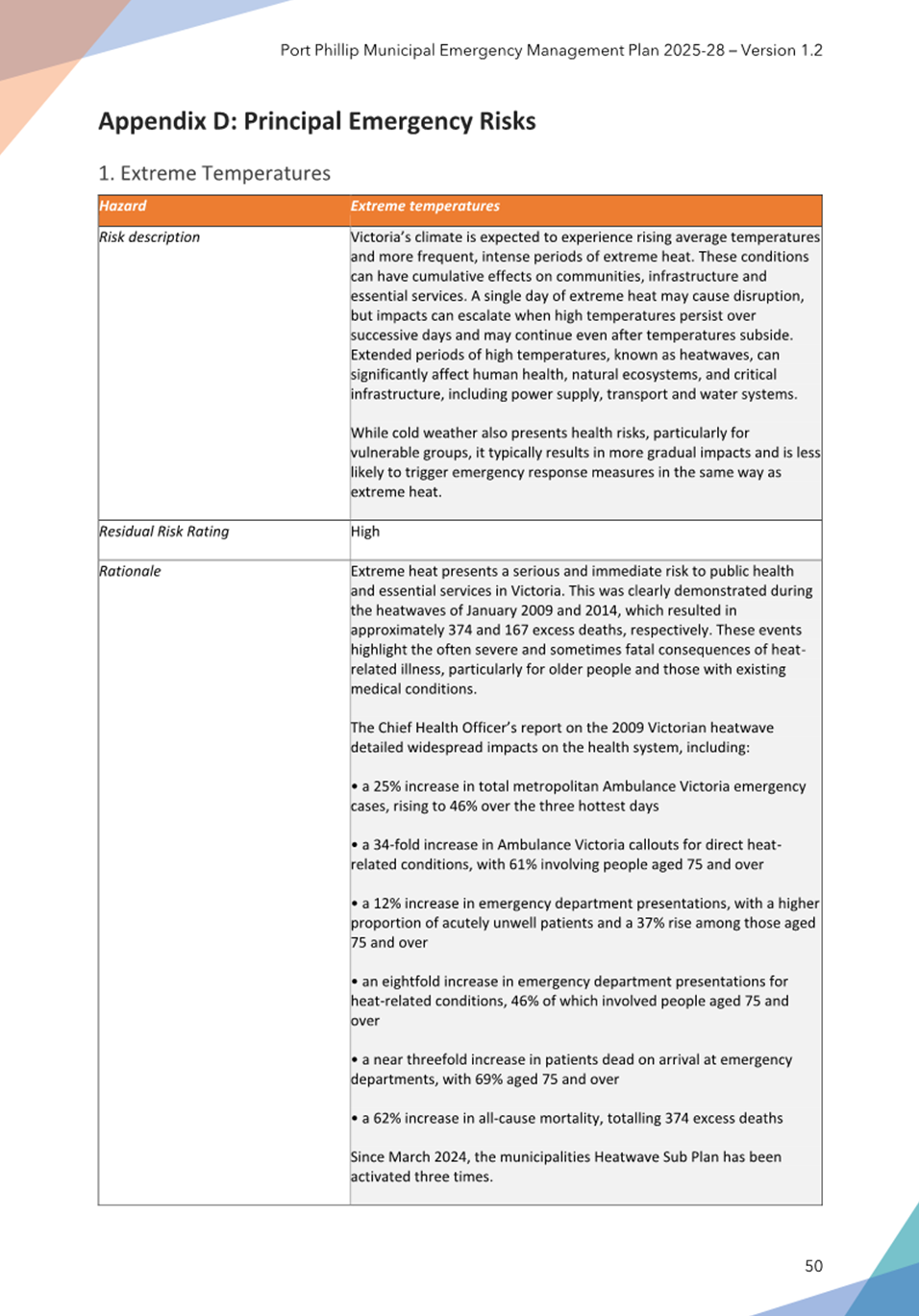
1. City of Port Phillip - Municipal Emergency
Management Plan 2025-2028 |
Meeting of the Port Phillip City Council
4 March 2026
11. A Vibrant and Thriving Community
Nil
12. An Engaged and Empowered Community
12.1 Submission to the Victorian Government's Electric Line Clearance Review...................... 175
Meeting of the Port Phillip City Council
4 March 2026
|
Submission to the Victorian Government's Electric Line Clearance Review |
|
|
Executive Member: |
Robyn Borley, General Manager, Governance and Performance |
|
PREPARED BY: |
Elizabeth Cowin, Coordinator Advocacy, Grants & Partnership |
1. PURPOSE
1.1 To note City of Port Phillip’s submission to the Victorian Government’s engagement on their Electrical Line Clearance Review.
2. EXECUTIVE Summary
2.1 The Department of Energy, Environment and Climate Action (DEECA) is remaking the Electricity Safety (Electric Line Clearance) Interim Regulations 2025, and has invited community feedback on the proposed regulations and the changes introduced.
2.2 Submissions via the Engage Victoria website closed on 23 February 2026.
2.3 Council’s submission aligns with the endorsed City of Port Phillip Urban Forest Strategy 2024-2040 Action 6: “Advocate to the Victorian Government to ensure appropriate consideration of canopy cover in Electrical Line Clearance Regulations and for funding to support engineered solutions that address safety while reducing negative impacts on canopy coverage”. As such, formal council endorsement was not sought.
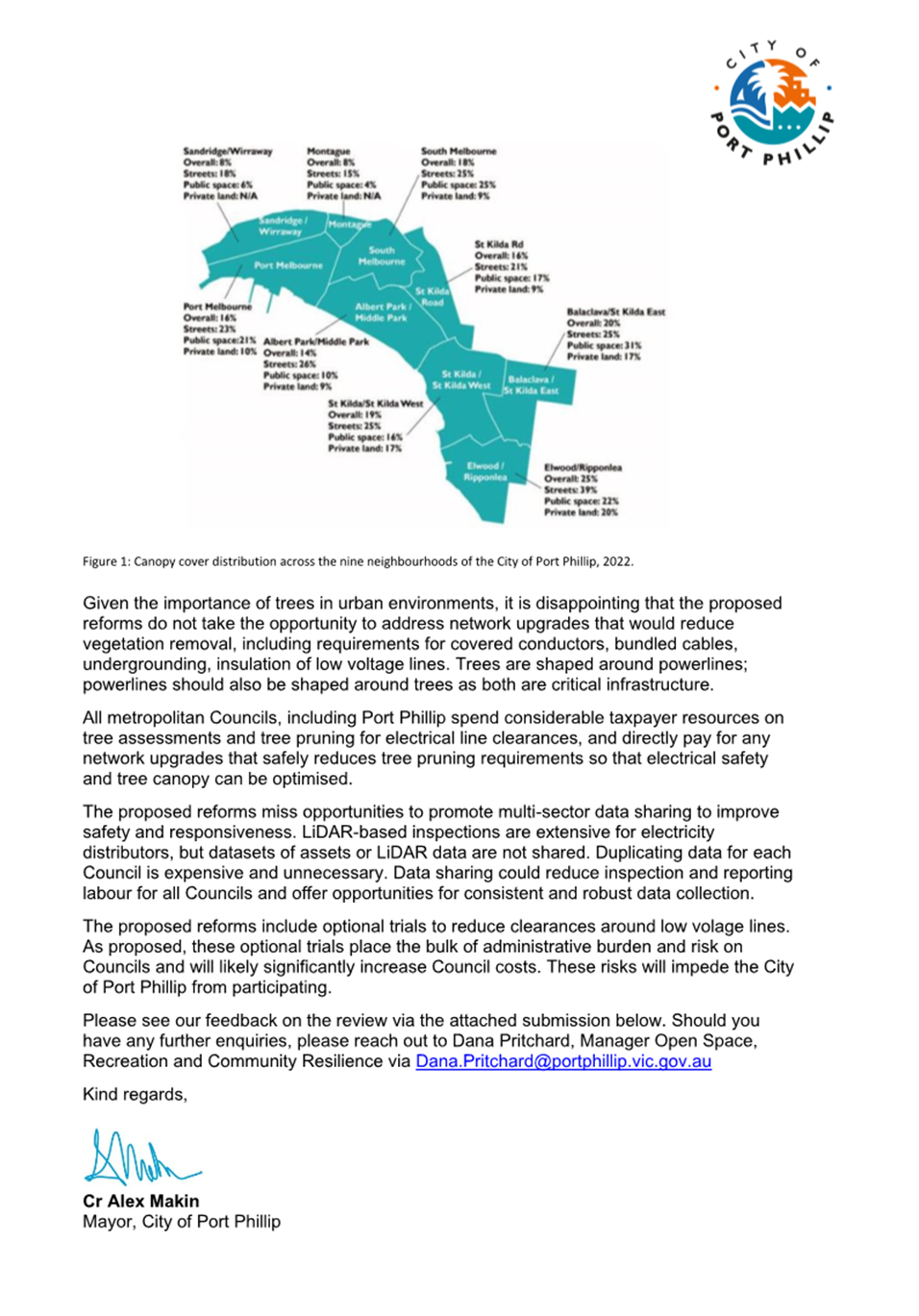
2.4 Council’s submission highlights the importance of the tree canopy cover as an essential part of our highly urbanised environment.
|
That Council: 3.1 Notes the City of Port Phillip’s submission to the Victorian Government’s engagement on the Electrical Line Clearance Review (Attachment 1) 3.2 Thanks members of the community who contributed to the Victorian Government’s Electric Line Clearance Review by making their own submissions to the state’s consultation process. |
4. KEY POINTS/ISSUES
4.1 Key changes proposed to the new policy
4.1.1 Introduction of trials for reduced Minimum Clearance Spaces.
4.1.2 Removing the requirement for annual Electrical Line Clearance Management Plans, so that all plans are 5-years, and changing and removing some of the information that is required to be in a plan.
4.1.3 Removing and changing the requirements to use a Minimum Clearance Space exception.
4.1.4 Introducing a new requirement that responsible persons must keep detailed records if an indigenous or significant tree is pruned or removed to make an unsafe situation safe, and removing the requirement to translocate threatened fauna.
4.2 Council’s recommendations
4.2.1 Expand the review scope to explicitly address climate change and the urban heat island (UHI) effect so reforms materially support achieving the 30% urban canopy cover target and account for ongoing urban densification.
4.2.2 Mandate (or strongly require) network upgrades that reduce vegetation removal - specifically greater use of covered conductors, aerial bundled cable (ABC), undergrounding, and insulation of low‑voltage lines - so safety and tree canopy outcomes can both be achieved. (Council notes it currently pays >$20,000 per span to convert uninsulated spans to ABC and seeks relief from this burden.)
4.2.3 Establish multi‑sector data sharing, including distributors sharing LiDAR and asset datasets with councils to avoid duplication, cut costs, and improve safety and reporting. This data sharing should also underpin any trials so results are consistent and comparable.
4.2.4 Create a standard, pre approved suite of trials (developed by ESV/DEECA with distributors) that councils can opt into, with consistent data collection and reporting requirements. Priority scenarios to include:
· Reduced distances for structural limbs currently managed under exception clauses;
· Lateral pruning to shape canopy around/above LV lines;
· Under pruning to manage upward growth.
4.2.5 Where major limbs/lateral shaping are involved, set 8–10 year trial durations to capture growth effects.
4.2.6 Put clear governance and resourcing in place for trials, including: an independent assessment panel with an appeals process; a transparent approvals sequence (distributors then ESV); clear definitions of minor/major/infringeable non compliance at reduced clearances; the ability to modify a trial rather than cancel it; and scaled rectification timeframes (minimum 90 days up to 12 months, with a mechanism for urgent works).
4.2.7 Address the admin/financial burden on councils by providing guidance on which trial options are likely to be approved and reflecting council costs in the RIS, not just distributor costs
5. CONSULTATION AND STAKEHOLDERS
5.1 This submission is consistent with the endorsed City of Port Phillip Urban Forest Strategy 2024-40.
5.2 This submission is broadly consistent with the advocacy of the Municipal Association of Victoria.
6. LEGAL AND RISK IMPLICATIONS
6.1 There are no legal or risk implications associated with this submission.
7. FINANCIAL IMPACT
7.1 There are no financial impacts associated with this submission.
8. ENVIRONMENTAL IMPACT
8.1 This submission seeks to reduce vegetation loss and urban heat while enhancing biodiversity by mandating electrical line network upgrades (e.g., covered/underground lines), enabling shared data for consistent trials, and strengthening protections and records for indigenous and significant trees.
9. COMMUNITY IMPACT
9.1 This submission advocates cooler, safer, greener streets and better value for ratepayers, provided the trials and network upgrades are designed with clear governance, shared data, and fair cost‑sharing.
10. Gender Impact Assessment
10.1 No Gener Impact Assessment is required.
11. ALIGNMENT TO COUNCIL PLAN AND COUNCIL POLICY
11.1 This submission aligns with the Plan for Port Phillip’s strategic directions “An engaged and empowered community” as policy submissions are an advocacy tool; and “An environmentally sustainable and resilient City” through the environmentally sustainable urban forest angle.
11.2 The submission related to Action 6 of Council’s Urban Forest Strategy 2024-2040.
12. IMPLEMENTATION STRATEGY
12.1 TIMELINE
12.1.1 The submission was made on 20 February 2026.
12.2 COMMUNICATION
12.2.1 Community was notified of our submission and invited to participate in the engagement process via a social media post on Instagram and Facebook, and via a news article on Council’s news and media website page.
13. OFFICER MATERIAL OR GENERAL INTEREST
13.1 No officers involved in the preparation of this report has declared a material or general interest in the matter.
|
ATTACHMENTS |
1. City of Port Phillip submission to Electicity Safety
(Electric Line Clearnace) Regulations Review |
|
City of Port Phillip submission to Electicity Safety (Electric Line Clearnace) Regulations Review |
Meeting of the Port Phillip City Council
4 March 2026
13. A Trusted and High Performing Organisation
13.1 Submission to the Federal Parliamentary Inquiry into Local Government Funding and Fiscal Sustainability................................................... 186
13.2 Proposed Discontinuance and Sale of Laneway R3052, off Kings Way, South Melbourne Vic 3205................................................................. 203
Meeting of the Port Phillip City Council
4 March 2026
|
Submission to the Federal Parliamentary Inquiry into Local Government Funding and Fiscal Sustainability |
|
|
Executive Member: |
Robyn Borley, General Manager, Governance and Performance |
|
PREPARED BY: |
Peter Liu, Chief Financial Officer |
1. PURPOSE
1.1 To note the submission to the Federal Parliamentary Inquiry into Local Government Funding and Fiscal Sustainability.
2. EXECUTIVE Summary
2.1 The Australian Government has established a parliamentary inquiry into Local Government Funding and Fiscal Sustainability through the House of Representatives Standing Committee on Regional Development, Infrastructure and Transport to examine the financial relationship between local government and other levels of government.
2.2 Submissions to the Committee close on 3 February 2026. As this is prior to the first meeting of Council for 2026, an officer submission was prepared based on Council’s financial plan and strategy.
2.3 Local government is the level of government closest to communities and is critical to delivering the services, infrastructure and place‑based outcomes that support Australia’s economic, social and environmental wellbeing. Councils are central to the delivery of national and state priorities, including housing supply and affordability, climate resilience, waste and circular economy reform, community health and wellbeing. However, the current funding framework for local government is structurally misaligned with these expanding responsibilities.
2.4 This submission highlights Council’s experience, which reflects a broader, systemic challenge across the local government sector. Prolonged rate capping arrangements that do not reflect the real cost drivers of council services, combined with ongoing cost shifting, unfunded or partially funded policy reforms, and the erosion of shared funding arrangements, have significantly constrained councils’ financial capacity. As a result, the gap between the expectations placed on local government and the revenue available to meet them continues to widen.
2.5 Over the past five years, rate indexation has failed to keep pace with underlying cost growth, resulting in an estimated cumulative revenue shortfall of more than $17 million for the City of Port Phillip. During this period, Council has absorbed increasing costs associated with State‑imposed levies, declining co‑contributions for service delivery and infrastructure, and major policy reforms - particularly in the waste sector and housing policy.
2.6 These pressures are compounded by climate change impacts on a mature and highly exposed asset base, including significant coastal and foreshore infrastructure, requiring increasing levels of investment simply to maintain existing service standards.
2.7 Commonwealth and State Government funding represents a relatively small proportion of Council’s total revenue and is often short‑term, prescriptive or ad hoc in nature. As a result, councils are increasingly reliant on own‑source revenue, primarily rates to fund essential services and infrastructure. In a rate‑capped environment, this funding model is not sustainable and exacerbates vertical fiscal imbalance, with local government bearing a disproportionate share of the cost of delivering services and implementing reforms determined by other levels of government.
2.8 Consistent with the advocacy of Melbourne 9 (M9) councils and the Municipal Association of Victoria, this submission calls on the Commonwealth Government to play a stronger leadership role in restoring the financial sustainability of local government. In particular, the City of Port Phillip seeks:
2.8.1 An increase in the overall level of Federal Assistance Grants funding to local government.
2.8.2 Reform of rate capping arrangements so that, if retained, they are based on a fit‑for‑purpose Local Government Cost Index that reflects key cost drivers such as wages, construction and contracted services, rather than Consumer Price Indexation.
2.8.3 A requirement for State Governments to undertake and publish Local Government Impact Assessments for new and amended policies, with identified impacts informing funding decisions and cost indexation.
2.8.4 Action to address the long‑term decline in State and Commonwealth co‑contributions to service delivery and infrastructure, including indexing future funding increases to relevant service cost indices to maintain relative funding shares.
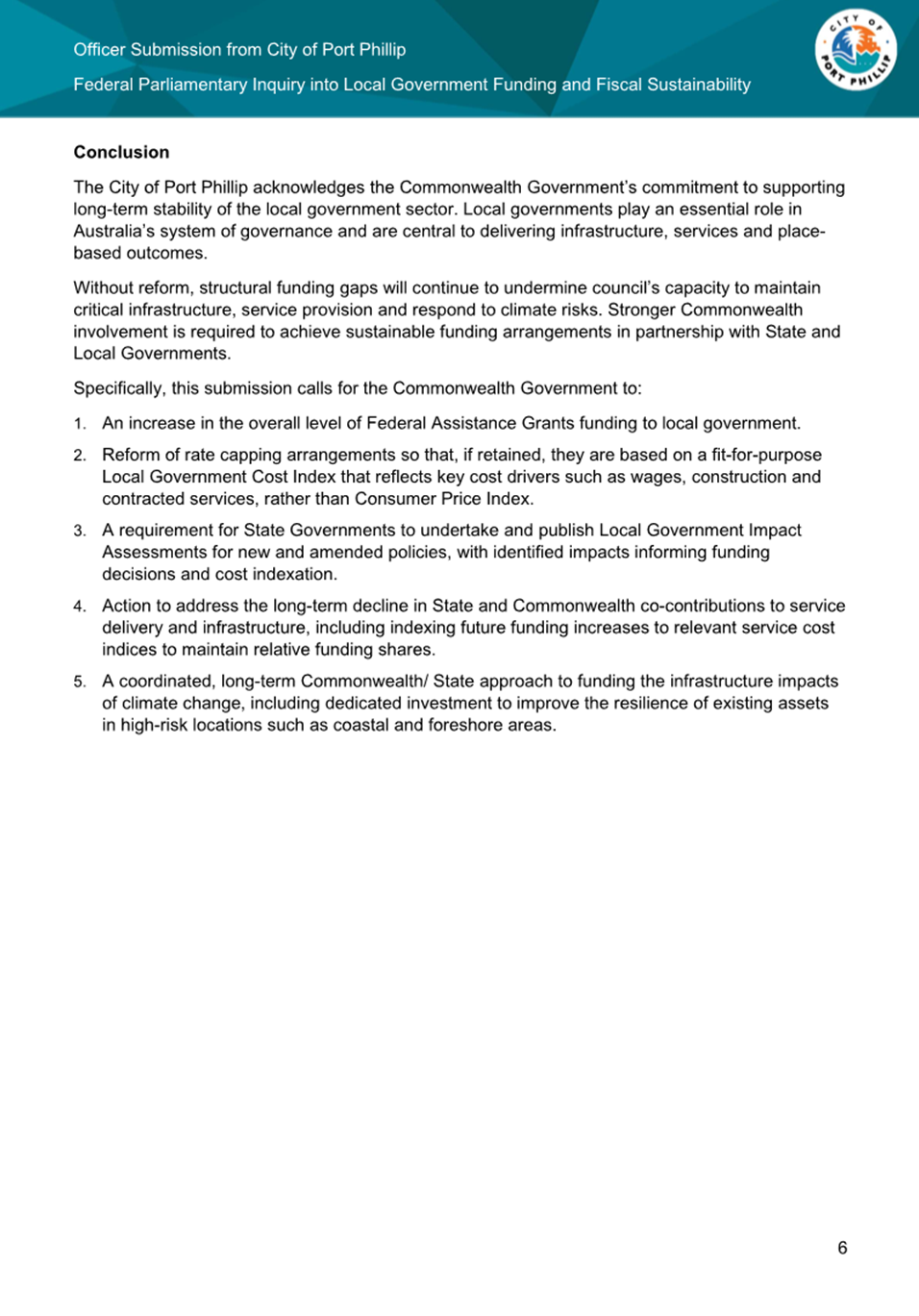
2.8.5 A coordinated, long‑term Commonwealth/ State approach to funding the infrastructure impacts of climate change, including dedicated investment to improve the resilience of existing assets in high‑risk locations such as coastal and foreshore areas.
2.9 Without structural reform to the local government funding framework, councils will continue to face increasing financial strain, limiting their capacity to deliver services, renew infrastructure and support broader economic and social objectives. Strengthening local government funding is therefore essential to ensuring sustainable communities and the effective functioning of Australia’s system of government.
|
That Council: 3.1 Notes the City of Port Phillip’s submission to the Federal Parliamentary Inquiry into Local Government Funding and Fiscal Sustainability (attachment 1). 3.2 Notes without structural reform to the local government funding framework, councils will continue to face increasing financial strain, limiting their capacity to deliver services, renew infrastructure and support broader economic and social objectives. 3.3 Notes the submission recommended the following five key actions: 3.3.1 An increase in the overall level of Federal Assistance Grants funding to local government. 3.3.2 Reform of rate capping arrangements so that, if retained, they are based on a fit‑for‑purpose Local Government Cost Index that reflects key cost drivers such as wages, construction and contracted services, rather than Consumer Price Indexation. 3.3.3 A requirement for State Governments to undertake and publish Local Government Impact Assessments for new and amended policies, with identified impacts informing funding decisions and cost indexation. 3.3.4 Action to address the long‑term decline in State and Commonwealth co‑contributions to service delivery and infrastructure, including indexing future funding increases to relevant service cost indices to maintain relative funding shares. 3.3.5 A coordinated, long‑term Commonwealth/ State approach to funding the infrastructure impacts of climate change, including dedicated investment to improve the resilience of existing assets in high‑risk locations such as coastal and foreshore areas. 3.4 Notes strengthening local government funding is essential to ensuring sustainable communities and the effective functioning of Australia’s system of government. |
4. KEY POINTS/ISSUES
4.1 The Australian Government has established a parliamentary inquiry into Local Government Funding and Fiscal Sustainability through the House of Representatives Standing Committee on Regional Development, Infrastructure and Transport to examine the financial relationship between local government and other levels of government.
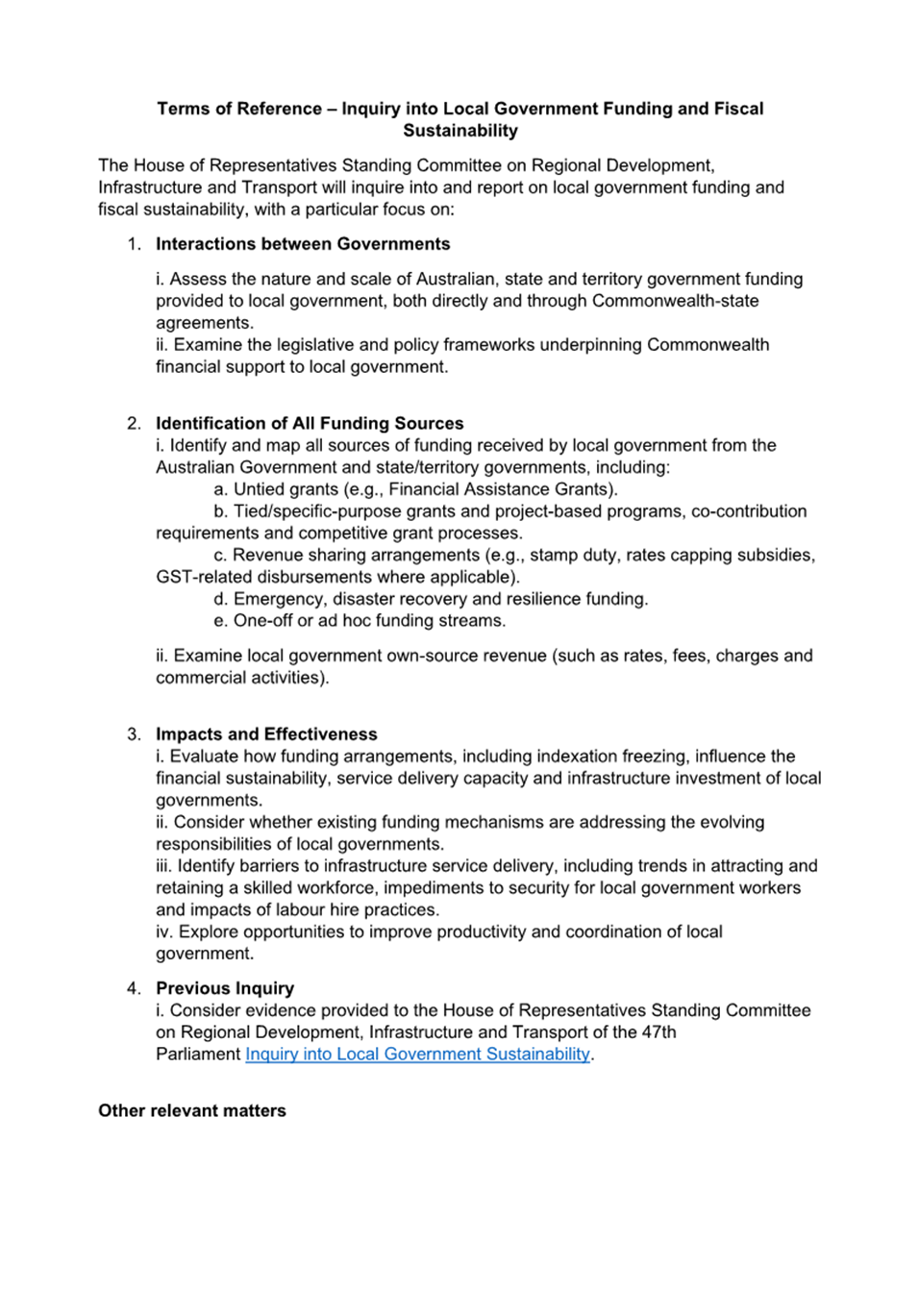
4.2 The inquiry focuses on funding mechanisms, fiscal sustainability and whether current arrangements adequately support councils’ ability to deliver services and invest in infrastructure as responsibilities continue to evolve, building on evidence from the previous inquiry while inviting updated information under revised terms of reference (attachment two – terms of reference)
4.3 Written submissions to the inquiry closed on Tuesday, 3 February 2026, with the inquiry intended to inform final recommendations to government on strengthening the long‑term financial sustainability of the local government sector.
4.4 This submission based on Council’s experience reflects a broader, systemic challenge across the local government sector. Prolonged rate capping arrangements that do not reflect the real cost drivers of council services, combined with ongoing cost shifting, unfunded or partially funded policy reforms, and the erosion of shared funding arrangements, have significantly constrained councils’ financial capacity. As a result, the gap between the expectations placed on local government and the revenue available to meet them continues to widen.
4.5 Over the past five years, rate indexation has failed to keep pace with underlying cost growth, resulting in an estimated cumulative revenue shortfall of more than $17 million for the City of Port Phillip. During this period, Council has absorbed increasing costs associated with State‑imposed levies, declining co‑contributions for service delivery and infrastructure, and major policy reforms - particularly in the waste sector and housing policy.
4.6 These pressures are compounded by climate change impacts on a mature and highly exposed asset base, including significant coastal and foreshore infrastructure, requiring increasing levels of investment simply to maintain existing service standards.
4.7 Commonwealth and State Government funding represents a relatively small proportion of Council’s total revenue and is often short‑term, prescriptive or ad hoc in nature. As a result, councils are increasingly reliant on own‑source revenue, primarily rates to fund essential services and infrastructure. In a rate‑capped environment, this funding model is not sustainable and exacerbates vertical fiscal imbalance, with local government bearing a disproportionate share of the cost of delivering services and implementing reforms determined by other levels of government.
4.8 This submission aligns with the advocacy of Melbourne 9 (M9) councils and the Municipal Association of Victoria in calling for stronger Australian Government leadership to restore the financial sustainability of local government.
4.9 Council’s submission recommends five key actions:
Action 1. An increase in the overall level of Federal Assistance Grants funding to local government.
Local governments now deliver an expanding range of essential services well beyond traditional “roads, rates and rubbish”. These include community health, childcare, aged care support, emergency management, climate adaptation, and infrastructure required to unlock housing supply - often stepping in where services are not commercially viable or where other levels of government have withdrawn.
At the same time, councils’ capacity to fund these responsibilities has been progressively constrained by limited revenue‑raising powers, state‑based rate capping, ageing infrastructure, and sustained cost shifting from other levels of government.
Parliamentary inquiries and sector evidence consistently demonstrate that Financial Assistance Grants, while critical and untied, have declined significantly as a share of Commonwealth taxation revenue over the past three decades. This decline has materially eroded councils’ ability to maintain existing services and invest in essential community infrastructure.
Federal Assistance Grants currently contribute approximately 8 per cent of total local government revenue, and significantly less for the City of Port Phillip. In 2025/26, Port Phillip’s allocation of $3.5 million, represents just 1.2 per cent of total revenue. A 25 per cent increase would provide an additional $0.88 million in ongoing funding, directly supporting the City’s financial sustainability.
Council’s position is not about redistribution of existing funding envelope; the entire sector is facing structural financial sustainability challenges. A substantial increase in untied, formula‑based Commonwealth funding is therefore required to restore local government financial sustainability, enable councils to meet growing service demands, and support the effective local delivery of national priorities such as housing supply, disaster resilience and community wellbeing.
Action 2. Reform of rate capping arrangements so that, if retained, they are based on a fit‑for‑purpose Local Government Cost Index that reflects key cost drivers such as wages, construction and contracted services, rather than Consumer Price Index.
Rates are the primary source of income for local government. For the City of Port Phillip, rates account for approximately 55 per cent of total revenue. Council’s capacity to increase this revenue is constrained by the Victorian Government’s rate‑capping framework.
It is therefore critical that the rate cap reflects the actual costs of delivering council services and maintaining infrastructure. Under the current framework, this alignment does not occur.
The Consumer Price Index (CPI) used to set the cap does not adequately represent local government’s major cost drivers: labour, contracted services, and the construction, maintenance and renewal of infrastructure.
As a result, Council faces a structural mismatch between capped rate revenue and the true cost of service delivery. This gap compounds over time, progressively eroding financial capacity and limiting Council’s ability to sustain service levels.
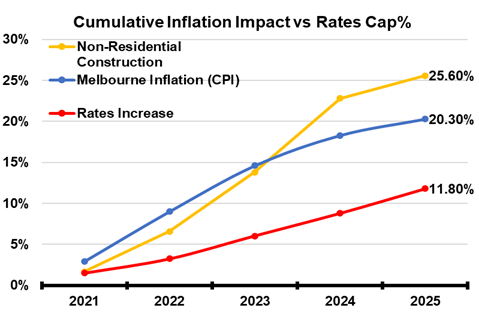
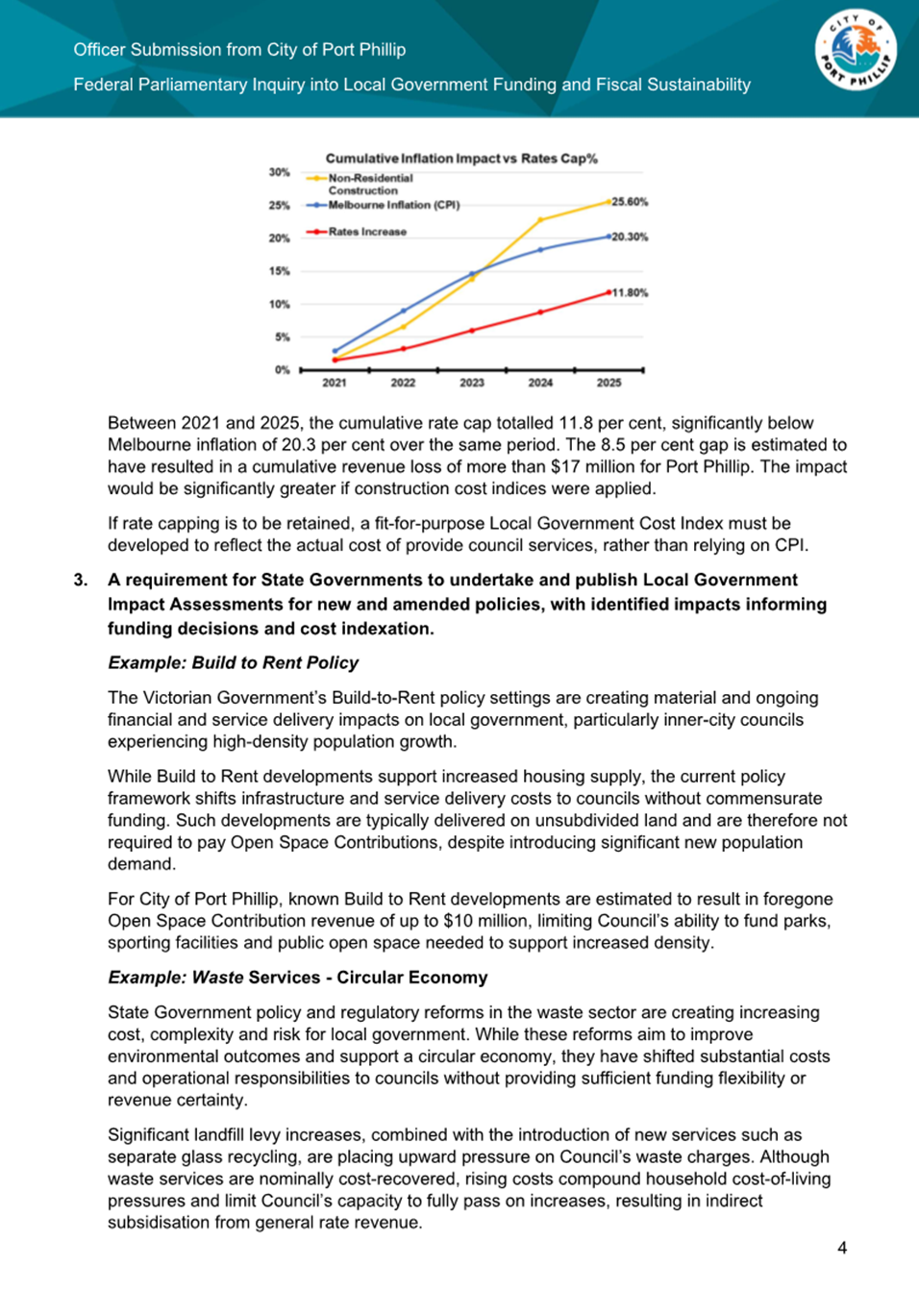
Between 2021 and 2025, the cumulative rate cap totalled 11.8 per cent, significantly below Melbourne inflation of 20.3 per cent over the same period. The 8.5 per cent gap is estimated to have resulted in a cumulative revenue loss of more than $17 million for Port Phillip. The impact would be significantly greater if construction cost indices were applied.
If rate capping is to be retained, a fit-for-purpose Local Government Cost Index must be developed to reflect the actual cost of provide council services, rather than relying on CPI.
Action 3. A requirement for State Governments to undertake and publish Local Government Impact Assessments for new and amended policies, with identified impacts informing funding decisions and cost indexation.
Example: Build to Rent Policy
The Victorian Government’s Build‑to‑Rent policy settings are creating material and ongoing financial and service delivery impacts on local government, particularly inner‑city councils experiencing high-density population growth.
While Build to Rent developments support increased housing supply, the current policy framework shifts infrastructure and service delivery costs to councils without commensurate funding. Such developments are typically delivered on unsubdivided land and are therefore not required to pay Open Space Contributions, despite introducing significant new population demand.
For City of Port Phillip, known Build to Rent developments are estimated to result in foregone Open Space Contribution revenue of up to $10 million, limiting Council’s ability to fund parks, sporting facilities and public open space needed to support increased density.
Example: Waste Services - Circular Economy
State Government policy and regulatory reforms in the waste sector are creating increasing cost, complexity and risk for local government. While these reforms aim to improve environmental outcomes and support a circular economy, they have shifted substantial costs and operational responsibilities to councils without providing sufficient funding flexibility or revenue certainty.
Significant landfill levy increases, combined with the introduction of new services such as separate glass recycling, are placing upward pressure on Council’s waste charges. Although waste services are nominally cost‑recovered, rising costs compound household cost‑of‑living pressures and limit Council’s capacity to fully pass on increases, resulting in indirect subsidisation from general rate revenue.
Action 4. Action to address the long‑term decline in State and Commonwealth co‑contributions to service delivery and infrastructure, including indexing future funding increases to relevant service cost indices to maintain relative funding shares.
The State Government provides funding to councils on a shared-funding basis to deliver services including libraries, Maternal Child Health, school crossing, and immunisation. In practice, indexation of these funding streams has failed to keep pace with actual service delivery costs.
For example, library services were initially funded by State at 50 per cent of operating costs. Port Phillip Council currently receives funding equivalent to approximately 15% of total library service costs.
Ongoing cost shifting, combined with low levels of recurrent external funding, increases reliance on rate revenue to subsidise State‑driven costs. This reliance is constrained by the rate‑capping framework, amplifying financial sustainability pressures.
Action 5. A coordinated, long‑term Commonwealth/ State approach to funding the infrastructure impacts of climate change, including dedicated investment to improve the resilience of existing assets in high‑risk locations such as coastal and foreshore areas.
The City of Port Phillip is responsible for maintaining infrastructure and assets with a total replacement value exceeding $3.6 billion. The cost of maintaining and renewing these assets continues to increase at a rate greater than CPI. A significant proportion of Council’s asset base is located along the foreshore, increasing exposure to climate‑related risks.
With approximately 11 kilometres of foreshore, the City of Port Phillip is highly exposed to sea level rise and storm surge impacts. Coastal protective structures, including seawalls and rock revetments, were constructed by the State Government around 100 years ago, with urban beaches constructed over 50 years ago to provide additional buffering.
There is currently no sustainable State funding model for renewing, upgrading or maintaining these assets, and no ongoing State funding or grant programs to support their upkeep.
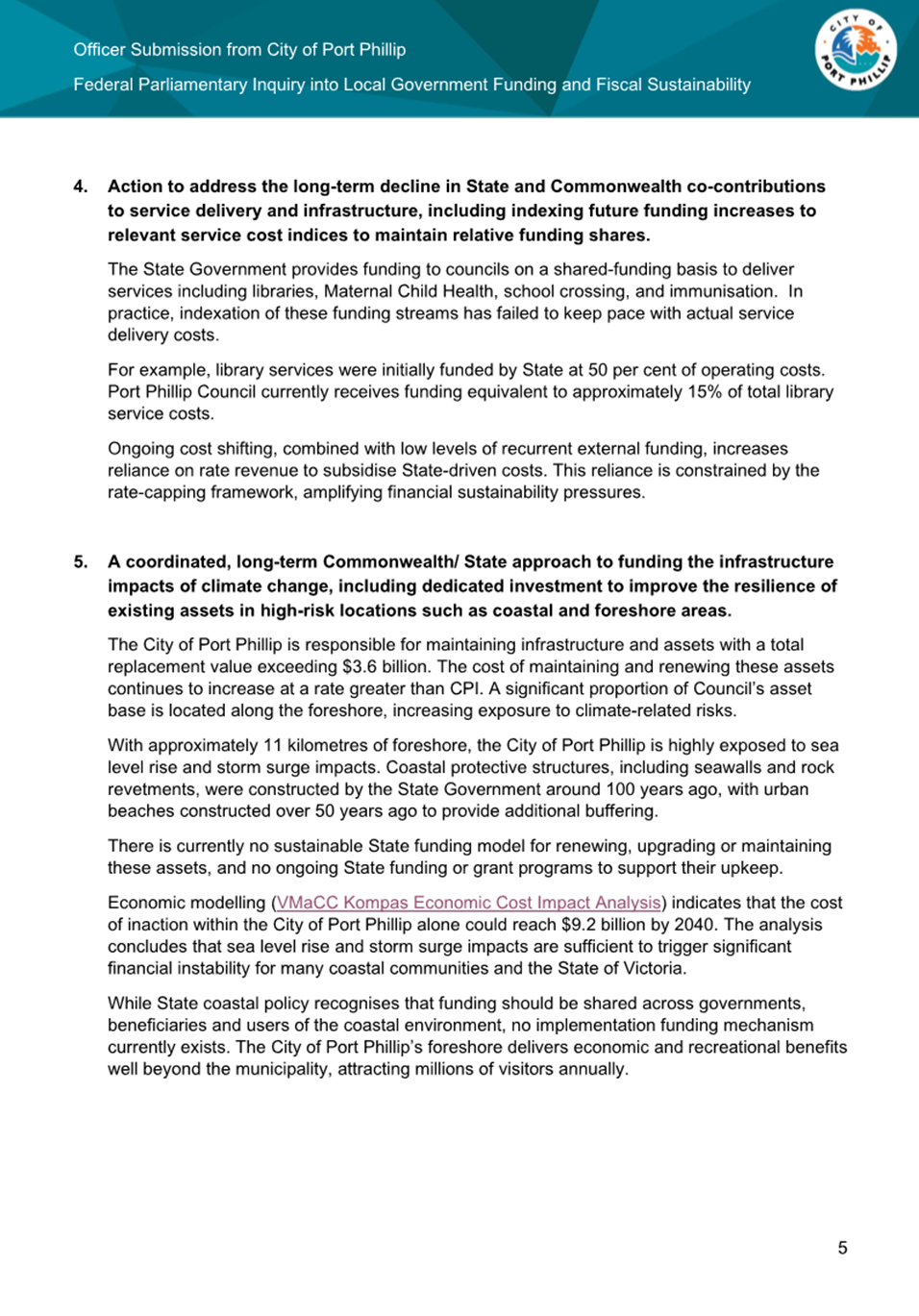
Economic modelling (VMaCC Kompas Economic Cost Impact Analysis) indicates that the cost of inaction within the City of Port Phillip alone could reach $9.2 billion by 2040. The analysis concludes that sea level rise and storm surge impacts are sufficient to trigger significant financial instability for many coastal communities and the State of Victoria.
While State coastal policy recognises that funding should be shared across governments, beneficiaries and users of the coastal environment, no implementation funding mechanism currently exists. The City of Port Phillip’s foreshore delivers economic and recreational benefits well beyond the municipality, attracting millions of visitors annually.
4.10 Without structural reform to the local government funding framework, councils will continue to face increasing financial strain, limiting their capacity to deliver services, renew infrastructure and support broader economic and social objectives. Strengthening local government funding is therefore essential to ensuring sustainable communities and the effective functioning of Australia’s system of government.
5. CONSULTATION AND STAKEHOLDERS
5.1 This submission is consistent with endorsed Council Financial Strategy and Long-Term Financial Plan (10-Year).
5.2 This submission is broadly consistent with the advocacy of Melbourne 9 (M9) councils and the Municipal Association of Victoria.
6. LEGAL AND RISK IMPLICATIONS
6.1 This submission advocates changes to the broader funding framework of local government to improve council’s financial sustainability.
7. FINANCIAL IMPACT
7.1 This submission advocates for more funding to local government to improve the financial sustainability of local government.
8. ENVIRONMENTAL IMPACT
8.1 This submission advocates for a coordinated, long-term Commonwealth/ State approach to funding the infrastructure impacts of climate change, including dedicated investment to improve the resilience of existing assets in high‑risk locations such as coastal and foreshore areas.
9. COMMUNITY IMPACT
9.1 This submission advocates for action to address the long‑term decline in State and Commonwealth co‑contributions to service delivery and infrastructure, including indexing future funding increases to relevant service cost indices to maintain relative funding shares.
10. Gender Impact Assessment
10.1 This submission advocates for more funding to local government therefore will positively impact all ratepayers equally.
11. ALIGNMENT TO COUNCIL PLAN AND COUNCIL POLICY
11.1 Council’s submission supports all directions of the council plan.
12. IMPLEMENTATION STRATEGY
12.1 TIMELINE
12.1.1 Submission date was 3 February 2026.
12.2 COMMUNICATION
12.2.1 All submissions are expected to be made public on the Standing Committee on Regional Development, Infrastructure and Transport.
13. OFFICER MATERIAL OR GENERAL INTEREST
13.1 No officers involved in the preparation of this report has declared a material or general interest in the matter.
|
ATTACHMENTS |
1. Inquiry into Local Government Funding and Fiscal
Sustainability - City of Port Phillip Submission 2. Terms of Reference - Inquiry into Local Government
Funding and Fiscal Sustainability |
|
Inquiry into Local Government Funding and Fiscal Sustainability - City of Port Phillip Submission |
Meeting of the Port Phillip City Council
4 March 2026
|
Proposed Discontinuance and Sale of Laneway R3052, off Kings Way, South Melbourne Vic 3205 |
|
|
Executive Member: |
Paul Wood, Acting General Manager, City Infrastructure |
|
PREPARED BY: |
Vicki Tuchtan, Manager Property and Assets Michael Major, Team Leader Property Operations |
1. PURPOSE
1.1 For Council:
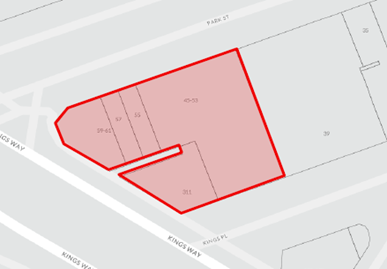
1.1.1 To consider whether the road adjoining 45-53, 55, 57, 59-61 Park Street and 311 Kings Way, South Melbourne, being the laneway known as R3052 (Road) on Council’s Register of Public Roads should be discontinued pursuant to the Local Government Act 1989 (Vic) (the Act) and sold to the adjoining owner.
2. EXECUTIVE Summary
2.1 The Applicant (the Purchaser) of the properties 45-53, 55, 57, 59-61 Park Street and 311 Kings Way, South Melbourne has requested that Council discontinues and sells the Road known as R3052 on Council’s Register of Public Roads to them (the Proposal).
2.2 The subject Road has an area of approximately 49 square metres and is adjoined by 311 Kings Way and 45-53, 55, 57 and 59-61 Park Street, South Melbourne.
2.3 It is considered that the Road is no longer reasonably required for general public use as it:
2.3.1 Is fully enclosed on the northern, eastern and southern boundaries by adjoining properties, and is only accessible on the western boundary from Kings Way;
2.3.2 Is only used for pedestrian and vehicular access to service the adjoining properties (under contract to the Purchaser and pending settlement), namely 45-53, 55, 57, 59-61 Park Street and 311 Kings Way, South Melbourne; and
2.3.3 Does not form part of a thoroughfare for pedestrian or vehicular traffic to any other public road.
2.4 The Purchaser has agreed to pay Council’s costs and disbursements associated with the proposed discontinuance of the Road, together with the full market value, which has been assessed by Westlink Consulting at $263,000 plus GST.
2.5 Council has no current or future municipal use of the road, thus providing the land to have a more compatible use with the adjoining owner.
2.6 At a meeting of Council held on Wednesday 5 November 2025, Council resolved to:
· Commence the statutory procedures and give notice pursuant to sections 207A and 223 of the Act of its intention to discontinue and sell the Road to the adjoining owner for market value.
2.7 On Tuesday 25 November 2025, Council gave public notice by publication in ‘The Age’ newspaper and on Council’s website.
2.8 Council did not receive any submissions in response to the public notice by the closing date of 4 January 2026.
2.9 Council is now able to consider whether to discontinue and sell the Road to the Purchaser.
2.10 Officers recommend that Council discontinues and sells the land to the adjoining owner for market value, being $263,000 plus GST, plus reimbursement of Council costs to facilitate this transaction.
2.11 The proceeds of the sale will be held in Council’s Strategic Property Reserves to support the acquisition and development of the property portfolio.
|
That Council: Having considered that there were no submissions received regarding Council’s proposal to discontinue the road being the land more particularly known as R3052: 3.1 Resolves to discontinue the Road as it considers that the Road is not reasonably required for public use for the following reasons: 3.1.1 Is fully enclosed on the northern, eastern and southern boundaries by adjoining properties, and is only accessible on the western boundary from Kings Way; 3.1.2 Is only used for pedestrian and vehicular access to service the adjoining properties (under contract to the Purchaser and pending settlement), namely 45-53, 55, 57, 59-61 Park Street and 311 Kings Way, South Melbourne; and 3.1.3 Does not form part of a thoroughfare for pedestrian or vehicular traffic to any other public road. 3.2 Resolves to sell the land in the discontinued Road for market value plus reimbursement of Council’s costs to facilitate this transaction to the Purchaser; 3.3 Notes that proceeds from the sale will go into Council’s Strategic Property Reserve used to support the acquisition and development of the property portfolio; 3.4 Authorises the Chief Executive Officer or their delegate to negotiate, approve, and enter into such documentation to complete the discontinuance, sale, and transfer of the Road; 3.5 Directs that the Chief Executive Officer or their delegate signs an authorisation allowing Council’s solicitors to execute transfer documents and any other documents required to be signed on Council’s behalf in connection with the transfer of the discontinued Road to the Purchaser; 3.6 Directs that any easements, rights, or interests required to be created or saved over the Road by any public authority be done so and not be affected by the discontinuance and sale of the Road; and 3.7 Directs that the Purchaser be required to consolidate the title to the discontinued Road within the title to their land (or such part of it approved by Council) within 12 months of the date of the transfer of the discontinued Road. |
4. KEY POINTS/ISSUES
Background
4.1 The Road is listed on Council’s Register of Public Roads, known as R3052.
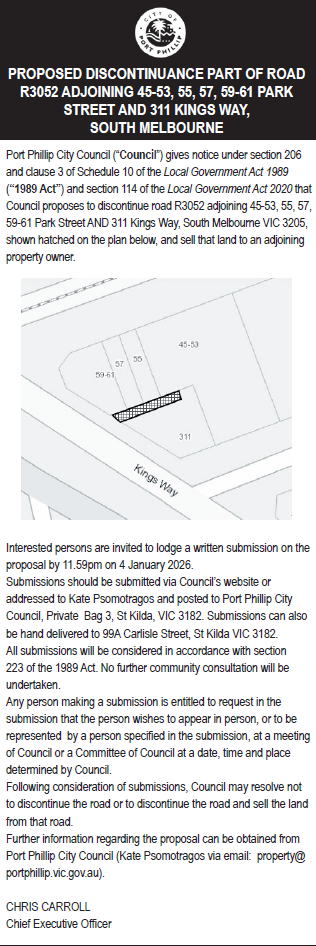
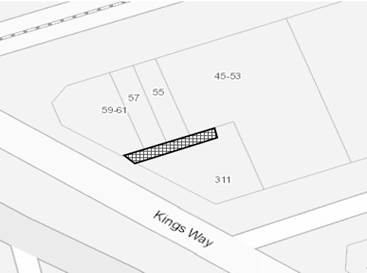
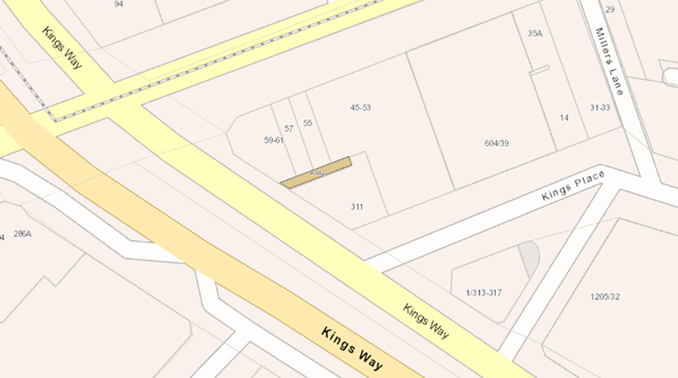
4.2 The Road is shown shaded brown on the image below:
Adjoining Properties
4.3 Properties that directly adjoin the Road, being 45-53, 55, 57, 59-61 Park Street and 311 Kings Way, South Melbourne are currently under contract, pending settlement to the Purchaser.
Application
4.4 The proposal was submitted to Council by the Purchaser, who holds interests in the properties adjoining the Road.
4.5 Properties that directly adjoin the subject Road are subject to an impending settlement to the Purchaser.
4.6 The Purchaser, upon settlement of the adjoining properties, intends to carry out redevelopment of the adjoining properties.
4.7 The Purchaser has agreed to pay Council’s costs and disbursements associated with the proposed discontinuance of the Road, together with the market value for the transfer of the discontinued Road.
4.8 If the Road is discontinued and sold to the Purchaser, Council will require the Purchaser to consolidate the title to the discontinued Road within the title to the adjoining properties within 12 months of the date of transfer of the Road, at that Purchaser’s expense.
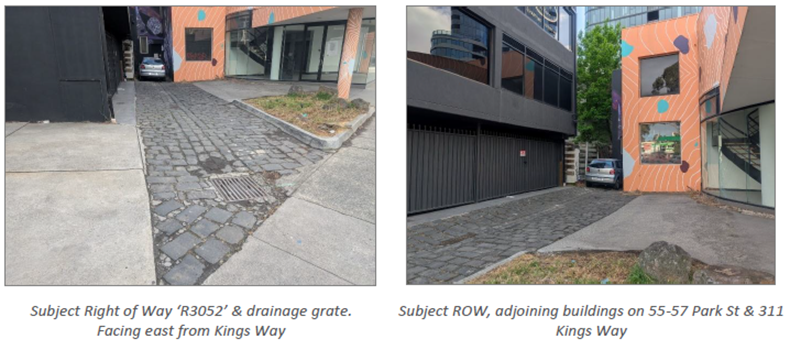
4.9 The property situated at 59-61 Park Street (being the land described in certificate of title volume 9762 folio 954, on TP349446X) has a legal abuttal on title and a registered right of carriageway over the Road (as shown on Title Plan TP349446X).
4.10 The property
situated at 311 Kings Way (being the land described in certificate of title
volume 06300 folio 904), rear portion of the laneway is owned by 311
Kings Way, South Melbourne created by instrument CP163441K 16/12/1986, shown
highlighted in yellow on the below plan.
Analysis
4.11 It is considered that the Road is no longer reasonably required for general public use.
4.12 The Proposal has been referred internally within Council and no objections have been received. As such, the Road is deemed to have no immediate or future strategic purpose for Council.
4.14 Council is now able to consider whether to:
4.14.1 Remove the Road from Council’s Register of Public Roads; and
4.14.2 Commence the statutory procedure to discontinue and sell the Road.
4.15 Officers propose that Council considers removing the Road from Council’s Register of Public Roads on the basis that the Road is no longer reasonably required for general public use for the reasons set out herein, and that Council considers commencing the statutory procedures to discontinue the Road.
4.16 If the Road is subsequently discontinued, the Road is proposed to be sold to the Purchaser for market value currently assessed at $263,000 plus GST based a valuation undertaken by Westlink Consulting 13 October 2025. A revised valuation at a later date will be required to comply with Council’s statutory obligations under the Act.
5. CONSULTATION AND STAKEHOLDERS
5.1 The following statutory authorities have been advised of the proposed discontinuance of the Road and have been asked to respond to the question of whether they have any existing assets in the Road, which should be saved under section 207C of the Act:
5.1.1 CitiPower.
5.1.2 Port Phillip City Council.
5.1.3 DGtek Pty Ltd.
5.1.4 KDR Victoria Pty Ltd.
5.1.5 Melbourne Water.
5.1.6 Multinet Gas.
5.1.7 NBN Co VicTas.
5.1.8 Nextgen (VIC).
5.1.9 Optus and or Uecomm Vic.
5.1.10 South East Water Corporation.
5.1.11 Telstra VICTAS.
5.1.12 Vocus (Primus VIC).
5.2 At the date that this report was prepared, Council had not received formal responses from all external service providers.
5.3 Council is proceeding on the basis that the respective providers do not have any rights, powers, or interests they wish to be saved under section 207C of the Act.
5.4 Council notified the community of the Proposal through a public notice published in ‘The Age’ newspaper and on Council’s website on Tuesday 25 November 2025 inviting submissions in accordance with section 223 of the Act.
5.5 The deadline for submissions to be lodged was 11.59 pm on 4 January 2026.
5.6 No submissions were received by Council in response to the public notice.
6. LEGAL AND RISK IMPLICATIONS
6.1 Under clause 3 of Schedule 10 of the Act, a council has the power to discontinue roads located within its municipality and sell the land from that road or retain the land for itself.
6.2 Council’s Policy enables roads that are no longer required for public access to be discontinued and sold to the adjoining owner.
7. FINANCIAL IMPACT
7.1 The Purchaser has agreed to acquire the Road for its market value (plus GST) in addition to Council’s costs and disbursements associated with the proposed discontinuance of the Road.
7.2 An independent valuation of the land dated 13 October 2025 determined the market value to be $263,000 plus GST. An updated valuation will be sought by Council prior to any transfer. In accordance with Council’s Policy, the value attributed to the land in the Road is based on the following assumptions:
7.2.1 The Road is valued using a “direct comparison on land value rate”, on a before and after basis, taking into account the value which the subject land contributes to the adjoining land, including the possibility of consolidation and redevelopment with adjoining properties.
7.2.2 No discount is applicable to the full land value due to the limited purchasing market for the Road.
7.2.3 A revised market valuation will be required (valid for a period of up to 6 months) if the proposal is supported by Council.
8. ENVIRONMENTAL IMPACT
8.1 The Proposal is not considered to have any detrimental environmental implications.
9. COMMUNITY IMPACT
9.1 Council will facilitate the discontinuance and sale of roads where appropriate consultation has occurred, legislative requirements have been met, and it is considered that the road discontinuance and sale is in the best interest of the wider community.
9.2 The proposed discontinuance and sale of the Road will enable the land in the Road to be repurposed.
9.3 If Council resolves to discontinue and sell the Road, proceeds from the sale will go into Council’s Strategic Property Reserves used to support the acquisition and development of the property portfolio.
10. Gender Impact Assessment
10.1 The proposal is not considered to have any detrimental gender implications.
11. ALIGNMENT TO COUNCIL PLAN AND COUNCIL POLICY
11.1 The proposal aligns to the strategic direction ‘A trusted and high-performing organisation’ ensuring Council’s property and assets meet the needs of current and future generations.
12. IMPLEMENTATION STRATEGY
12.1 TIMELINE
12.1.1 If the Proposal is endorsed by Council:
§ A notice will be published in the Victorian Government Gazette to formally discontinue the Road; and
§ A contract of sale for the discontinued Road and transfer of the discontinued Road pursuant to section 207D of the Act will be prepared by Council’s solicitors.
12.2 COMMUNICATION
12.2.1 The public notification process has provided the community with the opportunity to make submissions in respect of the Proposal. Having considered that no submissions were received, Council may now determine to discontinue and sell the Road.
12.2.2 The Purchaser will be advised of the final Council decision and the reasons for it within five (5) days of the Council meeting.
13. OFFICER MATERIAL OR GENERAL INTEREST
13.1 No officers involved in the preparation of this report has declared a material or general interest in the matter.
|
ATTACHMENTS |
1. Kings Way Discontinuance - The Age Public Notice |
Meeting of the Port Phillip City Council
4 March 2026
14.1 Notice of Motion - Councillor Cunsolo - Hooning......................................................................... 209
14.2 Notice of Motion - Councillor Halliday - Public Active Transport Election Commitments......... 210
Meeting of the Port Phillip City Council
4 March 2026
|
14.1 |
Notice of Motion - Councillor Cunsolo - Hooning |
I, Councillor Heather Cunsolo, give notice that I intend to move the Motion outlined below at the Ordinary Meeting of Council on 04 March 2026:
|
1. Requests officers to advocate to the State Government of Victoria to: 1.1 implement a noise camera trial in response to community concerns about anti-social behaviour and noisy vehicles building on the recent NSW approach to hooning. 1.2 seek a partnership with Victoria Police, Environment Protection Authority (EPA) Victoria and Council to ensure a suitable anti-hooning trial be undertaken within City of Port Phillip at recognised hotspots. 2. Reaffirms its support for a contribution to an acoustic noise camera to be used within the City of Port Phillip. 3. Requests the Mayor write to Local MPs and relevant Ministers, relevant Shadow Cabinet Ministers and emerging State Election Candidates seeking action on hooning as per this resolution of Council. |
Supporting Information
Hooning and dangerous driving continues to be a significant issue across the City of Port Phillip, undermining public safety and the amenity of local residents. Reports of dangerous driving and extreme vehicle noise — often exceeding EPA noise thresholds — remain persistent, particularly in residential areas such as Port Melbourne.
Council previously endorsed advocacy on anti-hooning initiatives in 2022, and this Motion reaffirms Council’s support for practical, evidence based measures — including the exploration of new technologies already being trialled interstate.
Council reminds residents that hoon activity should be reported to Crime Stoppers on 1800 333 000. When a hoon event is occurring, always call Triple Zero (000).
The Beacon Cove Neighbourhood Association (BCNA), as a local residents group, has advocated strongly on this topic, highlighting that hooning not only disturbs residents’ rest but also creates a sense of intimidation within the community. They have raised that excessive vehicle noise is more than a nuisance: the World Health Organization identifies environmental noise as a major health risk, contributing to sleep disturbance, cardiovascular stress, and mental health impacts, ranking second only to air pollution in its effect on quality of life.
Council also recognises the efforts of individual community members who have raised hooning with Council to improve the safety and amenity of their neighbourhoods.
Meeting of the Port Phillip City Council
4 March 2026
|
14.2 |
Notice of Motion - Councillor Halliday - Public Active Transport Election Commitments |
I, Councillor Justin Halliday, give notice that I intend to move the Motion outlined below at the Ordinary Meeting of Council on 04 March 2026:
|
1. Advocates to relevant candidates contesting the 2026 Victorian State Government election to publicly commit to the delivery of priority public and active transport projects across Port Phillip. 2. Specifically advocates to candidates to commit to: a. A clear and funded timeline for the delivery of the proposed tram lines and active transport links and bridges in Fishermans Bend, as outlined in the Fishermans Bend Integrated Transport Plan. b. An increase in the frequency, reliability and capacity of the Route 606 bus service to improve reliability and meet current and future demand. c. A clear and funded timeline for the delivery of a new high frequency bus service connecting Fishermans Bend with ANZAC Station, noting the ongoing delay in delivery of the Park Street Tram Link d. An increase in the frequency and capacity of the 96 and 109 tram services to meet current and future demand. e. A clear and funded timeline for the delivery of DDA compliant tram stops. f. A clear and funded timeline for the delivery of state-significant cycling corridors, including: i. St Kilda Road to Carlisle Street ii. Kerferd Road, from Canterbury Road to Beaconsfield Parade and Albert Road, from Canterbury Road to ANZAC Station. g. A clear and funded timeline for the delivery of the pedestrian crossings, including: i. Active pedestrian crossing on Glenhuntly Rd at Elwood Canal ii. Signalised crossing at Plummer St and Graham St, Port Melbourne. h. A funded feasibility study into the delivery of a permanent pedestrian overpass on Queens Rd into Albert Park to investigate options to improve connectivity across. i. A clear and funded timeline for the delivery of upgrades to the Kings Way/Albert Rd intersection to improve safety and connectivity to ANZAC Station. j. Retain regular tram stopping patterns during the Grand Prix period, rather than express trams. k. Immediate implementation of the 40km/h speed limit through the Glen Eira Rd shopping area. 3. Requests the Mayor as a part of Council’s broader election commitment campaign write to relevant declared State election candidates, relevant political parties, and ministers and shadow ministers outlining Council’s expectations and seeking formal commitments to these projects. 4. Requests officers informally report back to Council on responses received from candidates and parties ahead of the 2026 State Government election. |
Supporting Information
Ahead of the 2026 Victorian State Government election, Council calls on candidates from all political parties to commit to the delivery of key State Government public and active transport projects serving the City of Port Phillip, as documented in the Victorian Government’s Fishermans Bend Integrated Transport Plan and as recommended by Infrastructure Victoria. This request aligns with Port Phillip’s Move, Connect, Live: Integrated Transport Strategy 2018-2028, and with council’s endorsed advocacy priorities.
Timely delivery of high-quality public and active transport infrastructure is essential to reduce congestion, support sustainable growth, and ensure liveability for existing and future communities across Port Phillip, and in Fishermans Bend specifically. Fishermans Bend is Australia’s largest urban renewal area and will accommodate tens of thousands of new residents and jobs.
In recent years, the Victorian State Government has implemented significant planning reforms and sought density uplifts from the City of Port Phillip, substantially increasing anticipated population growth. These changes have been imposed through State planning processes, with limited local discretion, and have materially increased demand on the transport network.
Council considers that density uplift of this scale must be accompanied by the timely delivery of corresponding State Government transport infrastructure, as recommended by Infrastructure Victoria. Failure to align infrastructure provision with mandated growth risks worsening congestion, undermining public transport reliability, eroding the liveability of both new and existing communities, and reducing housing demand in areas that lack public and active transport infrastructure.
Meeting of the Port Phillip City Council
4 March 2026
15. Reports by Councillor Delegates
16. Urgent Business
17.1 Collaborative HVHR - Parking Infringement Management Services
17.2 HR Solution Project
17.3 South Melbourne Town Hall – Funding and Contract Variation
That Council resolves to move into confidential to deal with the following matters pursuant to section 66(2) of the Local Government Act 2020:
17.1 Collaborative HVHR - Parking Infringement Management Services
3(1)(a) Council business information, being information that would prejudice the Council's position in commercial negotiations if prematurely released.
Reason: This report presents the findings of the Tender Evaluation Panel for the collaborative HVHR procurement conducted jointly with the Cities of Stonnington and Glen Eira. While the evaluation process was undertaken collaboratively, each Council is required to make its own independent decision regarding the tender outcome. To protect the integrity of the procurement process and prevent any Council’s decision from influencing the others, this information must remain confidential until all three Councils have formally awarded the tender.
17.2 HR Solution Project
3(1)(a) Council business information, being information that would prejudice the Council's position in commercial negotiations if prematurely released.
Reason: This report is required to remain confidential as it forms part of an active procurement and tender process for selcting a new HR system. Releasing its contents at this stage could disadvantage Council and may compromise the integrity of Council’s procurement activities.
17.3 South Melbourne Town Hall – Funding and Contract Variation
3(1)(a). Council business information, being information that would prejudice the Council's position in commercial negotiations if prematurely released.
Reason: This report contains contractural information, including project and construction contract contingency provisions, that if released at this time would disadvantage Council in its ability to manage its construction contract in the best interests of the community.